
278
©2014 Pearson Education, Inc.
Chapter 14
Oligopoly and Monopolistic Competition
Chapter Outline
14.1 Market Structures
14.2 Cartels
Why Cartels Succeed or Fail
Why Cartels Form
Laws Against Cartels
Application: Catwalk Cartel
Why Cartels Fail
Maintaining Cartels
Detection and Enforcement
Government Support
Barriers to Entry
Mergers
Application: Market Power Versus Efficiency in Hospital Mergers
14.3 Cournot Oligopoly Model
The Duopoly Nash-Cournot Equilibrium
The Cournot Model with Many Firms
General Case
Linear Case
Airline Example
The Cournot Model with Nonidentical Firms
Unequal Costs
Solved Problem 14.1
Application: Air Ticket Prices and Rivalry
Differentiated Products
Solved Problem 14.2
Application: Bottled Water
14.4 Stackelberg Oligopoly Model
Calculus Solution
Graphical Solution
Why Moving Sequentially Is Essential
Strategic Trade Policy: An Application of the Stackelberg Model

Chapter 14 Oligopoly and Monopolistic Competition 279
©2014 Pearson Education, Inc.
Government Subsidy for an Airline
Solved Problem 14.3
Problems with Government Intervention
Comparison of Collusive, Nash–Cournot, Stackelberg, and Competitive Equilibria
Application: Deadweight Losses in the Food and Tobacco Industries
14.5 Bertrand Oligopoly Model
Nash–Bertrand Equilibrium with Identical Products
Best–Response Curves
Bertrand Versus Cournot
Nash–Bertrand Equilibrium with Differentiated Products
General Demand Functions
Cola Market
Product Differentiation and Welfare
Application: Welfare Gain from Greater Toilet Paper Variety
14.6 Monopolistic Competition
Monopolistically Competitive Equilibrium
Fixed Costs and the Number of Firms
Solved Problem 14.4
Application: Zoning Laws as a Barrier to Entry by Hotel Chains
Teaching Tips
Chapter 14 begins with a general description of market structures that lie between perfect competition
and monopoly in the competitive spectrum. Table 14.1 in the text provides a good summary of eight
characteristics of various market structures, plus an example of each. It would be well worth the time
to begin this section by discussing this table with the class and asking the students to come up with
additional examples of each market structure.
There are a number of models presented in this chapter and the next, and you may not have time to cover
all of them. If they are presented too quickly in succession, students are more likely to get confused between
the models and their outcomes. You might consider introducing game theory as the primary method of
analysis and discuss other approaches (e.g., the graphical approach to the Cournot and Stackelberg models)
in the context of game theory.
When presenting game theory, consider dividing the class into small groups before making any formal
presentation of types of equilibria and strategic rules. Give each group three or four games to solve,
including a simple zero-sum game, a dominant strategy equilibrium where players follow a given strategy
no matter what the other does, and a Nash equilibrium where the payoffs create a prisoners’ dilemma.
(The Additional Questions and Problems section in this chapter includes sample payoff matrices.) You can
ask the groups to simply play the games at first, under the following rules. First, assume that each player must
move simultaneously and that no cooperation is allowed. Second, allow collusion between players, and
third, assume that one player gets to move first. Finally, you could ask the groups to try to write down general
decision–making rules for players and note if they need to modify those rules when the game is played
repeatedly. If you try this, you may find that students are quite good at identifying strategic decision–making
rules once they understand the games. By asking students to play the games first, you can then go back through
the various outcomes and identify them as Cournot, cartel, and so on. One of the great advantages of game

280 Perloff • Microeconomics: Theory and Applications with Calculus, Third Edition
©2014 Pearson Education, Inc.
theory is that by simply changing the rules, the same payoff matrix can be evaluated more than once, with
different outcomes. You can return to this discussion when covering the final section of the chapter on the
comparison of output, price, and welfare effects for the various models, which can also be related back to
the game theory examples in Chapter 13.
The text contains a large number of examples in the cartel section that illustrate the inefficiencies caused
by cartels if they succeed, and the difficulties that they face that often lead them to fail. One point to stress
is that this is the only model in which firms are asked to produce where marginal cost is not equal to marginal
revenue and make note of the incentive to cheat that is created by this divergence. In addition to the examples
in the text, one of the great examples of the punishment not fitting the crime for a cartel was the United
States Football League successful antitrust suit against the NFL in which they were awarded a judgment
of $3. Despite winning the case, the lack of any significant award helped to end the USFL’s effort to form
a competing league. Since that decision, no serious effort to launch another competing league has been
attempted.
If you cover the Cournot and Stackelberg models using algebra and graphs, you may want to keep the
functions as simple as possible in order to maintain the focus on reaction functions and residual demand.
With all models of oligopoly, the behavior of the firms at a conceptual level is a prerequisite to understanding
the mechanics of solutions. Once the class gets going, they can often think of many examples of rival
firms that coincide with these models. In cases where they appear to find contradictions, it is often a
misunderstanding of the assumptions of the model.
The model of monopolistic competition can be covered fairly quickly through a description of Figure 14.8
in the text. Students should be able to think of many examples in this industry among the consumer products
they routinely buy, such as clothing. As part of the minimum efficient scale discussion, you might note the
trade–off between the efficiency of perfect competition and utility derived from nonhomogeneity of product.
Additional Applications
Combining Soft Drinks1
In 1986, Coke, the largest producer of carbonated soft drinks (38.6 percent market share), tried to buy the
third largest firm, Dr. Pepper (7.1 percent share). Also, Pepsi (27.4 percent share) tried to acquire the
fourth largest firm, Seven Up Co. (6.3 percent share). Had these proposed mergers taken place, Coke’s
market share would have risen to 45.7 percent and Pepsi’s to 33.7 percent. Their combined share would
have gone from 66 percent to 79.4 percent.
The mergers were not consummated. The Federal Trade Commission (FTC) opposed these mergers on the
grounds that they would increase the market shares of these firms, make entry more difficult, and “ease
collusion among the participants in the relevant markets.”
Later in 1986, after Coke’s and Pepsi’s proposed mergers were blocked, both Dr. Pepper and Seven Up
were sold. Dr. Pepper Co. was sold for $416 million to an investor group, and Seven Up Co. was sold for
$240 million to another investment group. Coke had offered $470 million for Dr. Pepper Co., which
means that owners of Dr. Pepper got $54 million less than they would have had they sold to Coke for
1Oswald Johnston, “Coke and Pepsi Proposals Face Close Scrutiny,” Los Angeles Times, February 24, 1986: Part 4, p.1; Jube,
Shiver Jr. “RC Takes Fight on Coke, Pepsi Deals to Public,” Los Angeles Times, June 12, 1986; Nathaniel C. Nash, “Seven–Up
Sale to Pepsico Canceled,” New York Times, August 21, 1986:D1; “Soft Drinks and Other Trusts,” New York Times, June 27,
1986:A34; Jube Shiver Jr. “Forstman, Little, Will Sell Dr. Pepper for $416 Million,” Los Angeles Times, August 21, 1986: Part IV,
1–2; Glen Collins, “Cadbury Purchases Dr. Pepper,” New York Times, January 27, 1995:C1 and C5.

Chapter 14 Oligopoly and Monopolistic Competition 281
©2014 Pearson Education, Inc.
$470 million. Similarly, the owners of Seven Up, Philip Morris Co., got $140 million less than Pepsi’s
bid of $380 million. That Dr. Pepper and Seven Up had lower value to others than to Coke and Pepsi is
consistent with the FTC’s view that Coke and Pepsi would have gained market power through these
mergers. (This result may also be consistent, however, with the view that the larger firms could have
more efficiently marketed the other firm’s brands.)
Eventually, Dr. Pepper and Seven Up merged. By 1995, Dr. Pepper/Seven–Up had 11.5 percent of the
carbonated beverage market and Cadbury had 5.5 percent, with its Schweppes, Canada Dry, Crush,
Sunkist, and A&W brands. In 1995, Cadbury bought Dr. Pepper/Seven Up. The new firm’s market share
was 17 percent of the carbonated drink market and 50 percent of the noncola market. Coke’s share was 41
percent and Pepsi’s 32 percent of the carbonated drink market. Thus mergers have increased the share of
the industry controlled by the top three firms. The FTC’s actions, however, have limited the share
controlled by the top two firms. As Jesse Meyers, publisher of Beverage Digest, an industry newsletter,
observed, “(W)orld–wide, Coca–Cola is the gorilla, Pepsi is the younger gorilla in several markets, and
now Cadbury will definitely be a gorilla-ette to be contended with in the world market.”
1. Do you think the original proposed mergers might have been accepted in today’s market, with the
emergence of iced teas as popular soft drinks, even though they are noncarbonated?
2. What do you believe are important sources of scale economies in soft drink marketing?
Are Universities Cartels?2
Gordon K. Davies, the former executive officer of the Virginia State Council of Higher Education, believes
that the state university systems in the United States have historically functioned as cartels. Could it be
that these institutions will go the way of so many cartels before—failing in the face of competitive
force? Davies thinks so. Because they are unable to prevent entry to the education market by more agile,
technologically efficient, for–profit universities such as the University of Phoenix and the Graduate School
of America, state universities’ market position is severely threatened.
At the core of the problem for state university systems are fundamental changes in demand and supply that
have eroded their traditional entry barriers. On the demand side, accreditation and recognition by external
constituents (both students and employers) are now driven by the highly vocational focus of today’s students
and their focus on employment as the desired outcome of an education. “We will see a market for education
that leads directly and immediately to employment,” Davies says. In addition, firms are now looking to
private universities, unburdened by the traditional constraints, to solve their training needs. According to
Davies, “AT&T has contracted with the University of Phoenix for employee training, for example, citing
the institution’s responsiveness.” Davies believes that if accreditation bodies do not become more flexible,
they risk replacement by entities similar to Consumer Reports.
On the supply side, changes in technology now allow for the delivery of courses to students without the
need for students to sit in a traditional classroom. The ability to offer courses electronically means that
geographic market edges may be blurred, if not gone altogether, and that education can be customized to
fit the needs of the student and/or employer at very low cost. “(E)ntry into the market of large–scale,
national providers of electronic courses changes everything,” remarks Davies. He recommends that state
university systems form alliances similar to athletic conferences to collaborate on the delivery of electronic
education.
2Gordon K. Davies, “Point of View: Higher Education Systems as Cartels: The End Is Near,” The Chronicle of Higher Education,
October 3, 1997: A68.

282 Perloff • Microeconomics: Theory and Applications with Calculus, Third Edition
©2014 Pearson Education, Inc.
1. What do you predict will happen to the price of education as more firms enter the market? Are there
quality issues that must be considered?
2. How are the definitions of the product and units of output important to the study of the education market?
3. Is competition in the education market a good thing?
DeBeers Pleads to Price Fixing to Reenter U.S. Market3
DeBeers SA, the huge diamond company, pleaded guilty recently to price fixing and agreed to pay
$10 million to settle a 10–year-old indictment. This action will allow the company to start doing business
directly with the American market.
Based in London and South Africa, DeBeers controls 60 percent of all rough, uncut diamonds sold
worldwide. It already reaches U.S. consumers through intermediaries, including diamond distributors and
marketing firms. So this action may have little impact on diamond prices and market share here. But the
settlement will give DeBeers a bigger marketing presence and greater legitimacy with U.S. consumers.
DeBeers is the biggest diamond mining operation in the world, but its dominance of the world’s diamond
market has been declining in recent years as new mines have opened in Russia, Canada, and Australia and
as new varieties of synthetic diamonds—both industrial and gem quality—are being created.
Industry experts say the company may have settled because it was too risky to stay away from the U.S.
market when so many new sources of diamonds are emerging.
DeBeers’s competitors said they were expecting such a settlement, though. “DeBeers may recognize that
market dynamics are going to change with the introduction of cultured diamonds,” said Robert C. Linares,
chairman of Apollo Diamond Inc., one of the few makers of new, high-quality synthetic diamonds for both
the jewelry and technology markets. Linares added, “It does . . . seem coincidental that their settlement comes
at the same time that Apollo Diamond is entering the market with cultured diamonds.”
1. What do you think is the major economic reason for DeBeers to change its strategy and plead to price
fixing?
2. What would be the possible impact of Apollo Diamond’s new product on DeBeers’ market power?
Discussion Questions
1. Which types of markets are more likely to have cartels and which are less likely? Why?
2. In a prisoners’ dilemma game, will prisoners confess to a crime even if they are not guilty? What are
the implications of this analysis for our legal system?
3. Should we pass laws to prevent firms offering to “meet or beat” other firm’s prices?
4. Should the government engage in strategic trade policies? Why or why not?
5. Some political leaders argue that we should do away with certain antitrust laws to facilitate cooperation
between firms in their competition with foreign rivals. Explain or attack this reasoning using the
models discussed in the chapter.
3 Margaret Webb Pressler, “DeBeers Pleads to Price Fixing,” Washington Post, July 14, 2004, Page E01.

Chapter 14 Oligopoly and Monopolistic Competition 283
©2014 Pearson Education, Inc.
6. Should your government subsidize domestic firms to enable them to compete more successfully with
foreign rivals?
7. Will the creation of the Euro currency facilitate collusion among EU countries?
Additional Questions and Problems
1. The following game is called a zero–sum game because the winnings of one player are always taken
directly from the other player (such as a market share battle between two firms). In the payoff matrix
shown below, payoffs shown are for player A (B gets minus one times what A receives). What strategy
would each player select? Does it matter which player gets to choose first? Can you determine a
general rule for strategies when the game is zero–sum? Would collusion alter the outcome? Why or
why not?
B
B1 B2
A1 4 −1
A A2 2 1
2. In each payoff matrix shown below, determine the strategy of each player assuming they must play
simultaneously. Would collusion alter the outcome? Why or why not? Payoffs shown are A, B.
a.
B
B1 B2
A1 4, 2 1, 1
A A2 2, 1 0, 0
b.
B
B1 B2
A1 –1, –2 1, –3
A A2 2, 3 2, 2
c.
B
B1 B2
A1 3, 3 7, 2
A A2 1, 7 6, 6
3. What types of industries or firms would a local government be most likely to subsidize? Why?
4. Describe, using game theory, the recent rash of professional sports teams receiving generous deals for
new stadiums from state and local governments.
284 Perloff • Microeconomics: Theory and Applications with Calculus, Third Edition
©2014 Pearson Education, Inc.
5. Suppose the market demand function facing three firms is Q = 500 − 2p. Each firm has a marginal
cost of $5 per unit. What is the cartel solution? Suppose instead that one of the firms could supply up
to 100 units at MC = 4, and the other two firms had a marginal cost of $5. How would this alter the
final output, price, and profit? Does this complicate the division of profits? How?
6. In an industry where any firm can enter the industry and produce according to the cost function
C = 50 + 5q, what is the optimal number of firms? Does your answer change if there are no fixed
costs?
7. True, false, or uncertain; explain your answer. “If all firms charge the same price, they must be
colluding.” Does your answer create difficulties for those charged with enforcing industrial policy?
8. In a Cournot duopoly, each firm has marginal cost MC = 20, and market demand is Q = 100 − 1/2p.
What are the best response functions of each firm? What is the best output level for each? How does
the total output level compare to the cartel output level?
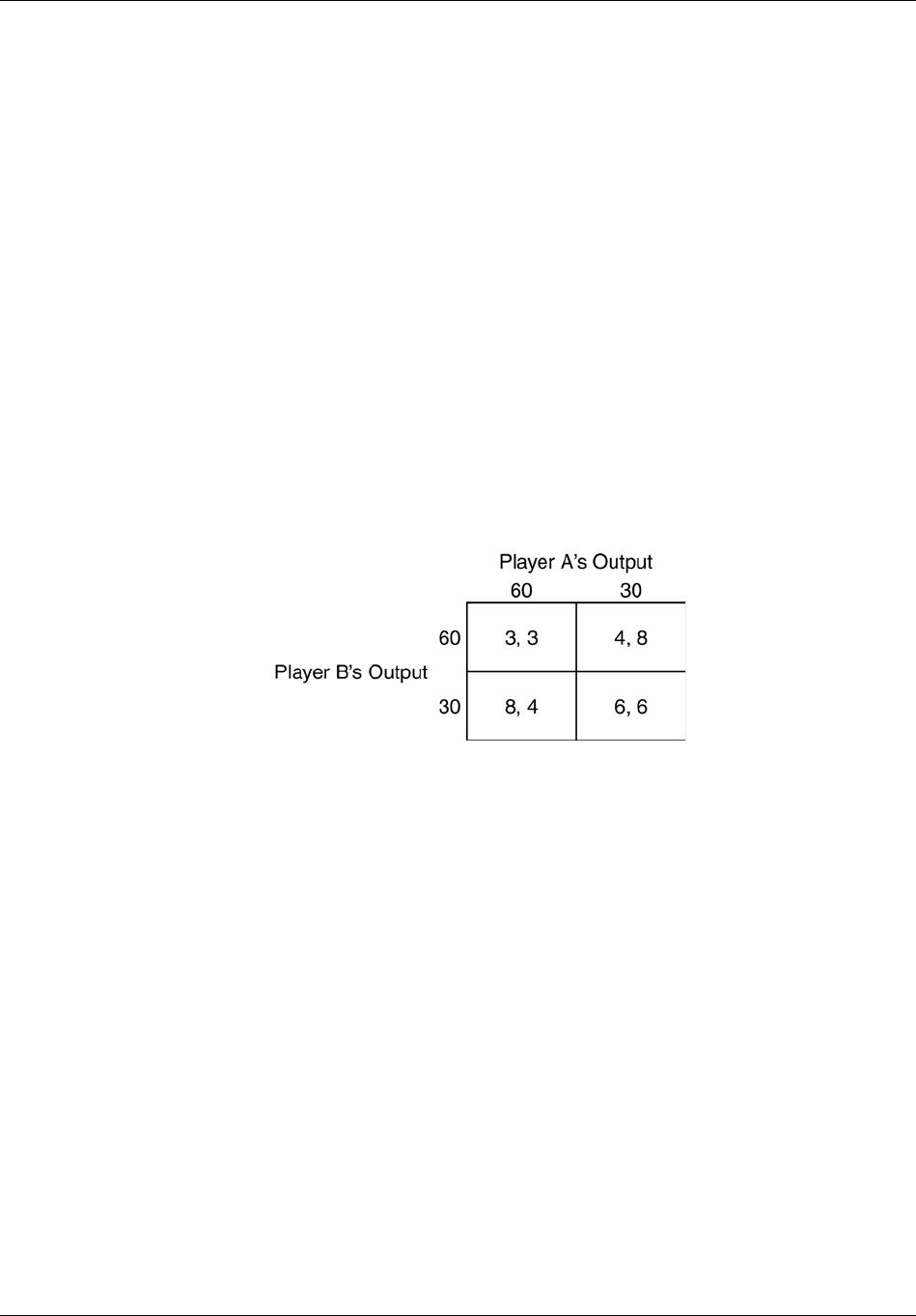
9. Assume that the payoffs in the matrix below are profits from various output choices, based on a non-
cooperative game, with A as the leader. Because of product tie–ins, the firms must choose to produce
either 60 units or 30. No other output levels are possible. Re-write the payoffs in extended “tree”
form similar to Figure 13.2 in the text. Payoffs shown are A, B. What is the equilibrium? How would
your answer change if B was the leader?
10. Suppose in Question 9 that movement was simultaneous rather than sequential. Is there a unique
equilibrium? If so, what is it? Instead, suppose movement was simultaneous, but collusion were
permitted. Would the outcome change?
11. How do a Bertrand equilibrium output and price compare to those of competitive equilibrium?
Answers to Additional Questions and Problems
1. In the payoff matrix, player A’s highest payoff is in the upper left (A1, B1), but B regards this as the
least preferred. Since B will not select B1, A can assure that they will not lose by selecting strategy A2.
This is referred to as a maximin strategy—choosing the strategy with the highest minimum payoff.
Player B will choose Strategy 2, in an attempt to minimize A’s payoff (which also maximizes their
own payoff). This is referred to as a minimax strategy. This solution would be the outcome regardless
of which player goes first. Collusion would never alter the outcome of a zero-sum game because what
is better for one player is, by definition, worse for the other.
2. a. Dominant strategies are A1, B1. Collusion would not alter the outcome because there is no other
combination in which both players are at least as well off.
b. Dominant strategies are A2, B1. Collusion would not alter the outcome because there is no other
combination in which both players are at least as well off.