Chapter 13 Game Theory 269
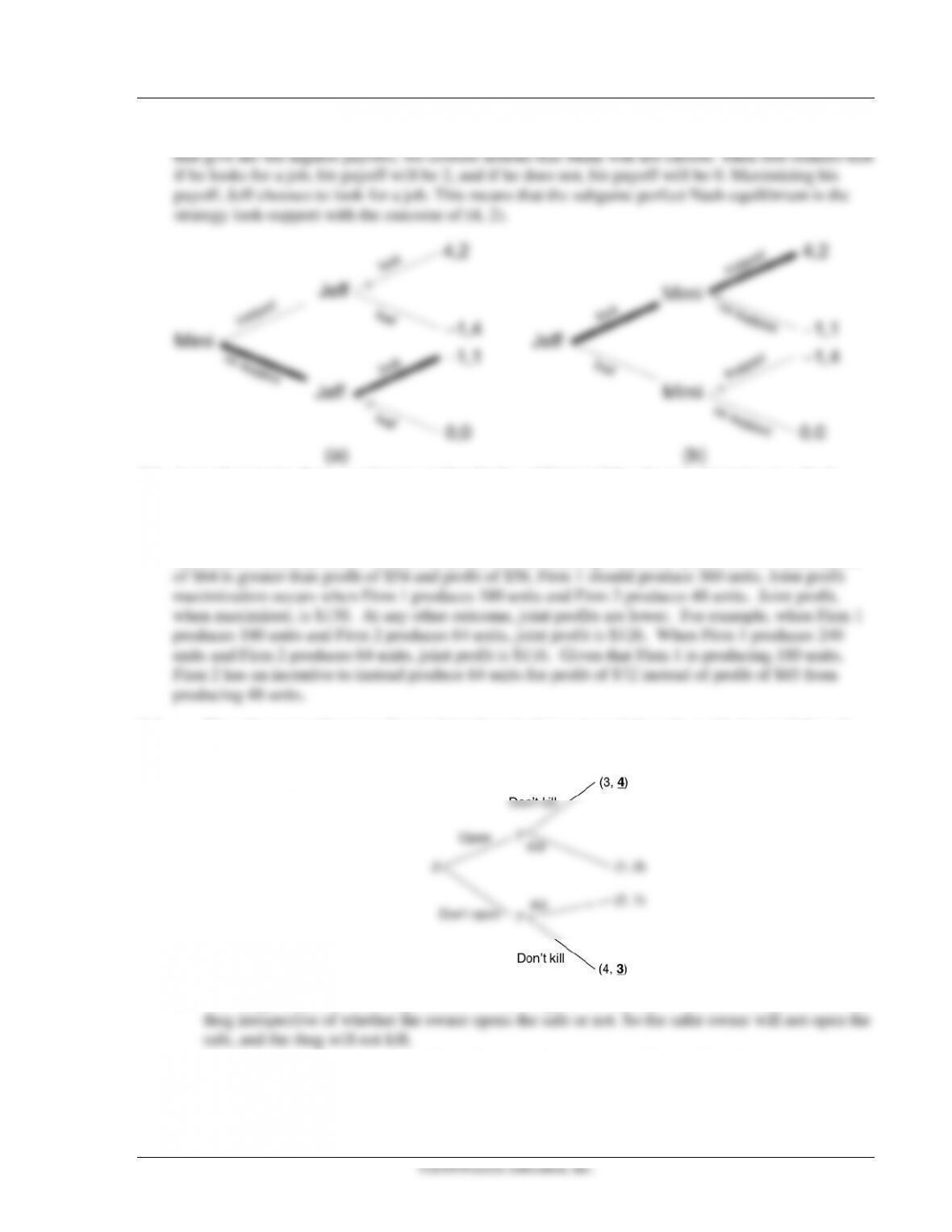
If Jeff moves first, the game looks as in panel b. When Mimi makes a decision, she chooses actions
2.6 A set of strategies forms a subgame perfect Nash equilibrium if the players’ strategies are a Nash
equilibrium in every subgame. If Firm 1 produces 180 units, then Firm 2 should produce 64 units for
profit of $72, which gives Firm 1 profit of $54. If Firm 1 produces 240 units, then Firm 2 should
produce 64 units for profit of $58, which gives Firm 1 profit of $58. If Firm 1 produces 360 units,
then Firm 2 should produce 48 units for profit of $32, which gives Firm 1 profit of $64. Since profit
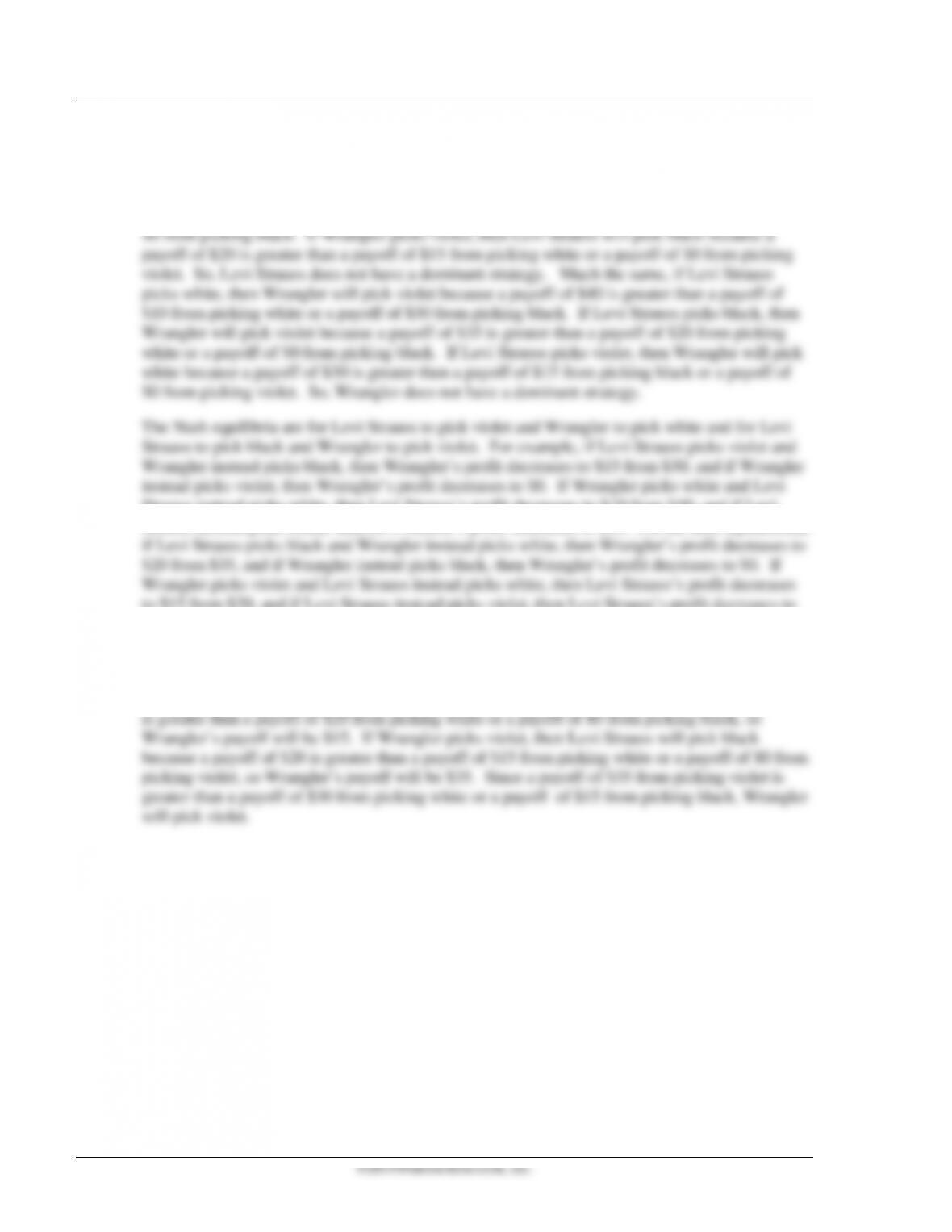
2.7 a. The safe owner (S) moves first and decides whether to “open” the safe or “don’t open” the safe.
Then the thug decides to “kill” or “don’t kill.”
b. The subgame perfect Nash equilibrium is “don’t open” for the safe owner and “don’t kill” for the
c. The thug’s threat is not credible. Therefore the safe owner should not believe it.
d. He will not open the safe.
270 Perloff • Microeconomics: Theory and Applications with Calculus, Third Edition
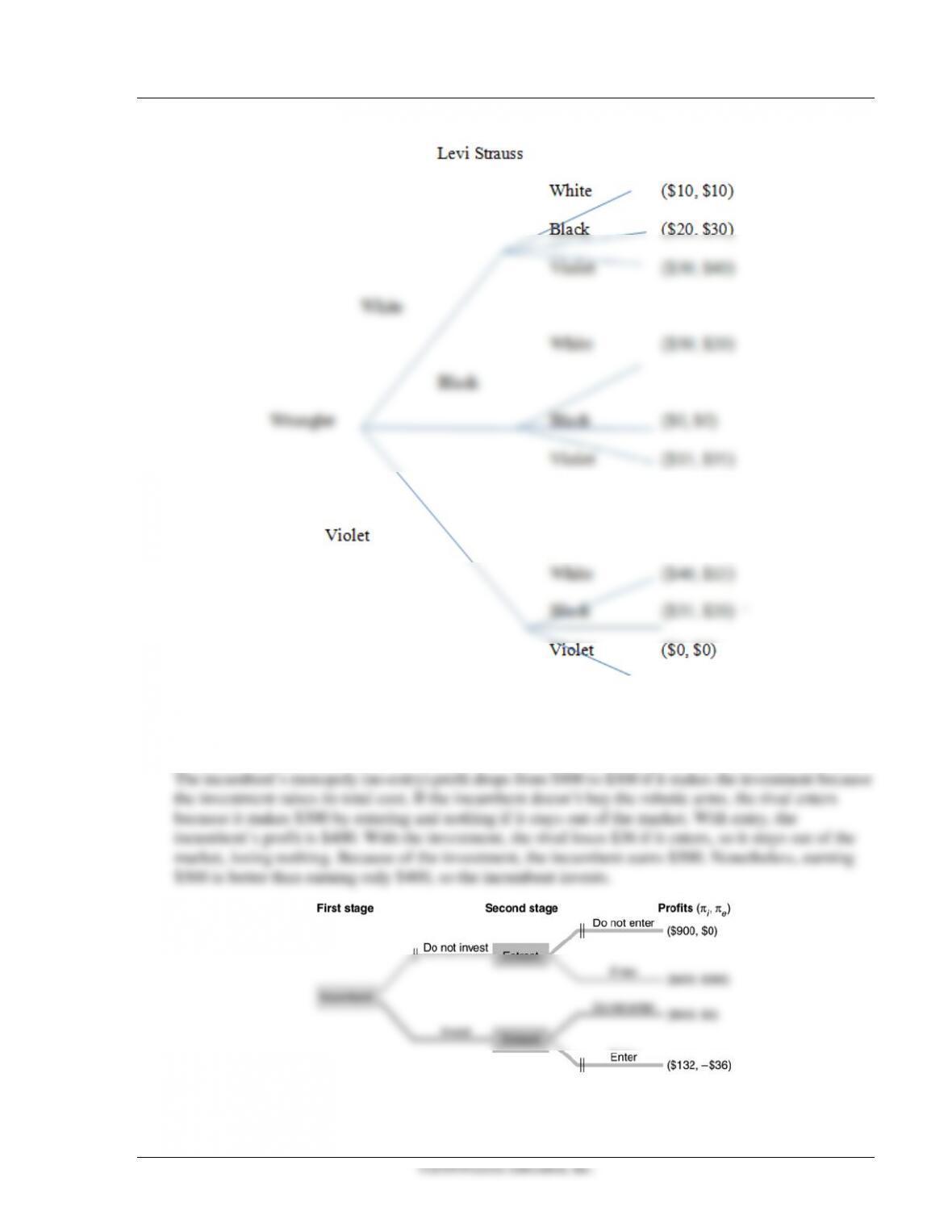
2.8 a. A dominant strategy is a strategy that produces a higher payoff than any other strategy the player
can use for every possible combination of its rivals’ strategies. If Wrangler picks white, then
Levi Strauss will pick violet because a payoff of $40 is greater than a payoff of $10 from picking
white or a payoff of $30 from picking black. If Wrangler picks black, then Levi Strauss will pick
violet because a payoff of $35 is greater than a payoff of $20 from picking white or a payoff of
Strauss instead picks white, then Levi Strauss’s profit decreases to $10 from $40, and if Levi
$0.
b. If Wrangler picks white, then Levi Strauss will pick violet because a payoff of $40 is greater than
a payoff of $10 from picking white or a payoff of $30 from picking black, so Wrangler’s payoff
will be $30. If Wrangler picks black, then Levi Strauss will pick violet because a payoff of $35
Chapter 13 Game Theory 271
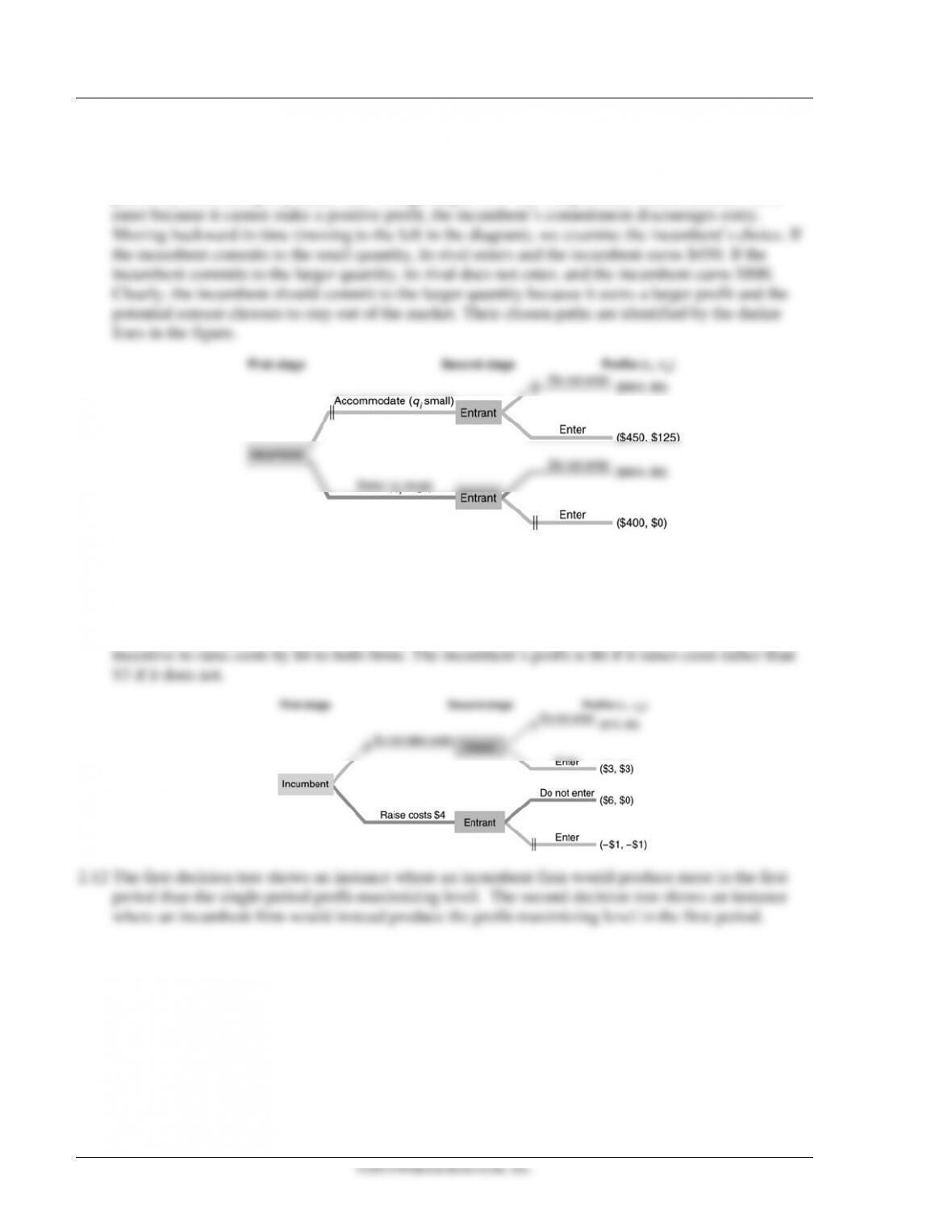
2.9 The game tree illustrates why the incumbent may install the robotic arms to discourage entry even
though its total cost rises. If the incumbent fears that a rival is poised to enter, it invests to discourage
entry. The incumbent can invest in equipment that lowers its marginal cost. With the lowered marginal
cost, it is credible that the incumbent will produce larger quantities of output, which discourages entry.
272 Perloff • Microeconomics: Theory and Applications with Calculus, Third Edition
2.10 The incumbent firm has a first-mover advantage, as the game tree illustrates. Moving first allows the
incumbent or leader firm to commit to producing a relatively large quantity. If the incumbent does not
make a commitment before its rival enters, entry occurs and the incumbent earns a relatively low
profit. By committing to produce such a large output level that the potential entrant decides not to
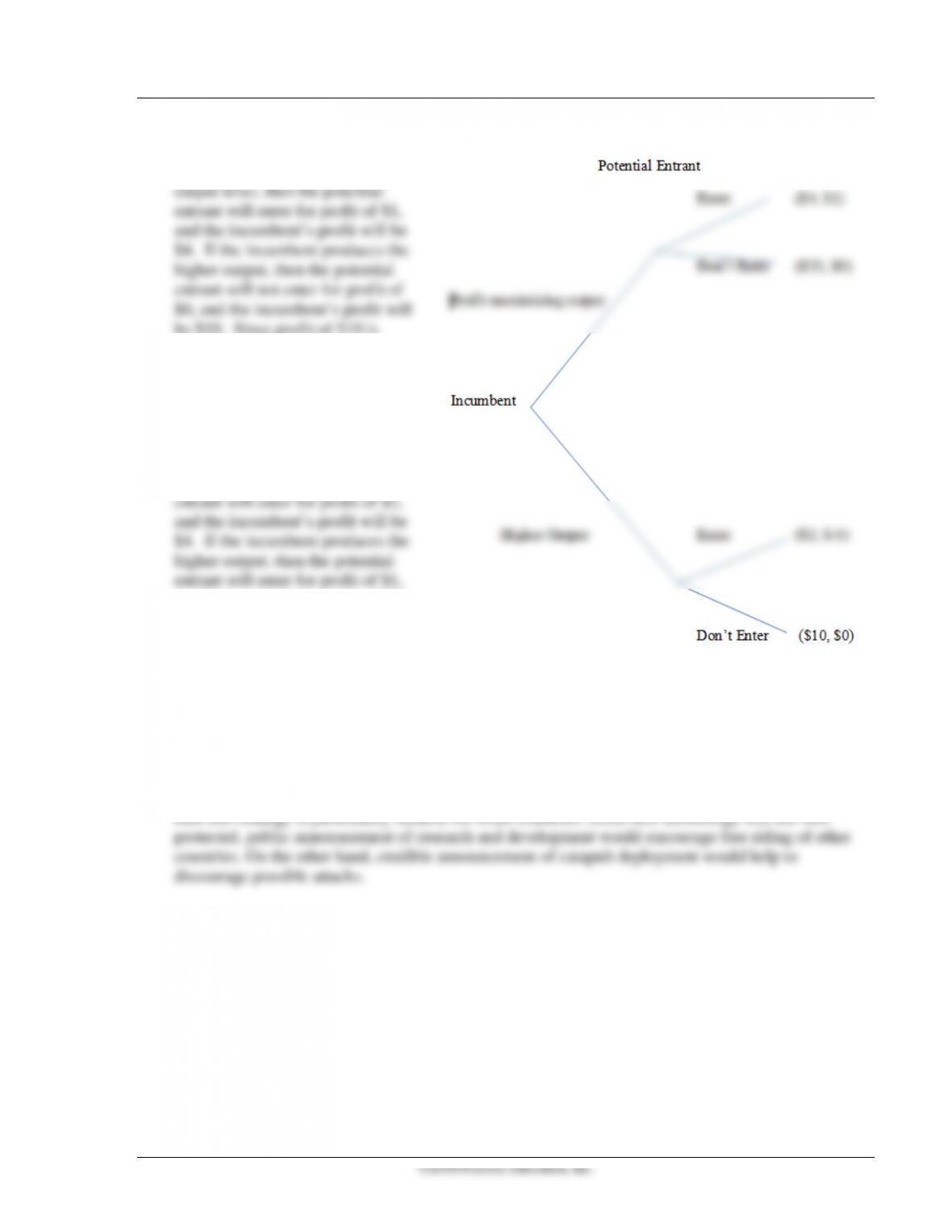
2.11 It is worth more to the monopoly to keep the potential entrant out than it is worth to the potential
entrant to enter, as the figure shows. Before the pollution–control device requirement, the entrant
would pay up to $3 to enter, whereas the incumbent would pay up to πi − πd = $7 to exclude the
potential entrant. The incumbent’s profit is $6 if entry does not occur, and it loses $1 if entry occurs.
Because the new firm would lose $1 if it enters, it does not enter. Thus the incumbent has an
Chapter 13 Game Theory 273
In this game, if the incumbent
produces the profit–maximizing
better than profit of $4, the
incumbent will produce the higher
output, and the potential entrant
will not enter.
In this game, if the incumbent
produces the profit–maximizing
output level, then the potential
and the incumbent’s profit will be
$2. Since profit of $4 is better than
profit of $2, the incumbent will
produce the profit-maximizing
output level ,and the potential
entrant will enter.
2.13 Given the information, an optimal strategy for the rulers may be: (i) spend little resource in catapult
research and development; (ii) buy latest technology from other countries; (iii) publicly announce the
deployment of catapult. Suppose catapult research and development required a substantial fixed cost,
274 Perloff • Microeconomics: Theory and Applications with Calculus, Third Edition
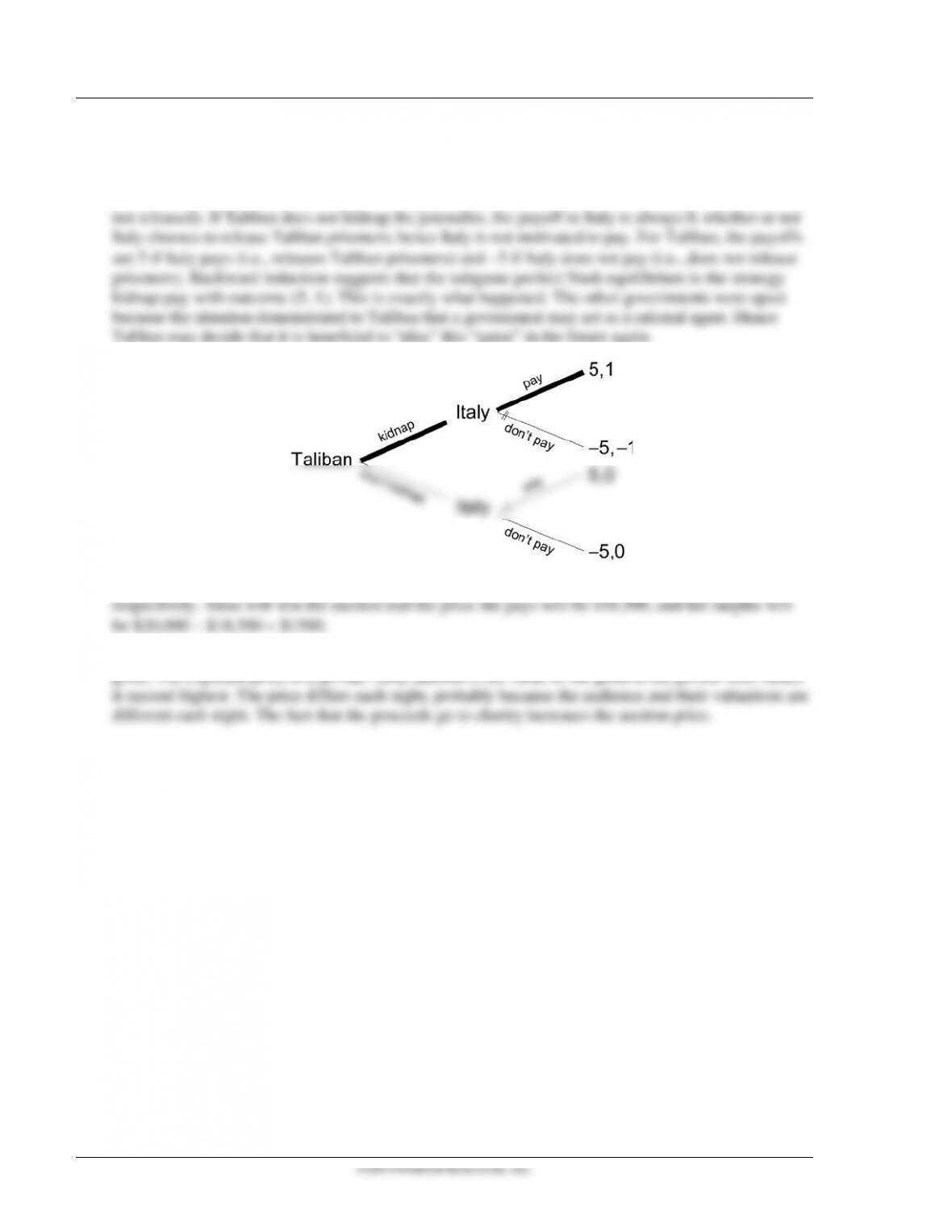
2.14 Taliban decides if kidnapping an Italian journalist will pay off. If Taliban kidnaps the journalist, Italy
should pay because if it pays, Italy gets the journalist back (payoff of 1), but if Italy does not pay, the
journalist is not going to be freed (payoff of −1 for Italy). If Italy pays, Taliban’s payoff is 5 (5 Taliban
prisoners are released), and if Italy does not pay, the payoff for Taliban is −5 (5 Taliban prisoners are
3.1 In the auction, Anna’s, Bill’s, and Cameron’s optimal bids will be $20,000, $18,500, and $16,800,
3.2 This is a private–value auction because each potential bidder places a different personal value on the
276 Perloff • Microeconomics: Theory and Applications with Calculus, Third Edition
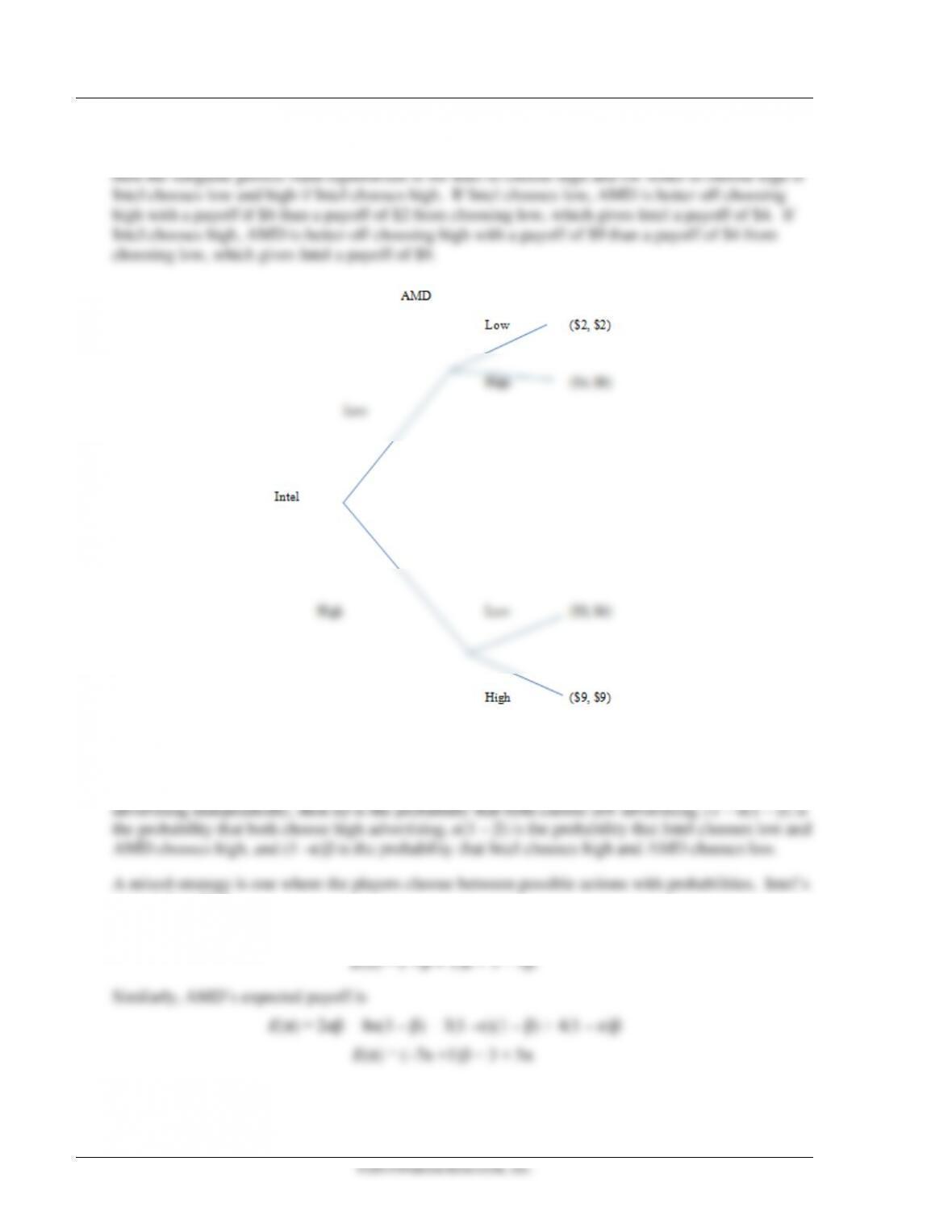
5.1 A set of strategies forms a subgame perfect Nash equilibrium if the players’ strategies are a Nash
equilibrium in every subgame. If Intel moves first and payoffs from both firms picking high are $9,
5.2 Let the probability that a firm chooses low be α for Intel and β for AMD. If the firms choose their
expected profit is
E(π) = 2αβ + 4α(1 – β) + 3(1 – α)(1 – β) + 8(1 – α)β
Chapter 13 Game Theory 277
To find α, set AMD’s payoff when choosing low equal to its payoff when choosing high. To find β,
set Intel’s payoff when choosing low equal to its payoff when choosing high. Thus, α = 0.142 and
β = 0.142.
If Intel chooses low advertising with a probability greater than 0.142, then AMD can maximize
expected profits by always choosing high advertising. However, then Intel would not pursue a mixed
strategy. Similarly, if AMD chooses low advertising with a probability greater than 0.142, then Intel