Chapter 13 Game Theory 259
Firm 1
Enter −1, −2 4, 0
Don’t enter 0, 4 0, 0
4. Two firms are considering entering a new market. Entrance requires construction of a highly
specialized plant. Demand is sufficient for either one to be profitable but not both. A newspaper
writer, observing the posturing of the two firms, each stating that they are planning to go ahead with
plans for the new facility, noted, “sunk costs make for credible threats.” What does she mean by this
statement?
5. Suppose an industry has one incumbent and three potential new entrants. Any firm can produce as the
incumbent does, with no fixed costs, and marginal cost MC = bq. Is entry blockaded? Can/should it
be deterred? What type of equilibrium will result?
6. A monopolist faces demand p = 20 – Q + 0.5A0.5. Cost is C = 4Q + A, where A is the quantity of
advertisement, measured in $1 units. What are the profit-maximizing output and advertising levels?
What are the profits?
7. What are the merits and disadvantages to developing word processing software that has a very
different command structure than others on the market?
8. Show that if learning by doing results in the incumbent firm having the cost function C = 100 + 5Q0.5,
the firm does not need any further action to deter entry.
9. Suppose the French fry market is a duopoly. Tests show that 95 percent of consumers prefer Brand X.
Could it ever be shown that Brand Z is preferred in taste tests? What does this imply about such tests?
10. Jerry has the only ice cream store in town. There are only two methods of ice cream advertising that
work: billboards and radio ads. Billboards are cheaper but less effective than radio. Upon learning
that Ben will soon open a rival store, Jerry immediately rents all available billboard space. Why might
he choose this strategy? Under what circumstances will it be effective?
Answers to Additional Questions and Problems
1. Firm 1 has a dominant strategy of A. However, without knowledge of the other player’s possible
outcomes, Firm 2 must guess, as they do not have a dominant strategy. The solution (A, A) is a Nash
2. Each player has the dominant solution of strategy A, which is the only Nash equilibrium, and will
3. As the matrix is written, neither player has a dominant strategy nor can they make a credible threat of
260 Perloff • Microeconomics: Theory and Applications with Calculus, Third Edition
Payoffs with a $1 Prize for All Entering Firms:
Firm 2
4. The fact that a firm must invest in fixed costs does not ensure a credible commitment because the
5. In this case, the lack of fixed costs means that entry is neither blockaded nor should it be deterred. If
the products are identical, a Bertrand equilibrium will likely occur, with firms pricing at marginal
6. In this case, there is more than one choice variable. To solve, set up the profit function, differentiate
with respect to Q and A, and solve two first-order conditions simultaneously to obtain Q* and A*.
π
7. Difference in command structure creates switching costs in the software market. If the product enjoys
or is able to capture a high market share by some other means, such as advertising or quality, switching
9. The company need only run the tests enough times, and eventually the firm will get a sample that
10. Jerry may choose to rent all available billboard space to raise Ben’s cost of entry. In order to gain
Chapter 13 Game Theory 261
Answers to Exercises in the Text
1.1 The payoff matrix in this prisoners’ dilemma game is
Duncan
If Duncan stays silent, Larry gets 0 if he squeals and −1 (a year in jail) if he stays silent. If Duncan
1.3 A Nash equilibrium is a set of strategies such that, holding the strategies of all other firms constant,
no firm can obtain a higher profit by choosing a different strategy. The Nash equilibria are for Firm 1
It is not a Nash equilibrium for Firm 1 to pick medium and Firm 2 to pick medium. Firm 1 could
increase profit from $2 to $25 by instead picking low. Firm 2 could increase profit from $3 to $19 by
instead picking low.
It is not a Nash equilibrium for Firm 1 to pick medium and Firm 2 to pick high. Firm 2 could increase
262 Perloff • Microeconomics: Theory and Applications with Calculus, Third Edition
1.4 A best response is the strategy that maximizes a player’s payoff given the player’s beliefs about its
rivals’ strategies. If PG picks high, then JNJ should pick low for a payoff of $3 instead of a payoff of
$2 from picking medium or a payoff of $1 from picking high. If PG picks medium, then JNJ should
pick low for a payoff of $5 instead of a payoff of $4 from picking medium or a payoff of $3 from
1.5 Assume you’re Lori. If Max works, your best strategy is to give no bonus (your payoff is 3), rather
than give a bonus (your payoff is 1). If Max loafs, again, your best strategy is to give no bonus (your
payoff is 0), rather than give a bonus (your payoff is −1). Hence “No Bonus” is Lori’s dominant
strategy. Now assume you’re Max. If Lori offers you a bonus, your best strategy is to loaf because the
1.6 a. The pure strategy Nash equilibrium in this game is for both Warner Bros. and the T-3 producer to
b. The release on July 18 by the T-3 producer and on July 4 by Warner Bros. maximizes joint profit.
c. The maximum Warner Bros. is willing to pay is the difference between its profit when both
movies are released on July 4th, and its payoff when it has bought the release of T-3 (released on
July 18) and Matrix 2 (released on July 4), i.e., 90 − 50 = 40. The profit the T-3 producer earns if
it does not sell its right of release is 50. Therefore the minimum price the T-3 producer accepts
d. Warner Bros. will release Matrix 2 movie on July 4th and T-3 on July 18.
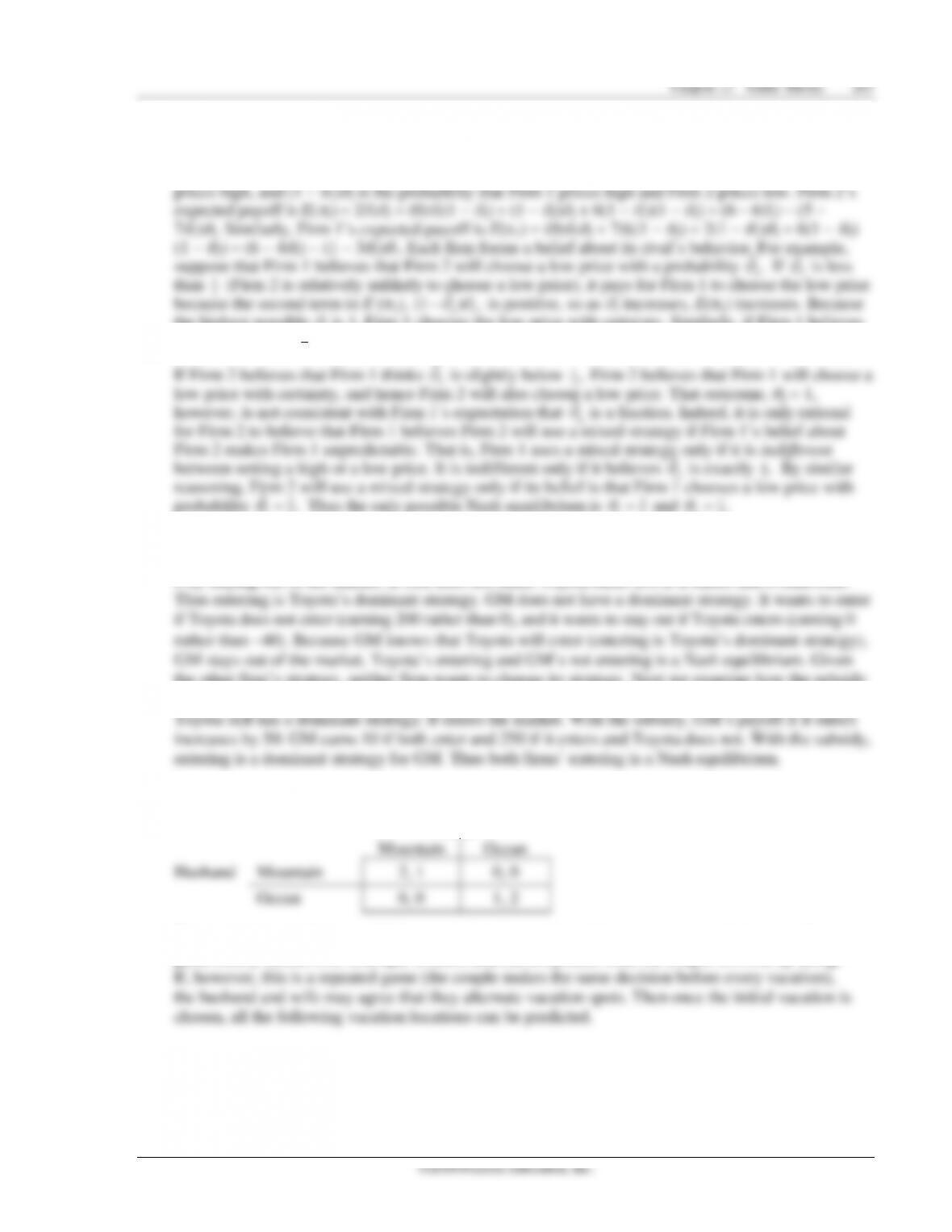
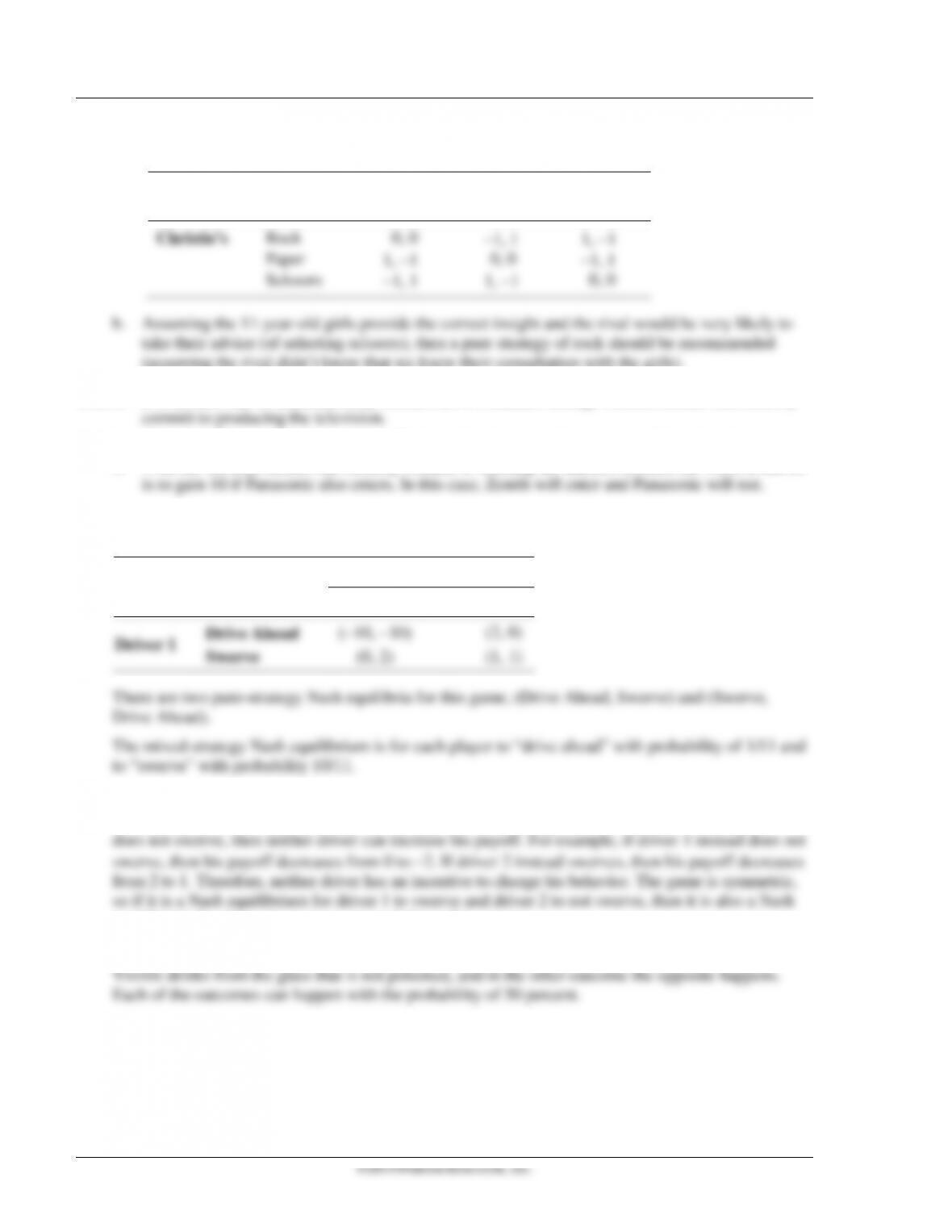
1.7 There are no pure-strategy Nash equilibria in this game. In each cell, one of the players always would
264 Perloff • Microeconomics: Theory and Applications with Calculus, Third Edition
1.11 a. Suppose the payoff is 1 if you win, 0 if you tie, and −1 if you lose. The payoff matrix will be the
following:
Sotheby’s
Rock
Paper
Scissors
Christie’s
Rock 0, 0 −
1, 1
1,
−
1
Paper
1, −1
0, 0
−1, 1
Scissors
−1, 1
1, −1
0, 0
b. Assuming the 11-year–old girls provide the correct insight and the rival would be very likely to
take their advice (of selecting scissors), then a pure strategy of rock should be recommended
(assuming the rival didn’t know that we knew their consultation with the girls).
1.12 a. If both must move simultaneously, neither has a dominant strategy because neither can credibly
b. The two Nash equilibria are on the off diagonals where one firm enters and the other does not.
1.13
Driver 2
Drive Ahead
Swerve
Drive Ahead
(−10, −10)
(2, 0)
1.14 A Nash equilibrium is a set of strategies such that, holding the strategies of all other firms constant,
no firm can obtain a higher profit by choosing a different strategy. If driver 1 swerves and driver 2
equilibrium for driver 1 to not swerve and driver 2 to swerve.
1.15 This game has two possible outcomes, one in which Wesley drinks from the poisoned glass and
266 Perloff • Microeconomics: Theory and Applications with Calculus, Third Edition
c. The Nash equilibrium is for both to offer three–year warranties. Offering three–year warranties is
d. They both offer the same warranty because this is best response to each other’s strategy.
e. If they collude, they will still provide three–year warranties. Following other strategies makes one
better off and the other worse off.
f.
Acura
1 2 3 4 5
Volvo
1 (12.5, 11.5) (8, 14) (5.75, 14.25) (4.4, 13.6) (3.5, 12.5)
2 (16, 7) (11.5, 9.5) (8.8, 10.2) (7, 10) (5.7, 9.3)
3 (17.25, 4.75) (13.2, 6.8) (10.5, 7.5) (8.6, 7.4) (7.2, 6.9)
4 (17.6, 3.4) (14, 5) (11.4, 5.6) (9.5, 5.5) (8, 5)
5 (17.5, 2.5) (14.3, 3.7) (11.9, 4.2) (10, 4) (8.5, 3.5)
The Nash equilibrium is now for Volvo to offer five–year warranties and for Acura to offer three–
year warranties. Now the Volvo profit is larger compared with when its costs were higher.
2.1 a. There are two Nash equilibria (the off diagonals). If either firm produces 20 while the other
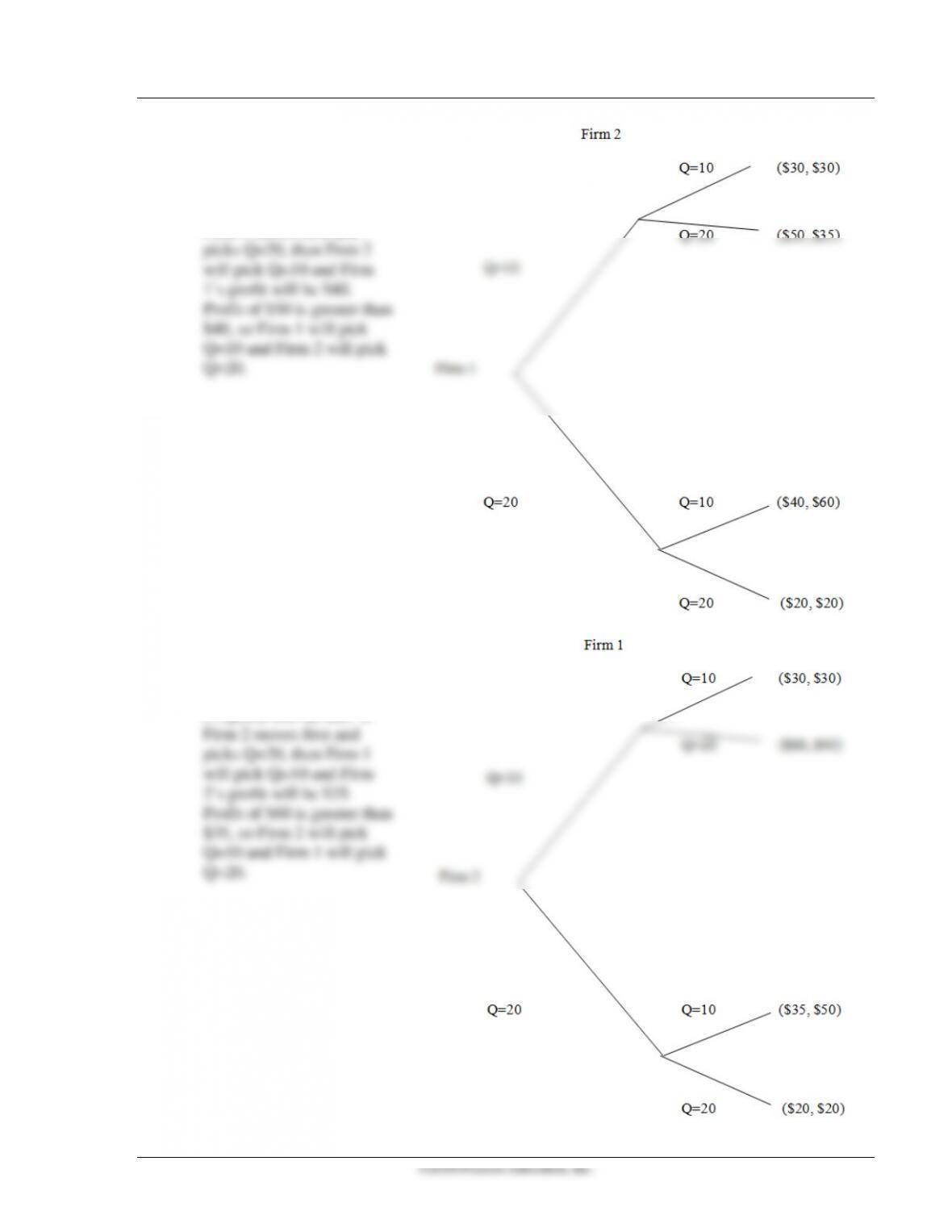
b. With a $40 lump-sum tax, all profits are reduced by $40, as illustrated below. If the firms could
Chapter 13 Game Theory 267
c. If Firm 1 moves first and
picks Q=10, then Firm 2
will pick Q=20 and Firm
1’s profit will be $50. If
d. If Firm 2 moves first and
picks Q=10, then Firm 1
will pick Q=20 and Firm
268 Perloff • Microeconomics: Theory and Applications with Calculus, Third Edition
(b) If the game is repeated a finite number of periods, then the Nash equilibrium is likely to result as
in a single–period game. This is because punishment for cheating on the cartel agreement cannot be
(c) If the game is repeated a finite number of times but the firms are unsure as to which period will be
the last, then the game will be treated as if it were played infinitely (because the players will not
2.3 If the discount rate of firms is sufficiently high, which implies that the firms only care about their
2.4 a. A Nash equilibrium is a set of strategies such that, holding the strategies of all other firms
constant, no firm can obtain a higher profit by choosing a different strategy. The Nash
b. When repeated indefinitely, a Nash equilibrium is any set of strategies where each restaurant
c. A firm does not have to punish its rival forever to induce it to cooperate. All it has to do is
punish it for enough periods that it does not pay to cheat in any one period. The benefit from
advertising when the other restaurant does not advertise is $4, from a payoff of $3 when neither
2.5 Panel (a) offers an extensive form representation of the sequential game when Mimi moves first.
Using backward induction, we conclude that Jeff will not choose actions that are double–crossed