248 Perloff • Microeconomics: Theory and Applications with Calculus, Third Edition
5.3 A two-part price is where a firm charges a consumer a lump–sum fee for the right to buy as many
units of the good as the consumer wants at a specified price. The optimal two-part price for the Club
MR = 120 – 4q.
Setting marginal cost equal to marginal revenue, the profit–maximizing quantity is
MC = MR
20 = 120 – 4q
4q = 100
Thus, the difference in profit from using the two-part tariff is $1,250 (from profit of $2,500 with the
two-part tariff minus profit of $1,250 from charging a single price).
5.4 A two-part price is where a firm charges a consumer a lump–sum fee for the right to buy as many
units of the good as the consumer wants at a specified price. The optimal two-part price for the Club
is to charge Joe and Susan a per–unit price equal to marginal cost ($20) and then set the lump-sum fee
Shown for exercise 5.3 above, the optimal lump-sum fee for Joe is $2,500.
Chapter 12 Pricing and Advertising 249
©2014 Pearson Education, Inc.
With different two–part tariffs, Joe pays a lump–sum fee of $2,500 and Susan pays a lump-sum fee of
$1,600, so profit is
π = $4,100.
Thus, the difference in profit from using different two–part tariffs is $900 (from profit of $4,100 with
different two-part tariffs minus profit of $3,200 from charging the same two-part tariff).
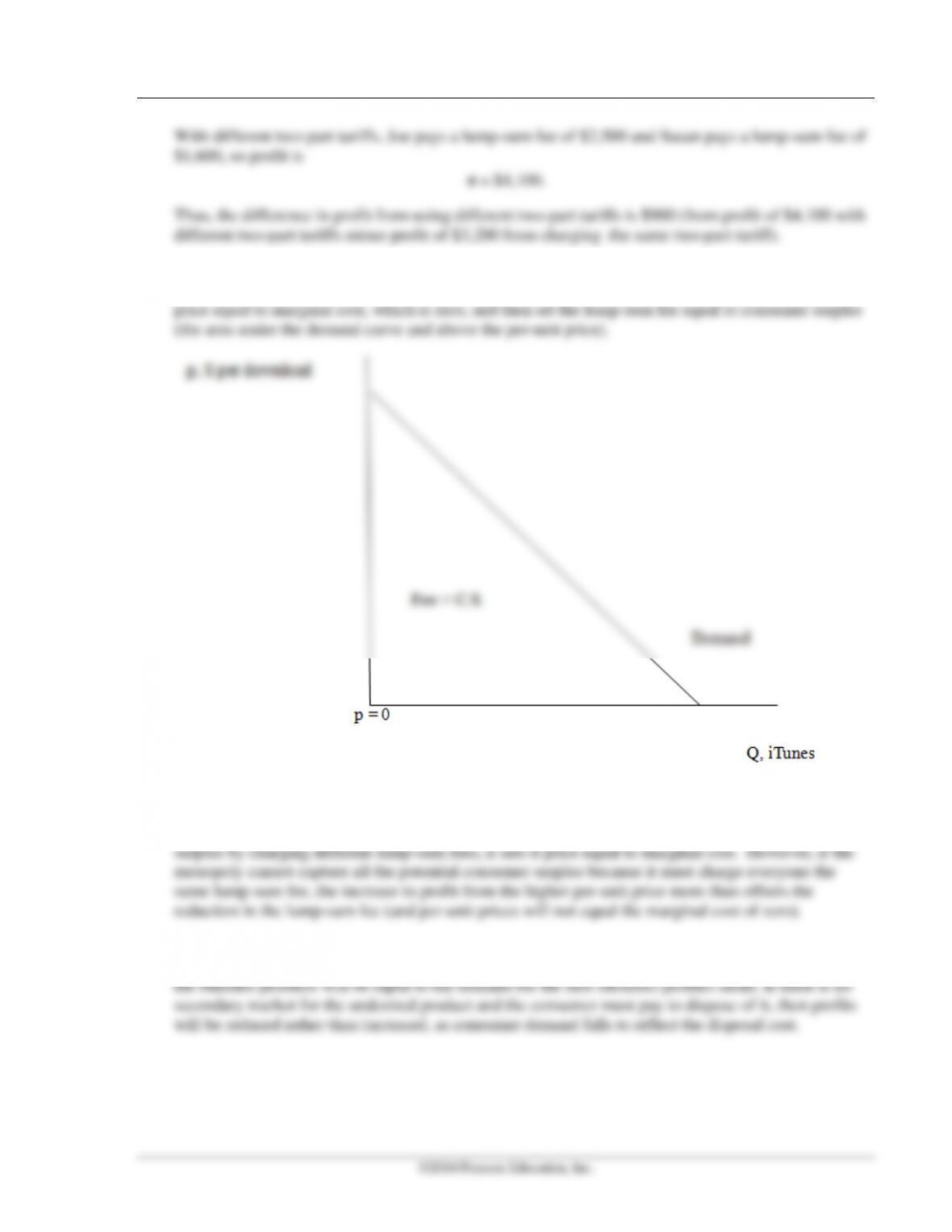
5.5 A two-part price is where a firm charges a consumer a lump–sum fee for the right to buy as many
units of the good as the consumer wants at a specified price. The optimal two-part price is a per–unit
The actual price per download is positive because consumers are not identical (with different
demands). By raising price, the monopoly earns more per unit from customers but lowers its
customers’ potential consumer surplus. If the monopoly can capture each customer’s potential
6.1 No. If no consumers want the second product, profits are reduced by bundling it with the first
product. The reason is that because there is no demand for the second product, consumer demand for
250 Perloff • Microeconomics: Theory and Applications with Calculus, Third Edition
6.2 a. If the firm charges $1,000 for laptops, then demand will be one, and profit will be $1,000. If the
firm charges $800 for laptops, then demand will be two, and profit will be $1,600. If the firm charges
$600 for laptops, then demand will be three, and profit will be $1,800. If the firm charges $150 for
6.3 a. The university will only buy Journals A and B.
c. The individual prices that maximize revenue for the publisher are $1,800 for Journal A, $1,100
for Journal B, and $1,400 for Journal C. In this case the total revenue will be $7,500. The
7.1 Assume one unit of advertising costs $1. Then monopoly solves
π
= −−
,
max ( , ) ( ) .
pA RpA Cp A
7.2 Assume one unit of advertising costs $1. The profit function is
p = (100 – Q + A1/2 )Q – 10Q – A.
p* = 70.
252 Perloff • Microeconomics: Theory and Applications with Calculus, Third Edition
8.1 Before the item is discounted, the department store attempts to sell the item to customers with relatively
8.2 Group price discrimination (or third–degree price discrimination) is where the firm charges different
groups of customers different prices but charges a given customer the same price for every unit of
output sold. In this instance, Heinz would always charge loyal customers the profit-maximizing price