238 Perloff • Microeconomics: Theory and Applications with Calculus, Third Edition
1. “All you can eat” buffets are an example of which pricing strategy discussed in this chapter? What
about hotels that have a “kids eat free in the hotel restaurant” policy?
2. A monopolist sells in two states and practices price discrimination by charging separate prices in each
state. The monopolist produces at constant marginal cost MC = 10. Demand in market 1 is Q1 = 50 – p1.
Market 2 demand is Q2 = 90 – 1.5p2. What price will be charged in each market? Suppose a third
party enters the market, not as a producer but as a reseller, capable of reselling by transporting the
goods from market to market at a cost of $4 per unit. How does this affect the monopolist?
3. Suppose a monopolist’s costs are described by the function C = 200 + 2Q2, and it faces a demand
curve of Q = 240 – p. If it cannot price discriminate, what are the profit-maximizing price and
quantity? What are the profits? If the monopolist uses block pricing by setting an intermediate price
but cannot charge more than two different prices in total, what would be the best prices to choose?
How does the use of an intermediate price change profits and consumer surplus compared to the
single price result?
4. Suppose that instead of block pricing in the question above, the firm is able to practice perfect price
discrimination. What are the values of output, profit, and consumer surplus?
5. True or false; explain your answer. If all consumers have identical tastes and preferences, perfect
price discrimination is impossible.
6. Tuan lives in a town with only one movie rental store. Suppose Tuan’s demand for movie rentals per
month is Q = 16 – 2P. The movie store currently charges $5 per movie but is thinking of adding
a flat monthly cardholder fee and dropping the price to $2 per rental. At this new price, what is the
largest cardholder fee that Tuan will pay? If the rental store has a constant marginal cost of $2, which
strategy is more profitable?
7. In most cases, when a consumer purchases season tickets for a professional sports team, the consumer
must purchase preseason games as well at the same price as regular season games. What type of
pricing strategy does this represent?
8. Why do firms place ads with coupons in the paper, instead of simply offering a sale price in the
same ad?
9. A firm believes the elasticity of demand it faces in its own country is −1.1 and in the other country is
−1.5. Suppose the firm can charge $1 for its products in its own country and can prevent resales
between these two countries. What price will it charge in the other country?
10. Perfect price discrimination generates higher total welfare than imperfect price discrimination.
Explain why?
Answers to Additional Questions and Problems
1. “All you can eat” buffets are examples of product bundling. Consumers cannot purchase the items
2. To get the profit–maximizing output and price levels, set marginal cost equal to marginal revenue in
Chapter 12 Pricing and Advertising 239
©2014 Pearson Education, Inc.
11
*
1
*
1
22
*
2
*
2
50 2 10
20
30
60 1.33 10
37.5
35
=−==
=
=
=−==
=
=
MR Q MC
Q
p
MR Q MC
Q
p
Because the reseller can transport goods from Market 1 to Market 2 for $4 per unit, the reseller could
underprice the monopolist in Market 2 by $1. This forces the monopolist to reduce the market price to
$34 per unit. Output increases to 39 units, and revenue increases to $1,326 from $1,312.50, but because
of the additional output, costs increase by $15, and profits fall by $1.50.
3. The standard monopoly solution is Q* = 40, p* = $200, which generates profits of $8,000. If an
4. With perfect price discrimination, the monopolist sets MC = p to determine the best output level.
π
=
= +× =
=−= − =
2
10368
200 2 (48) 4808
10368 4808 5560
C
RC
240 Perloff • Microeconomics: Theory and Applications with Calculus, Third Edition
5. False. Even though all consumers have identical tastes and preferences, each consumer still possesses
6. At the original price of $5 per rental, Tuan rents 6 videos per month. His total expenditure per month
is $30. Firm cost for these rentals is $12, leaving profits of $18 per month. Under the new pricing
8. By using coupons, firms restrict discounts to those consumers willing to take the time required to
clip the coupons and bring them to the store. Those consumers with more inelastic demand or less
9. The price charged in the other country will be (1 − 1/1.1)/(1 − 1/1.5) = 0.27.
Answers to Exercises in the Text
1.1 The pharmaceutical firms offer the discount to low-income seniors because the seniors would
1.2 In order to price discriminate, Alexx must have market power—the ability to set prices. Consumers
Chapter 12 Pricing and Advertising 241
groups of individuals based on willingness to pay. Alexx must also be able to prevent reselling after
the initial sale.
1.3 This policy allows the firm to maximize its profit by price discriminating if people who put a lower
1.4 The colleges may be providing scholarships as a form of charity, or they may be price discriminating
1.5 Since adults cannot use children’s tickets to enter Disneyland, there won’t be a resale problem. On
1.6 When there is a big price difference across the border and shipping the car from Canada to the United
States is relatively cheap, consumers in Canada are able to make a profit by reselling their cars in the
1.7 If the difference in the cost of a car renting service is equal to the difference in the rental price between
2.1 With perfect price discrimination, the firm sells each unit at the maximum amount any customer is
willing to pay for it, so prices differ across customers, and a given customer may pay more for some
units than for others. By selling each unit of its output to the customer who values it the most at the
maximum price that person is willing to pay, the perfectly price-discriminating monopoly captures all
possible consumer surplus. Perfect price discrimination is efficient because the price of the last unit
MR = 90 – 2q.
242 Perloff • Microeconomics: Theory and Applications with Calculus, Third Edition
Setting marginal cost equal to marginal revenue, the profit–maximizing quantity is
Welfare equals the monopoly’s producer surplus (which equals profit since there are no fixed costs)
plus consumer surplus:
2.3 Google is essentially practicing price discrimination perfectly by taking advantage of advertisers’
desire to reach small, difficult–to–find segments of the population and varying the price of ads according
to advertisers’ willingness to pay. The amount that firms will pay for advertisements depends on the
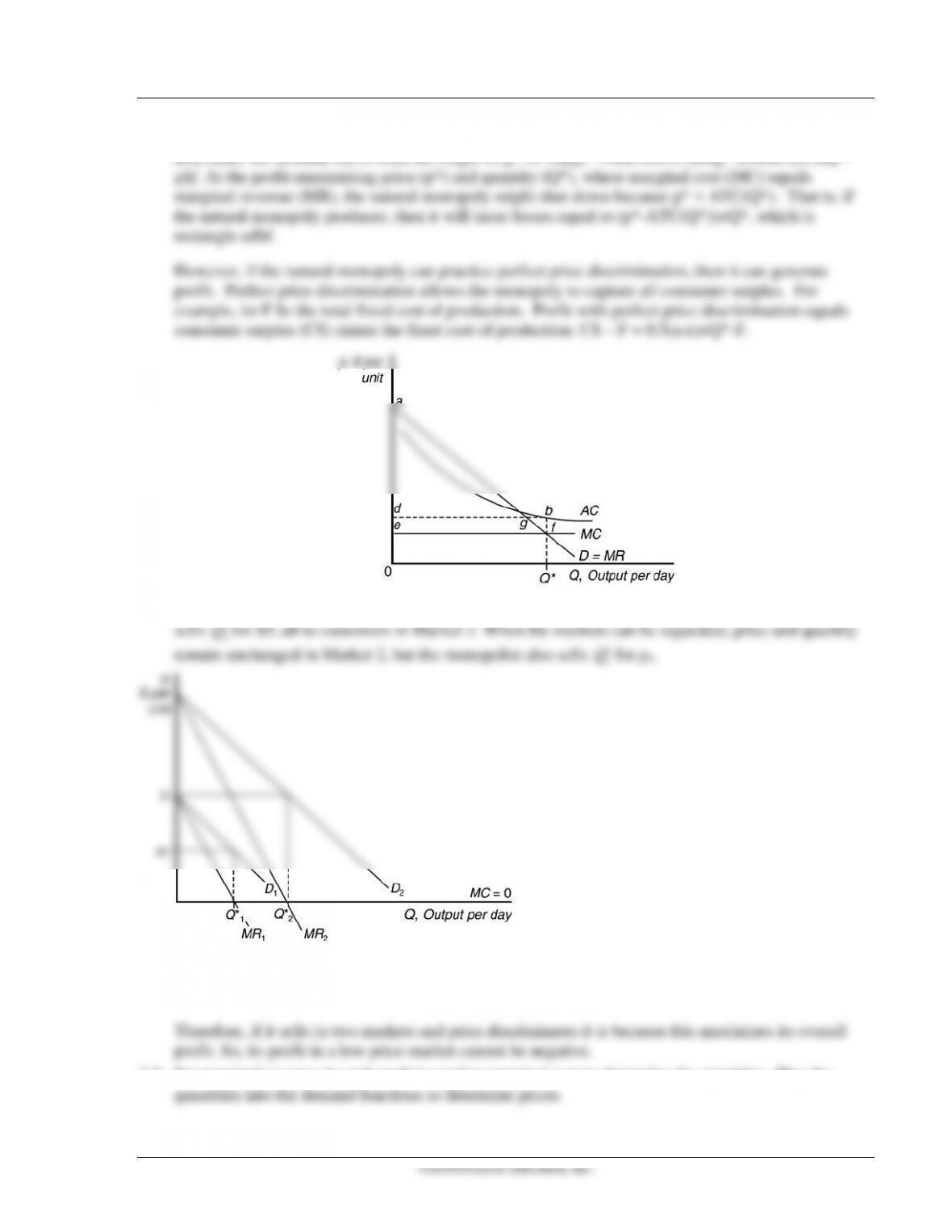
2.4 a. The marginal cost is zero, so the MC curve is the X axis. The amount of tickets sold will be T*,
Chapter 12 Pricing and Advertising 243
2.5 See the figure below. The monopolist produces where price equals marginal cost. Total revenue is the
3.1 Output expands, as do profit and consumer surplus. When the markets are combined, the monopolist
*
1
3.2 When the firm is operating in two markets its profit is
P1Q1
+
P2Q2
−
C(Q1
+
Q2).
3.3 Set marginal revenue in each market equal to marginal cost to determine the quantities. Plug the
244 Perloff • Microeconomics: Theory and Applications with Calculus, Third Edition
MR1 = 100 – 2Q1 = 30 = MC
3.4 a. Without price discrimination, the profit function is:
π
= − + − ⋅−[(10000 100 ) (9000 100 )] ( 5).p pp
The F.O.C. is:
π
∗
= − − −= ⇒ =19000 200 200( 5) 0 50.
dpp p
dp
The profit-maximizing quantity in the gate market is
∗
= − ⋅=10000 100 50 5000,
G
Q
and the
profit-maximizing quantity in the municipal offices is
∗
= − ⋅=9000 100 50 4000.
M
Q
The maximum possible profit is
π
∗
= −⋅+ −⋅ ⋅−=
( ) [(10000 100 50) (9000 100 50)] (50 5) 405000.
p
b. With price discrimination, the profit function in the gate market is:
π
= − ⋅−(10000 100 ) ( 5).
G GG
pp
∗∗
⇒= − =
10000 100 4750.
G
GG
Qp
The F.O.C. for the municipal offices market is:
π
∗
∗∗
= − − −=
⇒=
⇒=− =
9000 100 100( 5) 0
47.5
9000 100 4250.
MMM
M
M
MM
dpp
dp
p
Qp
The maximum possible profit in both markets is:
ππ π
∗∗ ∗ ∗
= + = × −+ × −=( 5) ( 5) 406250.
GM G G M M
Qp Qp
3.5 The two marginal revenue curves are MRJ = 3,500 − QJ and MRA = 4,500 − 2QA. Equating the
marginal revenues with the marginal cost of $500, we find that QJ = 3,000 and QA = 2,000.
4
3
2,500 1 1/( ) 1 1/
ε
+− +
AJ
p
Chapter 12 Pricing and Advertising 245
©2014 Pearson Education, Inc.
The profit in Japan is (pJ − m)QJ = ($2,000 − $500) × 3,000 = $4.5 million, and the U.S. profit is $4
million. The deadweight loss is greater in Japan, $2.25 million (=
1
2
× $1,500 × 3,000), than in the
United States, $2 million (=
1
2
× $2,000 × 2,000).
3.6 By differentiating, we find that the American marginal revenue function is MRA = 100 − 2QA, and
the Japanese one is MRJ = 80 − 4QJ. To determine how many units to sell in the United States, the
monopoly sets its American marginal revenue equal to its marginal cost, MRA = 100 − 2QA = 20,
and solves for the optimal quantity, QA = 40 units. Similarly, because MRJ = 80 − 4QJ = 20, the
optimal quantity is QJ = 15 units in Japan. Substituting QA = 40 into the American demand function,
3.7 With group price discrimination, a monopoly will equate the marginal revenue for each group to its
marginal cost, MC = m, such that the marginal revenues for the two countries are equal:
MRC = m = MRJ.
In this example, with group price discrimination, a monopoly will set price in Canada such that
ε
J = −1.032.
3.8 From the problem, we know that the profit-maximizing Chinese price is p = 3 and that the quantity
is Q = 0.1 (million). The marginal cost is m = 1. Using Equation 11.11, (pC − m)/pC = (3 − 1)/3 =
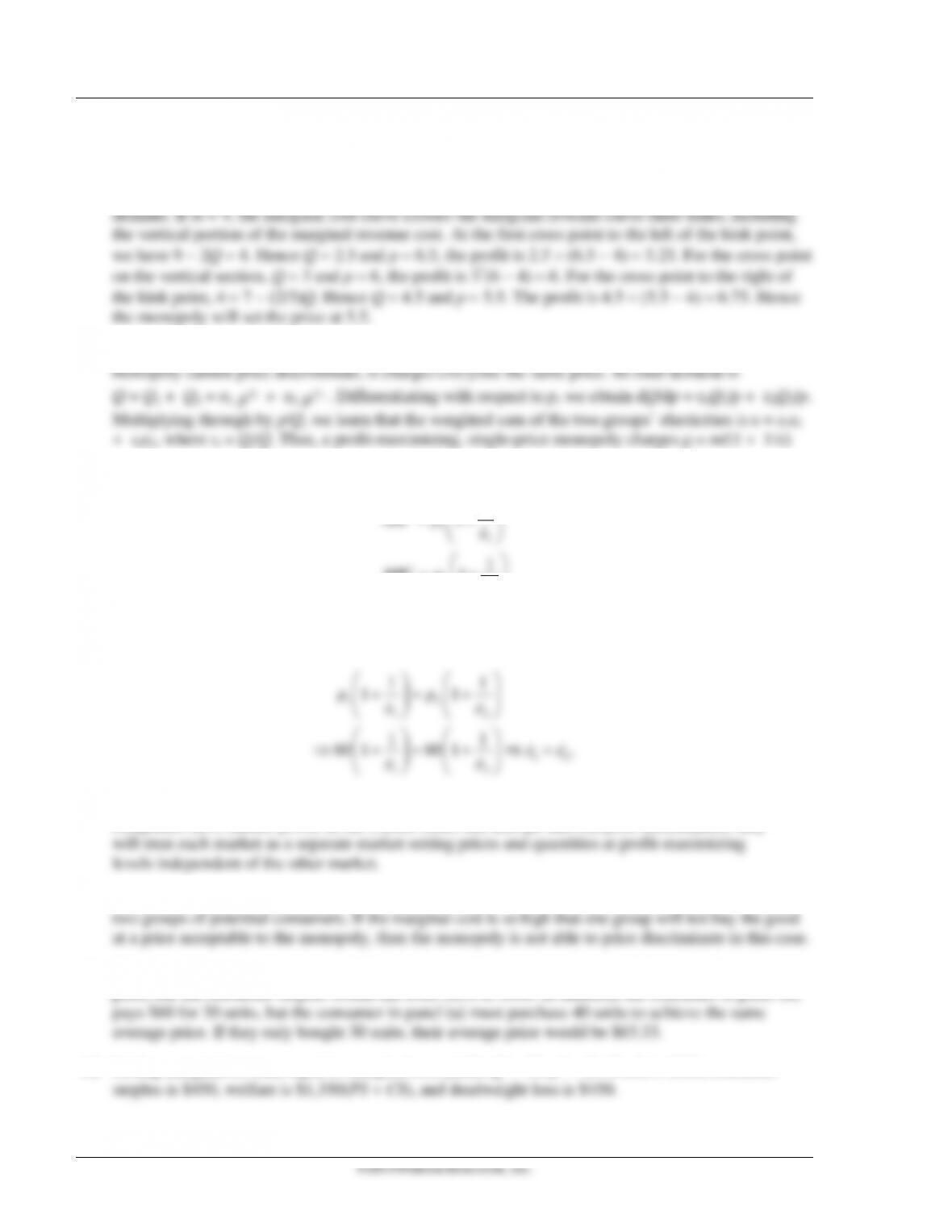
3.9 Using Equation 12.2,
pUS (1 − 1/2) = 10 = pJ (1 − 1/5)
246 Perloff • Microeconomics: Theory and Applications with Calculus, Third Edition
pUS = $20, pJ = $12.50.
3.10 If m = 7, the marginal revenue curve crosses the marginal cost curve above the kink point. The
monopoly will charge the monopoly price as if there is only one country, the country with higher
3.11 If a monopoly manufacturer can price discriminate, its price is pi = m/(1 + 1/εi) in Country i. If the
3.12 Marginal revenue depends on price and elasticity of demand:
11
1
22
2
1
1
1
1
ε
ε
= +
= +
MR p
MR p
From Solved Problem 12.3 we know that
12
60
= =pp
. Since multimarket price discrimination leads
to prices that equate marginal revenues, that is,
12
=MR MR
, we may write
12
12
12
11
11
11
60 1 60 1
εε
εε
+= +
⇒ += +
pp
εε
⇒=
12
.
3.13 No, it is not reasonable to conclude that U.S. drivers subsidize European gasoline prices. If oil
3.14 Yes. The monopoly’s ability to price discriminate depends on the marginal cost. Suppose there are
4.1 Yes. Even if a consumer purchased 40 units per day, the average price would just equal the monopoly