214 Perloff • Microeconomics: Theory and Applications with Calculus, Third Edition
10. The chapter notes that one possible alternative to regulation is for the government to encourage
competition. Would this be an efficient mechanism to increase efficiency in an industry where the
incumbent firm is a natural monopoly?
11. If a monopoly firm sells a product with price $100, whose marginal cost is $30, what is the price/
marginal cost ratio? What is the Lerner Index? And what is the demand elasticity the firm believes
it faces?
12. Suppose a monopoly firm with a constant marginal cost 10 faces an inverse linear demand function
p =
50 − Q. What would be the profit-maximizing price and quantity if its marginal cost doubles?
How does it compare to the outcome with original cost?
Answers to Additional Questions and Problems
1. In Equation 11.4 whenever demand is inelastic, MR is negative, indicating that the last unit sold
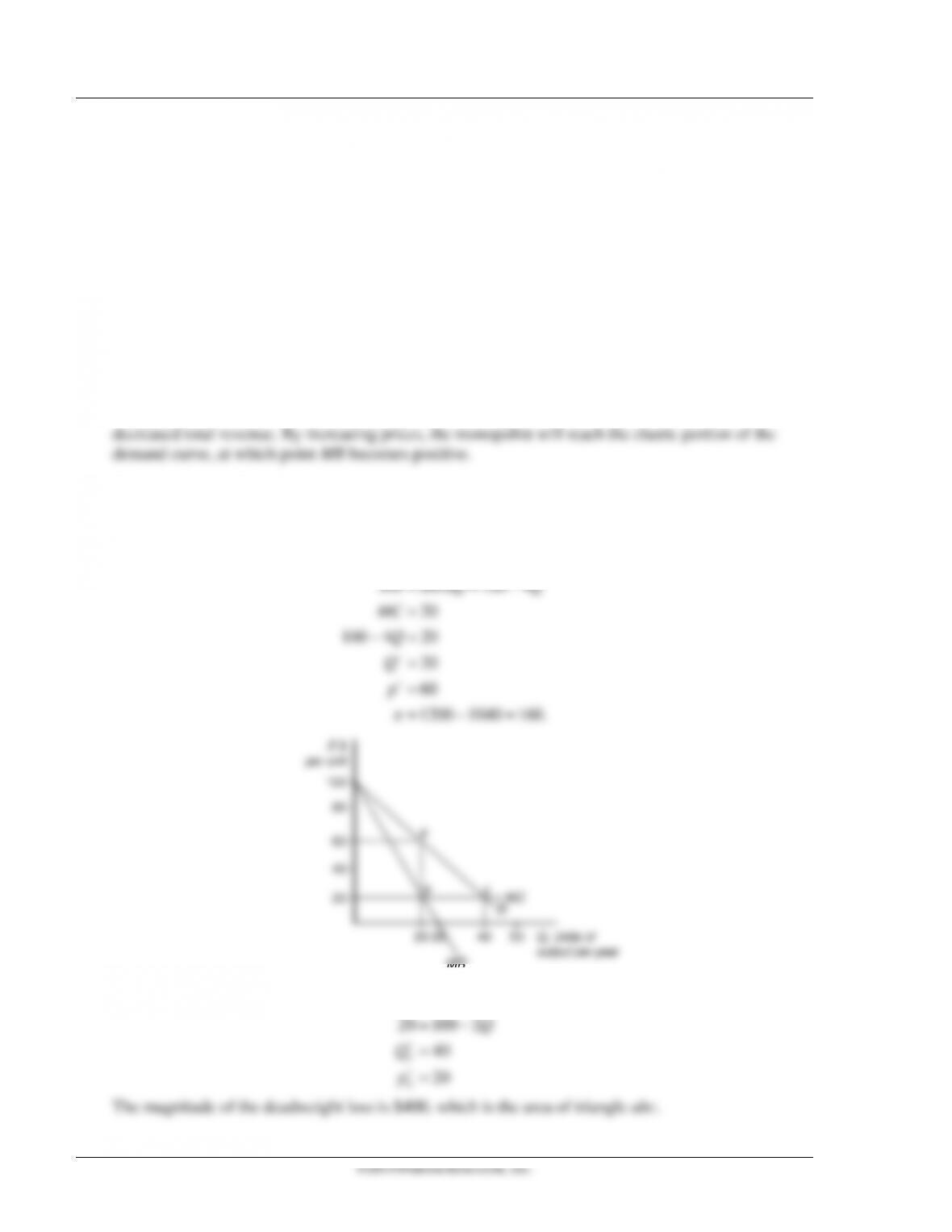
2. First, derive the MR and MC functions; then set MC = MR and solve. See Figure 11.1. Deadweight
loss is equal to area abc.
= −
= −
2
100 2
100 2
PQ
R QQ
216 Perloff • Microeconomics: Theory and Applications with Calculus, Third Edition
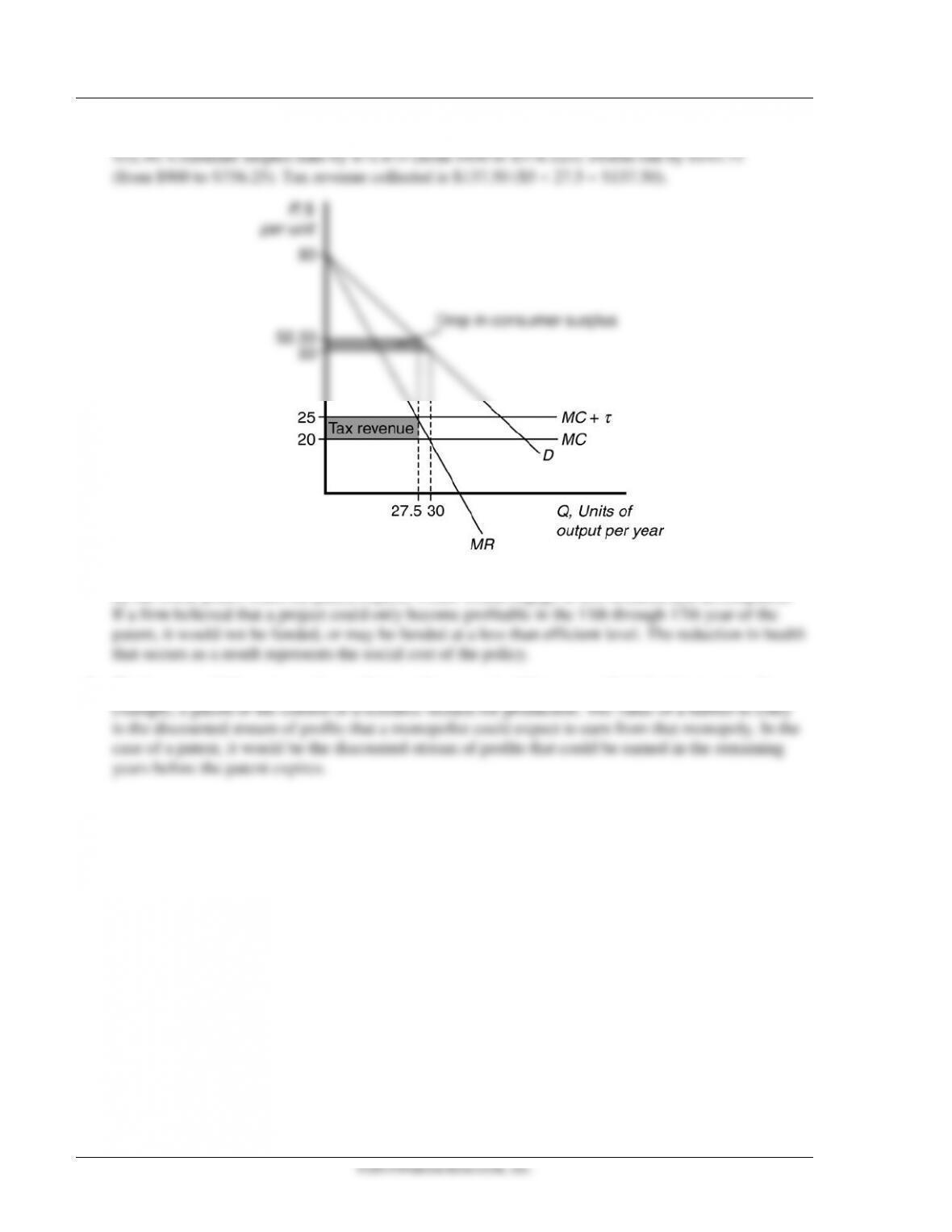
6. The $5 tax increases MC to $25. Quantity falls from 30 to 27.5, and price increases from $50 to
7. In order for the legislation to have a net positive effect, any social cost must be more than offset
8. The buyer would have to purchase whatever the source is of the monopolist’s barrier to entry, for
218 Perloff • Microeconomics: Theory and Applications with Calculus, Third Edition
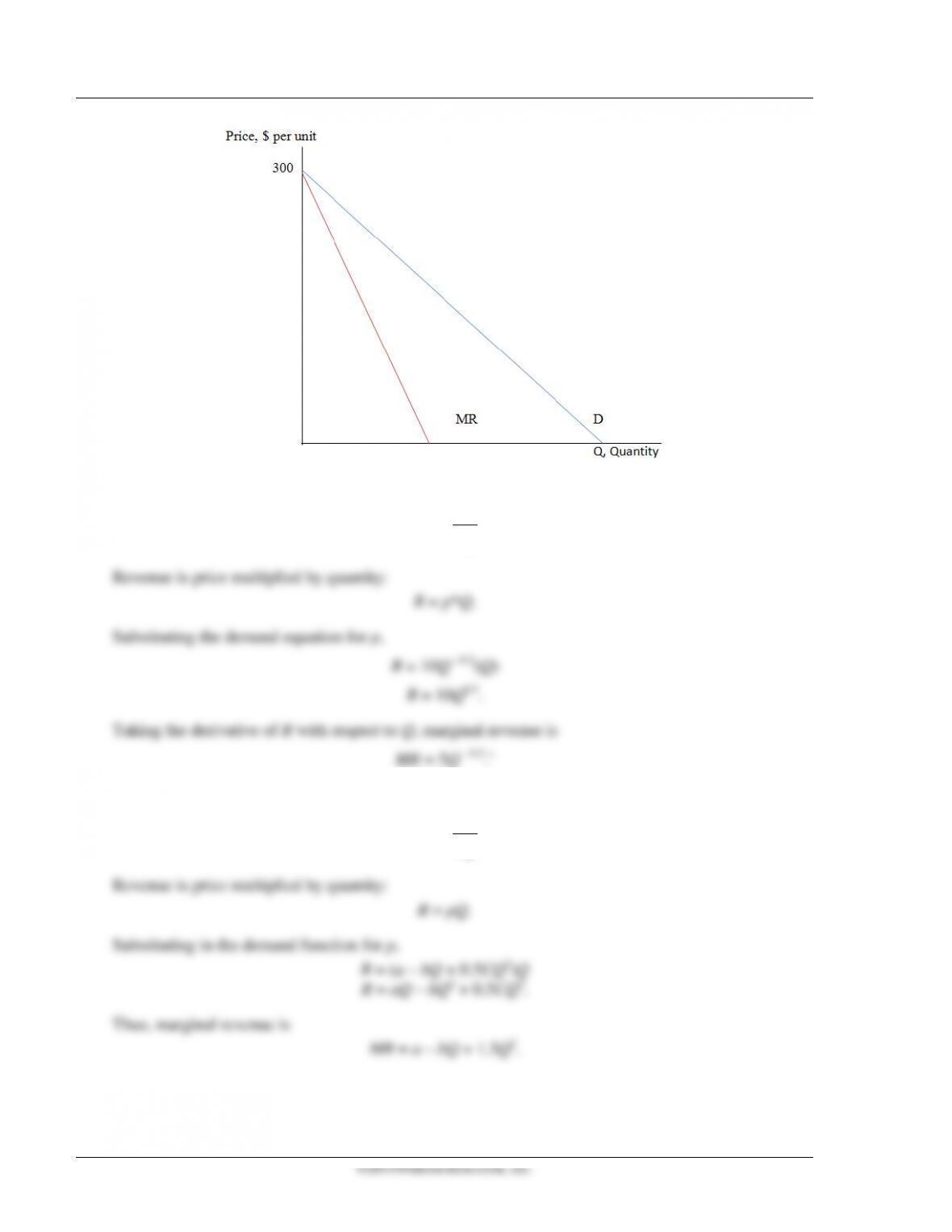
1.2 Marginal revenue (MR) is the change in revenue (R) with respect to quantity:
Q
R
MR ∂
∂
=
.
1.3 Marginal revenue is the change in revenue (R) with respect to output:
Q
R
MR ∂
∂
=
.
Chapter 11 Monopoly and Monopsony 219
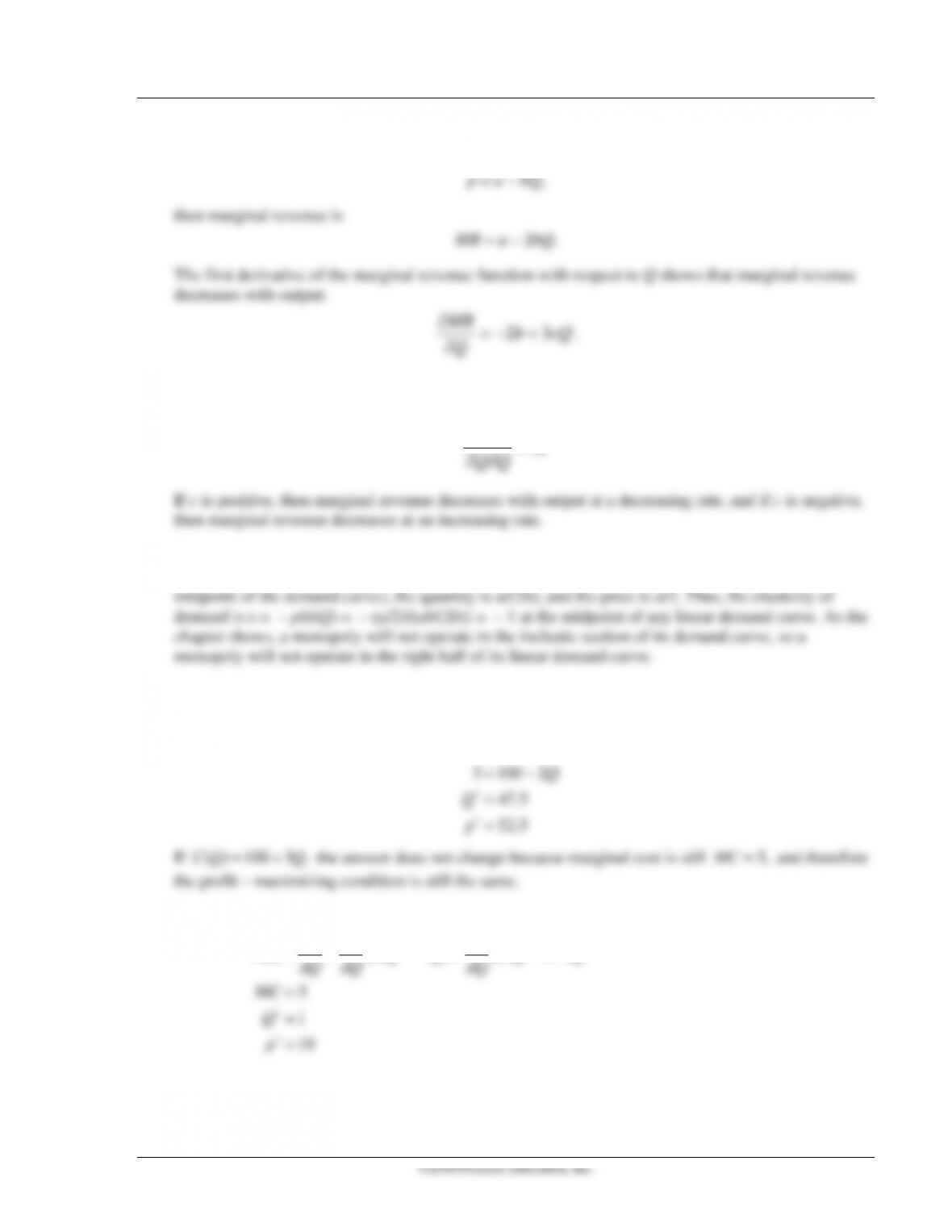
When the inverse demand curve is linear, marginal revenue has the same intercept and twice the
slope. Thus, if inverse demand is
Q
∂
The second derivative of the marginal revenue function with respect to Q shows whether marginal
revenue decreases with output at an increasing or decreasing rate:
MR 3
2=
∂
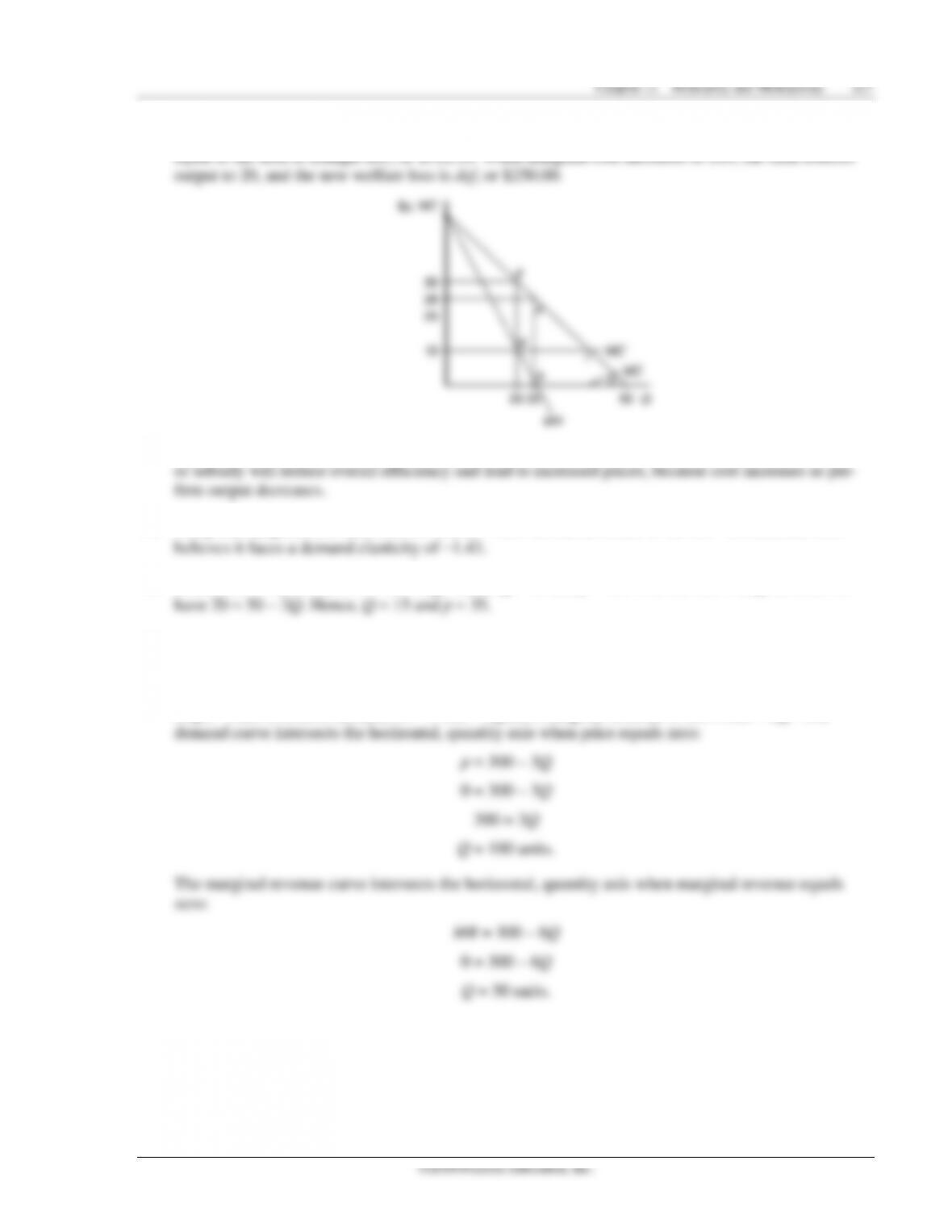
1.4 For a general linear inverse demand function, p(Q) = a – bQ, dQ/dp = – 1/b, so the elasticity is: ε =
– p/(bQ). The demand curve hits the horizontal (quantity) axis at a/b. At half that quantity (the
1.5 Set MC = MR and solve:
*
*
100 2
5
5 100 2
47.5
52.5
= −
=
= −
=
=
MR Q
MC
Q
Q
p
If
( ) 100 5 ,= +CQ Q
the answer does not change because marginal cost is still
5,=MC
and therefore
the profit – maximizing condition is still the same.
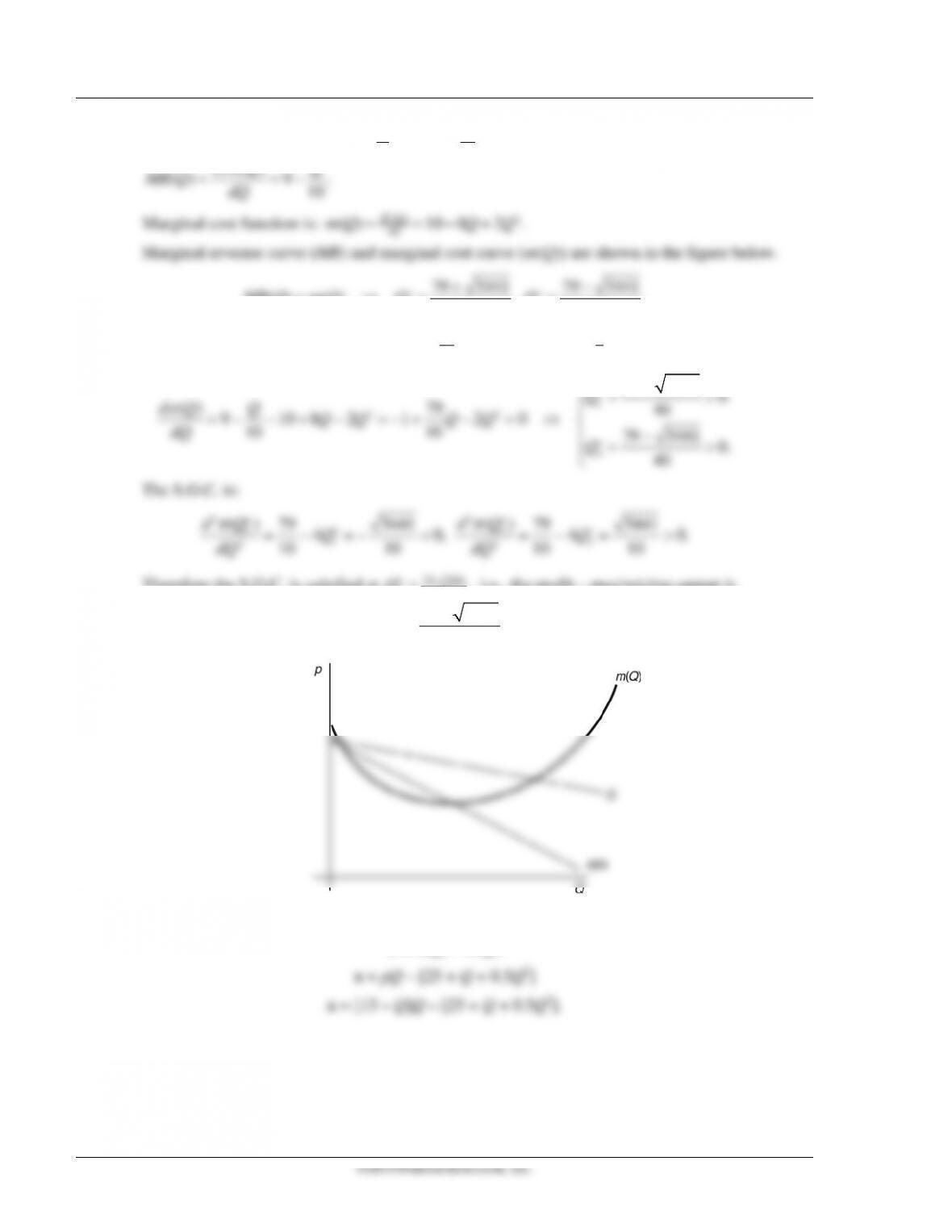
1.6 Set MC = MR and solve:
1/2 1/2 1/2
*
*
(10 ) (10 ) 5
5
1
10
−−
= = ⋅= =
=
=
=
dR d d
MR Q Q Q Q
dQ dQ dQ
MC
Q
p
220 Perloff • Microeconomics: Theory and Applications with Calculus, Third Edition
1.7 Total revenue is:
=⋅= − = −
2
20 20
( ) (9 ) 9 ,
QQ
TR Q p Q Q Q
therefore marginal revenue is:
()
dTR Q Q
Chapter 11 Monopoly and Monopsony 221
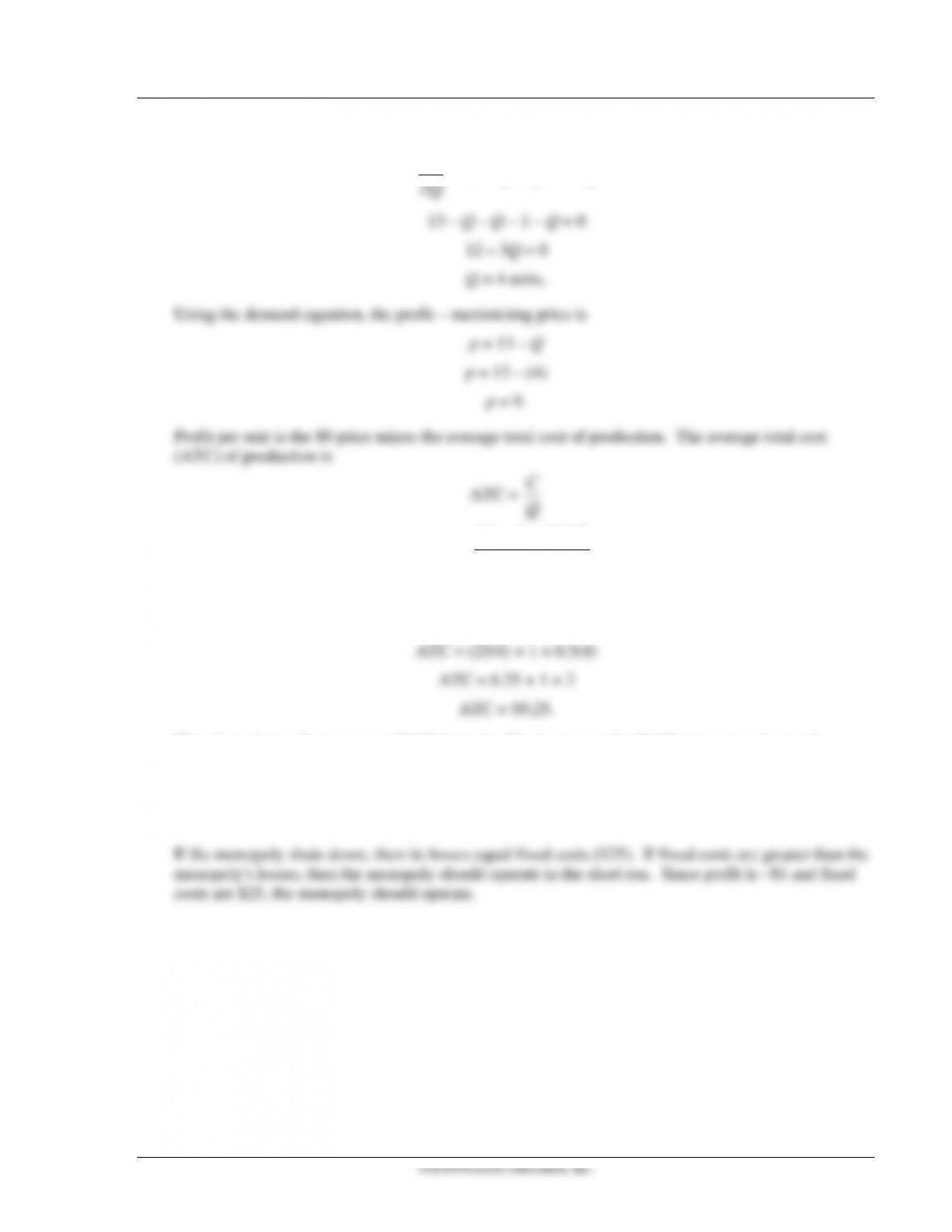
Maximizing this with respect to Q to find the profit – maximizing quantity:
Q∂
∂
π
= 13 – Q – Q – 1 – Q
Q
ATC =
Q
QQ
2
5.025 ++
ATC = (25/Q) + 1 + 0.5Q.
When producing four units of output, this cost is
Therefore, the profit margin is –$0.25, from the $9 price minus the $9.25 average total cost of
production.
Total profit is –$1, from the profit margin (–$0.25) multiplied by the profit-maximizing quantity
(4 units).
222 Perloff • Microeconomics: Theory and Applications with Calculus, Third Edition
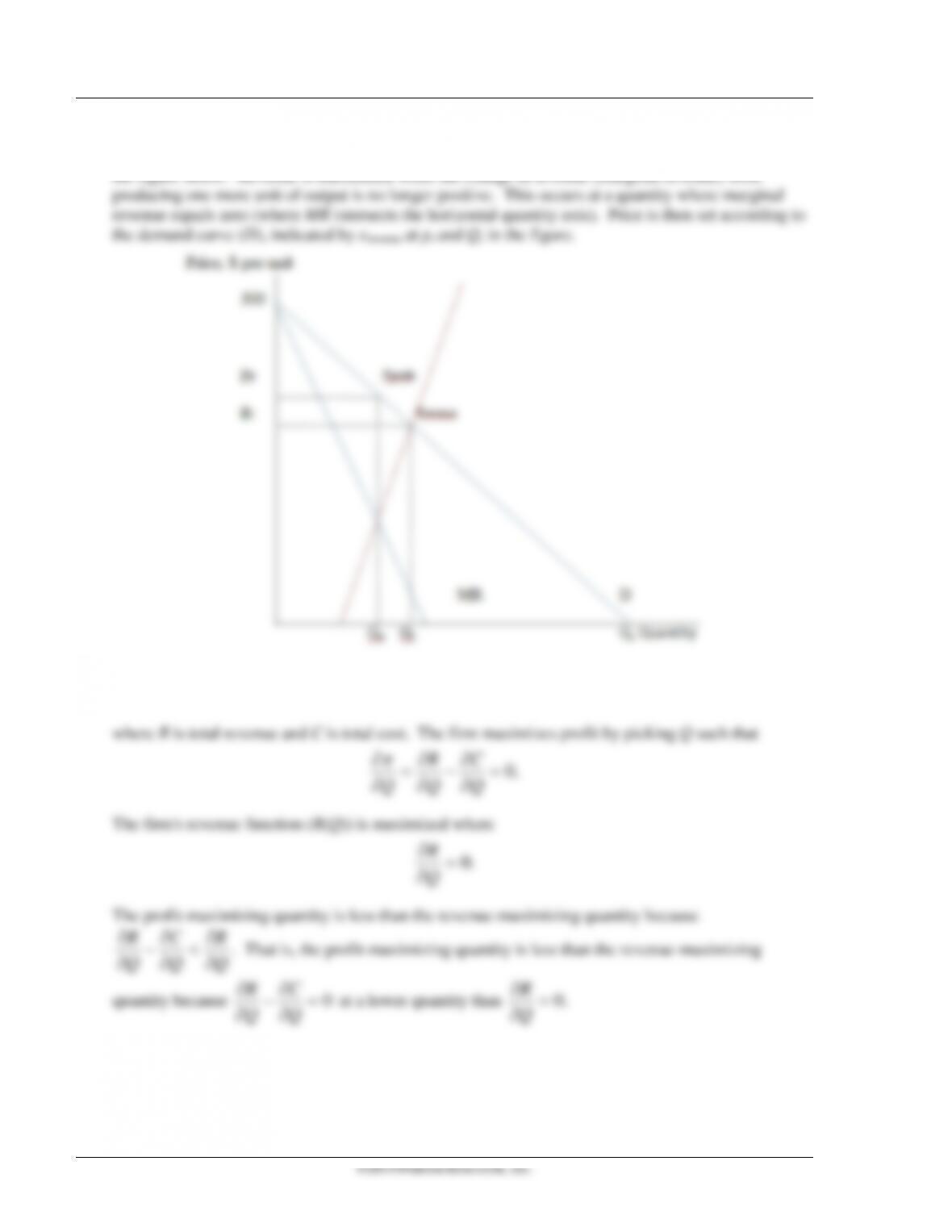
1.9 A monopoly maximizes profit by producing the quantity where marginal cost (MC) equals marginal
revenue (MR). Price is then set according to the demand curve (D), indicated by eprofit at pp and Qp in
Mathematically, assume the firm’s profit function (π(Q)) is
π(Q) = R(Q) – C(Q),
∂
∂
Q
Q
∂
Q
Chapter 11 Monopoly and Monopsony 223
1.10 The revenue function is:
=⋅= −
1000
( ) (10 ) ;
Q
RQ p Q Q
then the F.O.C. is:
∗
∗∗
=−=⇒ = ⇒=− =
() 10 0 5000 10 5.
500 1000
dR Q Q Q
Qp
dQ
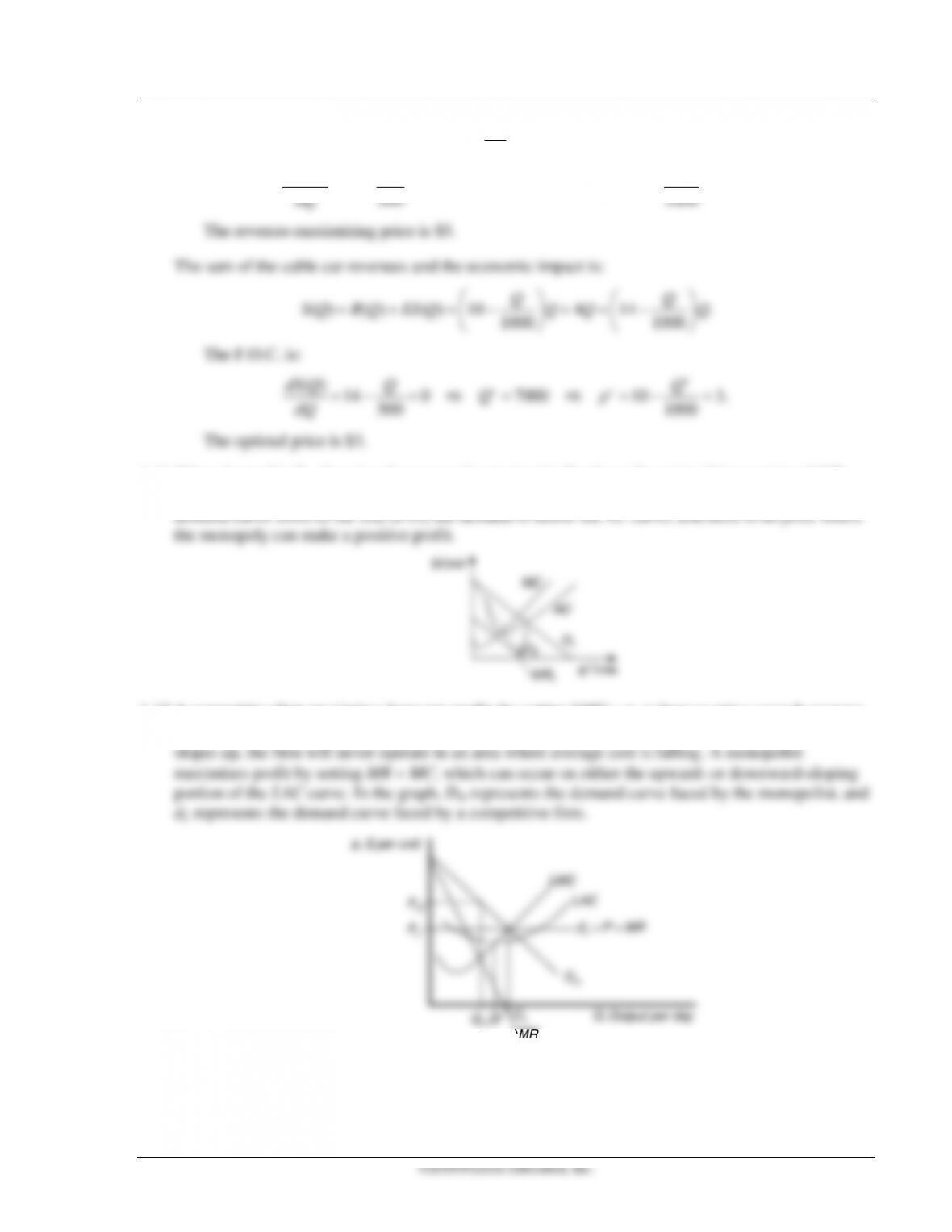
1.11 When demand is D1, the price the monopoly sets (vertically above the point of intersection of MR1
and MC on D1) is above the AC and thus the monopoly makes a positive profit. However, when the
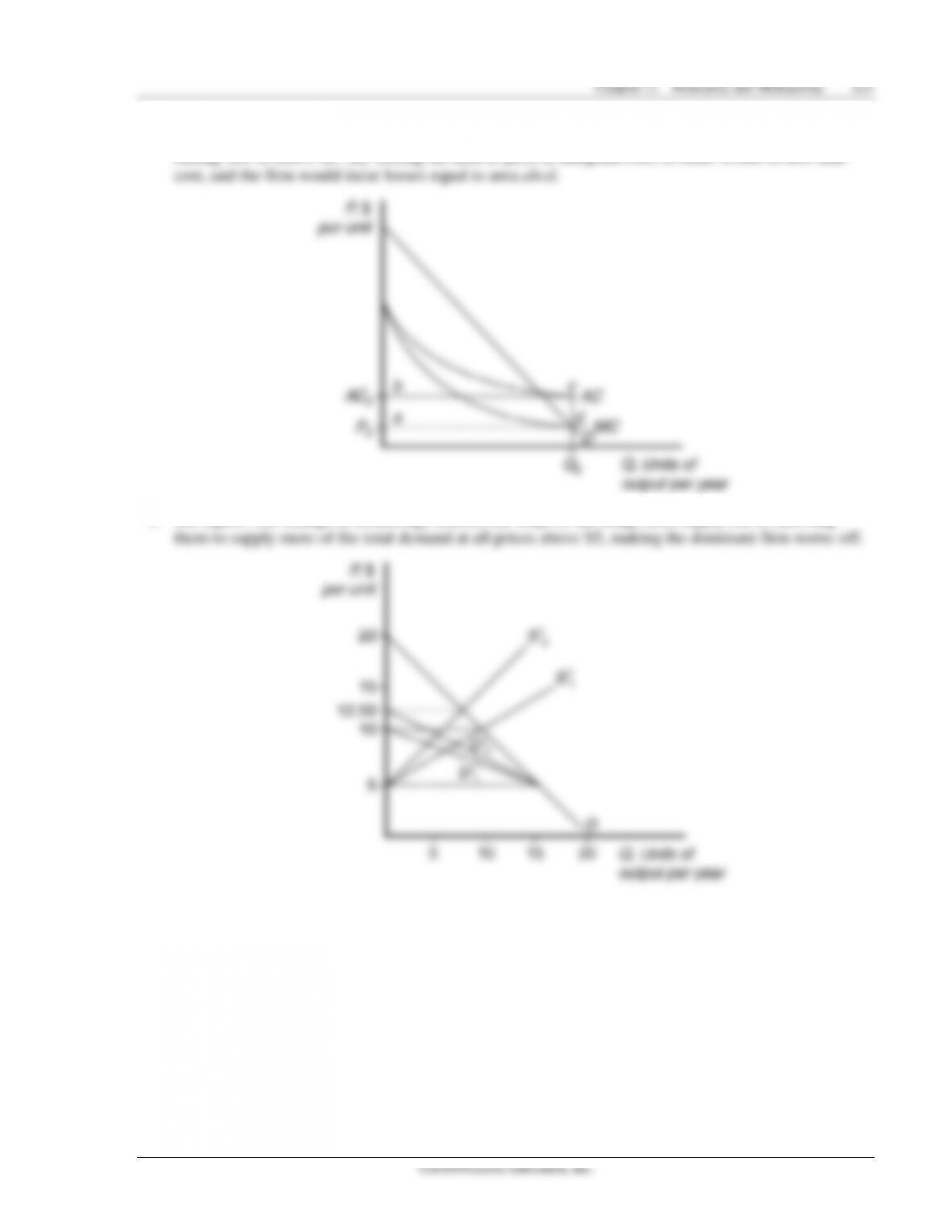
1.12 A competitive firm maximizes long–run profits by setting LMC = p, as long as price exceeds average
cost (it should shut down if p < LAC). Because marginal cost is above average cost only where AC