
209
©2014 Pearson Education, Inc.
Chapter 11
Monopoly and Monopsony
Chapter Outline
11.1 Monopoly Profit Maximization
The Necessary Conditions for Profit Maximization
Marginal Revenue and the Demand Curves
Solved Problem 11.1
Marginal Revenue Curve and the Price Elasticity of Demand
An Example of Monopoly Profit Maximization
The Profit–Maximizing Output
Application: Cable Cars and Profit Maximization
The Shutdown Decision
Choosing Price or Quantity
Effects of a Shift of the Demand Curve
11.2 Market Power and Welfare
Market Power and the Shape of the Demand Curve
The Lerner Index
Solved Problem 11.2
Sources of Market Power
Effect of Market Power on Welfare
11.3 Taxes and Monopoly
Effects of a Specific Tax
Solved Problem 11.3
Welfare Effects of Ad Valorem Versus Specific Taxes
11.4 Causes of Monopolies
Cost Advantages
Essential Facility
Superior Technology or Organization
Natural Monopoly
Solved Problem 11.4
Government Actions That Create Monopolies
Barriers to Entry
Patents
Application: Botox Patent Monopoly

210 Perloff • Microeconomics: Theory and Applications with Calculus, Third Edition
©2014 Pearson Education, Inc.
11.5 Government Actions That Reduce Market Power
Regulating Monopolies
Optimal Price Regulation
Nonoptimal Price Regulation
Solved Problem 11.5
Problems in Regulating
Application: Natural Gas Regulation
Increasing Competition
11.6 Monopoly Decisions over Time and Behavioral Economics
Network Externalities
Direct Effect
Behavioral Economics
Indirect Effect
Network Externalities as an Explanation for Monopolies
Application: Critical Mass and eBay
Introductory Prices: A Two-Period Monopoly Model
11.7 Monopsony
Monopsony Profit Maximization
Solved Problem 11.6
Welfare Effects of Monopsony
Teaching Tips
Chapter 11 begins the study of monopoly and concentrated markets. You might want to maintain a running
connection to the material in Chapters 8 and 9 by comparing the competitive solution or assumption to that
of monopoly throughout the early portion of the chapter. This will be helpful in the later stages when
evaluating deadweight loss and the comparison of efficient levels to competitive output and price levels.
Before beginning the material on profit maximization, it is worth the time to discuss the concept of market
edges. Because monopolies only exist when a product has no close substitutes, the class should see that
a monopoly on Ford pickup trucks is not meaningful. This will provide context for the discussion of
elasticity and market power that begins with the relationship among price, marginal revenue, and elasticity,
and continues in Section 11.2. The United States Postal Service is a great example to discuss, as most
students are familiar with the changes that have occurred in communication technology. Students with free
access to e–mail through the campus network are likely to have highly elastic demand for first class instant
messaging and mail.
In the presentation on profit maximization, two points tend to slow students down. The first is the
relationship between marginal revenue and price. If you are restricting your demand curves to be linear,
the price–marginal revenue relationship is greatly simplified. Although memorization is generally to be
discouraged, if students remember the “same intercept, twice the slope” relationship between linear
demand curves and their associated marginal revenue curves, it might prevent a silly mistake on an exam.
The shutdown point is the other point that occasionally throws students, as it implies that a monopolist
might not earn profits. When students think of monopolies, they usually associate them with high prices

Chapter 11 Monopoly and Monopsony 211
©2014 Pearson Education, Inc.
and profits, not the need to shut down. It is also worth using a graph to show a comparison to the shutdown
rule for the competitive firm.
Section 11.3, which covers the measurement of welfare loss, is extremely important. In order for students
to be able to assess monopoly effects at more than the most superficial level (price is higher, output is
lower), they must understand the concept of deadweight loss. You might use a current event, such as the
introduction of competition to the residential electricity industry, to discuss the relationship among the
inelasticity of demand, the magnitude of the welfare loss, and the importance of substitutes. As demand
elasticity decreases, loss of consumer surplus increases. Because consumers have historically had no
alternatives for commodities such as electricity and local telephone service, demand was highly inelastic.
Further, scale economies have made breakups unwise, with the result that utilities have been heavily
regulated to reduce welfare loss. Recent changes in technology have created the opportunity to replace
regulation with competition, which would increase the elasticity of demand faced by individual firms, thus
creating incentives for lower prices and increased efficiency.
The discussion of entry barriers in the text, with the exception of patents, is limited mostly to exogenous
barriers such as cost advantages due to scale economies and government actions such as the postal service
or licensing laws. Strategic actions such as advertising, product tie–ins, and raising rival’s costs are
discussed in Chapter 12. If you will not have time to cover all of Chapter 12 later in the course, you might
want to spend a few minutes discussing how firms can try to create barriers to entry and give some
examples. If you have Internet access in your classroom, you could log on to the major breakfast cereal
manufacturer Web sites and discuss product proliferation as an entry barrier. You may be able to generate
a good class discussion on the subject of patents. I present them as the classic example of a double–edged
sword—creating the incentive to innovate on the one hand, but at the same time creating a legal monopoly.
Students often will give the quick response of “too expensive” if asked about pharmaceuticals. This is
likely because they have not considered the alternatives, which are less research and development and
fewer new medicines. The line between too much protection for firm innovations and not enough
protection is difficult to determine. Recent changes in patent law such as the Drug Price Competition and
Patent Term Restoration Act in 1984 have moved this line toward more protection in the short run and
increased competition in the long run. This new law reduces the time required to approve generic
equivalent drugs, decreasing the time lag between the expiration of a patent and the introduction of
substitutes. It also allows for the extension of patents by up to five years to replace time lost in the
FDA approval process, increasing the incentive for firms to innovate.
The discussion of regulation is brief and deals largely with the issue of deadweight losses with average
cost pricing. Of course, there are many other issues relating to monopoly regulation; students often wish
to discuss these at this point, although these can also be deferred to the strategic issues dealt with in later
chapters. Finally, the concept of network externalities is introduced, with a simple two-period model of
profit maximization over time.
The chapter ends with a brief discussion of market power in factor markets, the case of monopsony.
Additional Applications
The Creation and Destruction of an Aluminum Monopoly1
Cost advantages and government actions allowed the Aluminum Company of America (Alcoa) to maintain
a monopoly in aluminum in the United States. Eventually, however, government and judicial action
destroyed Alcoa’s monopoly.
1Adele Hast, ed., International Directory of Company Histories, Vol. IV, Chicago and London: St. James Press.

212 Perloff • Microeconomics: Theory and Applications with Calculus, Third Edition
©2014 Pearson Education, Inc.
In 1893, Alfred Hall invented and patented a new process that allowed his firm, Pittsburgh Reduction
(which became Alcoa) to produce aluminum at much lower cost than his competitors. Over time, this firm
obtained control of most domestic and many international sources of bauxite ore, which is necessary to
produce aluminum. As a result, Alcoa was the only American producer of aluminum. Alcoa did face some
competition from foreign producers; however, the United States established high tariffs on aluminum
imports, which reduced this threat to Alcoa’s market power.
During World War I, when foreign competitors were unable to effectively produce and sell in other
countries, Alcoa became an exporter. It continued to export after the war. Between the two world wars,
Alcoa remained the only aluminum smelter (producer) in the United States due to its technological
advantages and economies of scale. The demand for aluminum increased substantially with the start of
World War II. Aluminum was used to produce planes and other manufactured products for military use.
Because of its important role in the production of military products, the government financed new plants
during World War II that were built and run by Alcoa and encouraged the development of other aluminum
producers.
In 1945, the U.S. Supreme Court ruled that Alcoa should be broken up because it had a monopoly, which
is a violation of U.S. law under the Sherman Antitrust Act (1890). With the end of the war, the Supreme
Court decision was enforced by the sale of government-financed Alcoa plants at low prices to Reynolds
Metals Company and Permanente Metals Corporation, owned by Henry Kaiser. By 1950, these
government sales created an oligopoly, where Alcoa made 50.9 percent of all sales, Reynolds 30.9 percent,
and Kaiser Aluminum and Chemical Corporation (the renamed Permanente Metals) 18.2 percent.
1. Based on your knowledge of general equilibrium from Chapter 10, what other markets do you believe
were affected by the Alcoa monopoly?
2. Are consumers necessarily better off with three producers rather than one? Why or why not?
Playmobil USA Was Not Playing Around When It Came to Market Power2
When a powerful seller exerts pressure on firms that make up its customer base, the result can be reduced
competition among those firms. Manufacturers often list suggested retail prices. In the case of Playmobil,
however, the U.S. Department of Justice believes that the manufacturer of children’s toys did more than
suggest. Playmobil was accused of threatening to discontinue retailers for violating rules on discounting its
products. Although the law does allow a manufacturer to drop a retailer for excessive discounting, it does not
allow for bullying. In the end, the case was settled through a consent decree, which means that the firm
agrees to alter its behavior subject to court mandates, without admitting guilt.
1. Why would retailers who carry Playmobil products object to standardized pricing mandated by
the manufacturer?
2. Should the government allow firms to refuse to even sell their products to discounters?
Discussion Questions
1. Is it feasible to prohibit monopolies in all markets?
2. Patents provide an incentive to invest. The government could provide other incentives such as
government grants or prizes for major discoveries. Why do you think patents are more commonly
used than these other approaches, even though patents lead to monopoly problems?
2http://www.usdoj.gov/atr/cases/f0000/0058.htm and http://www.usdoj.gov/atr/cases/f0000/0059.htm.

Chapter 11 Monopoly and Monopsony 213
©2014 Pearson Education, Inc.
3. How many monopolies can you list? List them and identify which markets they serve.
4. How many of the monopolies identified in Question 3 are unregulated?
5. Which of the monopolies identified in Question 3 are likely to be natural monopolies?
6. If the government regulates the price a monopoly may charge, how will that affect a firm’s Lerner
Index? When should we distinguish between an actual Lerner Index and a potential Lerner Index?
7. Sometimes a local convenience store is said to have “local monopoly power.” What is meant by
this phrase?
8. Would you expect monopolies to be more common in small countries or large ones? Why?
9. Is the Internet a monopoly? Can this change?
Additional Questions and Problems
1. Use Equation 11.4 to prove that a monopolist would never choose to price in the inelastic range
of demand.
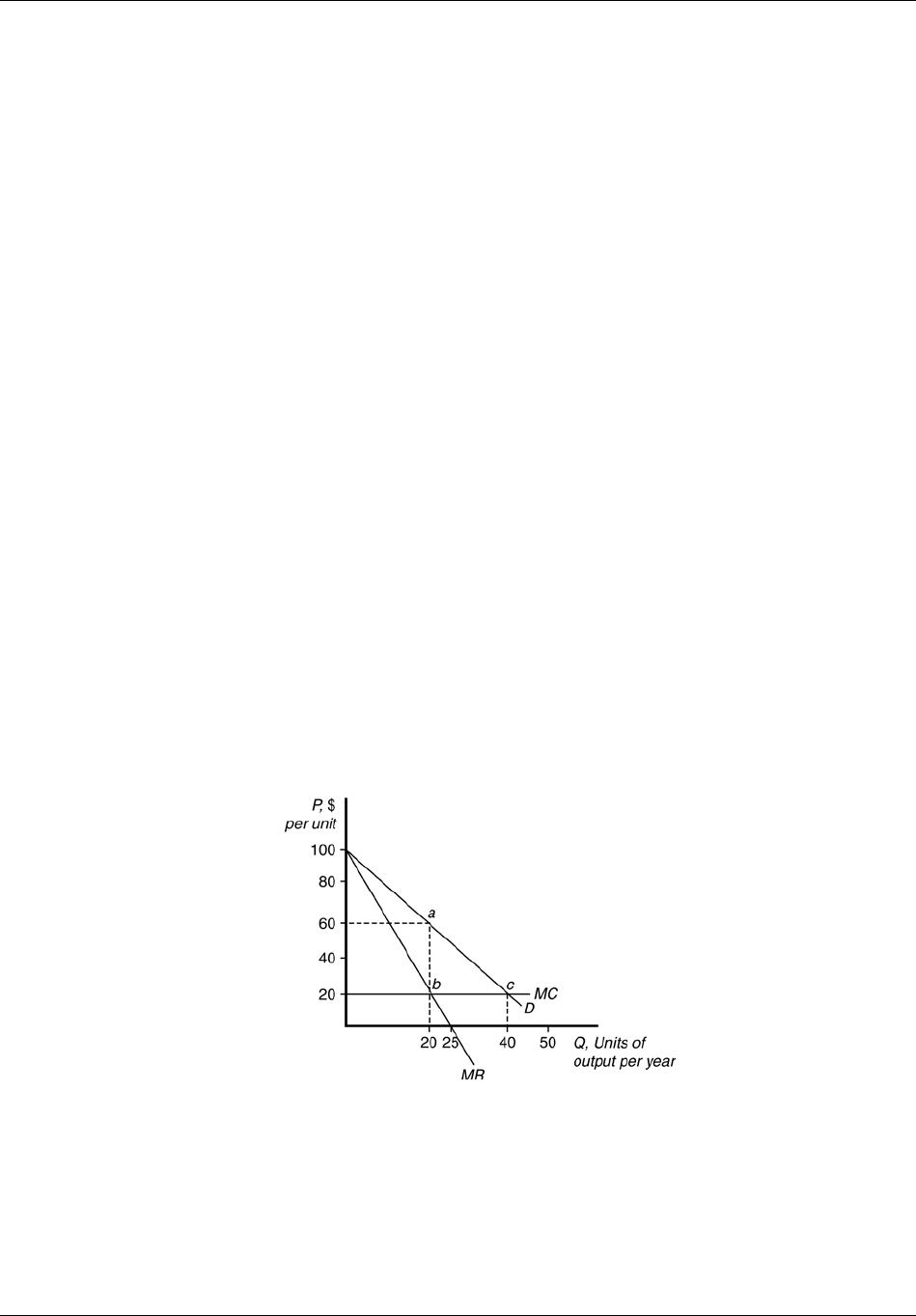
2. Assume a monopolist faces a market demand curve P = 100 − 2Q and has the short-run total cost
function C = 640 + 20Q. What is the profit–maximizing level of output? What are profits? Graph the
marginal revenue, marginal cost, and demand curves, and show the area that represents deadweight
loss on the graph.
3. In Question 2, what would price and output be if the firm priced at socially efficient (competitive)
levels? What is the magnitude of the deadweight loss caused by monopoly pricing?
4. Show that if a firm is a natural monopoly, a government policy that forces marginal cost pricing will
result in losses for the firm.
5. Suppose a change in technology available to fringe firms increases their elasticity of supply, altering
the total fringe supply curve from p = 5 + Q to p = 5 + 2Q. If market demand is Q = 20 − p, show the
change in the residual demand curve using a graph. Is the dominant firm better off or worse off after
the change?
6. If a monopolist has constant marginal cost MC = 20 and faces demand p = 80 − Q, what is the effect
on consumer surplus of a $5-per-unit tax on sellers? Is the tax revenue collected less than, equal to, or
greater than the consumer surplus loss plus the reduction in profits?
7. Suppose a legislator introduced a bill that would decrease patent life for new drugs from 17 years to
10 years, based on the argument that it would reduce deadweight loss through lower prices. What
argument could you make against such a change?
8. Suppose a monopoly is for sale. What specifically must be purchased by the buyer in order to retain
its market position? How much would it be worth?
9. Suppose a monopolist faces a market demand curve Q = 50 − p. If marginal cost is constant and
equal to zero, what is the magnitude of the welfare loss? If marginal cost increases to MC = 10,
does welfare loss increase or decrease? Use a graph to explain your answer.
214 Perloff • Microeconomics: Theory and Applications with Calculus, Third Edition
©2014 Pearson Education, Inc.
10. The chapter notes that one possible alternative to regulation is for the government to encourage
competition. Would this be an efficient mechanism to increase efficiency in an industry where the
incumbent firm is a natural monopoly?
11. If a monopoly firm sells a product with price $100, whose marginal cost is $30, what is the price/
marginal cost ratio? What is the Lerner Index? And what is the demand elasticity the firm believes
it faces?
12. Suppose a monopoly firm with a constant marginal cost 10 faces an inverse linear demand function
p =
50 − Q. What would be the profit-maximizing price and quantity if its marginal cost doubles?
How does it compare to the outcome with original cost?
Answers to Additional Questions and Problems
1. In Equation 11.4 whenever demand is inelastic, MR is negative, indicating that the last unit sold
decreased total revenue. By increasing prices, the monopolist will reach the elastic portion of the
demand curve, at which point MR becomes positive.
2. First, derive the MR and MC functions; then set MC = MR and solve. See Figure 11.1. Deadweight
loss is equal to area abc.
π
= −
= −
= = −
=
−=
=
=
=−=
2
*
*
100 2
100 2
/ 100 4
20
100 4 20
20
60
1200 1040 160.
PQ
R QQ
MR dR dQ Q
MC
Q
Q
p
3. To solve for the competitive price and output, set MC = p.
*
*
20 100 2
40
20
= −
=
=
C
C
Q
Q
p
The magnitude of the deadweight loss is $400, which is the area of triangle abc.