
193
©2014 Pearson Education, Inc.
Chapter 10
General Equilibrium and Economic Welfare
Chapter Outline
10.1 General Equilibrium
Competitive Equilibrium in Two Interrelated Markets
Application: Partial–Equilibrium Versus Multimarket-Equilibrium Analysis in Corn and
Soybean Markets
Minimum Wages with Incomplete Coverage
Solved Problem 10.1
Application: Urban Flight
10.2 Trading Between Two People
Endowments
Mutually Beneficial Trades
Solved Problem 10.2
Deriving the Contract Curve
Solved Problem 10.3
Bargaining Ability
10.3 Competitive Exchange
Competitive Equilibrium
Solved Problem 10.4
The Efficiency of Competition
Obtaining Any Efficient Allocation Using Competition
10.4 Production and Trading
Comparative Advantage
Production Possibilities Frontier
Marginal Rate of Transformation
Benefits of Trade
Solved Problem 10.5
The Number of Producers
Efficient Product Mix
Competition
10.5 Efficiency and Equity
Role of the Government
Application: The Wealth and Income of the 1%
Efficiency
Equity

194 Perloff • Microeconomics: Theory and Applications with Calculus, Third Edition
©2014 Pearson Education, Inc.
Voting
Social Welfare Functions
Efficiency Versus Equity
Theory of the Second Best
Teaching Tips
The material in Chapter 10 on general equilibrium and the basic welfare theorems concludes the study of
competitive markets. Although you may not have time to cover this chapter in depth, you might examine
the topic of general equilibrium using supply-and-demand analysis to discuss how changes in one market
lead to changes in another, and then talk about the welfare theorems at the intuitive level.
Using simple supply-and-demand format, you can introduce the comparison between partial equilibrium
and general equilibrium. The concept is not difficult, and students should catch on quickly to the idea of
spillover effects. You might choose an event such as the outbreak in the chicken population of “bird flu” in
China that resulted in a temporary ban on the importation of chickens to Hong Kong from mainland China
(a similar event was the mad cow disease scare in Europe). Ask the class to determine which other markets
would be affected. The class will likely be able to come up with some of the obvious answers, such as the
beef and pork markets. They may not think of other kinds of related markets beyond substitutes, such as
input markets and complement good markets. By showing these changes with supply-and-demand graphs,
you can also introduce the concept of the partial equilibrium bias.
When discussing welfare, the text emphasizes the efficiency of competitive equilibria. The first and
second theorems of welfare economics make a good deal of intuitive sense and can be presented with or
without the Edgeworth diagrams. As the discussion is extended to include production, remind the class that
competitive firms must price at marginal cost, which helps keep the focus on efficiency. By doing so, you
can refer back to this discussion while presenting the monopoly model and other structures where
competitive efficiency is typically compromised.
The material in Section 10.4 on production and trade is a great place to bring in examples that are international
in scope. Gains from trade is a very simple concept that students take for granted and, thus, do not always
grasp as well as they should. You may want to discuss comparative advantage at a very broad level in the
context of trading between regions. For example, South America has a very large endowment of natural
resources, such as lumber and minerals, but has less high technology resources compared to the Far East.
Japan, for example, is in the opposite situation, being technology rich but natural resource poor. Thus the
two regions are natural trading partners, and trade has grown rapidly between them.
Section 10.5 presents the tension between equity and efficiency from a government perspective. The concept
of the social welfare function is introduced, as well as the complexities of choosing welfare criteria. If you
have the time, the class might be very interested to discuss this topic. Are we as a society, as Rawls suggests,
only as well off as our poorest member? Or should it be considered a net positive for the society if a new
policy increases the welfare of the rich by more than it decreases the welfare of the middle class? While it
is unlikely that if you ask these questions you will get many students who subscribe to the second criterion,
you can then remind the class of Reagan tax cuts (which are mentioned in the chapter) that reduced the top
marginal rate from 70 percent to less than 30 percent. You might close the discussion by noting that the
intervention of governments to remedy welfare outcomes that are deemed unacceptable may well be an
exercise in the trade-off between equity and efficiency. For example, the institution of a minimum wage in
a previously stable competitive labor market may have equity implications that are intended but may also
have efficiency implications and secondary market effects that are not.

Chapter 10 General Equilibrium and Economic Welfare 195
©2014 Pearson Education, Inc.
Additional Applications
Spillover Effects from a National Political Convention1
The 2000 GOP convention was held in Philadelphia, Pennsylvania. During the very short time that the
convention was in process, the city was teeming with activity. Although the convention itself was held
mostly at the First Union Center, the economic impact stretched well beyond the South Philadelphia
Stadium Complex. CNN estimates that total attendance included 20,000 protestors, 2,066 delegates, 2,066
alternate delegates, 10,000–15,000 volunteers, and 15,000 members of the media. This massive influx of
short–term visitors to the city created a surge of economic activity. The estimated direct expenditure alone
was in excess of $100 million—a nice shot in the arm, especially given that the total cost was only $63.5
million, of which $13.5 million were federal funds. Retailers, restaurants, hotels, city attractions, and even
street vendors all benefited. In the hotel industry alone, 20,000 rooms were booked for the convention.
Although not a permanent increase in economic activity, major events such as conventions and Super
Bowl games do increase demand for local goods and services. In some cases, new sources of supply may
be brought in to help meet this demand, such as rental cars from other areas (General Motors supplied 420
loaners). In most cases, however, the supply of services is fixed, and the increase in demand can mean
price increases and big profits for sellers. More uncertain are the indirect benefits claimed from the
convention and other similar events. Again, CNN estimates that over $200 million in indirect (multiplier)
revenue was also generated by the convention.
1. Can you think of constituents in Philadelphia who would not want the city to host the convention?
2. Use a series of graphs to show the changes in four separate markets that would be affected by
the convention.
Discussion Questions
1. Suppose the government places a 10 percent sales (ad valorem) tax on a good. Give examples of
markets for which you think a partial-equilibrium analysis would provide an accurate prediction and
examples of markets in which a general–equilibrium analysis is necessary.
2. Discuss the general–equilibrium effects if states set different sales tax rates. What are the advantages
and disadvantages of having states set rates independently?
3. Given that the economy has a minimum-wage law, do you favor one that covers all industries, or one
that exempts some industries? Why?
4. If a new minimum–wage law does not cover teenagers, what is the likely effect on teenage and adult
employment?
5. Given that the United States allows domestic firms to lobby for tariffs and quota, should it prohibit
foreign firms from such lobbying?
6. Under what conditions would you not want to use the Pareto principle to analyze government
policies?
7. What rules would you impose for making interpersonal comparisons to evaluate the desirability
of government policies? Why?
1“GOP Convention at a Glance,” at http://www.cnn.com/ELECTION/2000/conventions/republican/features/convention.

196 Perloff • Microeconomics: Theory and Applications with Calculus, Third Edition
©2014 Pearson Education, Inc.
8. Why might you expect Rawls’ welfare rule to lead to a relatively equal distribution of income?
9. Can the Pareto criterion always be used to decide whether one government policy is better than
another, or one allocation is better than another?
10. Would Rawl’s welfare rule be easier or more difficult to apply if individuals have widely varying
utility functions?
Additional Questions and Problems
1. Suppose the government were to impose a 15 percent tax on newspapers. What other markets (both
product market and input market) should be included in a general equilibrium analysis?
2. Suppose the only two meat dishes consumed in the United States are flounder and beef. What are
the likely effects in these markets of a rumor of a major water pollution problem discovered in the
commercial fishing waters? Assume that production resources cannot be shifted between sectors.
3. True or false; explain your answer. Ted’s initial endowment of cakes is 1, and his initial endowment
of coffee is 6. Sandra’s initial endowment is 7 cakes and no coffee. “This allocation might be both
efficient and equitable, based on the Pareto principle.”
4. The city of Philadelphia has a two-tier wage tax. Residents of the city who work within the city limits
are taxed at one rate, and individuals who do not live in the city but work in the city are taxed at a
lower rate. Are individuals who live and work in the suburbs affected by the tax? Briefly describe
which markets are likely to be affected most by the tax and in what direction.
5. Two individuals, Fred and Helen, in an economy with no production, each have the utility function
U = 10XY. Prices of both X and Y are set at $1. Initial endowments for Fred are 10 units of X and
6 units of Y. Helen has 8 units of X and 12 units of Y. Show that this initial endowment is not on the
contract curve.
6. In Problem 5, suppose total economic welfare W is measured as suggested by Rawls; W = min(U1, U2).
Show that maximizing W by this criterion results in the same final allocation as an egalitarian scheme
where each individual gets an equal share.
7. In a competitive economy, the marginal cost of producing X is MCX = 20 + 5qX. The marginal cost of
producing Y is MCY = 10 + 10qY. Prices are pX = 5, and pY = 5. What linear relationship describes the
proportion in which the goods should be produced?
8. Suppose Jenna and Karen both regard peanut butter and jelly as perfect complements at a 1:1 ratio.
Show using an Edgeworth box diagram that if Jenna receives 10 peanut butter and no jelly, and Karen
receives 10 jelly and no peanut butter, after trading, they will each end up with 5 units of each.
9. Suppose that David and Harry consume oranges and apples. David views the two as perfect complements.
Harry views them as perfect substitutes. Each reaches his hand into a bag and selects six pieces of
fruit but cannot see what they have chosen until it is in their basket. If they apply the Pareto criterion
to wealth distribution, what will be their final endowment after trading?
10. In Problem 9, if Harry decides not to follow the Pareto criterion and each must pay a very small fee
for each trade, what will be the effect on trading?
Chapter 10 General Equilibrium and Economic Welfare 197
©2014 Pearson Education, Inc.
11. Suppose the society used a Rawlsian welfare function: It tries to maximize the well-being of the
worst–off member of the society. What is the welfare function? What allocation maximizes welfare in
this society?
12. Suppose the individual welfare is determined by the formula U = y, where y is individual income.
Does social welfare depend on the allocation of total income?
Answers to Additional Questions and Problems
1. As the demand for newspapers falls, affected product markets might include alternative news sources
such as television and news–related Internet sites, as well as other types of publications such
as news magazines. Input markets such as the paper and ink markets will experience a decrease in
demand as well. Additional effects may occur in the advertising market, as the ability to reach
consumers through newspaper ads falls with the decrease in demand for papers.
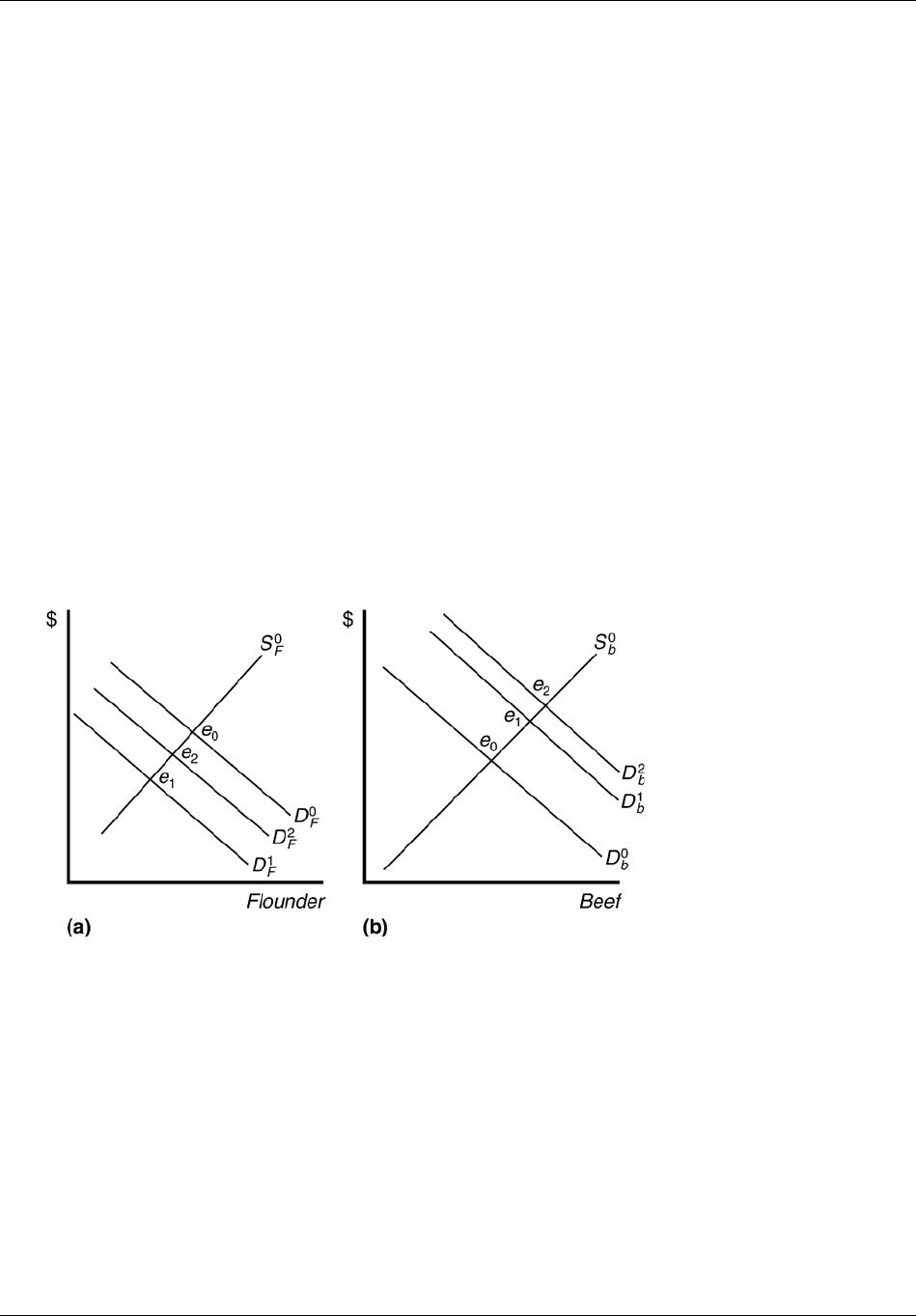
2. If consumers become concerned that the fish population is unsafe to eat, demand falls in the fish
market
0
(
f
D
falls to
1)
f
D
and increases in the substitute market, beef
0
(
b
D
increases to
1
)
b
D
. As the price
for beef increases due to increased demand, demand for fish increases, and
1
f
D
increases to
2.
f
D
The
increase in the price of fish leads to a second, smaller price increase in the beef market, and
1
b
D
increases to
2
.
b
D
Depending on the speed of adjustment, this shock may be completely reflected in
new stable prices in one or two periods or may cause fluctuations over several periods. Unlike the
example in the text, because producers are unable to shift production between fish and beef, the
supply curves do not shift.
3. This is true. The Pareto principle does not require that endowments be equitable. As long as the
endowments given are on the contract curve (where Sandra’s marginal rate of substitution is equal
to Ted’s), the solution is Pareto efficient.