Solutions to the End-of-Chapter Questions, Problems, and Data
Exercises
13.1 The Structure of the Federal Reserve System
Learning Objective: Explain why the Federal Reserve System is structured the way it is.
Review Questions
1.1 Congress established the first Bank of the United States in 1791 with a 20-year charter. When the
1.2 Congress split the Federal Reserve System into 12 districts in an attempt to decentralize the
1.3 During normal times, the Federal Open Market Committee is probably the more important body
During that period, certain members of the Board of Governors (part of the “four musketeers”)
1.4 The Dodd-Frank Act is legislation passed during 2010 that was intended to reform the regulation
of the financial system. The provisions of the bill relevant to the Fed make only relatively minor
changes to the system’s operation. The changes include:
1. Barring class A directors of the Federal Reserve banks from participating in the
election of bank presidents
2. Making the Fed a member of the new Financial Stability Oversight Council
Problems and Applications
1.5 Congress passed the Federal Reserve Act in order to deal with recurring financial panics. The
© 2014 Pearson Education, Inc.
Chapter 13 The Federal Reserve and Central Banking 160
1.6 Congress wanted the member banks to own the Federal Reserve banks in order to divide
economic power within the Federal Reserve System among bankers and businesses interests,
1.7 a. Congress created the tension between the Federal Reserve Banks and the Federal Reserve Board
b. The Board of Governors how has undisputed control over the Federal Reserve System. In that
1.8 a. A regional Federal Reserve Bank acting independently can move quickly to address regional
1.9 The boundaries would be different because, for example, California, Texas, and Florida are much
larger in population than they were in 1913. The commission should look to distribute the
1.10 a. Given a 10% required reserve ratio, Bank of America would have to hold $100 in reserves (10%
× $1,000) and will be make loans totaling $900 (= $1,000 $100). Bank of America will earn
b. The opportunity cost to banks of reserve requirements would likely be higher during a period of
1.11 The Sunshine Act required government agencies to post notices of meetings before they
13.2 How the Fed Operates
Learning Objective: Explain the key issues involved in the Fed’s operations.
Review Questions
© 2014 Pearson Education, Inc.
Chapter 13 The Federal Reserve and Central Banking 161
2.1 The president can exercise control over the membership of the Board of Governors and appoint a
2.2 The public interest view is a theory of central bank decision making that holds that officials act
in the best interest of the public. The principal-agent view is a theory of central bank decision
2.3 The main argument for Fed independence is that monetary policy is too important to be left to
politicians, who are not economists and have their own political interests at stake, not just the
Problems and Applications
2.4 The Fed did not operate independently of the Treasury during the 1942-1951 period, but instead
pegged interest rates on Treasury securities at low levels to help finance wartime budget deficits.
2.5 Having the Government Accountability Office (GAO) give an independent opinion of whether a
particular monetary policy action was the right decision would be a “nightmare scenario”
2.6 This statement is not necessarily correct. For instance, despite being insulated from direct
2.7 The way the Federal Reserve regional banks were created seems to fit more with the public
interest view, although there is some evidence that suggests the principal-agent view was a
2.8 The high inflation rates of the 1970s might appear to contradict the public interest view, but it
could be that Fed policymakers really were pursuing what they believed were correct policies. In
© 2014 Pearson Education, Inc.
Chapter 13 The Federal Reserve and Central Banking 162
2.9 The article hints that the Fed was protecting its power given the political circumstances. The
2.10 Answers will vary. Democratic principles would seem to suggest transparency up to the point
2.11 The Fed already serves the role of conducting monetary policy, but the amendment would
13.3 Central Bank Independence Outside the United States
Review Questions
3.1 Among the Federal Reserve, the European Central Bank (ECB), the Bank of England, and the
Bank of Japan, the length of terms of office are longest for the central bank board members of
3.2 Less independent central banks tend to lead to higher inflation. An independent central bank can
3.3 The European Central Bank (ECB) has an executive board of six members, with one of the
Finance after consulting the European Parliament and the Governing Council of the ECB. The
governance of the ECB also includes the governors of each of the member national central
© 2014 Pearson Education, Inc.
Chapter 13 The Federal Reserve and Central Banking 163
Problems and Applications
3.4 Low-income (less-developed) countries often have more trouble selling governmental debt to
investors than do high-income countries. As a result, it is often difficult for a central bank to act
3.5 a. People had fears about whether Greece, Spain, Portugal, and Ireland could continue making
b. One disaster scenario would be Greece dropping out of the euro zone and then defaulting on its
c. The purchase of securities by the central bank increases the money supply and can be similar to
3.6 a. Further easing means further accommodative monetary policy with increases in the money
b. The finance minister wants to be sensitive to the independence of the Bank of Japan to set
3.7 a. When the central bank purchases government debt, it serves as a way for the government to
spend money without having to raise taxes. This approach to financing government spending is
b. A central bank needs to be able to say no to actions that would harm the economy, like excessive
inflation from buying government bonds, and yes to actions that would help the economy. An
Data Exercises
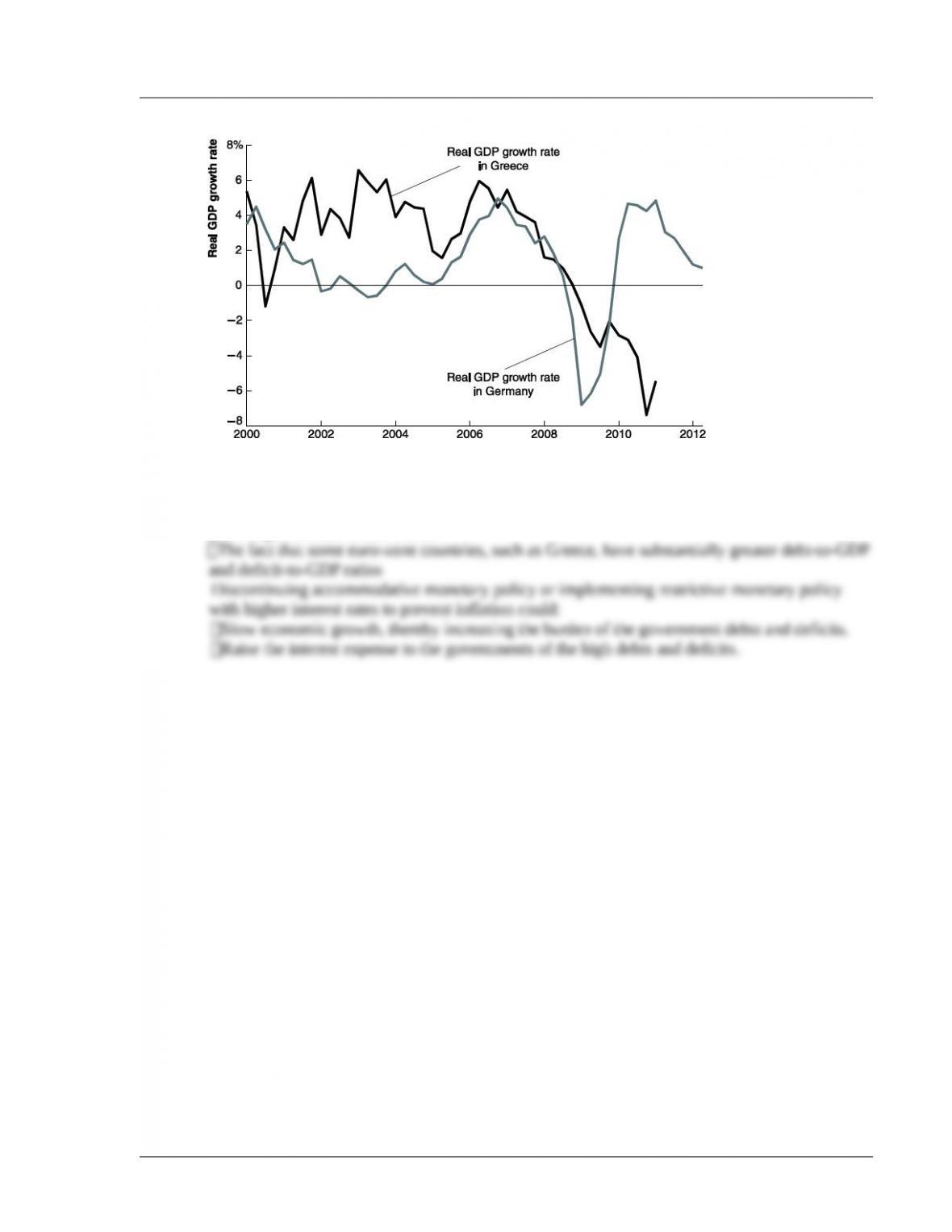
D13.1 For real GDP in Germany, use the quarterly series (DEUGDPRQPSMEI). Over the 2001 to
2006 period, Greece grew faster than Germany. Real GDP declined in both countries during
© 2014 Pearson Education, Inc.
Chapter 13 The Federal Reserve and Central Banking 164
D13.2 For the third quarter of 2012, the euro-zone debt/GDP ratio was 90% and the deficit/GDP ratio
was 4.4%. Both the debt/GDP and the deficit/GDP values are high for the euro zone. Policy
challenges to the European Central Bank (ECB) face include:
The high debt and deficit values
© 2014 Pearson Education, Inc.