Scott, Financial Accounting Theory, 7th Edition Instructor’s Solutions Manual Chapter 9
Additional Problems
9A-1. A manufacturer of farm equipment is headed for financial distress. Bonuses of
management are based on net income relative to budget. There has been a
recent change in management, occurring in early 2001. To the surprise of the
and that delay will result in significant profit losses to the company, a claim that is
very difficult for the operator of the common facility to verify or refute. What
sometimes results is a job being given priority, which causes a delay of some
other division’s job, where the cost of delay to the company (forgone profits due
to, say, impatient customers going elsewhere) is well in excess of the cost of
360
Industries under each alternative is as follows:
Kao Industries
Payoff Table for Year
NET INCOME FOR YEAR PROBABILITY PROBABILITY
(before manager (a1 = 560 hours) (a2 = 540 hours)
Scott, Financial Accounting Theory, 7th Edition Instructor’s Solutions Manual Chapter 9
Required
a. Show calculations to verify that for a fixed annual salary paid to the
manager, Mr. Kao will prefer that the manager work hard. Mr. Kao is risk–neutral.
b. For any fixed annual salary, will the manager prefer to work hard or to
362
away. The store’s earnings are highly dependent on how hard the manager
works, as per the following table:
a1: Work Hard a2: Shirk
Net Income Prob. Net Income Prob.
x1: High Earnings $300 0.7 $300 0.2
accept? Show calculations.
b. Henri’s bank manager, to whom he has turned for advice, suggests that if
he hires an agent, the store’s annual earnings should be audited by a
professional accountant. Explain why.
365
through a rush order for their own division that results in sufficiently higher costs to
another division that overall company profit is reduced.
A possible disadvantage of this solution would arise if (as is likely) overall company
profit is less correlated with the effort of a division manager than is divisional profit.
Then, the incentive effect (i.e., the sensitivity) of the compensation contract is lower.
(1997) in Section 10.2.
However, the assumption of Arya, Fellingham and Glover that each division manager
1994), p.71.
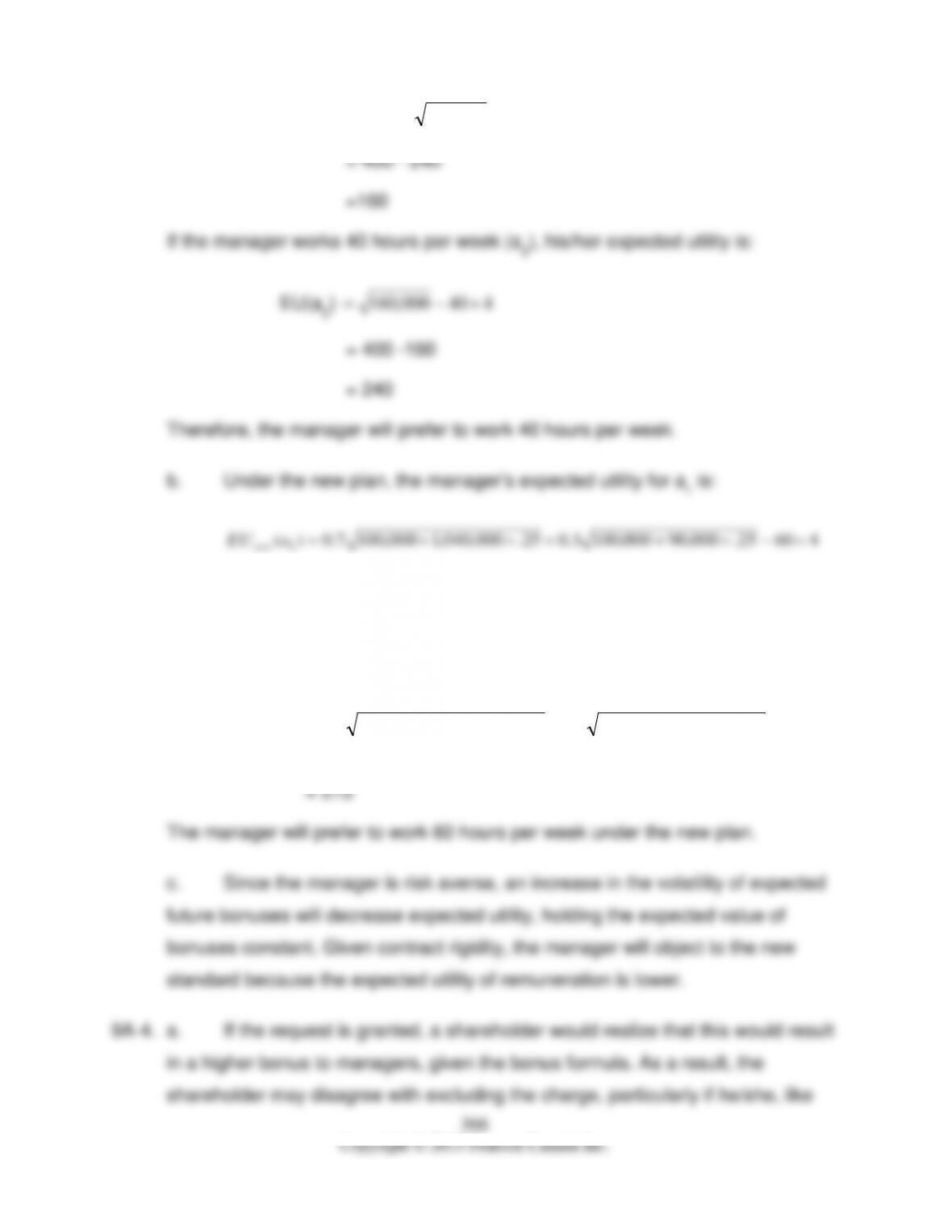
9A-3. a. If the manager works 60 hours per week (a1), his/her expected utility is:
Scott, Financial Accounting Theory, 7th Edition Instructor’s Solutions Manual Chapter 9
EU(a1)
460000,160 ×−=
1
new
= 0.7 × 600 + 0.3 × 350 – 240
= 285
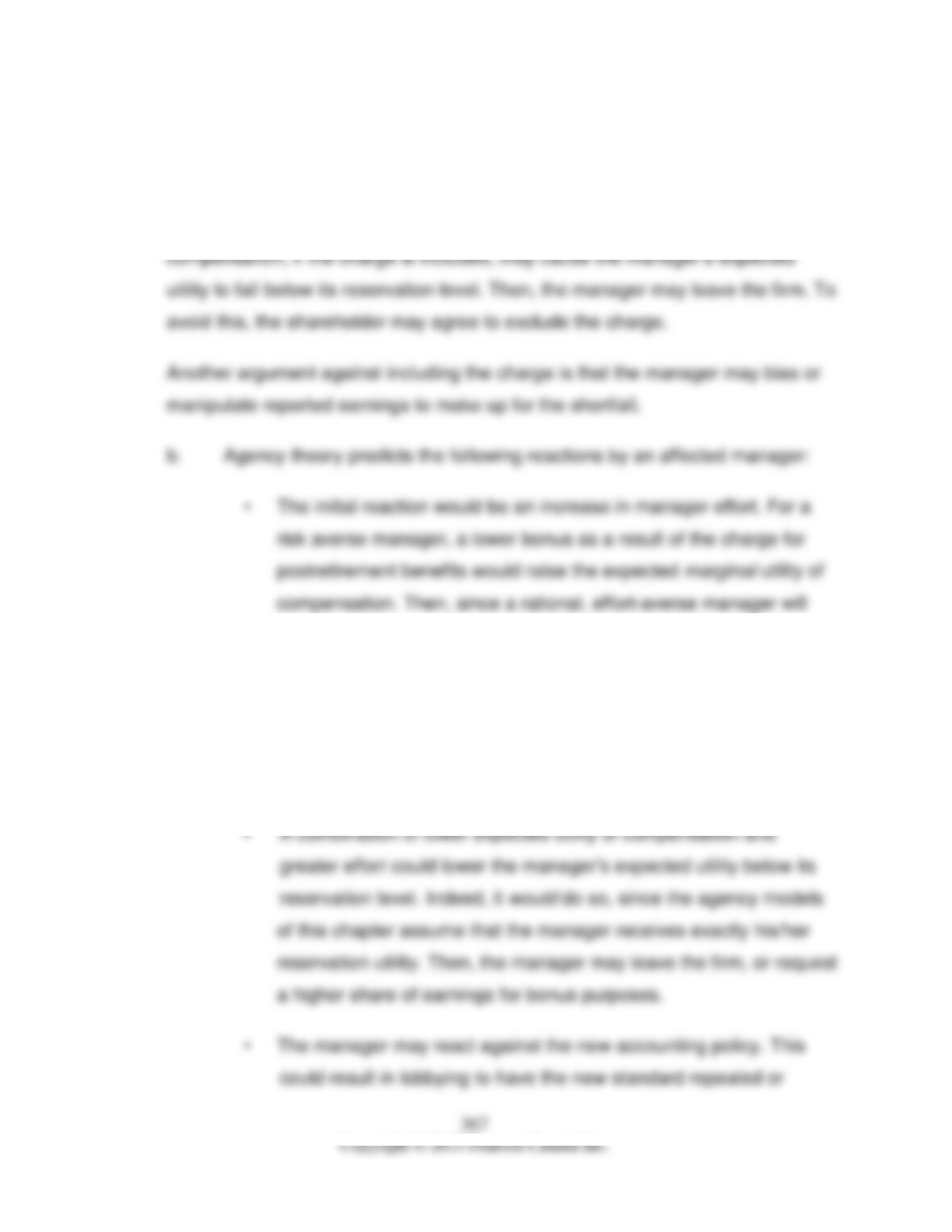
Under the new plan, the manager’s expected utility for a2 is:
440000,9025.000,1009.0000,040,125.000,1001.0)( 2×−×++×+=aEU new
= 0.1 × 600 + 0.9 × 350 – 160
Scott, Financial Accounting Theory, 7th Edition Instructor’s Solutions Manual Chapter 9
the United Shareholders Association, felt it was a valid business expense. This
would be especially the case if the shareholder felt that the manager was already
well–paid. Then, the bonus contract would be rigid, or resistant to change.
A counter argument is that, according to agency theory, the lower manager
choose effort level so as to equate the expected marginal utility of
compensation with the marginal disutility of effort, effort will rise to
restore the manager’s equilibrium.
In less technical terms, the manager will work harder so as to make
up some of the lost compensation.

368
amended and/or in biasing (i.e., managing) reported net income so
as to counter the effects of the standard on reported profits.
9A-5. a. Let the fixed annual salary be $w. Then, if hours worked are:
• a1 (60 hours per week):
Mr. Kao’s expected payoff is:
disutility of shirking (402/800) is less than that for working hard (602/800).
c. If the manager works hard (a1), expected utility EU of the manager is:
EU(a1) = 0.7 U(10 + 40) + 0.2 U(10 +20) + 0.1 U(10) – 602/800
800/600,3103.0302.0
507.0 −×+×+×=
Copyright © 2015 Pearson Canada Inc.