
Scott, Financial Accounting Theory, 7th Edition Instructor’s Solutions Manual Chapter 9
321
CHAPTER 9
AN ANALYSIS OF CONFLICT
9.1 Overview
9.2 Agency Theory
9.2.1 Introduction
9.2.2 Agency Contracts between Owner and Manager
9.3 Manager’s Information Advantage
9.3.1 Earnings Management
9.3.2 The Revelation Principle*
9.3.3 Controlling Earnings Management
9.3.4 Agency Theory With psychological Norms*
9.4 Discussion and Summary
9.5 Protecting Lenders from Manager Information Advantage
9.6 Implications of Agency Theory for Accounting
9.6.1 Is Two Better Than One?
9.6.2 Rigidity of Contracts
9.7 Reconciliation of Efficient Securities Market Theory with Economic
Consequences
9.8 Conclusions on the Analysis of Conflict
LEARNING OBJECTIVES AND SUGGESTED TEACHING APPROACHES

Scott, Financial Accounting Theory, 7th Edition Instructor’s Solutions Manual Chapter 9
322
1. To Introduce Fundamental Concepts of Agency Theory
In my outline of agency theory, note that the payoff from the manager’s current effort is
not realized until after the single–period contract expires. However, the agent must be
compensated at period end. This allows net income to be viewed as a performance
measure upon which compensation is based, leading naturally to consideration of the
ability of net income to predict the payoff, and the properties it needs to be a good
predictor.
Section 9.2 covers much of the basics of agency theory. Instructors who wish only to
develop the basic moral hazard problem of owner and manager, and why actual
executive compensation contracts are based, at least in part, could stop here. However,
Section 9.6 is useful in explaining why these contracts also depend on stock price
performance. This section also explains, using the concept of contract rigidity, why
managers have an interest in accounting policy choice. Section 9.5 demonstrates why
debt contracts typically contain covenants to protect lenders. Such covenants were
largely taken for granted in Chapter 8.
For those who wish to delve deeper, the Section 9.3 illustrates and discusses concepts
of biased reporting and earnings management. My objective in introducing this material
is to better integrate the theory into the coverage of executive compensation and
earnings management in Chapters 10 and 11. In particular, I show in Examples 9.4 and
9.5 that uncontrolled earnings management results in a very inefficient contract.
However, Example 9.6 shows that that if it is controlled (but not eliminated) by GAAP,
earnings management can be “good,” in the sense that a contract that allows a degree
of earnings management can be more efficient than one that motivates the manager to
tell the truth. This leads into the discussion of good versus bad earnings management
in Chapter 11. However, Chapter 11 stands on its own and does not require much of
the material in this chapter.
Since most students will not have been exposed to agency theory before, I suggest
working through some of the examples in class, or distributing solutions to end–of–
chapter problems and ask the students to work the problems on their own. My main

Scott, Financial Accounting Theory, 7th Edition Instructor’s Solutions Manual Chapter 9
323
goal is that the students understand why compensating a manager based on some
measure of his/her performance is usually desirable when moral hazard is present, and
are aware of the properties that net income needs to control moral hazard efficiently.
The risk–sharing aspect of agency contracts is worth emphasizing. The main point is
that to motivate effort, the manager must bear compensation risk—a fixed salary does
not provide any effort incentive. Instructors may wish to challenge this point, however.
What about ethics? Should an ethical manager shirk on his/her employer? I counter this
argument by asking what would happen if I cancelled the final exam. What about
reputation? While perhaps not completely convincing, I counter this argument by
suggesting that managers may be able to disguise shirking and preserve their
reputations by earnings management. Nevertheless, the reason I suggest discussion of
risk–sharing is that it supports the point made several times in the book that new
accounting standards that increase the volatility of earnings will be objected to by
managers. Since the manager is assumed risk averse, increased compensation risk
lowers the manager’s expected utility. Appreciation of the manager’s legitimate concern
about risk helps students to understand the controversies surrounding many accounting
standards.
I use the discussion of Holmström’s well–known 1979 paper in Section 9.6.1 to develop
several implications of agency theory for accounting:
• Is net income sufficiently observable that it can serve as a basis for
manager compensation? GAAP and the audit are the vehicles that give
net income sufficient observability that parties are willing to use it in
contracts. Although financial reporting disasters such as Enron may
threaten this argument, a theme of this book is that the contracting role for
net income is equally as important as its role in informing investors.
• I suggest to the class that historical cost–based net income, or at least net
income which excludes or minimizes current cost based valuations, may
be more informative about manager effort (and hence a more efficient
performance measure on which to base manager compensation) than net

Scott, Financial Accounting Theory, 7th Edition Instructor’s Solutions Manual Chapter 9
income determined under a fair value–based measurement perspective,
the reason being that current cost introduces low precision, which may
outweigh its greater sensitivity. A related argument is that net income
based on contract theory, emphasizing reliability and conditional
conservatism, is more precise but less sensitive than fair value
accounting—a different trade–off. These arguments could be discussed in
the context of amortized cost accounting for financial assets held to
receive interest and principle under IFRS 9 versus fair value accounting
for these assets.
• Holmström’s main contribution in his 1979 paper was his informativeness
condition, that is, the condition under which basing the agent’s
compensation on a second variable, in addition to the payoff itself, would
increase contracting efficiency. This leads to a suggestion to base
managerial compensation on both net income and share price.
• It is important to point out the rigid nature of contracts, once they are
signed, and to discuss the reasons for rigidity. Otherwise, students tend to
ask what the fuss is all about when GAAP changes. Why not just amend
the contract when this happens? Contract rigidity is crucial for accounting
policies to have economic consequences. The Mosaic, CanWest Group,
and AbitibiBowater examples in Theory in Practice 9.2 are useful in
bringing out the consequences of rigidity, and convincing students that the
implications of contracts (debt covenants in this case) for accounting
matter.
3. To Motivate Agency Theory to Accountants
Since the theory may be new to many students, I work to convince them it is relevant to
their future careers. Some of the points I bring out are;
• Agency relationships are very common. I sometimes discuss examples such as
hockey players, and ask why they are motivated to work hard. Presumably their

Scott, Financial Accounting Theory, 7th Edition Instructor’s Solutions Manual Chapter 9
325
effort is observable, so that they receive primarily salaries. I also ask about
visiting a lawyer or doctor, and ask how one can be sure the professional will
work hard on the client’s behalf. Here, the outcome is observable but the effort is
not. Asking what motivates an auditor to work hard also draws interesting
replies. The point here is that agent effort is important to everyone, and the
extent to which effort is observable influences how the agent is motivated and
compensated in predictable ways.
• I suggest to the students that in their careers they will find that much attention is
given to accounting policy choice and they will be arguing with managers about
such choices. Indeed, some of them will eventually be managers. Agency theory
helps us to understand how managers view accounting policies. For example,
the fact that managers bear considerable risk helps explain their often–negative
reaction to new accounting policies, especially ones that increase income
volatility,, such as fair value.
• I use Holström’s informativeness condition to point out that accounting competes
with share price as a performance measure. The demand for accountants’
services will fall if net income is squeezed out of compensation and debt
contracts. Students should be aware of the properties a good performance
measure should have, (the best trade–off between sensitivity and precision) and
that these properties are not necessarily the same as those needed to inform
investors (best trade–off between relevance and reliability).
4. To Reconcile Economic Consequences with Efficient Securities Markets
Finally, I use the prediction from agency theory that important classes of contracts will
be based on accounting variables, in conjunction with contract rigidity, to emphasize the
argument in the text that accounting policies can have economic consequences even if
securities markets are efficient. By this time, students have no problem in accepting this
argument (or else I have worn them out). I should note, however, that I back off this
argument somewhat in Section 11.6.2, by suggesting that another reason for economic
consequences arises if managers do not accept securities market efficiency. Then, they

Scott, Financial Accounting Theory, 7th Edition Instructor’s Solutions Manual Chapter 9
326
may feel they can influence the securities market by accounting policy choice and will
object if accountants try to constrain those choices.
Scott, Financial Accounting Theory, 7th Edition Instructor’s Solutions Manual Chapter 9
SUGGESTED SOLUTIONS TO QUESTIONS AND PROBLEMS
1. The manager’s effort is usually unobservable to owners because of the complex
and broadly–defined nature of manager effort. As a result, when the owner and
manager are different persons or unless the firm is very small, it is effectively
2. The payoffs from current manager effort often take a long time. Sales on credit
are a common example, since cash collection may not take place until next
period. As another example, payoffs from current R&D are usually not known
until after the current period is ended. Also, the ultimate payoffs from current
purchases of financial instruments are often unknown until a subsequent period.
328
3. Less noise means greater precision of net income as a performance measure.
Greater precision means greater accuracy in measuring the ultimate payoff. This
reduces the manager’s compensation risk. When net income is unbiased, there
is no effect on sensitivity. The result is a more efficient contract.
4. The basic reason for debt covenants is the moral hazard problem between
manager and lender. As a result, lenders demand a high interest rate to protect
themselves from the expected opportunistic manager behaviour (e.g., excessive
329
5. Current net income is not fully informative about manager effort because the full
payoff from current manager effort is not realized until some time in the future.
While net income contains accruals to estimate these future payoffs, these
6. Sensitivity is the rate at which the expected value of a performance measure
increases as the manager works harder, or decreases as the manager shirks.
Precision is the ability of a performance measure to accurately predict the payoff.
330
also increases sensitivity relative to contract theory accounting, since unrealized
increases in value are recognized as well as decreases.
Accountants can increase precision by reverting to historical cost accounting,
thereby reducing the effects of economy–wide events and also reducing the
possibility of error and bias in fair value estimates.
of the payoff, since then an increase in sensitivity usually (i.e., unless fair value is
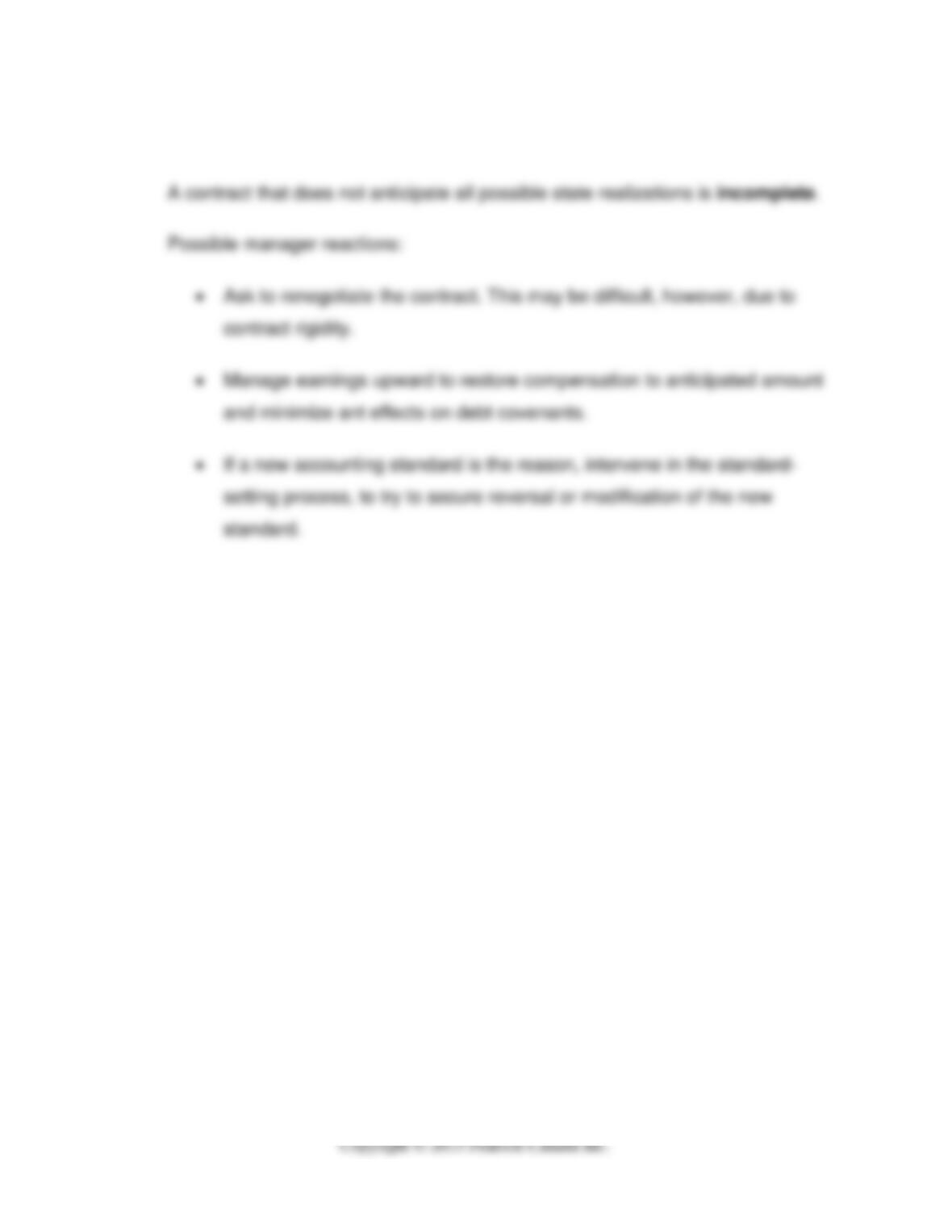
7. This $25 net income could happen if some state of nature that was not
anticipated was realized during the year. This could happen, for example, if a
new accounting standard changes the way net income is calculated.
Scott, Financial Accounting Theory, 7th Edition Instructor’s Solutions Manual Chapter 9
331
Alternatively, any other unanticipated event, such as a new competitor entering
the industry, could reduce profits.
332
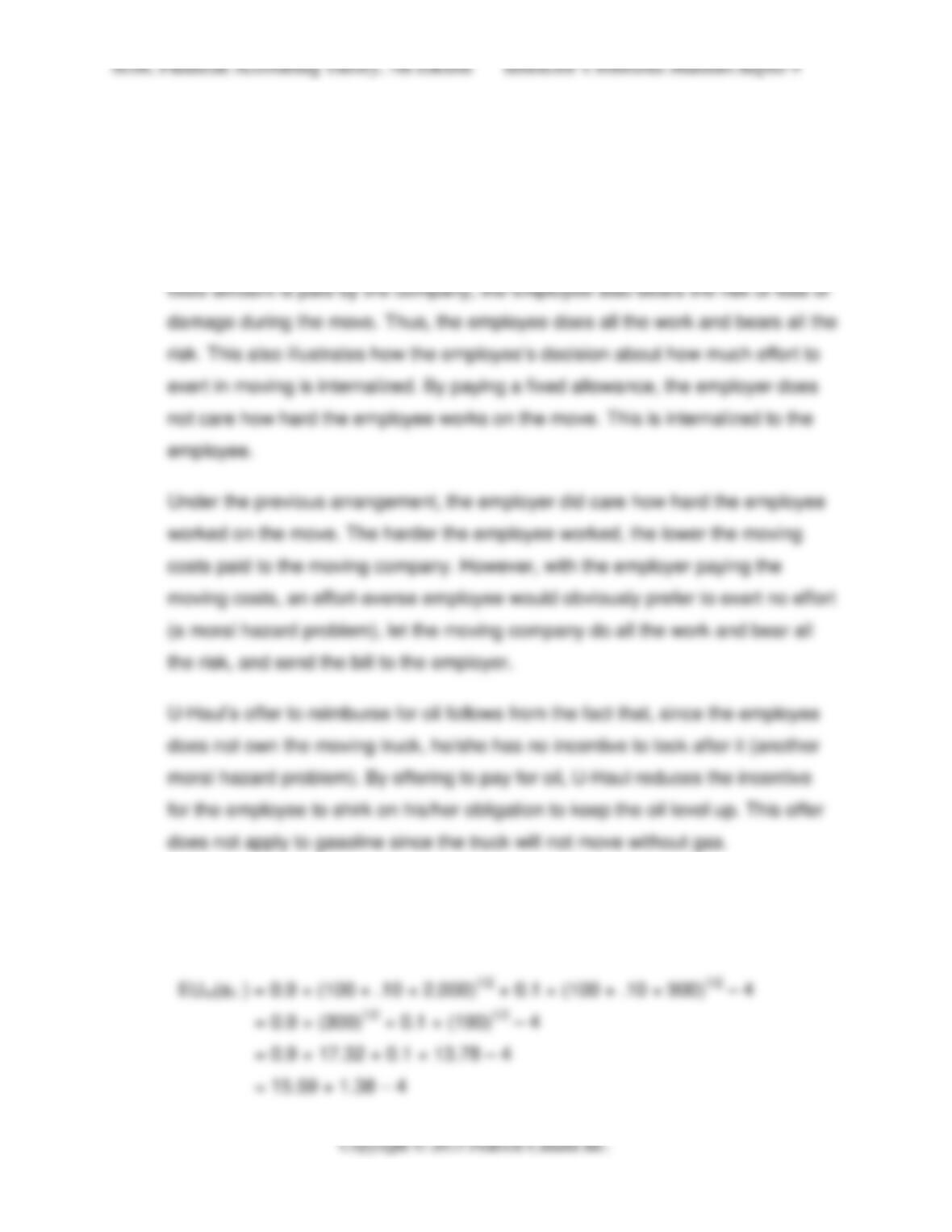
8. This is a version of the “owner rents firm to the manager” or tenant farming
scenario described in Section 9.2.2. Here, we can think of a firm as the principal,
or employer, with the employee as the agent or manager. The employer pays a
fixed rental to the employee for the move. The employee is then motivated to
move as cheaply as possible, since he/she keeps any excess. Note that since a
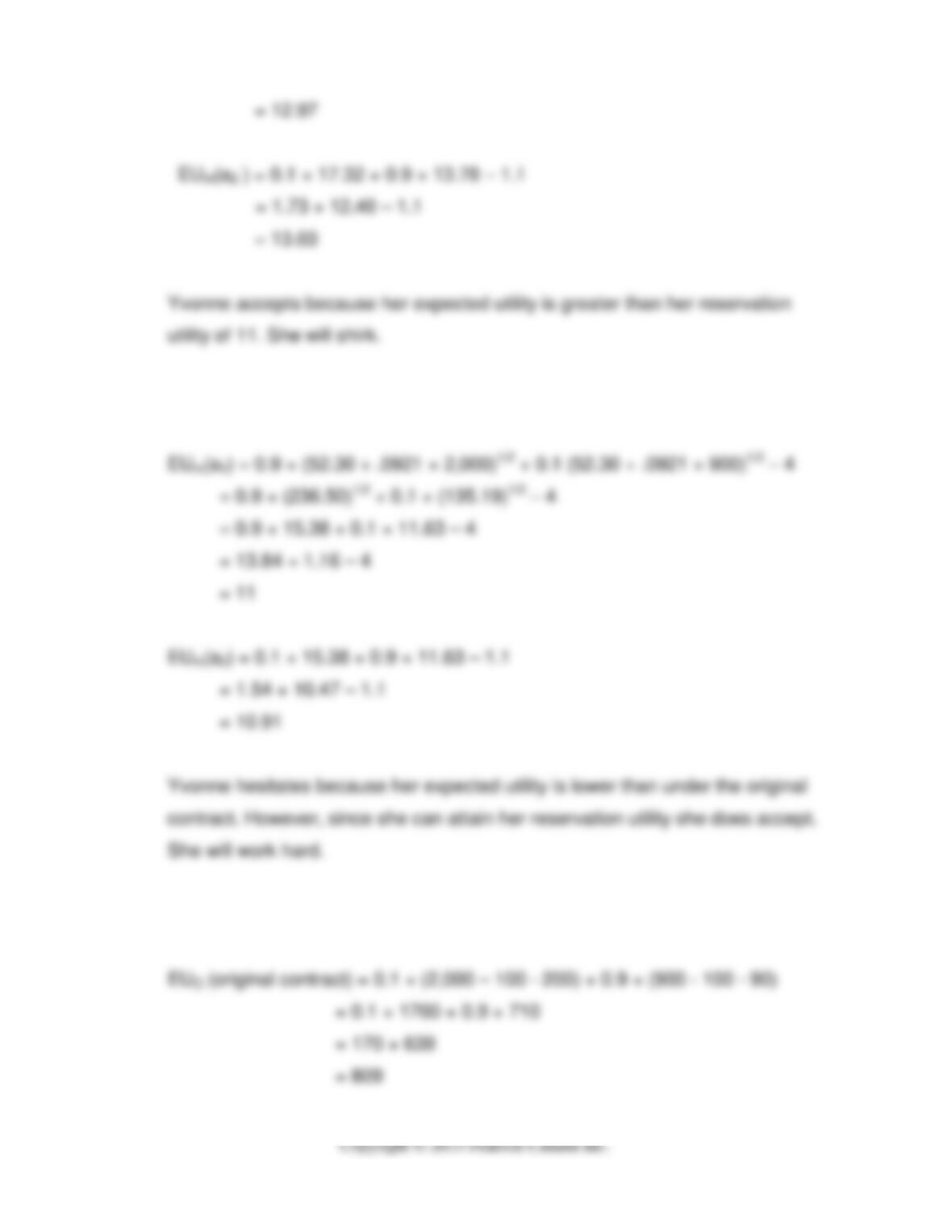
9. a. Denote working hard by a1 and shirking by a2. Yvonne’s expected utility of
each act is:
Scott, Financial Accounting Theory, 7th Edition Instructor’s Solutions Manual Chapter 9
333
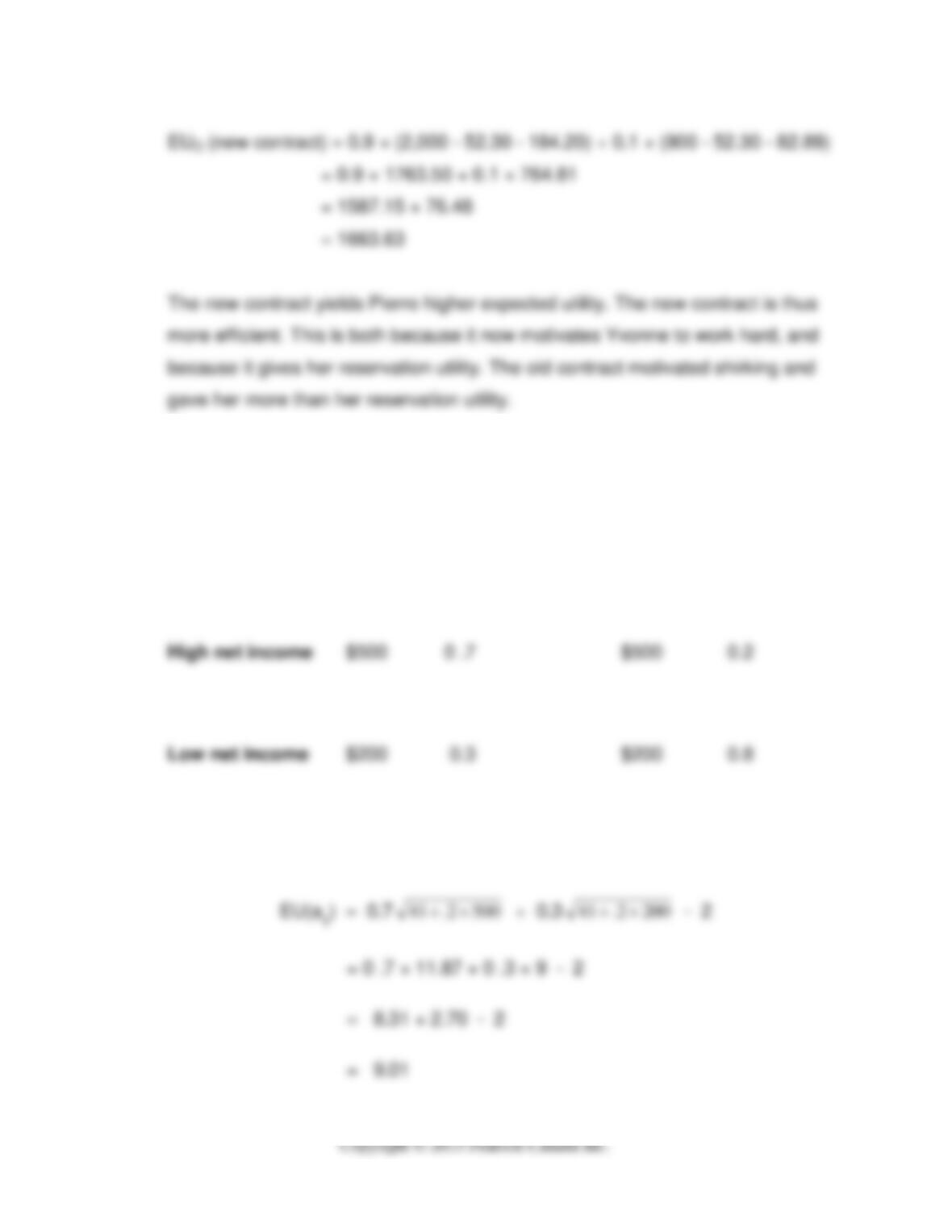
b. Under the new contract, Yvonne’s expected utility of each act is:
c. Denote Pierre’s utility by EUO:
Scott, Financial Accounting Theory, 7th Edition Instructor’s Solutions Manual Chapter 9
334
10. The payoff table for Growth Ltd. is as follows:
Manager’s Act
a1 (work hard) a2 (shirk)
Net Inc. Probability Net Inc. Probability
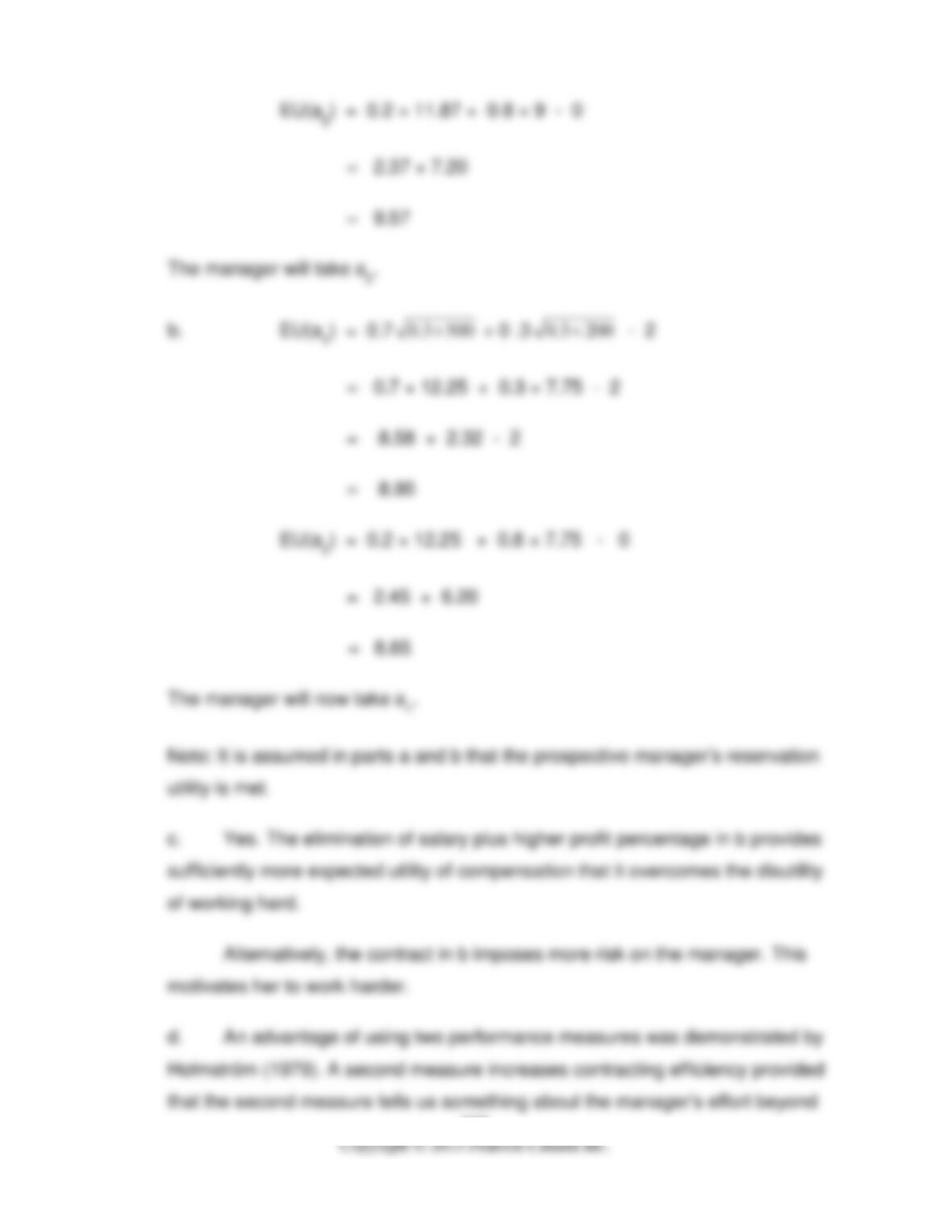
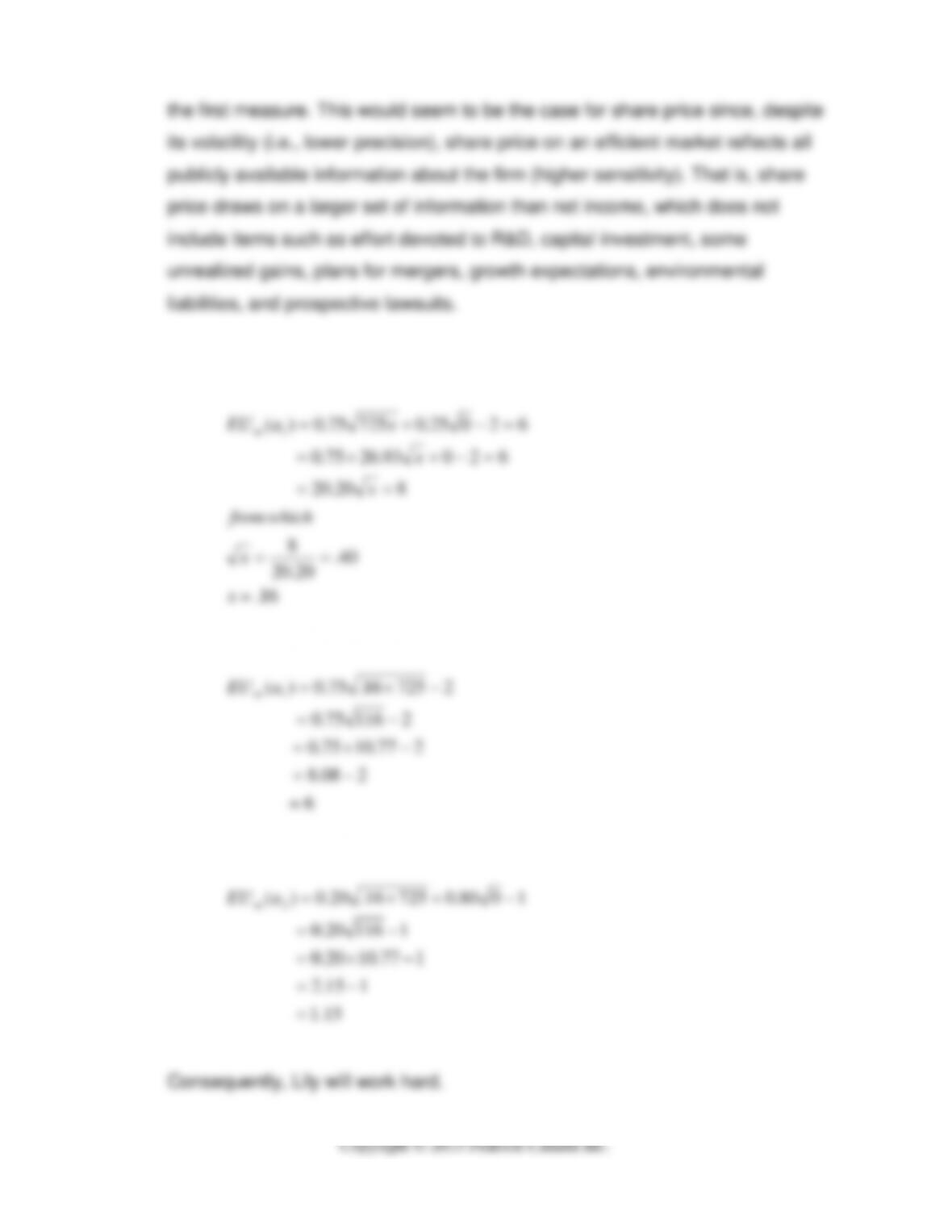
a. The manager’s expected utility for each act is:
– 2
Scott, Financial Accounting Theory, 7th Edition Instructor’s Solutions Manual Chapter 9
335
Scott, Financial Accounting Theory, 7th Edition Instructor’s Solutions Manual Chapter 9
336
11. a. Let the proportion of net income be x. Then we want
16.
40.
20.20
8
820.20
62093.2675.0
62025.072575.0)( 1
=
==
==
=−+×=
=−+=
x
x
whichfrom
x
x
xaEU m
b. To check, this profit share yields
6
208.8
211675.0
272516.75.0)( 1
≈
−=
−=
−×=aEU m
If Lily shirks with this profit share, her expected utility is
15.1
115.2
111620.0
1080.072516.20.0)(
2
=
−=
−=
−+
×=aEU m

Scott, Financial Accounting Theory, 7th Edition Instructor’s Solutions Manual Chapter 9
337
c. If Lily manages earnings and shirks in year 1, net income of $725 is
reported regardless of unmanaged net income. Lily’s expected utility is
1116
172516.)( 2
−=
−×=aEU
m
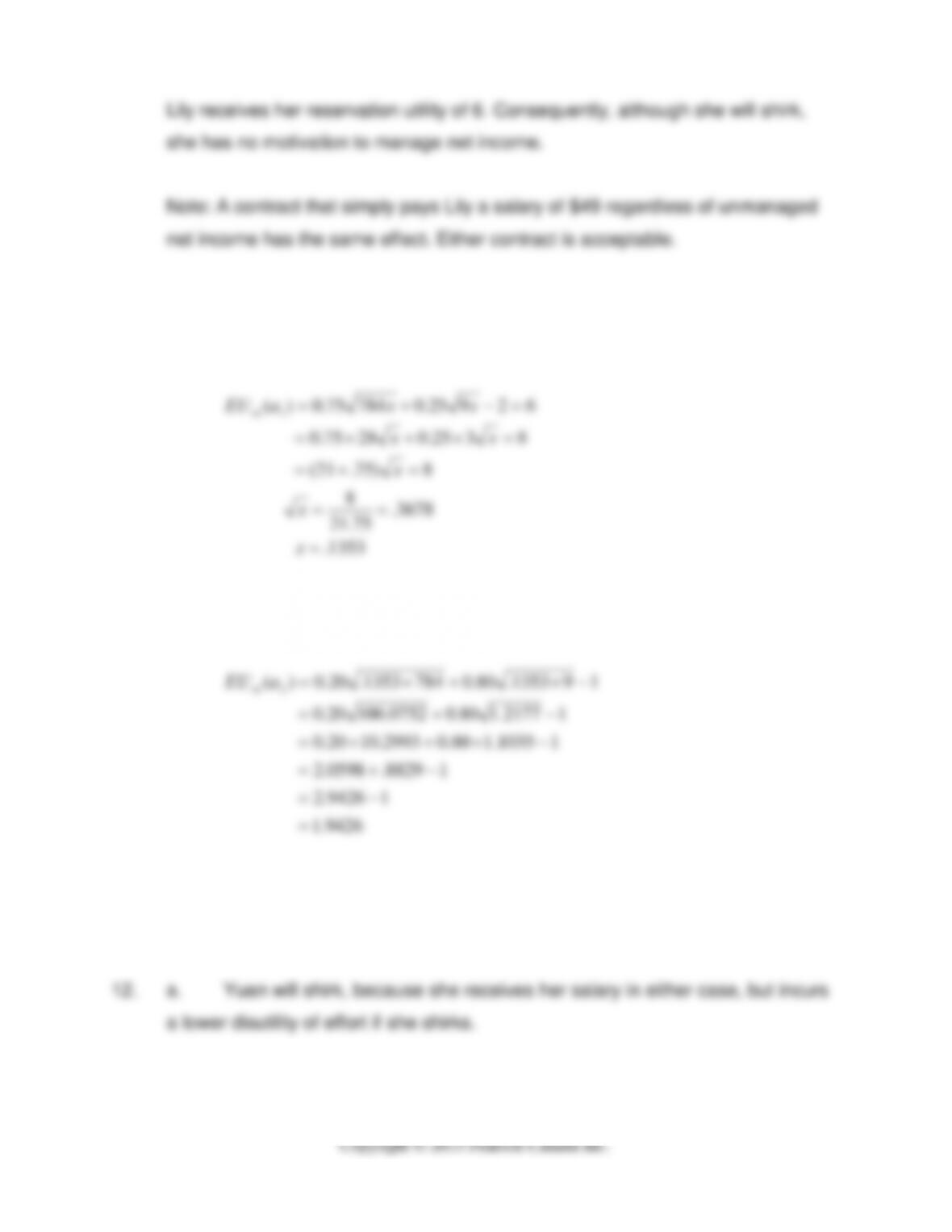
d. Suppose that unmanaged net income is $725. Then, if Lily reports
truthfully, that is $725 net income, the compensation she needs to attain
If net income is truthfully reported as zero, Lily must receive a salary to attain
reservation utility. The required salary s is:
49
=
s
Scott, Financial Accounting Theory, 7th Edition Instructor’s Solutions Manual Chapter 9
338
e. If Lily works hard, the required proportion of net income to attain
reservation utility of 6 is:
1353.
3678.
75.21
8
=
==
x
x
If Lily shirks under this contract, her expected utility is:
9426.1
19426.2
18829.0598.2
11035.180.02993.1020.0
12177.180.00752.10620.0
191353.80.07841353.20.0)(
2
=
−=
−+=
−×+×=
−+=
−×+×=aEU
m
Since this is less than reservation utility, Lily will now work hard, and will manage
earnings within GAAP.
Note: Calculations are not required. However, they are:

339
b. You advise against a salary because you know that, with a fixed salary
that yields more than reservation utility, Yuan will accept and shirk in a one–year
contract.
Let the proportion of net income be x. Then we want
0625.
25.
32
8
8824
62204.0406.0
62)4004.016006.0)( 1
=
==
=+=
=−×+×=
=−+=
x
x
whichfrom
xx
xx
xxaEU m
Note: In Part d it is verified that Yuan will work hard if offered this profit share.
c. Feng’s expected utility if Yuan is paid a salary (Yuan will shirk):
Feng’s expected utility if Yuan paid .0625 of net income:

Scott, Financial Accounting Theory, 7th Edition Instructor’s Solutions Manual Chapter 9
d. Your recommended profit share of .0625 yields Yuan:
6
226
2254.01006.0
24000625.4.016000625.6.0)( 1
=
−+=
−−=
−×+×=aEU m
If Yuan shirks with this profit share, her expected utility is
5.5
15.6
1257.01003.0
14000625.7.016000625.3.0)(
2
=
−=
−+=
−×+×=aEU
m
Consequently, Yuan will work hard.
13. a. We want
141270
122403.01007.0
122600,13.0000,107.0)(
1
=+=
=−×+×=
=−+=
xx
xx
xxaEU
m