Scott, Financial Accounting Theory, 7th Edition Instructor’s Solutions Manual Chapter 8
303
Copyright © 2015 Pearson Canada Inc.
lower per share earnings and dividends to investors that ESOs create. We
conclude that relevance of Black/Scholes as a measure is high.
Representationally faithful (i.e., reliable) information is complete, free from
material error, and neutral.
• The Black/Scholes model is complete, since the parameter inputs into the
model provide a theoretically correct representation of the determinants of
option value. However, when applied to ESOs, completeness is reduced
since the model does not allow for early exercise. That is, Black/Scholes
We conclude that the reliability of Black/Scholes as an estimate of ESO expense
is low.
Scott, Financial Accounting Theory, 7th Edition Instructor’s Solutions Manual Chapter 8
b. Some people claim that the cost of ESOs is zero because the firm does
not have to pay the recipients for their employee services. Indeed, some cash
(i.e., the exercise price) is received instead.
These claims are incorrect because they ignore the concept of opportunity cost.
• To the extent that expensing ESOs leads to reduced use of ESOs as
a compensation device, managers will not have as much scope to
increase the value of their ESOs by, for example, timing of release of
bad and good news, pump and dump, spring loading, and late timing.
• Securities market inefficiency. To the extent that management
Scott, Financial Accounting Theory, 7th Edition Instructor’s Solutions Manual Chapter 8
305
d. A firm may voluntarily adopt ESO expensing for the following reasons:
• Very large firms, who are often subject to political pressures due to
high profits, may wish to lower the amount of reported net income so
as to reduce political backlash. The voluntary adopters given in the
question, such as Microsoft, are very large.
• Little impact on reported net income. Some firms use ESOs more
Note: Reputation and signalling are not fully discussed in the text
11. a. Yes, the accusations are consistent with the findings of Aboody and
Kasznik (2000), assuming that the regular ESO awards were scheduled in
306
12. a. The answer depends on my risk aversion, my beliefs about the state of
the economy, my ability to evaluate the fair value of the debt, and the investment
alternatives available to me.
With respect to investment alternatives, I would be willing to invest in tranches of
covenant–lite debt if safer debt, such as government debt and debt issued with
underlying debt components of the tranche. If the tranche is rated by a credit
rating agency, my concerns about transparency would be reduced. However,
lack of knowledge of the rating agencies’ valuation methodology, including the
models they use, would leave me with some concerns even if the tranche is rated
307
covenants attached, the managers of firms issuing such debt may behave
opportunistically by failing to protect the interests of the trancheholders. That is,
managers have less motivation to maintain ratios that protect debtholders’
interests, such as debt–to–equity, interest coverage, and working capital. Such
firms also have less incentive to avoid excessive dividends and subsequent
13. a. Maintenance of a specified level of net worth is a way to reduce lenders’
risk, by providing a cushion of net assets available to them should the borrowing
Scott, Financial Accounting Theory, 7th Edition Instructor’s Solutions Manual Chapter 8
308
b. Managers of firms that issue debt may inflate current earnings to disguise
lenders’ concerns about the security of their loans and firm solvency. These
c. The escalator clause increases the manager’s incentive to adopt
conservative accounting since conservative accounting lowers net income,
thereby reducing the effect of the escalator clause. Lenders benefit from
14. a. Problems of the Black/Scholes option pricing model applied to ESOs:
• Black/Scholes assumes options are freely traded, whereas ESOs are not.
Scott, Financial Accounting Theory, 7th Edition Instructor’s Solutions Manual Chapter 8
309
• If the employee leaves the firm, ESOs are often forfeited. Also, for
• Black/Scholes assumes that the option is held to expiry, whereas an ESO
b. Not necessarily. Expensing ESOs increases relevance of earnings, since
not be observed.
d. A finding that management’s share price variability input to Black/Scholes
exceeded actual share price variability following the disavowal implies
Scott, Financial Accounting Theory, 7th Edition Instructor’s Solutions Manual Chapter 8
15. 1. To the extent that going concern value is greater than liquidating value, it
becomes less likely that a delegated monitor will trigger liquidation, and more
2. Lenders want timely warning of possible financial distress. They also want
the delegated monitor (the bank) to do a good job in monitoring the lender’s
financial condition. Since the bank will base a decision to accelerate loan
3. As information asymmetry increases, firm performance is harder to
312
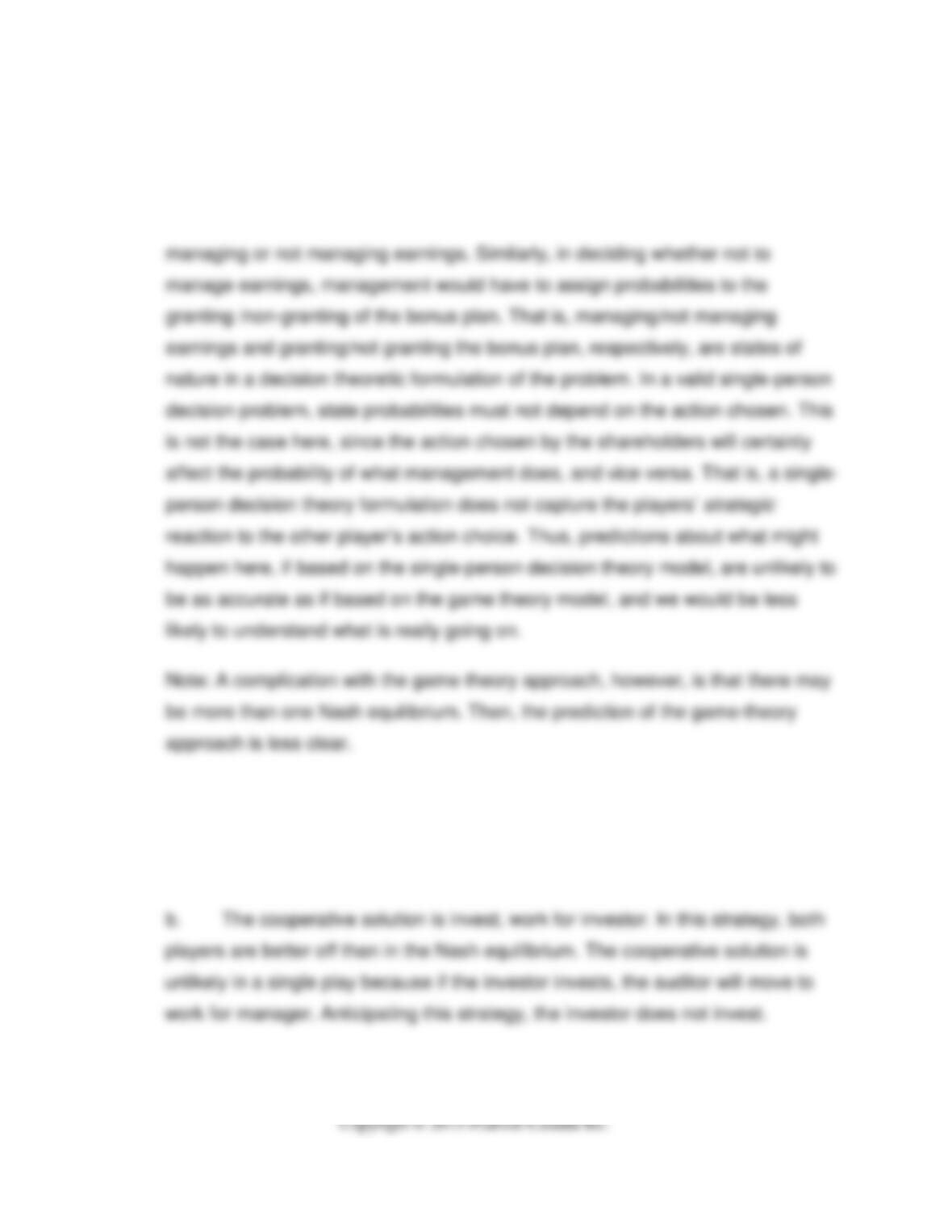
17. a. The cash flows to each player are as shown in the payoff table:
Management
Do not manage
earnings
Manage
earnings
plan
The first number in each box represents the payoff to shareholders. Note that
cash flows to shareholders are net of compensation paid to management. Note
b. A Nash equilibrium is (bonus plan, manage earnings).
Note that the manager is indifferent between managing and not managing
c. The main advantage is that the conflict situation between management
Scott, Financial Accounting Theory, 7th Edition Instructor’s Solutions Manual Chapter 8
313
management’s earnings management decision are simultaneously taken into
account.
In single–person decision theory, in deciding on which act to take, shareholders
would have to assign probabilities to management’s possible actions of
18. a. The Nash equilibrium is do not invest, work for manager. This is the only
strategy pair such that, given the strategy choice of the other player, neither
player has an incentive to change strategies.
c. Three possible ways to attain the cooperative solution:
Scott, Financial Accounting Theory, 7th Edition Instructor’s Solutions Manual Chapter 8
314
19. a. Three (pure strategy) Nash equilibria are (Violate, Keep), (Keep, Violate)
and (Violate, Violate), where the first word within brackets denotes country 2’s
b. Country 1 could switch to Violate, thereby punishing country 2 for not
playing Keep. When the game is repeated, each of the players realizes that it is
to their mutual benefit to play (Keep, Keep). This is because each country will
Scott, Financial Accounting Theory, 7th Edition Instructor’s Solutions Manual Chapter 8
315
Additional Problems
8A-1 Accounting standards such as IAS 19 require current value accounting for other
post–employment benefits (OPEBs). Under IAS 19, OPEBs expense includes the
change in the discounted present value of expected future payments to
employees. Similar provisions exist under FASB standards, where SFAS 106
(1990) (now ASC 715–60) was the original current value accounting standard in
this area. .
Prior to these standards, most other post–employment benefits were accounted
for on a cash basis, allowing companies to expense these benefits as they were
paid to employees.

Scott, Financial Accounting Theory, 7th Edition Instructor’s Solutions Manual Chapter 8
316
These new standards created economic consequences, whereby firms moved to
reduce their postretirement benefits. For example, as reported in The Wall Street
Journal (November 4, 1992), McDonnell Douglas Corp. cut benefits to retired
employees upon realizing that it faced a $1.2–billion charge against earnings from
SFAS 106.
Required
a. What is the after–tax impact on a firm’s cash flows following adoption of
current value accounting for OPEBs, assuming benefits are not cut?
b. Why would some firms move to reduce retiree benefits following adoption
of current value accounting for OPEBs?
c. Give an argument for how a firm’s share price might rise following the
reporting of a major charge from adopting current value accounting for OPEBs.
8A–2. The instability of economic cartels such as OPEC (Organization of Petroleum
Exporting Countries) can be explained, at least in part, by game theory
considerations. Typically such cartels attempt to agree to restrict oil production
and keep prices to customers high. Frequently, however, some countries violate
these agreements.
Required
Use the following depiction of a two–country non–cooperative game to explain
why violation occurs. That is, explain in words which strategy pair is likely to be
played in this game and why. Identify the Nash equilibrium of this game.
Country 1
Keep Violate
Keep 100, 100 40, 200

Scott, Financial Accounting Theory, 7th Edition Instructor’s Solutions Manual Chapter 8
317
Country 2
Violate 200, 40 50, 50
In each box, the first number represents country 2’s payoff and the second
country 1’s payoff. (CGA–Canada)
8A–3. Non–cooperative game theory is a way of modelling the conflict situation that
exists between a firm manager and investors. Consider the following depiction of
a game between a manager/entrepreneur and a potential investor in the firm.
Manager/Entrepreneur
Work hard Shirk
Invest 7, 6 2, 7
Investor
Do not invest 5, 3 6, 5
The manager may choose to work hard or shirk. The number pairs show the
payoffs to the investor (first number) and the manager (second number) for each
manager/investor strategy pair. For example, if the investor invests and the
manager works hard, they receive payoffs of 7 and 6 respectively.
Required
a. Identify the cooperative solution and explain why it is not a Nash
equilibrium.
b. Identify a Nash equilibrium and explain why it is the predicted outcome of
a single play of the game.
Suggested Solution to Additional Problems
Scott, Financial Accounting Theory, 7th Edition Instructor’s Solutions Manual Chapter 8
318
8A–1. a. This would depend on the tax deductibility of the accruals for other
postretirement benefits. If these are not deductible, there would be no effect of
OPEB standards on cash flows following their adoption, to the extent the
company continues to pay these benefits.
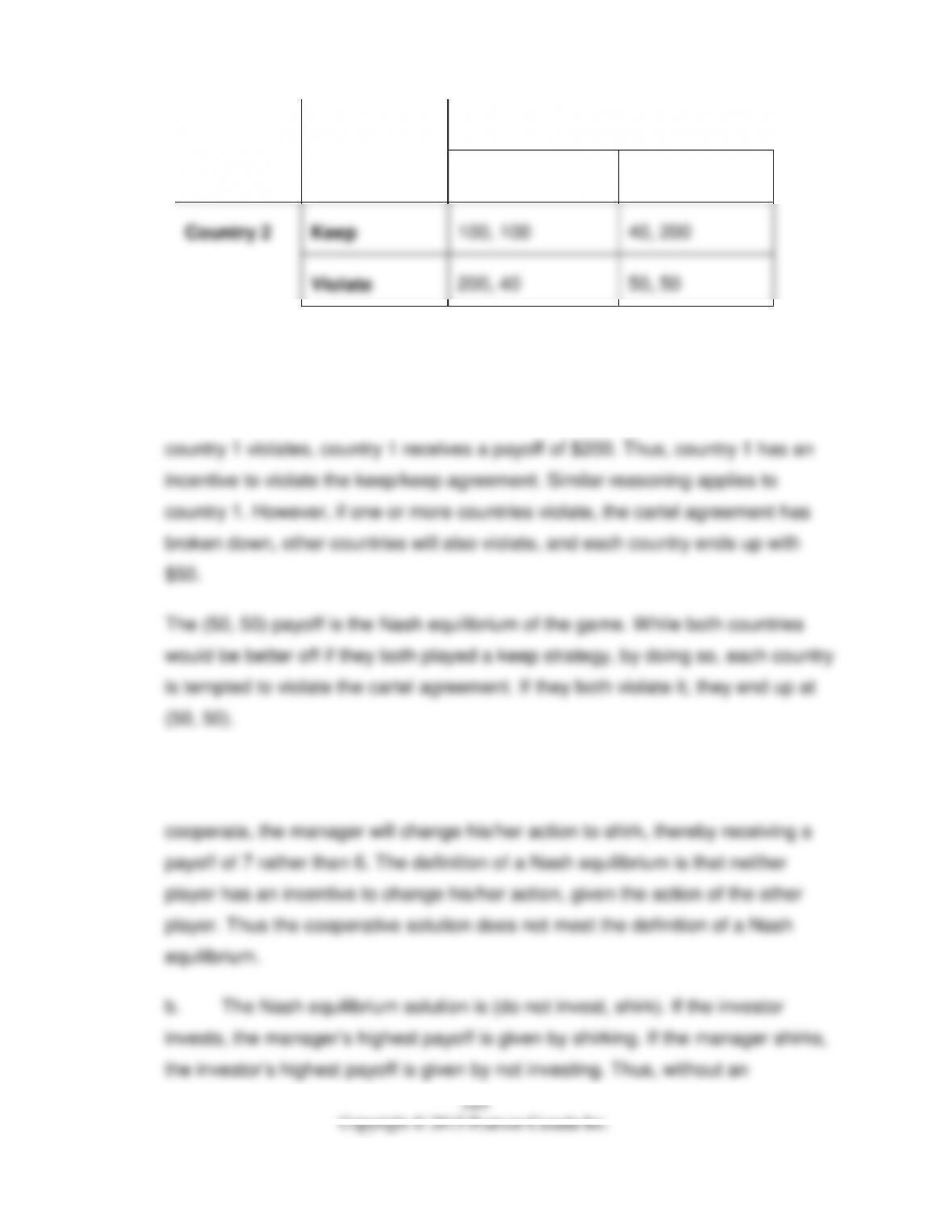
8A-2. The payoff table for the two–country, non–cooperative game, repeated here for
convenience, is:
Scott, Financial Accounting Theory, 7th Edition Instructor’s Solutions Manual Chapter 8
Country 1
Keep Violate
The first number in each box represents country 2’s payoff. To see why violation
of the keep/keep agreement may occur, we see that if country 2 keeps but
8A–3. a. The cooperative solution is (invest, work hard). This is not a Nash
equilibrium, however. Since it is assumed that the parties do not agree to

Scott, Financial Accounting Theory, 7th Edition Instructor’s Solutions Manual Chapter 8
320