257
13. a. Net income calculated this way would add nothing to what the market
already knows. If security markets are efficient, the share prices would already
incorporate all that the market knows. If markets are not fully efficient, that is,
shares are mispriced, the suggestion would simply perpetuate the mispricing.
14. a. If the CAPM and theory of rational decision–making are accepted, the risk
information seems largely firm–specific, hence diversifiable. Then, firm-specific
Scott, Financial Accounting Theory, 7th Edition Instructor’s Solutions Manual Chapter 7
258
However, the CAPM ignores estimation risk. Then, relevance is higher, since it
reveals concise information about the response of cash flows and earnings to
various price risks. Since it is management that has the best information about its
operations and cost structures, the sensitivities disclosures would likely reveal
b. To the extent Husky has reduced its real risks by hedging, the investor
who wants firm-specific risk information would find sensitivity information net of
Scott, Financial Accounting Theory, 7th Edition Instructor’s Solutions Manual Chapter 7
259
Some of these problems would be reduced given that the firm fully discloses its
hedging activities as supplementary information. For example, the investor could
c. The Board may be concerned that excessive hedging may turn into
speculation. Controlling management’s extent of hedging would help to control
and limit speculative activity.
15. a. Requirements for designation:
Scott, Financial Accounting Theory, 7th Edition Instructor’s Solutions Manual Chapter 7
260
b. Derivatives are valued at fair value under IFRS 9.
c. Benefits of hedge accounting:
• Gains and losses resulting from fair valuing derivative financial
instruments not designated as hedges are included in net income.
Hedge accounting reduces the resulting net income volatility.
261
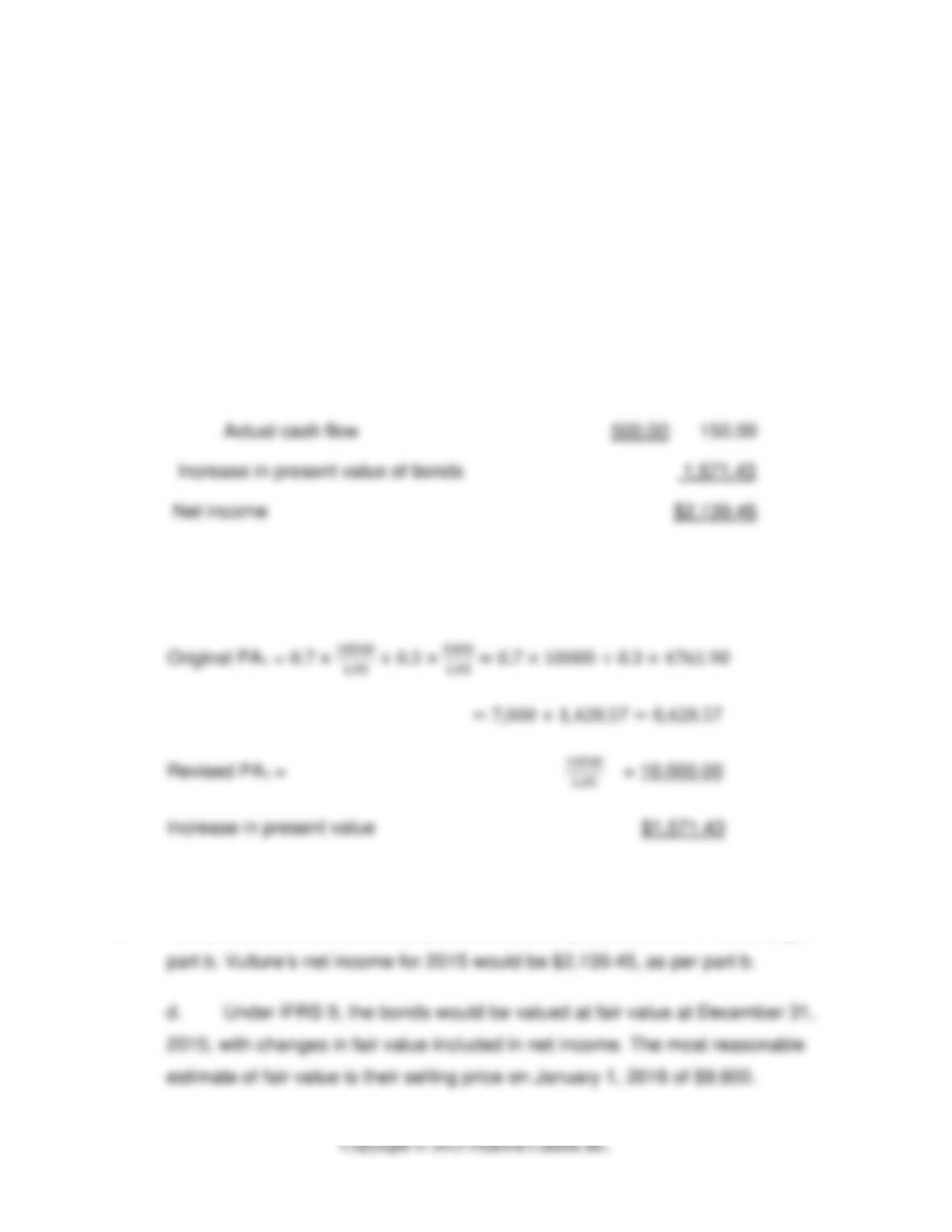
16. a. Under ideal conditions of uncertainty, the amount paid for an asset equals
its expected present value.
Expected present value of bonds on January 1, 2015:
( ) ( )
15.45353.081.952319.4767.0
05.1
000,5
05.1
0
3.0
05.1
500,10
05.1
500
7.0 22
0
++=
++
+=PA
b.
Vulture Ltd.
Balance sheet
As at December 31, 2015
Cash $500.00 Shareholders’ equity
Investments,
Scott, Financial Accounting Theory, 7th Edition Instructor’s Solutions Manual Chapter 7
262
Vulture Ltd.
Income Statement
For the year ended December 31, 2015
Accretion of discount (8,360.55 × .05) $418.02
Abnormal earnings
Expected cash flow (0,7 × 500) 350.00
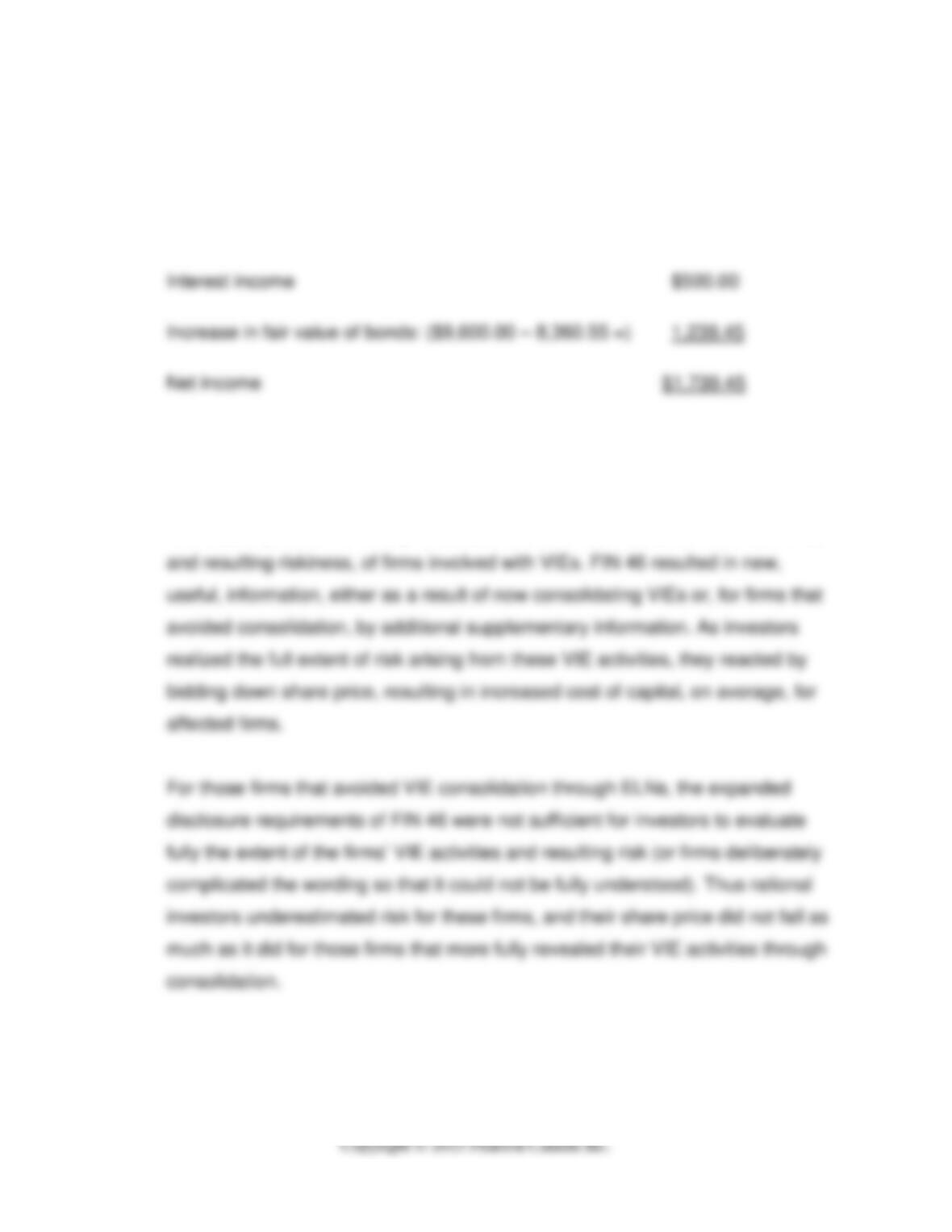
Note: Increase in value of bonds at December 31, 2015 calculated as follows
c. The bonds would be valued at amortised cost of $10,000 under IFRS 9, as per
Scott, Financial Accounting Theory, 7th Edition Instructor’s Solutions Manual Chapter 7
263
Vulture Ltd.
Income Statement
For the year ended December 31, 2015
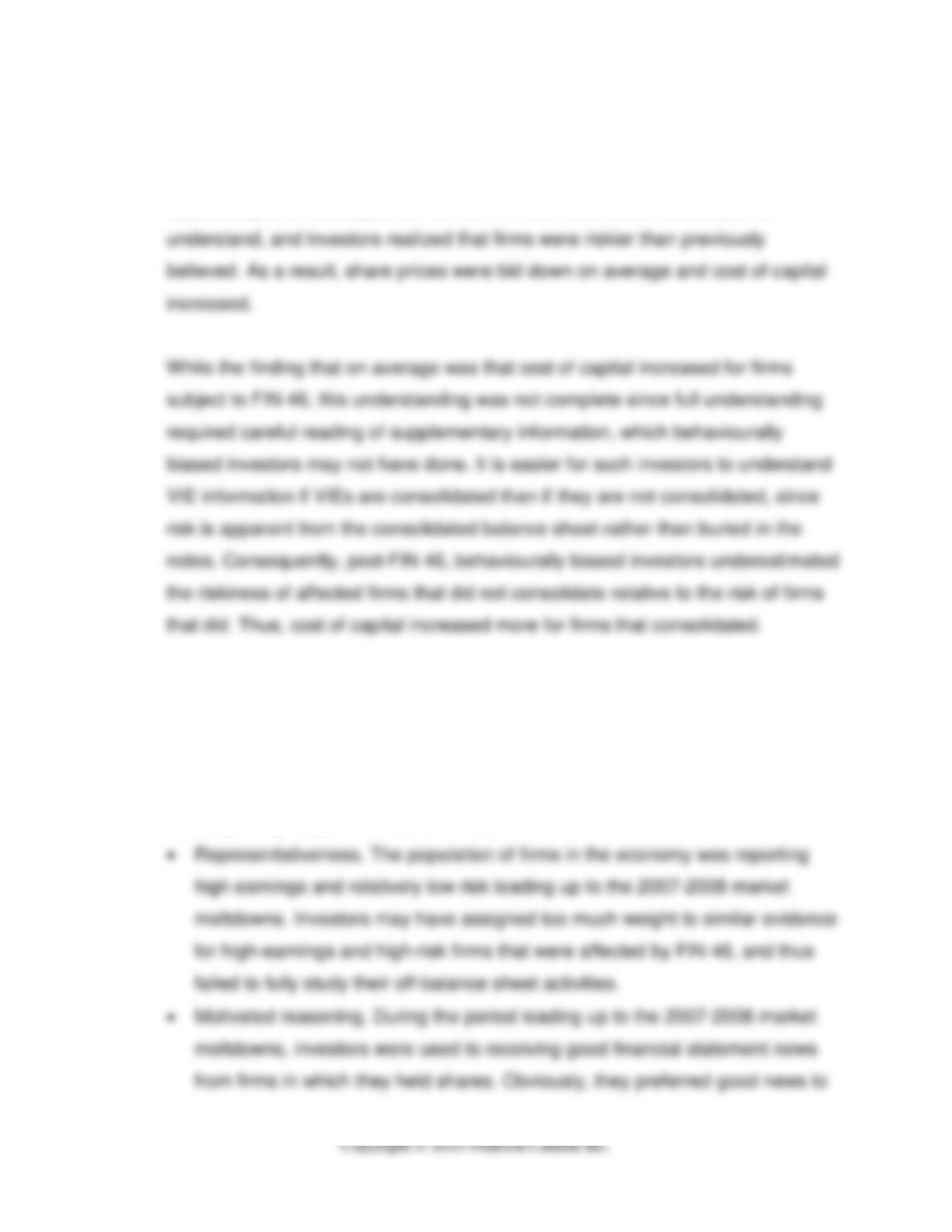
17. a. The average increase in cost of capital for firms affected by FIN 46 is
consistent with securities market efficiency if investors did not have enough
information pre–FIN 46 to fully evaluate the extent of off–balance sheet activities,
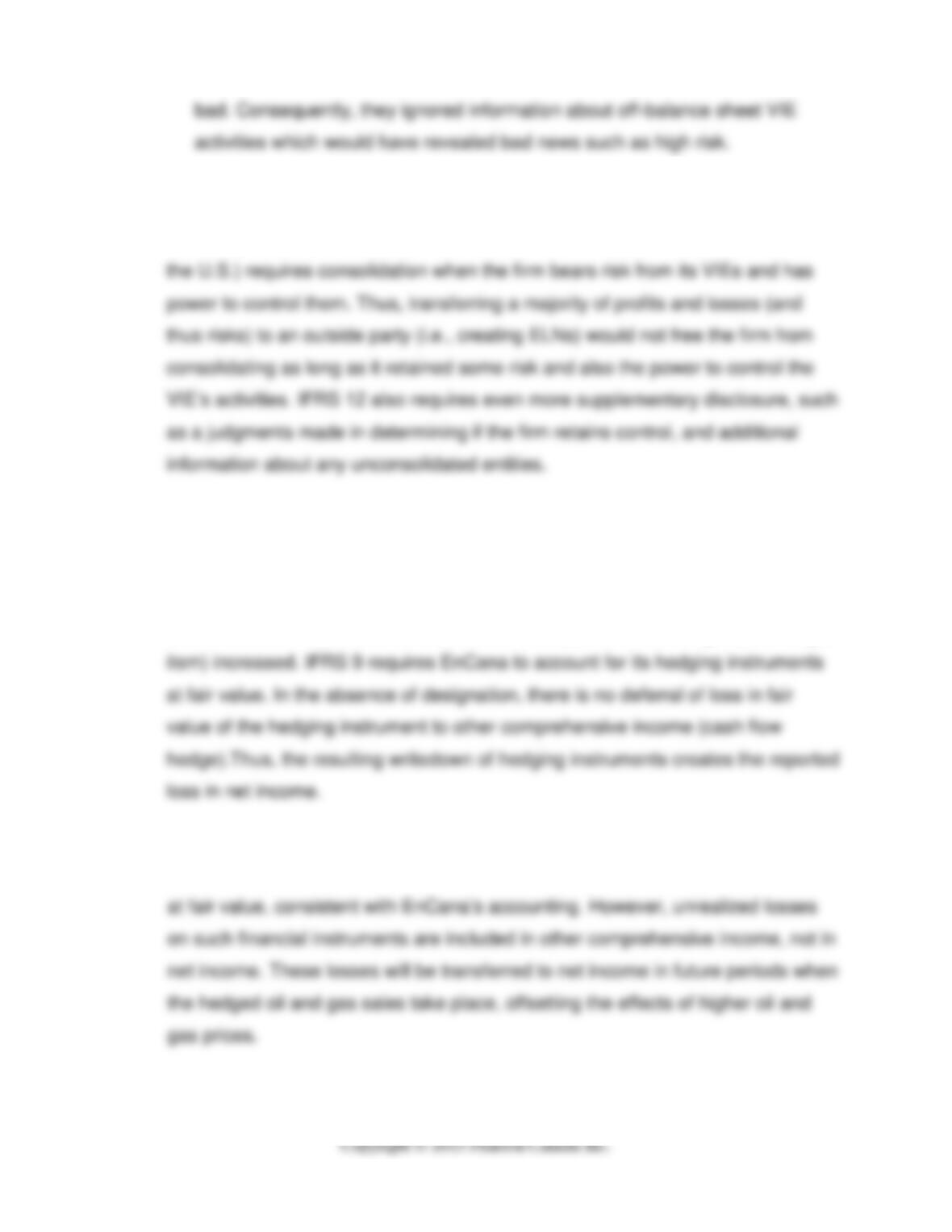
b. Pre–FIN 46, behaviourally biased investors did not fully realize the
riskiness of firms affected by FIN 46 since firms’ VIEs were not consolidated.
Scott, Financial Accounting Theory, 7th Edition Instructor’s Solutions Manual Chapter 7
264
That is, such investors may not have bothered to fully interpret the
supplementary information about VIE activities that firms provided pre–FIN 46.
Following FIN 46, additional supplementary information about VIEs had to be
reported by all firms subject to FIN 46. The new information was easier to
Note: Behavioural biases consistent with this argument include:
• Limited attention.
• Narrow framing, since investors may have economized on their mental effort
by ignoring supplementary information.
Scott, Financial Accounting Theory, 7th Edition Instructor’s Solutions Manual Chapter 7
265
c. The FASB and IASB have responded with new (converged) standards to
further tighten requirements for VIE consolidation. Thus IFRS 10 (ASC 810–10 in
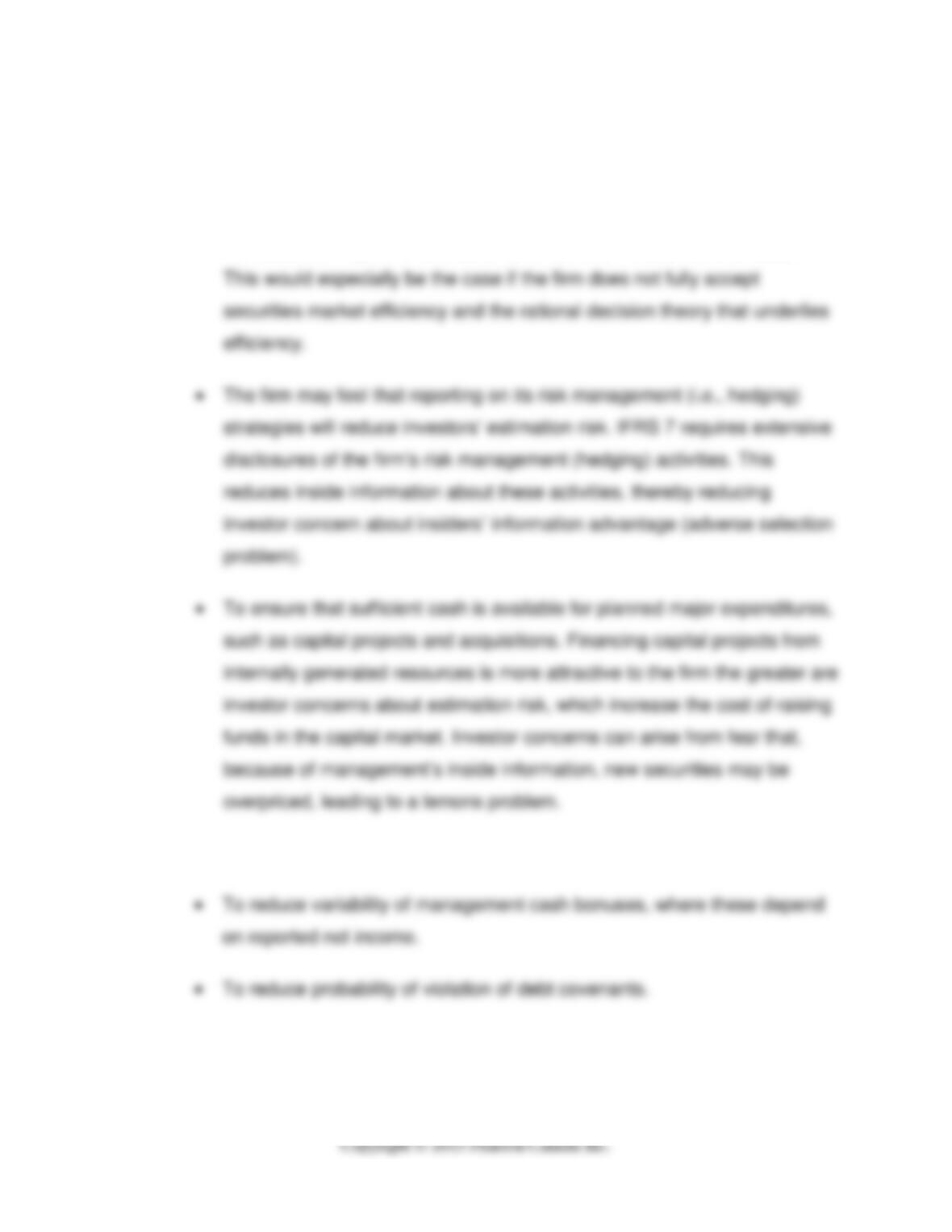
18. a. EnCana must not have designated the hedging instruments as hedges, or
perhaps did not fully follow the procedures required for designation. The hedging
instruments fell in fair value because the market prices of oil and gas (the hedged
b. Under IAS 39 and SFAS 133 (now ASC 815-30-35), financial instruments
designated as hedges of anticipated transactions (cash flow hedges) are valued
Scott, Financial Accounting Theory, 7th Edition Instructor’s Solutions Manual Chapter 7
266
c. Reasons why firms hedge at least part of their price risks of future anticipated
sales:
• To manage price risk to a level desired by the firm.
• To reduce firm–specific risk, as an alternative to investor diversification.
Note: Additional reasons, not yet covered in text:
19. a. The price of crude oil must have risen subsequent to CNRL’s entering into
the cash flow hedging contract. Since a cash flow hedge enables CNRL to sell its

Scott, Financial Accounting Theory, 7th Edition Instructor’s Solutions Manual Chapter 7
future oil and gas production at a designated price, any rise in oil and gas prices
above this price reduces the fair value of the hedging contract.
b. Under the hedging standards, financial instruments designated as hedges
of anticipated transactions (cash flow hedges) are valued at fair value. Unrealized
c. A reasonable answer is no. The loss on hedging reported by CNRL is the
268
20. a. Relevance is higher under fair value accounting than under historical cost.
From an asset point of view, the fair value of Blackstone’s carried interest option
conveys information about the amount of cash expected to be received. This
information is relevant to assessing the future performance of Blackstone. Under