108
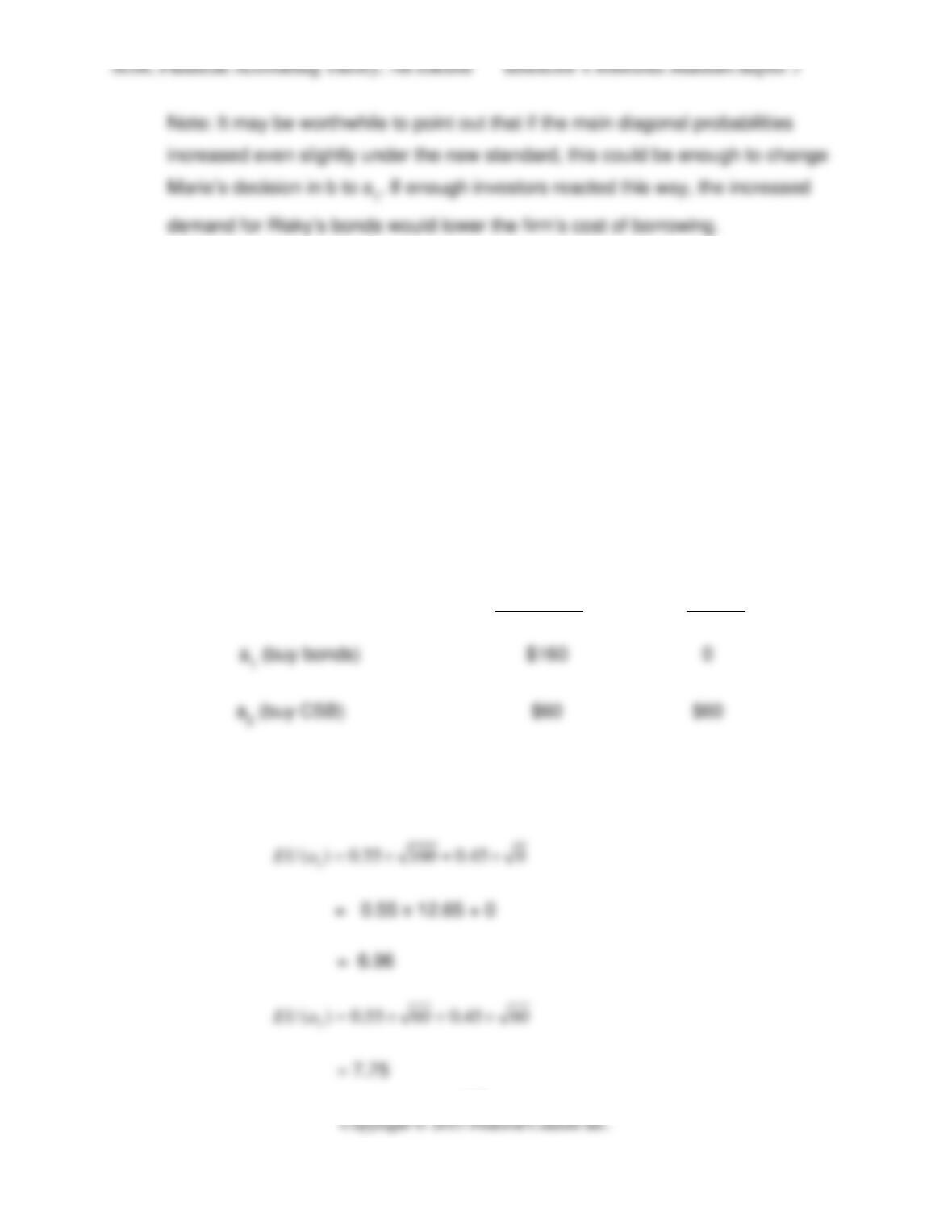
12. a. The payoff table for Lucas’ decision is:
Act State
No Default Default
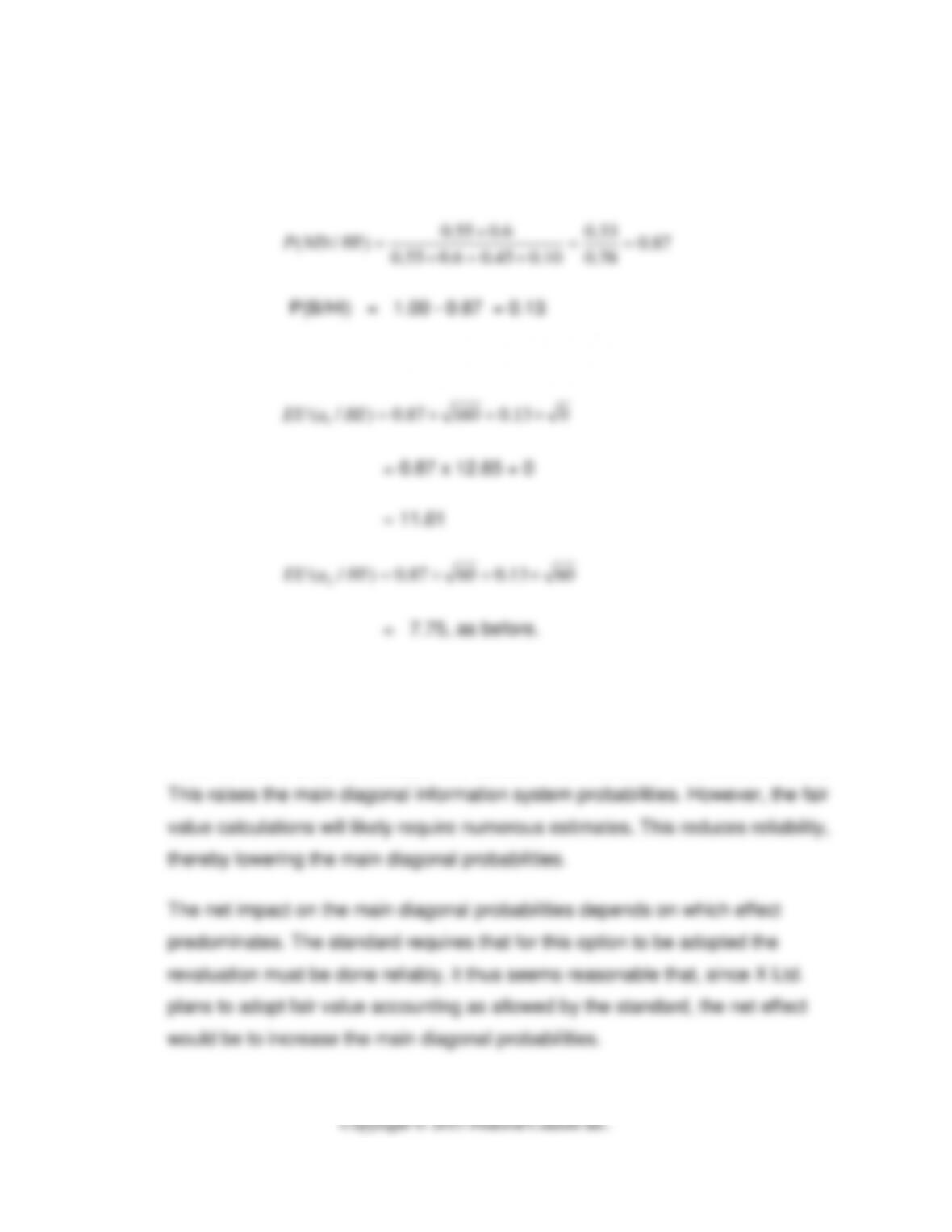
Based on his prior probabilities and square root utility function for net
payoff, the expected utility of each act is:
Scott, Financial Accounting Theory, 7th Edition Instructor’s Solutions Manual Chapter 3
109
Therefore, Lucas should take a2 and buy the government savings bonds.
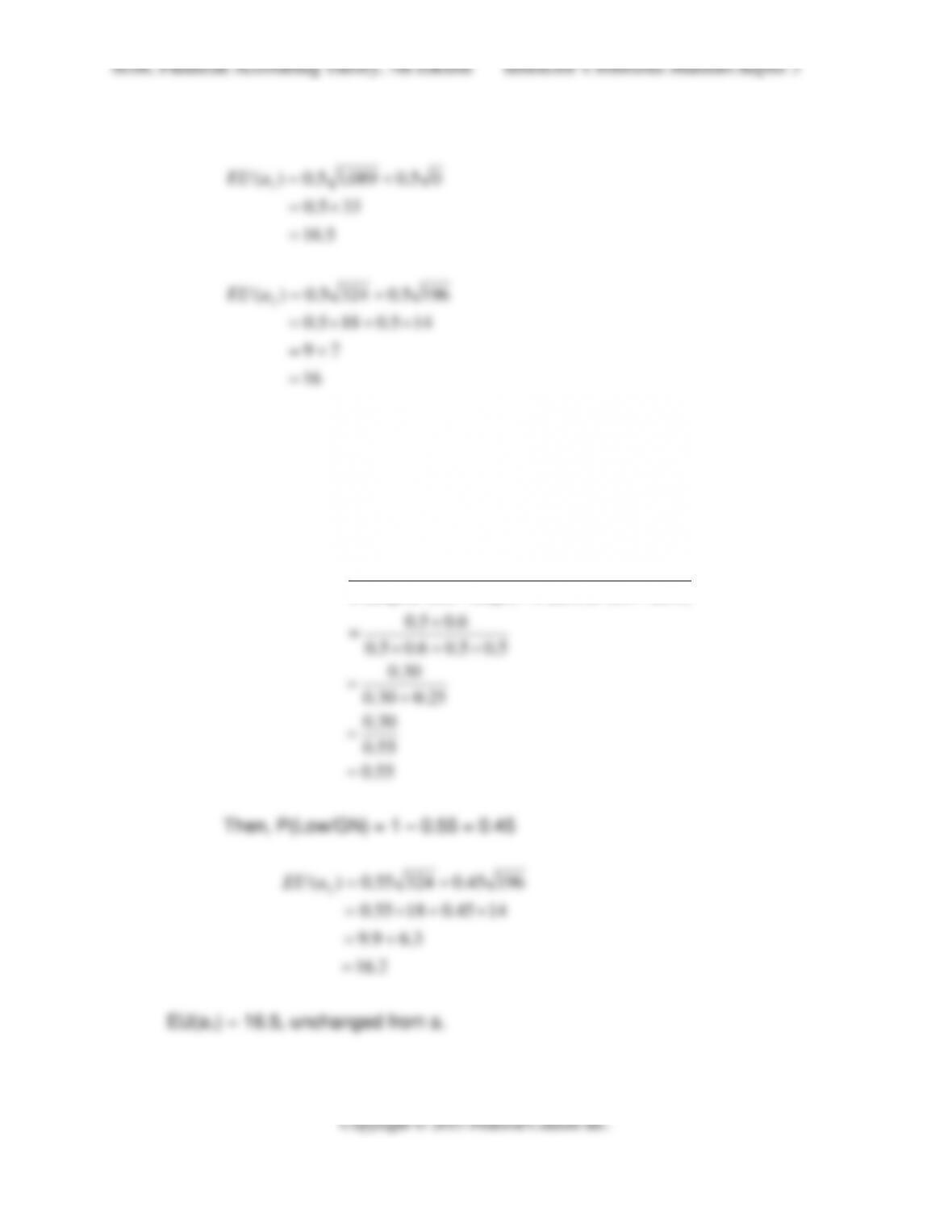
b. From Bayes’ theorem, Lucas’ posterior probabilities over the states are:
33.0
6.055.0
×
The expected utility of each act now is:
Lucas should now take a1.
c. The standard will increase the relevance of Risky’s financial statements,
since fair value (market value) of the assets is now shown on the balance sheet.
110
13. a.
16
79
145.0185.0
1965.03245.0)(
5.16
335.0
05.0089,15.0)(
2
1
=
+=
×+×=
+=
=
×=
+=
aEU
aEU
Ajay should take a1 and invest in AB Ltd., the speculative firm.
b. From Bayes’ theorem, Ajay’s posterior probability of high performance for
XY Ltd. is:
30.0
5.05.06.05.0
6.05.0
)/()()/()(
)/()(
)/(
×+×
×
=
+
=
LowGNPLowPHighGNPHighP
HighGNPHighP
GNHighP
Ajay should still take a1 and invest in AB.
Scott, Financial Accounting Theory, 7th Edition Instructor’s Solutions Manual Chapter 3
111
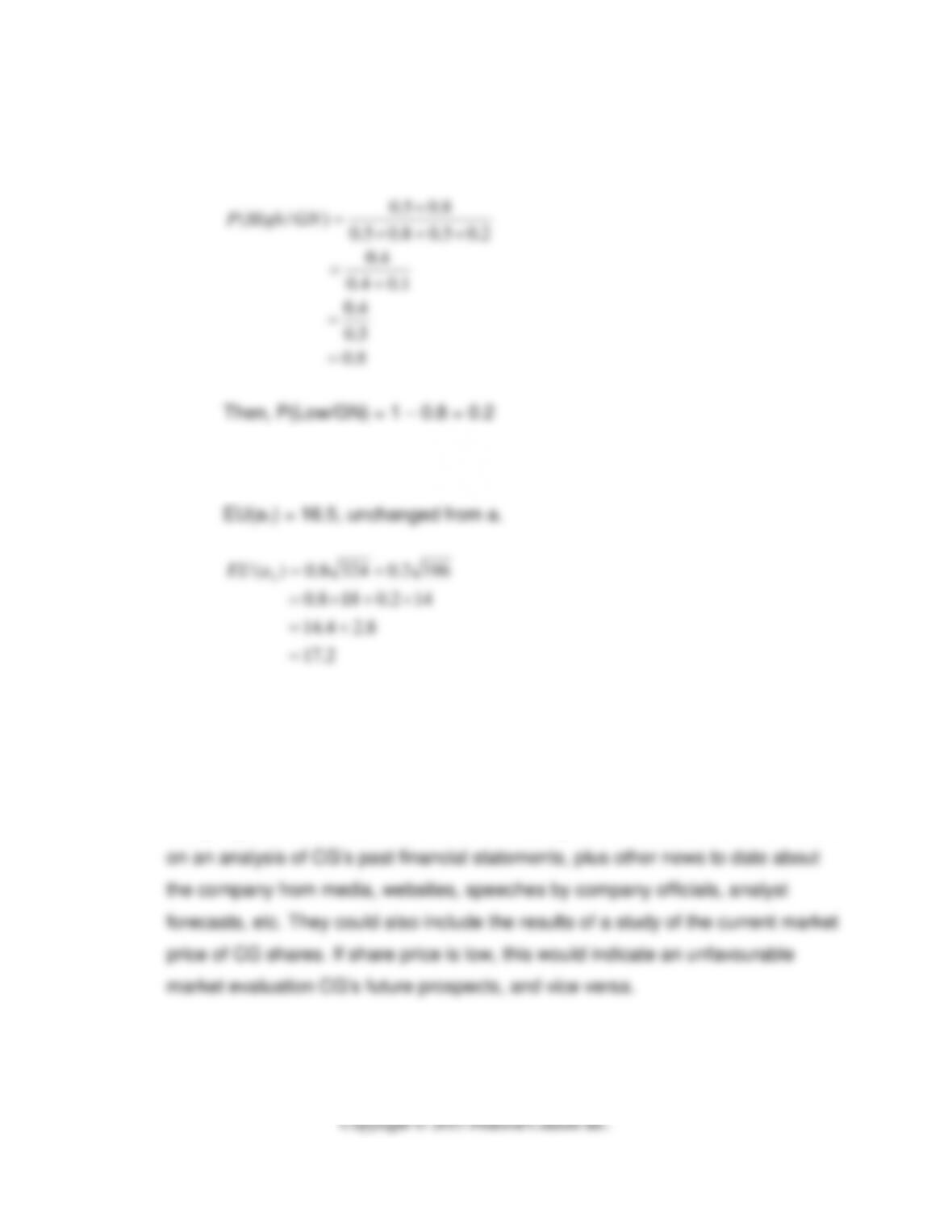
c. Based on the new information system, Ajay’s posterior probability of high
performance for XY Ltd. is
4.0
2.05.08.05.0
8.05.0
)/(
=
×+×
×
=GNHighP
From which
2.17
8.24.14
=
+=
Ajay should now take a2 and invest in XY Ltd. The new, higher quality, GAAP
adds increased weight to XY’s reported GN.
14. a. Your prior probabilities include all information you have up to just prior to
analyzing the CG Ltd. financial statements. They could include information based
These probabilities are subjective, since they must be assessed by the decision
maker.
Scott, Financial Accounting Theory, 7th Edition Instructor’s Solutions Manual Chapter 3
112
b. The information system probabilities are objective. They are determined
by the informativeness (i.e., quality) of the information system, that is, of current
GAAP.
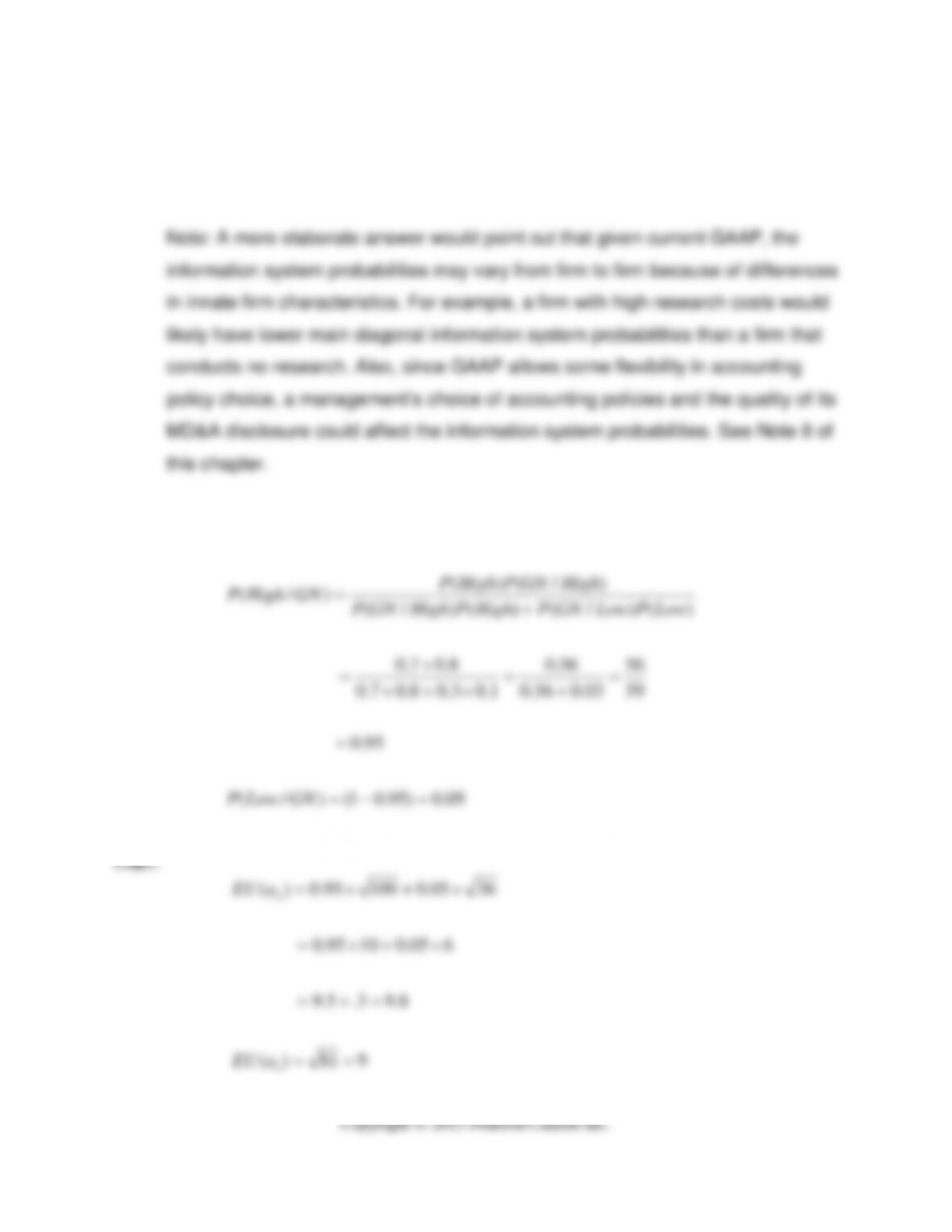
c. By Bayes’ theorem, the posterior probability of the high state, based on
GN in earnings, is:
05.0)95.01()/(
95.0
59
56
03.056.0
56.0
1.03.08.07.0
8.07.0
)()/()()/(
)/()(
)/(
=−=
=
=
+
=
×+×
×
=
+
=
GNLowP
LowPLowGNPHighPHighGNP
HighGNPHighP
GNHighP
Then:
981)(
8.93.5.9
605.01095.0
3605.010095.0)(
1
2
==
=+=
×+×=
×+×=
aEU
aEU

Scott, Financial Accounting Theory, 7th Edition Instructor’s Solutions Manual Chapter 3
113
15. a.
Note: Since the low state payoff for Q exceeds that of P by more than the high
state payoff for P exceeds that of Q, and the prior probabilities are the same for
each firm, an intuitive answer without calculations to invest in Q is acceptable,
providing an explanation is given..
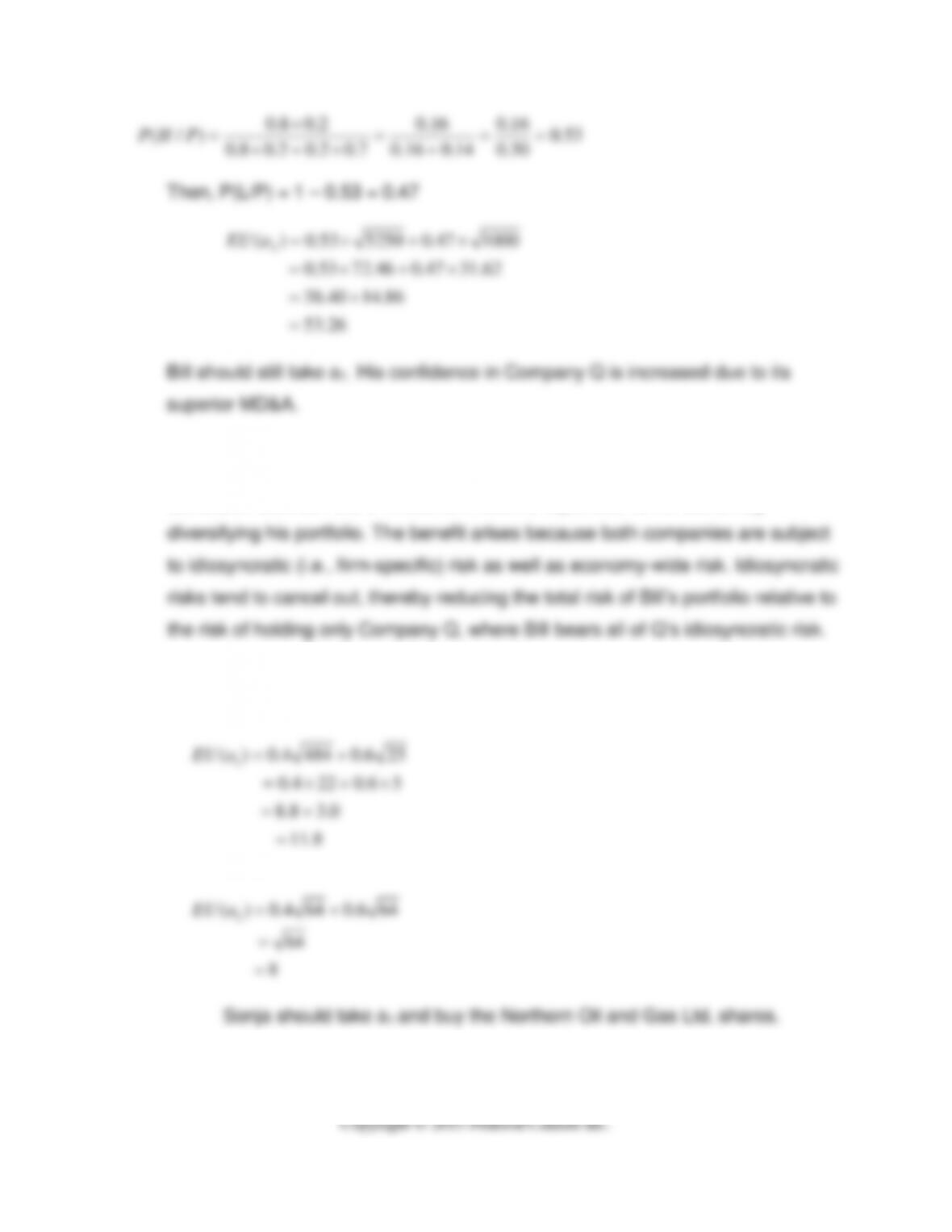
b. Denote good disclosure by G, and poor disclosure by B. Then, by Bayes’
theorem:
Company Q
37.68
02.435.64
=
+=
Company W
Scott, Financial Accounting Theory, 7th Edition Instructor’s Solutions Manual Chapter 3
114
16.0
16.0
2.08.0
×
c. You make this suggestion because Bill is risk averse. Thus, unless the
correlation between the 2 investment returns is perfect, he will benefit by
16. a.
Sonja’s expected utilities based on her prior probabilities:
8.11
0.38.8
56.0224.0
256.04844.0)(
1
=
+=
×+×=
+=aEU
8
64
646.0644.0)(
2
=
=
+=aEU
Sonja should take a1 and buy the Northern Oil and Gas Ltd. shares.
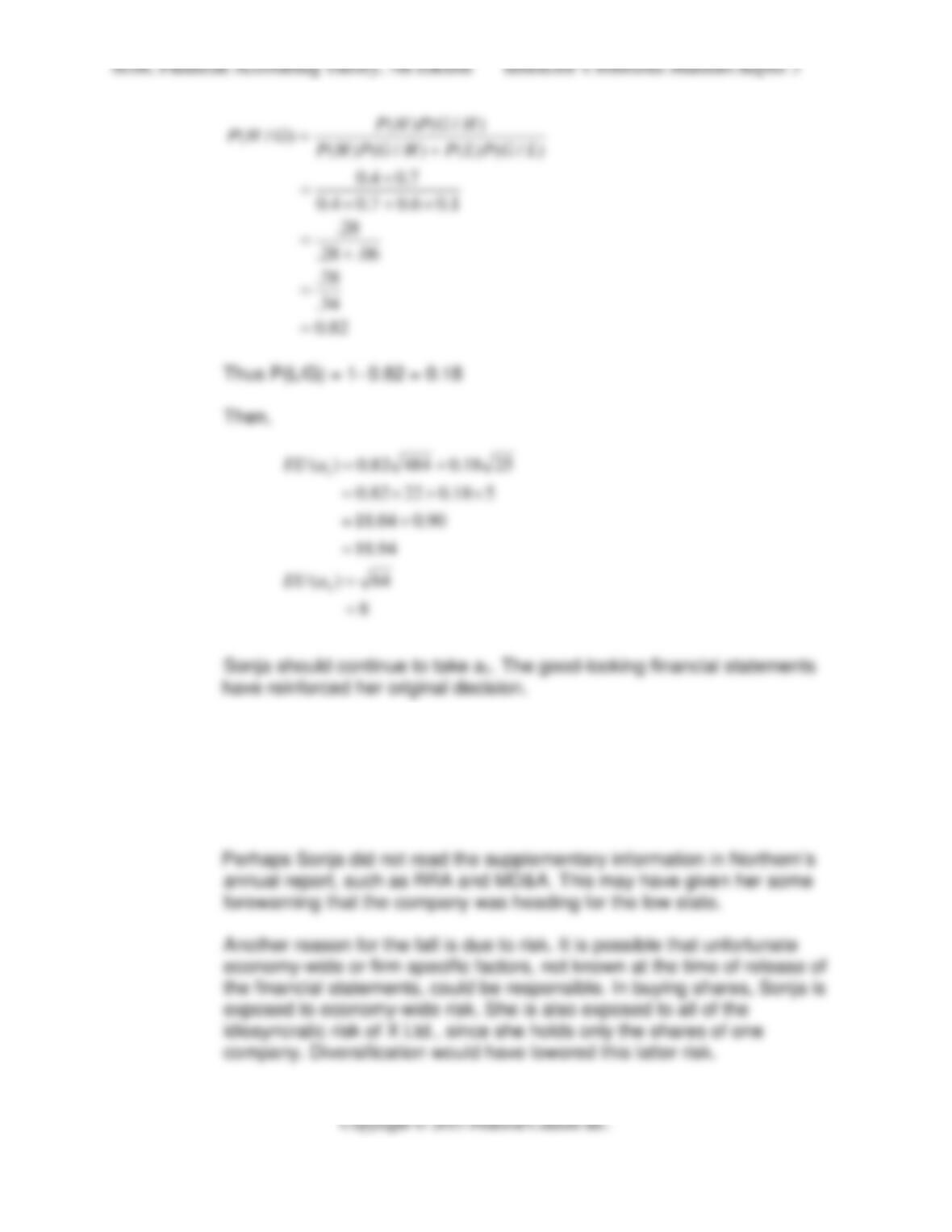
b. By Bayes theorem:
115
28.
1.06.07.04.0
7.04.0
)/()()/()(
)/()(
)/(
×+×
×
=
+
=
LGPLPHGPHP
HGPHP
GHP
c. Yes, a falling share price is possible. This is because financial statements
are not completely reliable. In fact, according to the information system,
there is a 0.1 probability that Northern could be in the low state but still
report good news in its financial statements.

Scott, Financial Accounting Theory, 7th Edition Instructor’s Solutions Manual Chapter 3
116
1
17. Let the two states of nature be:
D You have the disease
ND You do not have the disease
Let the messages you may receive be:
P Test results positive
N Test results negative
The information system is:
Message
P N
State
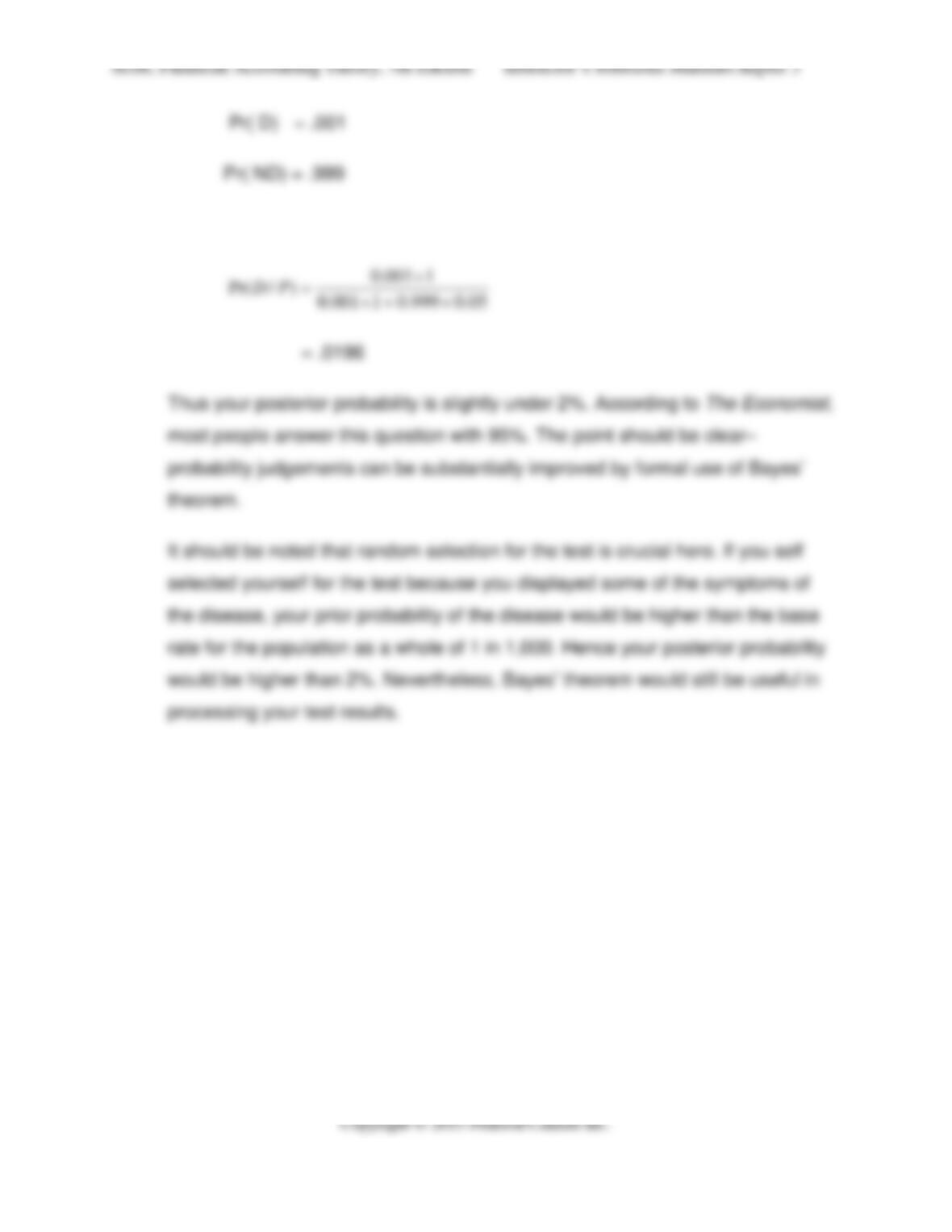
Since one person per thousand in the population has the disease, your prior
probabilities are:
117
Your posterior probability of D, by Bayes’ theorem, is:
1001.0
×
Scott, Financial Accounting Theory, 7th Edition Instructor’s Solutions Manual Chapter 3
118
Copyright © 2015 Pearson Canada Inc.
Additional Problems
3A–1. A problem that complicates the relationship between current reported earnings
and future earning power is when to recognize revenue as earned. IAS 18 states
that revenue should be recognized when significant risks and rewards of
A case in point is Nortel Networks Corporation. In its 2000 annual report, Nortel
stated:
The competitive environment in which we operate requires that we, and many of
our principal competitors, provide significant amounts of medium–term and long–
term customer financing….At December 31, 2000, we had entered into certain