Scott, Financial Accounting Theory, 7th Edition Instructor’s Solutions Manual Chapter 2
47
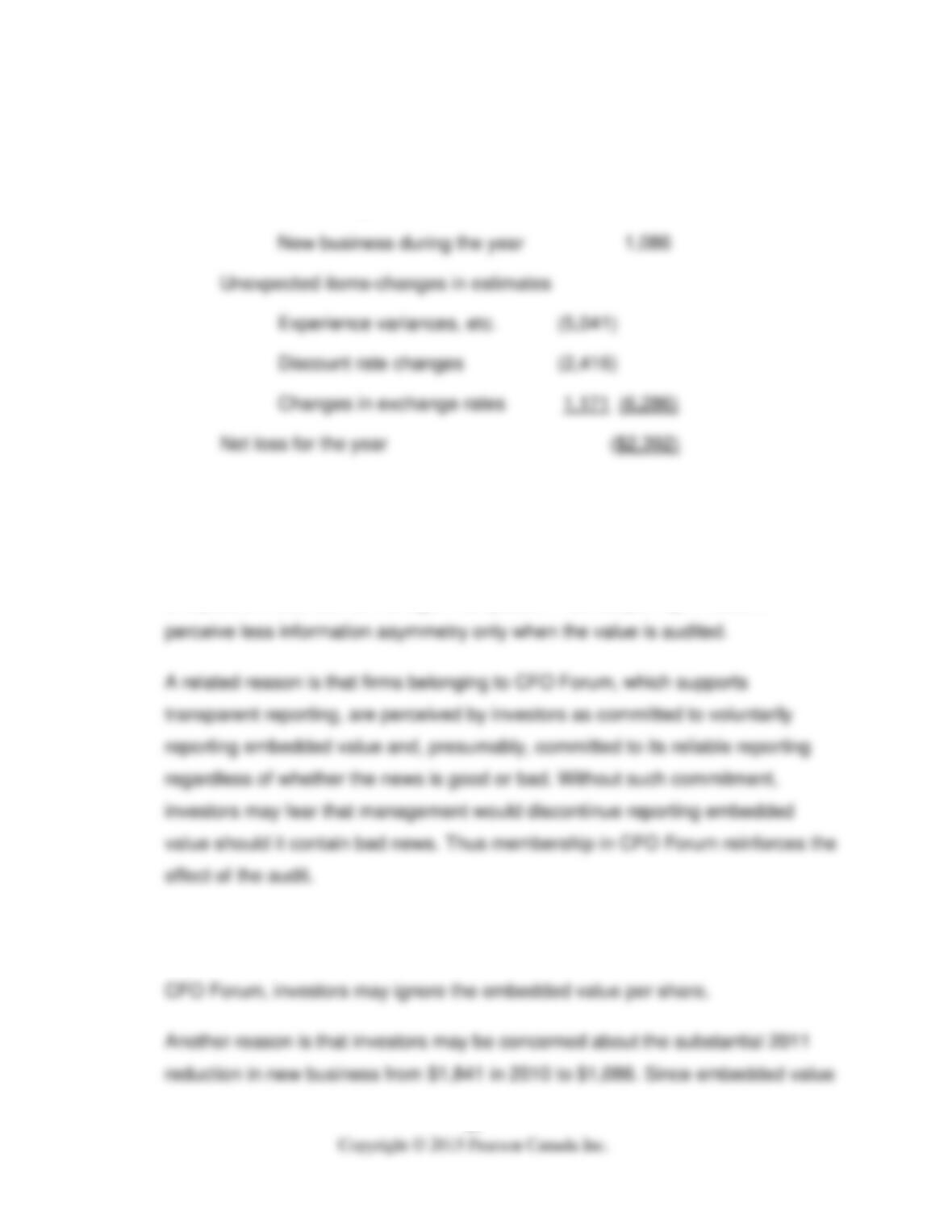
Accretion of discount $2,808
Abnormal earnings
b. The most likely reason is low reliability of the embedded value. Without an
audit to check the calculations, embedded value is subject to calculation error
and possible bias due to manager manipulation. Consequently, investors
c. One reason for the difference follows from the arguments in b. Since it
appears that Manulife neither has its embedded value audited nor belongs to
Scott, Financial Accounting Theory, 7th Edition Instructor’s Solutions Manual Chapter 2
48
does not include expected new business in future years, investors may be
concerned that the 2011 new business reduction will continue.
Note: Other possible reasons, which anticipate text topics not yet covered,
include:
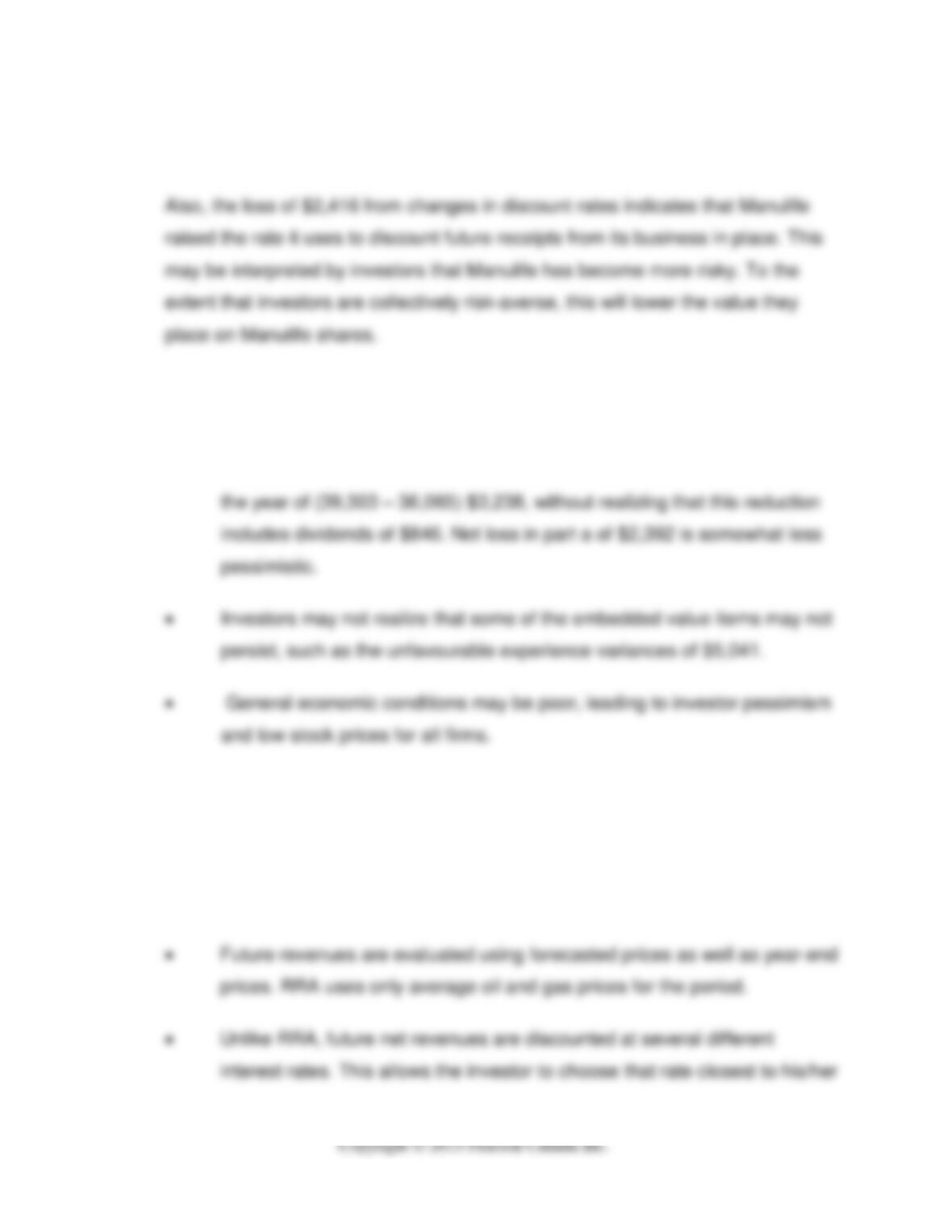
• Investors may be concerned about the reduction in embedded value for
28. a. The National Instrument 51–101 disclosures are more relevant than those
of RRA. Reasons include:
• Information about probable reserves is given in addition to information
about proved reserves.
Scott, Financial Accounting Theory, 7th Edition Instructor’s Solutions Manual Chapter 2
49
b. Points to consider:
• A reasonably precise definition of proved reserves and unproved reserves.
This adds to representational faithfulness.
c. Reasons for the disclaimer:
• Companies may be concerned about the reliability of their estimates, and
wish to alert investors to this possibility.
Scott, Financial Accounting Theory, 7th Edition Instructor’s Solutions Manual Chapter 2
50
29. a. A theoretically correct measure of income is the net income of a firm for a
period calculated on a present value basis; that is, accretion of discount on
opening firm present value, plus or minus any differences between expected and
actual cash flows for the period.
Scott, Financial Accounting Theory, 7th Edition Instructor’s Solutions Manual Chapter 2
51
cash flows face serious problems of reliability, as do the inputs into valuation
models.

52
Additional Problems
2A-1. Note: In this problem, state probabilities are not independent over time.
XYZ Ltd. purchased an asset on January 1, 2005 with a useful life of two years,
at the end of which time it has no residual value. The cash flows from the asset
are uncertain. If the economy turns out to be “normal,” the asset will generate
$4,000 in cash flow each year; if the economy is “bad,” it will generate $3,000 in
cash flow per year; and if the economy is “good,” the cash flow generated will be
$5,000 per year. Cash flows are received at year–end. In each year, the chances
of a “normal” economy being realized are 30%, the chances of a “bad” economy
are 50%, and the chances of a “good” economy are 20%. State realization for
both years becomes publicly known at the end of 2005, that is, if the normal state
happens for year 1, it will also happen for year 2, etc.
Assumptions
• Ideal conditions hold under uncertainty.
• The economy–wide interest rate is 10%.
• XYZ Ltd. finances the asset purchase partly by a bond issue and partly by
a common share issue. The bond has a $3,000 face value and a 10%
coupon rate and matures on December 31, 2001.
• XYZ Ltd. has adopted the policy of paying out 50% of its net income as
dividends to its shareholders.
• The economy turns out to be “good.”
Required
a. Calculate the present values of the asset at January 1, 2005, and
December 31, 2005.

Scott, Financial Accounting Theory, 7th Edition Instructor’s Solutions Manual Chapter 2
53
b. Prepare the present value–based income statement of XYZ Ltd. for the
year ended December 31, 2005.
c. Prepare the present value–based balance sheet of XYZ Ltd. as at
December 31, 2005.
d. Explain why, even under uncertainty, present value–based financial
statements are both relevant and reliable provided ideal conditions hold.
e. Explain why shareholders of XYZ Ltd. are indifferent to whether they
receive any dividend from the company.
2A-2. Relevant Ltd. operates under ideal conditions of uncertainty. Its operations are
highly dependent on the weather. For any given year, the probabilities are 0.3
that the weather will be bad and 0.7 that it will be good. These state probabilities
are independent over time. That is, the state probabilities for a given year are not
affected by the actual weather in previous years.
Relevant Ltd. produces a single product for which the demand will fall to zero at
the end of 2 years. It produces this product using specialized machinery, which
will have no value at the end of 2 years. The machinery was purchased on 1
January, 2005. It was financed in part by means of a bank loan of $2,000
repayable at the end of 2006, with the balance financed by capital stock. No
dividends will be paid until the end 2006. Interest on the bank loan is payable at
the end of each year. The interest rate in the economy is 6%.
Cash flows are not received until the end of each year. Amounts of cash flows for
each year are given in the following payoff table:
Cash Flow Cash Flow
State Probability Year 1 Year 2
Bad weather 0.3 $600 $400
Good weather 0.7 $6000 $3000

Scott, Financial Accounting Theory, 7th Edition Instructor’s Solutions Manual Chapter 2
54
State realization for 2005 is good weather.
Required
a. Prepare, in good form, a balance sheet for Relevant Ltd. as at the end of
2005 and an income statement for 2005.
b. As at January 1, 2006, how much is expected net income for 2006?
c. Explain why the financial statements you have prepared in part a are both
completely relevant and completely reliable.
2A-3. An area where discounting could possibly be applied is for future income tax
liability resulting from timing differences. Consider a firm that purchases an asset
costing $100,000 on January 1 of year 1. It is amortized on a straight–line basis at
20% per year on the firm’s books. Tax amortization is 40% on a declining –
balance basis. The income tax rate is 45%.
The following schedule shows a simplified calculation of the income tax liability balance
for this asset over its life, assuming zero salvage value. This is the firm’s only capital
asset.
Straight–
Opening Tax Line
Year Tax B.V. Additions Amortization Amortization Difference
1 — $100,000 $40,000 $20,000 $20,000
2 60,000 24,000 20,000 4,000
3 36,000 14,400 20,000 (5,600)
4 21,600 8,640 20,000 (11,360)
5 12,960 12,960* 20,000 (7,040)
Tax on Income Tax

Scott, Financial Accounting Theory, 7th Edition Instructor’s Solutions Manual Chapter 2
55
Year Difference Liability
1 9,000 9,000
2 1,800 10,800
3 (2,520) 8,280
4 (5,112) 3,168
5 (3,168) 0
*It is assumed that all of the remaining tax book value is claimed in year 5.
Required
a. Calculate the discounted present value of the future income tax liability at
the end of each of years 1 to 5. Use a discount rate of 12%.
b. Why are the balances calculated in part a different from the undiscounted
income tax liabilities?
c. What problems would there be if the discounting approach was applied to
the tax liability of a large, growing firm with many capital assets?
2A-4. On January 1, 2005, GAZ Ltd. purchased a producing oil well, with an estimated
life of 15 years, and started operating it immediately. The management of GAZ
Ltd. calculated the present value of future net cash flows from the well as
$1,500,000. The discount rate used was 10%, which is the company’s expected
return on investment. During 2005, GAZ Ltd. recorded cash sales (net of
production costs) of $600,000. GAZ Ltd. also paid $50,000 cash dividends during
2000.
Required
a. Prepare the income statement of GAZ Ltd. for the year ended December
31, 2005, using RRA.

Scott, Financial Accounting Theory, 7th Edition Instructor’s Solutions Manual Chapter 2
56
b. Prepare the balance sheet of GAZ Ltd. as at December 31, 2005, using
RRA.
c. Summarize the perceived weaknesses of RRA accounting.
d. Why does SFAS 69 require that a 10% discount rate should be used by all
oil and gas firms rather than allowing each firm to select its own discount rate?
2A-5 Rainy Ltd. operates under ideal conditions of uncertainty. Its cash flows depend
crucially on the weather. On January 1, 2010, Rainy acquired equipment to be
used in its operations. The equipment will last two years, at which time its
salvage value will be zero. Rainy financed the equipment purchase by issuing
common shares.
In 2010, net cash flows will be $700 if the weather is rainy and $200 if it is dry.
In 2011, cash flows will be $900 if the weather is rainy and $300 if it is dry. Cash
flows are received at year–end. In each year, the probability that the weather is
rainy is 0.3 and 0.7 that it is dry. The interest rate in the economy is 6% in both
years.
Rainy pays a dividend of $50 at the end of 2010.
Required
a. In 2010, the weather is rainy. Prepare a balance sheet as at the end of
2010 and an income statement for 2010.
b. If we attempt to apply the present value model under uncertainty to the
more realistic conditions under which accountants operate, the expected
present value calculations often become unreliable. Explain why.
c. Explain why well–defined (i.e., “true”) net income does not exist under the
realistic conditions under which accountants operate. In place of true net
Scott, Financial Accounting Theory, 7th Edition Instructor’s Solutions Manual Chapter 2
Copyright © 2015 Pearson Canada Inc.
57
income, what criterion have accountants adopted to guide their financial
accounting and reporting decisions?
Suggested Solutions to Additional Problems
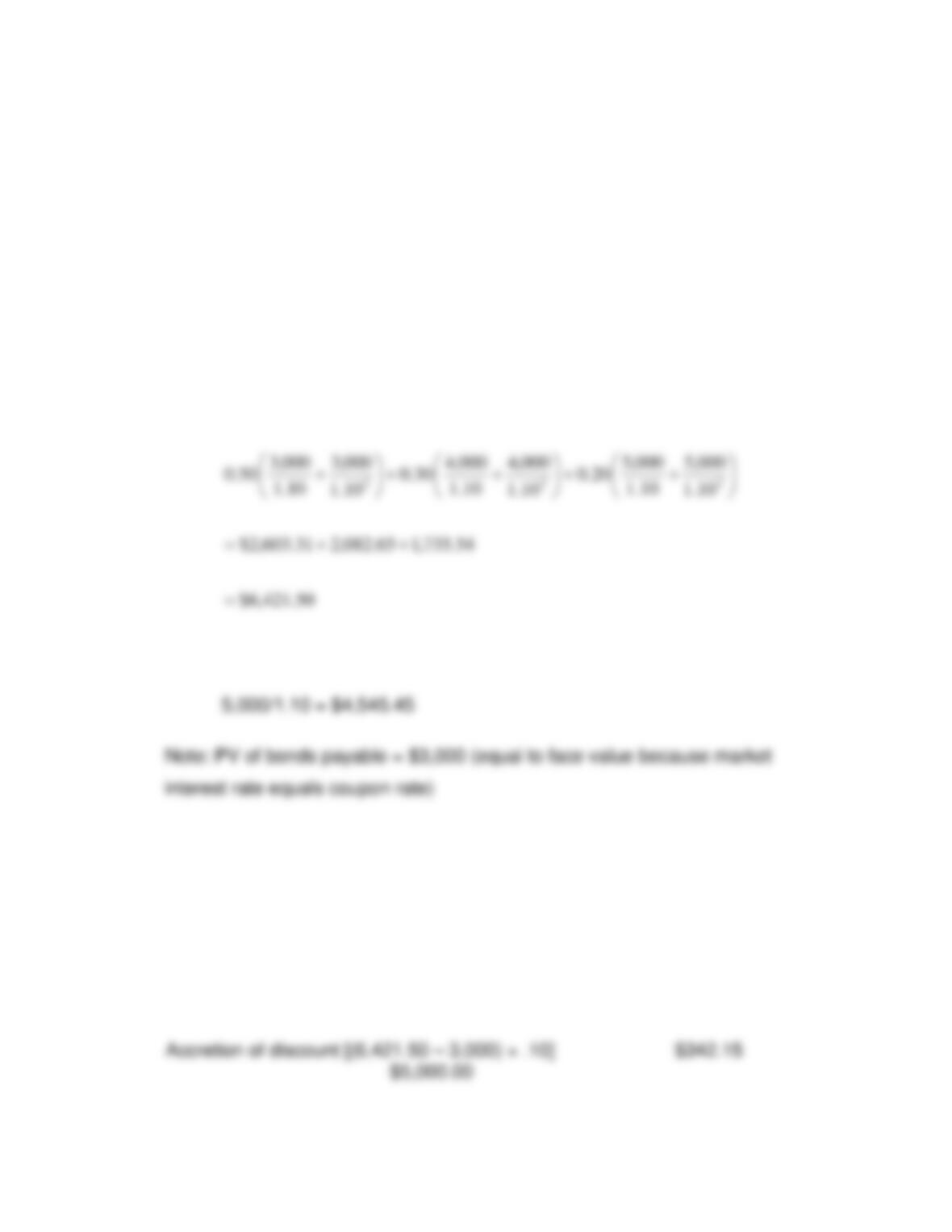
2A-1. a. Expected present value of asset on January 1, 2005:
50.421,6$
10.1
000,5
10.1
000,5
20.0
10.1
000,4
10.1
000,4
30.0
10.1
000,3
10.1
000,3
50.0 222
=
++
+
+
+
Expected present value of asset on December 31, 2005, given “good” economy:
b.
XYZ Ltd.
Income Statement
For the Year Ended December 31, 2005