
Scott, Financial Accounting Theory, 7th Edition Instructor’s Solutions Manual Chapter 2
7
CHAPTER 2
ACCOUNTING UNDER IDEAL CONDITIONS
2.1 Overview
2.2 The Present Value Model Under Certainty
2.2.1 Summary
2.3 The Present Value Model Under Uncertainty
2.3.1 Summary
2.4 Examples of Present Value Accounting
2.4.1 Embedded Value
2.4.2 Reserve Recognition Accounting (RRA)
2.4.3 Critique of RRA
2.4.4 Summary of RRA
2.5 Historical Cost Accounting Revisited
2.5.1 Comparison of Different Measurement Bases
2.5.2 Conclusion
2.6 The Non–Existence of True Net Income
2.7 Conclusion to Accounting Under Ideal Conditions
LEARNING OBJECTIVES AND SUGGESTED TEACHING APPROACHES
1. To Appreciate the Concept of Ideal Conditions
This concept is drawn on throughout the book. Roughly speaking, by ideal conditions I
mean conditions where future firm cash flows and interest rates are known with
certainty or, if not known with certainty, where there is a complete and publicly known

Scott, Financial Accounting Theory, 7th Edition Instructor’s Solutions Manual Chapter 2
8
set of states of nature and associated objective probabilities which enables a completely
relevant and reliable expected present value of the firm to be calculated.
I assume risk-neutral investors in this Chapter, so that valuation of the firm is on the
basis of expected present value, that is, no adjustment for risk is needed. The concept
of a risk–averse investor is introduced in Section 3.4, and a capital asset pricing model
of the firm’s shares is described in Section 4.5.
2. To Use the Present Value Model Under Ideal Conditions to Prepare an
Articulated Set of Financial Statements for a Simple Firm
The text limits itself to financial statements for the first year of operations. The problem
material extends the accounting to a subsequent year (see problems 1, 2, 3, 5, 15, and
19). In subsequent years, the firm earns interest on opening cash balance. This is
picked up by the accretion of discount calculation, since cash is included in opening net
assets. Interest earned on cash balances leads naturally to the role of dividends in
present–value accounting and the concept of dividend irrelevance.
3. To Critically Evaluate Reserve Recognition Accounting (RRA) as an
Application of the Present Value Model
I usually allow some class time to criticize the assumptions of ideal conditions. Some
students want to “blow off steam” because they perceive these assumptions as quite
strong. I find that RRA is an excellent vehicle both to motivate and critique present
value–based accounting. The fact that it is on line encourages students to take the
present value model seriously, which I emphasize by basing class discussion on an
example of RRA disclosure for a Canadian oil and gas firm that also reports to the SEC.
Such disclosures are usually in SEC Form 40–F, not in the annual report (which says
something about management’s view of RRA).
I also emphasize the point that present value–based accounting products run into
severe implementation problems when the ideal conditions they need do not hold.

Scott, Financial Accounting Theory, 7th Edition Instructor’s Solutions Manual Chapter 2
9
I sometimes receive comments that the text over–emphasizes RRA. I find RRA so
helpful to illustrate numerous course concepts that I have resisted such comments.
However, instructors may wish to emphasize that RRA, based on a United States
accounting standard, is relevant to Canadian oil and gas firms whose shares are traded
in the United States. In this regard, it is worth noting that Husky Energy Inc., used as the
text RRA illustration in Section 2.4.2, is a Canadian–based corporation.
4. Historical Cost Accounting in the Mixed Measurement Model
Instructors may wish to discuss historical cost accounting in relation to current value
accounting, since historical cost is still an important component of the mixed
measurement model. Section 2.5 compares these measurement bases in terms of
relevance and reliability, timing of revenue recognition, recognition lag, and matching.
This is a good place to emphasize the trade–off between relevance and reliability, and
how different measurement bases imply different trade–offs.
This is also a good place to discuss the relative importance of the balance sheet and
income statements under the two measurement bases. That is, historical cost
accounting takes the view that the income statement is of greater importance because it
gives the current installment of the firm’s earning power, and provides a place to start to
predict future firm performance. Under current value accounting, the balance sheet is of
greater performance, the argument being that current values of assets and liabilities
provides a better prediction of future firm performance.
6. To Question the Existence of Net Income as a Well–Defined Economic
Construct
I use the reliability problems of RRA to question the existence of “true” economic
income except under ideal conditions. With the text example, or some other example, of
RRA disclosure in front of us, I ask the students if they would be willing to pay the RRA
value for the proved reserves of an oil and gas company. Discussion usually brings out
a negative response, for reasons such as difficulties in assessing expected quantities

Scott, Financial Accounting Theory, 7th Edition Instructor’s Solutions Manual Chapter 2
10
and prices, disagreement with a 10% discount rate, possible inside information about
costs, additional reserves, etc.
I then point out that there are numerous other assets and liabilities for which a quoted
market price does not exist, and argue that information asymmetry is a major reason
why market prices may not exist. The market for used cars and problems surrounding
insurance markets in the presence of adverse selection and moral hazard provide other
examples of “missing” markets.
Having established that there are not quoted market prices available for “everything,” I
point out that it is then impossible to fully value a firm on this basis and, as a result, it is
also impossible to measure true economic income. I take a sort of perverse pleasure in
asking those students who are heading for a professional accounting career if they
really want to devote their lives to measuring something which does not exist. I am
careful to end on an upbeat note, however, by pointing out that lack of a true measure
of income means that a large amount of judgement is required to come up with a useful
measure, and that judgement is the basis of a profession.
I usually do not go further than the above intuitive argument that incomplete markets are
at the heart of problems of income measurement. However, instructors who wish to dig
into incompleteness more deeply and precisely can assign Beaver & Demski’s “The
Nature of Income Measurement” (The Accounting Review, January, 1979).
Scott, Financial Accounting Theory, 7th Edition Instructor’s Solutions Manual Chapter 2
Suggested Solutions to Questions and Problems
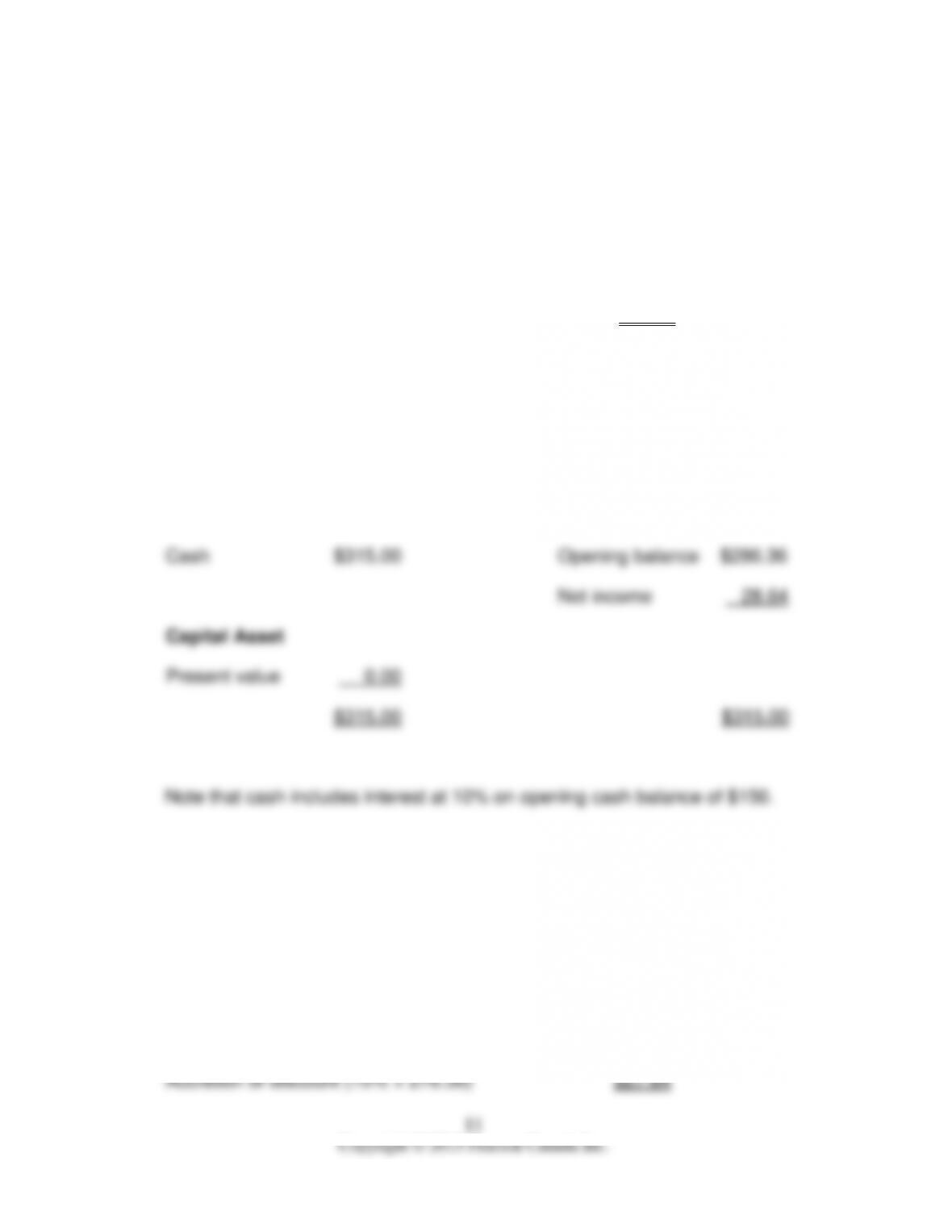
1.
P.V. Ltd.
Income Statement for Year 2
Accretion of discount (10% × 286.36) $28.64
P.V. Ltd.
Balance Sheet
As at Time 2
Financial Asset Shareholders’ Equity
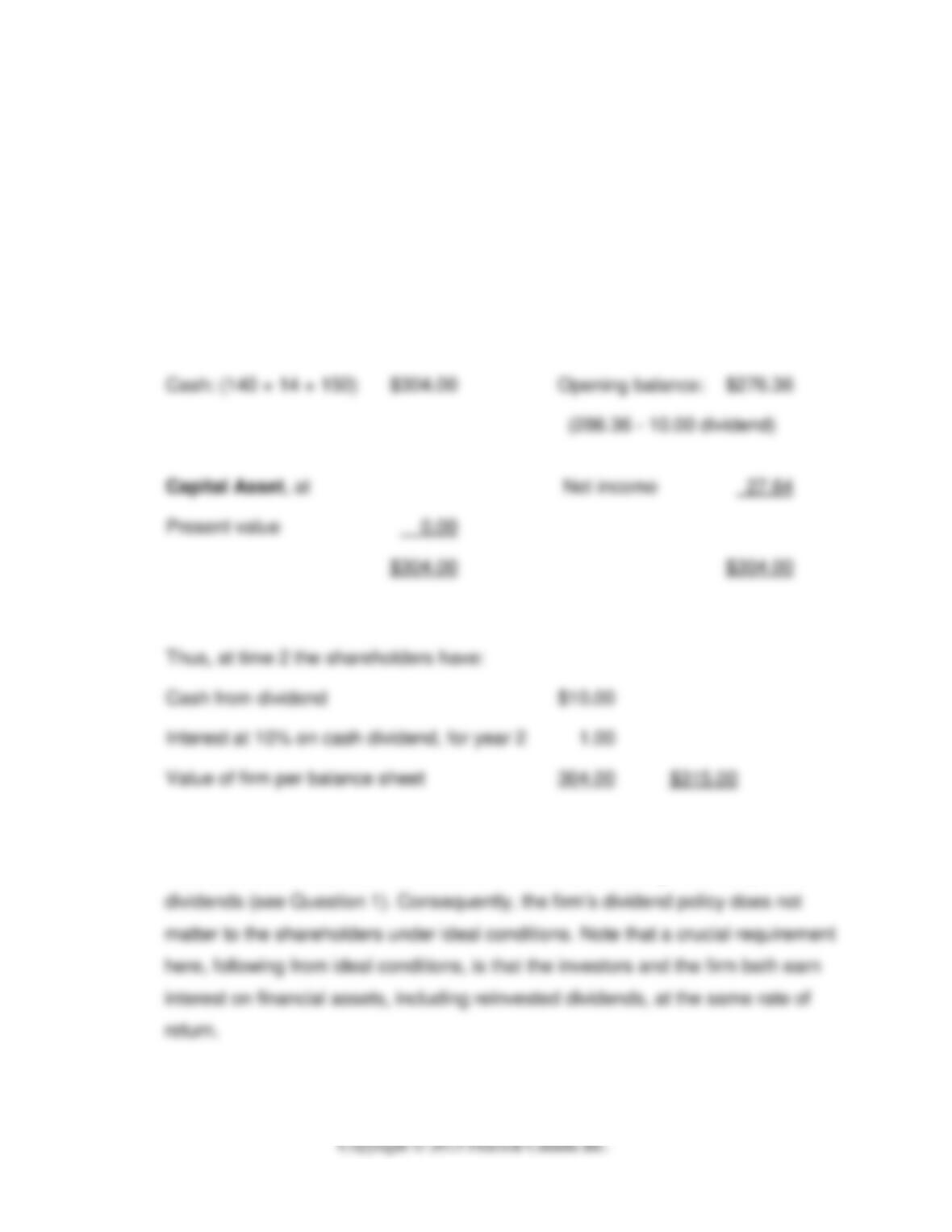
2. Suppose that P.V. Ltd. paid a dividend of $10 at the end of year 1 (any portion of
year 1 net income would do). Then, its year 2 opening net assets are $276.36,
and net income would be:
P.V. Ltd.
Income Statement
For Year 2
Scott, Financial Accounting Theory, 7th Edition Instructor’s Solutions Manual Chapter 2
12
P.V.’s balance sheet at time 2 would be:
P.V. Ltd.
Balance Sheet
As at Time 2
Financial Asset Shareholders’ Equity
This is the same value as that of the firm at time 2, assuming P.V. Ltd. paid no
13
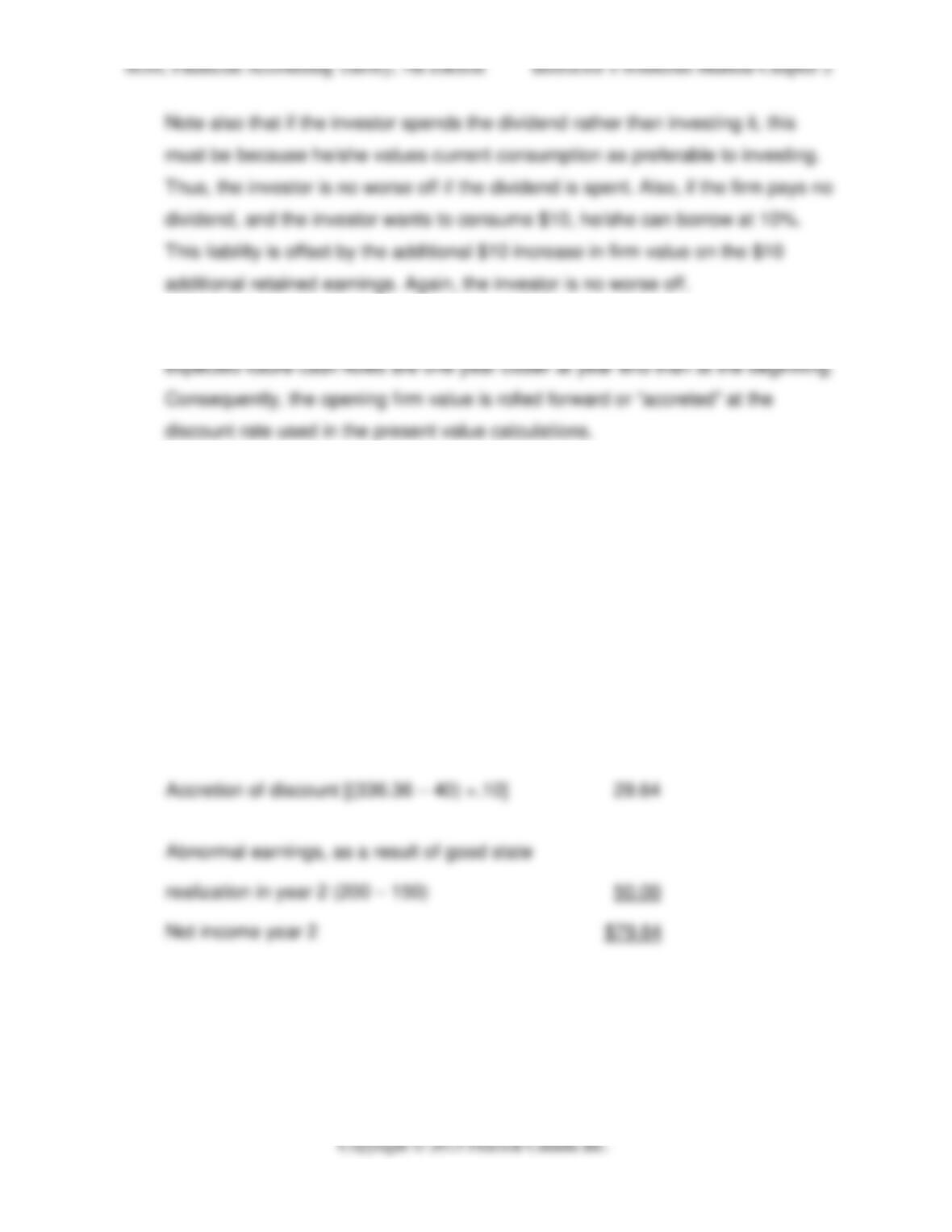
3. Expected net income is also called accretion of discount because the firm’s
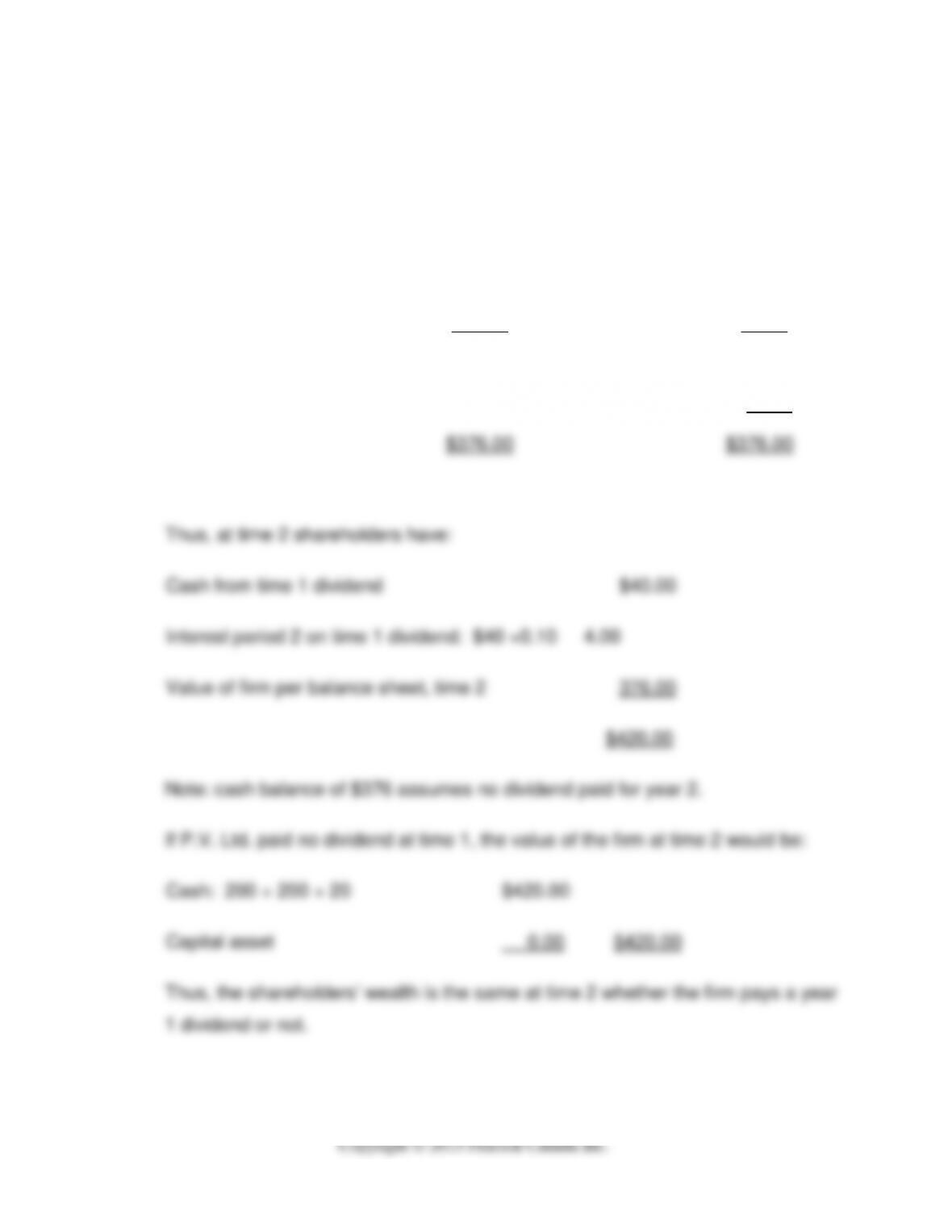
4. The procedure here is similar to that used in Question 2. Assume that the good
economy state is realized for year 1. Assume also that P.V. Ltd. pays a dividend
of, say, $40 at time 1. If the good economy state is also realized in year 2, P.V.’s
year 2 net income will then be:
P.V. Ltd.
Income Statement
For Year 2
(good economy in year 2)
PV’s balance sheet at the end of year 2 will then be:
P.V. Ltd.
Scott, Financial Accounting Theory, 7th Edition Instructor’s Solutions Manual Chapter 2
14
Balance Sheet
As at Time 2
Financial Asset Shareholders’ Equity
Cash (200 – 40 + 200 + 16) $376.00 Opening balance $336.36
Less: Dividend end
Capital Asset 0.00 of year 1 40.00
$296.36
Add: Net income 79.64
15
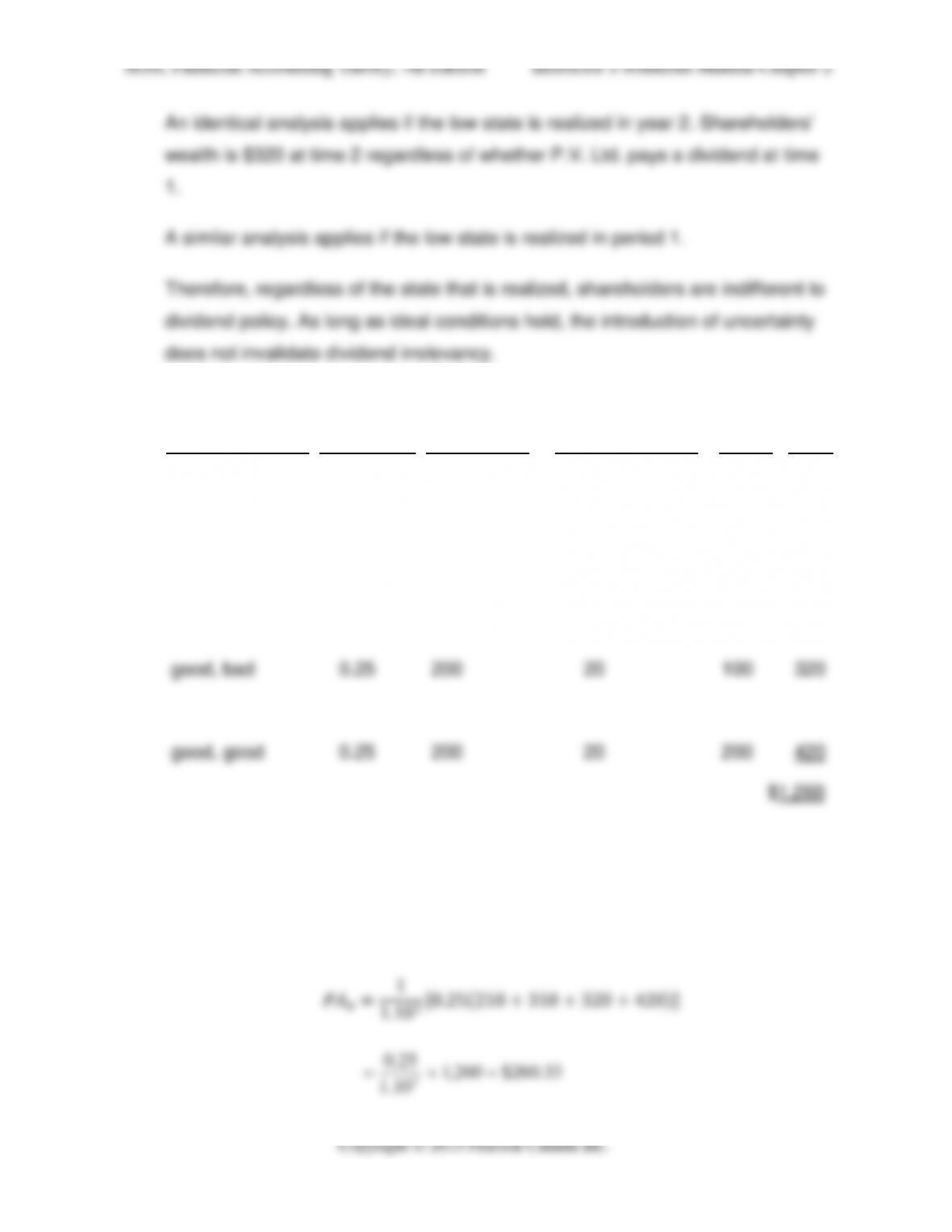
5. Cash end Interest on opening Sales
State realization Probability of year 1 cash balance year 2 Total
bad, bad 0.25 100 10 100 210
bad, good 0.25 100 10 200 310
Thus, the liquidating dividend will be $210, $310, $320, or $420; each with
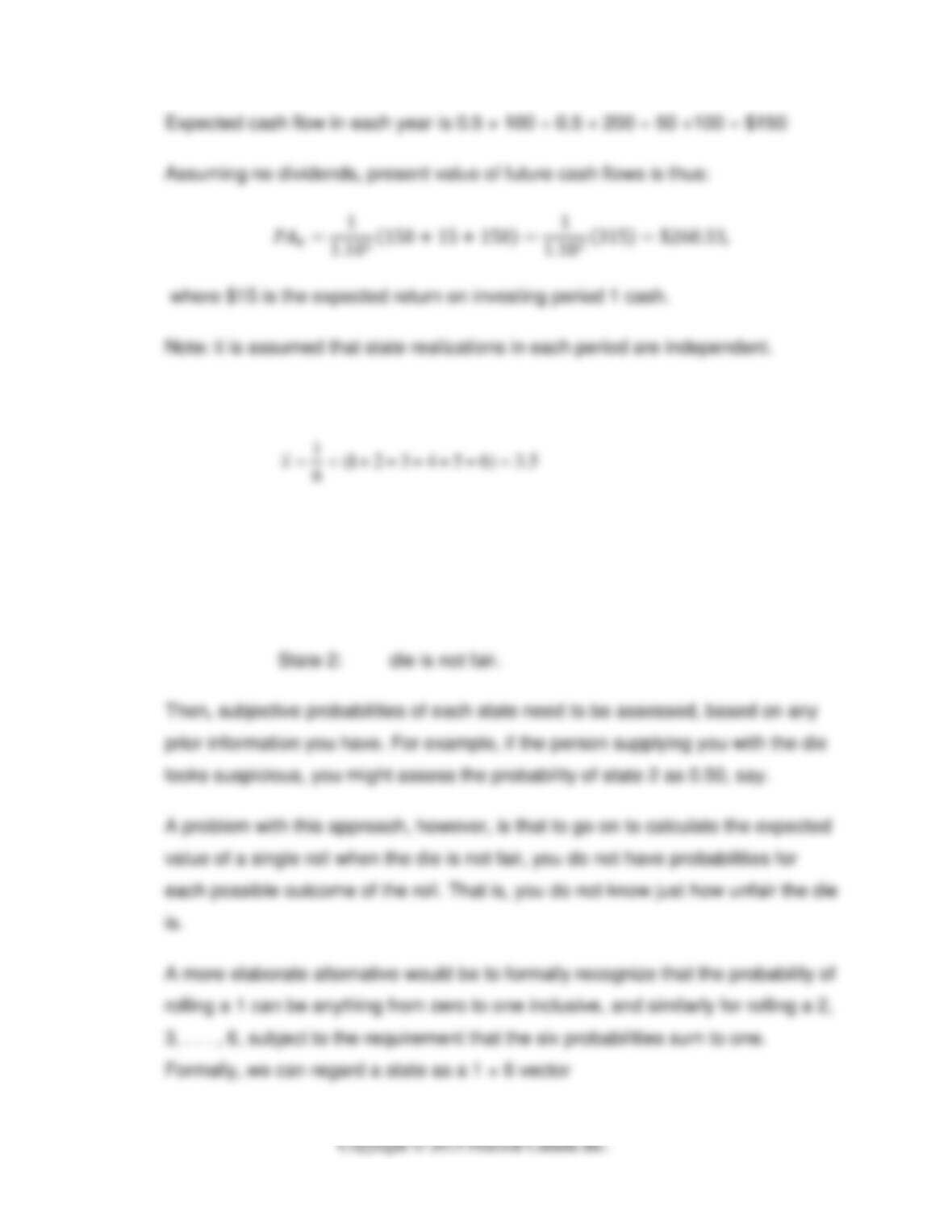
probability 0.25. Thus, present value, at time 0, of expected liquidating dividend
is:
10.1
2=×=
Scott, Financial Accounting Theory, 7th Edition Instructor’s Solutions Manual Chapter 2
16
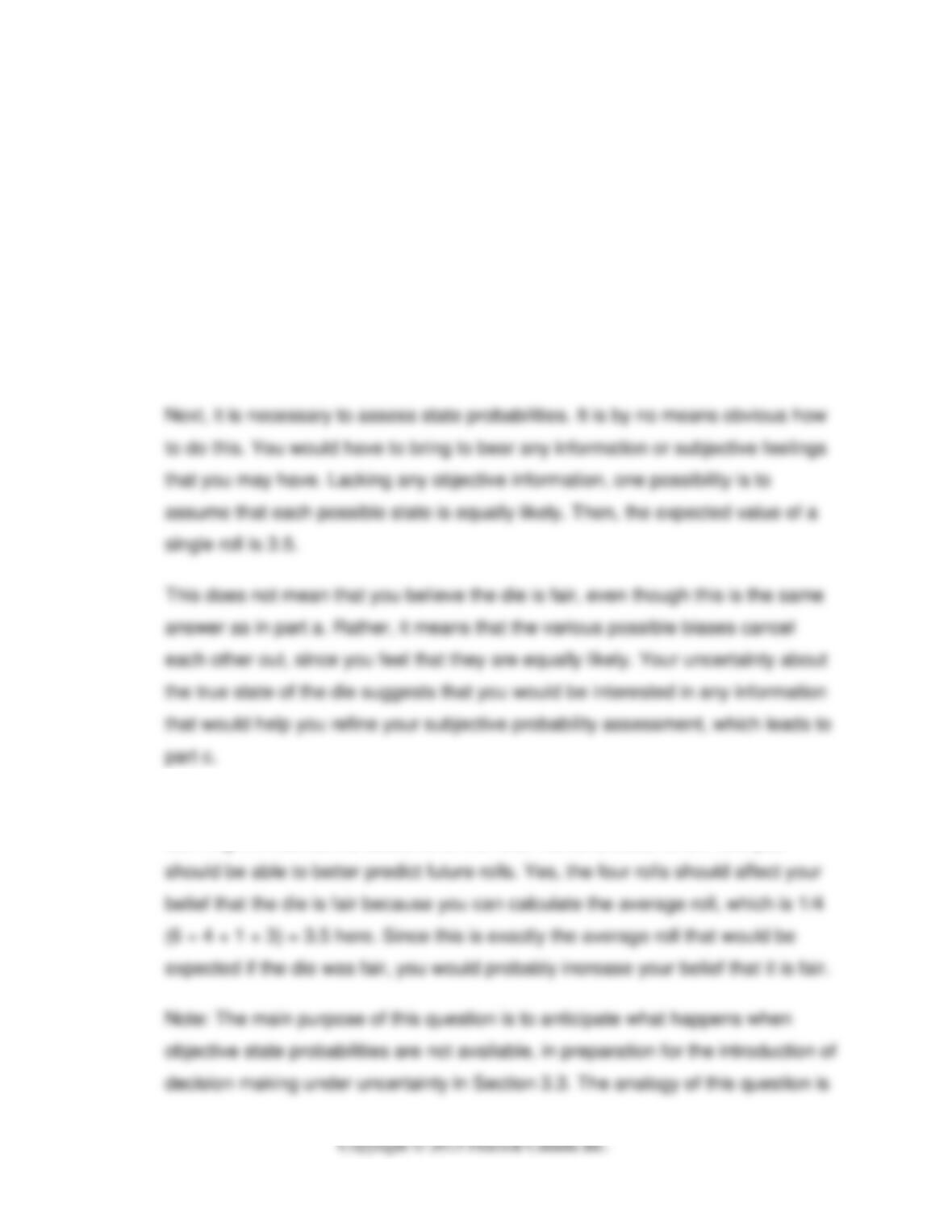
6. a. The expected value of a single roll of a fair die is:
6
1=+++++×=x
b. First, you would have to write down a set of possible states of nature for
the die. One simple possibility would be to define:
State 1: die is fair
Scott, Financial Accounting Theory, 7th Edition Instructor’s Solutions Manual Chapter 2
17
P = [ p1, p2, . . . , p6],
subject to pi ≥ 0
i = 1, 2, . . . , 6
∑ pi = 1
Thus, the set of states consists of all vectors satisfying these requirements. All
vectors except the one with all pi = 1/6 represent a different possible bias.
c. It will never be known with certainty whether the die is fair or not because
luck might influence the outcome of the rolls. However, after a few rolls you

Scott, Financial Accounting Theory, 7th Edition Instructor’s Solutions Manual Chapter 2
18
7. Under ideal conditions of certainty, future cash flows are known by assumption.
Thus estimates are not applicable.
8. Under non–ideal conditions, it may be difficult to write down a complete set of
states of nature and associated cash flows. Even if these can be written down,
difficulties remain because objective state probabilities are not available. This is
9. Market value will be affected if the RRA information affects investors’ subjective
probabilities of states of nature concerning future firm performance. This could
happen, for example, if the RRA statements show an increase or decrease in the
present values of proved reserves. This evidence, while highly relevant, suffers
10. Relevant information is information that enables investors to estimate the present
value of future receipts from an asset (or payments under a liability). In an
accounting context, relevant information helps investors to predict future firm
performance, such as cash flows.
Reliable information is information that faithfully represents what it is supposed to
an interest rate must be specified for the discounting calculations. All of these
procedures are subject to errors and possible bias, reducing reliability. Thus, like
almost all predictions of the future, relevant information tends to be unreliable.
Conversely, reliable information, such as the historical cost of a capital asset or
the face value of debt, tends to be low in relevance because this basis of
21
11. Several reasons can be suggested why oil company managers have reservations
about RRA:
• The discount rate of 10% might not reflect the firm’s cost of capital.
• Low reliability. RRA involves making a large number of assumptions and
estimates. While RRA deals with low reliability in part by requiring average
12. a. Most industrial and retail firms regard revenue as earned at the point of
sale. Since sale implies a contract with the buyer and change of ownership, this
Scott, Financial Accounting Theory, 7th Edition Instructor’s Solutions Manual Chapter 2
is usually the earliest point at which significant risks and rewards of ownership
13. a. From a balance sheet perspective under ideal conditions, inventory is
valued at current value. This could be the present value of expected future cash
receipts from sale, that is, value–in-use. Alternatively, inventory could be valued
at market value, that is, at fair value since under ideal conditions these 2 values
would be the same).
23
14. This practice implies that revenue is recognized as cash is collected. This basis
of valuation might be used if the firm sells with little or no money down and a long
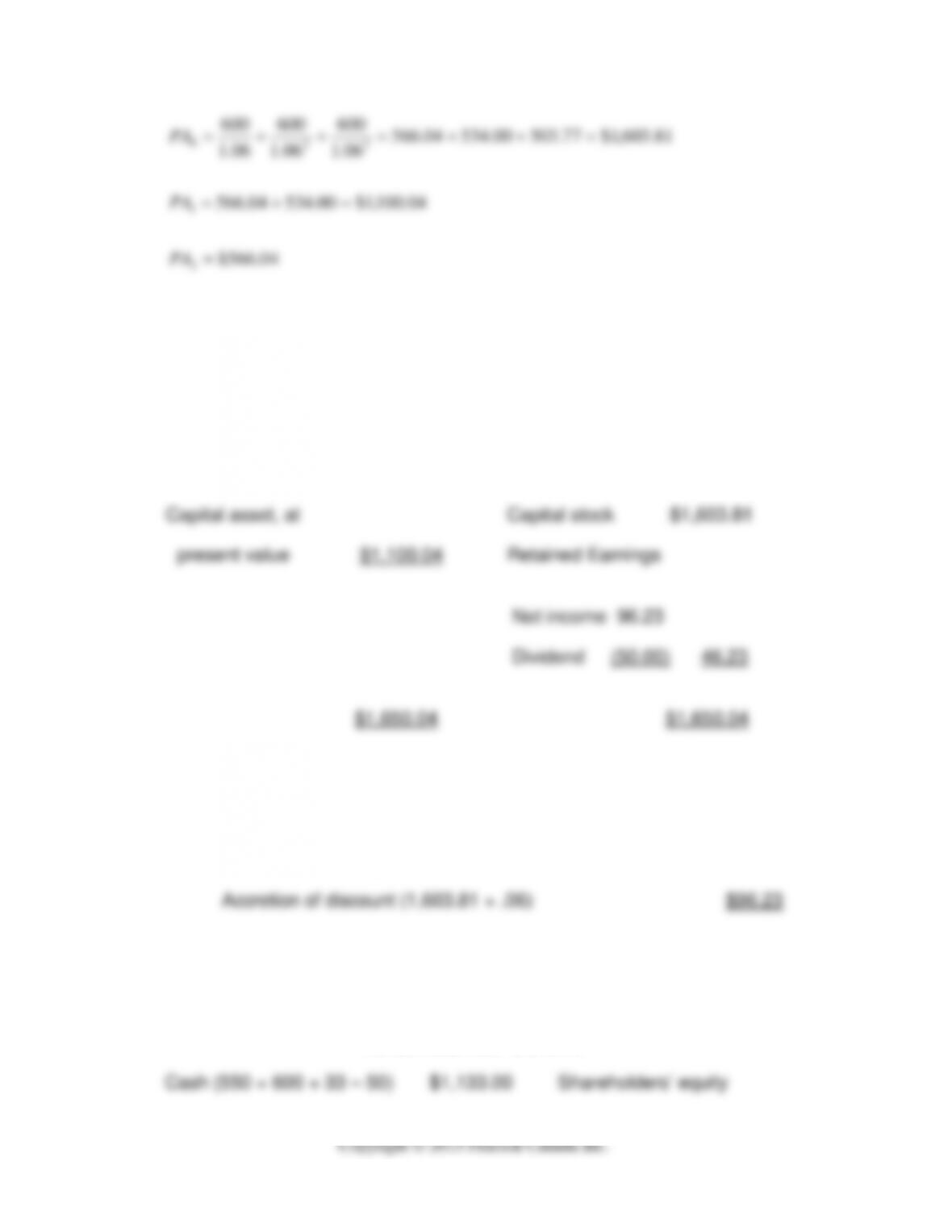
15. a. Present value of capital asset 2015, 2016, and 2017
Scott, Financial Accounting Theory, 7th Edition Instructor’s Solutions Manual Chapter 2
24
04.566$
81.603,1$77.50300.53404.566
06.1
600
06.1
600
06.1
600
2
1
32
0
=
=++=++=
PA
PA
Sure Corp.
Balance Sheet
As at December 31, 2015
Cash (600 – 50) $550.00 Shareholders’ equity
Sure Corp.
Income Statement
For the year ended December 31, 2015
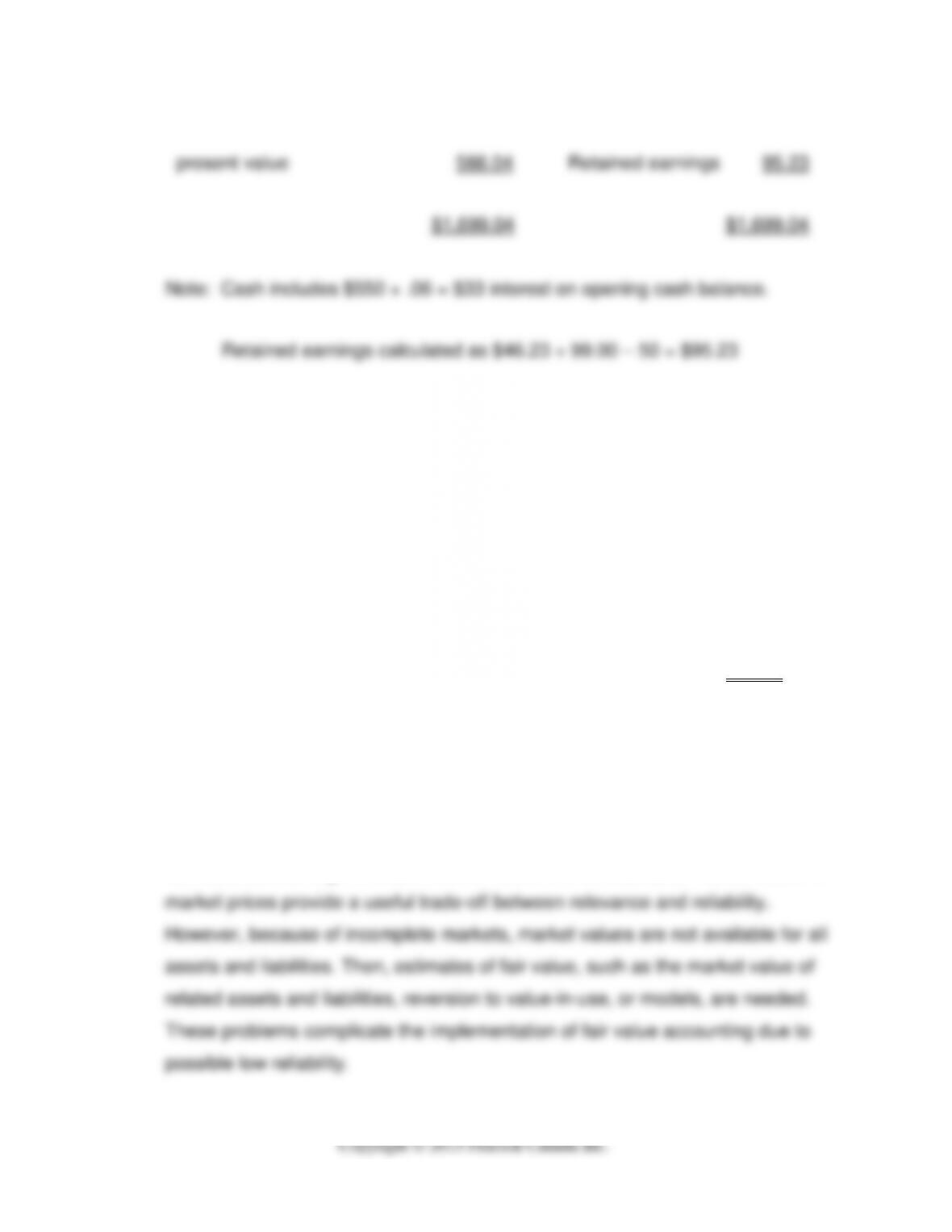
b. Sure Corp.
Balance Sheet
As at December 31, 2016
Scott, Financial Accounting Theory, 7th Edition Instructor’s Solutions Manual Chapter 2
25
Capital asset, at Capital stock $1,603.81
Sure Corp.
Income Statement
For the year ended December 31, 2016
Accretion of discount (1,650.04 × .06) $99.00
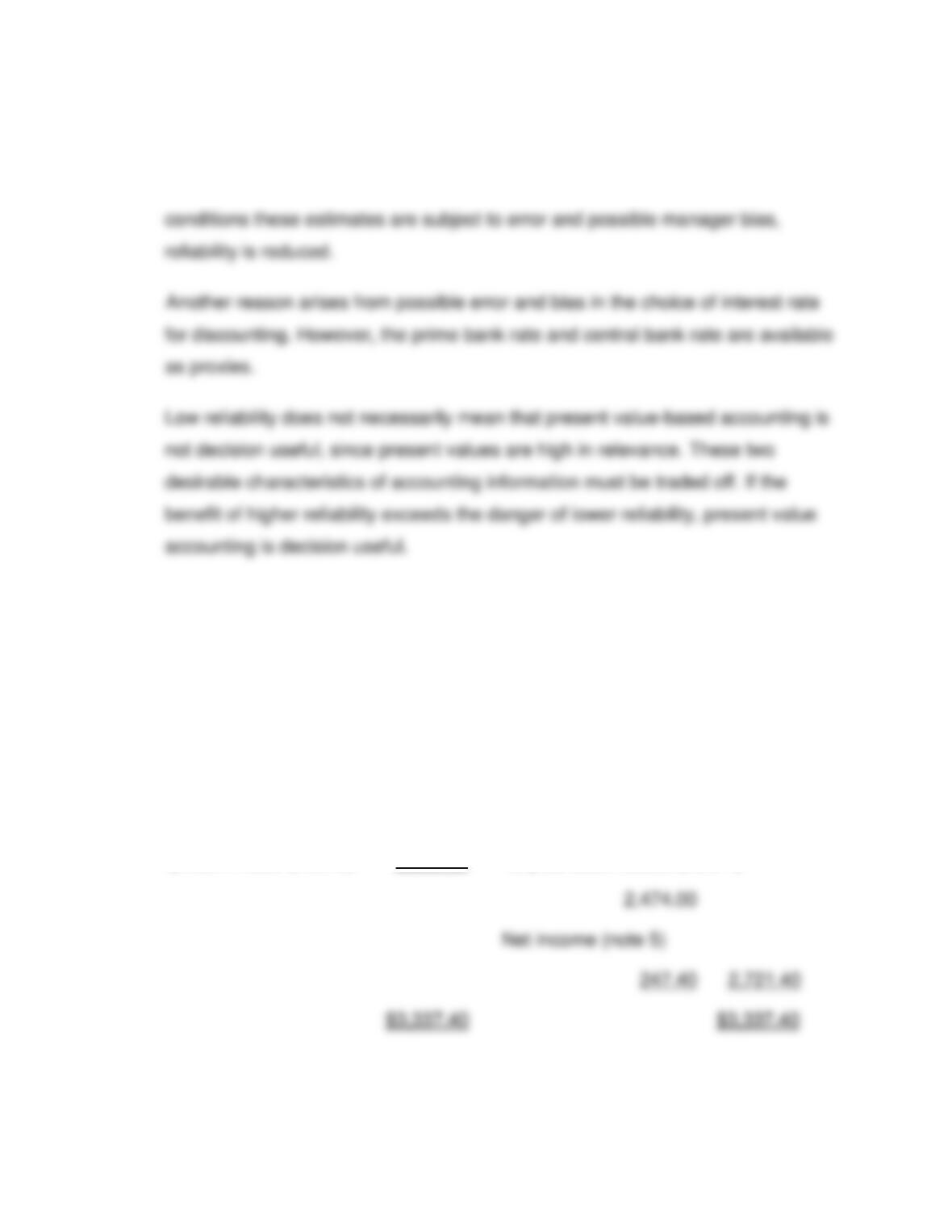
c. Under ideal conditions, present value and market value are equal. This is
because of arbitrage.
Under real conditions, market values provide only a partial implementation of
fair value accounting. If reliable market values are available, fair values based on
Scott, Financial Accounting Theory, 7th Edition Instructor’s Solutions Manual Chapter 2
Copyright © 2015 Pearson Canada Inc.
26
d. The main reason for low reliability is the difficulty of estimating expected
future cash flows, which would require a set of possible future cash flows (states
of nature) and subjective probabilities of these states. Since, under realistic
16. a. P Ltd.
Balance Sheet
As at End of First Year
Financial Asset Liabilities
Cash (note 1) $1,137.40 Bonds outstanding (note 3) $616.00
Capital Asset, at Shareholders’ Equity
present value (note 2) 2,200.00 Capital stock issued (note 4)
Notes: