Scott, Financial Accounting Theory, 7th Edition Instructor’s Solutions Manual Chapter 13
10. a. According to the public interest theory of regulation, OSFI would approve
the direct charge to retained earnings if it was concerned about Scotiabank’s
loan quality. OSFI knows that the failure of a major bank, or even public concern
about a bank’s financial condition, would cause significant economic and social
harm, and wishes to minimize the probability of this happening. Consequently, it
(CICA and OSC), increasing its influence over the banks, and increasing its
visibility in the eyes of investors.
c. Three arguments are possible here. First, the securities market would not
respond, since the direct charge to retained earnings does not affect cash flows,
and is fully disclosed.
552
14. a. The most likely reason is that Air Canada wanted to avoid a large decline
in its stock price if its quarterly report revealed unexpected bad news. By
releasing the information early through analysts that were obviously “friendly,”
the company may have felt that by “talking down” the analysts they would diffuse
or water down the bad news. This would reduce share price volatility.
Scott, Financial Accounting Theory, 7th Edition Instructor’s Solutions Manual Chapter 13
553
The resulting drop in market depth and increase in bid–ask spread lowered share
price.
A third reason is that the market as a whole may have dropped on those days,
pulling Air Canada’s share price down with it. The problem does not give
block sale is that an insider is taking advantage of inside information about
expected future earnings of Air Canada. Alternatively, or in addition, the seller
knew of the plan by Air Canada to talk down analysts and anticipated the
negative effects of investor reaction on its share price.
e. Air Canada should have been charged regardless. The problem is one of
15. a. The socially correct amount of information is the amount that equates the
marginal social costs and marginal social benefits of that information.
Scott, Financial Accounting Theory, 7th Edition Instructor’s Solutions Manual Chapter 13
554
Costs of Section 404 to shareholders and the economy:
compensation to maintain risk–averse managers’ reservation utility.
Increased compensation expense is borne by the shareholders.
• Possible overspending on corporate governance and internal controls.
Since managers are responsible for failures in meeting Sarbanes–Oxley
Section 404 requirements, but do not personally bear the all of the costs
Scott, Financial Accounting Theory, 7th Edition Instructor’s Solutions Manual Chapter 13
• Costs to the economy as firms, especially foreign firms, withdraw to other
capital markets. These costs include reduced underwriter and brokerage
fees, fewer head offices, and less liquid capital markets.
below its optimal level. Benefits of improved governance include reduced
likelihood of financial reporting failures, more informative earnings reports,
increased efficiency of compensation contracts and, more generally,
reduced agency costs due to less influence and power of insiders within
the firm.
• Less bad earnings management.
559
standards. These improvements will incur costs.
• Laws enforcing auditor liability vary across countries. Companies from
countries with relatively low auditor liability may receive low quality audits
(Section 13.7.3). Such companies will face higher audit costs if they list in
the U.S. since they will need to protect themselves from possible violation
country (Section 13.7.2) if higher IASB standards give them less flexibility
to manage earnings so as to avoid these costs.
Scott, Financial Accounting Theory, 7th Edition Instructor’s Solutions Manual Chapter 13
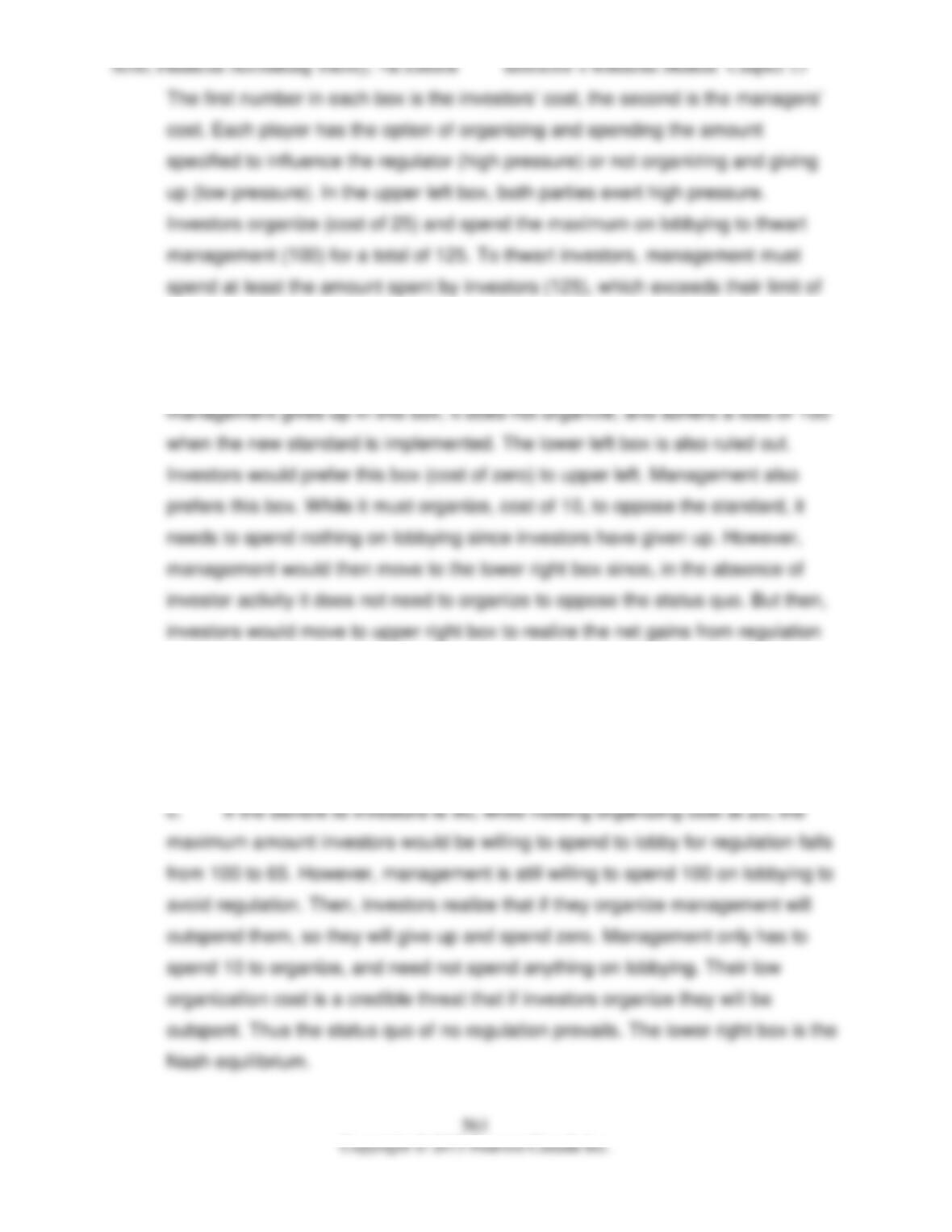
18. a. A Non–Cooperative Regulation Game between Investors and Management
Management
Investors
b. The Nash equilibrium is investors play high pressure, managers play low.
High Pressure
Low Pressure

Copyright © 2015 Pearson Canada Inc.