
446
Note: Subsequent articles relating to Sunbeam’s accounting problems include:
• “Troubled Sunbeam ousts CEO Al Dunlap,” The Globe and Mail, June
15, 1998, p. B6 (reprinted from The Wall Street Journal).
• “Teary–eyed Chainsaw Al defends record at Sunbeam,” The Globe and
Mail, July 10, 1998, p. B8 (reprinted from The Wall Street Journal).
• “Sunbeam audit finds mirage, no turnaround,” The Globe and Mail,
October 20, 1998, p. B15 (reprinted from The Wall Street Journal).
• “Despite Recovery Efforts, Sunbeam Files for Chapter 11,” The Wall
Street Journal, February 7, 2001.
• “S.E.C. Accuses Former Sunbeam Official of Fraud,” The Wall Street
Journal, May 16, 2001. Arthur Andersen partner Philip E. Harlow was
also charged.
• “Sunbeam’s ex–CEO settles SEC probe,” The Globe and Mail,
September 5, 2002, p. B6. The article reports that Mr. Dunlap will pay
$500,000 (U.S.) to settle charges he used inappropriate accounting
techniques that hid Sunbeam’s financial problems. Former CFO Russell
Kersh will pay $200,000. Both men were barred from ever serving as
officers or directors of any public company. Mr. Dunlap has also paid
$15 million and Mr. Kersh $250,000 to settle a class action lawsuit over
misrepresentation of Sunbeam’s results of operations.

Scott, Financial Accounting Theory, 7th Edition Instructor’s Solutions Manual Chapter 11
447
• “Morgan Stanley duped financier Perelman in ‘fraudulent deal’,”
Financial Times, April 7, 2005, page 16. The Laing article mentions
Sunbeam’s acquisition of Coleman Co., a maker of camping equipment.
The Financial Times article reports that Ronald Perelman, a wealthy
financier and chairman of cosmetics firm Revlon, is suing Morgan
Stanley, a large investment bank. Perelman had owned 82% of
Coleman, and accepted Sunbeam shares as payment. The lawsuit
claims that Morgan Stanley helped Sunbeam “dupe” Perelman about the
value of Sunbeam shares, which collapsed in value when the earnings
management described in the Laing article was revealed.
• Ball (2009) reports that Arthur Andersen, Sunbeam’s auditor, paid a total
of $110 millions in lawsuit settlements arising from Sunbeam’s earnings
management.
11. a. Managers may want to smooth earnings for the following reasons:
• They may feel that the market rewards share prices of firms that
report steadily increasing earnings.
Scott, Financial Accounting Theory, 7th Edition Instructor’s Solutions Manual Chapter 11
448
must bear risk.
Another potential cost is that hedging by derivatives reduces upside risk. The firm will
not benefit if underlying prices move opposite to the direction hedged. Smoothing by
accruals does not have this effect.
Managers will trade–off these 2 earnings management devices in order to minimize
Other firms may already be heavy derivatives users and may be concerned that
further usage could turn into speculation, which could increase, rather than reduce,
volatility of earnings. Alternatively, firms may be in a business for which a derivatives
market does not exist or is very costly. For example, a firm with operations very


Scott, Financial Accounting Theory, 7th Edition Instructor’s Solutions Manual Chapter 11
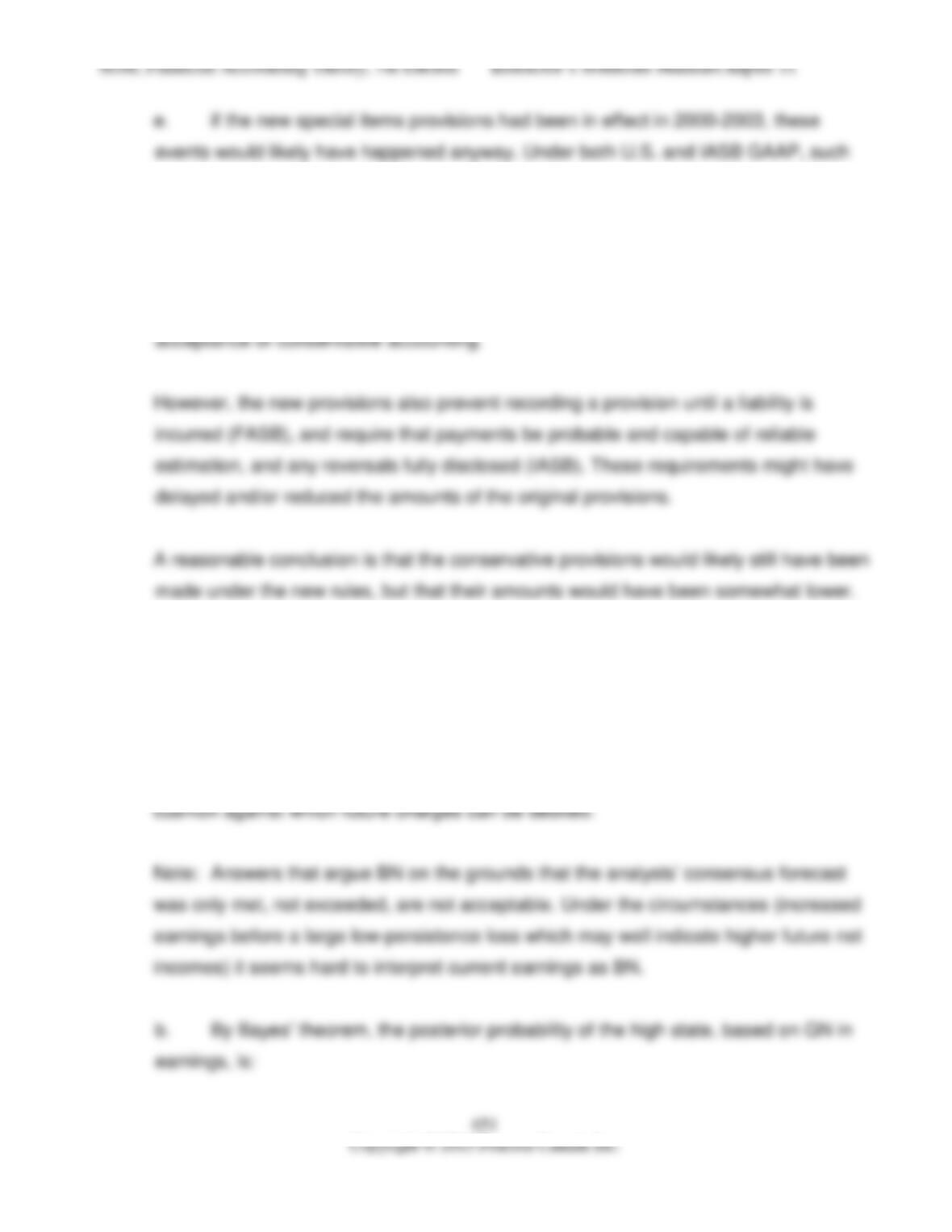
69
63
06.063.0
63.0
3.02.07.09.0
9.07.0
)()/()()/(
)/()(
)/(
=
+
=
×+×
×
=
+
=
LowPLowGNPHighPHighGNP
HighGNPHighP
GNHighP
earnings per share may suggest a break in HILO’s sequence of steadily increasing
Scott, Financial Accounting Theory, 7th Edition Instructor’s Solutions Manual Chapter 11
453
14. a. The revenue deferral will decrease relevance, since there is now a greater
recognition lag for contract revenue. This reduces the ability of investors to predict
future firm performance. However, by waiting until delivery (the usual basis of revenue
recognition) reliability will increase, since there is now less chance of error or bias in
the amounts of revenue recognized.
Scott, Financial Accounting Theory, 7th Edition Instructor’s Solutions Manual Chapter 11
15. a. Revenue recognition is an effective earnings management device because
recognition criteria under GAAP are vague and general. A company can speed up
revenue recognition but disguise the change through vague wording of its revenue
recognition accounting policy disclosure. Also, as in the case of Coca–Cola, revenue
recognition can be speeded up by stuffing the channels to unconsolidated subsidiaries
Scott, Financial Accounting Theory, 7th Edition Instructor’s Solutions Manual Chapter 11
455
revenue recognition may increase current recognized revenue, but there will be a
corresponding decrease in revenue of future periods. Thus, after a few periods of
stable operations, the amount of revenue recognized per period will be the same as
the amount recognized before the timing change.
A disadvantage of stuffing the channels is that it is difficult to maintain increased
reported revenue over time. Recording stuffing revenue this period reduces revenue of
next period.
Possible reasons why a firm may manage its reported earnings upwards:
458
compensation contract terms, could then drive stock repurchases.
To the extent that stock repurchases increase share price, due to less dilution and
positive market response to higher earnings per share, stock buybacks may increase
the value of stock-based compensation even if bonus based on net income is lower.
Thus stock-based compensation in the compensation contract could drive stock
17. a. Under ideal conditions, the two measures are equal. This is because
replacement cost is the current market price to buy an asset and fair value is the
current market price to sell an asset (i.e., exit price). In both cases, market price is the
(expected) present value of future cash receipts from the asset. Should these two
prices differ, the process of arbitrage would immediately take place to restore equality.
Scott, Financial Accounting Theory, 7th Edition Instructor’s Solutions Manual Chapter 11
459
Replacement cost–based profit is based on the going concern concept of historical
cost accounting. If the firm is to remain in business, the manager must be able to
replace the net assets consumed in the process of earning revenue. If profits are
accounting is less subject to this problem, since the selling price of net assets reflects
changes in technology, and in consumer preferences—existing assets, even if in
perfectly good condition, will not be worth replacing if better technology is available
and/or if consumer preferences have changed. Including fair value gains and losses in
earnings alerts the manager that changes in technology and preferences must be
motivate and monitor manager performance.
Scott, Financial Accounting Theory, 7th Edition Instructor’s Solutions Manual Chapter 11
460
c. According to BP, underlying replacement cost profit is “closely tracked by
management to evaluate operating performance and make financial, strategic, and
operating decisions.” If this is the way management runs the business, then
replacement cost profit has potential to give useful information to investors about
future cash flows.
d. To the extent that management uses replacement cost profit to manage
operations, and to the extent that it actually replaces inventory sold in the period,
replacement cost profit should be more useful than IASB GAAP in guiding
management’s operating decisions.
Scott, Financial Accounting Theory, 7th Edition Instructor’s Solutions Manual Chapter 11
461
18. Under historical cost accounting, capitalization of marketing costs for a growing
company has some conceptual justification. If the costs benefit the future, then they
should be matched with the future revenues generated by the marketing costs. To the
extent that once customers buy a coupon from Groupon they continue to be
customers, capitalization and amortizing the cost of obtaining those customers does
result in matching, much like capitalizing and amortizing the cost of plant and
equipment is justified by the matching criterion.
Scott, Financial Accounting Theory, 7th Edition Instructor’s Solutions Manual Chapter 11
462
b. A less aggressive way to account for Groupon’s revenue would be to recognize
revenue net, that is, only the amount that Groupon expects to retain for itself. The
c. it seems that Groupon management does not fully accept securities market
efficiency. If it did accept efficiency, it would make little sense to record revenue gross,
d. The enthusiastic securities market acceptance of the Groupon IPO and, in
particular, the rapid runup in share price in early trading, seems inconsistent with
market efficiency, particularly since Groupon’s aggressive policy of revenue reporting

463

Scott, Financial Accounting Theory, 7th Edition Instructor’s Solutions Manual Chapter 11
464
Additional Problems
11A-1. This problem is based on the paper by Elliott, Hanna, and Shaw (EHS), “The
Evaluation by the Financial Markets of Changes in Bank Loan Loss Reserve Levels,”
The Accounting Review (October, 1991), pp. 847–861. While the main research
interest of this article is information transfer (the impact of a firm’s financial statements
on the share prices of other firms—on this topic, see Lambert, Leuz, and Verrecchia
(2007) in Section 12.9.1), the evidence in the paper also provides an interesting and
persuasive illustration of how earnings management (in this case, the establishment of
loan loss reserves) can reveal inside information.
During 1987, many United States banks faced severe problems with respect to loans
to “lesser developed countries” (LDCs). For example, on February 20, 1987, Brazil
declared a moratorium on interest payments on $67 billion of its debt. This led to
problems of how to account for the LDC loans by the banks that were affected.
On May 19, 1987 (4.45 pm , i.e., after markets closed at 4PM), Citicorp (a money–
center bank and, at the time, the largest U.S. bank) announced a $3 billion increase in
its loan loss reserve for LDC loans. This amount equalled 25% of the book value of its
LDC loans. In the 2 days following the announcement, Citicorp’s share price rose by
10.1%, after falling by 3.1% on May 19. The market had possibly anticipated the4.45
pm announcement.
EHS also examined the share price behaviour of 45 other U.S. banks with foreign
loans in excess of $100,000 and which announced increases in their loan loss
provisions during 1987. Of these banks, 11 (excluding Citicorp) were money–center
banks (with major LDC exposure) and 34 other, regional banks (with lower LDC
exposure). For a 3–day window surrounding the May 19, 1987 Citicorp announcement,
EHS report the following abnormal returns:
11 money–center banks: 1.14%
34 other banks –.054%