Waldman/Jensen – Industrial Organization Theory and Practice, Fourth Edition
Chapter 7
Page 11
Problem 2:
The equilibrium in this game is for Ben to enter and Jerry to maintain current price.
Problem 4:
a. X has a dominant strategy to offer a “2 for 1” deal. No matter what strategy Y chooses,
Problem 6:
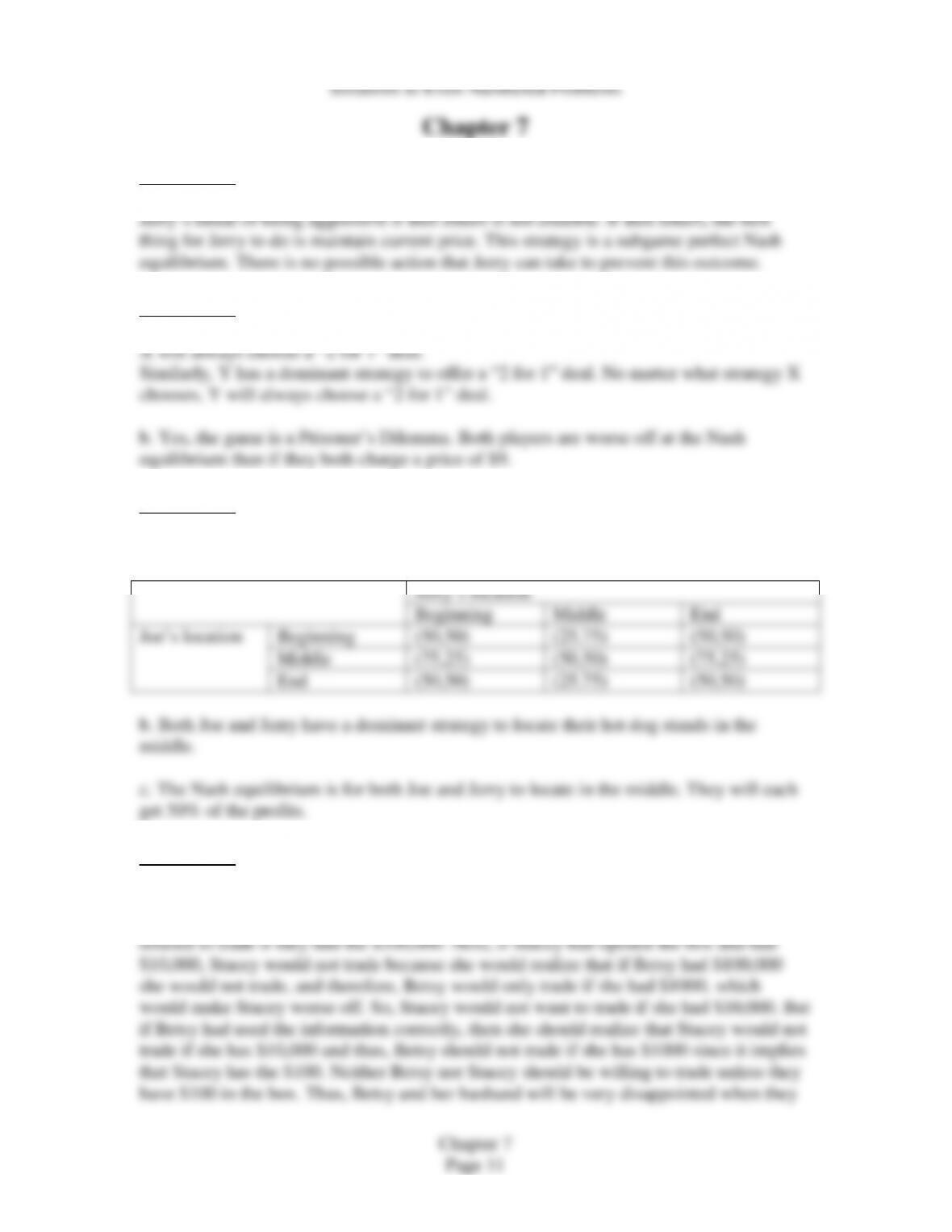
a. The payoff matrix would look like the following:
Payoffs are written as (Joe, Jerry)
Jerry’s location
Beginning
Middle
End
Joe’s location
Beginning
(50,50)
(25,75)
(50,50)
Middle
(75,25)
(50,50)
(75,25)
End
(50,50)
(25,75)
(50,50)
b. Both Joe and Jerry have a dominant strategy to locate their hot dog stands in the
middle.
c. The Nash equilibrium is for both Joe and Jerry to locate in the middle. They will each
get 50% of the profits.
Problem 8:
Betsy’s husband did not give her good advice. Betsy’s husband has ignored the
information in the game. Stacey has used all the information in the game, but Betsy has
not. Let’s look at how Betsy should have analyzed the game. Obviously, both would have
Chapter 7
Page 12
Problem 10:
a. Both Venezuela and Saudi Arabia have a dominant strategy to defect (increase output).
Problem 12:
a. Pepsi does not have a dominant strategy. Pepsi does not choose one strategy regardless
of what strategy Coke chooses. Specifically, if Coke chooses to develop a new product,
Pepsi will choose to advertise heavily. If Coke chooses to not develop a new product,
Pepsi will choose to lower the price. Based on this, Pepsi does not have a dominant
strategy.
the time or lower the price 100 percent of the time, or any other strategy.
Let pd equal the probability that Coke develops a new product and (1-pd) equal the
probability that Coke does not develop a new product. The equation to make the above
statement true is:
1200(pd) + 1200(1-pd) = 800pd + 1600(1-pd)
Solutions to Even Numbered Problems
1000(pAH) + 1200(1- pAH) = 1200(pAH) + 1000(1- pAH)
1000pAH + 1200 – 1200pAH = 1200pAH + 1000 – 1000pAH
400pAH = 200
pAH = ½ and 1- pAH = ½