CHAPTER 7
ALTERNATIVES AND MODELS IN DECISION MAKING
1) The process of generating alternatives may begin with a hazy idea about the problem to be
addressed but with good understanding about system requirements. A complete and all
inclusive alternative, the “ideal alternative,” rarely emerges in its final state. The alternative
which is chosen is usually not ideal, but the one which is judged best by the customer.
Reference: Section 7.1 (page 171) and Figure 2.10 (page 43).
8) The general form of the evaluation function for money-flow modeling may be stated as:
9) An example of a decision situation is the establishment of an optimal procurement quantity
for a single-item inventory. Here the evaluation measure is cost, and the objective is to
choose a procurement quantity in the face of demand, procurement cost, and inventory
holding cost, so that the total system cost is minimized. The decision variable under direct
control of the decision maker is the procurement quantity.
Market share
5.0
3.0
1.0
3.0
Tabulate the product of weight times ranking; add the products across all criteria to obtain:
SW I
SW II
SW III
SW IV
Profit potential
6.50
9.10
9.75
8.45
Profit risk
0.80
0.70
1.00
0.90
Market share
0.75
0.45
0.15
0.45
8.05
10.25
10.90
9.80
Under the given weights and the ranking values chosen, it would be best for the firm to
offer SW III. SW II is found to be a close second choice.
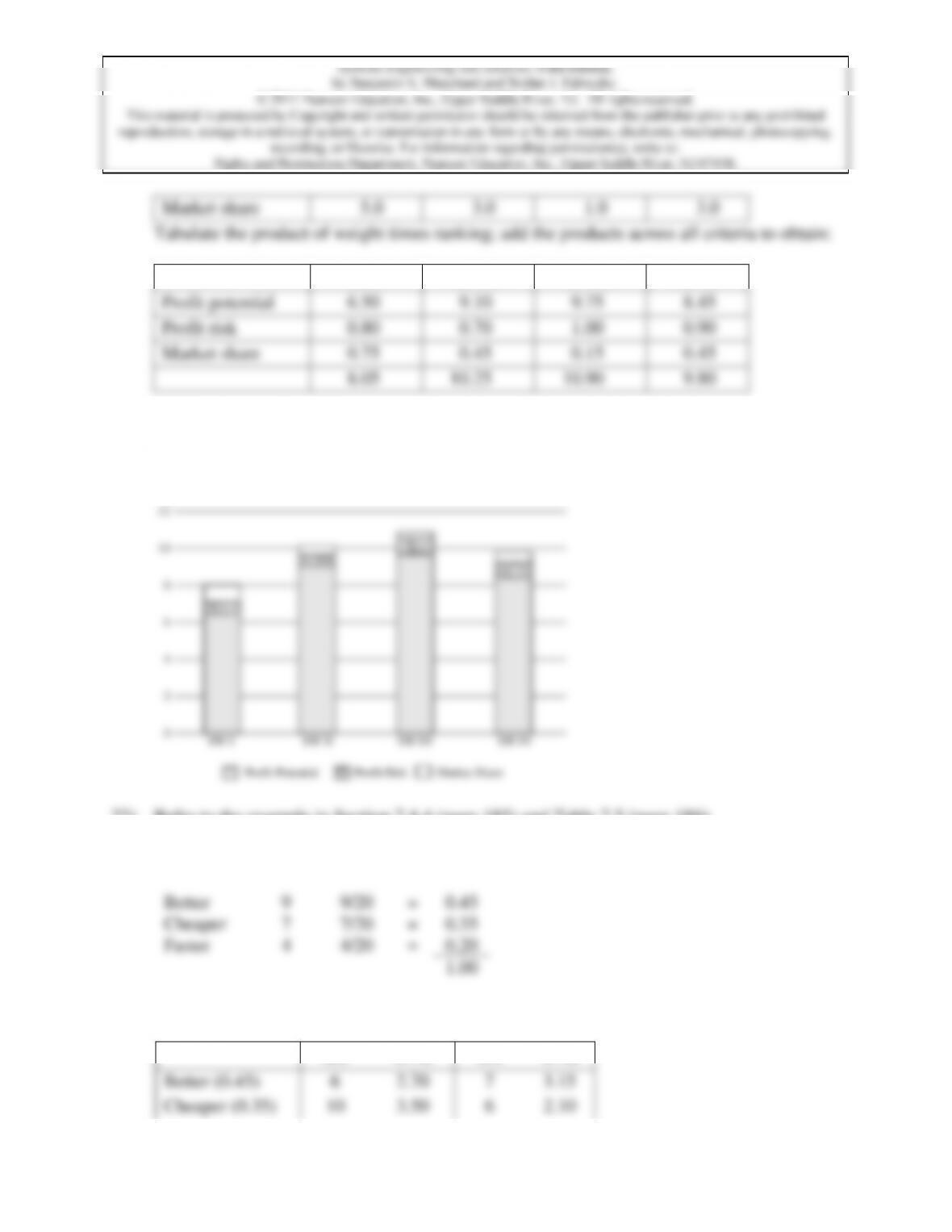
21) The stacked bar chart is:
0
2
4
6
8
10
12
Profit Potential Profit Risk Market Share
SW I SW II SW III SW IV
22) Refer to the example in Section 7.4.4 (page 185) and Table 7.5 (page 186).
The additive weights are recalculated to be:
51
3
3
3
3
Maximin
Maximax
Laplace
(α = 0.2)
Hurwicz
1
O
20
35
27.5
23
2
O
20
40
32.5
24
3
O
10
60
31.25
20
Decision
1
O
or
2
O
3
O
2
O
2
O
40) (a) The maximum probability of being in any area is 0.30. All systems will maximize this
probability of achieving a navigation error of 0.10 nm or less.
41)
10
50
26
20
35
26
50
23
25
40
31
or
Maximin
Maximax
(α = 0.4)
Hurwicz
4
1
3
4
39)
42) Using the payoff matrix of Problem 41, not 40 as stated, gives:
5
10
15
20
25
30
35
40
45
50
5
10
15
20
25
30
35
40
45
50
0 0.1 0.2 0.3 0.4 0.5 0.6 0.7 0.8 0.9 1.0
M
3
M
2
M
4
M
5
M
1
Policy
Most
Probable
Laplace
Maximax
Hurwicz
1
M
30
20.00
30
14.0
2
M
26
24.67
26
22.8
3
M
15
28.33
40
20.0
Policy
1
M
3
M
3
M
2
M
44) Facets of a decision situation which cannot be explained by a model being utilized should
be reserved for intuition and judgment applied by the decision maker.
43)