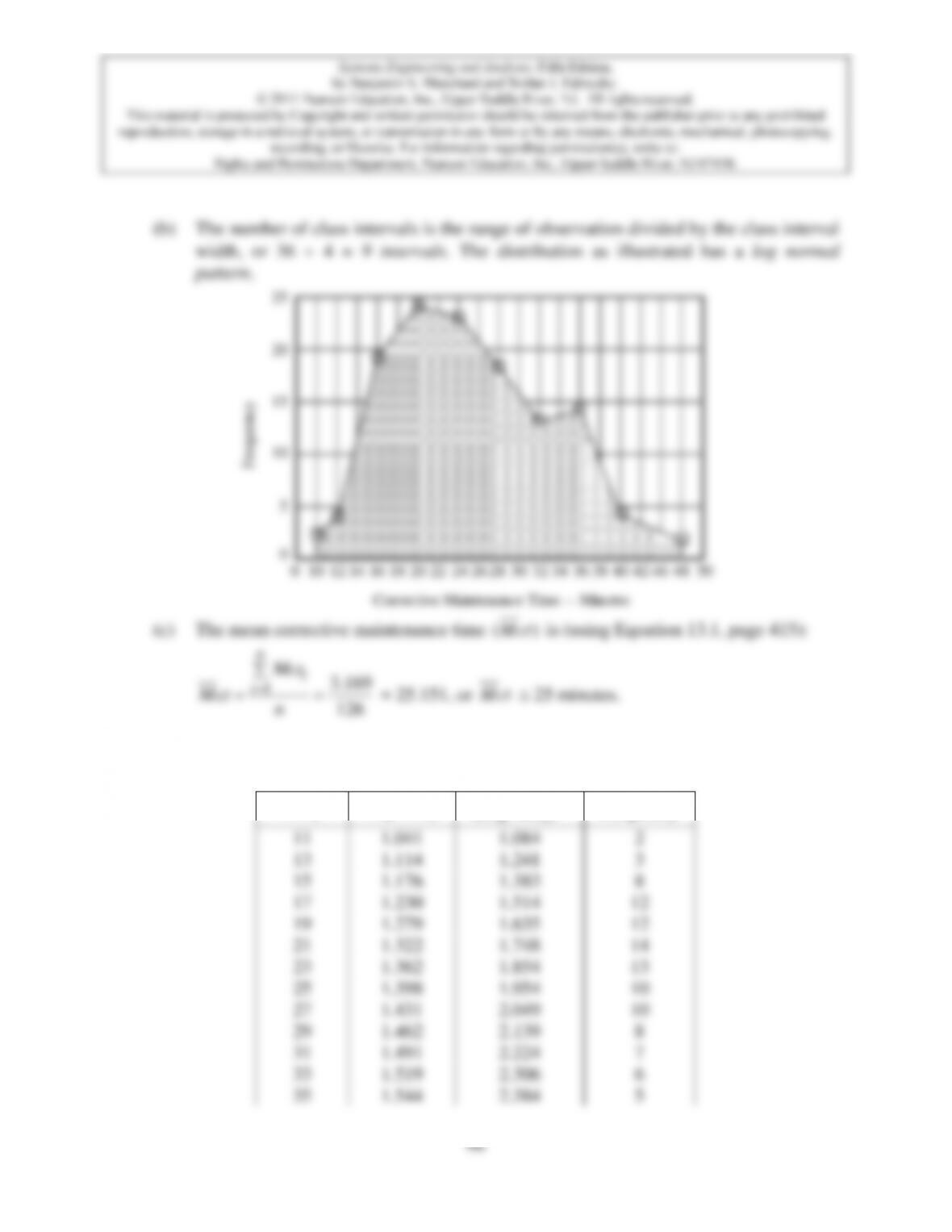
(b) The number of class intervals is the range of observation divided by the class interval
width, or 36 4 = 9 intervals. The distribution as illustrated has a log–normal
pattern.
010 12 14 16 18 20 22 24 26 28 30 32 34 36 38 40 42 46 48 50
25
20
15
10
5
0
Frequency
Corrective Maintenance Time –– Minutes
(c) The mean corrective maintenance time
()Mct
is (using Equation 13.1, page 415):
13.169
126
n
i
i
Mct
Mct n
=
==
= 25.151, or
Mct
25 minutes.
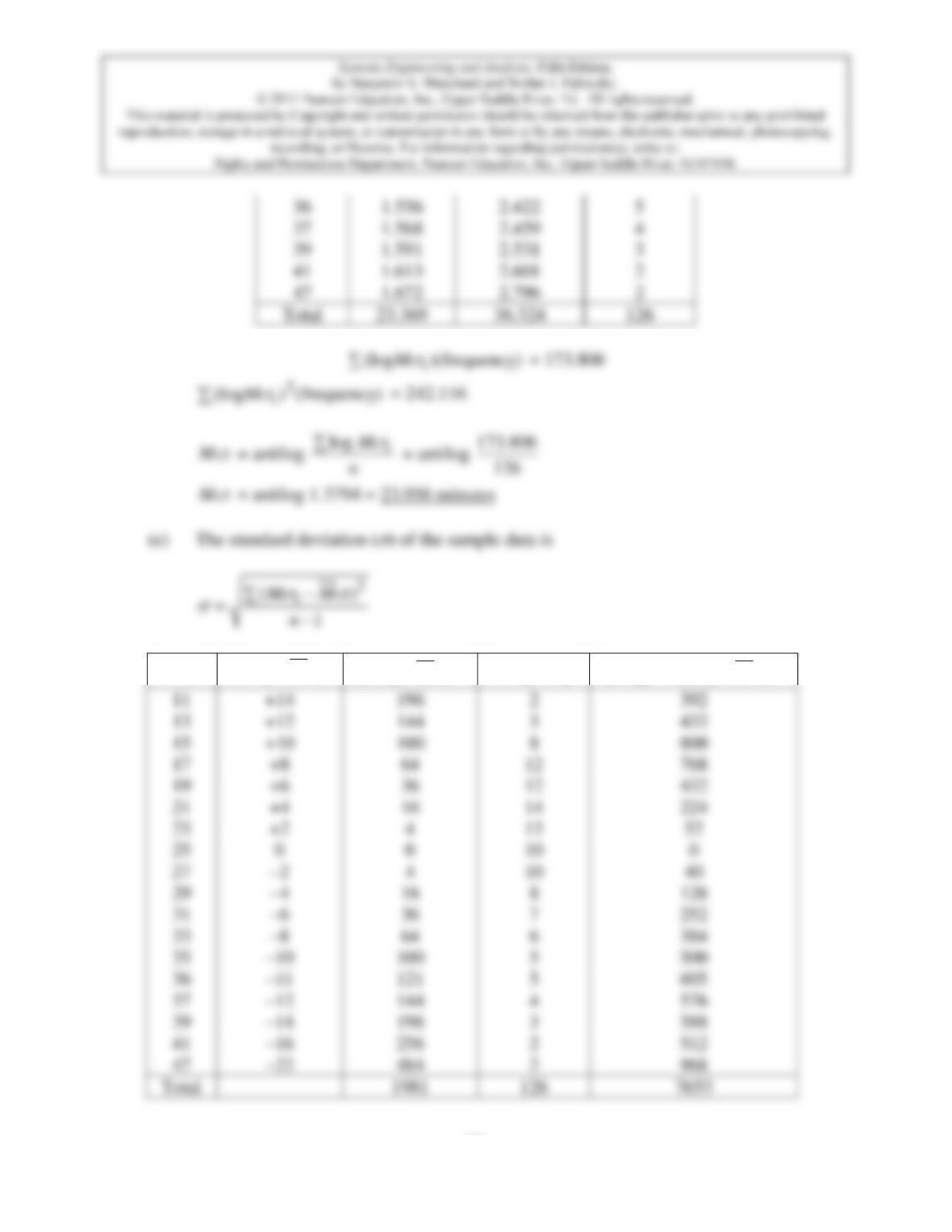
(d) Calculation for
,Mct
(Equation 13.6, page 420):
i
Mct
Log
i
Mct
(Log
2
)
i
Mct
Frequency
11
1.041
1.084
2
13
1.114
1.241
3
15
1.176
1.383
8
17
1.230
1.514
12
19
1.279
1.635
12
21
1.322
1.748
14
23
1.362
1.854
13
25
1.398
1.954
10
27
1.431
2.049
10
29
1.462
2.139
8
31
1.491
2.224
7
33
1.519
2.306
6
35
1.544
2.384
5
97
36
1.556
2.422
5
37
1.568
2.459
4
39
1.591
2.531
3
41
1.613
2.601
2
47
1.672
2.796
2
Total
23.369
36.324
126
(log )(frequency)
i
Mct
= 173.806
2
(log ) (frequency)
i
Mct
= 242.116
Mct
= antilog
log i
Mct
n
= antilog
173.806
126
Mct
= antilog 1.3794 = 23.956 minutes
(e) The standard deviation (
) of the sample data is
2
()
= 1
i
Mct Mct
n
−
−
i
Mct
()
i
Mct Mct−
2
()
i
Mct Mct−
Frequency
(Freq.)
2
()
i
Mct Mct−
11
+14
196
2
392
13
+12
144
3
432
15
+10
100
8
800
17
+8
64
12
768
19
+6
36
12
432
21
+4
16
14
224
23
+2
4
13
52
25
0
0
10
0
27
–2
4
10
40
29
–4
16
8
128
31
–6
36
7
252
33
–8
64
6
384
35
–10
100
5
500
36
–11
121
5
605
37
–12
144
4
576
39
–14
196
3
588
41
–16
256
2
512
47
–22
484
2
968
Total
1981
126
7653
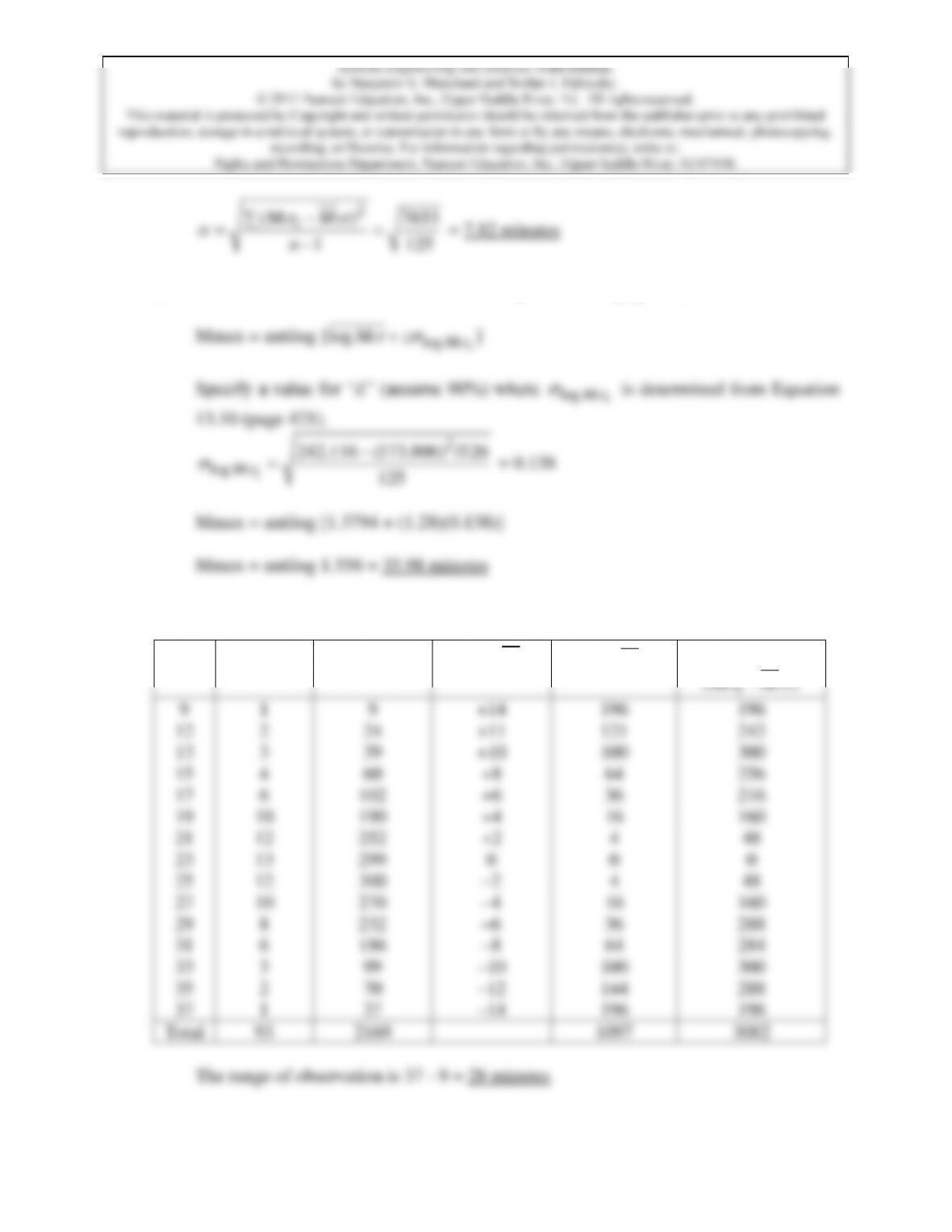
98
2
()
7653
i
Mct Mct
n
−
=
−
(f) The value for Mmax is determined from Equation 13.9 (page 421).
6) (a) In the textbook problem statement, substitute “below” for “on page xxx”.
i
Mct
Frequency
()
i
Mct
(Freq)
()
i
Mct Mct−
2
()
i
Mct Mct−
Freq
2
()
i
Mct Mct−
9
1
9
+14
196
196
12
2
24
+11
121
242
13
3
39
+10
100
300
15
4
60
+8
64
256
17
6
102
+6
36
216
19
10
190
+4
16
160
21
12
252
+2
4
48
23
13
299
0
0
0
25
12
300
–2
4
48
27
10
270
–4
16
160
29
8
232
–6
36
288
31
6
186
–8
64
284
33
3
99
–10
100
300
35
2
70
–12
144
288
37
1
37
–14
196
196
Total
93
2169
1097
3082
The range of observation is 37 – 9 = 28 minutes
(b)
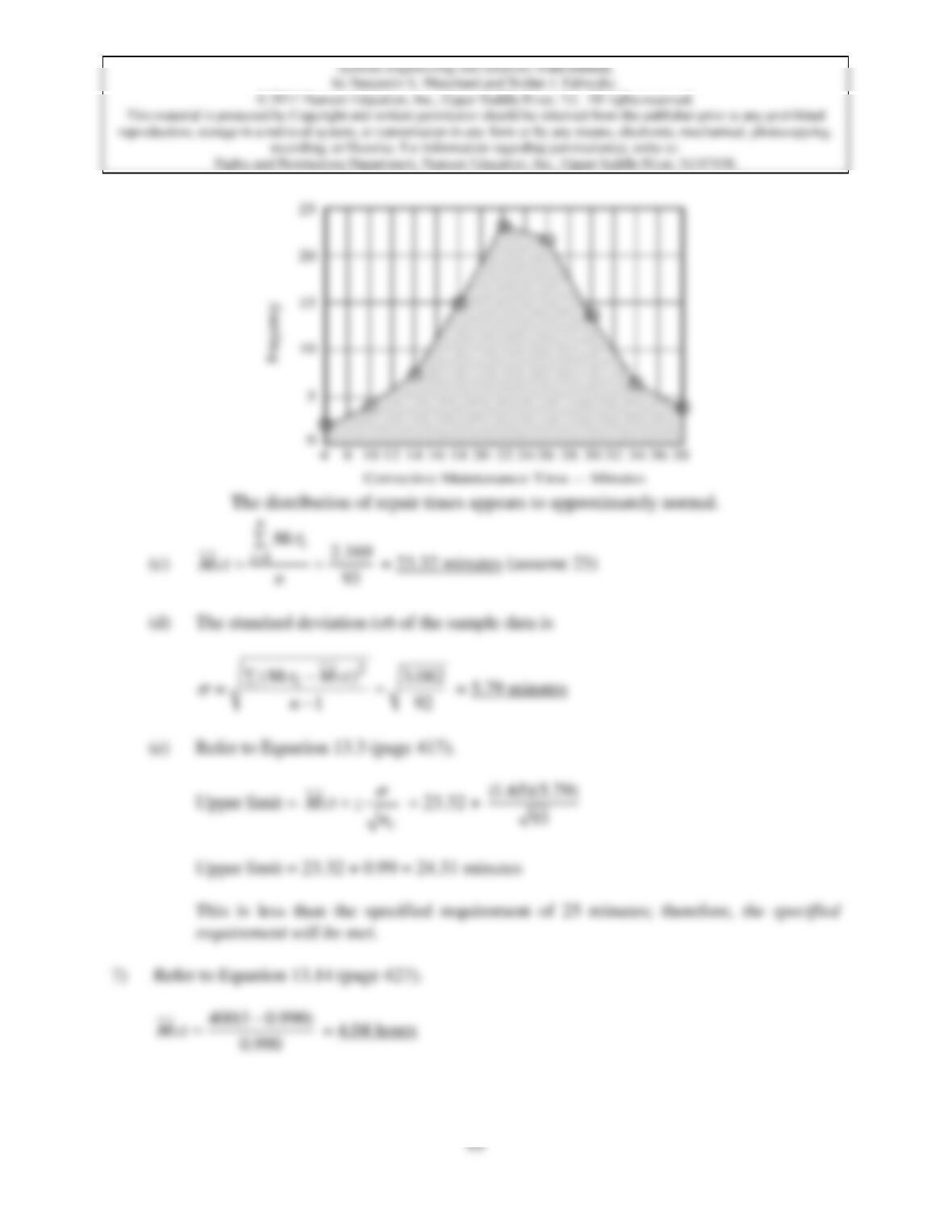
4 8 10 12 14 16 18 20 22 24 26 28 30 32 34 36 38
25
20
15
10
5
0
Frequency
Corrective Maintenance Time — Minutes
The distribution of repair times appears to approximately normal.
(c)
12.169
93
n
i
i
Mct
Mct n
=
==
= 23.32 minutes (assume 23)
(d) The standard deviation (
) of the sample data is
2
()
3.082
= 1 92
i
Mct Mct
n
−
=
−
= 5.79 minutes
(e) Refer to Equation 13.3 (page 417).
Upper limit =
c
Mct z n
+
= 23.32 +
(1.65)(5.79)
93
Upper limit = 23.32 + 0.99 = 24.31 minutes
This is less than the specified requirement of 25 minutes; therefore, the specified
requirement will be met.
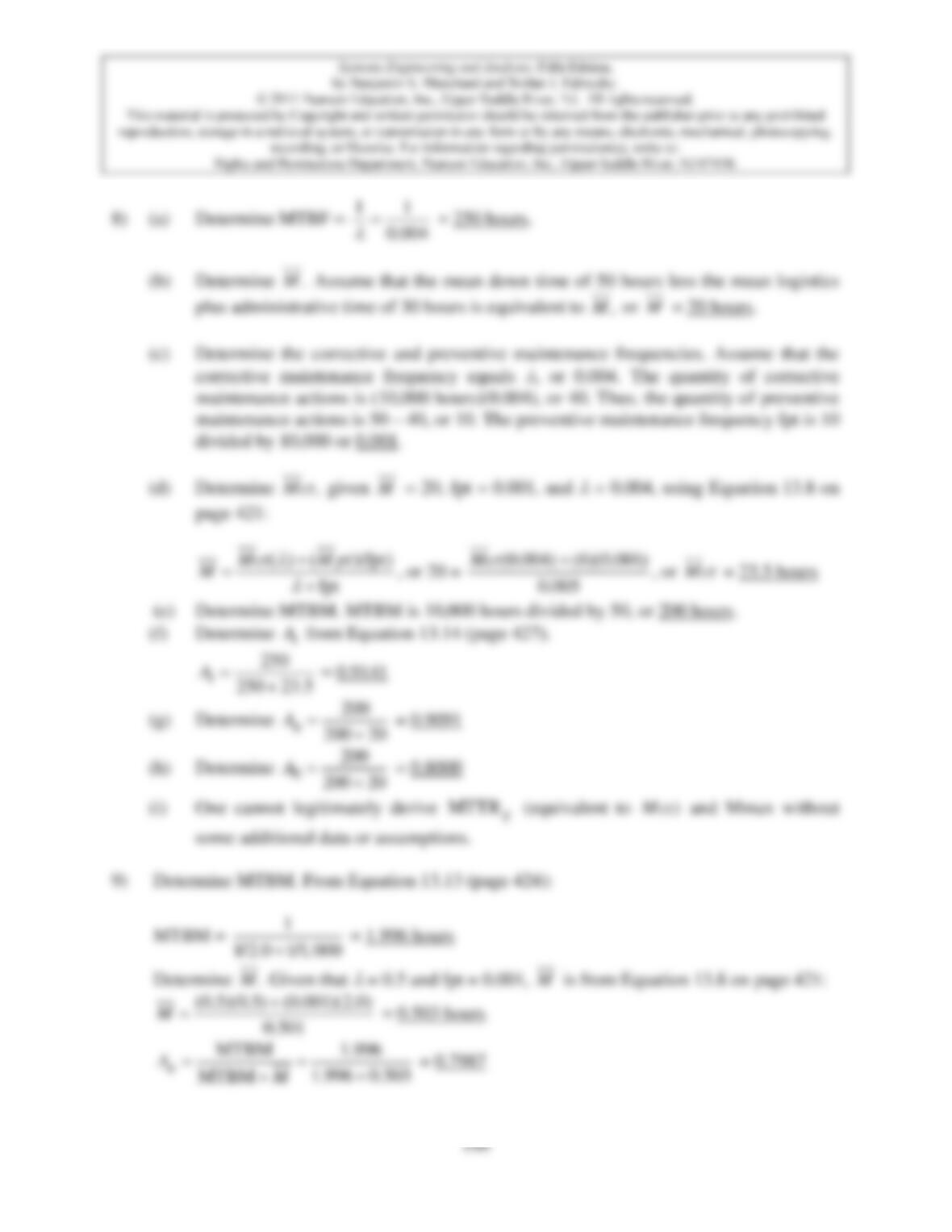
7) Refer to Equation 13.14 (page 427).
400(1 0.990)
0.990
Mct −
=
= 4.04 hours
10) Maintainability allocation is the process of allocating or apportioning one or more system–
level requirements down to the various sub–systems, units, assemblies, and so on. Given
11) Refer to Table 13.7 (page 432).
Item
Number
of
Items
Failure
R
at
e
(
)
Contribution
of
Total
Failure
s
Percent
Contri
bution
(%)
Average
i
Mct
*
Contribution of
Total
Corrective
Maint.
Time
(Minutes)
Assy A
1
0.05
0.05
0.07
2.0
1.00
Assy B
2
0.16
0.32
0.42
0.6
0.192
Assy C
1
0.27
0.27
0.35
0.9
0.243
Assy D
1
0.12
0.12
0.16
1.5
0.180
TOTAL
0.76
100
0.715
specified. If a 450–hour MTBM, or a 30–minute
,Mct
is the requirement included in the
system specification, then one needs to assess just how the design is doing relative to
meeting this requirement. Predictions are usually made in conjunction with formal design
reviews and/or when there have been significant changes in design. Predictions are based
on available design data, drawings, component part lists, the results from various analyses,
etc. Reference: Section 13.5.2 (page 437).
14) Refer to Section 13.5 (pages 436–456):
103
104
19) Response to this problem basically constitutes a student exercise where, in the evaluation
20) Preventive maintenance (PM) requirements should initially be determined from the results
of the FMECA, where the accomplishment of PM will improve the reliability of an item
105
24) Refer to Section 13.6.1 (page 457) for the approach to be followed in accomplishing
maintainability demonstration:
25) Yes, the equipment did pass maintainability demonstration.
50
i
Mct
2
()
i
Mct Mct−
i
Mct
2
()
i
Mct Mct−
i
Mct
2
()
i
Mct Mct−
39
484
63
4
49
144
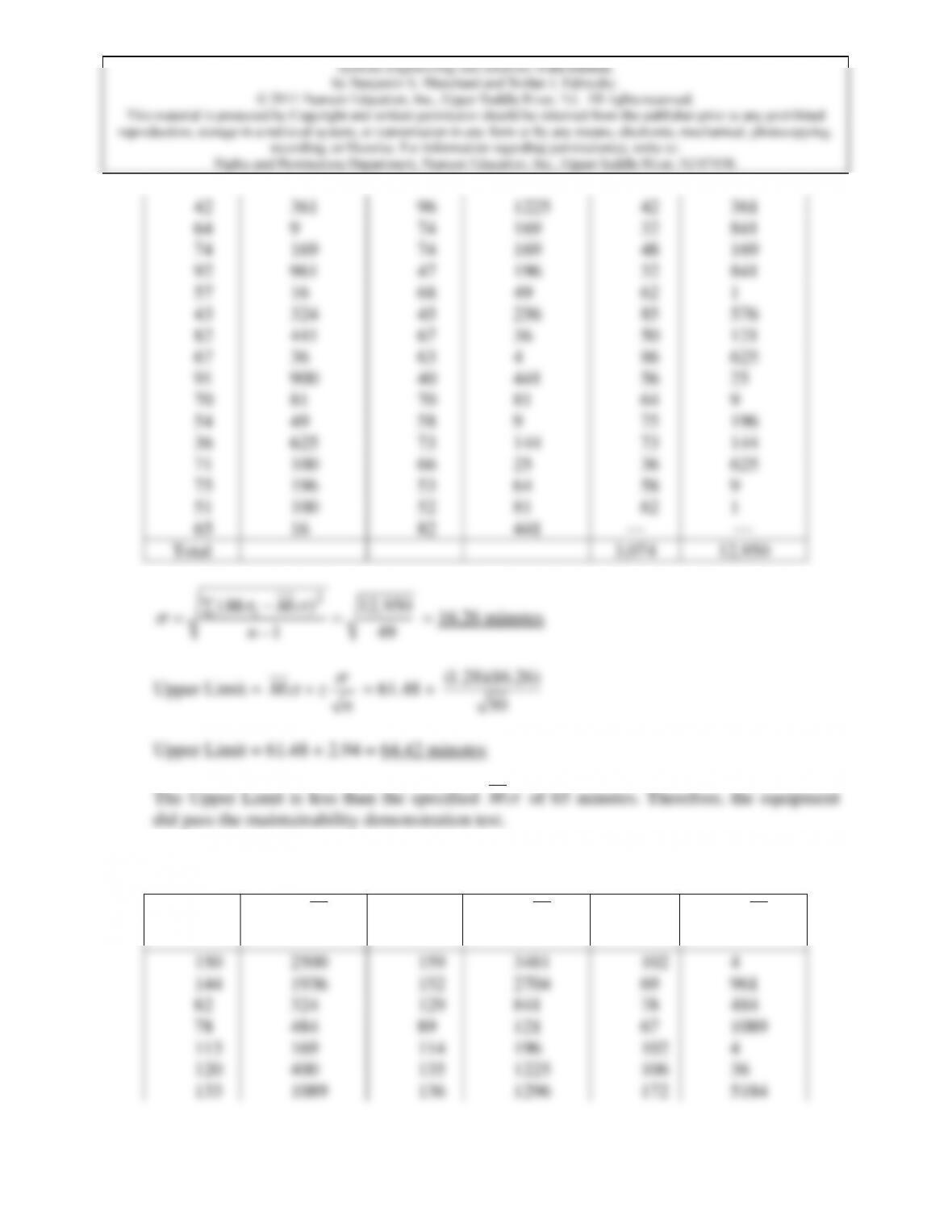
106
42
361
96
1225
42
361
64
9
74
169
32
841
74
169
74
169
48
169
92
961
47
196
32
841
57
16
68
49
62
1
43
324
45
256
85
576
82
441
67
36
50
121
67
36
63
4
86
625
91
900
40
441
56
25
70
81
70
81
64
9
54
49
58
9
75
196
36
625
73
144
73
144
71
100
66
25
36
625
75
196
53
64
58
9
51
100
52
81
62
1
65
16
82
441
—
—
Total
3,074
12,950
2
()
12,950
= 1 49
i
Mct Mct
n
−
=
−
= 16.26 minutes
Upper Limit =
Mct z n
+
= 61.48 +
(1.28)(16.26)
50
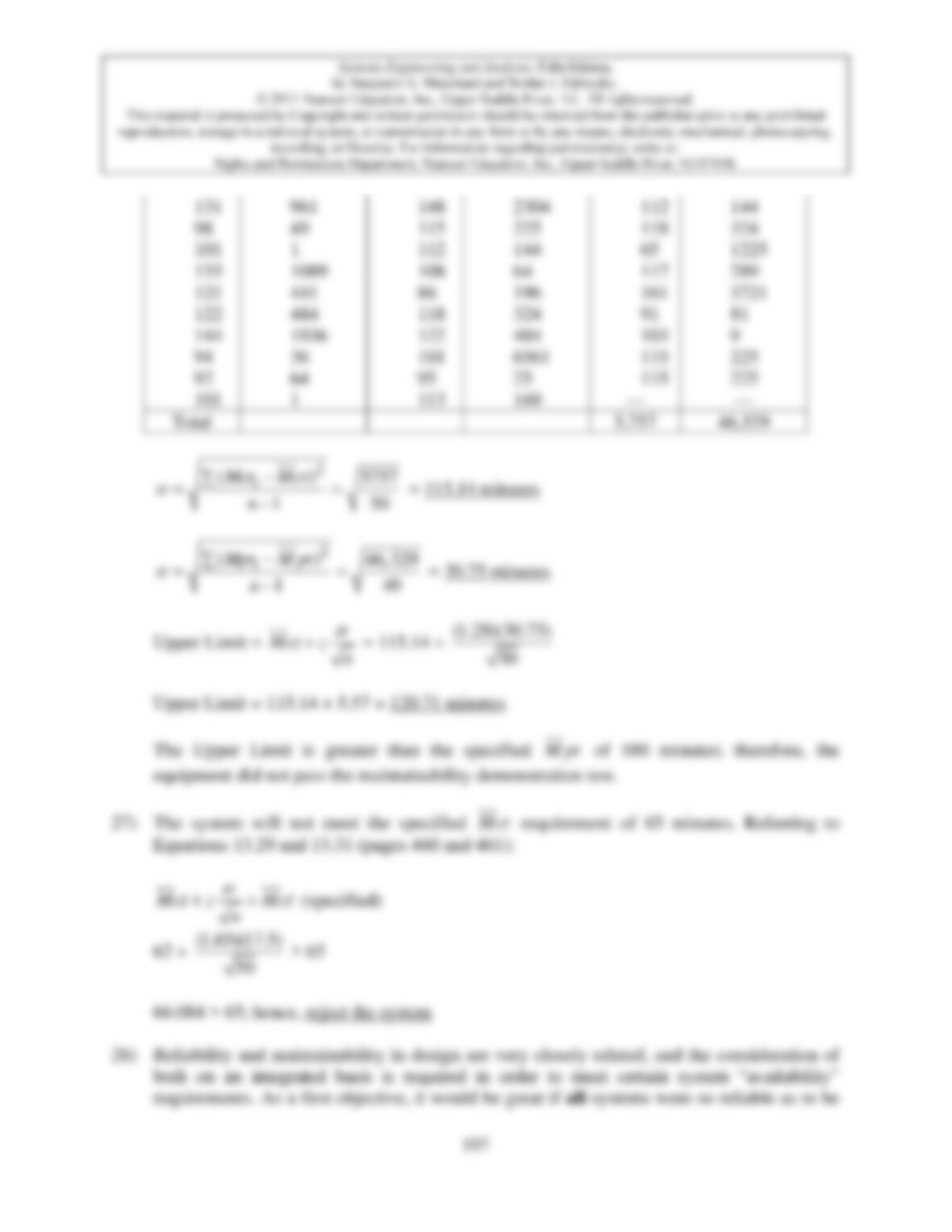
26) No, the equipment did not pass the maintainability demonstration.
i
Mct
2
()
i
Mct Mct−
i
Mct
2
()
i
Mct Mct−
i
Mct
2
()
i
Mct Mct−
150
2500
159
3481
102
4
144
1936
152
2704
69
961
82
324
129
841
78
484
78
484
89
121
67
1089
113
169
114
196
102
4
120
400
135
1225
106
36
133
1089
136
1296
172
5184
107
131
961
148
2304
112
144
98
49
115
225
118
324
101
1
112
144
65
1225
133
1089
108
64
117
289
121
441
86
196
161
3721
122
484
118
324
91
81
144
1936
122
484
103
9
94
36
181
6561
115
225
92
64
95
25
115
225
101
1
113
169
—
—
Total
5,757
46,329
2
()
5757
= 1 50
i
Mct Mct
n
−
=
−
= 115.14 minutes
2
()
46,329
= 1 49
i
Mpt M pt
n
−
=
−
= 30.75 minutes
Upper Limit =
Mct z n
+
= 115.14 +
(1.28)(30.75)
50
Upper Limit = 115.14 + 5.57 = 120.71 minutes
The Upper Limit is greater than the specified
M pt
of 100 minutes; therefore, the
equipment did not pass the maintainability demonstration test.
27) The system will not meet the specified
Mct
requirement of 65 minutes. Referring to
Equations 13.29 and 13.31 (pages 460 and 461):
Mct z Mct
n
+
(specified)
62 +
(1.65)(17.5)
50
> 65
66.084 > 65; hence, reject the system
28) Reliability and maintainability in design are very closely related, and the consideration of
both on an integrated basis is required in order to meet certain system “availability”
requirements. As a first objective, it would be great if all systems were so reliable as to be