CHAPTER 12
DESIGN FOR RELIABILITY
1) Reliability may be simply defined as the “probability that a system or product will perform
its designated mission in a satisfactory manner for a given period of time when used under
4) When addressing failure rate from a total “systems” perspective, there are a number of
factors that need to be considered; i.e., equipment failures, software failures, facility
failures, personnel–induced failures, process failures, failures in information flow, failures
per item of data, and so on. While the concentration is often on just equipment failures, all
of the factors listed in Table 12.1 (page 370) should be considered. Reference: Section
12.2.2 (page 366).
87
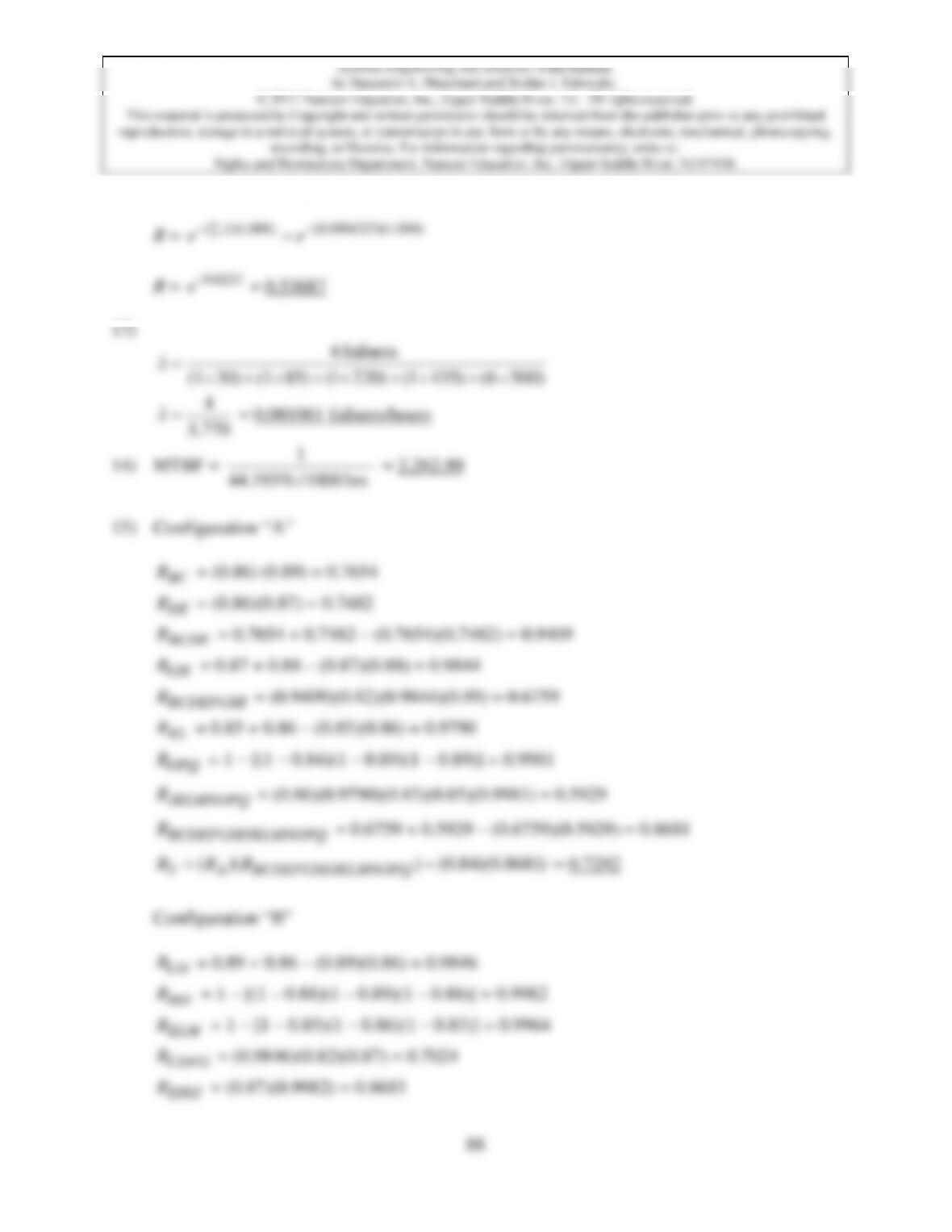
R =
( )(1,000) (0.0006223)(1.000)
ee
−−
=
R =
0.6223
e−
= 0.53687
13)
4 failures
(1 30) + (1 85) (1 220) (1 435) (6 500)
= + + +
4
3,770
=
= 0.001061 failures/hours
14) MTBF =
1
44.193% /1000 hrs
= 2,262.80
15) Configuration “A”
BC
R
= (0.86) (0.89) = 0.7654
DE
R
= (0.86)(0.87) = 0.7482
BCDE
R
= 0.7654 + 0.7482 – (0.7654)(0.7482) = 0.9409
GH
R
= 0.87 + 0.88 – (0.87)(0.88) = 0.9844
BCDEFGHI
R
= (0.9409)(0.82)(0.9844)(0.89) = 0.6759
KL
R
= 0.85 + 0.86 – (0.85)(0.86) = 0.9790
OPQ
R
= 1 – [(1 – 0.84)(1 – 0.89)(1 – 0.89)] = 0.9981
JKLMNOPQ
R
= (0.86)(0.9790)(0.83)(0.85)(0.9981) = 0.5929
BCDEFGHIJKLMNOPQ
R
= 0.6759 + 0.5929 – (0.6759)(0.5929) = 0.8681
( )( ) (0.84)(0.8681)
S A BCDEFGHIJKLMNOPQ
R R R==
= 0.7292
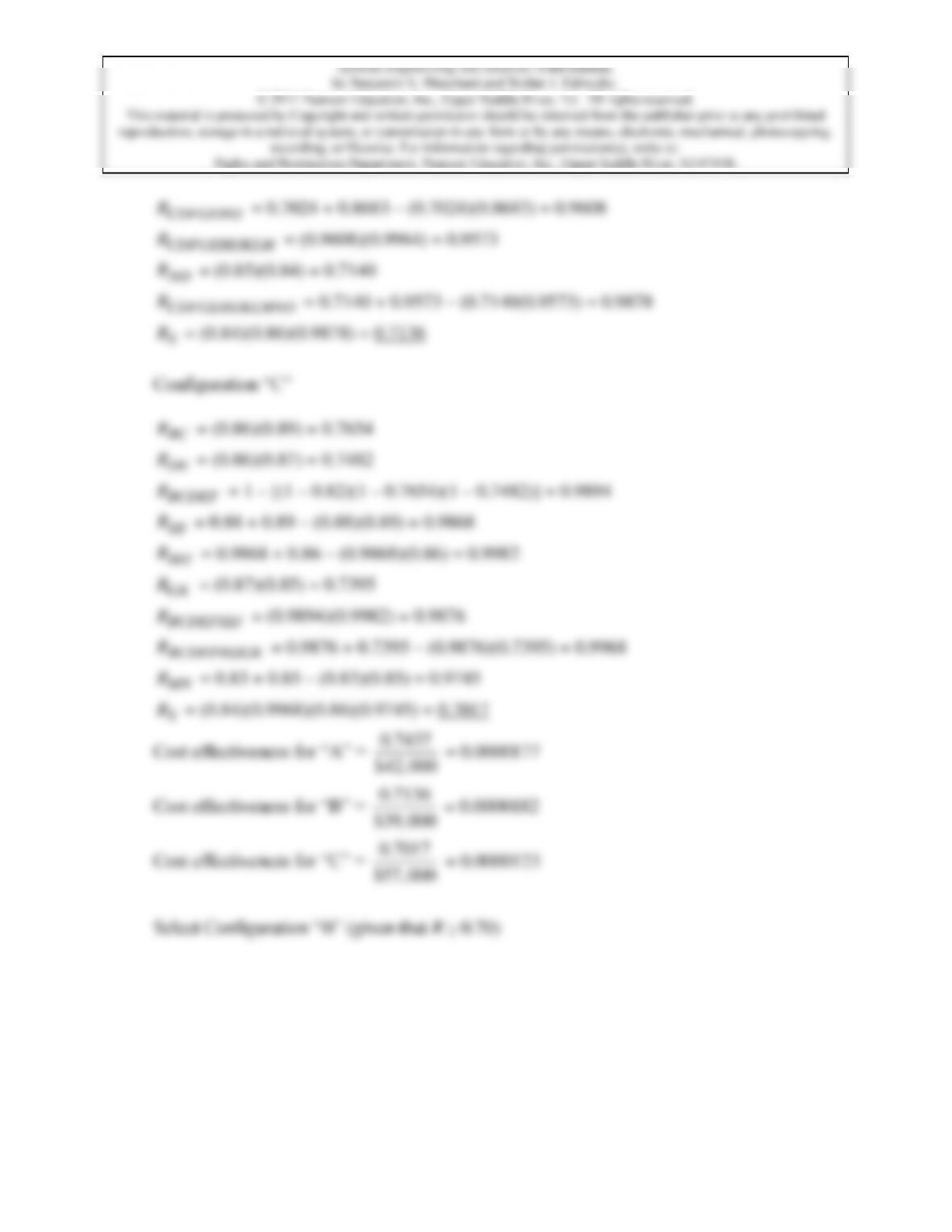
Configuration “B”
CD
R
= 0.89 + 0.86 – (0.89)(0.86) = 0.9846
HIJ
R
= 1 – [(1 – 0.88)(1 – 0.89)(1 – 0.86)] = 0.9982
KLM
R
= 1 – [1 – 0.85)(1 – 0.86)(1 – 0.83)] = 0.9964
CDFG
R
= (0.9846)(0.82)(0.87) = 0.7024
EHIJ
R
= (0.87)(0.9982) = 0.8683
89
16) The selection of common and standard components in design; selection of components
with a long shelf–life; incorporation of redundancy at the right level in design;
incorporation of fail–safe provisions in the event of failure; application of “derating”
methods in design (where a component may be selected and utilized in a “less–than–rated–
value” application) to improve reliability; elimination of adjustable components in design;
incorporation of modularization in design; incorporation of the essential environmental
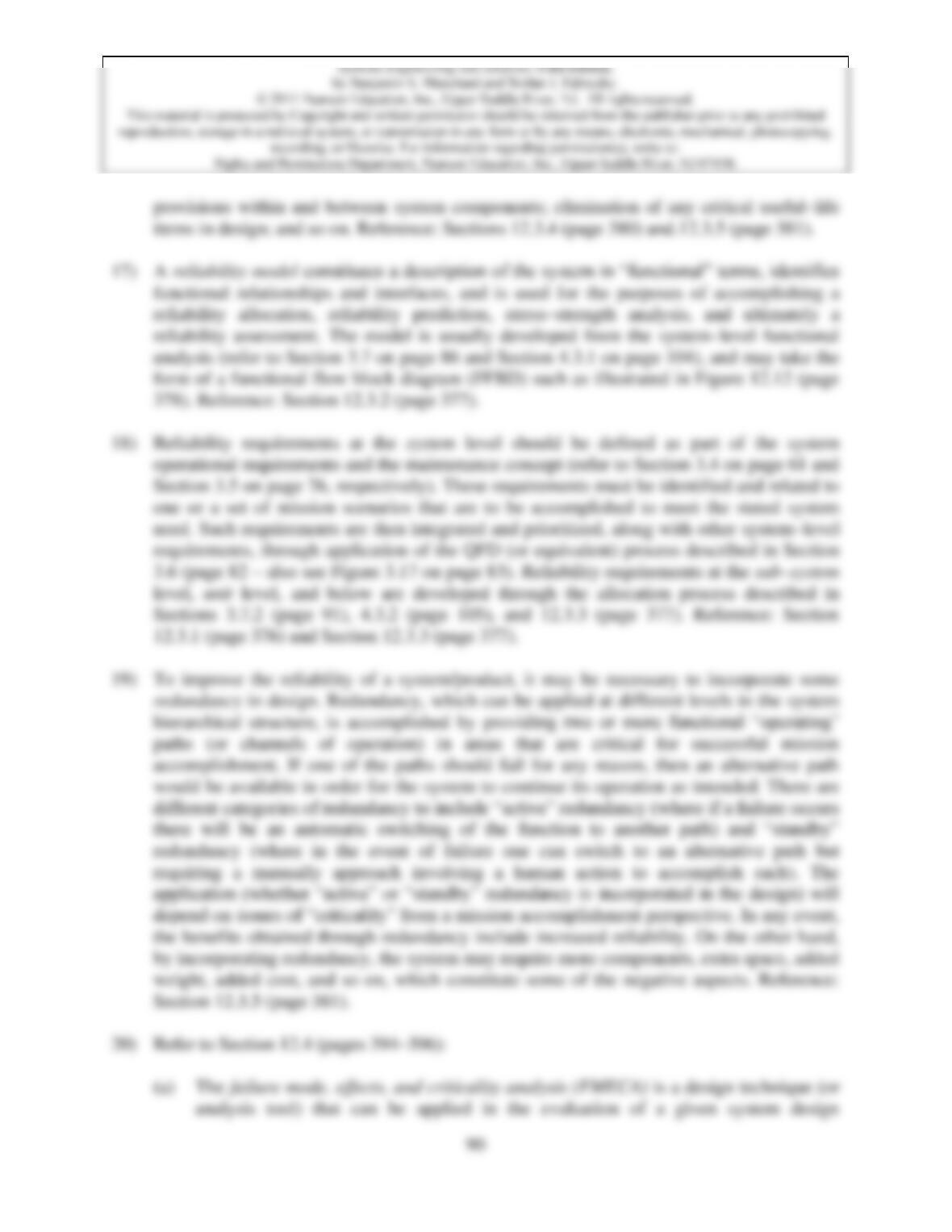
93
25) Accomplishing a sequential test on a “sampling” basis, throughout the production process,
may be required to ensure that the same reliability characteristics are inherent and built into
each of the items being produced. The sample may be based on a percentage of the total
items being produced over the entire period of production, or a set number of items
selected during a given time period. Even though reliability qualification testing has been
accomplished successfully on a pre–production prototype as part of Type 2 testing, one
needs to ensure that all of the “like” models being produced subsequently are equally as
reliable. Reference: Section 12.5.2 (page 403).
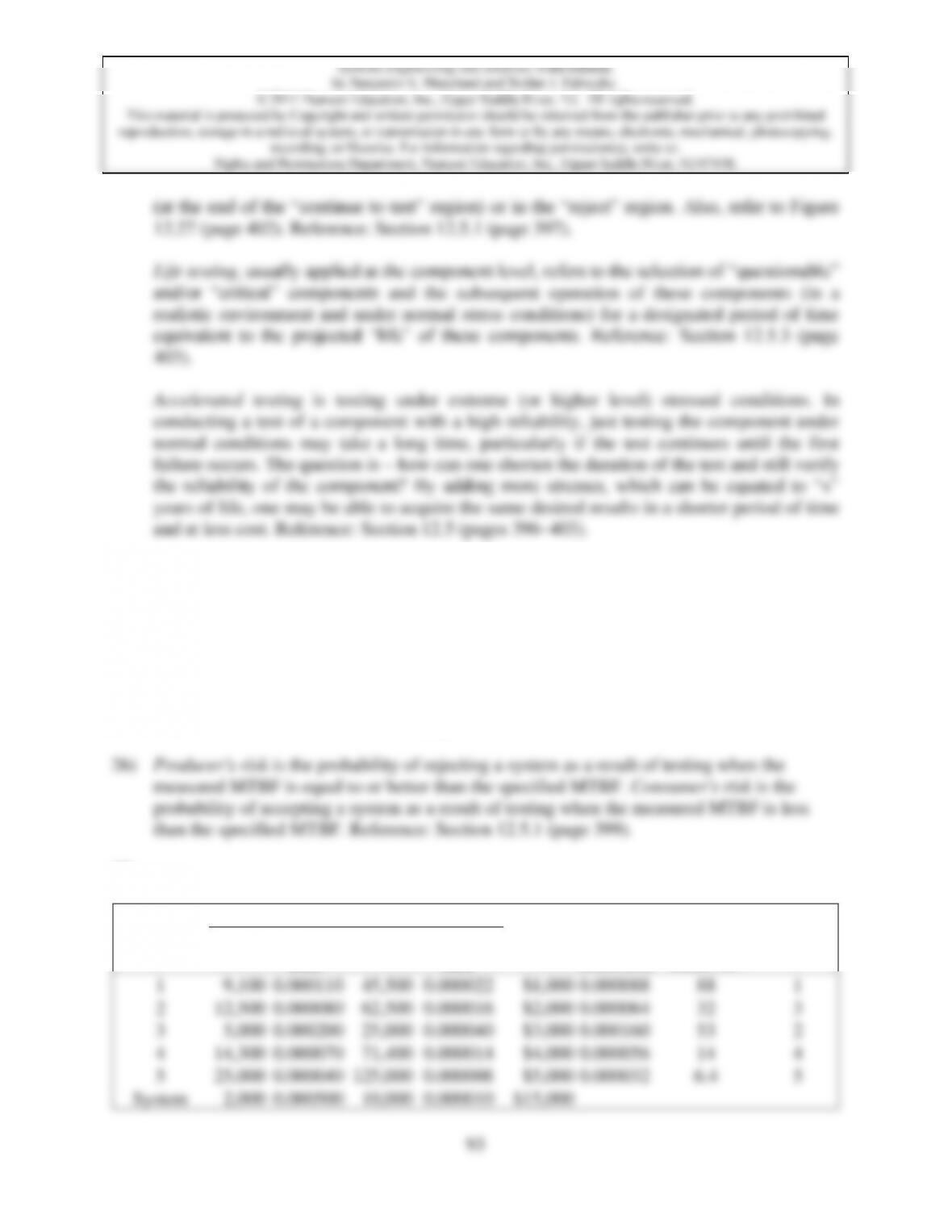
27)
Component
Original
Redesigned
Redesign
Cost
Failure
Rate
Reduction
Cost
Effectiveness
Times 109
Redesign
Priority
MTBF
Failure
Rate
MTBF
Failure
Rate
1
9,100
0.000110
45,500
0.000022
$1,000
0.000088
88
1
2
12,500
0.000080
62,500
0.000016
$2,000
0.000064
32
3
3
5,000
0.000200
25,000
0.000040
$3,000
0.000160
53
2
4
14,300
0.000070
71,400
0.000014
$4,000
0.000056
14
4
5
25,000
0.000040
125,000
0.000008
$5,000
0.000032
6.4
5
System
2,000
0.000500
10,000
0.000010
$15,000
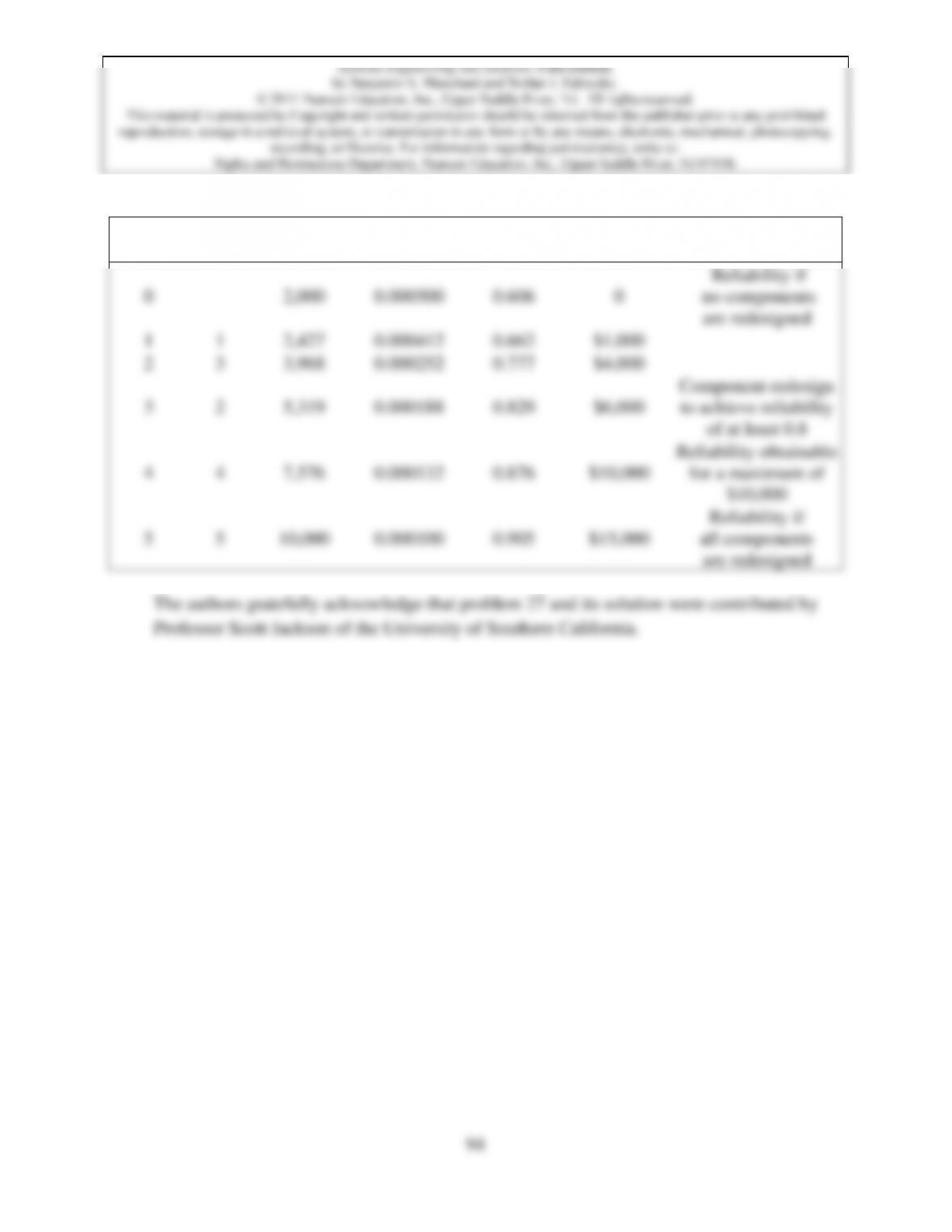
Redesign
Priority
Com-
ponent
Cumulative
MTBF
Cumulative
Failure Rate
Cumulative
Reliability
Cumulative
Cost
Decision Criterion
0
2,000
0.000500
0.606
0
Reliability if
no components
are redesigned
1
1
2,427
0.000412
0.662
$1,000
2
3
3,968
0.000252
0.777
$4,000
3
2
5,319
0.000188
0.829
$6,000
Component redesign
to achieve reliability
of at least 0.8
4
4
7,576
0.000132
0.876
$10,000
Reliability obtainable
for a maximum of
$10,000
5
5
10,000
0.000100
0.905
$15,000
Reliability if
all components
are redesigned