nAnswers to Textbook Problems
1. The arguments for free trade in this quote include:
Free trade allows consumers and producers to make decisions based upon the marginal cost and
benefits associated with a good when costs and prices are undistorted by government policy.
2. a. This is potentially a valid argument for a tariff, since it is based on an assumed ability of the
b. Sharply falling prices benefit U.S. consumers, and since these are off-season grapes and do not
c. The higher income of farmers, due to export subsidies and the potentially higher income to those
d. There may be external economies associated with the domestic production of semiconductors.
e. Thousands of home buyers as consumers (as well as workers who build the homes for which the
3. Without tariffs or subsidies, we compute domestic production as S 20 (10 10) 120 and
domestic consumption as D 400 (5 10) 350, for imports of 230.
a. To analyze the welfare effects of the tariff, it is helpful to draw a diagram for this small country.
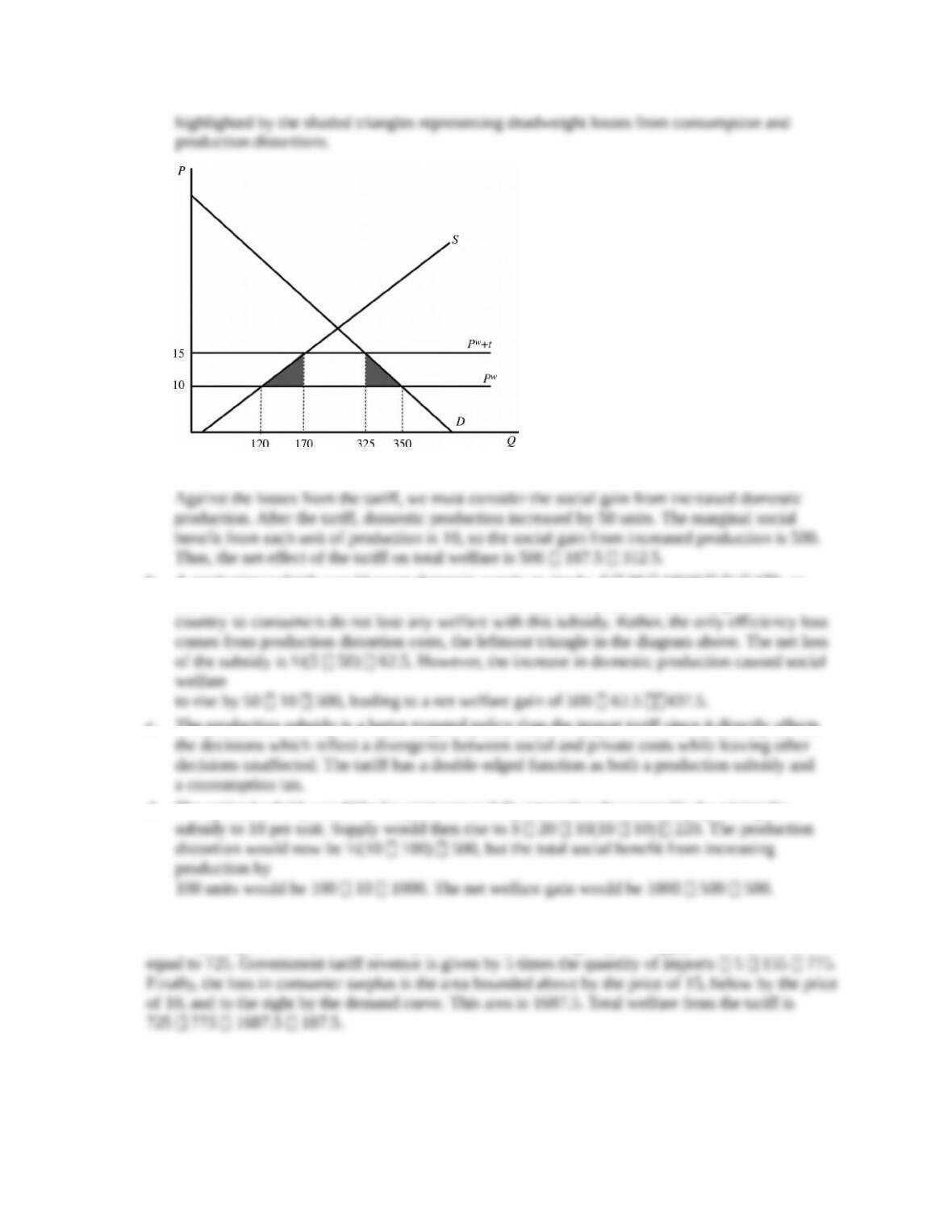
Computing the two deadweight loss triangles yields ½(5 50) ½(5 25) 187.5.
b. A production subsidy would cause domestic supply to rise by S 20 10(10 5) 170, an
increase of 50 units as with the tariff. However, the domestic price will not change in this
c. The production subsidy is a better targeted policy than the import tariff since it directly affects
d. The optimal subsidy would be for producers to fully internalize the externality by raising the
4. Refer back to the diagram in 3a. The gain in producer surplus from the tariff is equal to the area bounded
above by the price of 15, below by the price of 10 and to the right by the supply curve. This area is
However, if the government values every dollar of producer gain as worth $3 of consumer surplus,
then from the government’s perspective, the net gain from the tariff is equal to:
Gain in Producer Surplus 725
5. a. This would lead to trade diversion because the lower-cost Japanese cars with an import value
b. Before the addition of Poland to the EU, Japanese cars were not imported since their import
c. This would lead to trade diversion because the lower-cost Japanese cars with an import value
6. The United States has a legitimate interest in the trade policies of other countries, just as other
countries have a legitimate interest in U.S. activities. The reason is that uncoordinated trade policies
7. The optimal tariff argument rests on the idea that in a large country, tariff (or quota) protection in a
particular market can lower the world price of that good. Therefore, it is possible that with a (small)
8. The game is no longer a Prisoners’ Dilemma. As the chapter discusses, protectionist measures are
welfare reducing in their own right. Each country would have an incentive to engage in free trade no
9. The argument is probably not valid for a number of reasons. One reason is the domestic market failure
argument. There is a lack of information regarding safety standards that leads a government to
simply ban unsafe products, as opposed to letting consumers choose which risks they would like to
take. Thus, it is consistent for the United States to ban unsafe products from China since U.S.
regulators also ban unsafe products that are made in the United States. As for restricting products