9-1
9-1 No. Differences in operating income between variable costing and absorption costing are
due to accounting for fixed manufacturing costs. Under variable costing only variable
9-2 The term direct costing is a misnomer for variable costing for two reasons:
a. Variable costing does not include all direct costs as inventoriable costs. Only variable
9-3 No. The difference between absorption costing and variable costs is due to accounting for
9-4 The main issue between variable costing and absorption costing is the proper timing of
the release of fixed manufacturing costs as costs of the period:
9-5 No. A company that makes a variable-cost/fixed-cost distinction is not forced to use any
specific costing method. The Stassen Company example in the text of Chapter 9 makes a
incurred.
9-6 Variable costing does not view fixed costs as unimportant or irrelevant, but it maintains
9-7 Under absorption costing, heavy reductions of inventory during the accounting period
9-8 (a) The factors that affect the breakeven point under variable costing are:
2. Contribution margin per unit.
9-2
1. Fixed (manufacturing and operating) costs.
3. Production level in units in excess of breakeven sales in units.
9-9 Examples of dysfunctional decisions managers may make to increase reported operating
income are:
9-10 Approaches used to reduce the negative aspects associated with using absorption costing
include:
a. Change the accounting system:
• Adopt either variable or throughput costing, both of which reduce the incentives
9-11 The theoretical capacity and practical capacity denominator-level concepts emphasize
9-12 The downward demand spiral is the continuing reduction in demand for a company’s
9-13 No. It depends on how a company handles the production-volume variance in the end-of-
9-14 For tax reporting in the U.S., the IRS requires only that indirect production costs are
“fairly” apportioned among all items produced. Overhead rates based on normal or master–
9-15 No. The costs of having too much capacity/too little capacity involve revenue
opportunities potentially forgone as well as costs of money tied up in plant assets.
9-3
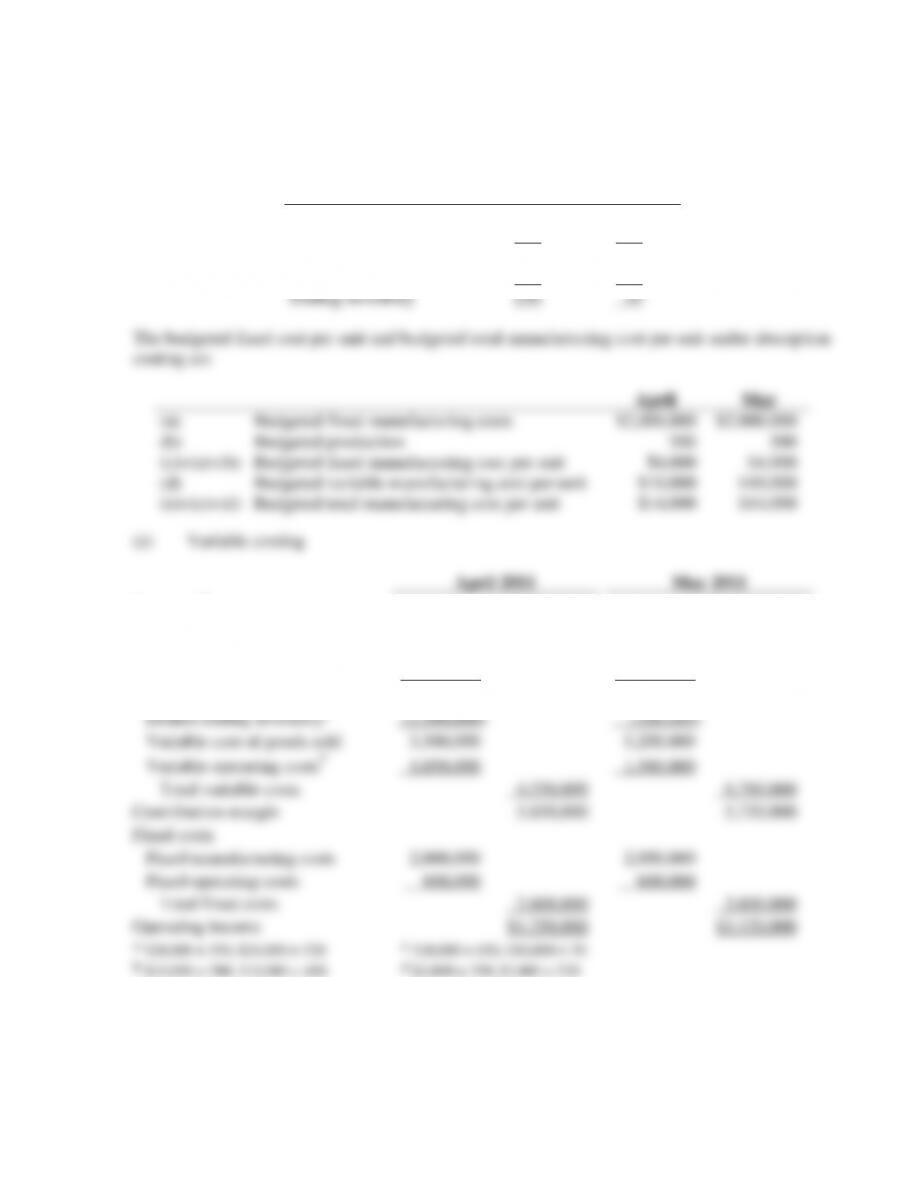
9-16 (30 min.) Variable and absorption costing, explaining operating-income differences.
1. Key inputs for income statement computations are
April
May
Beginning inventory
Production
Goods available for sale
Units sold
Ending inventory
0
500
500
350
150
150
400
550
520
30
The budgeted fixed cost per unit and budgeted total manufacturing cost per unit under absorption
costing are
April
May
(a) Budgeted fixed manufacturing costs
(b) Budgeted production
(c)=(a)÷(b) Budgeted fixed manufacturing cost per unit
(d) Budgeted variable manufacturing cost per unit
(e)=(c)+(d) Budgeted total manufacturing cost per unit
$2,000,000
500
$4,000
$10,000
$14,000
$2,000,000
500
$4,000
$10,000
$14,000
(a) Variable costing
April 2011
May 2011
Revenuesa
$8,400,000
$12,480,000
Variable costs
Beginning inventory
$ 0
$1,500,000
Variable manufacturing costsb
5,000,000
4,000,000
Cost of goods available for sale
5,000,000
5,500,000
Deduct ending inventoryc
(1,500,000)
(300,000)
Variable cost of goods sold
3,500,000
5,200,000
Variable operating costsd
1,050,000
1,560,000
Total variable costs
4,550,000
6,760,000
Contribution margin
3,850,000
5,720,000
Fixed costs
Fixed manufacturing costs
2,000,000
2,000,000
Fixed operating costs
600,000
600,000
Total fixed costs
2,600,000
2,600,000
Operating income
$1,250,000
$3,120,000
a $24,000 × 350; $24,000 × 520 c $10,000 × 150; $10,000 × 30
b $10,000 × 500; $10,000 × 400 d $3,000 × 350; $3,000 × 520
9-4
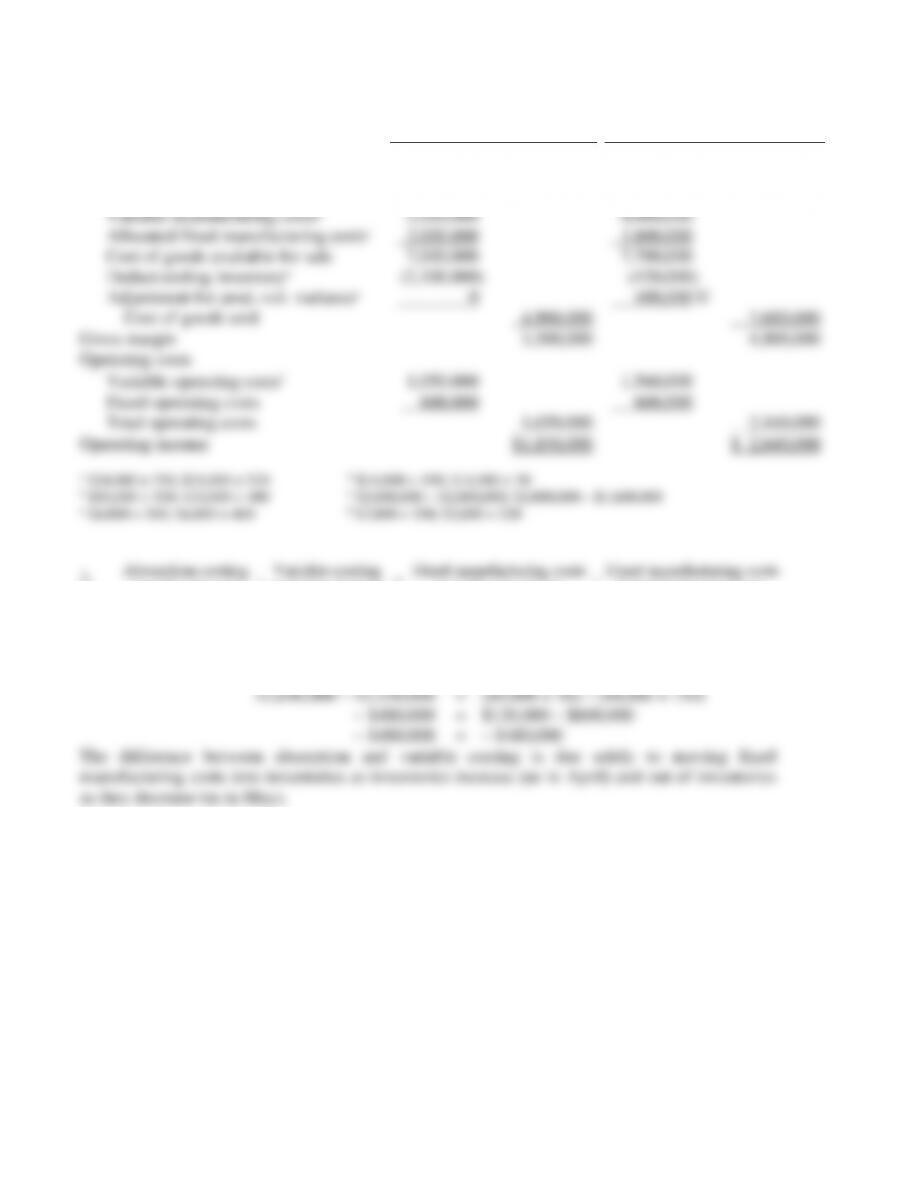
(b) Absorption costing
April 2011
May 2011
Revenuesa
$8,400,000
$12,480,000
Cost of goods sold
Beginning inventory
$ 0
$2,100,000
Variable manufacturing costsb
5,000,000
4,000,000
Allocated fixed manufacturing costsc
2,000,000
1,600,000
Cost of goods available for sale
7,000,000
7,700,000
Deduct ending inventoryd
(2,100,000)
(420,000)
Adjustment for prod.-vol. variancee
0
400,000 U
Cost of goods sold
4,900,000
7,680,000
Gross margin
3,500,000
4,800,000
Operating costs
Variable operating costsf
1,050,000
1,560,000
Fixed operating costs
600,000
600,000
Total operating costs
1,650,000
2,160,000
Operating income
$1,850,000
$ 2,640,000
2.
Absorption-costing
operating income
–
Variable-costing
operating income
=
Fixed manufacturing costs
in ending inventory
–
Fixed manufacturing costs
in beginning inventory
April:
$1,850,000 – $1,250,000 = ($4,000 × 150) – ($0)
$600,000 = $600,000
May:
9-5
9-17 (20 min.) Throughput costing (continuation of Exercise 9-16).
1.
April 2011
May 2011
Revenuesa
$8,400,000
$12,480,000
Direct material cost of goods sold
Beginning inventory
Direct materials in goods
manufacturedb
$ 0
3,350,000
$1,005,000
2,680,000
Cost of goods available for sale
Deduct ending inventoryc
3,350,000
(1,005,000)
3,685,000
(201,000)
Total direct material cost of goods sold
Throughput margin
Other costs
2,345,000
6,055,000
3,484,000
8,996,000
Manufacturing costs
3,650,000d
3,320,000e
Other operating costs
1,650,000f
2,160,000g
Total other costs
Operating income
5,300,000
$ 755,000
5,480,000
$ 3,516,000
2. Operating income under:
April
May
Variable costing
Absorption costing
Throughput costing
$1,250,000
1,850,000
755,000
$3,120,000
2,640,000
3,516,000
In April, throughput costing has the lowest operating income, whereas in May throughput
costing has the highest operating income. Throughput costing puts greater emphasis on sales as
the source of operating income than does either absorption or variable costing.
3. Throughput costing puts a penalty on production without a corresponding sale in the
same period. Costs other than direct materials that are variable with respect to production are
9-6
9-18 (40 min.) Variable and absorption costing, explaining operating-income differences.
1. Key inputs for income statement computations are:
January
February
March
Beginning inventory
Production
Goods available for sale
Units sold
Ending inventory
0
1,000
1,000
700
300
300
800
1,100
800
300
300
1,250
1,550
1,500
50
The budgeted fixed manufacturing cost per unit and budgeted total manufacturing cost
per unit under absorption costing are:
January
February
March
(a) Budgeted fixed manufacturing costs
(b) Budgeted production
(c)=(a)÷(b) Budgeted fixed manufacturing cost per unit
(d) Budgeted variable manufacturing cost per unit
(e)=(c)+(d) Budgeted total manufacturing cost per unit
$400,000
1,000
$ 400
$ 900
$ 1,300
$400,000
1,000
$ 400
$ 900
$ 1,300
$400,000
1,000
$ 400
$ 900
$ 1,300
9-7
(a) Variable Costing
January 2012
February 2012
March 2012
Revenuesa
$1,750,000
$2,000,000
$3,750,000
Variable costs
Beginning inventoryb
$ 0
$270,000
$ 270,000
Variable manufacturing costsc
900,000
720,000
1,125,000
Cost of goods available for sale
Deduct ending inventoryd
900,000
(270,000)
990,000
(270,000)
1,395,000
(45,000)
Variable cost of goods sold
Variable operating costse
Total variable costs
630,000
420,000
1,050,000
720,000
480,000
1,200,000
1,350,000
900,000
2,250,000
Contribution margin
Fixed costs
Fixed manufacturing costs
Fixed operating costs
Total fixed costs
Operating income
400,000
140,000
700,000
540,000
$ 160,000
400,000
140,000
800,000
540,000
$ 260,000
400,000
140,000
1,500,000
540,000
$ 960,000
a $2,500 × 700; $2,500 × 800; $2,500 × 1,500
b $? × 0; $900 × 300; $900 × 300
c $900 × 1,000; $900 × 800; $900 × 1,250
d $900 × 300; $900 × 300; $900 × 50
e $600 × 700; $600 × 800; $600 × 1,500
9-8
(b) Absorption Costing
January 2012
February 2012
March 2012
Revenuesa
Cost of goods sold
Beginning inventoryb
$ 0
$1,750,000
$ 390,000
$2,000,000
$ 390,000
$3,750,000
Variable manufacturing costsc
900,000
720,000
1,125,000
Allocated fixed manufacturing
costsd
400,000
320,000
500,000
Cost of goods available for sale
1,300,000
1,430,000
2,015,000
Deduct ending inventorye
(390,000)
(390,000)
(65,000)
Adjustment for prod. vol. var.f
0
80,000 U
(100,000) F
Cost of goods sold
910,000
1,120,000
1,850,000
Gross margin
840,000
880,000
1,900,000
Operating costs
Variable operating costsg
420,000
480,000
900,000
Fixed operating costs
140,000
140,000
140,000
Total operating costs
560,000
620,000
1,040,000
Operating income
$ 280,000
$ 260,000
$ 860,000
9-9
2.
Absorption-costing Variable costing Fixed manufacturing Fixed manufacturing
operating operating costs in costs in
income income ending inventory beginning inventory
− = −
9-19 (20–30 min.) Throughput costing (continuation of Exercise 9-18).
1.
January
February
March
Revenuesa
Direct material cost of
goods sold
Beginning inventoryb
$ 0
$1,750,000
$150,000
$2,000,000
$ 150,000
$3,750,000
Direct materials in goods
manufacturedc
Cost of goods available
for sale
Deduct ending inventoryd
Total direct material
cost of goods sold
500,000
500,000
(150,000)
350,000
400,000
550,000
(150,000)
400,000
625,000
775,000
(25,000)
750,000
Throughput margin
1,400,000
1,600,000
3,000,000
Other costs
Manufacturinge
Operatingf
Total other costs
Operating income
800,000
560,000
1,360,000
$ 40,000
720,000
620,000
1,340,000
$ 260,000
900,000
1,040,000
1,940,000
$1,060,000
a $2,500 × 700; $2,500 × 800; $2,500 × 1,500
b $? × 0; $500 × 300; $500 × 300
c $500 × 1,000; $500 × 800; $500 × 1,250
d $500 × 300; $500 × 300; $500 ×50
e ($400 × 1,000) + $400,000; ($400 × 800) + $400,000; ($400 × 1,250) + $400,000
f ($600 × 700) + $140,000; ($600 × 800) + $140,000; ($600 × 1,500) + $140,000
2. Operating income under:
January
February
March
Variable costing
Absorption costing
Throughput costing
$160,000
280,000
40,000
$260,000
260,000
260,000
$ 960,000
860,000
1,060,000
Throughput costing puts greater emphasis on sales as the source of operating income than does
absorption or variable costing. Accordingly, income under throughput costing is highest in
periods where the number of units sold is relatively large (as in March) and lower in periods of
weaker sales (as in January).
3. Throughput costing puts a penalty on producing without a corresponding sale in the same
cost.