8-1
CHAPTER 8
8-1 Effective planning of variable overhead costs involves:
2. Planning to use the drivers of costs in those activities in the most efficient way.
8-2 At the start of an accounting period, a larger percentage of fixed overhead costs are
8-3 The key differences are how direct costs are traced to a cost object and how indirect costs
are allocated to a cost object:
Actual Costing
Standard Costing
Direct costs
Actual prices
× Actual inputs used
Standard prices
× Standard inputs allowed for actual output
Indirect costs
Actual indirect rate
× Actual inputs used
Standard indirect cost-allocation rate
× Standard quantity of cost-allocation base
allowed for actual output
1. Choose the period to be used for the budget,
3. Identify the variable overhead costs associated with each cost-allocation base, and
8-5 Two factors affecting the spending variance for variable manufacturing overhead are:
a. Price changes of individual inputs (such as energy and indirect materials) included in
8-6 Possible reasons for a favorable variable-overhead efficiency variance are:
• Workers more skillful in using machines than budgeted,
8-2
8-7 A direct materials efficiency variance indicates whether more or less direct materials
1. Choose the period to use for the budget,
produced,
3. Identify the fixed-overhead costs associated with each cost-allocation base, and
8-9 The relationship for fixed-manufacturing overhead variances is:
8-10 For planning and control purposes, fixed overhead costs are a lump sum amount that is
8-11 An important caveat is what change in selling price might have been necessary to attain
the level of sales assumed in the denominator of the fixed manufacturing overhead rate. For
Flexible-budget variance
Spending variance
Efficiency variance
(never a variance)
8-3
8-12 A strong case can be made for writing off an unfavorable production-volume variance to
cost of goods sold. The alternative is prorating it among inventories and cost of goods sold, but
this would “penalize” the units produced (and in inventory) for the cost of unused capacity, i.e.,
sold.
8-13 The four variances are:
• Variable manufacturing overhead costs
8-14 Interdependencies among the variances could arise for the spending and efficiency
variances. For example, if the chosen allocation base for the variable overhead efficiency
8-15 Flexible-budget variance analysis can be used in the control of costs in an activity area by
8-16 (20 min.) Variable manufacturing overhead, variance analysis.
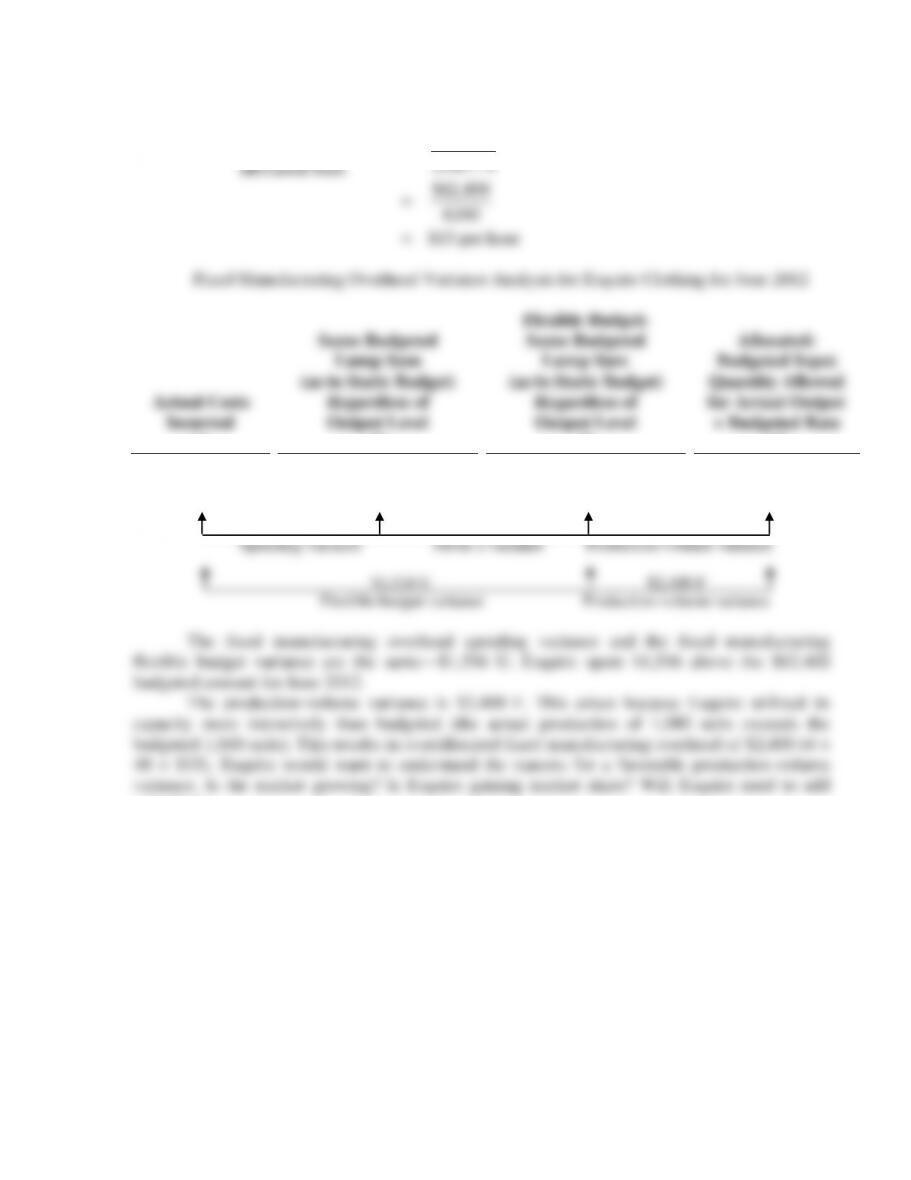
1. Variable Manufacturing Overhead Variance Analysis for Esquire Clothing for June 2012
Actual Costs
Incurred
Actual Input
Quantity
× Actual Rate
(1)
Actual Input
Quantity
× Budgeted Rate
(2)
Flexible Budget:
Budgeted Input
Quantity Allowed
for Actual Output
× Budgeted Rate
(3)
Allocated:
Budgeted Input
Quantity Allowed
for Actual Output
× Budgeted Rate
(4)
(4,536 × $11.50)
$52,164
(4,536 × $12)
$54,432
(4 × 1,080 × $12)
$51,840
(4 × 1,080 × $12)
$51,840
2. Esquire had a favorable spending variance of $2,268 because the actual variable overhead
$2,268 F
Spending variance
$2,592 U
Efficiency variance
Never a variance
$324 U
Flexible-budget variance
Never a variance
8-17 (20 min.) Fixed-manufacturing overhead, variance analysis (continuation of 8-16).
1 & 2.
Budgeted fixed overhead
rate per unit of
allocation base
=
4040,1
400,62$
400,62$
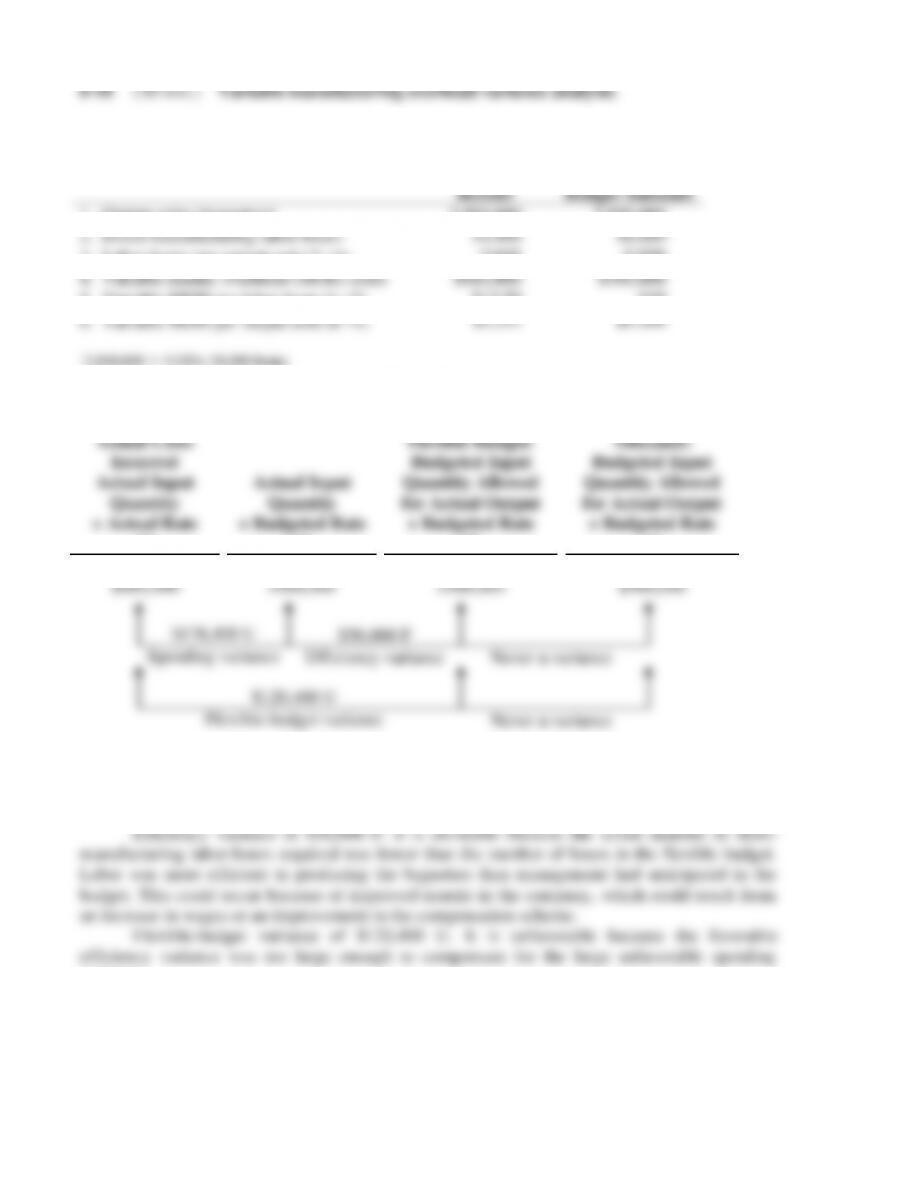
1. Denominator level = (3,200,000 × 0.02 hours) = 64,000 hours
2.
Actual
Results
Flexible
Budget Amounts
1. Output units (baguettes)
2,800,000
2,800,000
2. Direct manufacturing labor-hours
50,400
56,000a
3. Labor-hours per output unit (2 1)
0.018
0.020
4. Variable manuf. overhead (MOH) costs
$680,400
$560,000
5. Variable MOH per labor-hour (4 2)
$13.50
$10
6. Variable MOH per output unit (4 1)
$0.243
$0.200
0.020= 56,000 hours
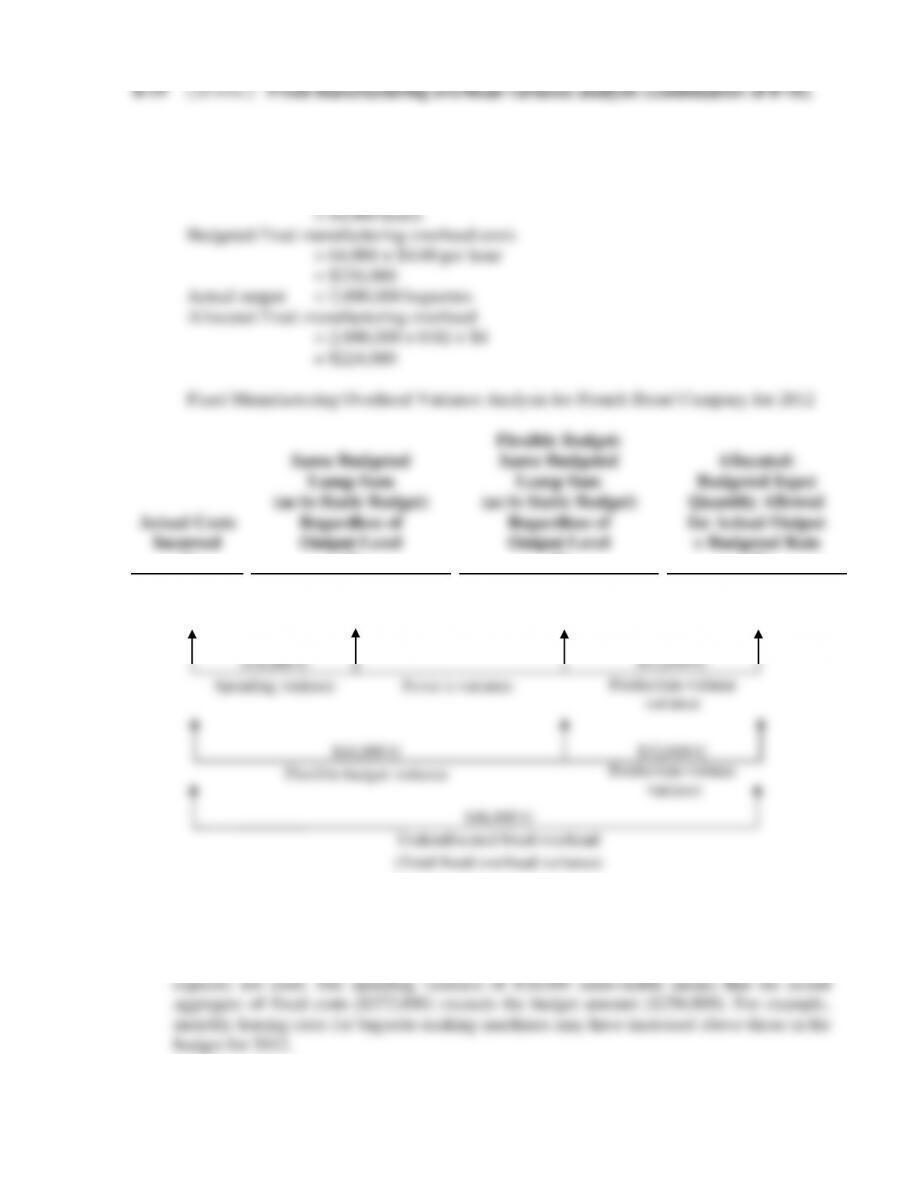
Variable Manufacturing Overhead Variance Analysis for French Bread Company for 2012
Actual Costs
Incurred
Actual Input
Quantity
× Actual Rate
(1)
Actual Input
Quantity
× Budgeted Rate
(2)
Flexible Budget:
Budgeted Input
Quantity Allowed
for Actual Output
× Budgeted Rate
(3)
Allocated:
Budgeted Input
Quantity Allowed
for Actual Output
× Budgeted Rate
(4)
(50,400 × $13.50)
$680,400
(50,400 × $10)
$504,000
(56,000 × $10)
$560,000
(56,000 × $10)
$560,000
3. Spending variance of $176,400 U. It is unfavorable because variable manufacturing
overhead was 35% higher than planned. A possible explanation could be an increase in energy
rates relative to the rate per standard labor-hour assumed in the flexible budget.
variance.
$176,400 U
Spending variance
$56,000 F
Efficiency variance
Never a variance
$120,400 U
Flexible-budget variance
Never a variance
1. Budgeted standard direct manufacturing labor used = 0.02 per baguette
Budgeted output = 3,200,000 baguettes
Budgeted standard direct manufacturing labor-hours
= 3,200,000 × 0.02
8-8
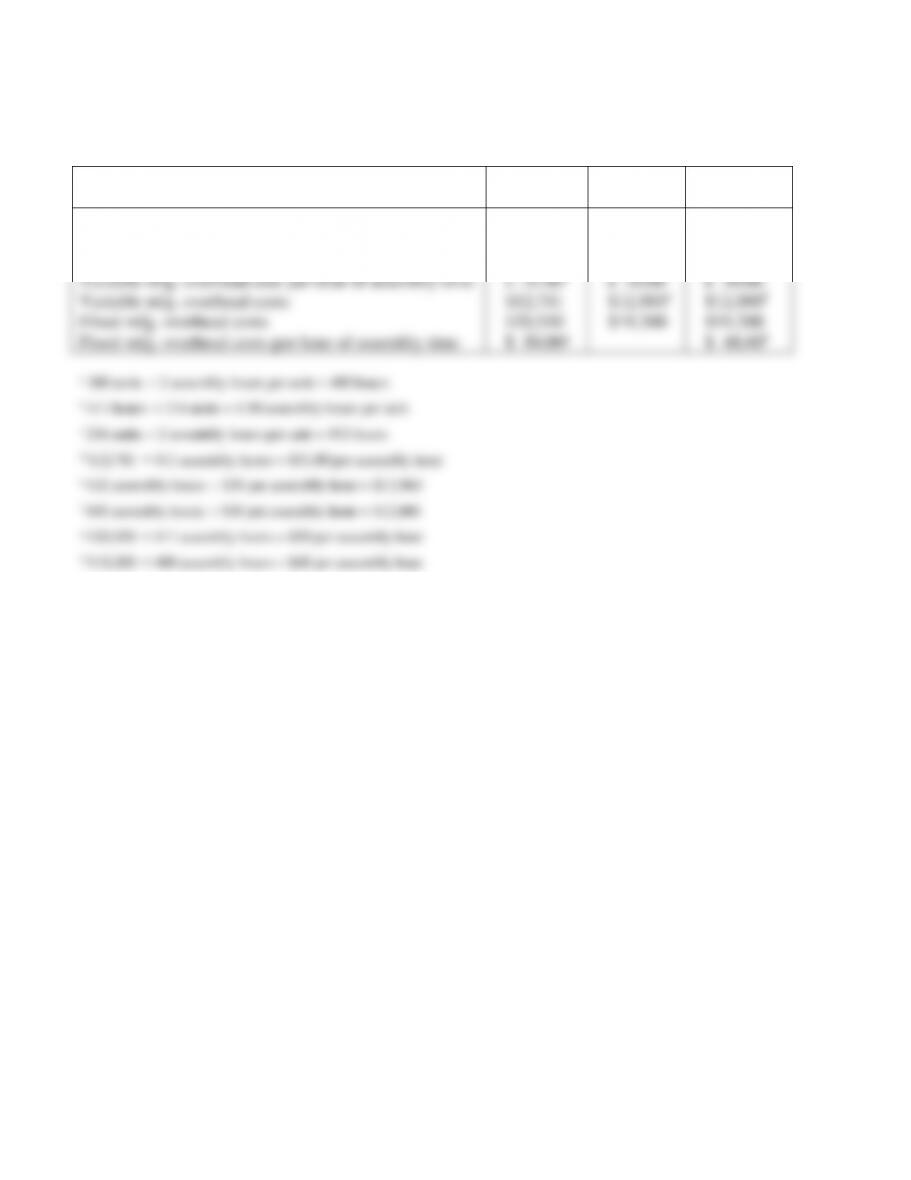
8-20 (30–40 min.) Manufacturing overhead, variance analysis.
1. The summary information is:
The Solutions Corporation (June 2012)
Actual
Flexible
Budget
Static
Budget
Outputs units (number of assembled units)
216
216
200
Hours of assembly time
411
432c
400a
Assembly hours per unit
1.90b
2.00
2.00
Variable mfg. overhead cost per hour of assembly time
$ 31.00d
$ 30.00
$ 30.00
Variable mfg. overhead costs
$12,741
$12,960e
$12,000f
Fixed mfg. overhead costs
$20,550
$19,200
$19,200
Fixed mfg. overhead costs per hour of assembly time
$ 50.00g
$ 48.00h
a 200 units
2 assembly hours per unit = 400 hours
b 411 hours
216 units = 1.90 assembly hours per unit
c 216 units
2 assembly hours per unit = 432 hours
d $12,741
411 assembly hours = $31.00 per assembly hour
e 432 assembly hours
$30 per assembly hour = $12,960
f 400 assembly hours
$30 per assembly hour = $12,000
g $20,550
411 assembly hours = $50 per assembly hour
h $19,200
400 assembly hours = $48 per assembly hour
8-9
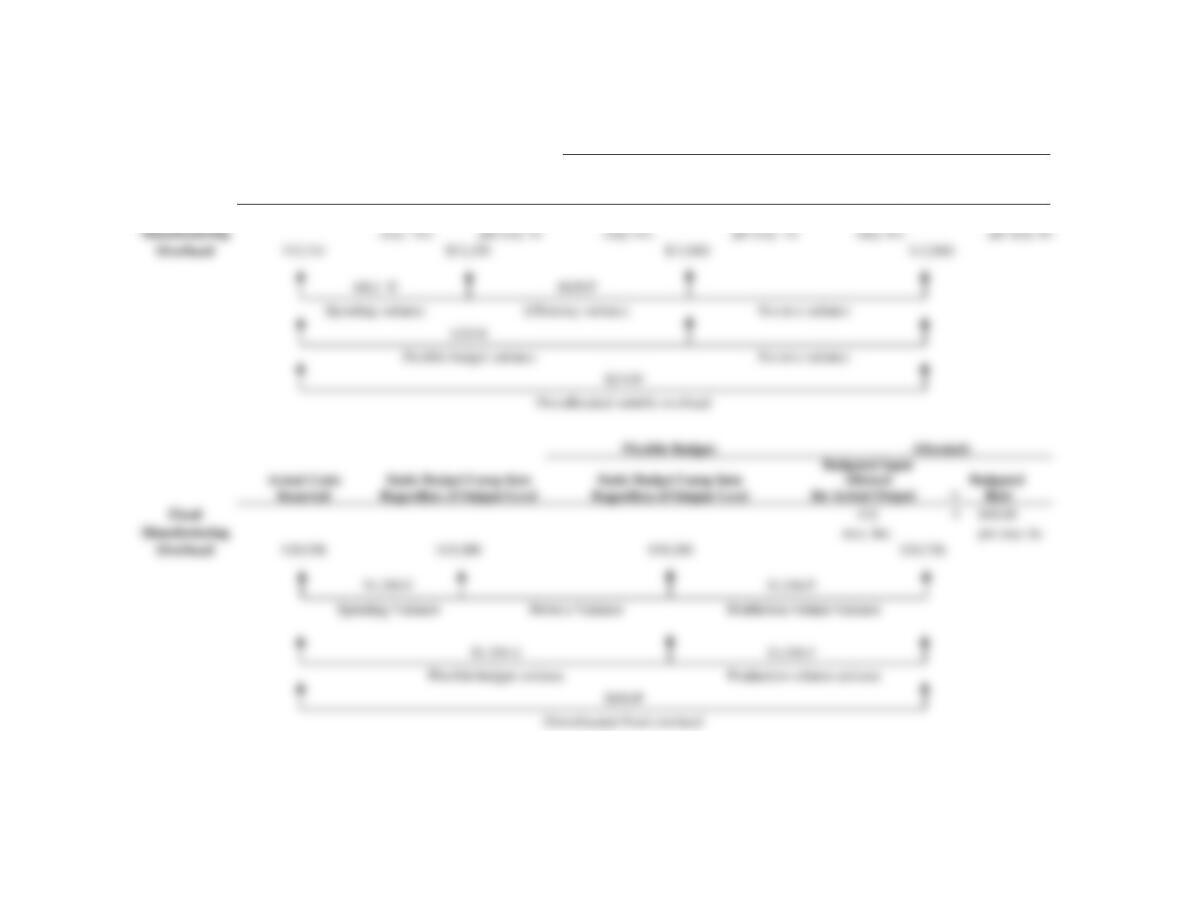
Flexible Budget:
Allocated:
Actual Costs
Actual Input Quantity
Budgeted Input
Quantity Allowed
Budgeted
Budgeted Input
Quantity Allowed
Budgeted
Incurred
Budgeted Rate
for Actual Output
Rate
for Actual Output
Rate
Variable
411
$30.00
432
$30.00
432
$30.00
Manufacturing
assy. hrs.
per assy. hr.
assy. hrs.
per assy. hr.
assy. hrs.
per assy. hr.
Overhead
$12,741
$12,330
$12,960
$12,960
$411 U $630 F
Spending variance Efficiency variance Never a variance
$219 F
Flexible-budget variance Never a variance
$219 F
Overallocated variable overhead
Flexible Budget:
Allocated:
Actual Costs
Static Budget Lump Sum
Static Budget Lump Sum
Budgeted Input
Allowed
Budgeted
Incurred
Regardless of Output Level
Regardless of Output Level
for Actual Output
Rate
Fixed
432
$48.00
Manufacturing
assy. hrs.
per assy. hr.
Overhead
$20,550
$19,200
$19,200
$20,736
$1,350 U $1,536 F
Spending Variance Never a Variance Production-volume variance
$1,350 U $1,536 F
Flexible-budget variance Production-volume variance
$186 F
Overallocated fixed overhead
8-10
The summary analysis is:
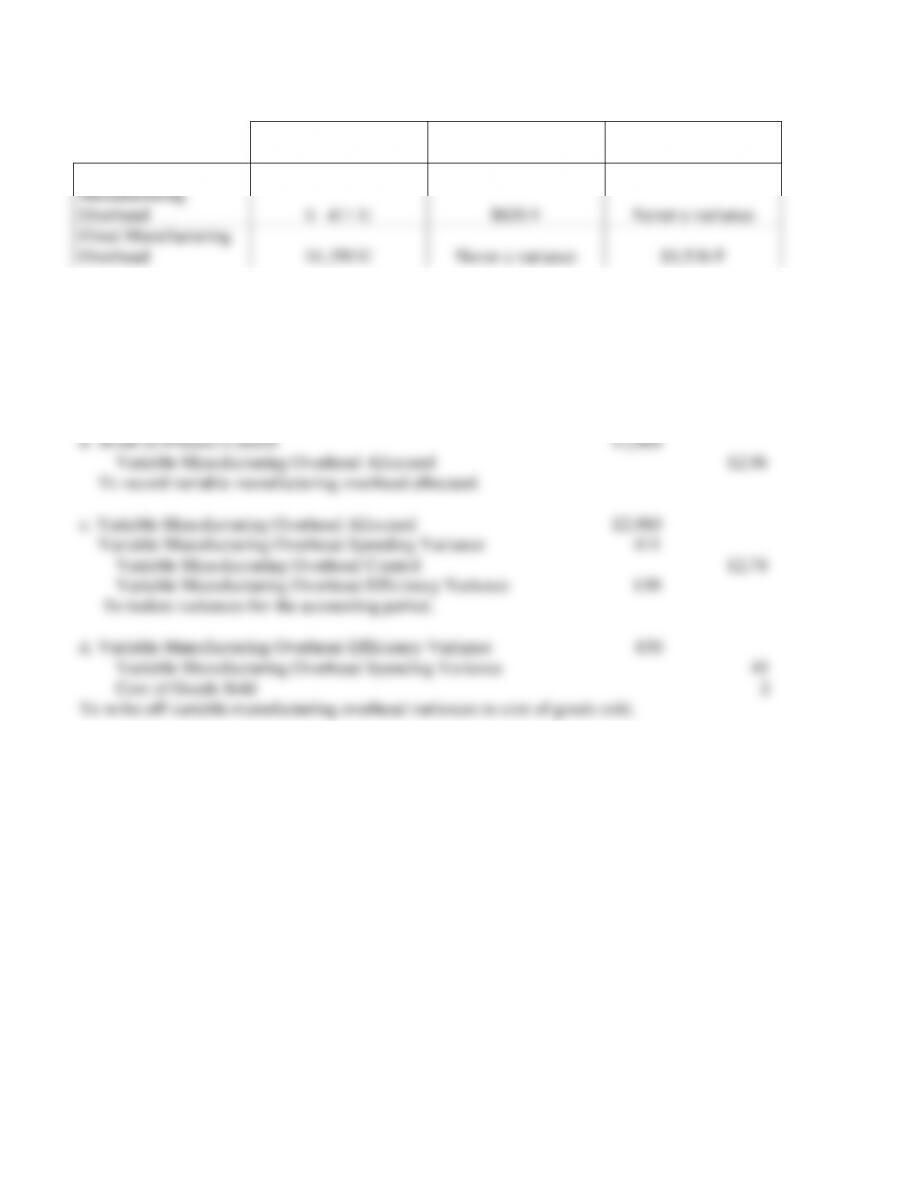
Spending
Variance
Efficiency
Variance
Production-Volume
Variance
Variable
Manufacturing
Overhead
$ 411 U
$630 F
Never a variance
Fixed Manufacturing
Overhead
$1,350 U
Never a variance
$1,536 F
2. Variable Manufacturing Costs and Variances
a. Variable Manufacturing Overhead Control
12,741
Accounts Payable Control and various other accounts
12,741
To record actual variable manufacturing overhead costs incurred
b. Work–in–Process Control
12,960
Variable Manufacturing Overhead Allocated
12,96
To record variable manufacturing overhead allocated.
c. Variable Manufacturing Overhead Allocated
12,960
Variable Manufacturing Overhead Spending Variance
411
Variable Manufacturing Overhead Control
12,74
Variable Manufacturing Overhead Efficiency Variance
630
To isolate variances for the accounting period.
d. Variable Manufacturing Overhead Efficiency Variance
630
Variable Manufacturing Overhead Spending Variance
41
Cost of Goods Sold
2
To write off variable manufacturing overhead variances to cost of goods sold.