7-21
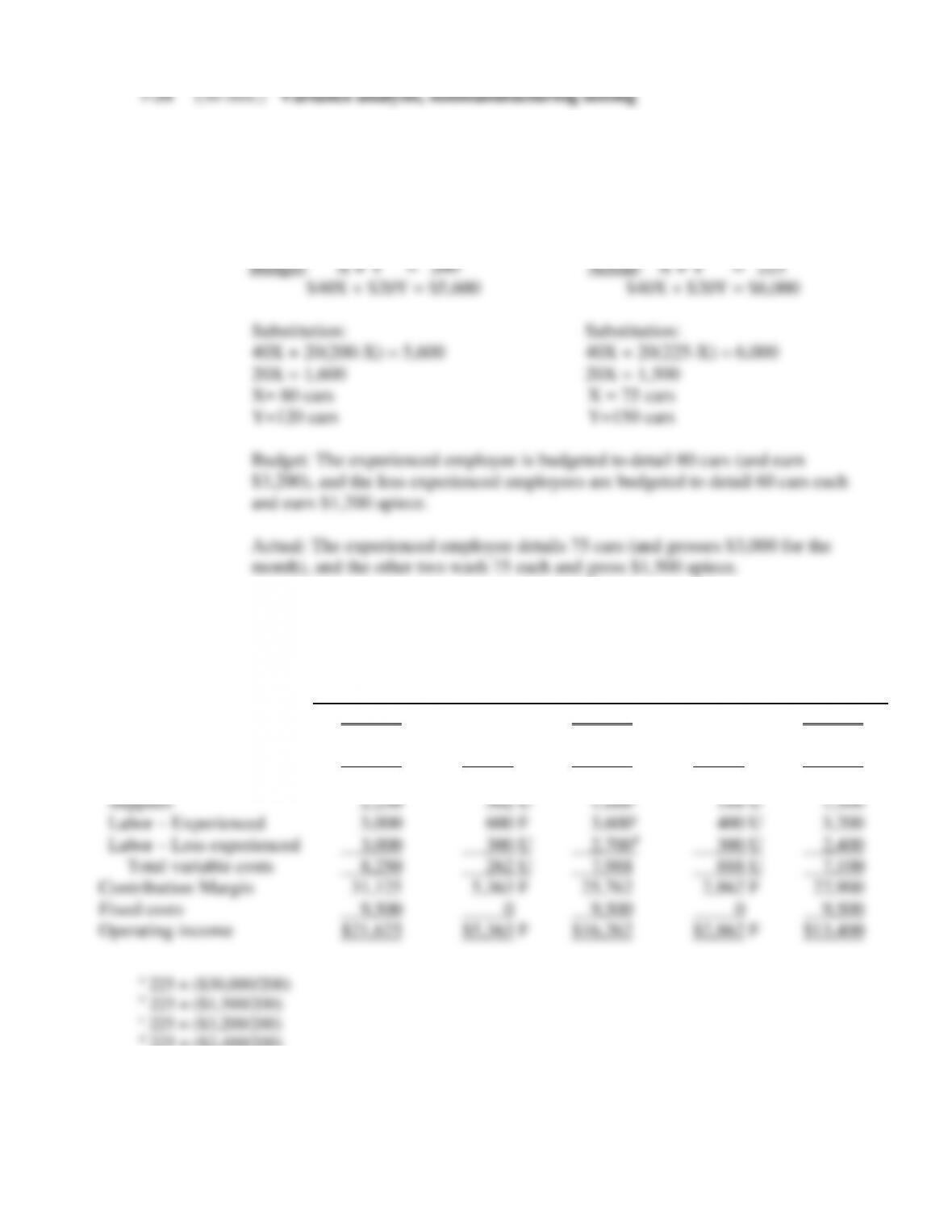
1. This is a problem of two equations & two unknowns. The two equations relate to the
number of cars detailed and the labor costs (the wages paid to the employees).
X = number of cars detailed by the experienced employee
Y = number of cars detailed by the less experienced employees (combined)
2.
Actual
Results
(1)
Flexible-
Budget
Variances
(2)=(1)-(3)
Flexible
Budget
(3)
Sales –
Volume
Variance
(4)=(3)-(5)
Static
Budget
(5)
Units sold
225
225
200
Revenues
$39,375
$5,625 F
$33,750a
$3,750 F
$30,000
Variable costs
Supplies
2,250
562 U
1,688b
188 U
1,500
Labor – Experienced
3,000
600 F
3,600c
400 U
3,200
Labor – Less experienced
3,000
300 U
2,700d
300 U
2,400
Total variable costs
8,250
262 U
7,988
888 U
7,100
Contribution Margin
31,125
5,363 F
25,762
2,862 F
22,900
Fixed costs
9,500
0
9,500
0
9,500
Operating income
$21,625
$5,363 F
$16,262
$2,862 F
$13,400
a 225 × ($30,000/200)
b 225 × ($1,500/200)
c 225 × ($3,200/200)
d 225 × ($2,400/200)
7-22
3. Actual sales price = $39,375 ÷ 225 = $175
Sales Price Variance
= (Actual sales price – Budgeted sales price) × Actual number of cars detailed:
= ($175 – $150) × 225
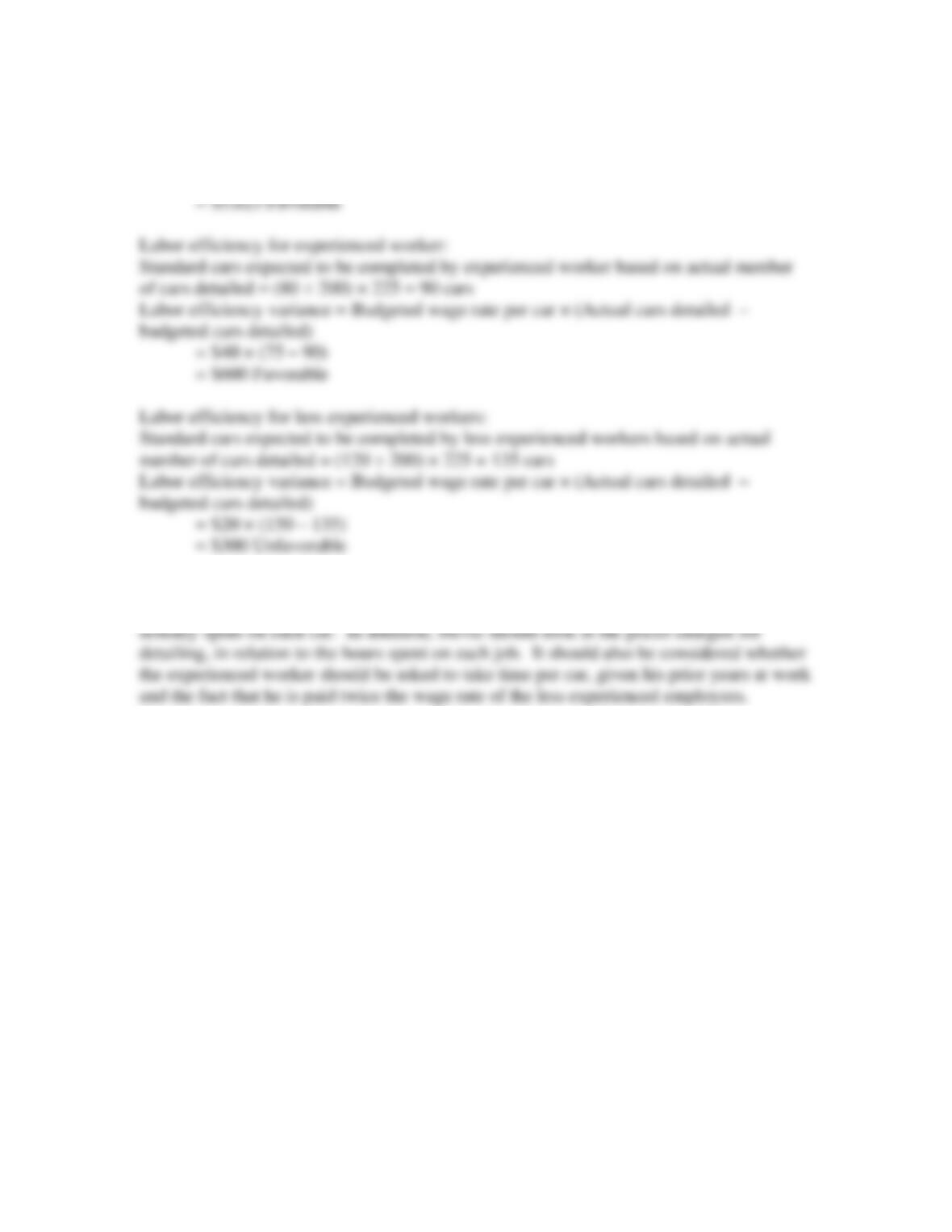
4. In addition to understanding the variances computed above, Stevie should attempt to keep
track of the number of cars worked on by each employee, as well as the number of hours
7-23
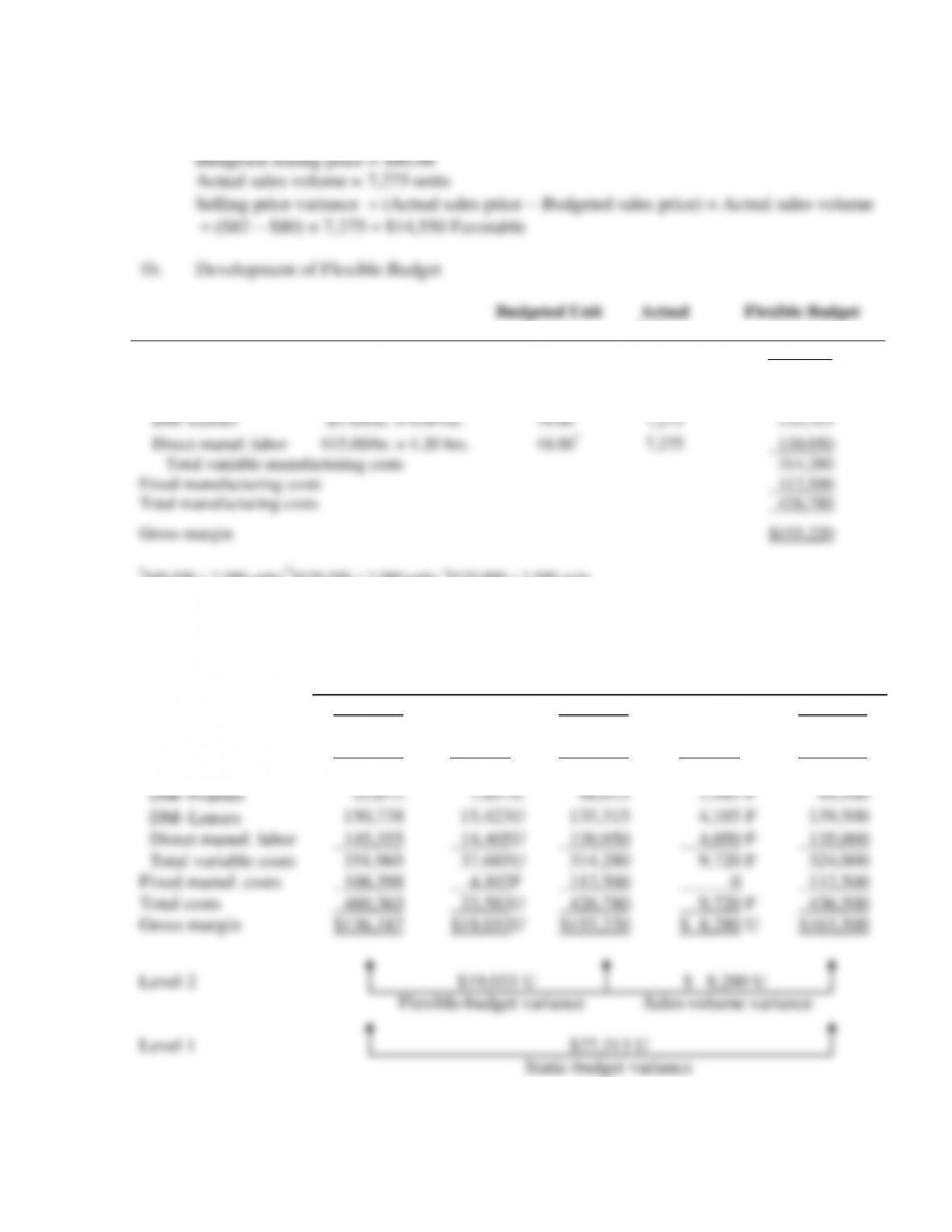
7-32 (60 min.) Comprehensive variance analysis, responsibility issues.
1a. Actual selling price = $82.00
Budgeted Unit
Amounts
Actual
Volume
Flexible Budget
Amount
Revenues
$80.00
7,275
$582,000
Variable costs
DM−Frames
$2.20/oz. × 3.00 oz.
6.60a
7,275
48,015
DM−Lenses
$3.10/oz. × 6.00 oz.
18.60b
7,275
135,315
Direct manuf. labor
$15.00/hr. × 1.20 hrs.
18.00c
7,275
130,950
Total variable manufacturing costs
314,280
Fixed manufacturing costs
112,500
Total manufacturing costs
426,780
Gross margin
$155,220
Actual
Results
(1)
Flexible-
Budget
Variances
(2)=(1)-(3)
Flexible
Budget
(3)
Sales –
Volume
Variance
(4)=(3)-(5)
Static
Budget
(5)
Units sold
7,275
7,275
7,500
Revenues
$596,550
$14,550F
$582,000
$18,000 U
$600,000
Variable costs
DM−Frames
55,872
7,857U
48,015
1,485 F
49,500
DM−Lenses
150,738
15,423U
135,315
4,185 F
139,500
Direct manuf. labor
145,355
14,405U
130,950
4,050 F
135,000
Total variable costs
351,965
37,685U
314,280
9,720 F
324,000
Fixed manuf. costs
108,398
4,102F
112,500
0
112,500
Total costs
460,363
33,583U
426,780
9,720 F
436,500
Gross margin
$136,187
$19,033U
$155,220
$ 8,280 U
$163,500
Level 2 $19,033 U $ 8,280 U
Flexible-budget variance Sales-volume variance
Level 1 $27,313 U
Static-budget variance
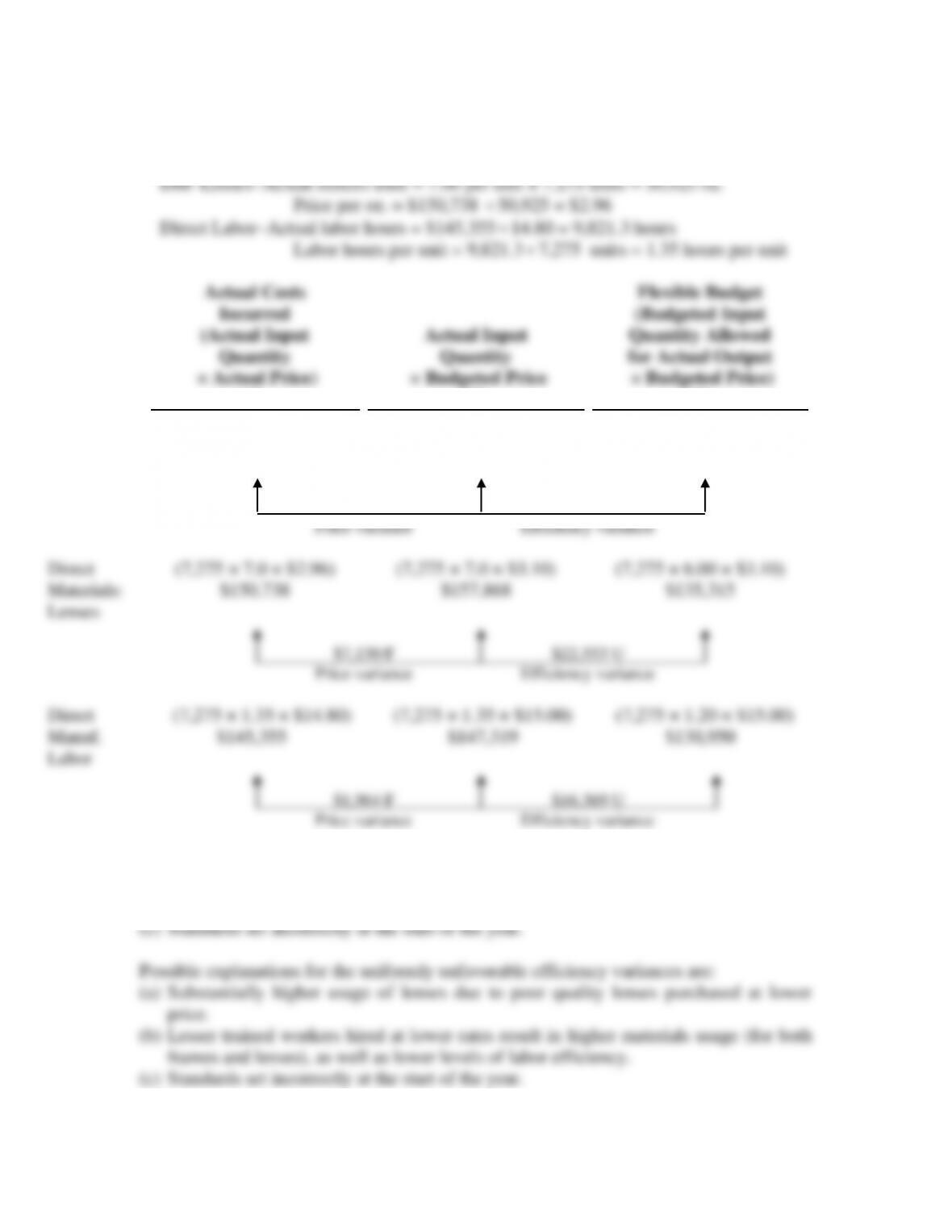
1c. Price and Efficiency Variances
DM−Frames−Actual ounces used = 3.20 per unit × 7,275 units = 23,280 oz.
Price per oz. = $55,872
23,280 = $2.40
Actual Costs
Incurred
(Actual Input
Quantity
× Actual Price)
(1)
Actual Input
Quantity
× Budgeted Price
(2)
Flexible Budget
(Budgeted Input
Quantity Allowed
for Actual Output
× Budgeted Price)
(3)
Direct
Materials:
Frames
(7,275 × 3.2 × $2.40)
$55,872
(7,275 × 3.2 × $2.20)
$51,216
(7,275 × 3.00 × $2.20)
$48,015
$4,656 U $3,201 U
2. Possible explanations for the price variances are:
(a) Unexpected outcomes from purchasing and labor negotiations during the year.
(b) Higher quality of frames and/or lower quality of lenses purchased.
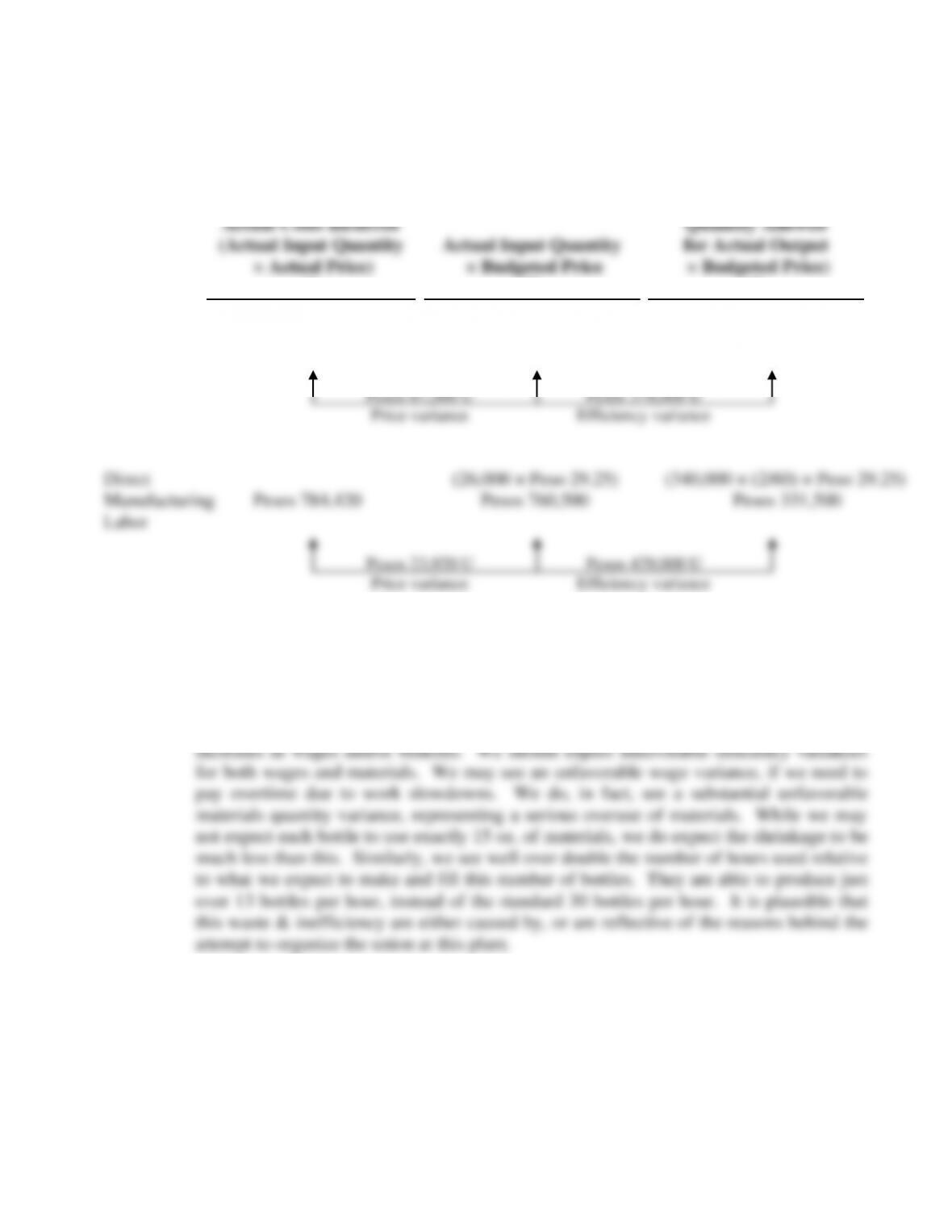
7-33 (20 min.) Possible causes for price and efficiency variances
1.
Actual Costs Incurred
(Actual Input Quantity
× Actual Price)
(1)
Actual Input Quantity
× Budgeted Price
(2)
Flexible Budget
(Budgeted Input
Quantity Allowed
for Actual Output
× Budgeted Price)
(3)
Direct
Materials:
Bottles
Pesos 2,275,500
(6,150,000 × Peso 0.36)
Pesos 2,214,000
(340,000 × 15 × Peso 0.36)
Pesos 1,836,000
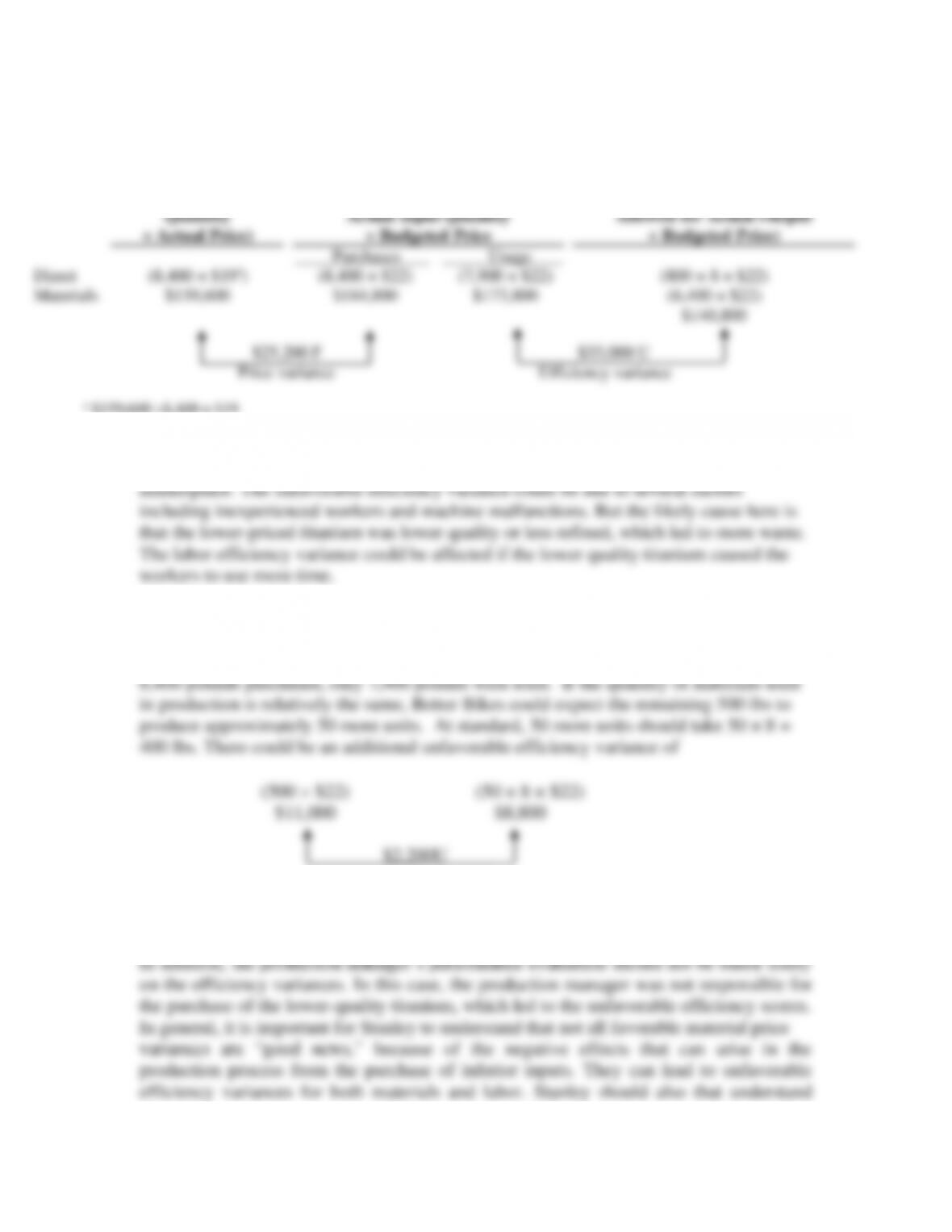
2. If union organizers are targeting our plant, it could suggest employee dissatisfaction with
our wage and benefits policies. During this time of targeting, we might expect employees
to work more slowly and they may be less careful with the materials that they are using.
These tactics might be seen as helpful in either organizing the union or in receiving
7-26
7-34 (35 min.) Material cost variances, use of variances for performance evaluation
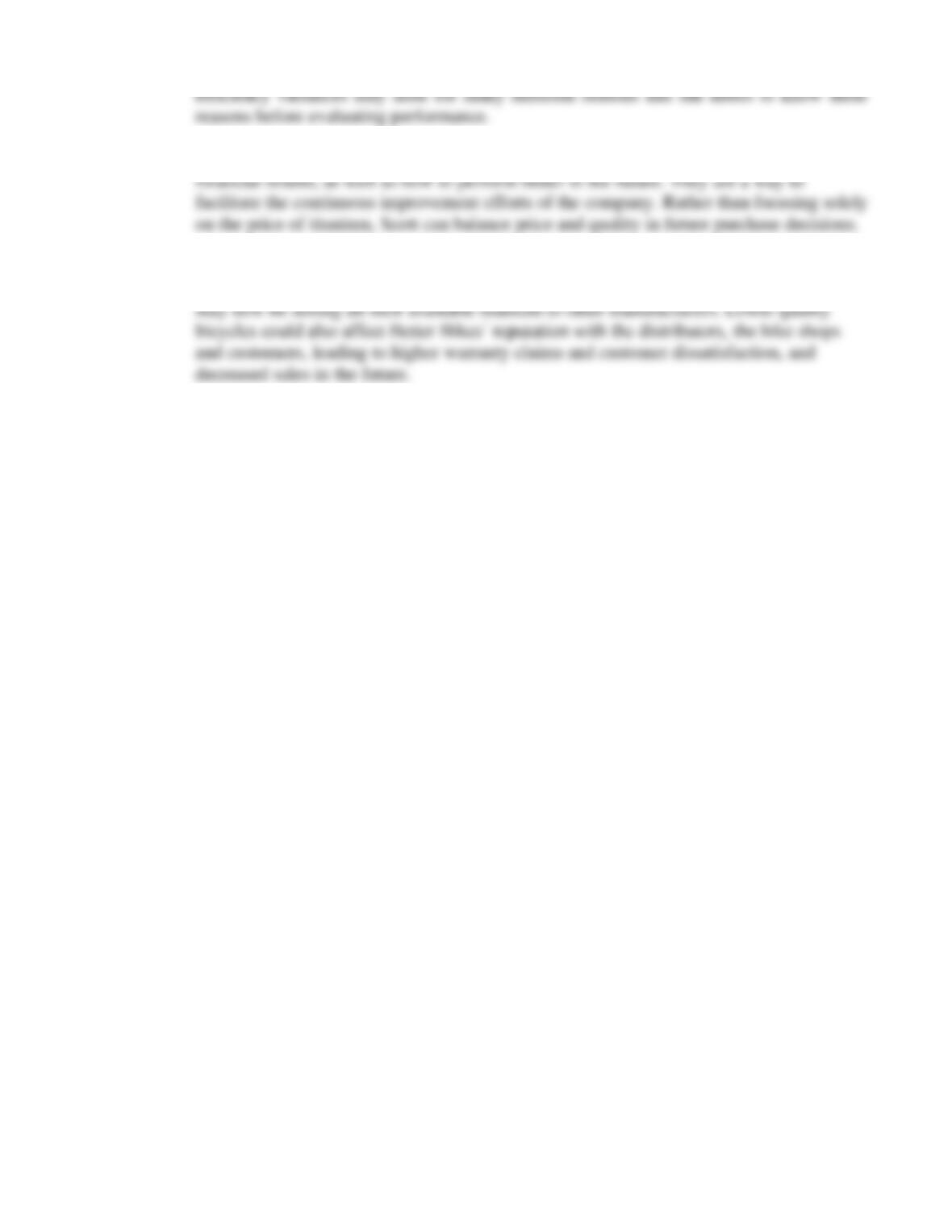
1. Materials Variances
Actual Costs Incurred
(Actual Input
Quantity
× Actual Price)
Actual Input Quantity
× Budgeted Price
Flexible Budget
(Budgeted Input Quantity
Allowed for Actual Output
× Budgeted Price)
Direct
Materials
(8,400 × $19a)
$159,600
Purchases Usage
(8,400 × $22) (7,900 × $22)
$184,800 $173,800
(800 × 8 × $22)
(6,400 × $22)
$140,800
$25,200 F $33,000 U
Price variance Efficiency variance
a $159,600 ÷8,400 = $19
2. The favorable price variance is due to the $3 difference ($22 – $19) between the standard
price based on the previous suppliers and the actual price paid through the on–line
3. Switching suppliers was not a good idea. The $25,200 savings in the cost of titanium was
outweighed by the $33,000 extra material usage. In addition, the $33,000U efficiency
variance does not recognize the total impact of the lower quality titanium because, of the
4. The purchasing manager’s performance evaluation should not be based solely on the
price variance. The short-run reduction in purchase costs was more than offset by higher
usage rates. His evaluation should be based on the total costs of the company as a whole.
7-27
5. Variances should be used to help Better Bikes understand what led to the current set of
6. Future problems can arise in the supply chain. Scott may need to go back to the previous
suppliers. But Better Bikes’ relationship with them may have been damaged and they
7-28
1.
Actual Costs
Incurred
(Actual Input
Quantity
Actual Price)
Actual Input
Quantity
Budgeted Price
Flexible Budget
(Budgeted Input
Quantity Allowed
for Actual Output
Budgeted Price)
Direct mfg. labor $739,900a $735,000b $742,500c
$4,900 U $7,500 F
Price variance Efficiency variance
$2,600 F
Flexible-budget variance
a Given (or 49,000 hours × $15.10/hour)
b 49,000 hours × $15/hour = $735,000
c 5,500 units × 9 hours/unit × $15/hour = $742,500
2. Unfavorable direct materials efficiency variance of $1,500 indicates that fewer pounds of
direct materials were actually used than the budgeted quantity allowed for actual output.
$1,500 efficiency variance
3. Actual price paid per pound = 579,500/190,000
= $3.05 per pound
4. Actual Costs Incurred Actual Input ×
(Actual Input × Actual Price) Budgeted Price
7-36 (20–30 min.) Direct materials and manufacturing labor variances, solving
unknowns.
All given items are designated by an asterisk.
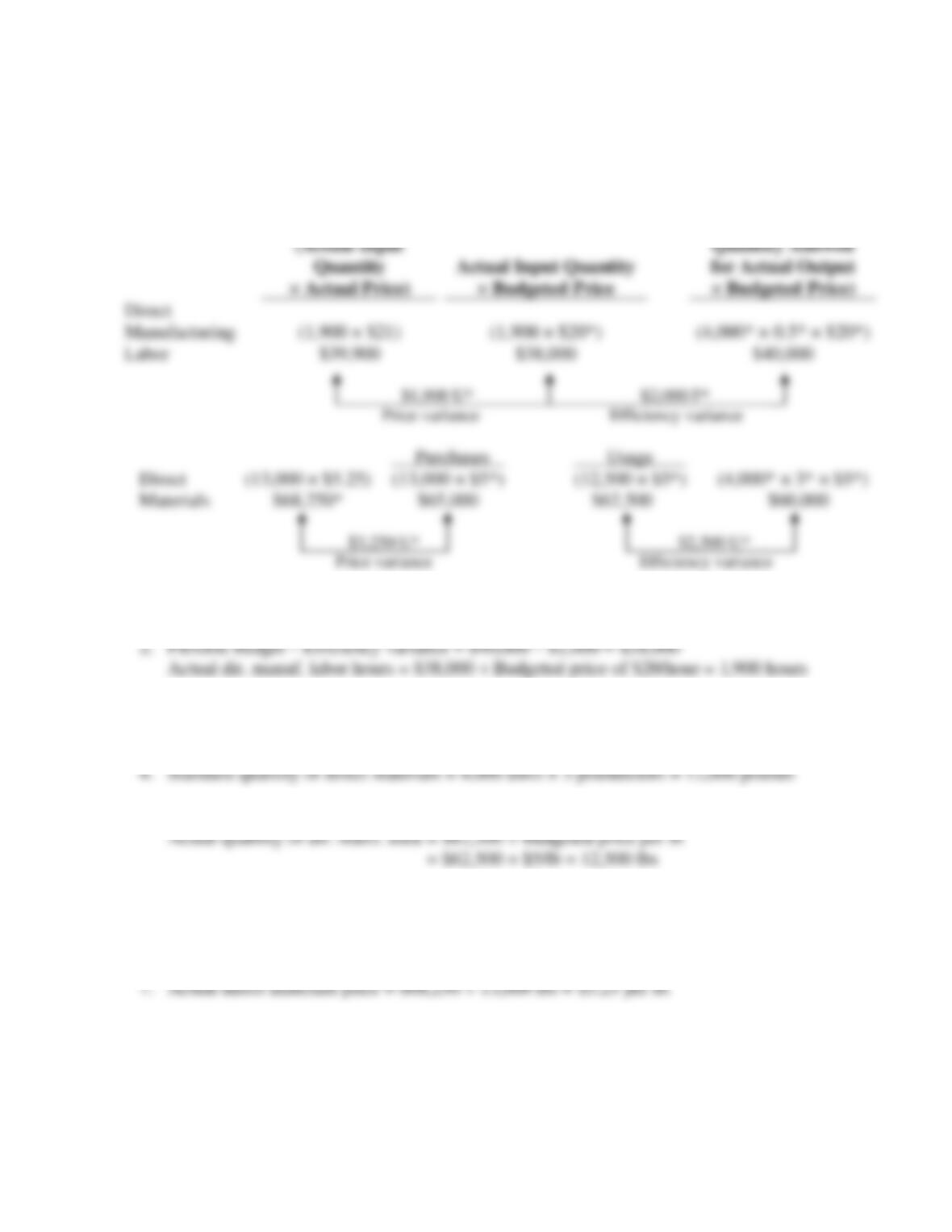
Actual Costs
Incurred
(Actual Input
Quantity
× Actual Price)
(1,900 × $21)
$39,900
Actual Input Quantity
× Budgeted Price
Flexible Budget
(Budgeted Input
Quantity Allowed
for Actual Output
× Budgeted Price)
Direct
Manufacturing
Labor
(1,900 × $20*)
$38,000
(4,000* × 0.5* × $20*)
$40,000
$1,900 U* $2,000 F*
Price variance Efficiency variance
Purchases Usage
Direct (13,000 × $5.25) (13,000 × $5*) (12,500 × $5*) (4,000* × 3* × $5*)
Materials $68,250* $65,000 $62,500 $60,000
$3,250 U* $2,500 U*
Price variance Efficiency variance
1. 4,000 units × 0.5 hours/unit = 2,000 hours
3. $38,000 + Price variance, $1,900 = $39,900, the actual direct manuf. labor cost
Actual rate = Actual cost ÷ Actual hours = $39,000 ÷ 1,900 hours = $21/hour (rounded)
5. Flexible budget + Dir. matls. effcy. var. = $60,000 + $2,500 = $62,500
6. Actual cost of direct materials, $68,250 – Price variance, $3,250 = $65,000
Actual quantity of direct materials purchased = $65,000 ÷ Budgeted price, $5/lb = 13,000
lbs.
7-30
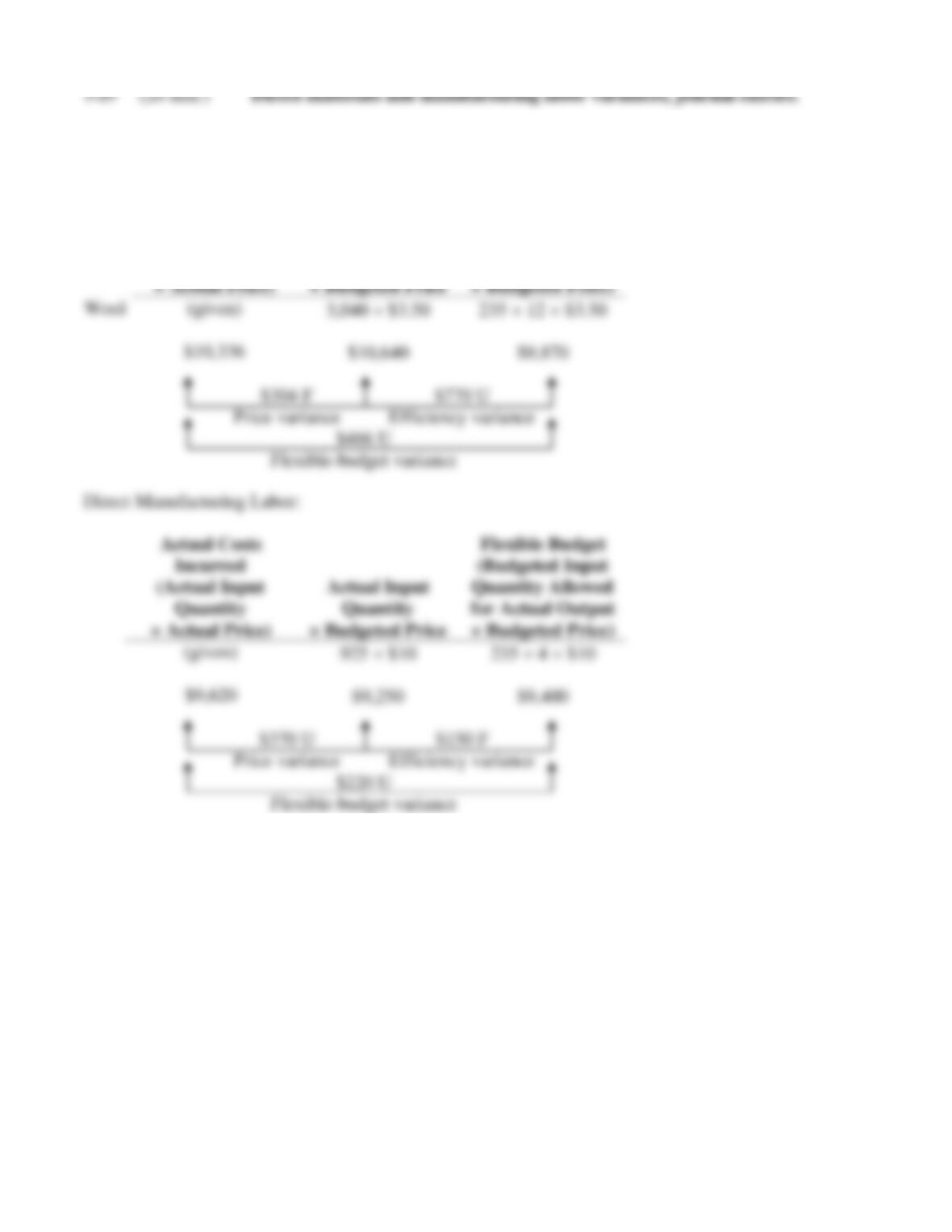
1.
Direct Materials:
Actual Costs
Incurred
(Actual Input
Quantity
× Actual Price)
Actual Input
Quantity
× Budgeted Price
Flexible Budget
(Budgeted Input
Quantity Allowed
for Actual Output
× Budgeted Price)
Wool
(given)
$10,336
3,040 $3.50
$10,640
235 12 $3.50
$9,870
$304 F $770 U
Price variance Efficiency variance
$466 U
Flexible-budget variance
Direct Manufacturing Labor:
Actual Costs
Incurred
(Actual Input
Quantity
× Actual Price)
Actual Input
Quantity
× Budgeted Price
Flexible Budget
(Budgeted Input
Quantity Allowed
for Actual Output
× Budgeted Price)
(given)
$9,620
925 $10
$9,250
235 4 $10
$9,400
$370 U $150 F
Price variance Efficiency variance
$220 U
Flexible-budget variance