6-11
6-26 (15 min.) Responsibility and controllability.
1. (a) Production manager
(b) Purchasing Manager
2. (a) Production Manager
(b) External Forces
3. (a) Van 3 driver
(b) Service manager
4. (a) Anderson’s service manager
(b) Bigstore Warehouse manager
5. (a) Service manager
(b) This depends…
6-12
6. (a) Service manager
(b) External forces
6-13
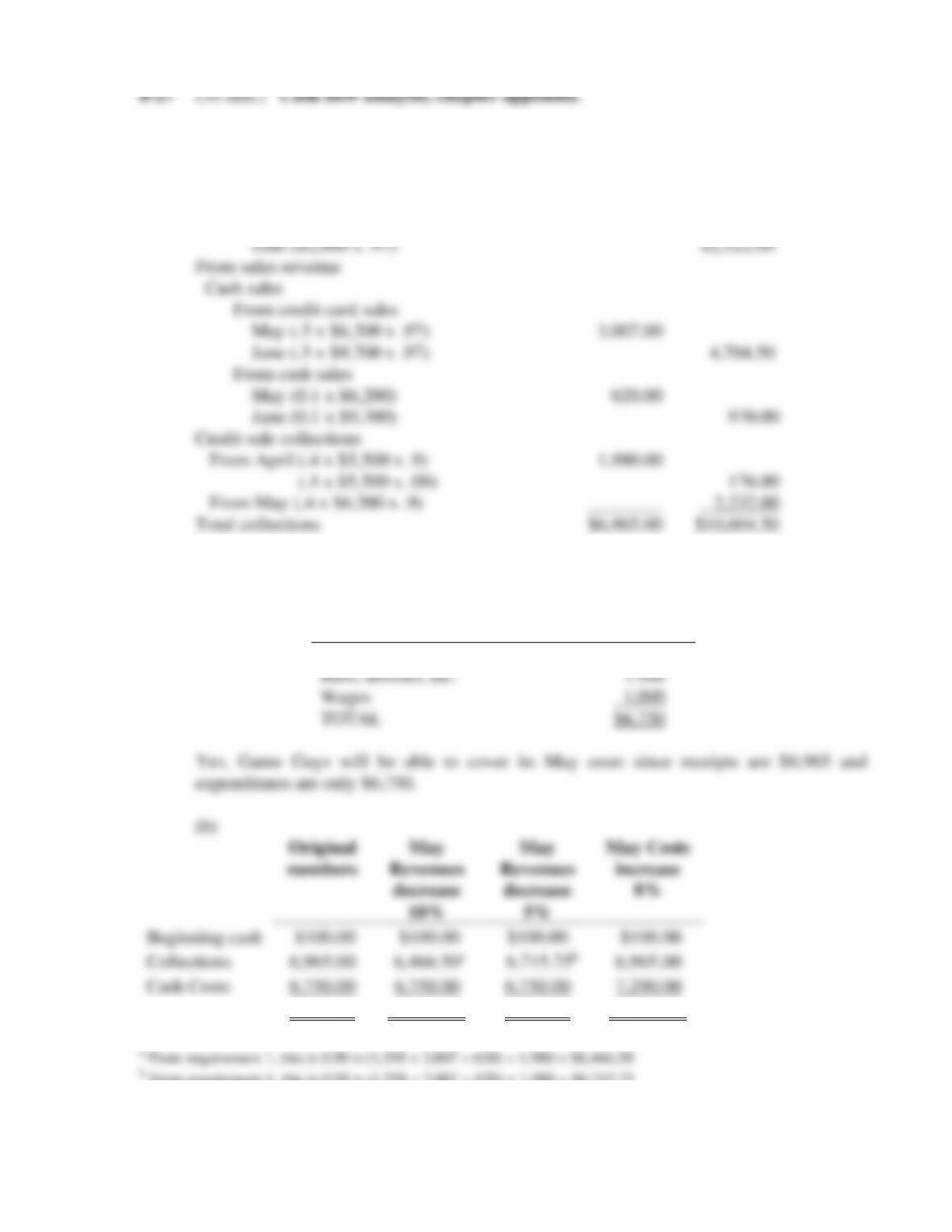
1. The cash that Game Guys can expect to collect during May and June is calculated below.
Cash collected in May June
From service revenue
May ($1,400 x .97) $1,358.00
2. (a) Budgeted expenditures for May are as follows.
Costs
Inventory purchases
$4,350
Rent, utilities, etc.
1,400
Wages
1,000
TOTAL
$6,750
Yes, Game Guys will be able to cover its May costs since receipts are $6,965 and
expenditures are only $6,750.
(b)
Original
numbers
May
Revenues
decrease
10%
May
Revenues
decrease
5%
May Costs
increase
8%
Beginning cash
$100.00
$100.00
$100.00
$100.00
Collections
6,965.00
6,466.50a
6,715.75b
6,965.00
Cash Costs
6,750.00
6,750.00
6,750.00
7,290.00
Total
$315.00
$(183.50)
$ 65.75
$(225.00)
6-14
3. The cost of inventory purchases without the discount is $4,350, which Game Guys would
not have to pay until June if they buy the inventory on account in May. However, if they
take the discount and pay in May, the cost will be $4,350 x (100% – 2%) = $4,263. This
means they will save $87.
6-28 (40 min.) Budget schedules for a manufacturer.
1a. Revenues Budget
Knights
Blankets
Raiders
Blankets
Total
Units sold
120
180
Selling price
$150
$175
Budgeted revenues
$18,000
$31,500
$49,500
Budgeted unit sales
Add budgeted ending fin. goods inventory
Total requirements
Deduct beginning fin. goods inventory
Budgeted production
Knights blankets:
1. Budgeted input per f.g. unit
1
2. Budgeted production
130
3. Budgeted usage (1 × 2)
390
Raiders blankets:
4. Budgeted input per f.g. unit
1
5. Budgeted production
6. Budgeted usage (4 × 5)
7. Total direct materials
usage (3 + 6)
390
Direct Materials Cost Budget
8. Beginning inventory
10
40
55
9. Unit price (FIFO)
$6
$5
360
90
12. Cost of DM in March
$9
$6
$7
$3,240
$10,278
$3,480
$11,133
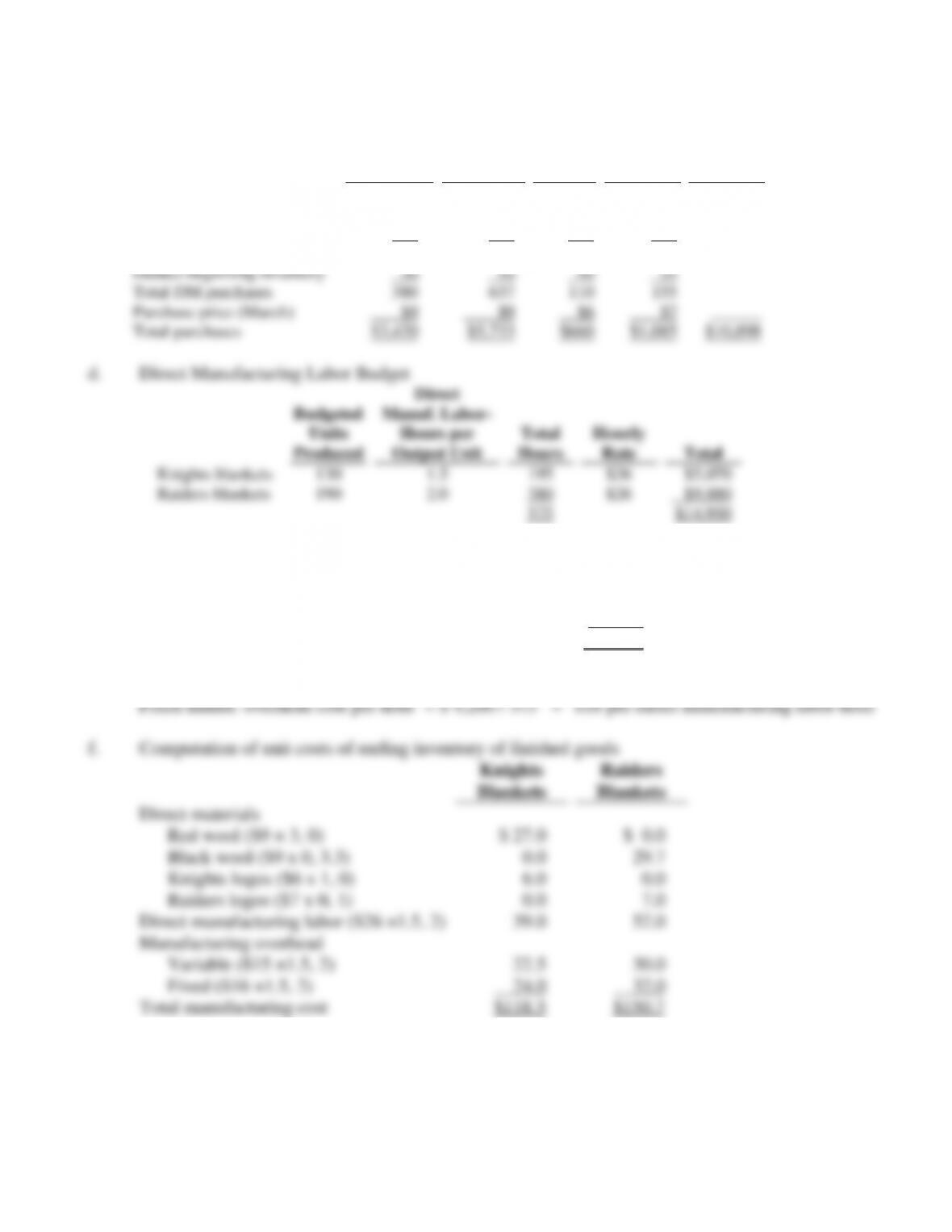
Direct Materials Purchases Budget
Red wool
Black
wool
Knights
logos
Raiders
logos
Total
Budgeted usage
(from line 7)
390
627
130
190
Add target ending inventory
20
20
20
20
Total requirements
410
647
150
210
Deduct beginning inventory
30
10
40
55
Total DM purchases
380
637
110
155
Purchase price (March)
$9
$9
$6
$7
______
Total purchases
$3,420
$5,733
$660
$1,085
$10,898
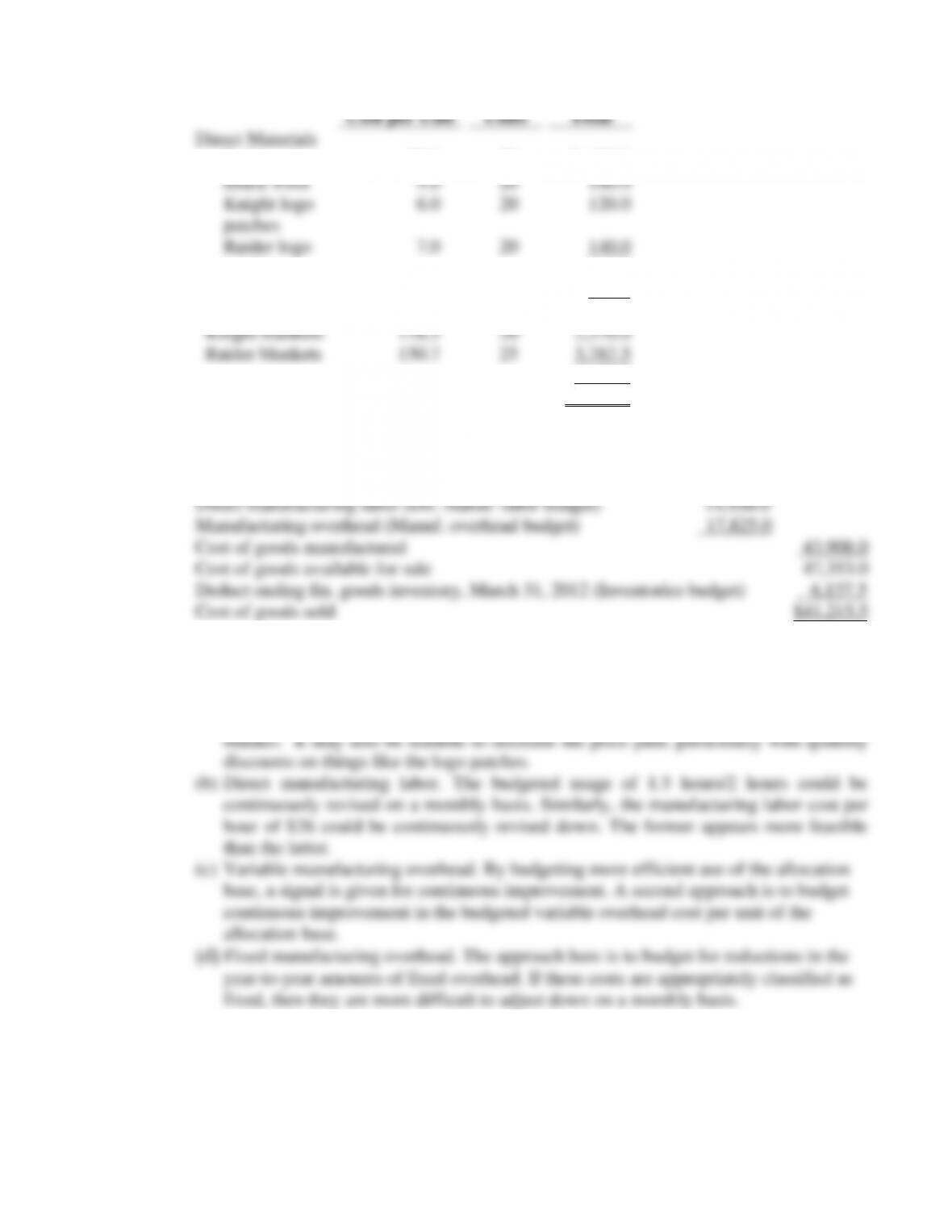
d. Direct Manufacturing Labor Budget
Budgeted
Direct
Manuf. Labor-
Units
Hours per
Total
Hourly
Produced
Output Unit
Hours
Rate
Total
Knights blankets
130
1.5
195
$26
$5,070
Raiders blankets
190
2.0
380
$26
$9,880
575
$14,950
e. Manufacturing Overhead Budget
Variable manufacturing overhead costs (575 × $15) $8,625
Fixed manufacturing overhead costs 9,200
Total manufacturing overhead costs $17,825
Total manuf. overhead cost per hour = $17,825 / 575 = $31 per direct manufacturing labor-hour
6-17
Ending Inventories Budget
Cost per Unit
Units
Total
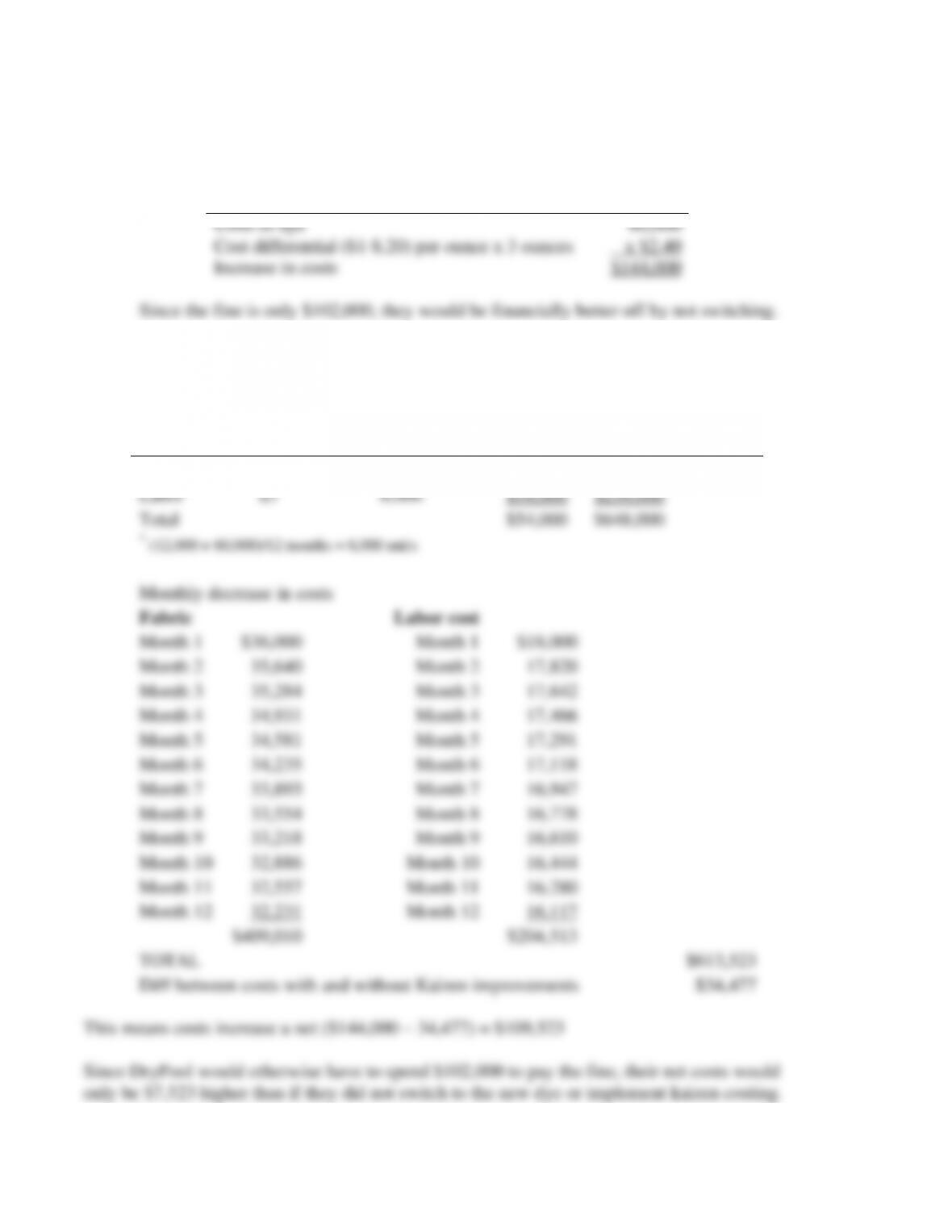
Direct Materials
Red wool
$9.0
20
$ 180.0
Black wool
9.0
20
180.0
Knight logo
patches
6.0
20
120.0
Raider logo
patches
7.0
20
140.0
620.0
Finished Goods
Knight blankets
118.5
20
2,370.0
Raider blankets
150.7
25
3,767.5
6,137.5
Total
$6,757.5
g. Cost of goods sold budget
Beginning fin. goods inventory, March 1, 2012 ($1,210 + $2,235) $ 3,445.0
Direct materials used (from Dir. materials cost budget) $11,133.0
2. Areas where continuous improvement might be incorporated into the budgeting process:
(a) Direct materials. Either an improvement in usage or price could be budgeted. For
example, the budgeted usage amounts for the fabric could be related to the maximum
improvement (current usage – minimum possible usage) of yards of fabric for either
6-18
6-29 (45 min.) Activity-based budget: kaizen improvements.
1.
Increase in Costs for the Year
Assume DryPool uses New Dye
Units to dye
60,000
Cost differential ($1-$.20) per ounce x 3 ounces
x $2.40
Increase in costs
$144,000
Since the fine is only $102,000, they would be financially better off by not switching.
2. If DryPool switches to the new dye, costs will increase by $144,000.
If DryPool implements kaizen costing, costs will be reduced as follows:
Original monthly costs
Input
Unit cost
Number of units
Total cost
Annual cost
Fabric
$6
6,000*
$36,000
$432,000
Labor
$3
6,000*
$18,000
$216,000
Total
$54,000
$648,000
* (12,000 + 60,000)/12 months = 6,000 units
Monthly decrease in costs
Fabric
Labor cost
Month 1
$36,000
Month 1
$18,000
Month 2
35,640
Month 2
17,820
Month 3
35,284
Month 3
17,642
Month 4
34,931
Month 4
17,466
Month 5
34,581
Month 5
17,291
Month 6
34,235
Month 6
17,118
Month 7
33,893
Month 7
16,947
Month 8
33,554
Month 8
16,778
Month 9
33,218
Month 9
16,610
Month 10
32,886
Month 10
16,444
Month 11
32,557
Month 11
16,280
Month 12
32,231
Month 12
16,117
$409,010
$204,513
TOTAL
$613,523
Diff between costs with and without Kaizen improvements
$34,477
This means costs increase a net ($144,000 – 34,477) = $109,523
Since DryPool would otherwise have to spend $102,000 to pay the fine, their net costs would
only be $7,523 higher than if they did not switch to the new dye or implement kaizen costing.

6-19
3. Reduction in materials can be accomplished by reducing waste and scrap. Reduction in
direct labor can be accomplished by improving the efficiency of operations and decreasing down
6-20
6-30 (30–40 min.) Revenue and production budgets.
This is a routine budgeting problem. The key to its solution is to compute the correct quantities
or purchases =
inventory +
materials used –
1. Scarborough Corporation
Revenue Budget for 2012
2. Scarborough Corporation
Production Budget (in units) for 2012
Thingone
Thingtwo
Budgeted sales in units
60,000
40,000
Add target finished goods inventories,
December 31, 2012
25,000
9,000
Total requirements
85,000
49,000
Deduct finished goods inventories,
January 1, 2012
20,000
8,000
Units to be produced
65,000
41,000
3. Scarborough Corporation
Direct Materials Purchases Budget (in quantities) for 2012
Direct Materials
A
B
C
Direct materials to be used in production
• Thingone (budgeted production of 65,000
units times 4 lbs. of A, 2 lbs. of B)
260,000
130,000
—
• Thingtwo (budgeted production of 41,000
units times 5 lbs. of A, 3 lbs. of B, 1 lb. of C)
205,000
123,000
41,000
Total
465,000
253,000
41,000
Add target ending inventories, December 31, 2012
36,000
32,000
7,000
Total requirements in units
501,000
285,000
48,000
Deduct beginning inventories, January 1, 2012
32,000
29,000
6,000
Direct materials to be purchased (units)
469,000
256,000
42,000