5-47
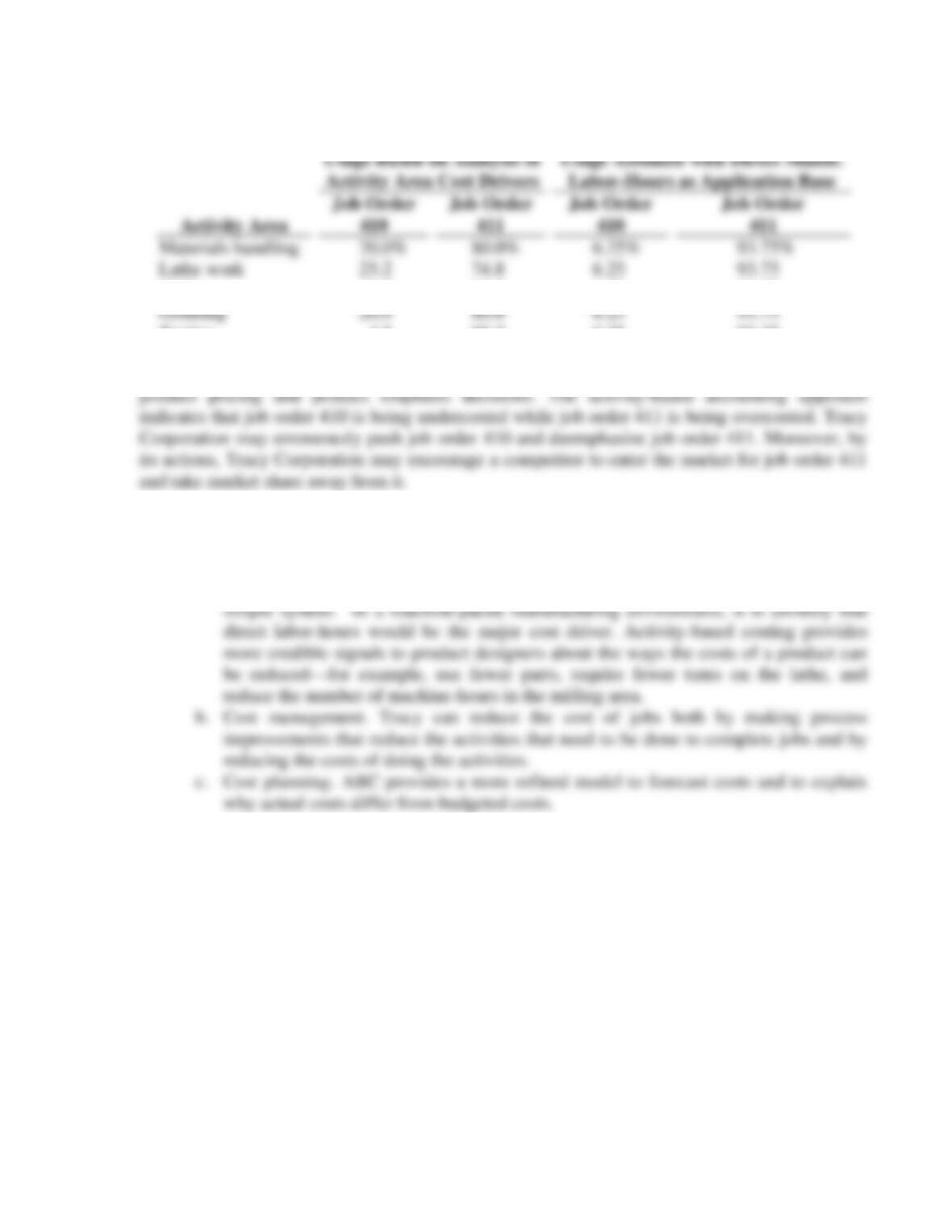
The following table documents how the two job orders differ in the way they use each of the five
activity areas included in indirect manufacturing costs:
Usage Based on Analysis of
Activity Area Cost Drivers
Usage Assumed with Direct Manuf.
Labor-Hours as Application Base
Activity Area
Job Order
410
Job Order
411
Job Order
410
Job Order
411
Materials handling
20.0%
80.0%
6.25%
93.75%
Lathe work
25.2
74.8
6.25
93.75
Milling
12.5
87.5
6.25
93.75
Grinding
20.0
80.0
6.25
93.75
Testing
4.8
95.2
6.25
93.75
The differences in product cost figures might be important to Tracy Corporation for
4. Information from the ABC system can also help Tracy manage its business better in
several ways.
a. Product design. Product designers at Tracy Corporation likely will find the numbers
in the activity-based costing approach more believable and credible than those in the
5-48
1. Applewood Electronics should not emphasize the Regal model and should not phase out
the Monarch model. Under activity-based costing, the Regal model has an operating income
percentage of less than 3%, while the Monarch model has an operating income percentage of
nearly 43%.
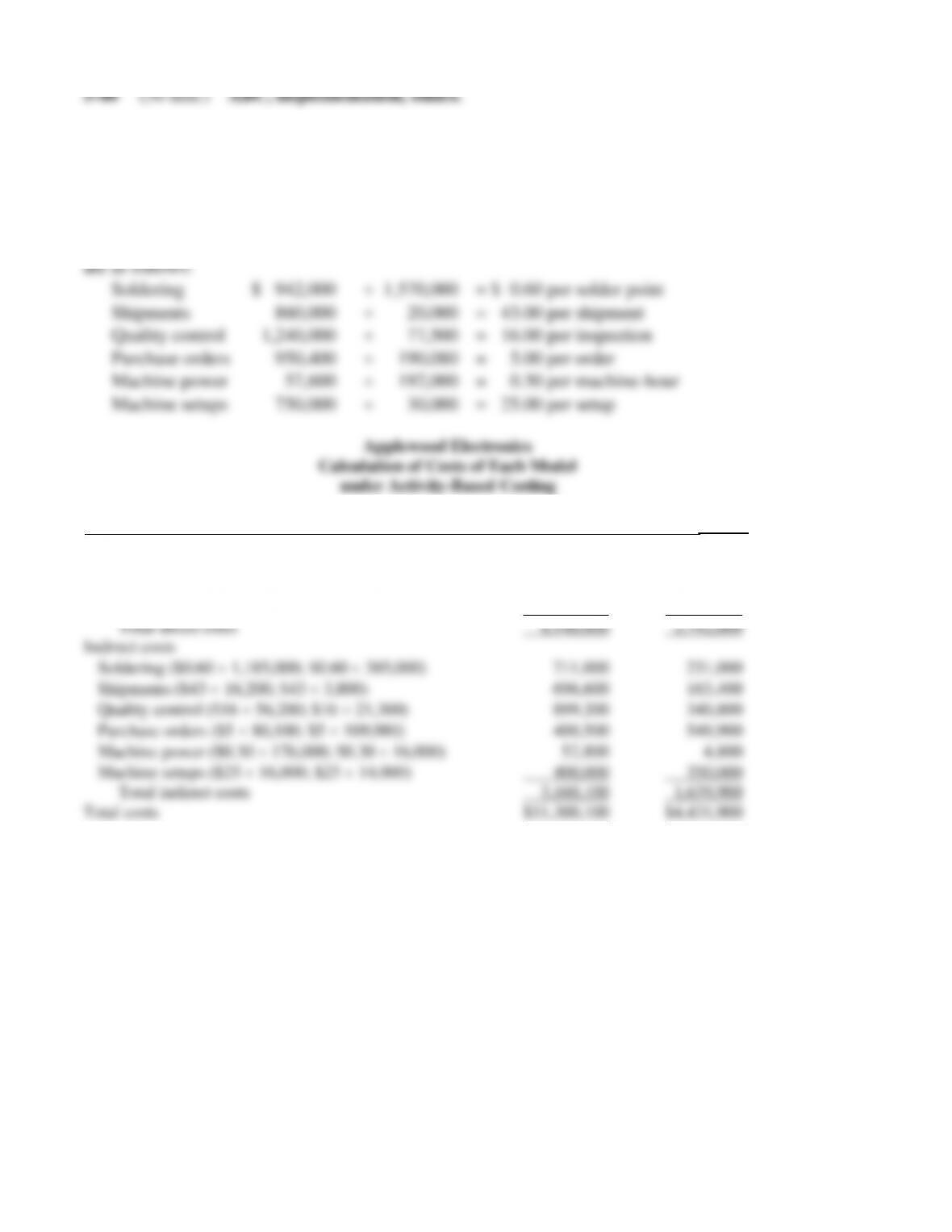
Cost driver rates for the various activities identified in the activity-based costing (ABC) system
Monarch Regal
Direct costs
Direct materials ($208 22,000; $584 4,000) $ 4,576,000 $2,336,000
Direct manufacturing labor ($18 22,000; $42 4,000) 396,000 168,000
Machine costs ($144 22,000; $72 4,000) 3,168,000 288,000
5-49
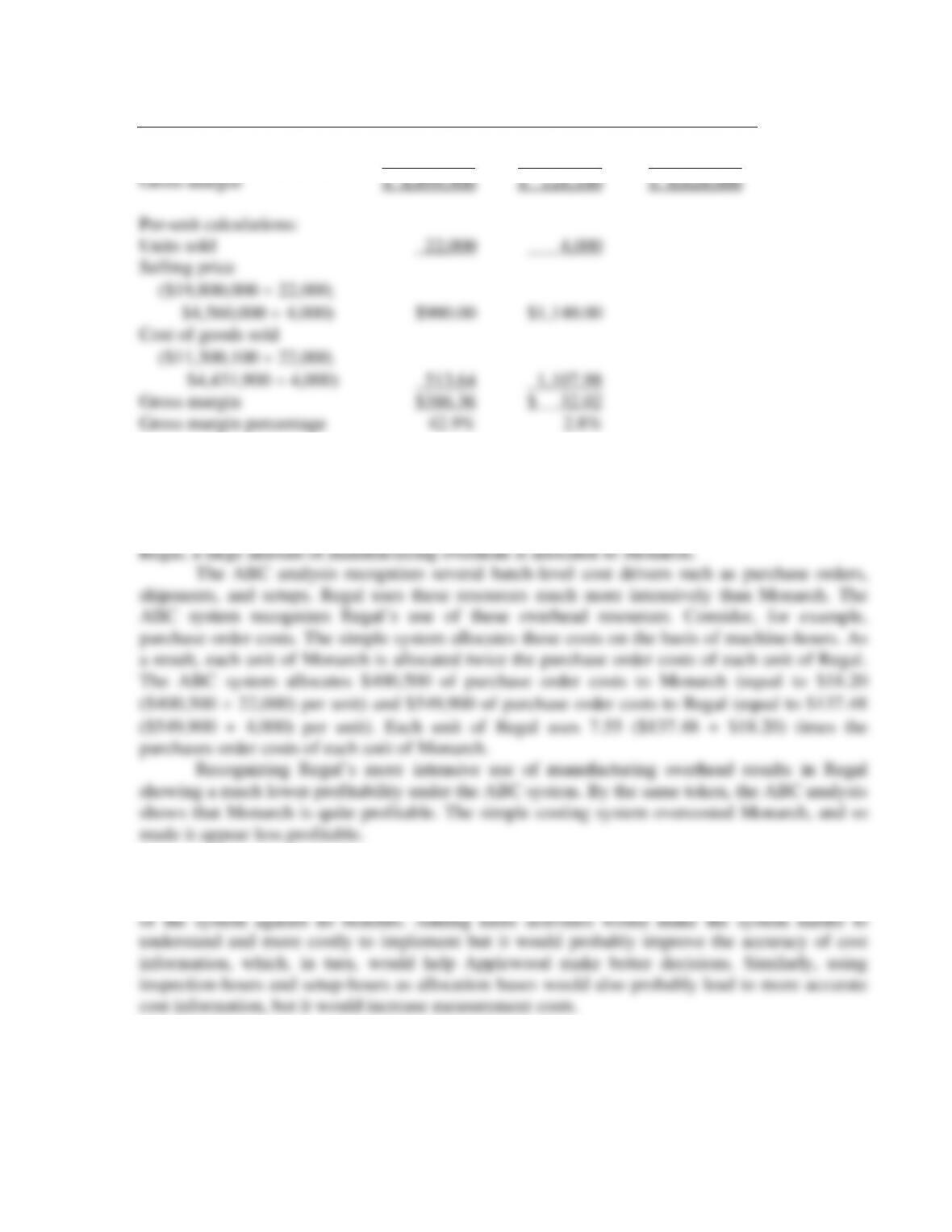
Profitability analysis
Monarch Regal Total
Revenues $19,800,000 $4,560,000 $24,360,000
Cost of goods sold 11,300,100 4,431,900 15,732,000
2. Applewood’s simple costing system allocates all manufacturing overhead other than
machine costs on the basis of machine-hours, an output unit-level cost driver. Consequently, the
more machine-hours per unit that a product needs, the greater the manufacturing overhead
allocated to it. Because Monarch uses twice the number of machine-hours per unit compared to
3. Duval’s comments about ABC implementation are valid. When designing and
implementing ABC systems, managers and management accountants need to trade off the costs
5-50
4. Activity-based management (ABM) is the use of information from activity-based costing
to make improvements in a firm. For example, a firm could revise product prices on the basis of
revised cost information. For the long term, activity-based costing can assist management in
5. Incorrect reporting of ABC costs with the goal of retaining both the Monarch and Regal
product lines is unethical. In assessing the situation, the specific “Standards of Ethical Conduct
for Management Accountants” (described in Exhibit 1-7) that the management accountant should
consider are listed below.
Competence
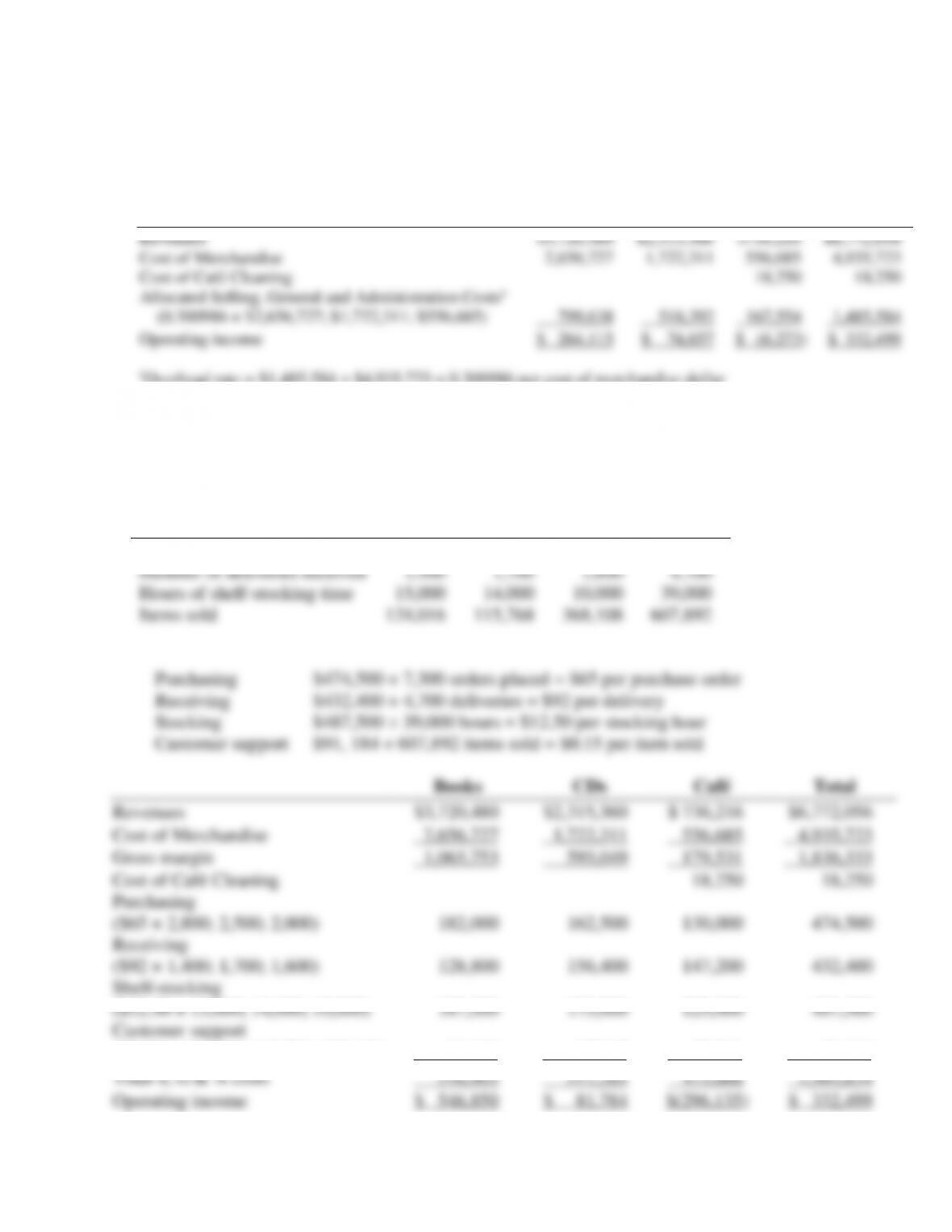
5-41 (30-40 mins.) Activity-based costing, cost hierarchy.
1.
Super Bookstore
Income Statement
For the Year Ended 31 December, 2010
Books
CDs
Café
Total
Revenues
$3,720,480
$2,315,360
$736,216
$6,772,056
Cost of Merchandise
2,656,727
1,722,311
556,685
4,935,723
Cost of Café Cleaning
18,250
18,250
Allocated Selling, General and Administration Costsa
(0.300986 × $2,656,727; $1,722,311; $556,685)
799,638
518,392
167,554
1,485,584
Operating income
$ 264,115
$ 74,657
$ (6,273)
$ 332,499
aOverhead rate = $1,485,584 ÷ $4,935,723 = 0.300986 per cost of merchandise dollar
2. Selling, general and administration (S,G & A) is comprised of a variety of costs that are
unlikely to be consumed uniformly across product lines based on the cost of merchandise.
Super Bookstore should consider an activity-based costing system to clarify how each product
line uses these S, G & A resources.
Books
CDs
Café
Total
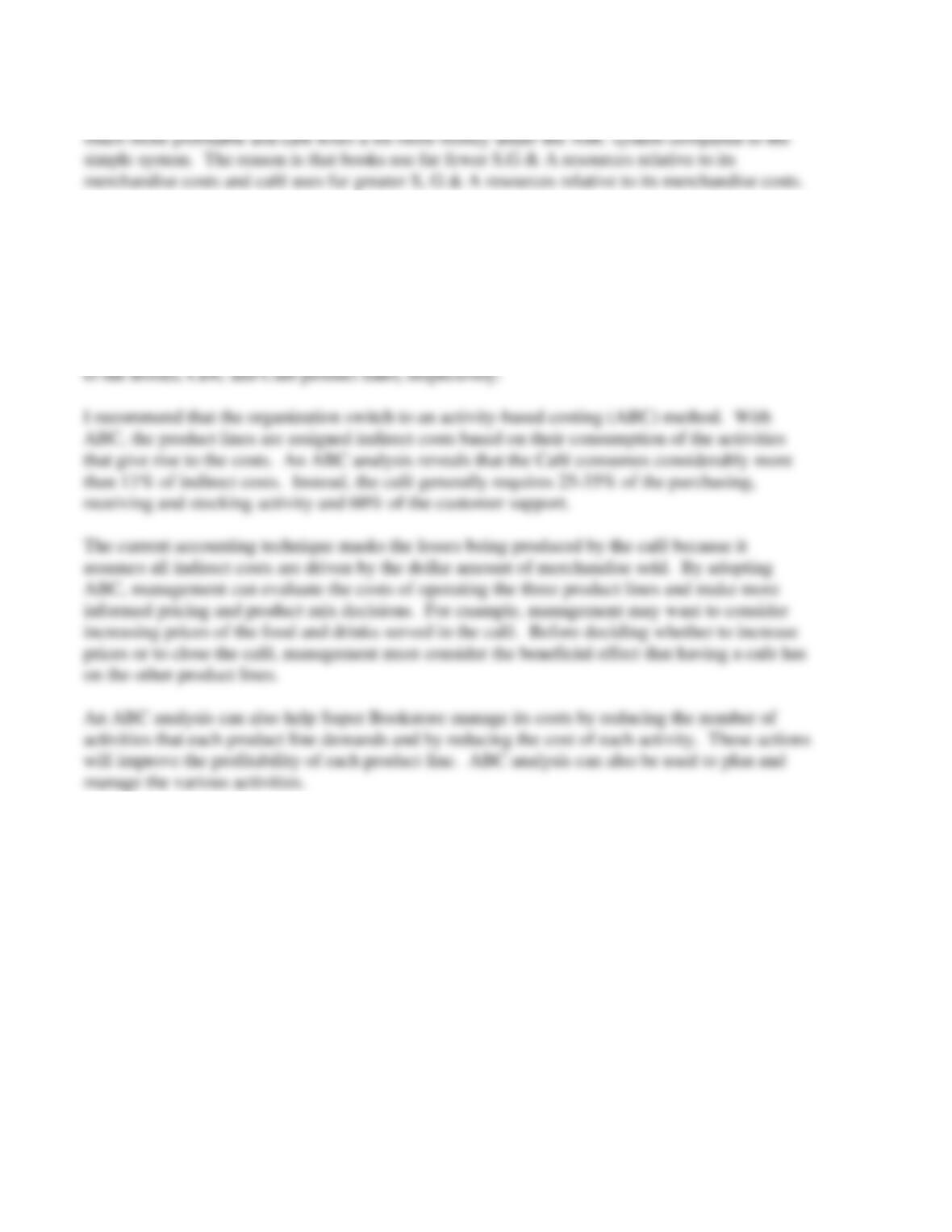
Number of purchase orders
2,800
2,500
2,000
7,300
Number of deliveries received
1,400
1,700
1,600
4,700
Hours of shelf-stocking time
15,000
14,000
10,000
39,000
Items sold
124,016
115,768
368,108
607,892
Purchasing
$474,500 ÷ 7,300 orders placed = $65 per purchase order
Receiving
$432,400 ÷ 4,700 deliveries = $92 per delivery
Stocking
$487,500 ÷ 39,000 hours = $12.50 per stocking hour
Customer support
$91, 184 ÷ 607,892 items sold = $0.15 per item sold
5-52
Comparing product line income statements in requirements 1 and 2, it appears that books are
3.
To: Super Bookstore Management Team
From: Cost Analyst
Re: Costing System
The current accounting system allocates indirect costs (S,G & A) to product lines based on the
Cost of Merchandise sold. Using this method, the S, G & A costs are assigned 54%, 35%, 11%,