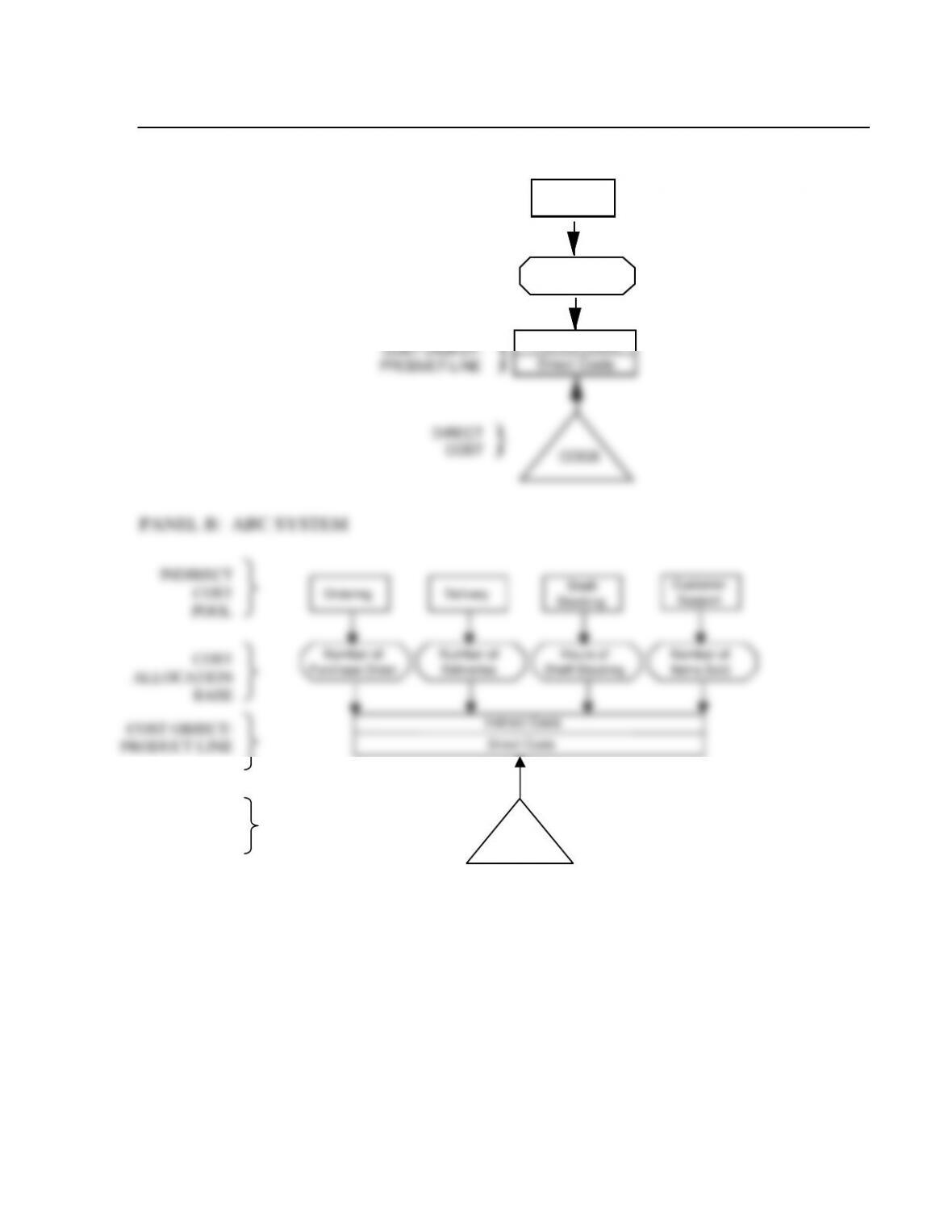
SOLUTION EXHIBIT 5-24
Product-Costing Overviews of Family Supermarkets
PANEL A: SIMPLE COSTING SYSTEM
COST OBJECT:
PRODUCT LINE
Indirect Costs
Direct Costs
Store
Support
COGS
COGS
INDIRECT
COST
POOL
COST
ALLOCATION
BASE
DIRECT
COST
PANEL B: ABC SYSTEM
Ordering Delivery Shelf-
Stocking
Customer
Support
Number of
Purchase Order
Number of
Deliveries
Hours of
Shelf-Stocking
Number of
Items Sold
Indirect Costs
Direct Costs
COGS
INDIRECT
COST
POOL
COST
ALLOCATION
BASE
COST OBJECT:
PRODUCT LINE
DIRECT
COST
5-22
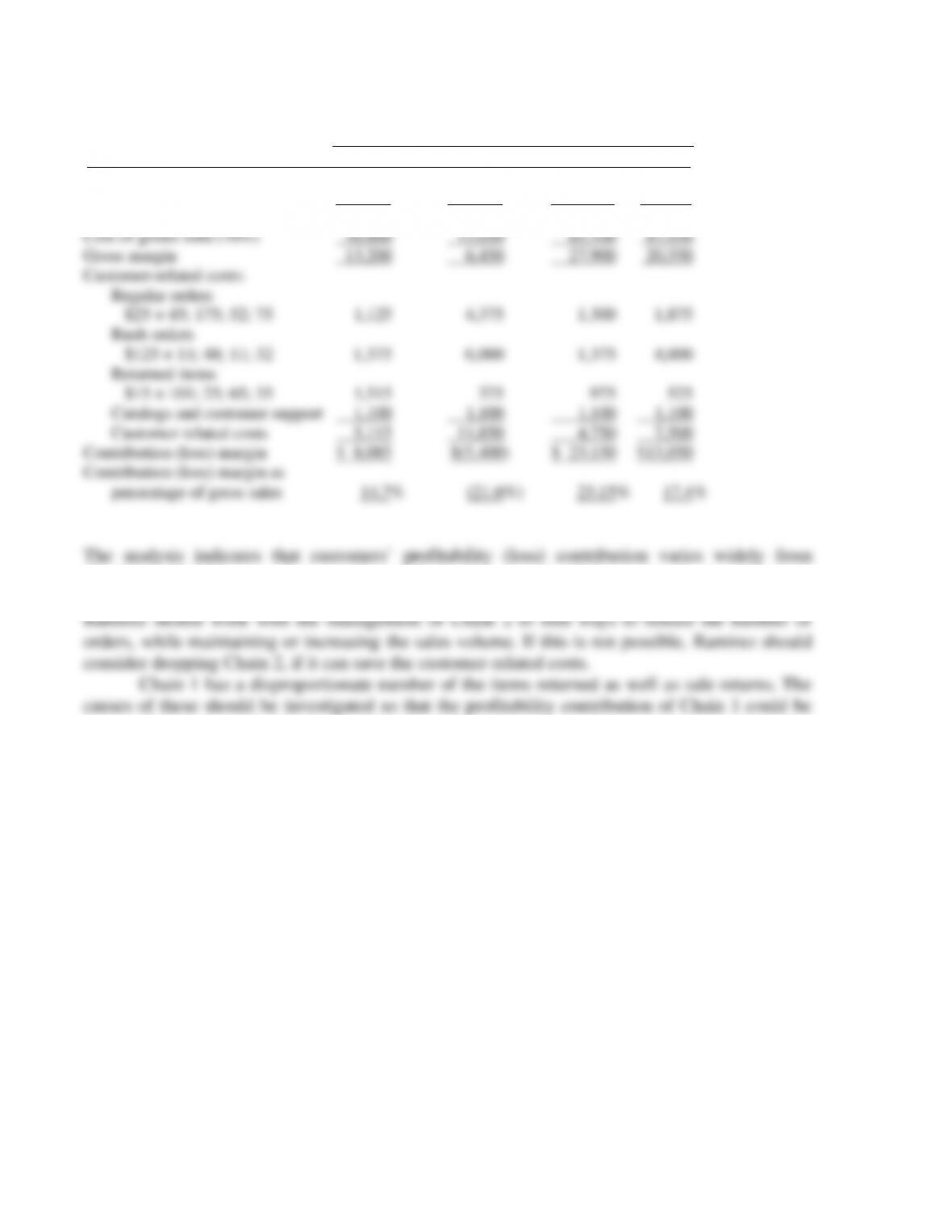
5-25 (15–20 min.) ABC, wholesale, customer profitability.
Chain
1 2 3 4
Gross sales $55,000 $25,000 $100,000 $75,000
Sales returns 11,000 3,500 7,000 6,500
Net sales 44,000 21,500 93,000 68,500
(21.6%) to 23.15%. Immediate attention to Chain 2 is required which is currently showing a loss
contribution. The chain has a disproportionate number of both regular orders and rush orders.
improved.
5-23
5-26 (50 min.) ABC, activity area cost-driver rates, product cross-subsidization.
1. Direct costs
Direct materials $ 150,000
000,000,1
2. Cost Costs in Number of Costs per
Pool Pool Driver Units Driver Unit
3. Retail Potato Cuts Institutional Potato Cuts
Direct costs
Direct materials $135,000 $15,000
Packaging 180,000 $ 315,000 8,000 $23,000
5-24
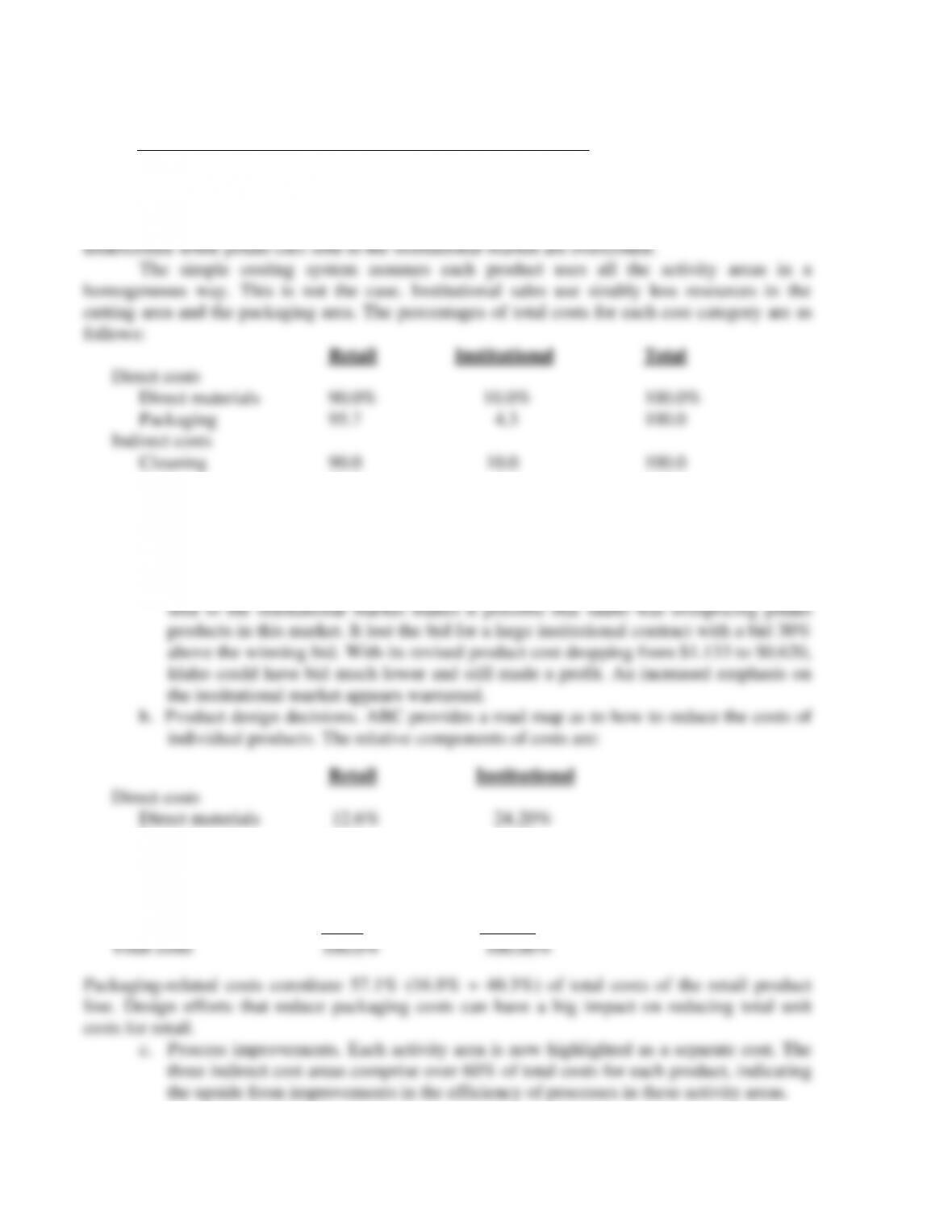
4. There is much evidence of product-cost cross-subsidization.
Cost per Pound Retail Institutional
Simple costing system $1.133 $1.133
ABC system $1.190 $0.620
Assuming the ABC numbers are more accurate, potato cuts sold to the retail market are
Cutting 93.5 6.5 100.0
Packaging 97.3 2.7 100.0
Units produced 90.0% 10.0% 100.0%
Idaho can use the revised cost information for a variety of purposes:
a. Pricing/product emphasis decisions. The sizable drop in the reported cost of potatoes
Packaging 16.8 12.90
Indirect costs
Cleaning 10.1 19.35
Cutting 20.2 24.20
Packaging 40.3 19.35
5-25
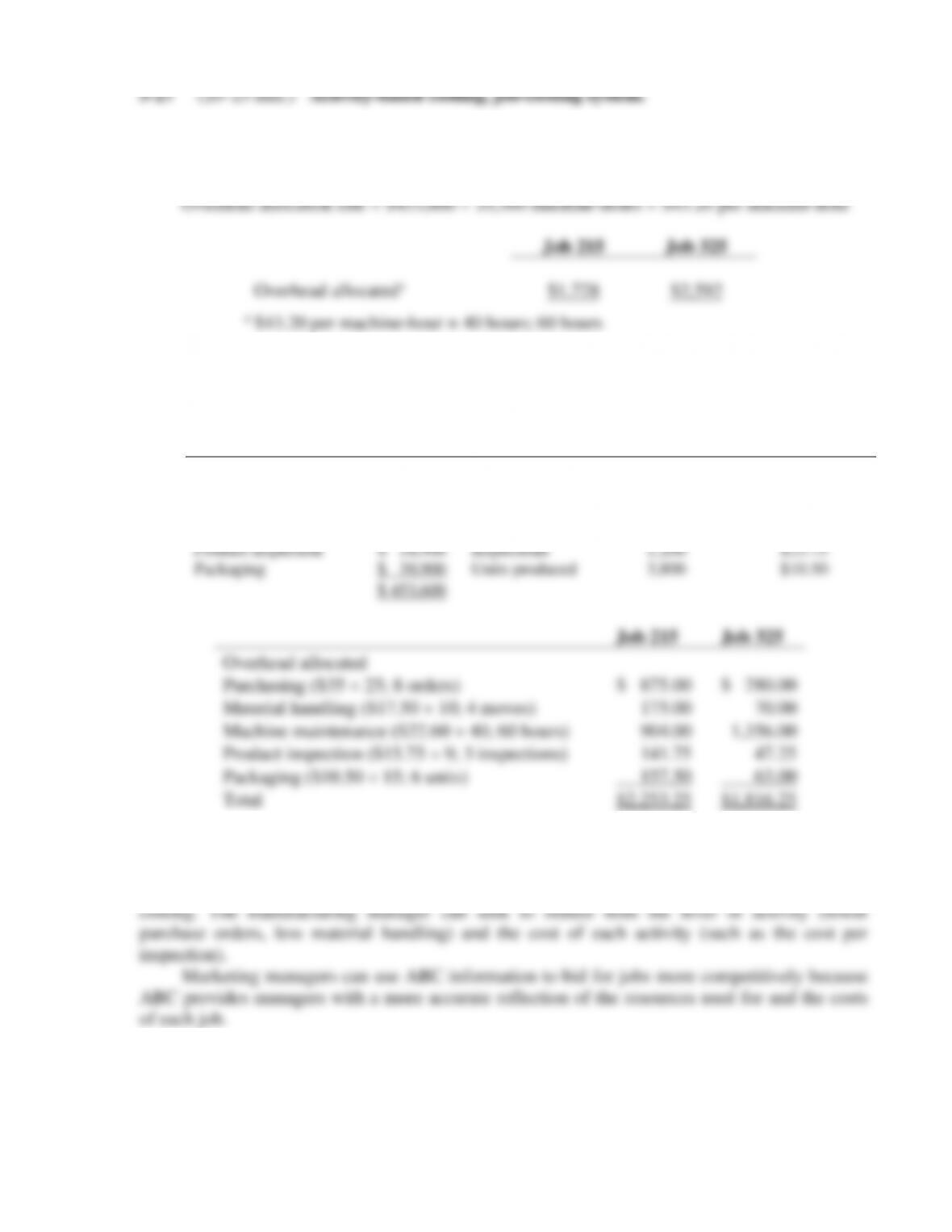
1. Overhead allocation using a simple job-costing system, where overhead is allocated based
on machine hours:
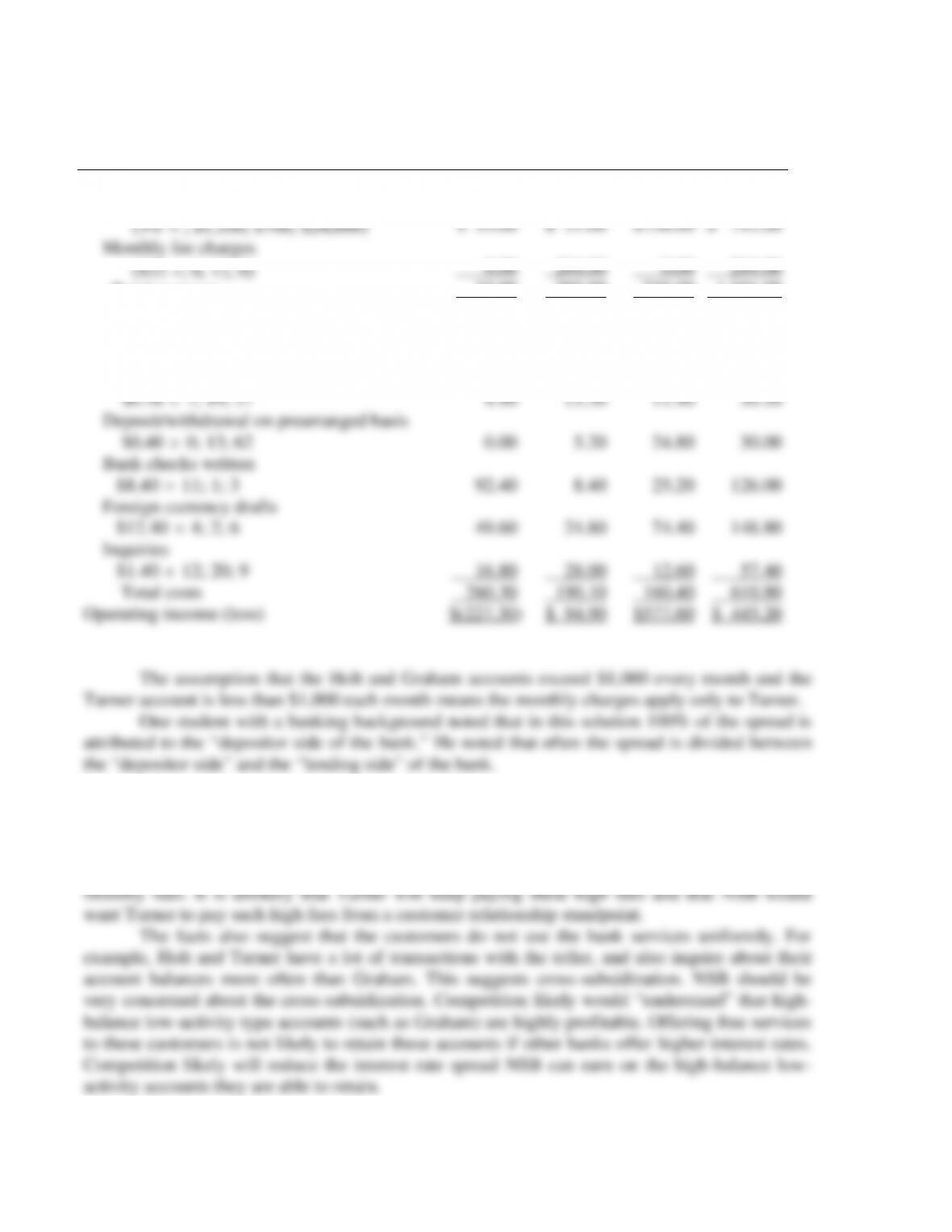
2. Overhead allocation using an activity-based job-costing system:
Budgeted
Overhead
(1)
Activity Driver
(2)
Budgeted
Activity Driver
(3)
Activity Rate
(4) = (1) (3)
Purchasing
$ 70,000
Purchase orders
processed
2,000
$35.00
Material handling
$ 87,500
Material moves
5,000
$17.50
Machine maintenance
$ 237,300
Machine hours
10,500
$22.60
Product inspection
$ 18,900
Inspections
1,200
$15.75
Packaging
$ 39,900
Units produced
3,800
$10.50
$ 453,600
Job 215
Job 325
Overhead allocated
Purchasing ($35 25; 8 orders)
$ 875.00
$ 280.00
Material handling ($17.50 10; 4 moves)
175.00
70.00
Machine maintenance ($22.60 40; 60 hours)
904.00
1,356.00
Product inspection ($15.75 9; 3 inspections)
141.75
47.25
Packaging ($10.50 15; 6 units)
157.50
63.00
Total
$2,253.25
$1,816.25
3. The manufacturing manager likely would find the ABC job-costing system more useful in
cost management. Unlike direct manufacturing labor costs, the five indirect cost pools are
systematically linked to the activity areas at the plant. The result is more accurate product
5-28 (30 min.) ABC, product-costing at banks, cross-subsidization.
1.
Holt
Turner
Graham
Total
Revenues
Spread revenue on annual basis
(3% ; $1,100, $700, $24,600)
Monthly fee charges
($22 ; 0, 12, 0)
Total revenues
$ 33.00
0.00
33.00
$ 21.00
264.00
285.00
$738.00
0.00
738.00
$ 792.00
264.00
1,056.00
Costs
Deposit/withdrawal with teller
$2.30
42; 48; 5
Deposit/withdrawal with ATM
$0.70
7; 19; 17
Deposit/withdrawal on prearranged basis
$0.40
0; 13; 62
Bank checks written
$8.40
11; 1; 3
Foreign currency drafts
$12.40
4; 2; 6
Inquiries
$1.40
12; 20; 9
Total costs
Operating income (loss)
96.60
4.90
0.00
92.40
49.60
16.80
260.30
$(227.30)
110.40
13.30
5.20
8.40
24.80
28.00
190.10
$ 94.90
11.50
11.90
24.80
25.20
74.40
12.60
160.40
$577.60
218.50
30.10
30.00
126.00
148.80
57.40
610.80
$ 445.20
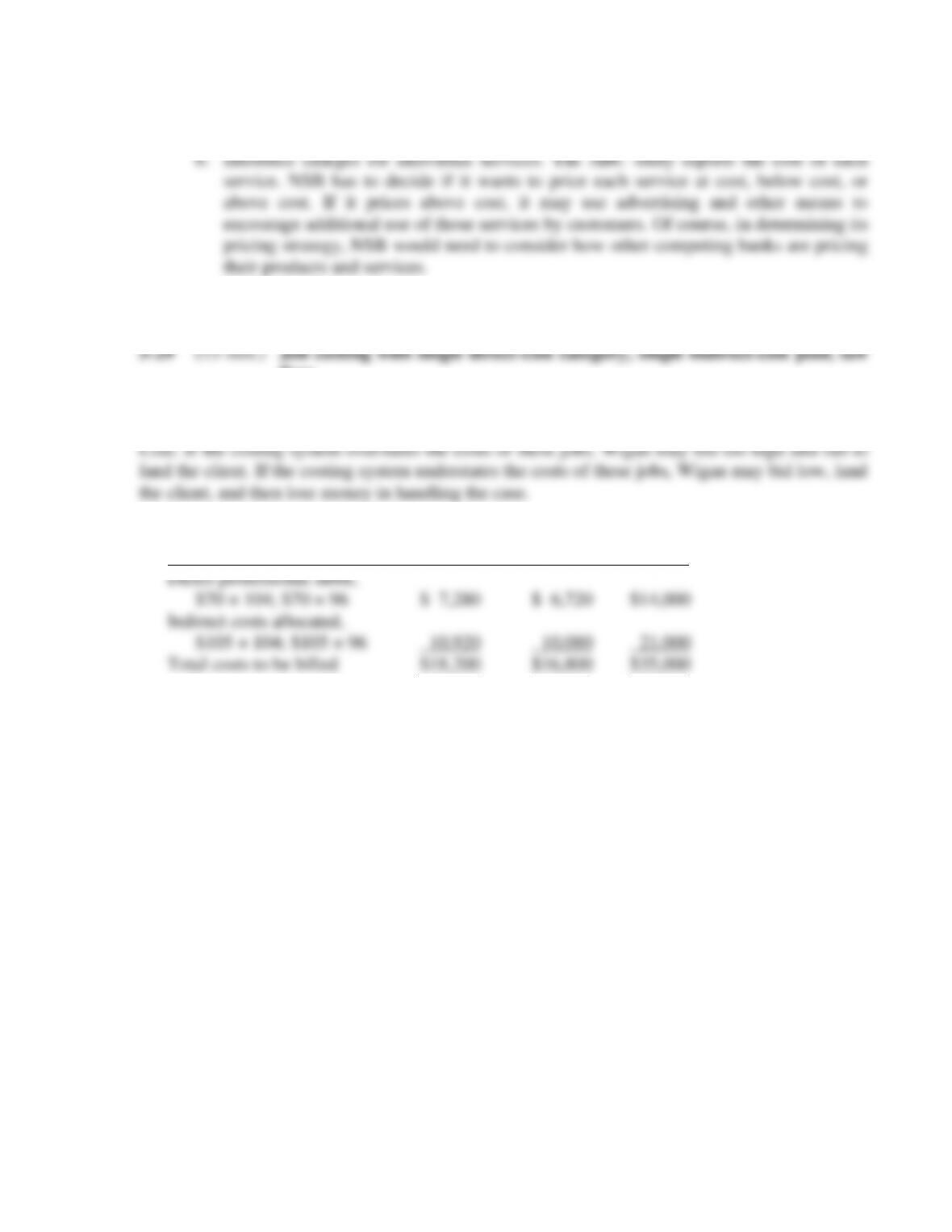
The assumption that the Holt and Graham accounts exceed $1,000 every month and the
Turner account is less than $1,000 each month means the monthly charges apply only to Turner.
One student with a banking background noted that in this solution 100% of the spread is
attributed to the “depositor side of the bank.” He noted that often the spread is divided between
the “depositor side” and the “lending side” of the bank.
2. Cross-subsidization across individual Premier Accounts occurs when profits made on
some accounts are offset by losses on other accounts. The aggregate profitability on the three
customers is $445.20. The Graham account is highly profitable, $577.60, while the Holt account
is sizably unprofitable. The Turner account shows a small profit but only because of the $264
5-27
3. Possible changes NSB could make are:
a. Offer higher interest rates on high-balance accounts to increase NSB’s
competitiveness in attracting and retaining these accounts.
firm.
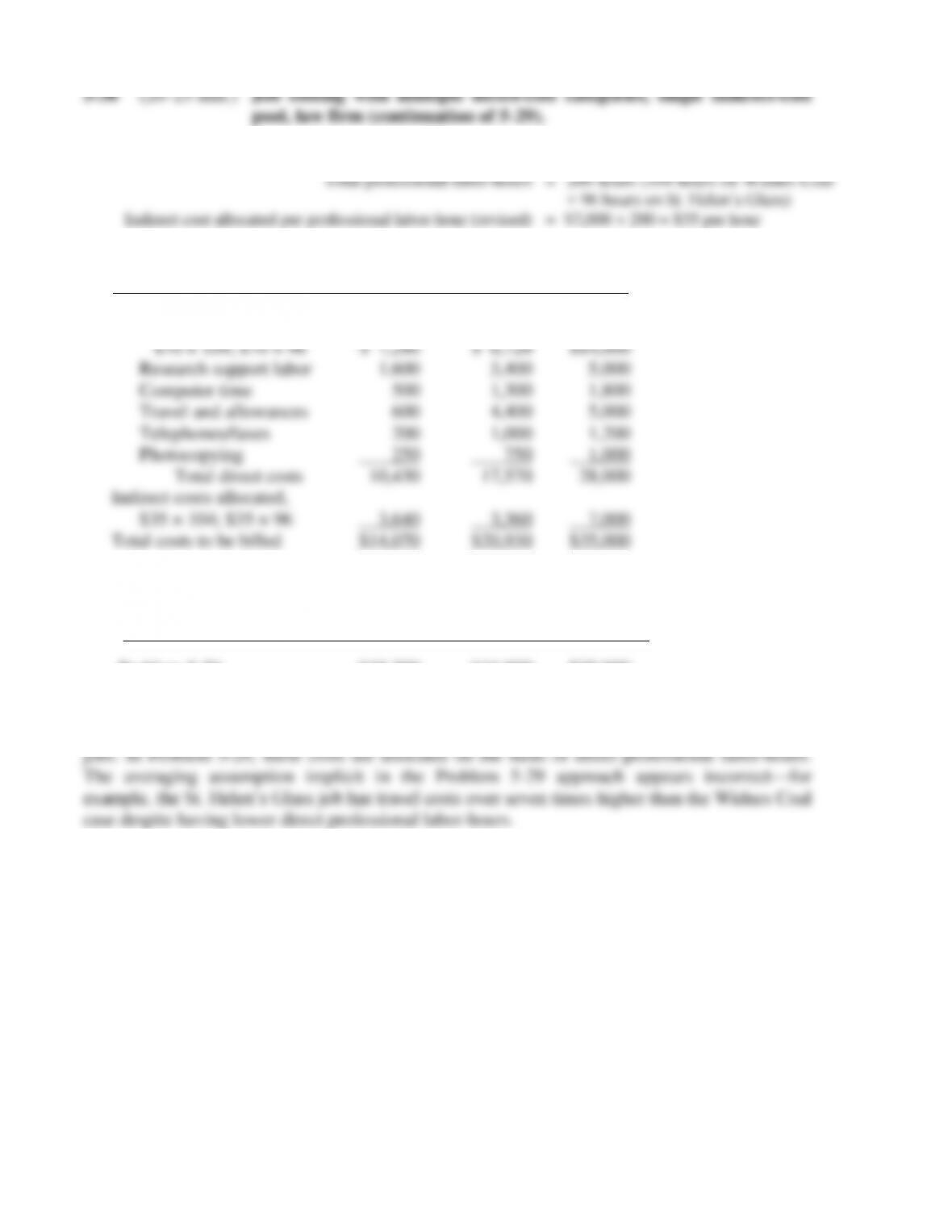
1. Pricing decisions at Wigan Associates are heavily influenced by reported cost numbers.
Suppose Wigan is bidding against another firm for a client with a job similar to that of Widnes
2. Widnes St. Helen’s
Coal Glass Total
5-28
1. Indirect costs = $7,000
2. Widnes St. Helen’s
Coal Glass Total
Direct costs:
Direct professional labor,
3.
Widnes St. Helen’s
Coal Glass Total
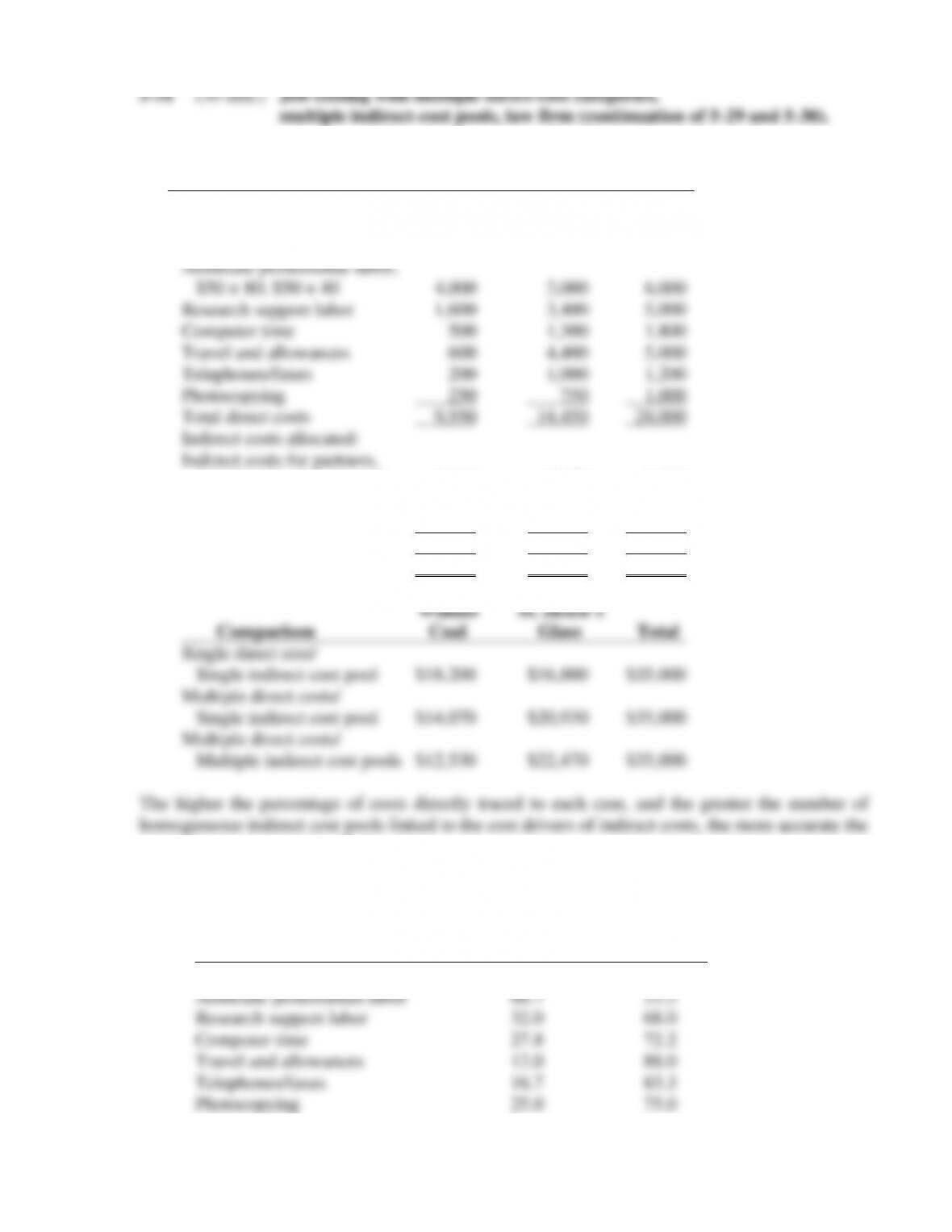
Problem 5-30 14,070 20,930 35,000
The Problem 5-30 approach directly traces $14,000 of general support costs to the individual
5-29
1. Widnes St. Helen’s
Coal Glass Total
Direct costs:
Partner professional labor,
$100 × 24; $100 × 56 $ 2,400 $ 5,600 $ 8,000
$57.50 × 24; $57.50 × 56 1,380 3,220 4,600
Indirect costs for associates,
$20 × 80; $20 × 40 1,600 800 2,400
Total indirect costs 2,980 4,020 7,000
Total costs to be billed $12,530 $22,470 $35,000
product cost of each individual case.
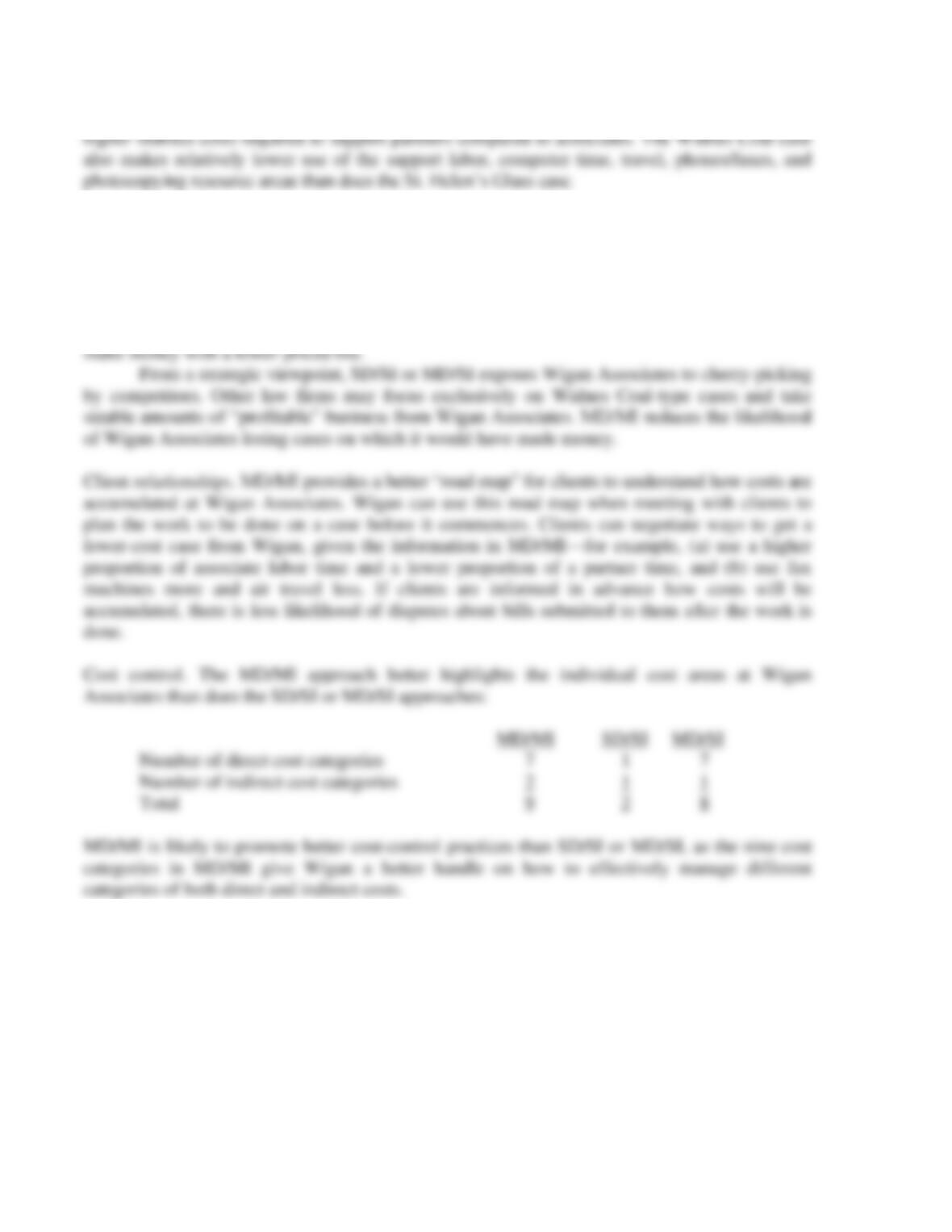
The Widnes and St. Helen’s cases differ in how they use “resource areas” of Wigan Associates:
Widnes St. Helen’s
Coal Glass
Partner professional labor 30.0% 70.0%
5-30
The Widnes Coal case makes relatively low use of the higher-cost partners but relatively higher
use of the lower-cost associates than does St. Helen’s Glass. As a result, it also uses less of the
2. The specific areas where the multiple direct/multiple indirect (MD/MI) approach can
provide better information for decisions at Wigan Associates include:
Pricing and product (case) emphasis decisions. In a bidding situation using single direct/single
indirect (SD/SI) or multiple direct/single indirect (MD/SI) data, Wigan may win bids for legal
cases on which it will subsequently lose money. It may also not win bids on which it would