4-33 (25–30 min.) Service industry, job costing, two direct– and indirect-cost categories,
law firm (continuation of 4-32).
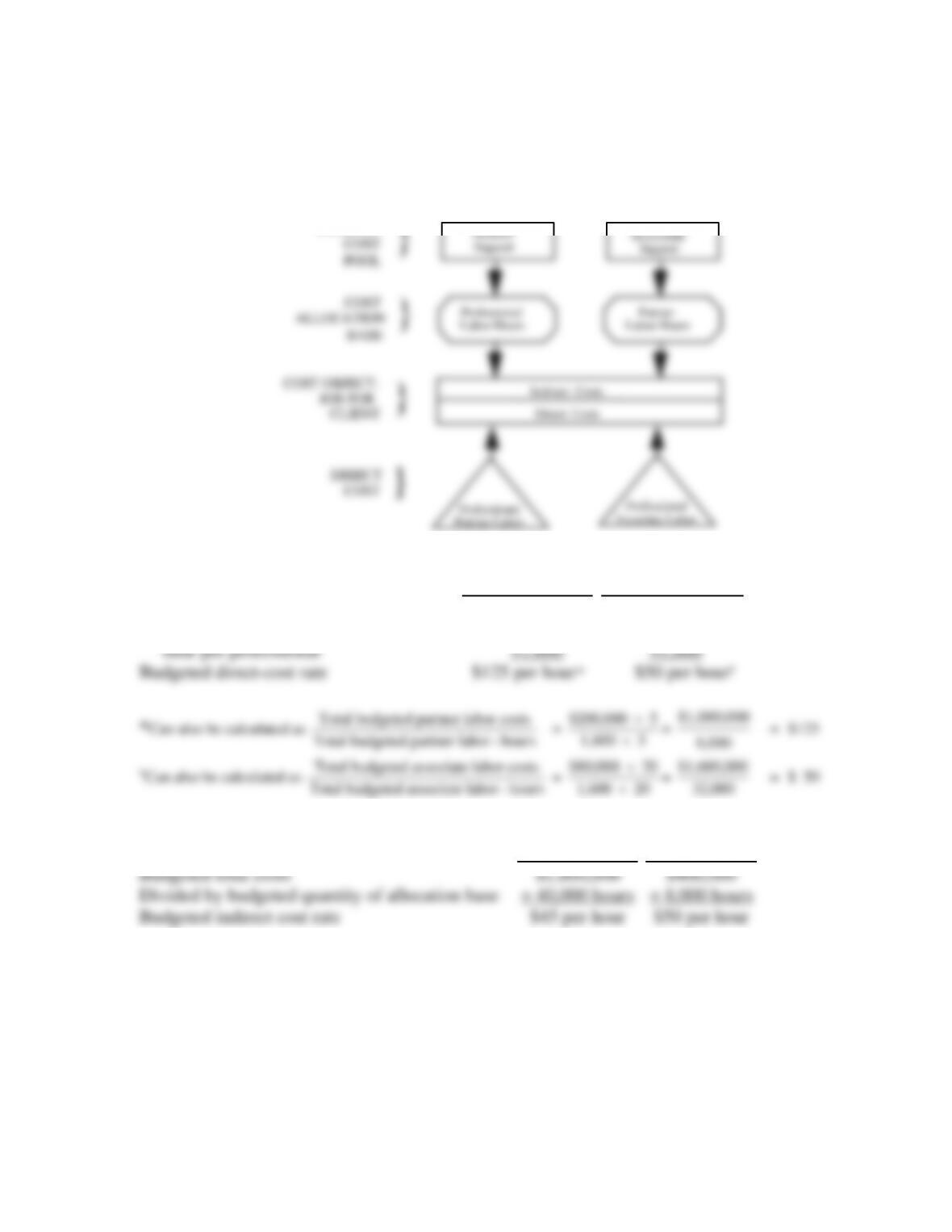
Although not required, the following overview diagram is helpful to understand Keating’s job–
costing system.
Professional
Labor-Hours
General
Support
COST OBJECT:
JOB FOR
CLIENT
INDIRECT
COST
POOL
COST
ALLOCATION
BASE
}
DIRECT
COST
Indirect Costs
Direct Costs
Partner
Labor-Hours
Secretarial
Support
Professional
Associate Labor
Professional
Partner Labor
1.
Professional
Partner Labor
Professional
Associate Labor
Budgeted compensation per professional
Divided by budgeted hours of billable
time per professional
Budgeted direct-cost rate
$ 200,000
÷1,600
$125 per hour*
$80,000
÷1,600
$50 per hour†
*Can also be calculated as
Total budgeted partner labor costs
Total budgeted partner labor – hours
=
$200,000 5
1,600 5
=
000,8
$1,000,000
= $125
†Can also be calculated as
Total budgeted associate labor costs
Total budgeted associate labor –hours
=
$80,000 20
1,600 20
=
$1,600,000
32 000,
= $ 50
2.
General
Support
Secretarial
Support
Budgeted total costs
Divided by budgeted quantity of allocation base
Budgeted indirect cost rate
$1,800,000
÷ 40,000 hours
$45 per hour
$400,000
÷ 8,000 hours
$50 per hour
4-32
3.
Richardson
Punch
Direct costs:
Professional partners,
$125 60 hr.; $125 30 hr.
Professional associates,
$50 40 hr.; $50 120 hr.
Direct costs
Indirect costs:
General support,
$45 100 hr.; $45 150 hr.
Secretarial support,
$50 60 hr.; $50 30 hr.
Indirect costs
Total costs
$7,500
2,000
$ 9,500
4,500
3,000
7,500
$17,000
$3,750
6,000
$ 9,750
6,750
1,500
8,250
$18,000
4.
Richardson
Punch
Single direct – Single indirect
(from Problem 4-32)
Multiple direct – Multiple indirect
(from requirement 3 of Problem 4-33)
Difference
$12,000
17,000
$ 5,000
undercosted
$18,000
18,000
$ 0
no change
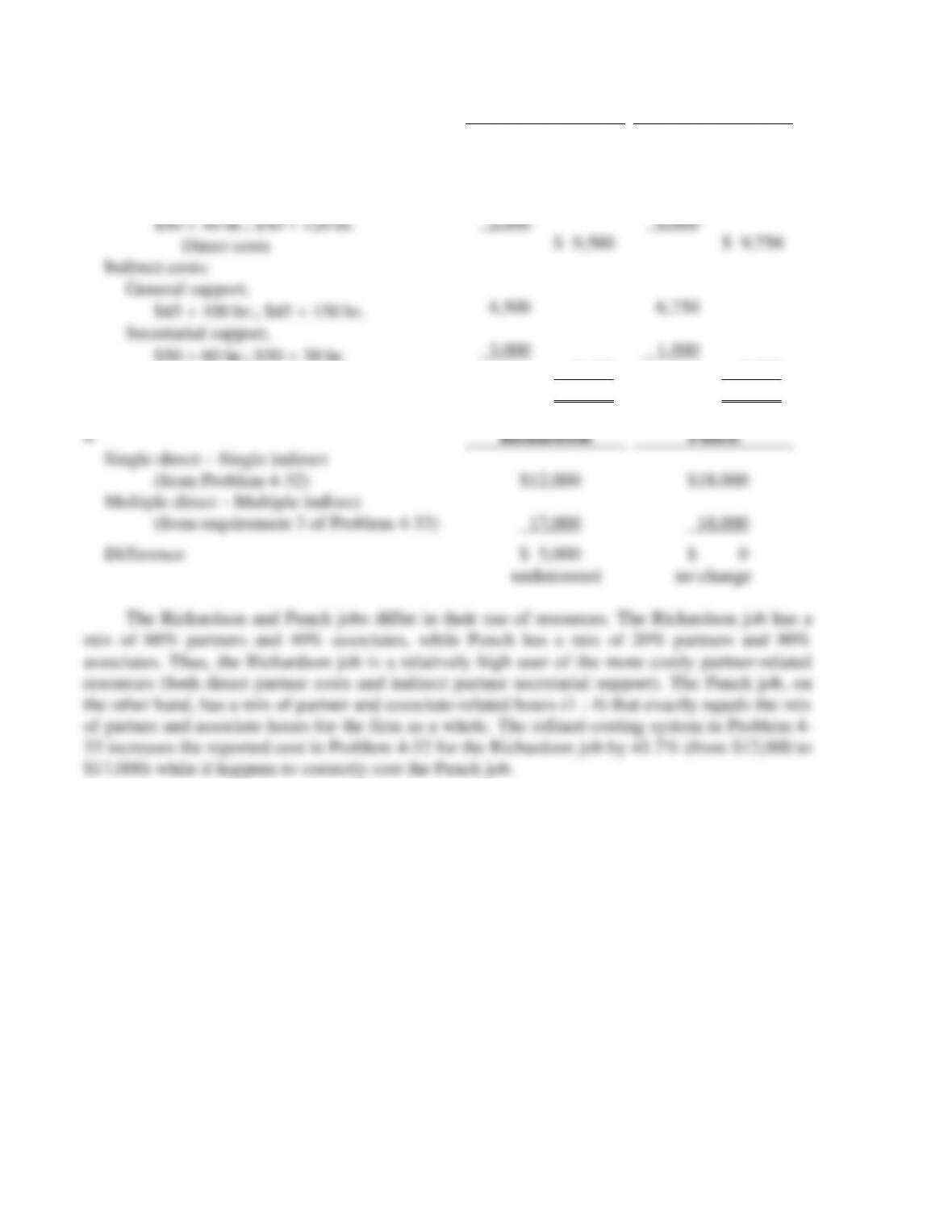
The Richardson and Punch jobs differ in their use of resources. The Richardson job has a
mix of 60% partners and 40% associates, while Punch has a mix of 20% partners and 80%
associates. Thus, the Richardson job is a relatively high user of the more costly partner-related
resources (both direct partner costs and indirect partner secretarial support). The Punch job, on
the other hand, has a mix of partner and associate-related hours (1 : 4) that exactly equals the mix
of partner and associate hours for the firm as a whole. The refined-costing system in Problem 4–
33 increases the reported cost in Problem 4-32 for the Richardson job by 41.7% (from $12,000 to
$17,000) while it happens to correctly cost the Punch job.
1. Budgeted manufacturing overhead rate is $4,800,000 ÷ 80,000 hours = $60 per machine-hour.
2.
Manufacturing overhead
underallocated
=
Manufacturing overhead
incurred
–
Manufacturing overhead
allocated
= $4,900,000 – $4,500,000*
= $400,000
4-34
3. Alternative (c) is theoretically preferred over (a) and (b) because the underallocated
amount and the balances in work–in-process and finished goods inventories are material.
rate.
4-35 (15 min.) Normal costing, overhead allocation, working backward.
1a. Manufacturing overhead allocated = 200% × Direct manufacturing labor cost
$3,600,000 = 2 × Direct manufacturing labor cost
$3,600,000
2.
Work in process
1/1/2011
+
Total
manufacturing cost
=
Cost of goods
manufactured
+
Work in process
12/31/2011
4-36 (40 min.) Proration of overhead with two indirect cost pools.
1. a. Molding department:
1. b. Painting department:
Overhead allocated = $2,306 + $1,897 + $24,982 = $29,185
Underallocated overhead = Actual overhead costs – Overhead allocated
Account
Account Balance
(Before Proration)
(1)
Proration of $1,500
Underallocated
Overhead
(2)
Account Balance
(After Proration)
(3) = (1) + (2)
WIP
$ 27,720.00
0
$ 27,720.00
Finished Goods
15,523.20
0
15,523.20
Cost of Goods Sold
115,156.80
–$800 + $2,300
116,656.80
Total
$158,400.00
$ 1,500
$159,900.00
2b. Underallocated overhead prorated based on ending balances
Account
Account
Balance
(Before
Proration)
(1)
Account Balance
as a Percent of Total
(2) = (1) ÷ $2,000,000
Proration of $1,500
Underallocated Overhead
(3) = (2)
10,000
Account
Balance
(After
Proration)
(4) = (1) + (3)
WIP
$ 27,720.00
0.175
0.175
$1,500 = $ 262.50
$ 27,982.50
Finished Goods
15,523.20
0.098
0.098
$1,500 = 147.00
15,670.20
Cost of Goods Sold
115,156.80
0.727
0.727
$1,500 = 1,090.50
116,247.30
Total
$158,400.00
1.000
$1,500.00
$159,900.00
2c. Under/overallocated overhead prorated based on overhead in ending balances. (Note:
overhead must be allocated separately from each department. This can be done using the number
of machine hours/direct labor hours as a surrogate for overhead in ending balances.)
For Molding department:
Account
Allocated Overhead
in Account Balance
(1)
Allocated Overhead in
Account Balance
as a Percent of Total
(2) = (1) ÷ $18,048
Proration of $800
Overallocated
Overhead
(3) = (2)
$800
WIP
$ 4,602
0.255
0.255
$800 = $204.00
Finished Goods
957
0.053
0.053
$800 = 42.40
Cost of Goods Sold
12,489
0.692
0.692
$800 = 553.60
Total
$18,048
1.000
$800.00
For finishing department:
Account
Allocated Overhead
in Account Balance
(4)
Allocated Overhead
in Account Balance
as a Percent of Total
(5) = (4) ÷ $29,185
Proration of $2,300
Underallocated Overhead
(6) = (5)
$2,300
WIP
$ 2,306
0.079
0.079
$2,300 = $ 181.70
Finished Goods
1,897
0.065
0.065
$2,300 = 149.50
Cost of Goods Sold
24,982
0.856
0.856
$2,300 = 1,968.80
Total
$29,185
1.000
$2,300.00
Account
Account Balance
(Before Proration)
(7)
Underallocated/
Overallocated
Overhead
(8) = (3) – (6)
Account Balance
(After Proration)
(9) = (7) + (8)
WIP
$27,720.00
–$204 + $181.70 = $ (22.30)
$ 27,697.70
Finished Goods
15,523.20
–$42.40 + $149.50 = 107.10
15,630.30
Cost of Goods Sold
115,156.80
–$553.60 + $1,968.80 = 1,415.20
116,572.00
Total
$158,400.00
$1,500.00
$159,900.00
3. The first method is simple and Cost of Goods Sold accounts for almost 73% of the three
4-37 (35 min.) General ledger relationships, under- and overallocation.
6.
Manufacturing overhead
underallocated
=
Debits to Manufacturing
Overhead Control
–
Credit to Manufacturing
Overhead Allocated
7. a. Write-off to Cost of Goods Sold will increase (debit) Cost of Goods Sold by $60,000.
Hence, Cost of Goods Sold = $900,000 + $60,000 = $960,000.