4-21
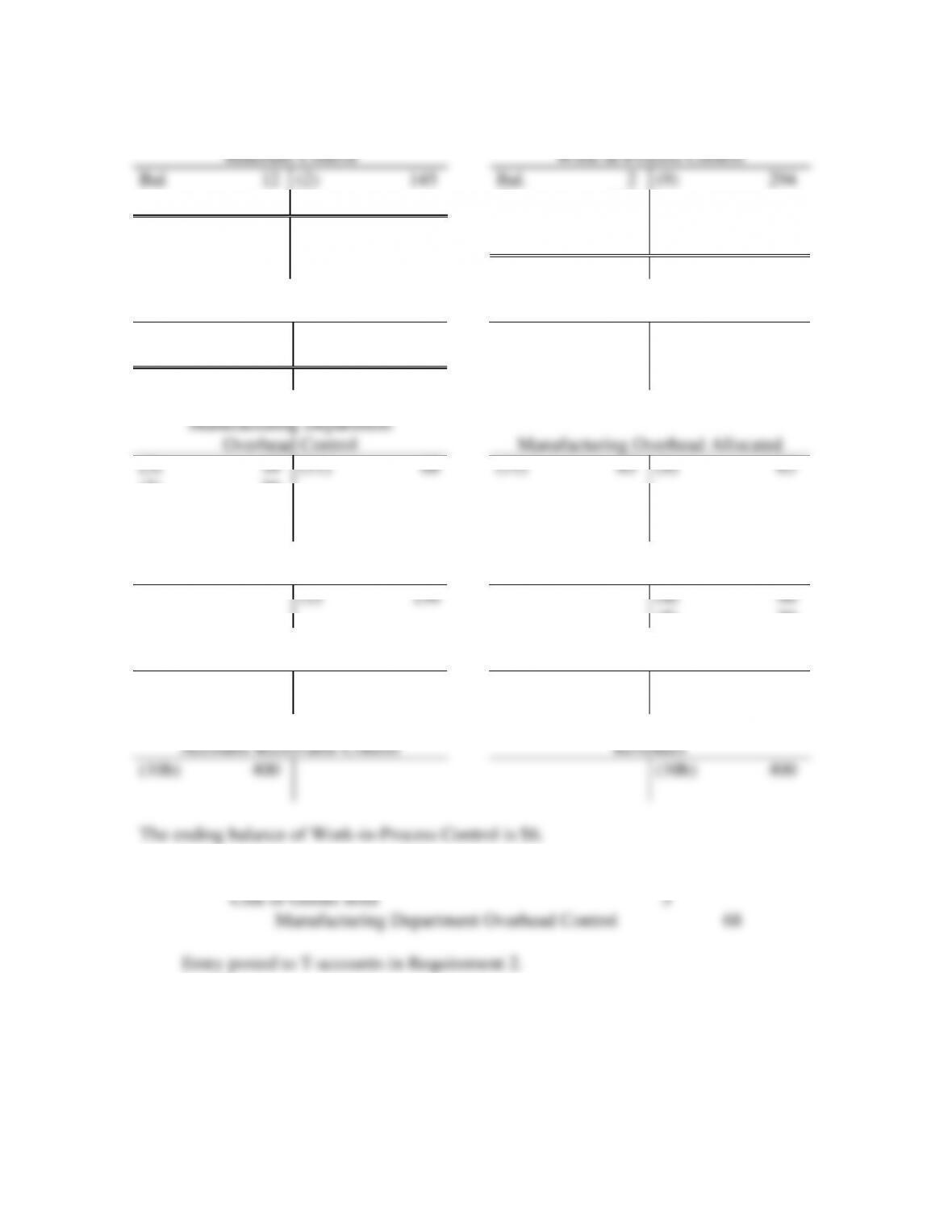
The posting of entries to T-accounts is as follows:
Materials Control
Work-in–Process Control
Bal 12
(2) 145
Bal. 2
(2) 145
(4) 90
(8) 63
(9) 294
(1) 150
(3) 10
Bal. 7
Bal. 6
Finished Goods Control
Cost of Goods Sold
Bal. 6
(9) 294
(10a) 292
(10a) 292
(11) 5
Bal. 8
Manufacturing Department
Overhead Control
Manufacturing Overhead Allocated
(3) 10
(5) 30
(6) 19
(7) 9
(11) 68
(11) 63
(8) 63
Accounts Payable Control
Wages Payable Control
(1) 150
(4) 90
(5) 30
Accumulated Depreciation
Various Liabilities
(6) 19
(7) 9
Accounts Receivable Control
Revenues
(10b) 400
(10b) 400
3. (11) Manufacturing Overhead Allocated 63
4-22
4-27 (15 min.) Job costing, unit cost, ending work in progress.
1.
Direct manufacturing labor rate per hour
$26
Manufacturing overhead cost allocated
per manufacturing labor-hour
$20
Job M1
Job M2
Direct manufacturing labor costs
$273,000
$208,000
Direct manufacturing labor hours
($273,000
$26; $208,000
$26)
10,500
8,000
Manufacturing overhead cost allocated
(10,500
$20; 8,000
$20)
$210,000
$160,000
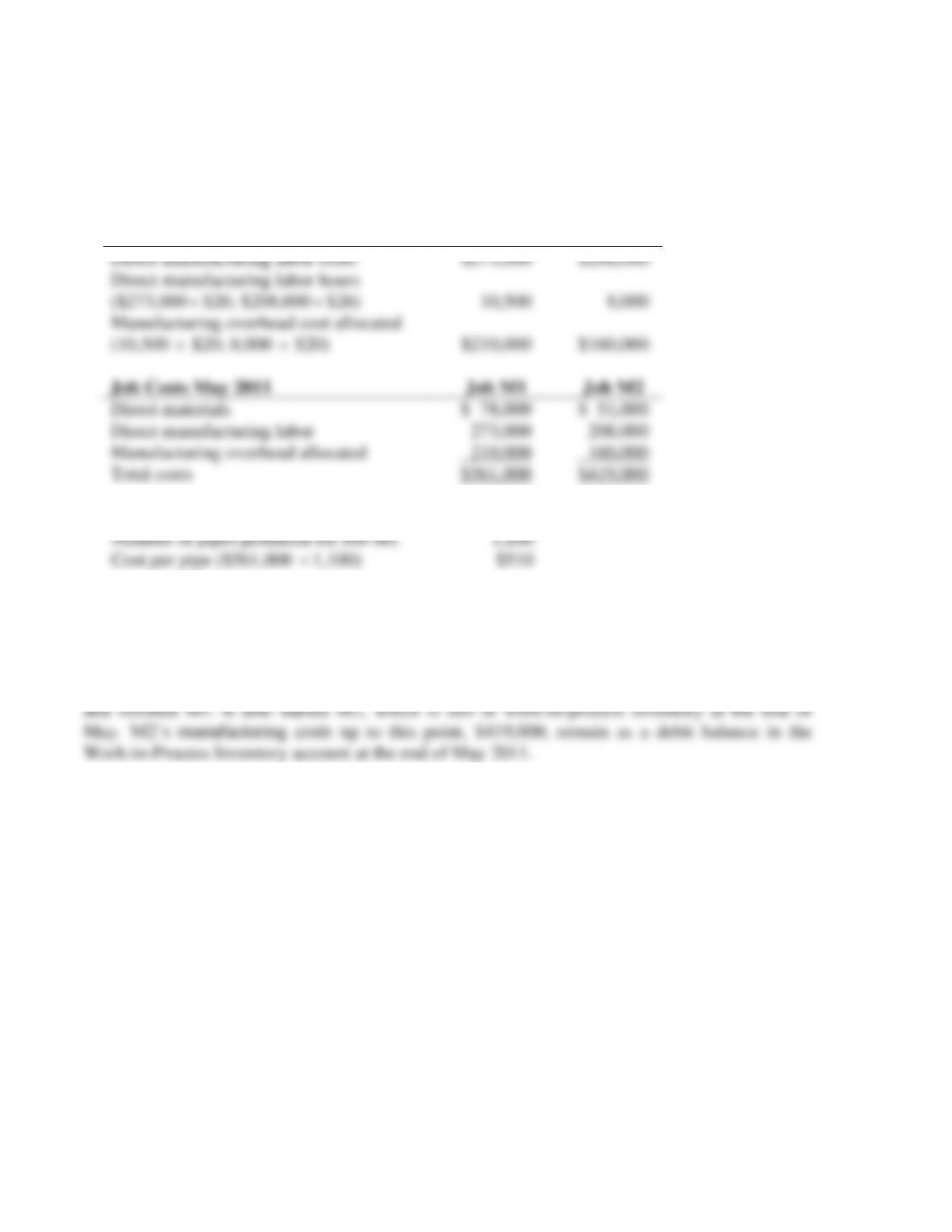
Job Costs May 2011
Job M1
Job M2
Direct materials
$ 78,000
$ 51,000
Direct manufacturing labor
273,000
208,000
Manufacturing overhead allocated
210,000
160,000
Total costs
$561,000
$419,000
2.
Number of pipes produced for Job M1
1,100
Cost per pipe ($561,000
1,100)
$510
3.
Finished Goods Control 561,000
Work-in–Process Control 561,000
4. Rafael Company began May 2011 with no work-in-process inventory. During May, it started
4-28 (20−30 min.) Job costing; actual, normal, and variation from normal costing.
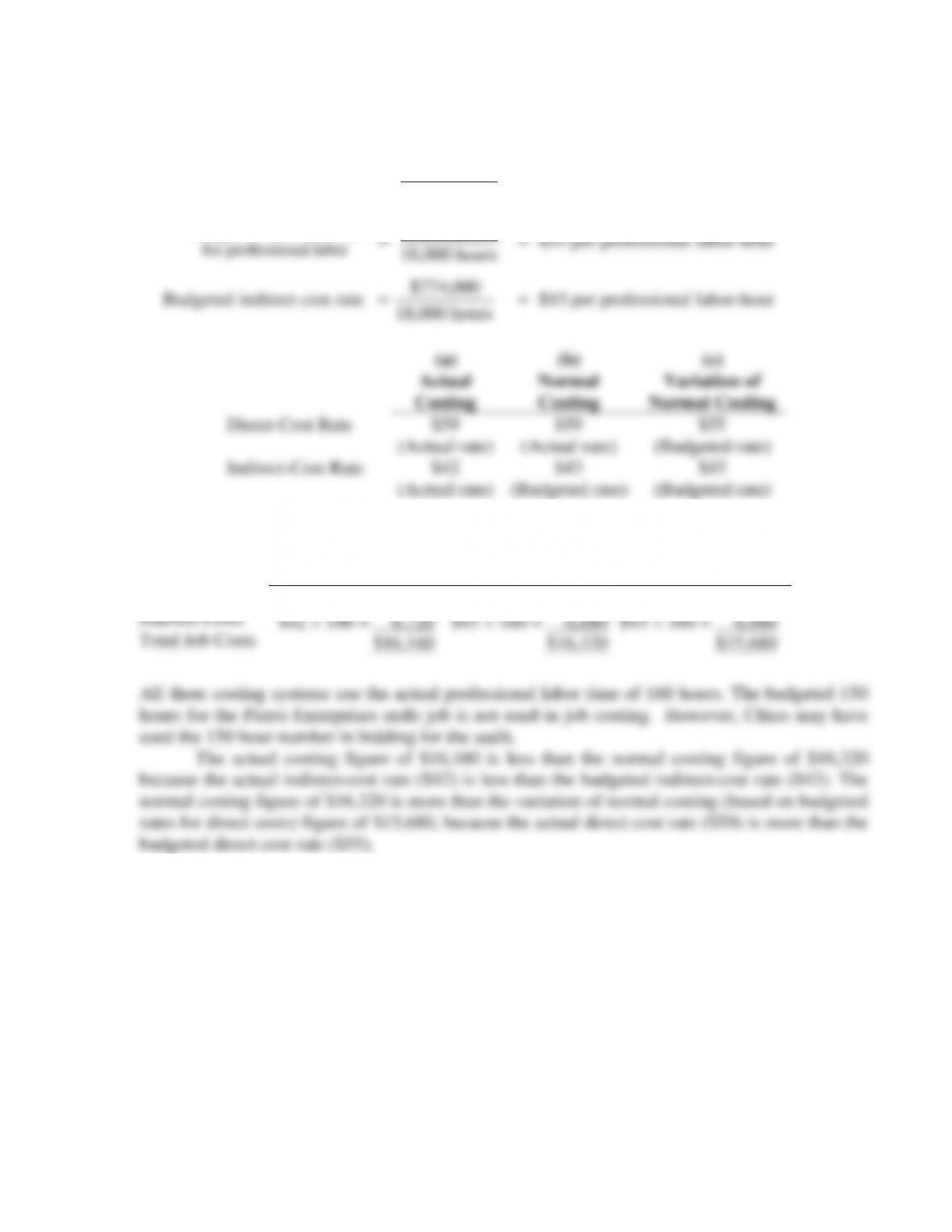
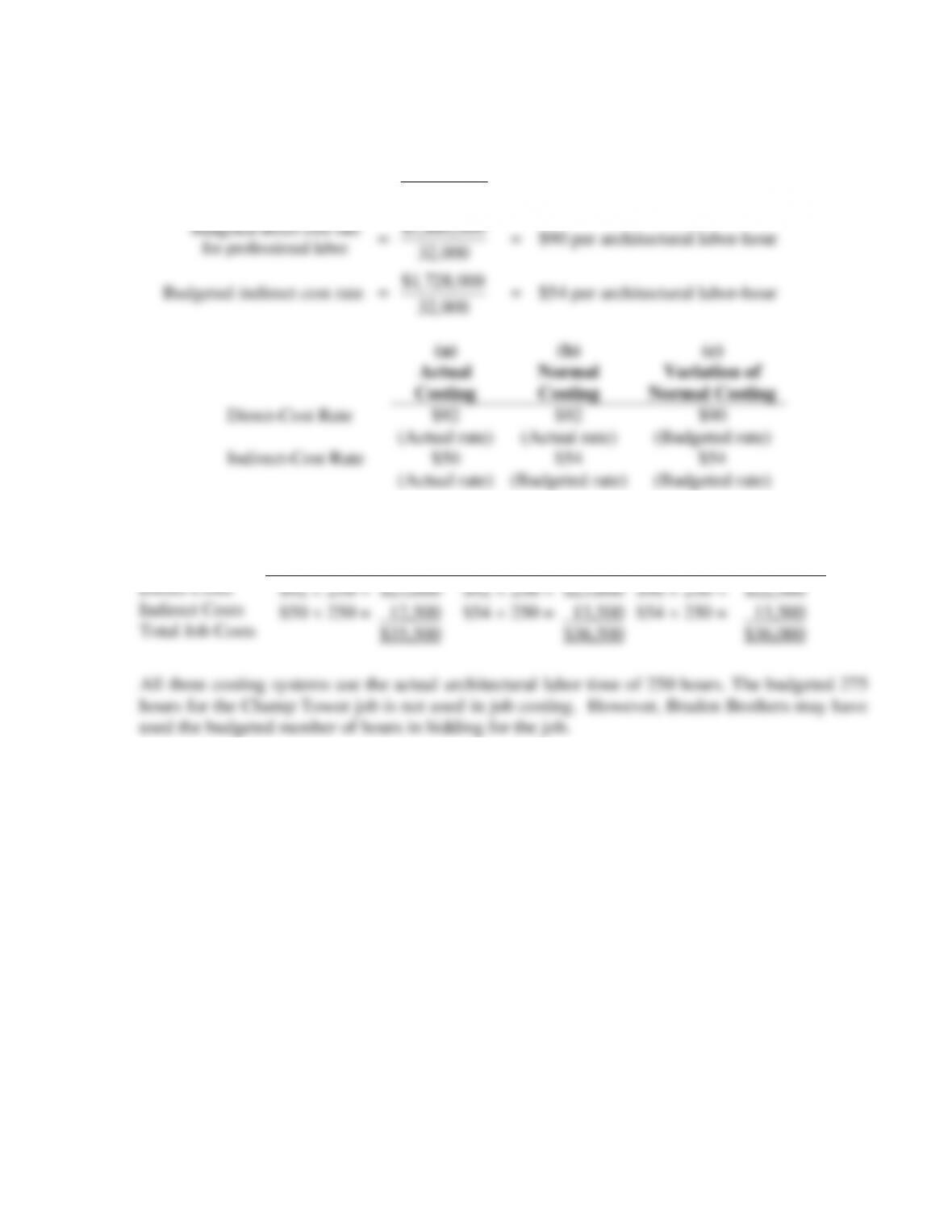
1. Actual direct cost rate for professional labor = $59 per professional labor-hour
Actual indirect cost rate =
$735,000
17,500 hours
= $42 per professional labor-hour
Budgeted direct cost rate
$990,000
18,000 hours
4-24
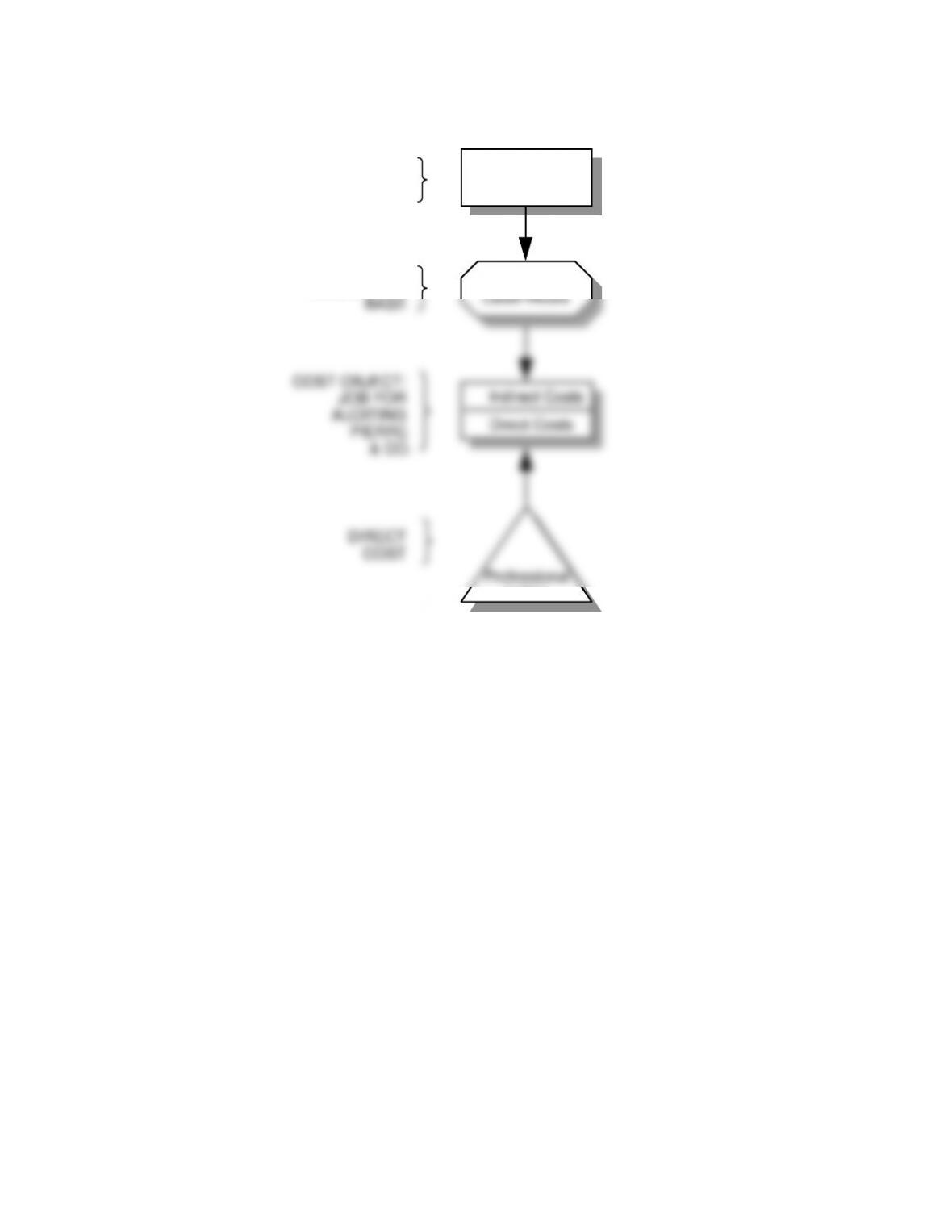
Although not required, the following overview diagram summarizes Chico’s job-costing
system.
Audit
Support
Professional
Labor-Hours
Indirect Costs
Direct Costs
INDIRECT
COST
POOL
COST
ALLOCATION
BASE
COST OBJECT:
JOB FOR
AUDITING
PIERRE
& CO.
DIRECT
COST
Professional
Labor
4-29 (20−30 min.) Job costing; actual, normal, and variation from normal costing.
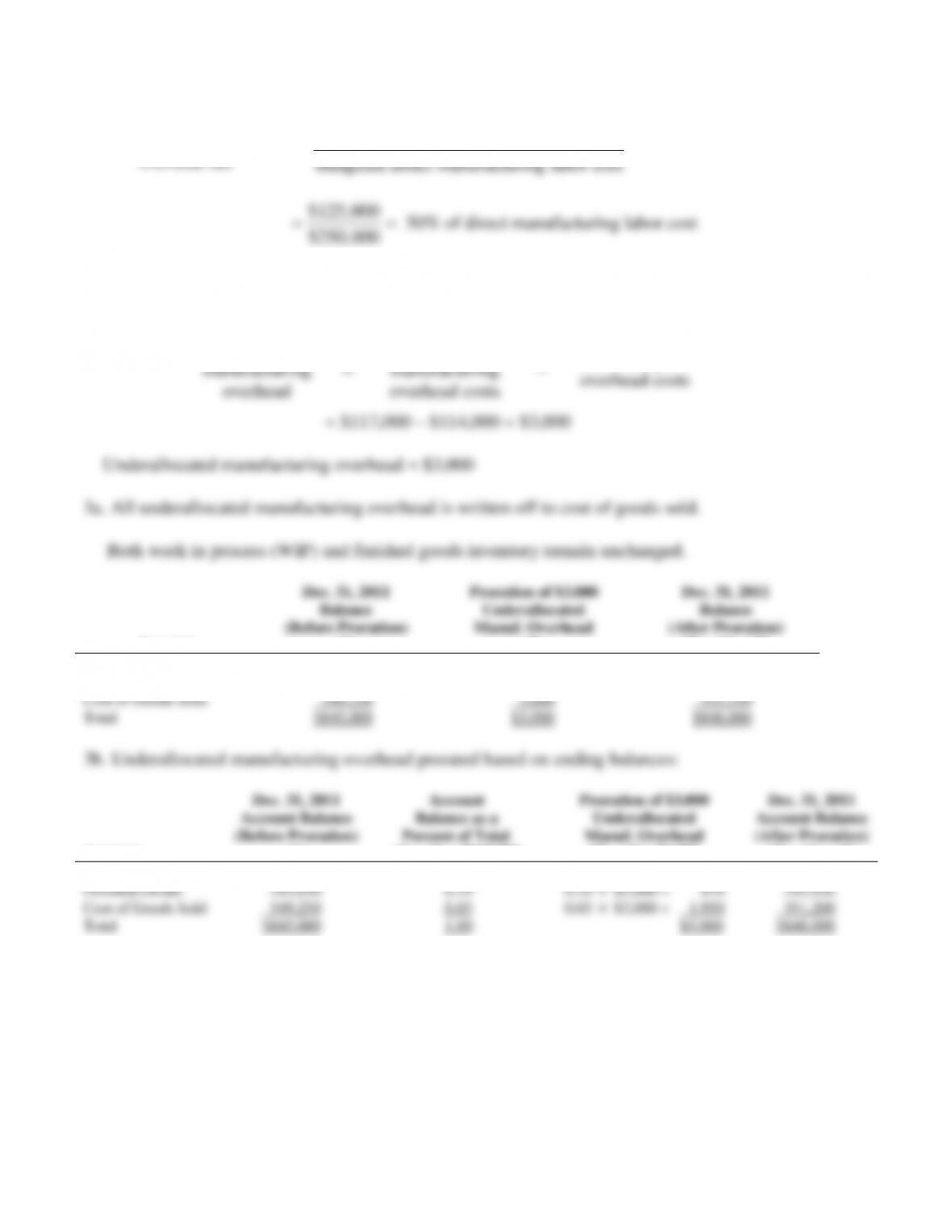
1. Actual direct cost rate for architectural labor = $92 per architectural labor-hour
Actual indirect cost rate =
$1,729,500
34,590
= $50 per architectural labor-hour
Budgeted direct cost rate
$2,880,000
$1,728,000
4-30 (30 min.) Proration of overhead.
overhead rate
1. Budgeted manufacturing
=
Budgeted manufacturing overhead cost
Budgeted direct manufacturing labor cost
$250,000
2. Overhead allocated = 50%
Actual direct manufacturing labor cost
= 50%
$228,000 = $114,000
Underallocated
manufacturing
overhead
=
Actual
manufacturing
overhead costs
–
Allocated plant
overhead costs
= $117,000 – $114,000 = $3,000
Underallocated manufacturing overhead = $3,000
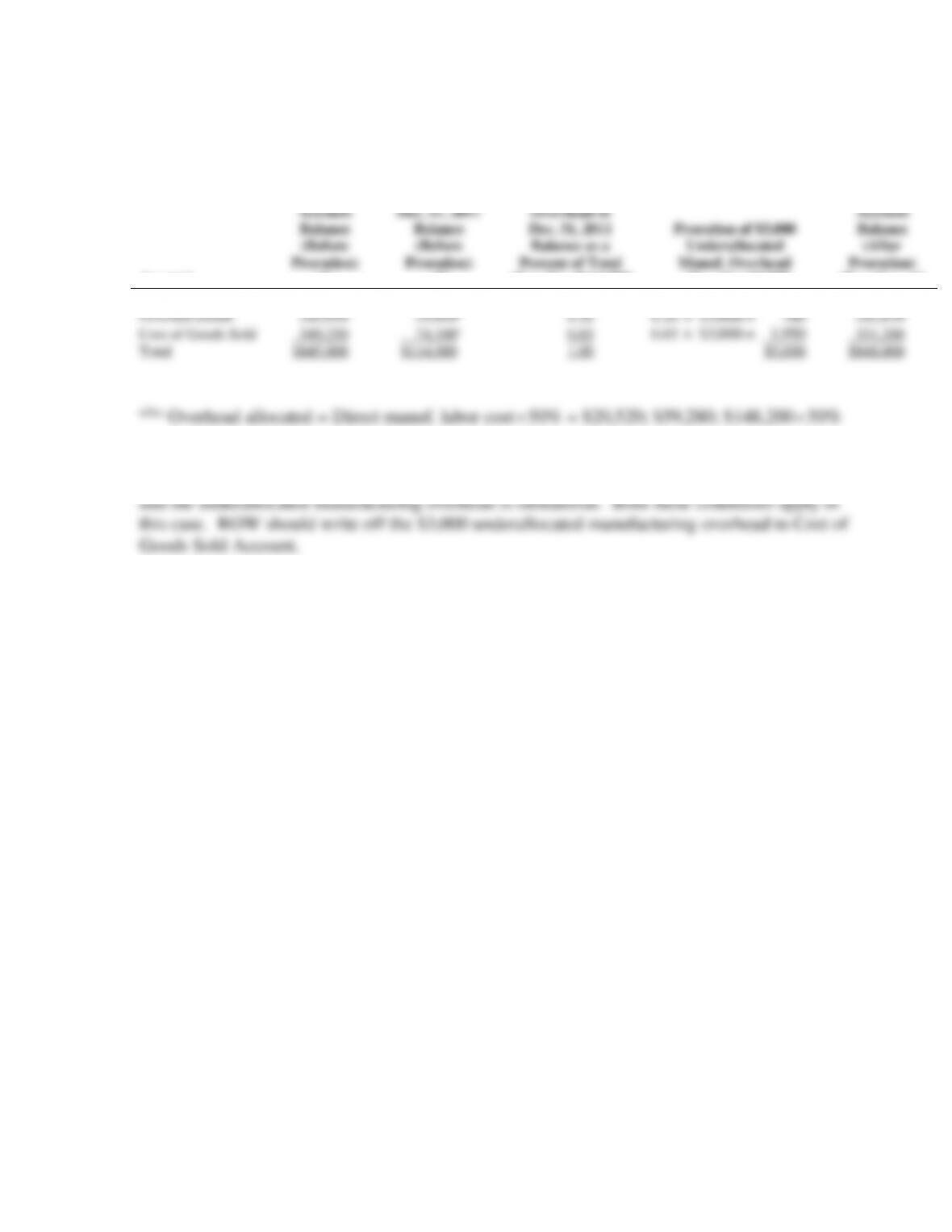
3a. All underallocated manufacturing overhead is written off to cost of goods sold.
Both work in process (WIP) and finished goods inventory remain unchanged.
Account
Dec. 31, 2011
Balance
(Before Proration)
(1)
Proration of $3,000
Underallocated
Manuf. Overhead
(2)
Dec. 31, 2011
Balance
(After Proration)
(3) = (1) + (2)
WIP
$ 50,700
$ 0
$ 50,700
Finished Goods
245,050
0
245,050
Cost of Goods Sold
549,250
3,000
552,250
Total
$845,000
$3,000
$848,000
Account
Dec. 31, 2011
Account Balance
(Before Proration)
(1)
Account
Balance as a
Percent of Total
(2) = (1) ÷ $845,000
Proration of $3,000
Underallocated
Manuf. Overhead
(3) = (2)
$3,000
Dec. 31, 2011
Account Balance
(After Proration)
(4) = (1) + (3)
WIP
$ 50,700
0.06
0.06
$3,000 = $ 180
$ 50,880
Finished Goods
245,050
0.29
0.29
$3,000 = 870
245,920
Cost of Goods Sold
549,250
0.65
0.65
$3,000 = 1,950
551,200
Total
$845,000
1.00
$3,000
$848,000
3c. Underallocated manufacturing overhead prorated based on 2011 overhead in ending
balances:
Account
Dec. 31, 2011
Account
Balance
(Before
Proration)
(1)
Allocated
Manuf.
Overhead in
Dec. 31, 2011
Balance
(Before
Proration)
(2)
Allocated Manuf.
Overhead in
Dec. 31, 2011
Balance as a
Percent of Total
(3) = (2) ÷ $114,000
Proration of $3,000
Underallocated
Manuf. Overhead
(4) = (3)
$3,000
Dec. 31, 2011
Account
Balance
(After
Proration)
(5) = (1) + (4)
WIP
$ 50,700
$ 10,260a
0.09
0.09
$3,000 = $ 270
$ 50,970
Finished Goods
245,050
29,640b
0.26
0.26
$3,000 = 780
245,830
Cost of Goods Sold
549,250
74,100c
0.65
0.65
$3,000 = 1,950
551,200
Total
$845,000
$114,000
1.00
$3,000
$848,000
a,b,c Overhead allocated = Direct manuf. labor cost
50% = $20,520; $59,280; $148,200
50%
4. Writing off all of the underallocated manufacturing overhead to Cost of Goods Sold (CGS) is
usually warranted when CGS is large relative to Work-in–Process and Finished Goods Inventory
4-31 (20−30 min) Job costing, accounting for manufacturing overhead, budgeted rates.
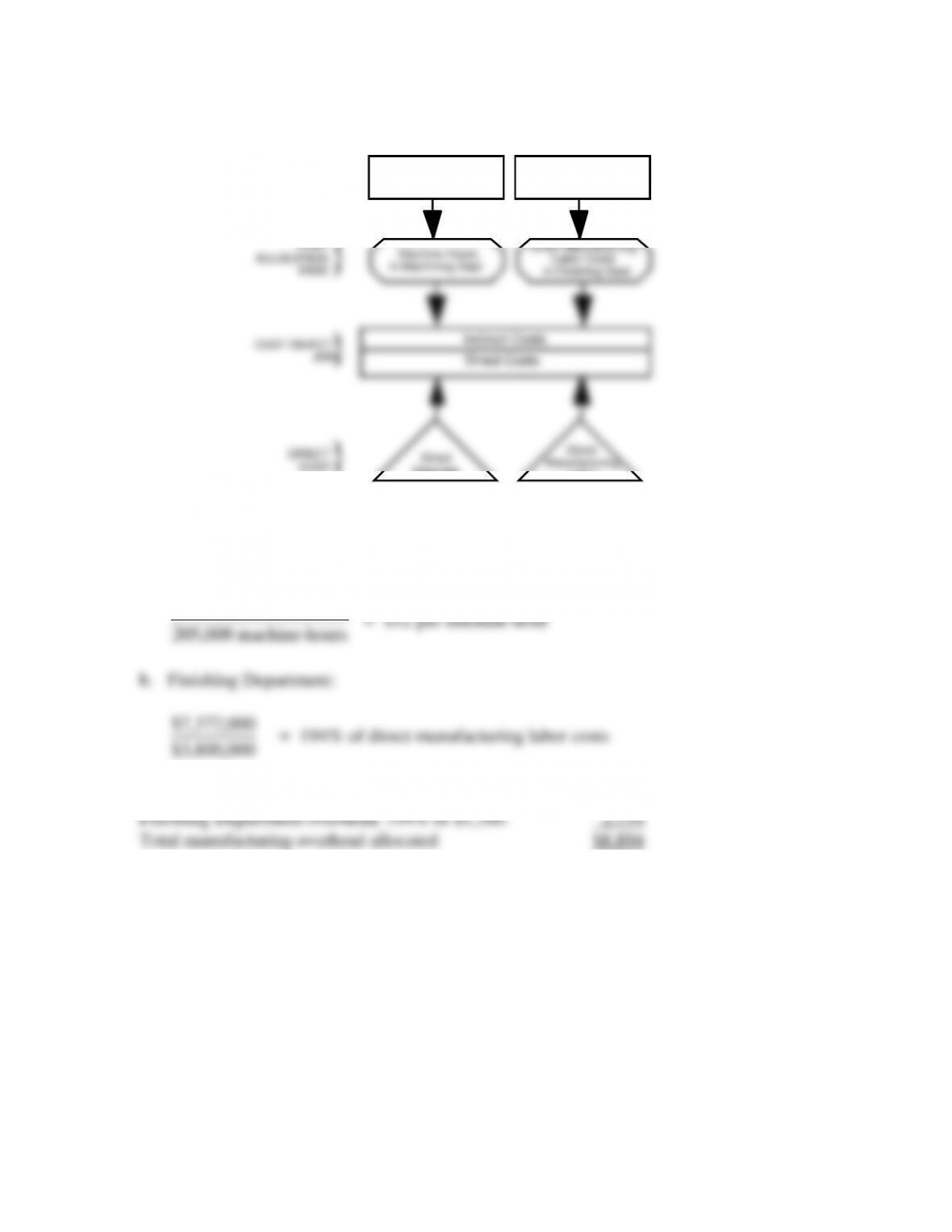
1. An overview of the job-costing system is:
COST OBJECT:
PRODUCT
COST
ALLOCATION
BASE
DIRECT
COST
Machining Department
Manufacturing Overhead
Machine-Hours
in Machining Dept.
Direct
Materials
INDIRECT
COST
POOL
Direct
Manufacturing
Labor
Indirect Costs
Direct Costs
Finishing Department
Manufacturing Overhead
Direct Manufacturing
Labor Costs
in Finishing Dept.
2. Budgeted manufacturing overhead divided by allocation base:
a. Machining Department:
$10,660,000
205,000 machine-hours
= $52 per machine-hour
b. Finishing Department:
$7,372,000
$3,800,000
= 194% of direct manufacturing labor costs
3. Machining Department overhead, $52 130 machine-hours $6,760
COST OBJECT:
JOB
4-29
4. Total costs of Job 431:
Direct costs:
Direct materials––Machining Department $15,500
––Finishing Department 5,000
rate.
5.
Machining Finishing
Manufacturing overhead incurred (actual) $11,070,000 $8,236,000
6. A homogeneous cost pool is one where all costs have the same or a similar cause-and–
effect or benefits-received relationship with the cost-allocation base. Fasano likely assumes that
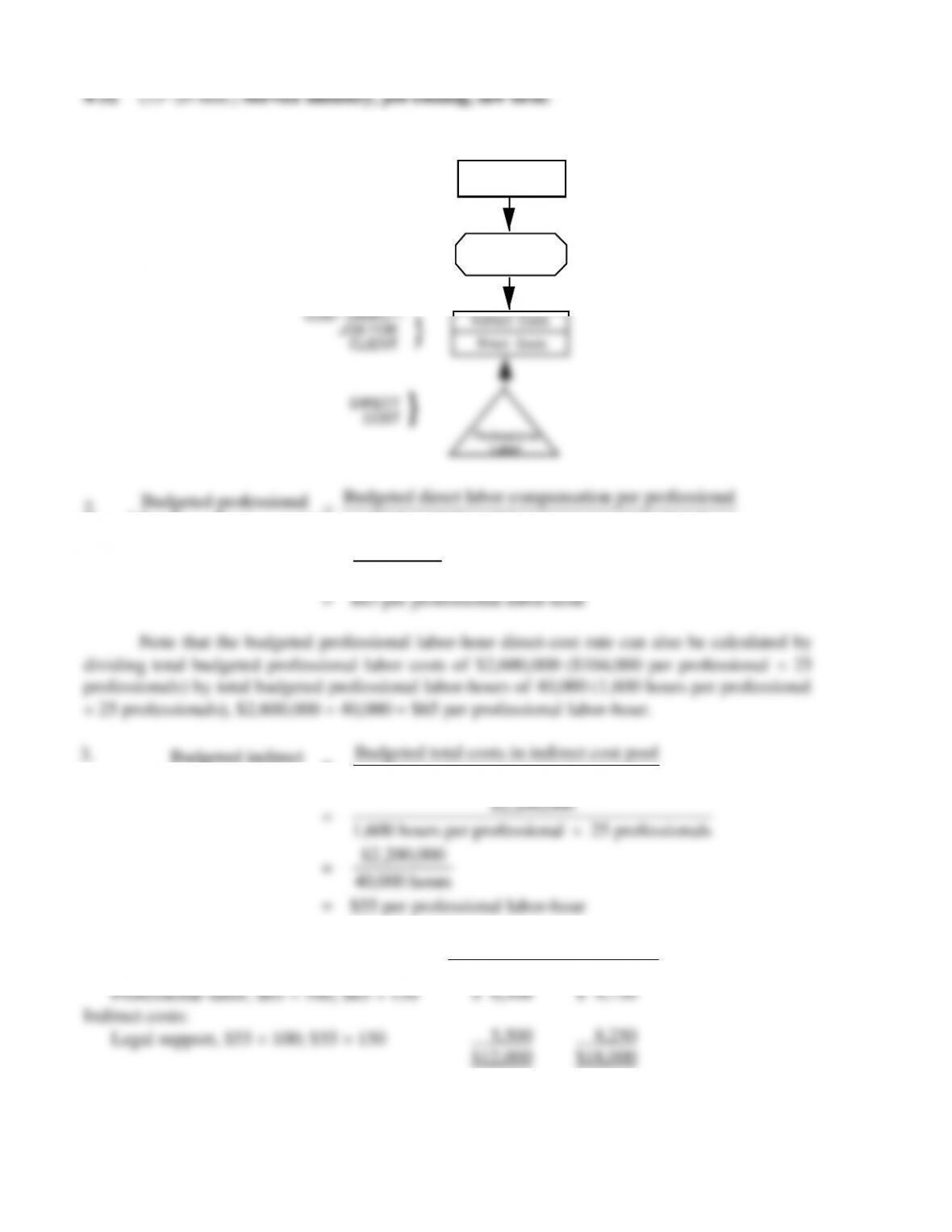
1.
Professional
Labor-Hours
Legal
Support
COST OBJECT:
JOB FOR
CLIENT
INDIRECT
COST
POOL
COST
ALLOCATION
BASE
}
DIRECT
COST
Indirect Costs
Direct Costs
Professional
Labor
2.
Budgeted professional
labor-hour direct cost rate
=
Budgeted direct labor compensation per professional
Budgeted direct labor-hours per professional
=
$104,000
1,600 hours
Budgeted indirect
cost rate
=
Budgeted total costs in indirect cost pool
Budgeted total professional labor-hours
$2,200,000
4.
Richardson
Punch
Direct costs:
Professional labor, $65 100; $65 150
Indirect costs:
Legal support, $55 100; $55 150
$ 6,500
5,500
$12,000
$ 9,750
8,250
$18,000
3.