4-1
CHAPTER 4
JOB COSTING
4-1 Cost pool––a grouping of individual indirect cost items.
Cost tracing––the assigning of direct costs to the chosen cost object.
4-2 In a job-costing system, costs are assigned to a distinct unit, batch, or lot of a product or
4-3 An advertising campaign for Pepsi is likely to be very specific to that individual client.
4-4 The seven steps in job costing are: (1) identify the job that is the chosen cost object, (2)
(5) compute the rate per unit of each cost–allocation base used to allocate indirect costs to the
4-5 Major cost objects that managers focus on in companies using job costing are a product
4-6 Three major source documents used in job-costing systems are (1) job cost record or job
cost sheet, a document that records and accumulates all costs assigned to a specific job, starting
4-7 The main advantages of using computerized source documents for job cost records are
4-8 Two reasons for using an annual budget period are
a. The numerator reason––the longer the time period, the less the influence of seasonal
4-2
4-9 Actual costing and normal costing differ in their use of actual or budgeted indirect cost
rates:
Actual
Costing
Normal
Costing
Direct-cost rates
Indirect-cost rates
Actual rates
Actual rates
Actual rates
Budgeted rates
Each costing method uses the actual quantity of the direct-cost input and the actual quantity of
the cost-allocation base.
4-10 A house construction firm can use job cost information (a) to determine the profitability
4-11 The statement is false. In a normal costing system, the Manufacturing Overhead Control
account will not, in general, equal the amounts in the Manufacturing Overhead Allocated
account. The Manufacturing Overhead Control account aggregates the actual overhead costs
4-12 Debit entries to Work-in-Process Control represent increases in work in process.
4-13 Alternative ways to make end-of-period adjustments to dispose of underallocated or
overallocated overhead are as follows:
(i) Proration based on the total amount of indirect costs allocated (before proration) in
4-14 A company might use budgeted costs rather than actual costs to compute direct labor
4-15 Modern technology of electronic data interchange (EDI) is helpful to managers because it
4-3
4-16 (10 min) Job order costing, process costing.
a. Job costing l. Job costing
b. Process costing m. Process costing
4-4
4-17 (20 min.) Actual costing, normal costing, accounting for manufacturing overhead.
1.
Budgeted manufacturing
overhead rate
=
costslabor ingmanufacturdirect Budgeted
costs overhead ingmanufactur Budgeted
=
$2,700,000
$1,500,000
= 1.80 or 180%
costs overhead ingmanufactur Actual
=
$2,755,000
$1,450,000
= 1.9 or 190%
2. Costs of Job 626 under actual and normal costing follow:
Actual Normal
Costing Costing
3.
Total manufacturing overhead
allocated under normal costing
=
Actual manufacturing
labor costs
Budgeted
overhead rate
= $1,450,000 1.80
Actual manufacturing
overhead.
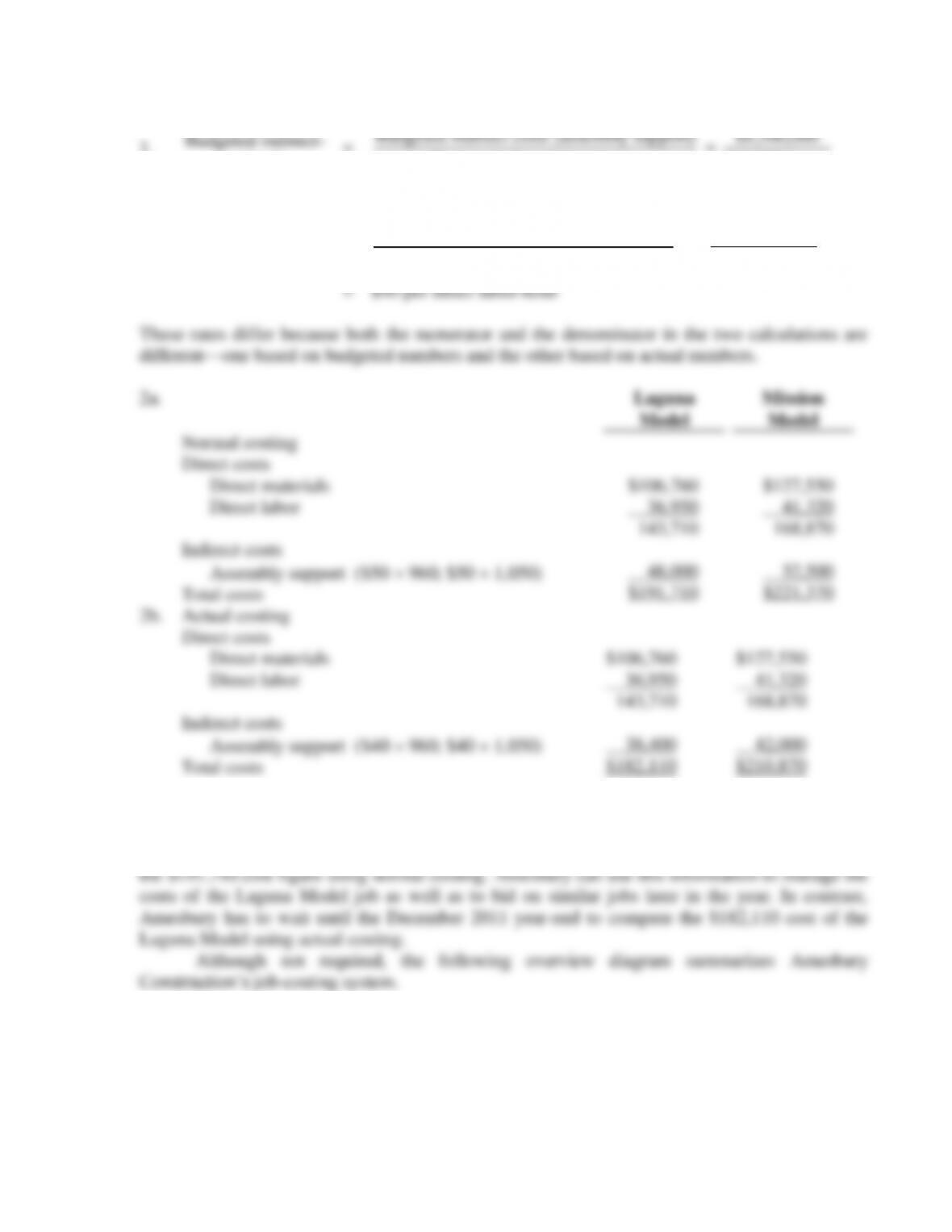
4-18 (20 -30 min.) Job costing, normal and actual costing.
1.
Budgeted indirect-
cost rate
=
Budgeted indirect costs (assembly support)
Budgeted direct labor-hours
=
$8,300,000
166,000 hours
= $50 per direct labor–hour
Actual indirect-
cost rate
=
Actual indirect costs (assembly support)
Actual direct labor-hours
=
$6,520,000
163,000 hours
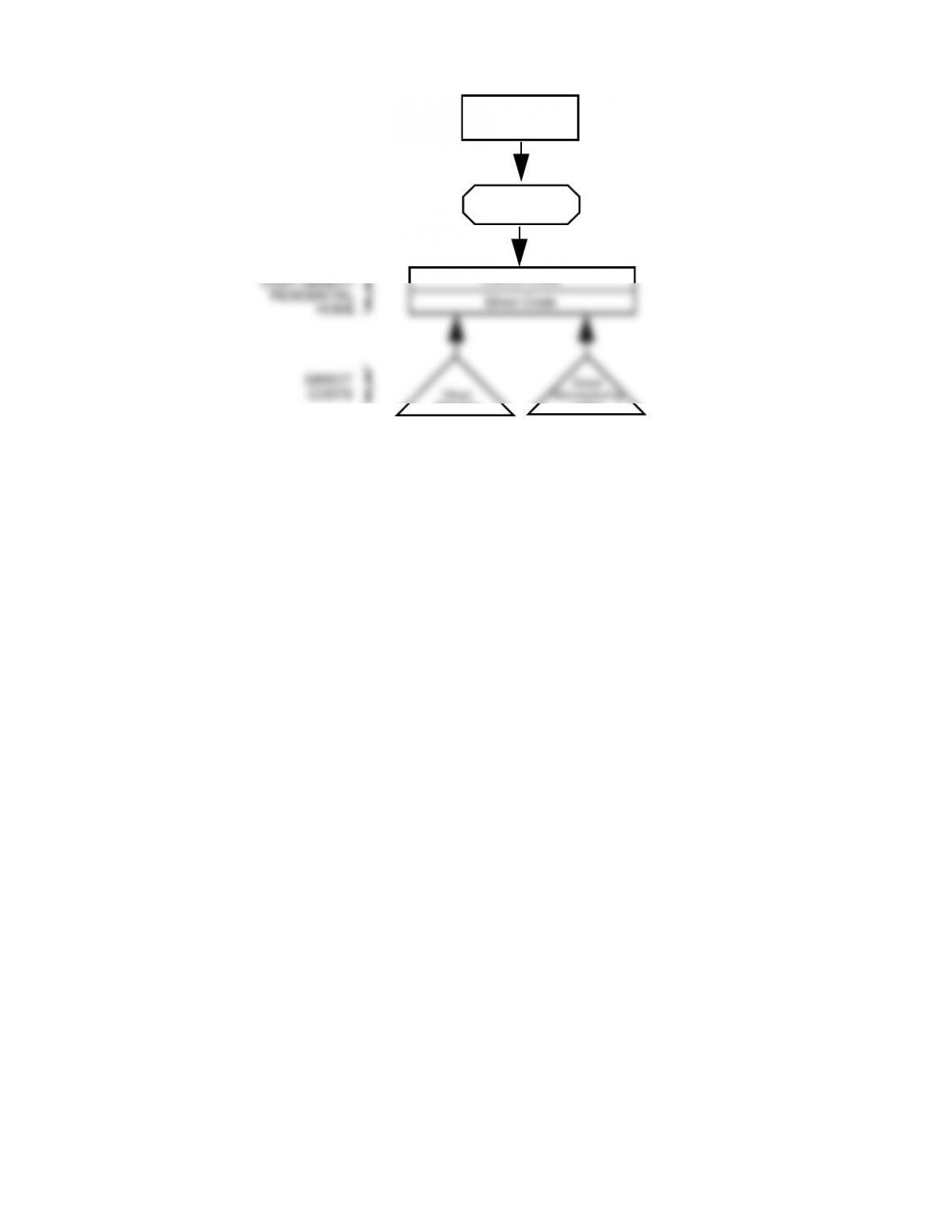
INDIRECT
COST
POOL
COST
ALLOCATION
BASE
Direct
Materials
COST OBJECT:
RESIDENTIAL
HOME
DIRECT
COSTS
Direct
Manufacturing
Labor
Indirect Costs
Direct Costs
Assembly
Support
Direct
Labor-Hours
4-7
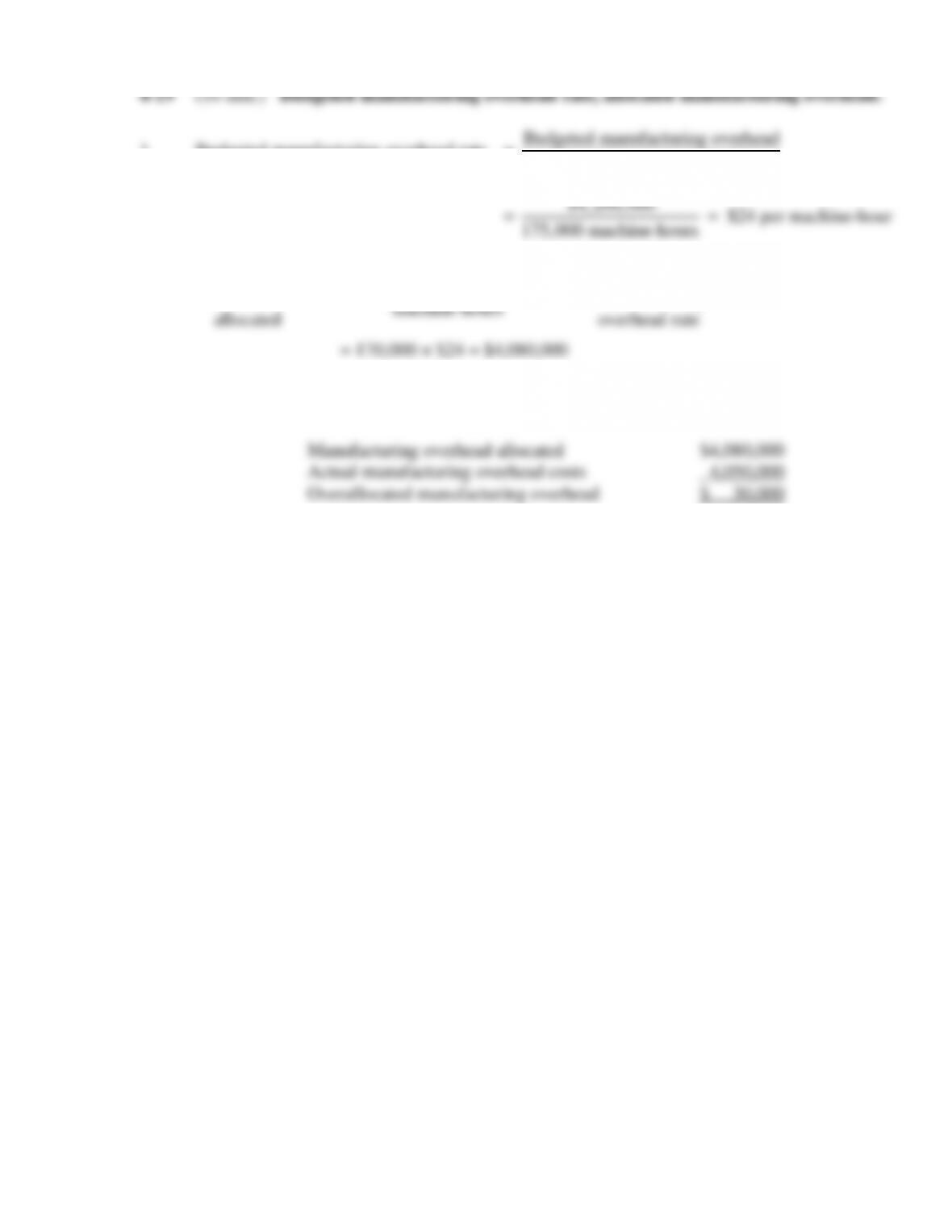
1. Budgeted manufacturing overhead rate =
Budgeted manufacturing overhead
Budgeted machine hours
$4,200,000
175,000 machine-hours
2.
Manufacturing
overhead
allocated
=
Actual
machine-hours
Budgeted
manufacturing
overhead rate
= 170,000 × $24 = $4,080,000
3. Since manufacturing overhead allocated is greater than the actual manufacturing overhead
costs, Gammaro overallocated manufacturing overhead:
4-8
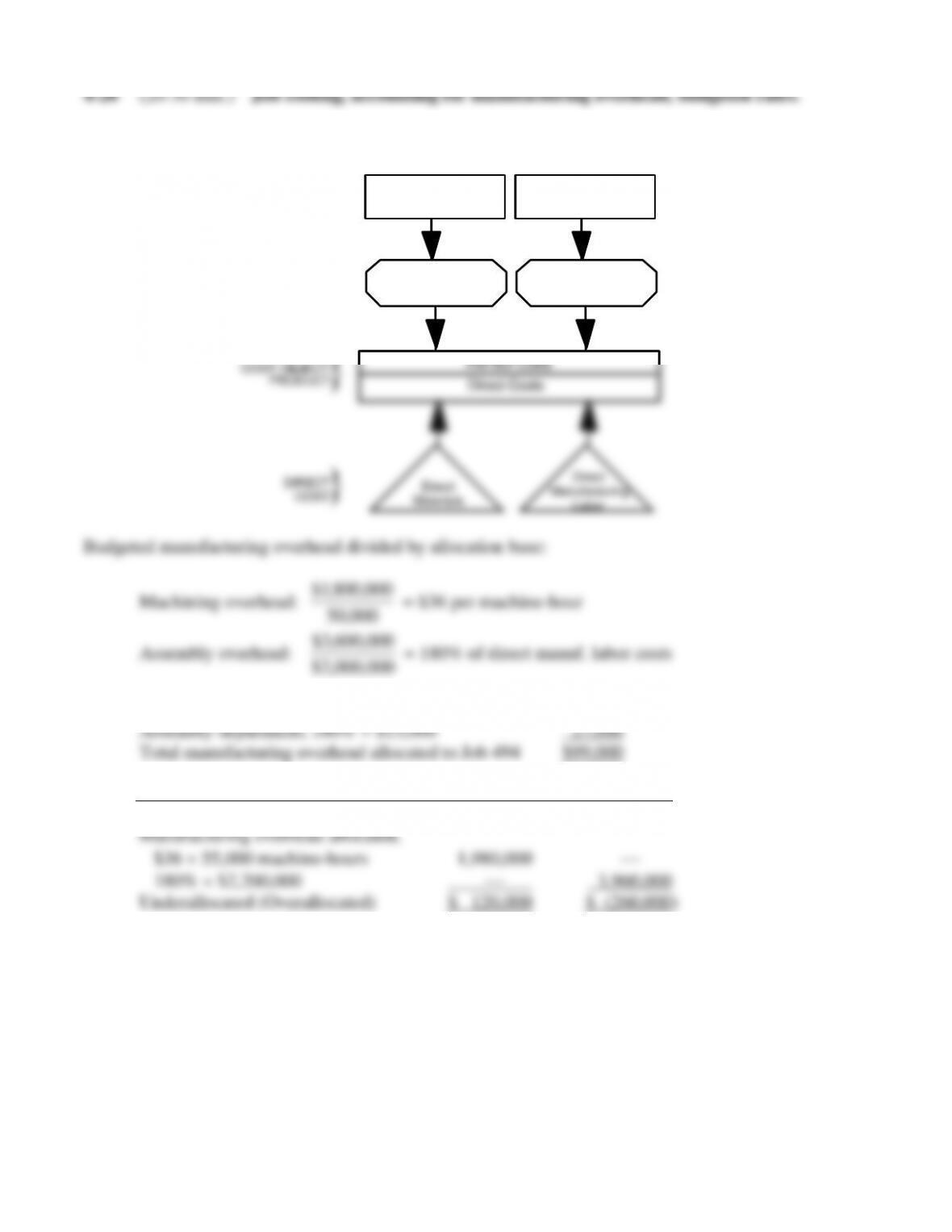
1. An overview of the product costing system is
COST OBJECT:
PRODUCT
COST
ALLOCATION
BASE
DIRECT
COST
Machining Department
Manufacturing Overhead
Machine-Hours
Direct
Materials
INDIRECT
COST
POOL
Direct
Manufacturing
Labor
Indirect Costs
Direct Costs
Assembly Department
Manufacturing Overhead
Direct Manuf.
Labor Cost
000,000,2$
2. Machining department, 2,000 hours $36 $72,000
3. Machining Assembly
Actual manufacturing overhead $2,100,000 $ 3,700,000
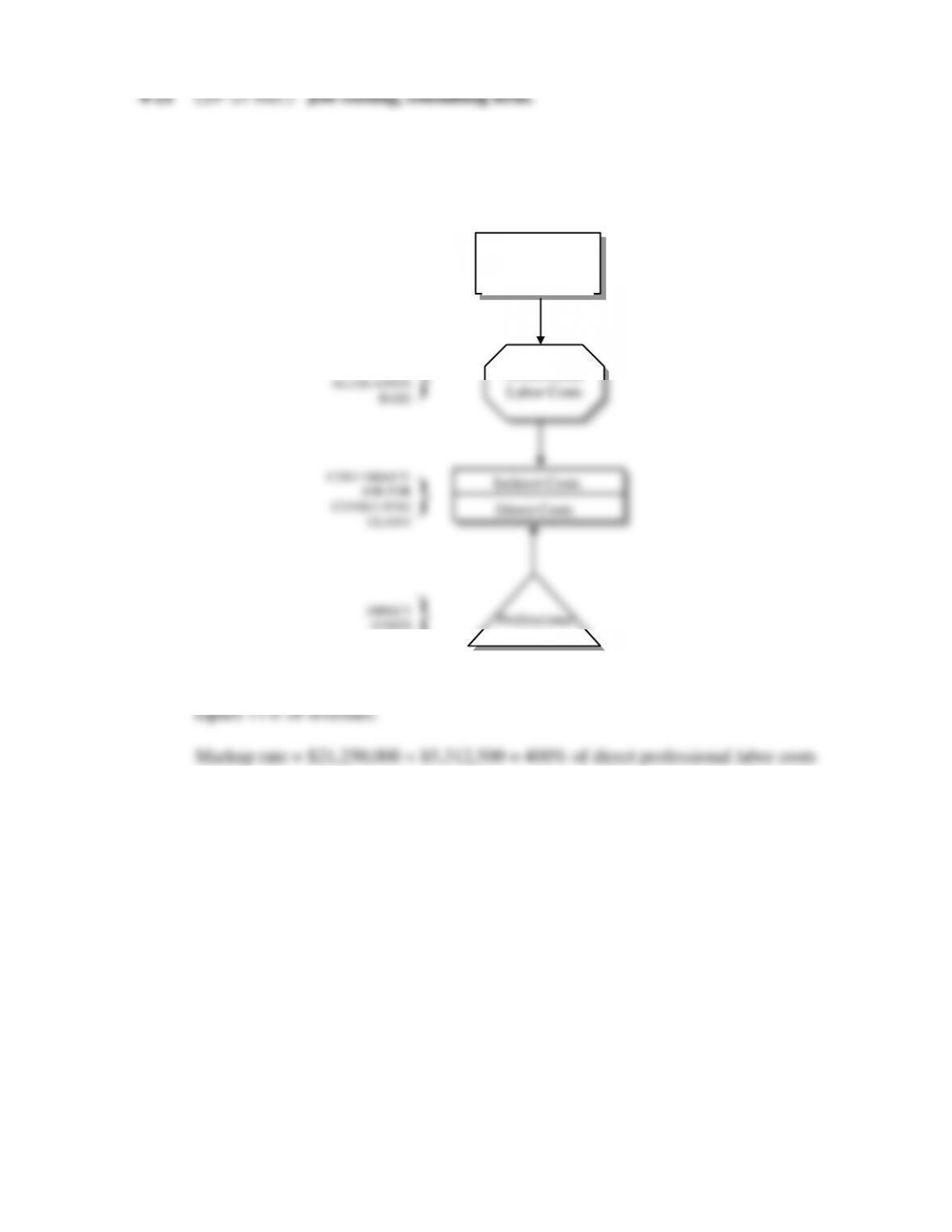
1. Budgeted indirect-cost rate for client support can be calculated as follows:
Budgeted indirect-cost rate = $13,600,000 ÷ $5,312,500 = 256% of professional labor costs
2. At the budgeted revenues of $21,250,000 Taylor’s operating income of $2,337,500
COST
ALLOCATION
BASE
Consulting
Support
Consulting
Support
COST OBJECT:
JOB FOR
CONSULTING
CLIENT
DIRECT
COSTS
Indirect Costs
Direct Costs
INDIRECT
COST
POOL
Professional
Labor Costs
Professional
Labor Costs
Professional
Labor
Client
Support
4-10
3. Budgeted costs
Direct costs:
Director, $198 4 $ 792
Partner, $101 17 1,717
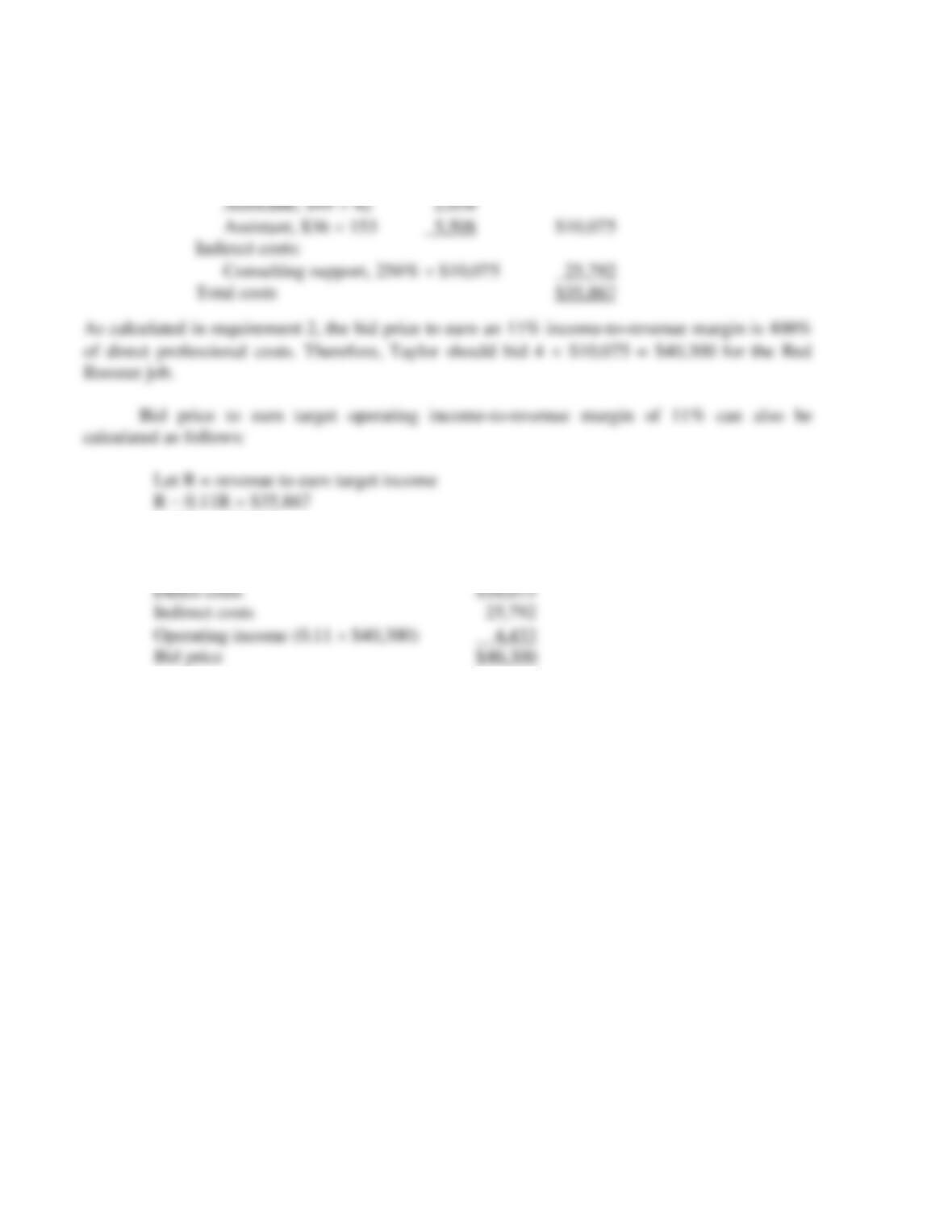
0.89R = $35,867
R = $35,867 ÷ 0.89 = $40,300
Or