3-1
CHAPTER 3
COST-VOLUME-PROFIT ANALYSIS
3-1 Cost-volume-profit (CVP) analysis examines the behavior of total revenues, total costs,
3-2 The assumptions underlying the CVP analysis outlined in Chapter 3 are
2. Total costs can be separated into a fixed component that does not vary with the units sold
and a variable component that changes with respect to the units sold.
period.
4. The selling price, variable cost per unit, and fixed costs are known and constant.
3-3 Operating income is total revenues from operations for the accounting period minus cost
of goods sold and operating costs (excluding income taxes):
3-4 Contribution margin is the difference between total revenues and total variable costs.
3-5 Three methods to express CVP relationships are the equation method, the contribution
3-2
3-6 Breakeven analysis denotes the study of the breakeven point, which is often only an
3-7 CVP certainly is simple, with its assumption of output as the only revenue and cost
driver, and linear revenue and cost relationships. Whether these assumptions make it simplistic
expanded.
3-8 An increase in the income tax rate does not affect the breakeven point. Operating income
at the breakeven point is zero, and no income taxes are paid at this point.
3-9 Sensitivity analysis is a “what–if” technique that managers use to examine how an
outcome will change if the original predicted data are not achieved or if an underlying
3-10 Examples include:
Manufacturing––substituting a robotic machine for hourly wage workers.
3-11 Examples include:
Manufacturing––subcontracting a component to a supplier on a per-unit basis to avoid
3-12 Operating leverage describes the effects that fixed costs have on changes in operating
3-13 CVP analysis is always conducted for a specified time horizon. One extreme is a very
variable.
3-3
CVP itself is not made any less relevant when the time horizon lengthens. What happens
3-15 Yes, gross margin calculations emphasize the distinction between manufacturing and
nonmanufacturing costs (gross margins are calculated after subtracting variable and fixed
3-16 (10 min.) CVP computations.
Variable
Fixed
Total
Operating
Contribution
Contribution
Revenues
Costs
Costs
Costs
Income
Margin
Margin %
a.
$2,000
$ 500
$300
$ 800
$1,200
$1,500
75.0%
b.
2,000
1,500
300
1,800
200
500
25.0%
c.
1,000
700
300
1,000
0
300
30.0%
d.
1,500
900
300
1,200
300
600
40.0%
3-17 (10–15 min.) CVP computations.
1a. Sales ($68 per unit × 410,000 units) $27,880,000
Variable costs ($60 per unit × 410,000 units) 24,600,000
Contribution margin $ 3,280,000
3. Operating income is expected to decrease by $1,230,000 ($1,640,000 − $410,000) if Ms.
Schoenen’s proposal is accepted.
3-18 (35–40 min.) CVP analysis, changing revenues and costs.
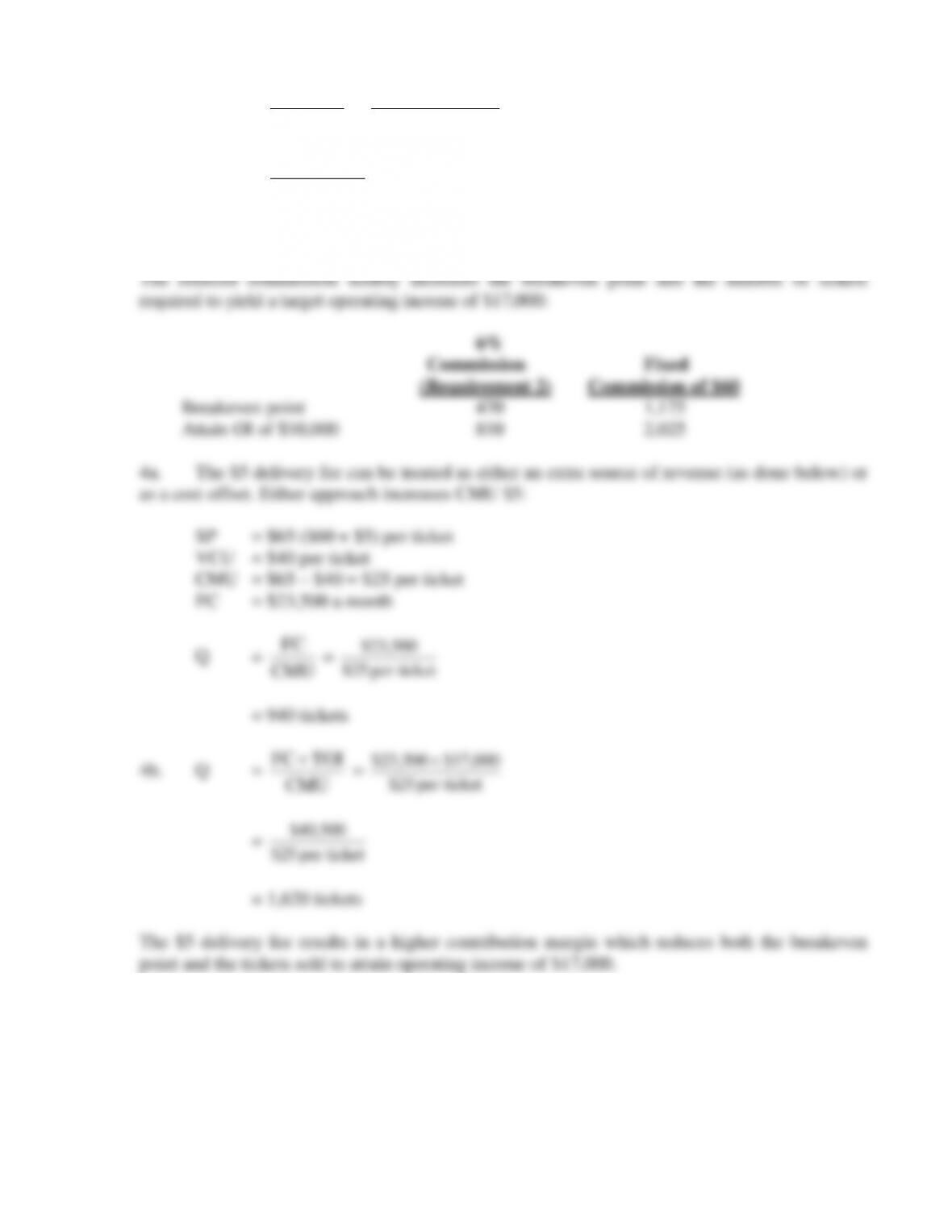
1a. SP = 6% × $1,500 = $90 per ticket
VCU = $43 per ticket
CMU = $90 – $43 = $47 per ticket
FC = $23,500 a month
Q =
CMU
FC
=
per ticket $47
$23,500
per ticket $47
$40,500
CMU
FC
per ticket $50
$23,500
per ticket $50
$40,500
CMU
FC
3-5
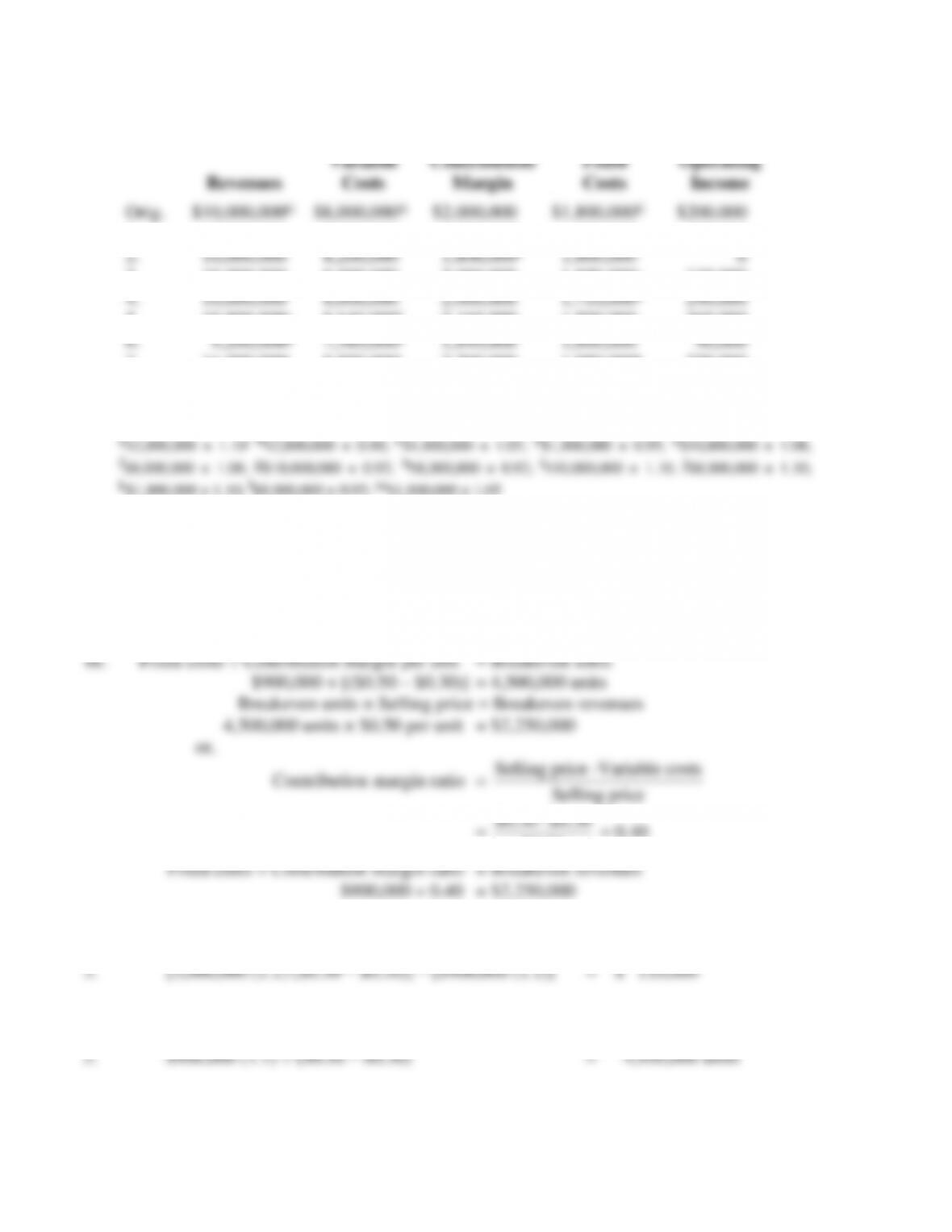
3b. Q =
CMU
TOI FC +
=
per ticket $20
$17,000 $23,500+
=
per ticket $20
$40,500
= 2,025 tickets
CMU
per ticket $25
TOI FC +
$17,000 $23,500+
3-6
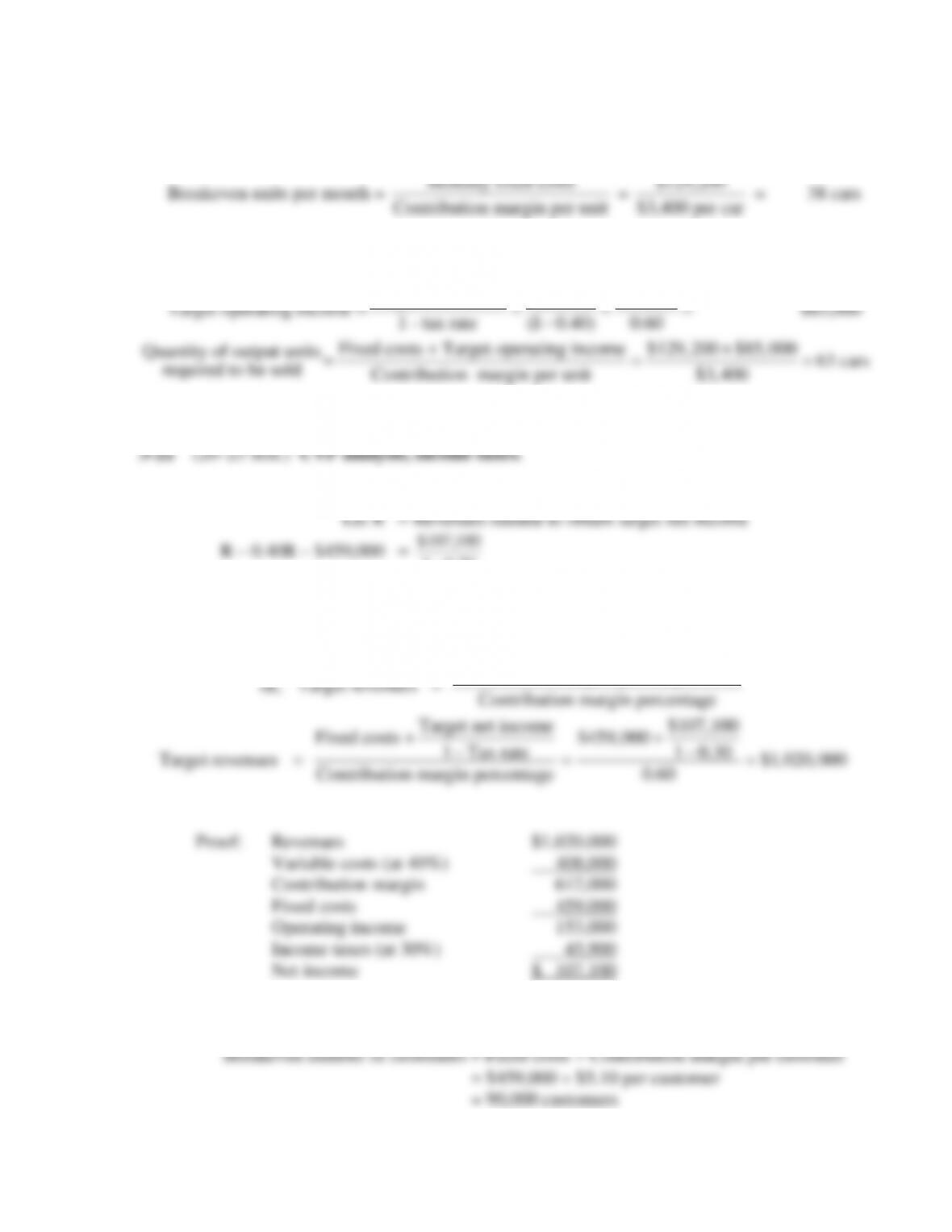
3-19 (20 min.) CVP exercises.
Revenues
Variable
Costs
Contribution
Margin
Fixed
Costs
Budgeted
Operating
Income
Orig.
$10,000,000G
$8,000,000G
$2,000,000
$1,800,000G
$200,000
1.
10,000,000
7,800,000
2,200,000a
1,800,000
400,000
2.
10,000,000
8,200,000
1,800,000b
1,800,000
0
3.
10,000,000
8,000,000
2,000,000
1,890,000c
110,000
4.
10,000,000
8,000,000
2,000,000
1,710,000d
290,000
5.
10,800,000e
8,640,000f
2,160,000
1,800,000
360,000
6.
9,200,000g
7,360,000h
1,840,000
1,800,000
40,000
7.
11,000,000i
8,800,000j
2,200,000
1,980,000k
220,000
8.
10,000,000
7,600,000l
2,400,000
1,890,000m
510,000
Gstands for given.
3-20 (20 min.) CVP exercises.
1a. [Units sold (Selling price – Variable costs)] – Fixed costs = Operating income
[5,000,000 ($0.50 – $0.30)] – $900,000 = $100,000
price Selling
=
$0.50
$0.30 – $0.50
= 0.40
2.
5,000,000 ($0.50 – $0.34) – $900,000
=
$ (100,000)
3.
[5,000,000 (1.1) ($0.50 – $0.30)] – [$900,000 (1.1)]
=
$ 110,000
4.
[5,000,000 (1.4) ($0.40 – $0.27)] – [$900,000 (0.8)]
=
$ 190,000
5.
$900,000 (1.1) ÷ ($0.50 – $0.30)
=
4,950,000 units
6.
($900,000 + $20,000) ÷ ($0.55 – $0.30)
=
3,680,000 units
3-7
3-21 (10 min.) CVP analysis, income taxes.
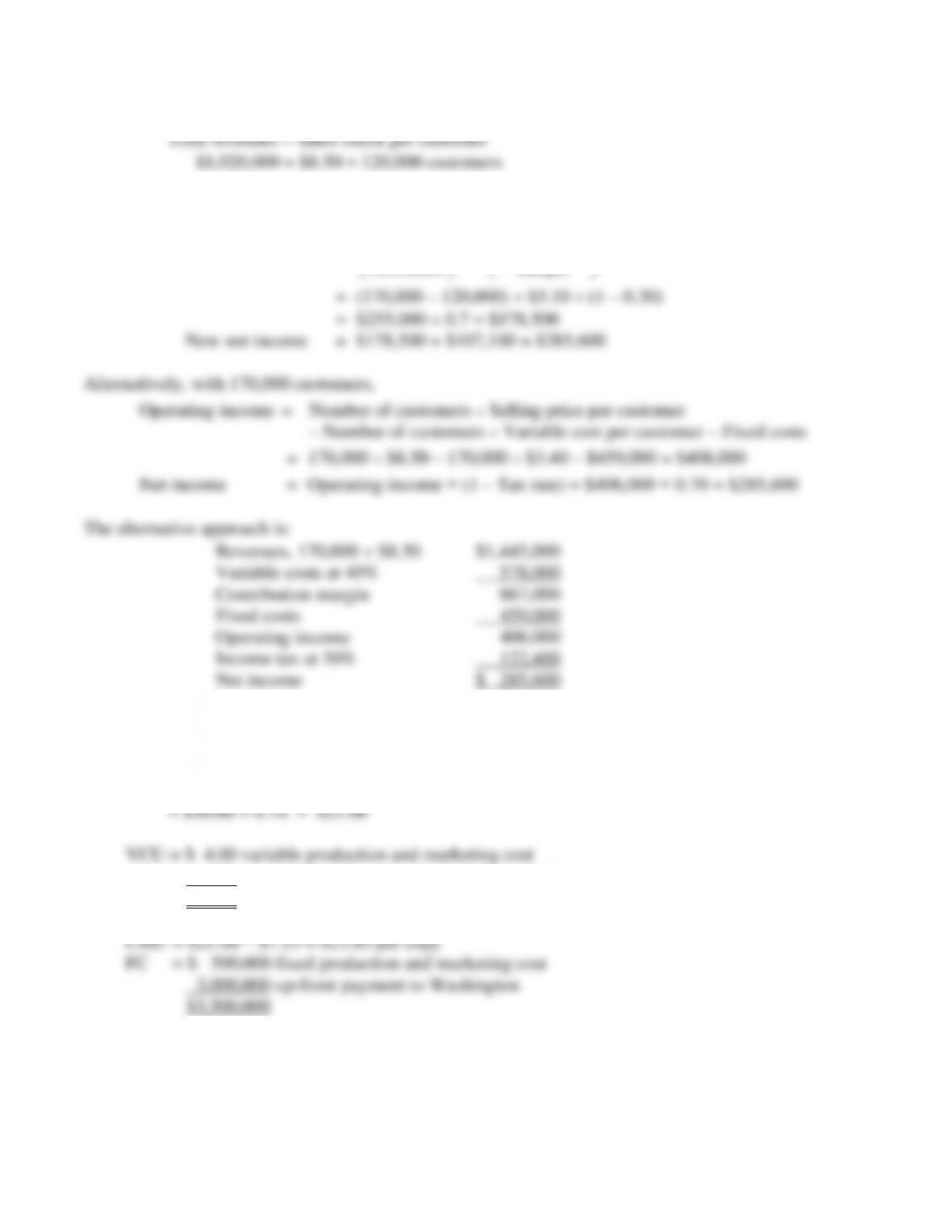
1. Monthly fixed costs = $48,200 + $68,000 + $13,000 = $129,200
Contribution margin per unit = $27,000 – $23,000 – $600 = $ 3,400
Monthly fixed costs
Contribution margin per unit
$129,200
$3,400 per car
2. Tax rate 40%
Target net income $51,000
Target net income $51,000 $51,000
1 – tax rate (1 0.40) 0.60
−
Quantity of output units
required to be sold
=
Fixed costs + Target operating income $129,200 $85,000
Contribution margin per unit $3,400
+
==
63 cars
1. Variable cost percentage is $3.40 $8.50 = 40%
30.01
−
0.60R = $459,000 + $153,000
R = $612,000 0.60
R = $1,020,000
Fixed costs + Target operating income
Target net income $107,100
Fixed costs + $459,000
1 Tax rate 1 0.30
Target revenues $1,020,000
Contribution margin percentage 0.60
+
−−
= = =
Proof: Revenues $1,020,000
Variable costs (at 40%) 408,000
Contribution margin 612,000
Fixed costs 459,000
Operating income 153,000
Income taxes (at 30%) 45,900
Net income $ 107,100
2.a. Customers needed to break even:
Contribution margin per customer = $8.50 – $3.40 = $5.10
3-8
2.b. Customers needed to earn net income of $107,100:
3. Using the shortcut approach:
Change in net income =
( )
Change in Unit
number of contribution 1 Tax rate
customers margin
−
3-23 (30 min.) CVP analysis, sensitivity analysis.
1. SP = $30.00 (1 – 0.30 margin to bookstore)
3.15 variable author royalty cost (0.15 $21.00)
$ 7.15
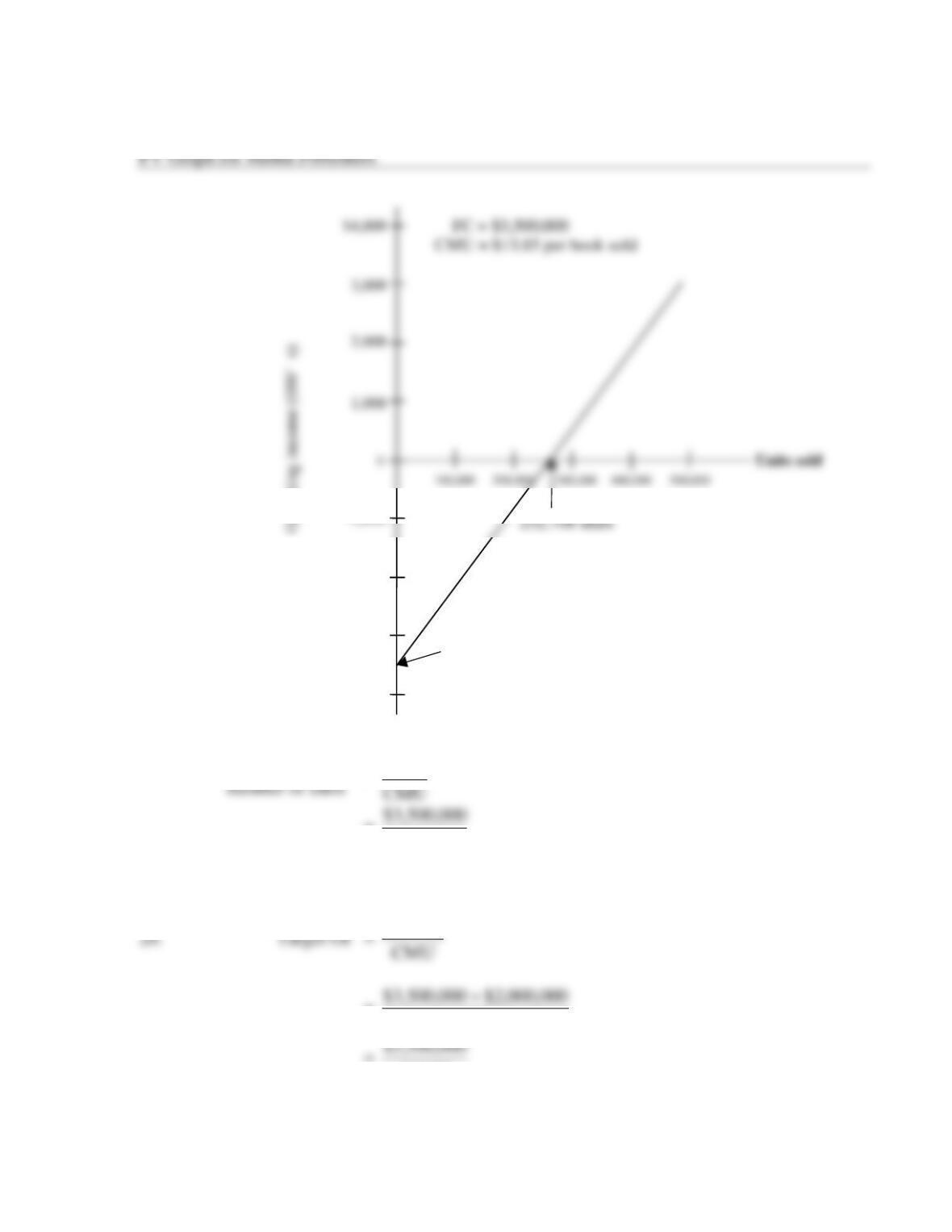
Solution Exhibit 3-23A shows the PV graph.
SOLUTION EXHIBIT 3-23A
$4,000
3,000
2,000
1,000
2a.
Breakeven
FC
$3.5 million
252,708 units
-1,000
-2,000
-3,000
-4,000
100,000
200,000
300,000
400,000
500,000
3-10
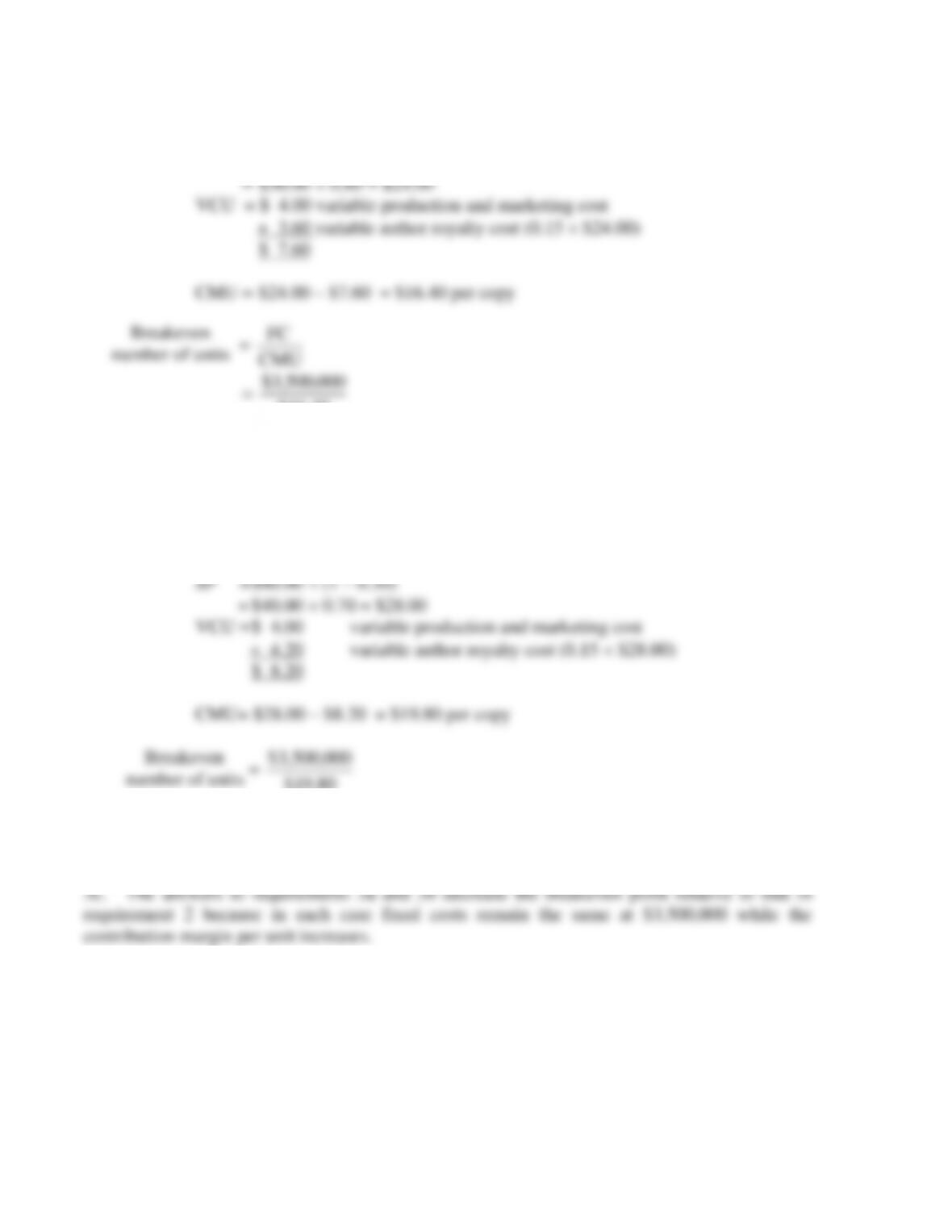
3a. Decreasing the normal bookstore margin to 20% of the listed bookstore price of $30 has the
following effects:
SP = $30.00 (1 – 0.20)
$16.40
= 213,415 copies sold (rounded up)
The breakeven point decreases from 252,708 copies in requirement 2 to 213,415 copies.
3b. Increasing the listed bookstore price to $40 while keeping the bookstore margin at 30%
has the following effects:
$19.80
= 176,768 copies sold (rounded up)
The breakeven point decreases from 252,708 copies in requirement 2 to 176,768 copies.