22-1
CHAPTER 22
22-1 A management control system is a means of gathering and using information to aid and
22-2 To be effective, management control systems should be (a) closely aligned to an
22-3 Motivation combines goal congruence and effort. Motivation is the desire to attain a
1. Creates greater responsiveness to local needs
3. Increases motivation of subunit managers
5. Sharpens the focus of subunit managers
The chapter cites four costs of decentralization:
2. Focuses managers’ attention on the subunit rather than the company as a whole
4. Results in duplication of activities
22-5 No. Organizations typically compare the benefits and costs of decentralization on a
22-6 No. A transfer price is the price one subunit of an organization charges for a product or
service supplied to another subunit of the same organization. The two segments can be cost
1. Market-based transfer prices
3. Hybrid transfer prices
22-2
22-8 Transfer prices should have the following properties. They should
2. be useful for evaluating subunit performance,
4. preserve a high level of subunit autonomy in decision making.
22-10 Transferring products or services at market prices generally leads to optimal decisions
when (a) the market for the intermediate product market is perfectly competitive, (b)
22-11 One potential limitation of full-cost-based transfer prices is that they can lead to
suboptimal decisions for the company as a whole. An example of a conflict between divisional
action and overall company profitability resulting from an inappropriate transfer-pricing policy is
buying products or services outside the company when it is beneficial to overall company
22-12 Reasons why a dual-pricing approach to transfer pricing is not widely used in practice
include:
2. This approach does not provide clear signals to division managers about the level of
decentralization top management wants.
4. It leads to problems in computing the taxable income of subunits located in different tax
jurisdictions.
22-13 Disagree. Cost and price information are often useful starting points in the negotiation
process. Costs, particularly variable costs of the selling division, serve as a “floor” below which
22-3
22-14 Yes. The general transfer-pricing guideline specifies that the minimum transfer price
equals the incremental cost per unit incurred up to the point of transfer plus the opportunity cost
22-15 Alternative transfer-pricing methods can result in sizable differences in the reported
22-16 (15 min.) Evaluating management control systems, balanced scorecard.
1. Correct answers may include any of the following:
Financial perspective – stock price, net income, return on investment, cash flow from operations,
cost per visitor, gross margin percentage in retail venues
2. Each manager would be concerned with management controls related specifically to
their level of responsibility. Within the financial perspective, for example, the souvenir shop
22-4
22-17 (25 min.) Cost centers, profit centers, decentralization.
1. The Glass Department sends its product to the Wood and Metal Departments for
3. A centralized department can be a profit center. Centralization relates to the degree of
autonomy that a department has for decision making. This concept is independent of the
4. a) With these changes, Fenster will be moving toward a more decentralized environment
because each department will have more local decision-making authority, such as the
22-5
1. Health Source has a centralized structure. Individual managers have little autonomy in
decision-making.
2. Harvest Moon has a decentralized structure. Store managers have significant autonomy.
They are able to customize product offerings, negotiate purchases with local farmers, and can
even influence store expansion decisions.
3. The stores in the Health Source chain would be considered profit centers. Store
managers are responsible for store revenues and costs, and as such, would be evaluated based on
4. Jackson must be attentive to the fact that Harvest Moon managers have enjoyed
significant freedom to make decisions about their own stores. Jackson will need to carefully
22-6
22-19 (35 min.) Multinational transfer pricing, effect of alternative transfer-pricing
methods, global income tax minimization.
1. This is a three-country, three-division transfer-pricing problem with three alternative
transfer-pricing methods. Summary data in U.S. dollars are:
China Plant
Variable costs: 900 Yuan ÷ 9 Yuan per $ = $100 per subunit
Fixed costs: 1,980 Yuan ÷ 9 Yuan per $ = $220 per subunit
2.0 ($640 + $350 + $470) = $2,920 per unit
3.5 $100 = $350 per subunit
• South Korea to U.S. Plant
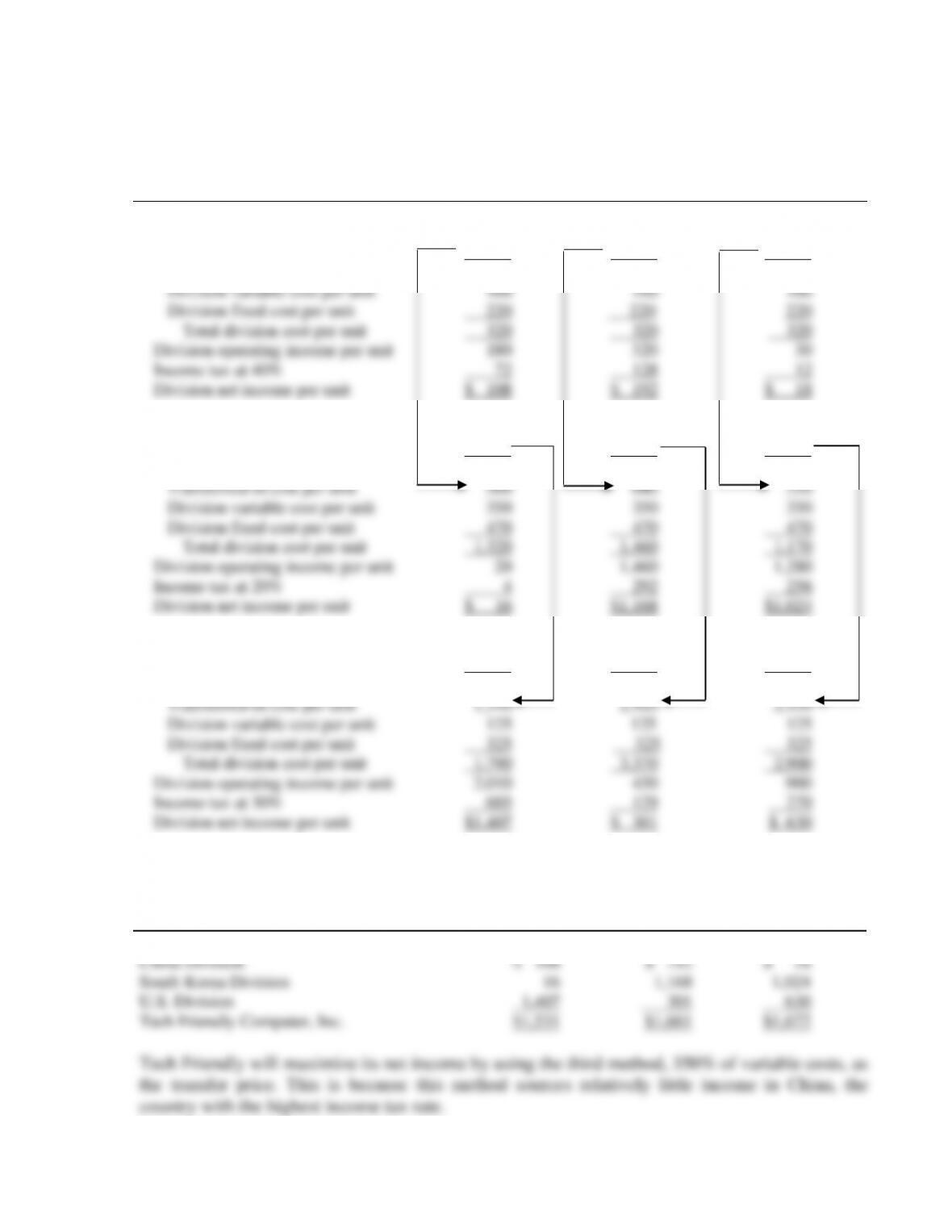
Method A
Method B
Method C
Internal
Transfers
at Market
Price
Internal
Transfers
at 200% of
Full Costs
Internal
Transfers
at 350% of
Variable Costs
1. China Division
Division revenue per unit
Cost per unit:
Division variable cost per unit
Division fixed cost per unit
Total division cost per unit
Division operating income per unit
Income tax at 40%
Division net income per unit
2. South Korea Division
Division revenue per unit
Cost per unit:
Transferred-in cost per unit
Division variable cost per unit
Division fixed cost per unit
Total division cost per unit
Division operating income per unit
Income tax at 20%
Division net income per unit
3. United States Division
Division revenue per unit
Division operating income per unit
Income tax at 30%
Division net income per unit
$ 500
100
220
320
180
72
$ 108
$1,340
500
350
470
1,320
20
4
$ 16
$3,800
2,010
603
$1,407
$ 640
100
220
320
320
128
$ 192
$2,920
640
350
470
1,460
1,460
292
$1,168
$3,800
430
129
$ 301
$ 350
100
220
320
30
12
$ 18
$2,450
350
350
470
1,170
1,280
256
$1,024
$3,800
900
270
$ 630
U.S. Division
Tech Friendly Computer, Inc.
1,407
$1,531
301
$1,661
630
$1,672
Tech Friendly will maximize its net income by using the third method, 350% of variable costs, as
22-20 (30 min.) Transfer-pricing methods, goal congruence.
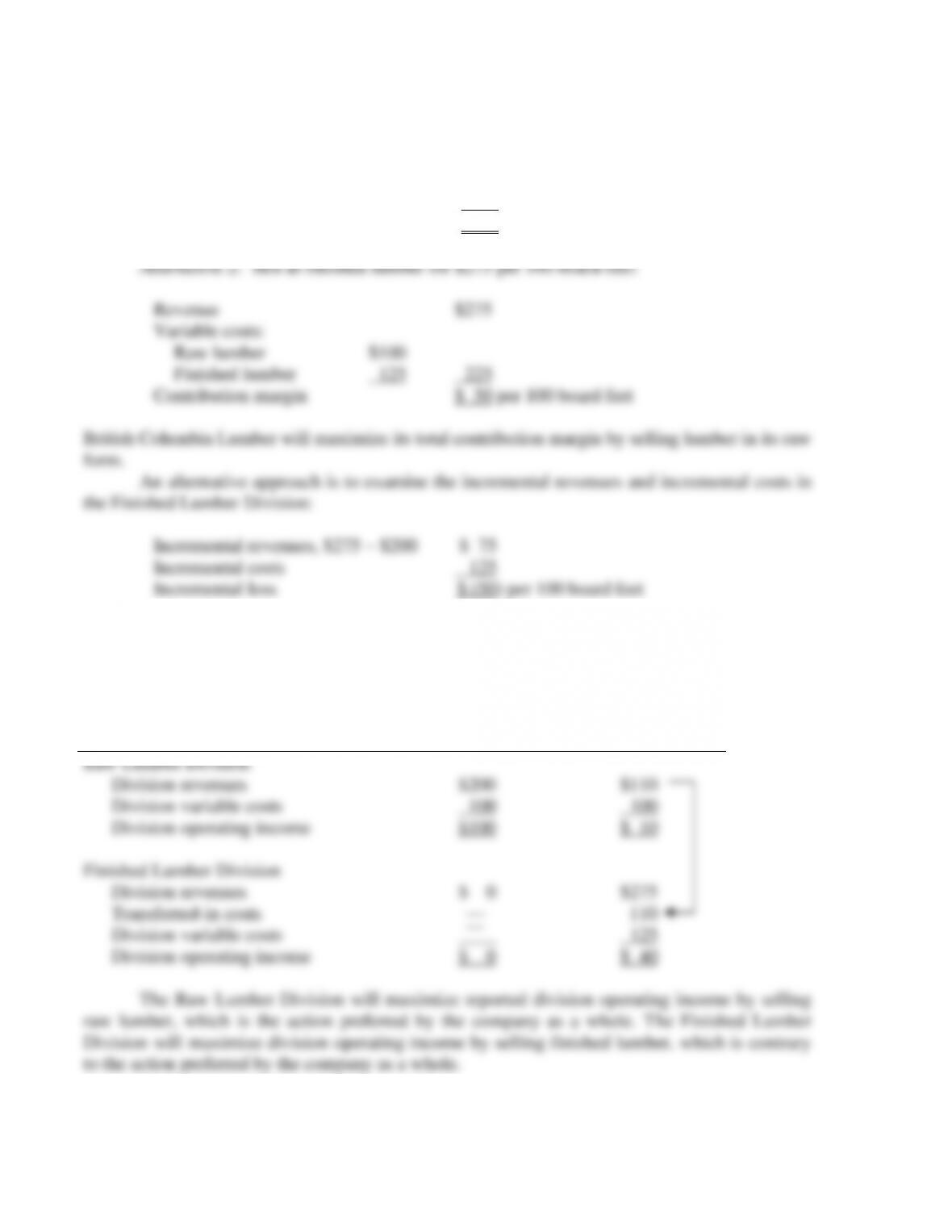
1. Alternative 1: Sell as raw lumber for $200 per 100 board feet:
Revenue $200
Variable costs 100
Contribution margin $100 per 100 board feet
2. Transfer price at 110% of variable costs:
= $100 + ($100 0.10)
= $110 per 100 board feet
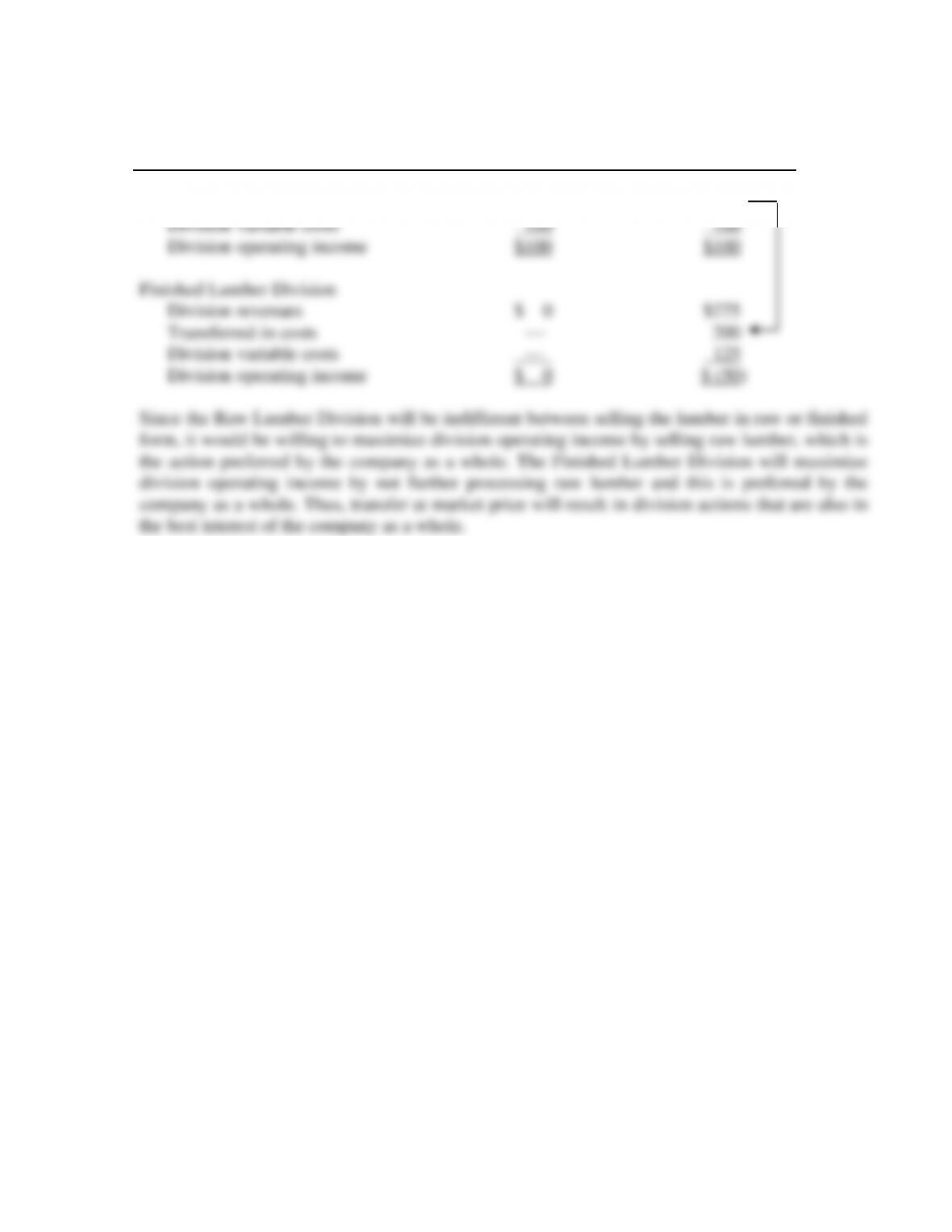
Sell as
Raw Lumber
Sell as
Finished Lumber
Raw Lumber Division
Division revenues
Division variable costs
Division operating income
Finished Lumber Division
Division revenues
Transferred-in costs
Division variable costs
Division operating income
$200
100
$100
$ 0
—
$ 0
$110
100
$ 10
$275
110
125
$ 40
The Raw Lumber Division will maximize reported division operating income by selling
raw lumber, which is the action preferred by the company as a whole. The Finished Lumber
3. Transfer price at market price = $200 per 100 board feet.
Sell as
Raw Lumber
Sell as
Finished Lumber
Raw Lumber Division
Division revenues
Division variable costs
Division operating income
Finished Lumber Division
Division revenues
Transferred-in costs
Division variable costs
Division operating income
$200
100
$100
$ 0
—
—
$ 0
$200
100
$100
$275
200
125
$ (50)
Since the Raw Lumber Division will be indifferent between selling the lumber in raw or finished
form, it would be willing to maximize division operating income by selling raw lumber, which is
the action preferred by the company as a whole. The Finished Lumber Division will maximize
division operating income by not further processing raw lumber and this is preferred by the
company as a whole. Thus, transfer at market price will result in division actions that are also in
the best interest of the company as a whole.
22-10
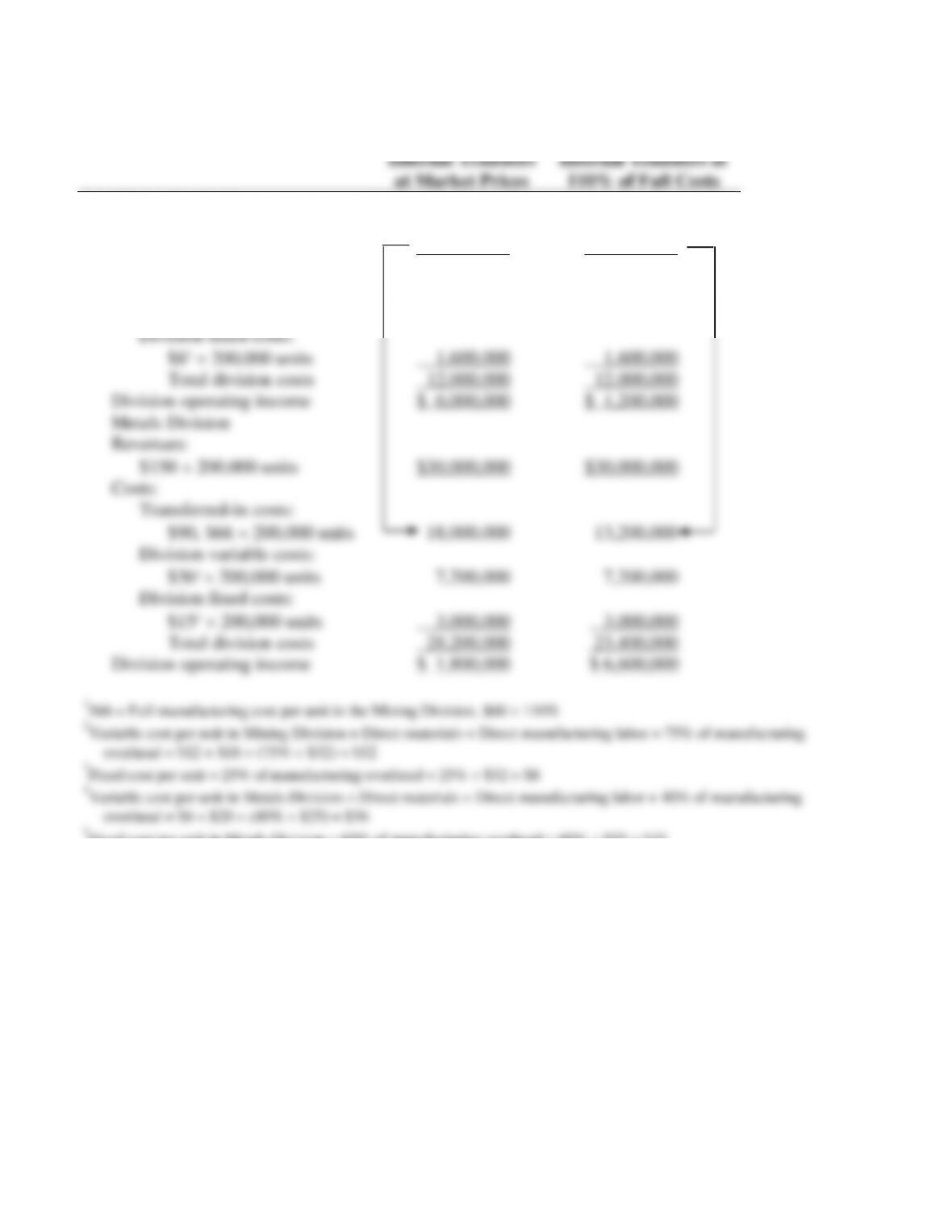
22-21 (30 min.) Effect of alternative transfer-pricing methods on division operating income.
Method A
Internal Transfers
at Market Prices
Method B
Internal Transfers at
110% of Full Costs
1. Mining Division
Revenues:
$90, $661 200,000 units
$18,000,000
$13,200,000
Costs:
Division variable costs:
$522 200,000 units
10,400,000
10,400,000
Division fixed costs:
$83 200,000 units
1,600,000
1,600,000
Total division costs
12,000,000
12,000,000
Division operating income
$ 6,000,000
$ 1,200,000
Metals Division
Revenues:
$150 200,000 units
$30,000,000
$30,000,000
Costs:
Transferred-in costs:
$90, $66 200,000 units
18,000,000
13,200,000
Division variable costs:
$364 200,000 units
7,200,000
7,200,000
Division fixed costs:
$155 200,000 units
3,000,000
3,000,000
Total division costs
28,200,000
23,400,000
Division operating income
$ 1,800,000
$ 6,600,000
1$66 = Full manufacturing cost per unit in the Mining Division, $60 110%
2Variable cost per unit in Mining Division = Direct materials + Direct manufacturing labor + 75% of manufacturing
overhead = $12 + $16 + (75% $32) = $52
3Fixed cost per unit = 25% of manufacturing overhead = 25% $32 = $8
4Variable cost per unit in Metals Division = Direct materials + Direct manufacturing labor + 40% of manufacturing
overhead = $6 + $20 + (40% $25) = $36
5Fixed cost per unit in Metals Division = 60% of manufacturing overhead = 60% $25 = $15