22-32 (40 min.) Multinational transfer pricing, global tax minimization.
This is a two-country two-division transfer-pricing problem with two alternative transfer-pricing
methods.
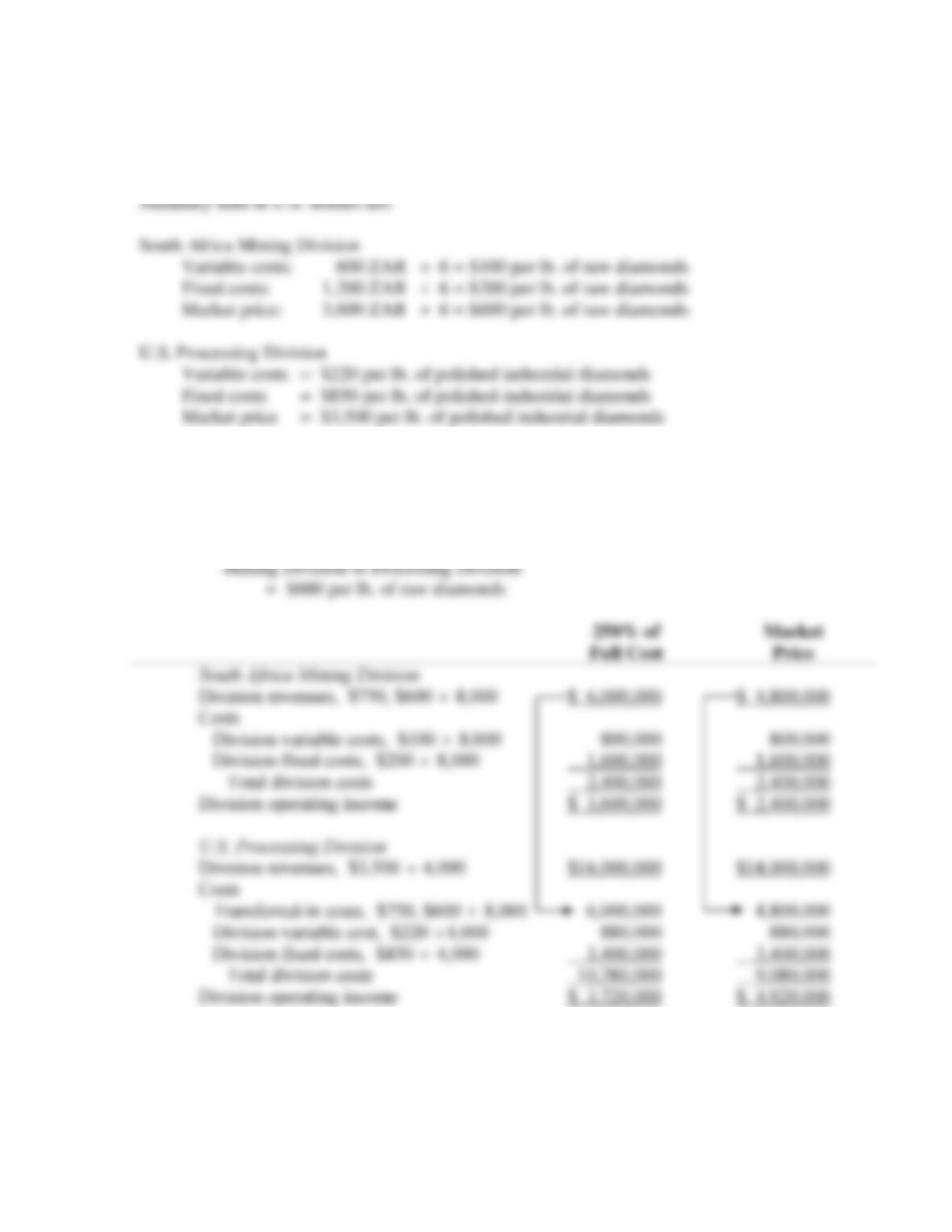
1. The transfer prices are:
a. 250% of full costs
Mining Division to Processing Division
= 2.5 × ($100 + $200) = $750 per lb. of raw diamonds
b. Market price
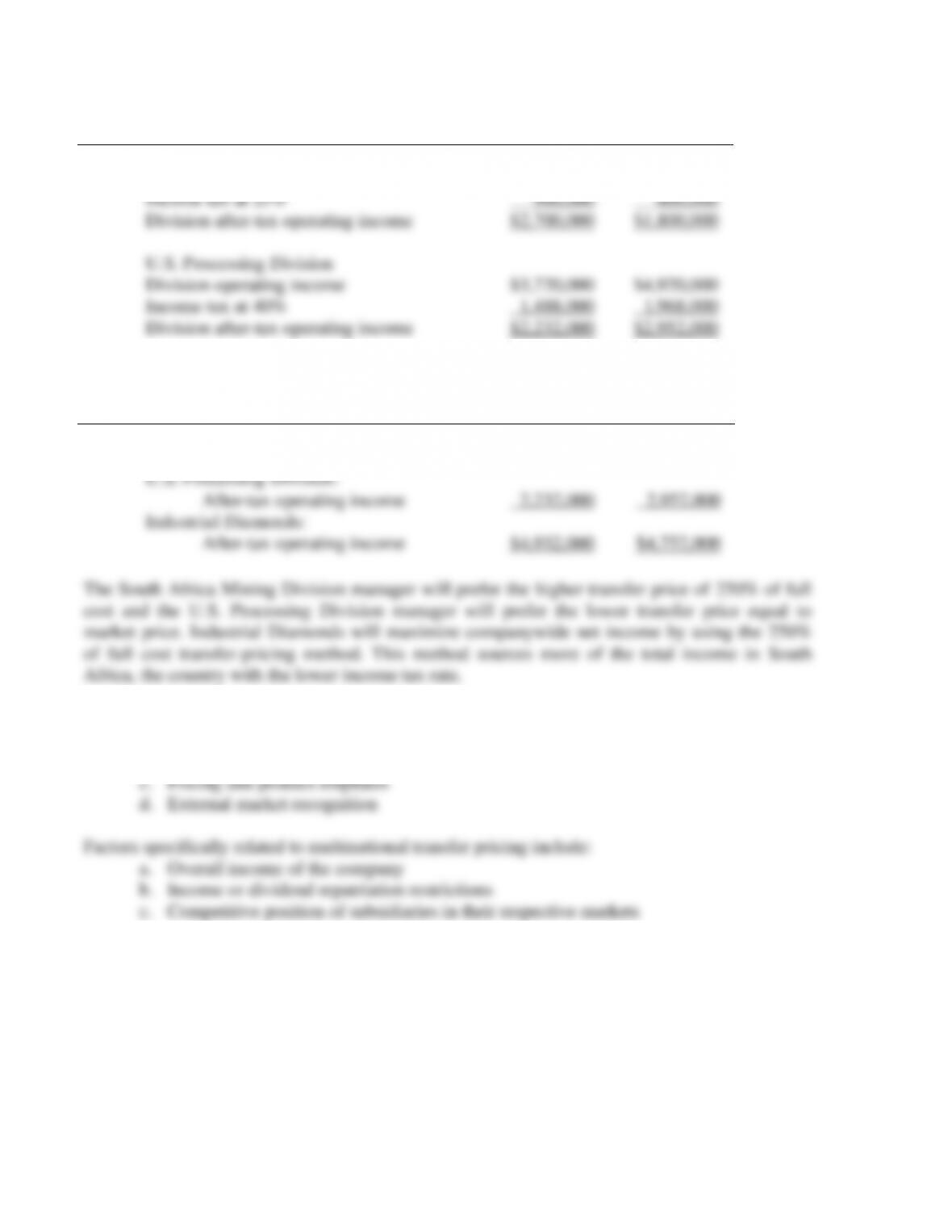
2.
250% of
Full Cost
Market
Price
South Africa Mining Division
Division operating income
Income tax at 25%
Division after-tax operating income
$3,600,000
900,000
$2,700,000
$2,400,000
600,000
$1,800,000
U.S. Processing Division
Division operating income
Income tax at 40%
Division after-tax operating income
$3,720,000
1,488,000
$2,232,000
$4,920,000
1,968,000
$2,952,000
3.
250% of
Full Cost
Market
Price
South Africa Mining Division:
After-tax operating income
U.S. Processing Division:
After-tax operating income
Industrial Diamonds:
After-tax operating income
$2,700,000
2,232,000
$4,932,000
$1,800,000
2,952,000
$4,752,000
The South Africa Mining Division manager will prefer the higher transfer price of 250% of full
cost and the U.S. Processing Division manager will prefer the lower transfer price equal to
market price. Industrial Diamonds will maximize companywide net income by using the 250%
of full cost transfer-pricing method. This method sources more of the total income in South
Africa, the country with the lower income tax rate.
4. Factors that executives consider important in transfer pricing decisions include:
a. Performance evaluation
b. Management motivation
22-33
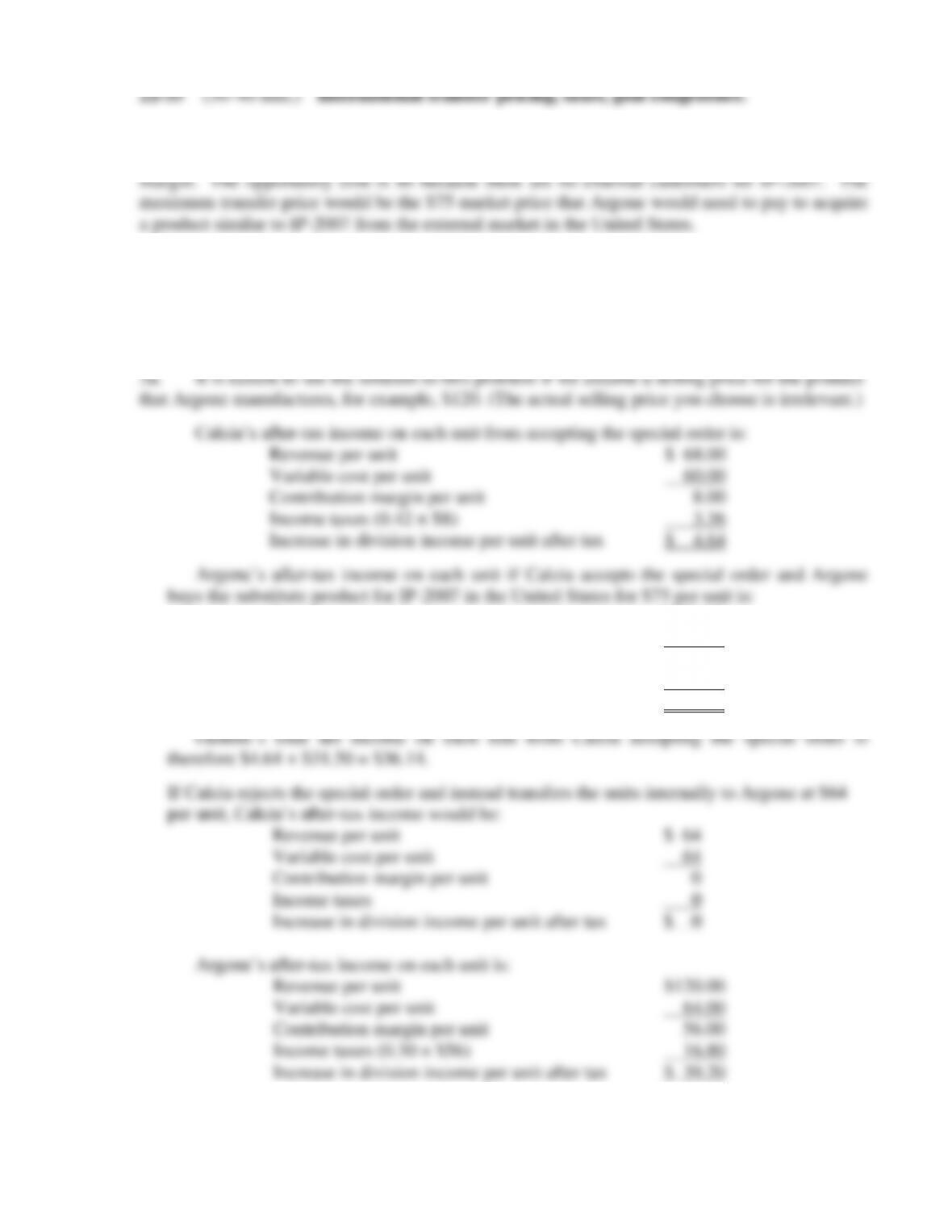
1. The minimum transfer price would be $64 to cover the variable production ($60 per unit)
and shipping ($4 per unit) costs, because Calcia would want, at a minimum, zero contribution
2. To minimize income taxes, Gemini should use a transfer price of $64. Canada has a
higher tax rate so goods coming from Canada should have the lowest transfer price. Calcia
would not like a transfer price of $64 because it would report no operating income from the
transfer. Argone would like a transfer price of $64 because it is lower than the outside market
price of $75.
Revenue per unit
$ 68.00
Variable cost per unit
60.00
Contribution margin per unit
8.00
Income taxes (0.42 × $8)
3.36
Increase in division income per unit after tax
$ 4.64
Argone’s after-tax income on each unit if Calcia accepts the special order and Argone
buys the substitute product for IP-2007 in the United States for $75 per unit is:
Revenue per unit
$120.00
Variable cost per unit
75.00
Contribution margin per unit
45.00
Income taxes (0.30 × $45)
13.50
Increase in division income per unit after tax
$ 31.50
Revenue per unit
$ 64
Variable cost per unit
64
Contribution margin per unit
0
Income taxes
0
Increase in division income per unit after tax
$ 0
Argone’s after-tax income on each unit is:
Revenue per unit
$120.00
Variable cost per unit
64.00
Contribution margin per unit
56.00
Income taxes (0.30 × $56)
16.80
Increase in division income per unit after tax
$ 39.20
22-34
Gemini’s total net income on each unit as a result of Calcia rejecting the special order and
transferring units of IP-2007 to Argone at $64 per unit is therefore $39.20 per unit. Since this is
higher than $36.14, accepting the special order does not maximize after-tax operating income.
After-tax operating income is maximized by rejecting the special order.
3b. Argone will not want Calcia to accept the special order. It is more costly to buy from the
Minimum transfer
price
=
Incremental cost per
unit inccurred up to
the point of transfer
+
Opportunity cost per
unit to the
selling subunit
So, minimum
transfer price
$64 + $0 = $64 per unit for the next 7,000 units
Gemini should use these minimum transfer prices because they are also tax-efficient.
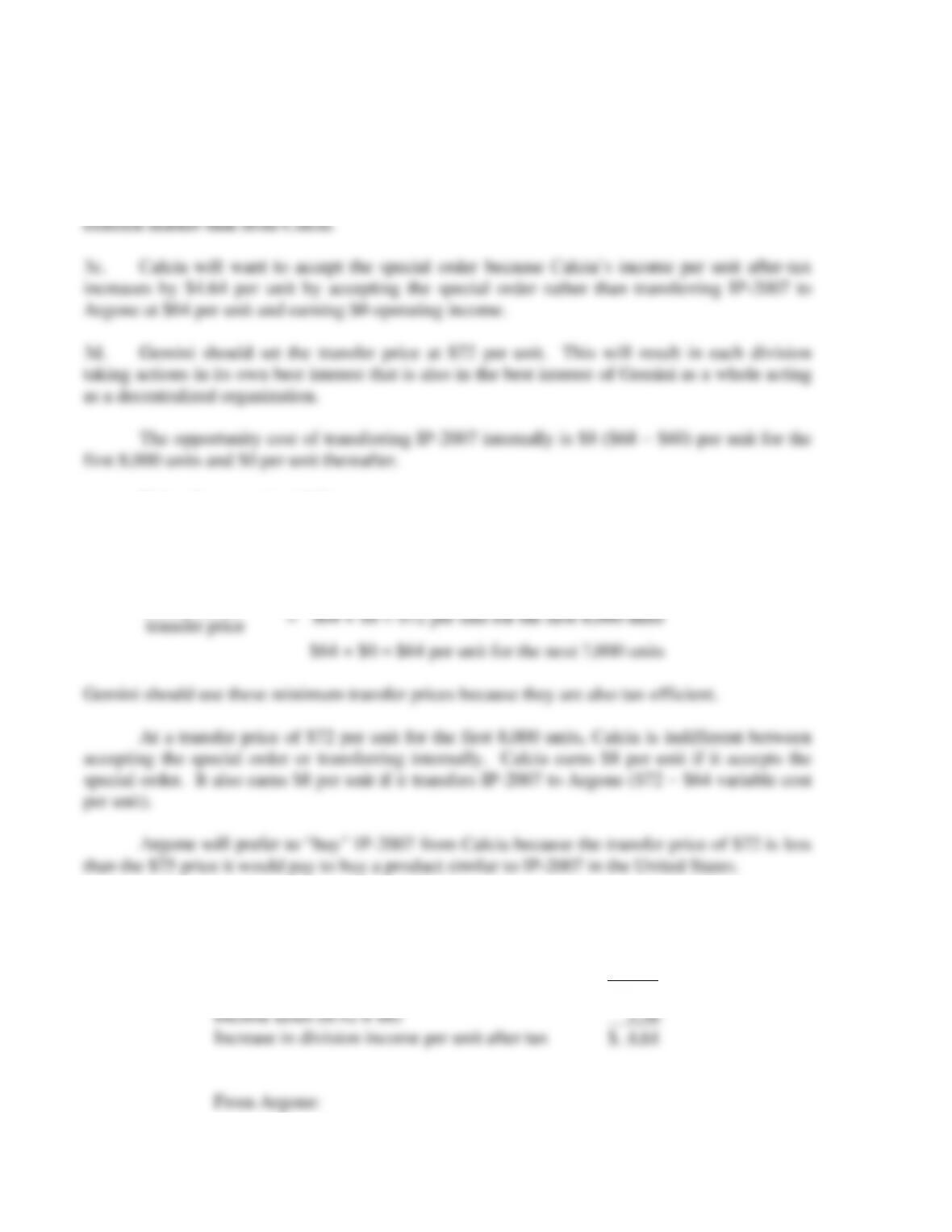
At a transfer price of $72 per unit for the first 8,000 units, Calcia is indifferent between
accepting the special order or transferring internally. Calcia earns $8 per unit if it accepts the
special order. It also earns $8 per unit if it transfers IP-2007 to Argone ($72 – $64 variable cost
per unit).
Argone will prefer to “buy” IP-2007 from Calcia because the transfer price of $72 is less
than the $75 price it would pay to buy a product similar to IP-2007 in the United States.
The increase in Gemini’s income will be as follows:
From Calcia:
Revenue per unit
$72.00
Variable cost per unit
64.00
Contribution margin per unit
8.00
Income taxes (0.42 × $8)
3.36
Increase in division income per unit after tax
$ 4.64
From Argone:
22-35
Revenue per unit
$120.00
Transfer price per unit
72.00
Contribution margin per unit
48.00
Income taxes (0.30 × $48)
14.40
Increase in division income per unit after tax
$ 33.60
(transferring IP-2007 internally) but at a higher cost because of the higher taxes that
Calcia would have to pay in Canada. Consider for example a transfer price of $80 per
unit. The increase in Gemini’s income will be as follows:
From Calcia:
Revenue per unit
$80.00
Variable cost per unit
64.00
Contribution margin per unit
16.00
Income taxes (0.42 × $16)
6.72
Increase in division income per unit after tax
$ 9.28
From Argone:
Revenue per unit
$120.00
Transfer price per unit
80.00
Contribution margin per unit
40.00
Income taxes (0.30 × $40)
12.00
Increase in division income per unit after tax
$ 28.00
Calcia.
1. See column (1) of Solution Exhibit 22-34. The net cost of the in-house option is
$570,000.
2. See columns (2a) and (2b) of Solution Exhibit 22-34.
SOLUTION EXHIBIT 22-34
Transfer 20,000
CD players to
Assembly. Sell
2,000 in outside
market at $45
each
(1)
Buy 20,000 CD
players from
Hawei at $44.
Sell 22,000 CD
players in outside
market at $45
each
(2a)
Buy 20,000 CD
players from
Hawei at $51.
Sell 22,000 CD
players in
outside market
at $45 each
(2x)
Buy 20,000 CD
players from
Hawei at $52. Sell
22,000 CD
players in
outside market at
$45 each
(2b)
Incremental cost of CD Division
supplying 20,000 CD players to
Assembly Division
$30 20,000; 0; 0; 0
$(600,000)
$ 0
$ 0
$ 0
Incremental costs of buying 20,000
CD players from Hawei
$0; $44 20,000; $51 20,000;
$52 20,000
0
(880,000)
(1,020,000)
(1,040,000)
Revenue from selling CD players in
outside market $45 2,000;
22,000; 22,000; 22,000
90,000
990,000
990,000
990,000
Incremental costs of manufacturing
CD players for sale in outside
market $30 2,000; 22,000;
22,000; 22,000
(60,000)
(660,000)
(660,000)
(660,000)
Revenue from supplying head
mechanism to Hawei
$24 0; 20,000; 20,000; 20,000
0
480,000
480,000
480,000
Incremental costs of supplying head
mechanism to Hawei
$18 0; 20,000; 20,000; 20,000
0
(360,000)
(360,000)
(360,000)
Net costs
$(570,000)
$(430,000)
$(570,000)
$ (590,000)
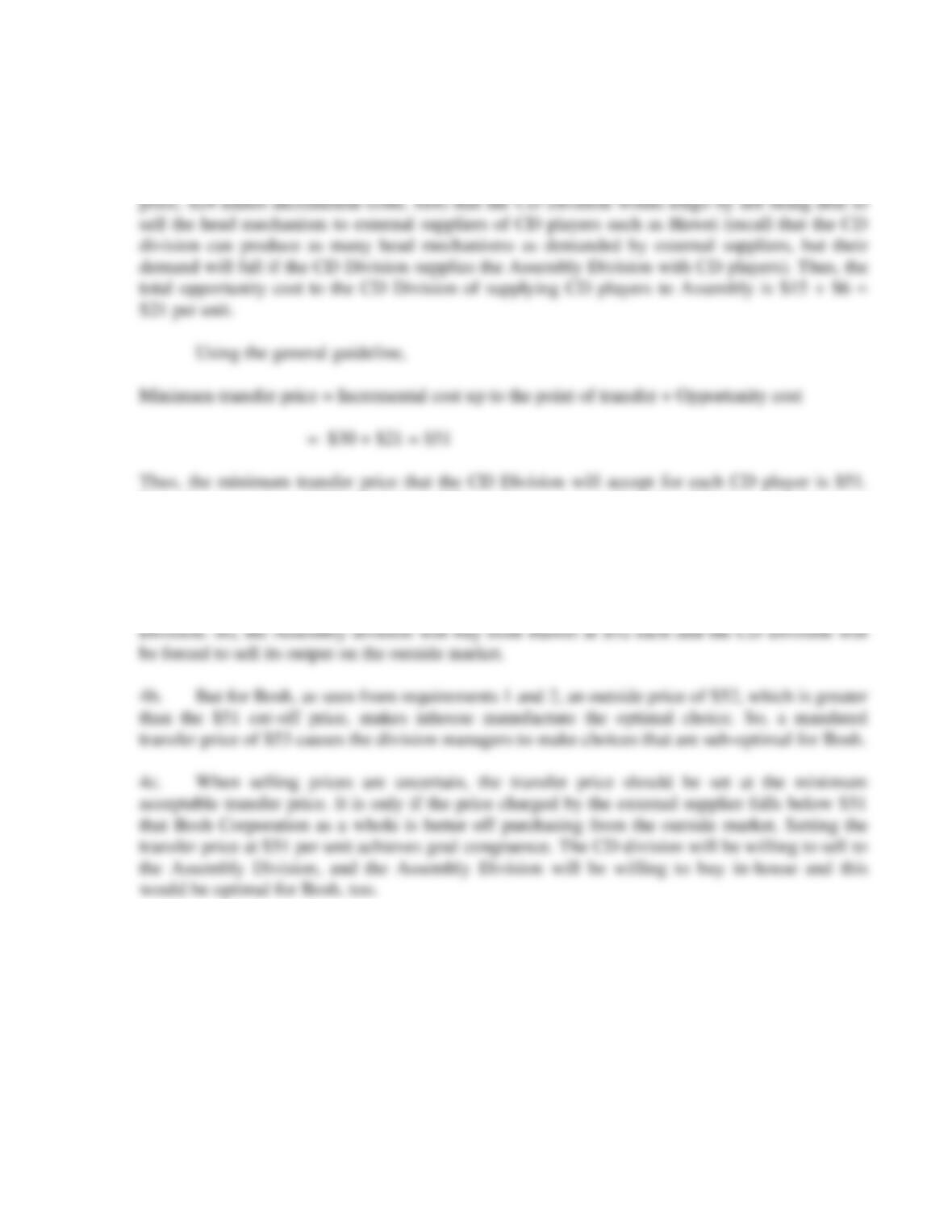
Comparing columns (1) and (2a), at a price of $44 per CD player from Hawei, the net
cost of $430,000 is less than the net cost of $570,000 to Bosh Corporation if it made the CD
players in-house. So, Bosh Corporation should outsource to Hawei.
Comparing columns (1) and (2b), at a price of $52 per CD player from Hawei, the net
cost of $590,000 is $20,000 is greater than the net cost of $570,000 to Bosh Corporation if it
made the CD players in–house. Therefore, Bosh Corporation should reject Hawei’s offer.
Now consider column (2x) of Solution Exhibit 22-34. It shows that at a price of $51 per
CD player from Hawei, the net cost is exactly $570,000, the same as the net cost to Bosh
Corporation of manufacturing in-house (column 1). Thus, for prices between $44 and $51, Bosh
will prefer to purchase from Hawei. For prices greater than $51 (and up to $52), Bosh will prefer
to manufacture in-house.
22-37
3. The CD Division can manufacture at most 22,000 CD players and it is currently
operating at capacity. The incremental costs of manufacturing a CD player are $30 per unit. The
opportunity cost of manufacturing CD players for the Assembly Division is (1) the contribution
margin of $15 (selling price, $45 minus incremental costs $30) that the CD Division would forgo
by not selling CD players in the outside market plus (2) the contribution margin of $6 (selling
Note that at a price of $51, Bosh is indifferent between manufacturing CD players in-house or
purchasing them from an external supplier.
4a. The transfer price is set to $51 + $2 = $53 and Hawei is offering the CD players for $52
each. Now, for an outside price per CD player below $53, the Assembly Division would prefer to
purchase from outside; above it, the Assembly Division would prefer to purchase from the CD
22-38
1. The transfer price is 110% of the full cost per unit:
1.10 ($0.50 + $2.80 + $1.50) = $5.28
2. The purchase is not in the best interest of Jeremiah Industries because, if produced
internally, the additional 10,000 pound would only cost the company $33,000 ($3.30 of variable
$5.50 is a more correct market price. The fabrication manager was not acting ethically in this
situation because he or she was withholding pertinent information from both upper management
22-39
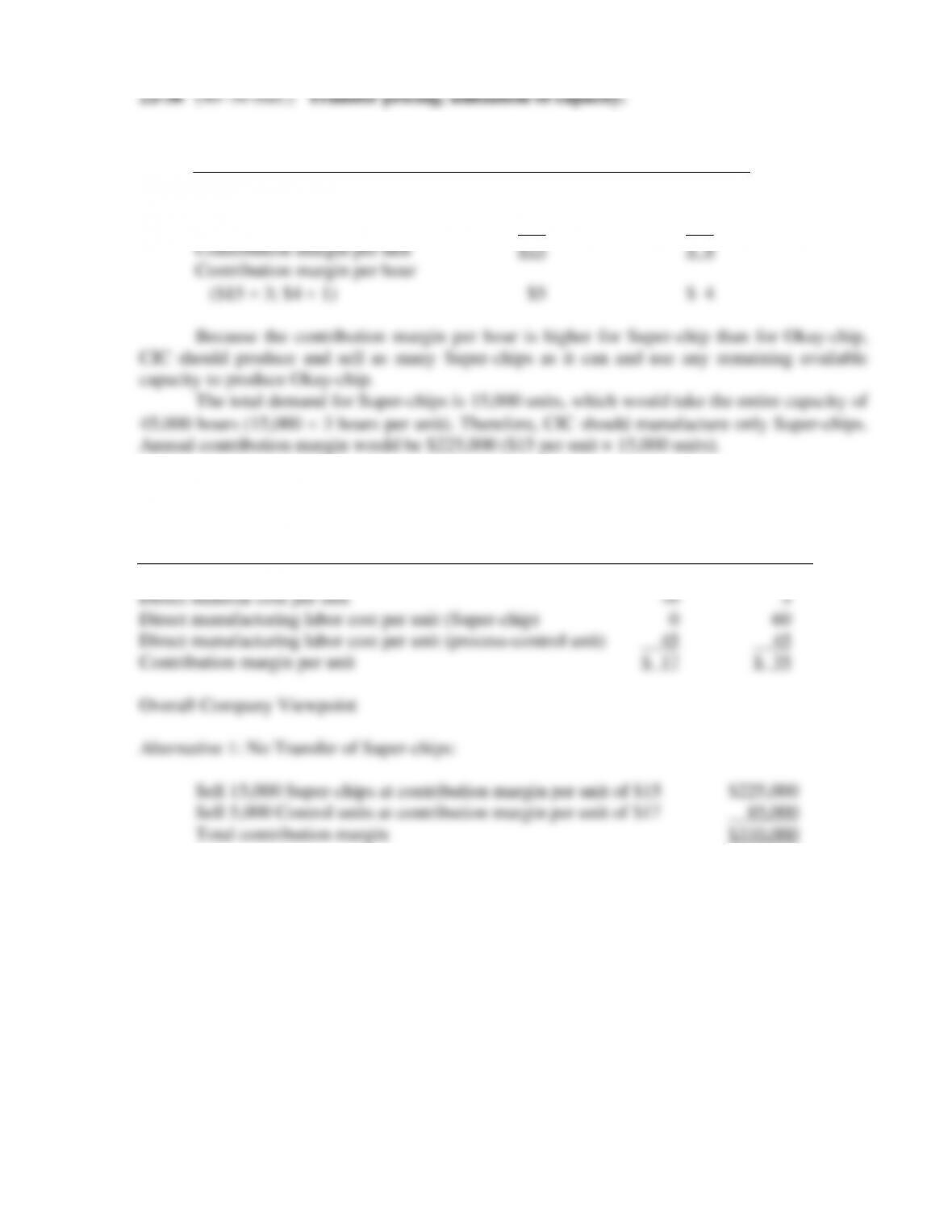
1. Super-chip Okay-chip
Selling price $80 $26
Direct material cost per unit 5 2
Direct manufacturing labor cost per unit 60 20
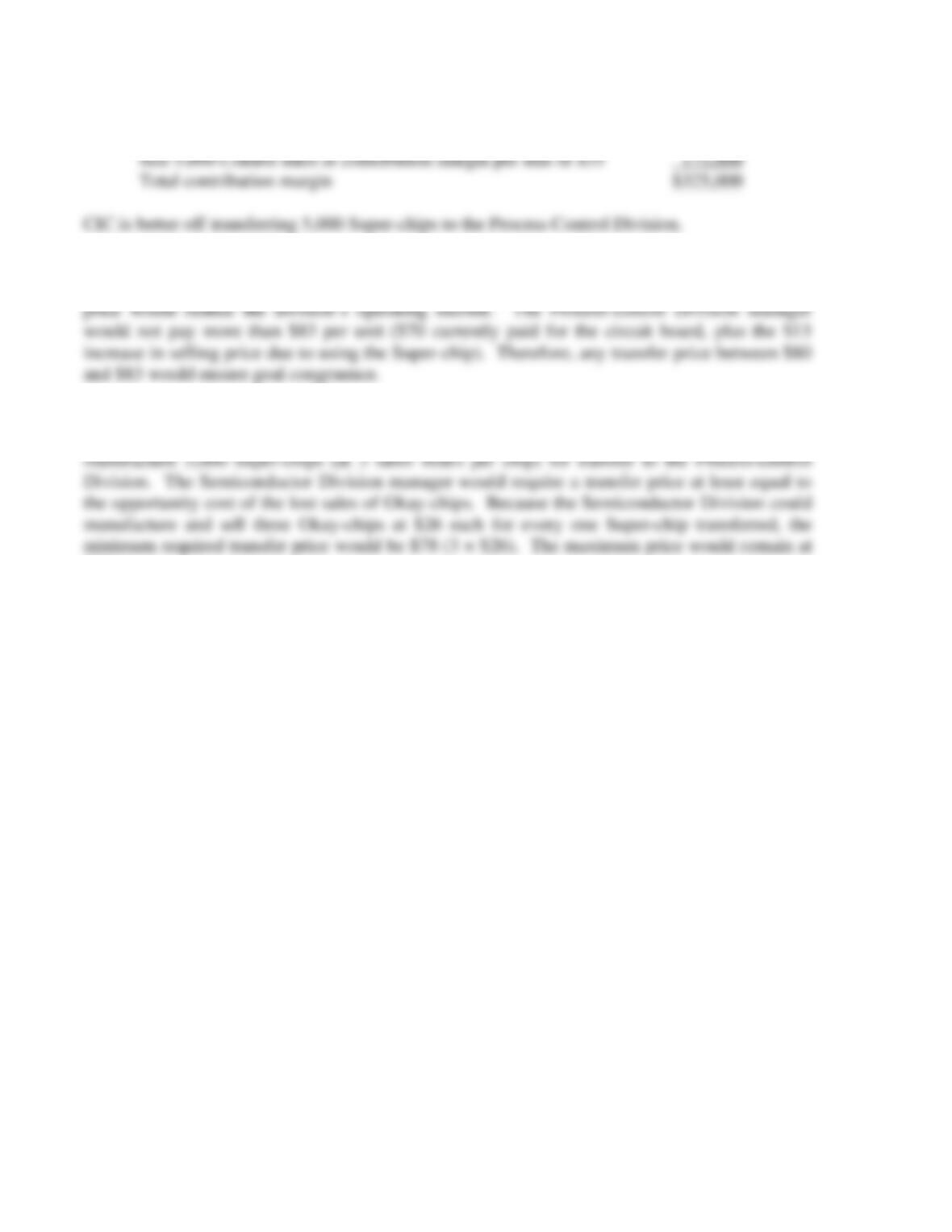
2. Options for manufacturing process-control unit:
Using Using
Circuit Board Super-chip
Selling price $132 $145
22-40
Alternative 2: Transfer 5,000 Super-chips to Process-Control Division:
Sell 10,000 Super-chips at contribution margin per unit of $15 $150,000
3. The Semiconductor Division manager would not accept a transfer price below the market
price of $80 per unit because the division has willing outside buyers at that price. Any lower
4. If 15,000 additional labor hours were available in the Semiconductor Division, those
hours could be used to manufacture 15,000 Okay-chips (at 1 labor hour per chip), or be used to
$83.