22-21
2. If (a) A has excess capacity, (b) there is intermediate external demand for only 800 units
at $200, and (c) the $200 price is to be maintained, then the opportunity costs per unit to the
supplying division are $0. The general guideline indicates a minimum transfer price of: $120 +
$0 = $120, which is the incremental or outlay costs for the first 200 units. B would buy 200 units
0–200 $120–$150
3. Division B would show zero contribution, but the company as a whole would generate a
contribution of $30 per unit on the 200 units transferred. Any price between $120 and $150
would induce the transfer that would be desirable for the company as a whole. A motivational
problem may arise regarding how to split the $30 contribution between Division A and B.
Unless the price is below $150, B would have little incentive to buy.
22-22
22-29 (30–40 min.) Pricing in imperfect markets (continuation of 22-28).
1. Potential contribution from external intermediate sale is
1,000 ($195 – $120) $75,000
Contribution through keeping price at $200 is
800 $80. 64,000
Forgone contribution by transferring 200 units $11,000
22-23
Minimum
transfer price =
Additional cos
incurred up
to the point of transfer
incremental t
per unit
+
cos
to
Division A
Opportunity t
per unit
Perfect markets: = $120 + (Selling price – Outlay costs per unit)
are not the same.
The following discussion is optional. These points should be explored only if there is
sufficient class time:
Some students may erroneously say that the “new” market price of $195 is the
appropriate transfer price. They may claim that the general guideline says that the transfer price
22-24
Or the same facts can be analyzed for the company as a whole:
Sales of intermediate product,
800 ($200 – $120) = $64,000
2. a. Division A can sell 900 units at $195 to the outside market and 100 units to Division
B, or 800 at $200 to the outside market and 200 units to Division B. Note that, under
both alternatives, 100 units can be transferred to Division B at no opportunity cost to
A.
Using the general guideline, the minimum transfer price of the first 100 units [901–
1000] is: TP1 = $120 + 0 = $120
22-25
b. The manager of Division B will not want to purchase more than 100 units because the
units at $155 would decrease his contribution ($155 + $150 > $300). Because the
manager of Division B does not buy more than 100 units, the manager of Division A
will have 900 units available for sale to the outside market. The manager of Division
1. Company Viewpoint
a: Sell 1,000 units outside at $195 per unit b: Sell 800 units outside at $200 per unit, transfer 200
Price $195 Transfer price $200
Variable cost per unit 120 Variable cost per unit 120
200
By formula, costs are:
Increment cost per unit
incurred up to point
to transfer
+
Lost opportunity to
sell 200 units at $195 per unit,
for contribution of $75 per unit
–
Gain when 1st 800 units
sell at $200 per unit
instead of $195 per unit
75$200
800)195$200($ −
Gain when 1st 800 units
sell at $200 per unit
instead of $195 per unit
22-27
income.
1.
Pounds of cranberries harvested
400,000
Gallons of juice processed (500 gals per 1,000 lbs.)
200,000
Revenues (200,000 gals.
$2.10 per gal.)
$420,000
Costs
Harvesting Division
Variable costs (400,000 lbs.
$0.10 per lb.)
$ 40,000
Fixed costs (400,000 lbs.
$0.25 per lb.)
100,000
Total Harvesting Division costs
140,000
Processing Division
Variable costs (200,000 gals.
$0.20 per gal.)
$ 40,000
Fixed costs (200,000 gals.
$0.40 per gal.)
80,000
Total Processing Division costs
120,000
Total costs
260,000
Operating income
$160,000
2.
200% of
Full Costs
Market
Price
Transfer price per pound (($0.10 + $0.25)
2; $0.60)
$0.70
$0.60
1. Harvesting Division
Revenues (400,000 lbs.
$0.70; $0.60)
$280,000
$240,000
Costs
Division variable costs (400,000 lbs.
$0.10 per lb.)
40,000
40,000
Division fixed costs (400,000 lbs.
$0.25 per lb.)
100,000
100,000
Total division costs
140,000
140,000
Division operating income
$140,000
$100,000
Harvesting Division manager’s bonus (5% of operating income)
$7,000
$5,000
2. Processing Division
Revenues (200,000 gals.
$2.10 per gal.)
$420,000
$420,000
Costs
Transferred-in costs
280,000
240,000
Division variable costs (200,000 gals.
$0.20 per gal.)
40,000
40,000
Division fixed costs (200,000 gals.
$0.40 per gal.)
80,000
80,000
Total division costs
400,000
360,000
Division operating income
$ 20,000
$ 60,000
Processing Division manager’s bonus (5% of operating income)
$ 1,000
$ 3,000
22-28
3. Bonus paid to division managers at 5% of division operating income is computed above
and summarized below:
Internal Transfers
at 200% of Full Costs
Internal Transfers
at Market Prices
Harvesting Division manager’s bonus
(5% × $140,000; 5% × $100,000)
$7,000
$5,000
Processing Division manager’s bonus
(5% × $20,000; 5% × $60,000)
$1,000
$3,000
The Harvesting Division manager will prefer to transfer at 200% of full costs because this
method gives a higher bonus. The Processing Division manager will prefer transfer at market
price for its higher resulting bonus.
Crango may resolve or reduce transfer pricing conflicts by:
• Basing division managers’ bonuses on overall Crango profits in addition to division
operating income. This will motivate each manager to consider what is best for
Crango overall and not be concerned with the transfer price alone.
• Letting the two divisions negotiate the transfer price between themselves. However,
this may result in constant re-negotiation between the two managers each accounting
period.
• Using dual transfer prices However, a cost-based transfer price will not motivate cost
control by the Harvesting Division manager. It will also insulate that division from
the discipline of market prices.
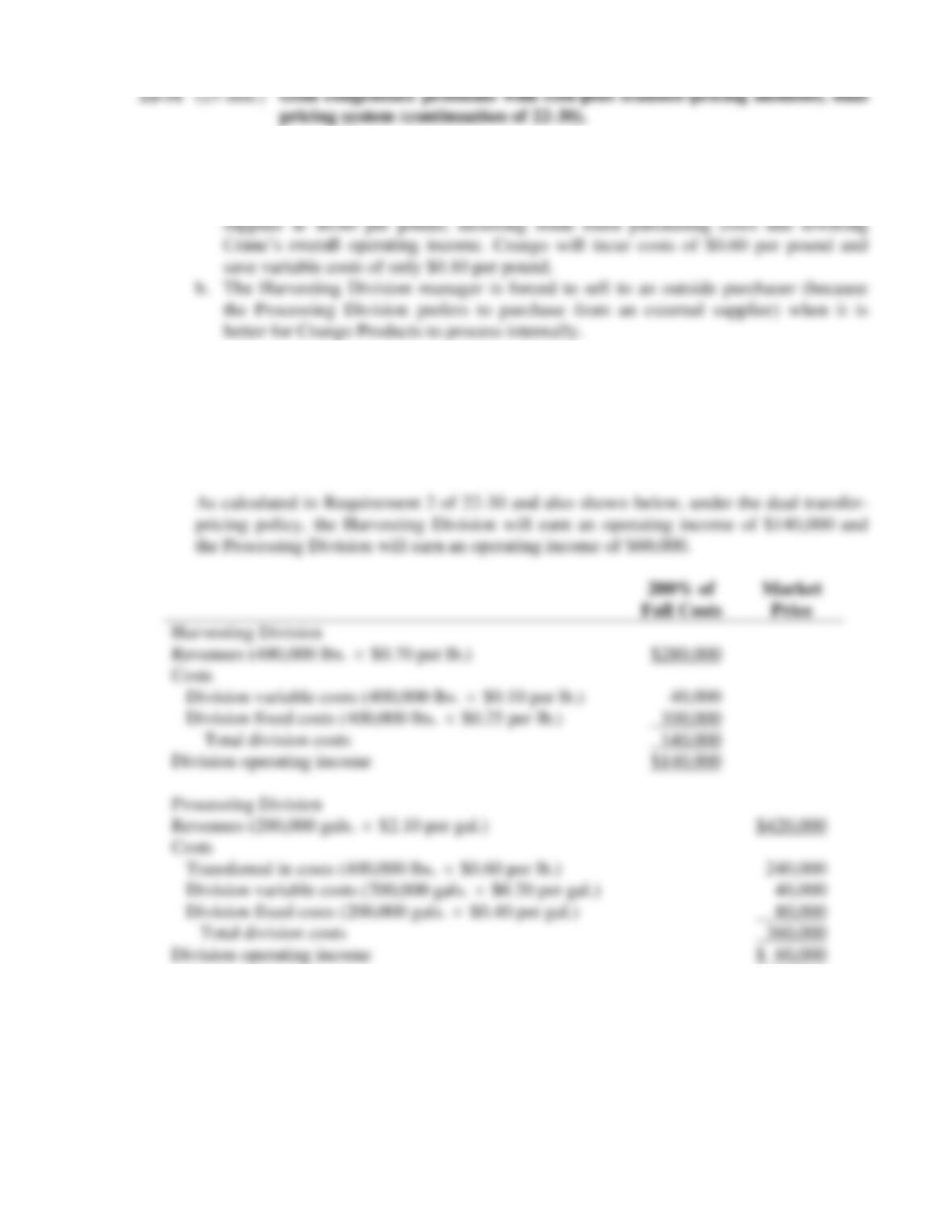
1. Two examples of goal congruence problems that arise if a transfer price of 200% of full
costs is mandated and Borges’ decentralization policy is adopted are:
a. The Processing Division manager will prefer to buy cranberries from an external
2. Transfer into buying division at market price
Harvesting Division to Processing Division = $0.60 per pound of cranberries
Transfer out of selling division at 200% of full costs
Harvesting Division to Processing Division = 2.0 × ($0.10 + $0.25) = $0.70 per pound of
cranberries
22-30
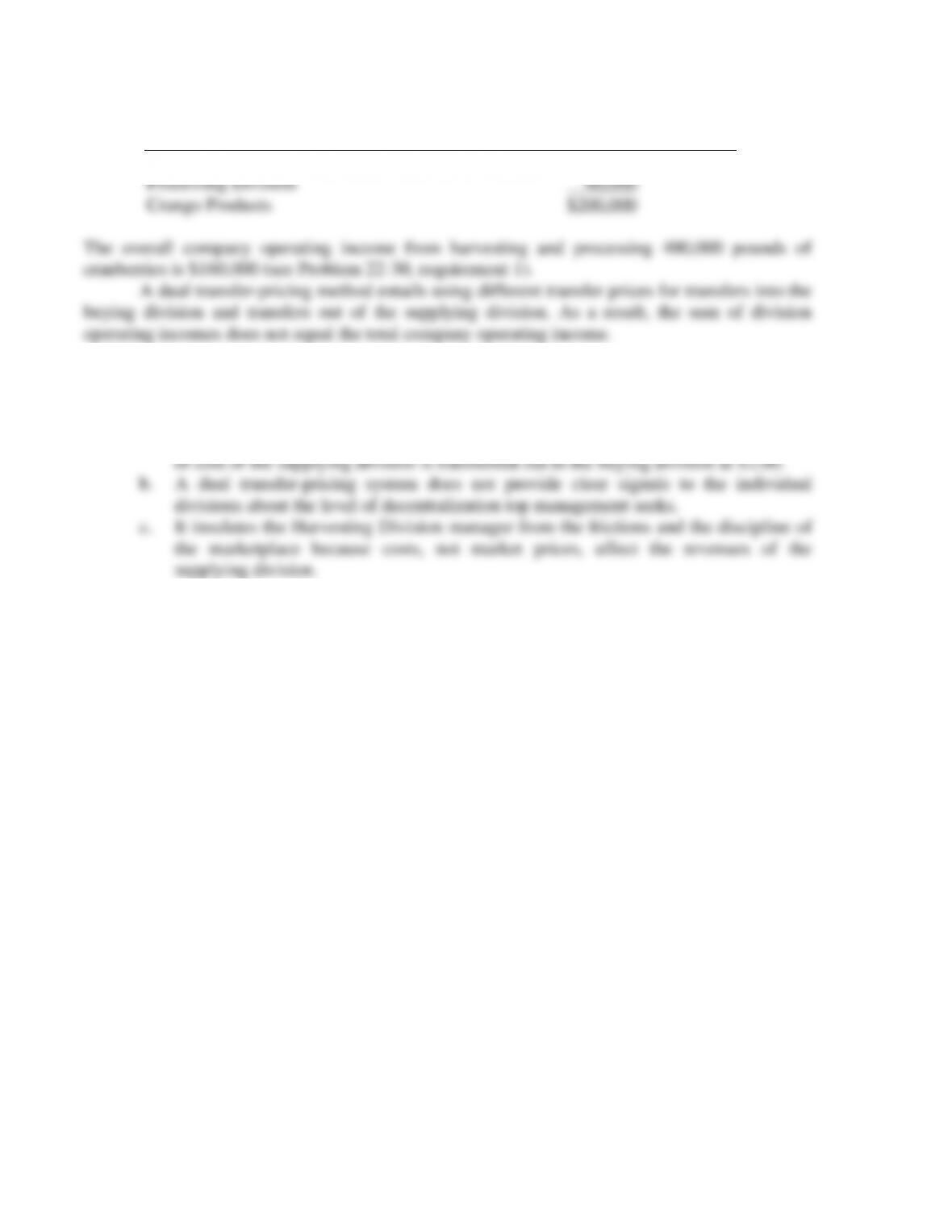
3. Under the dual transfer pricing policy,
Division Operating Income
Harvesting Division $140,000
4. Problems which may arise if Crango Products uses the dual transfer-pricing system
include:
a. It may reduce the incentives of the supplying division to control costs since every $1