22-11
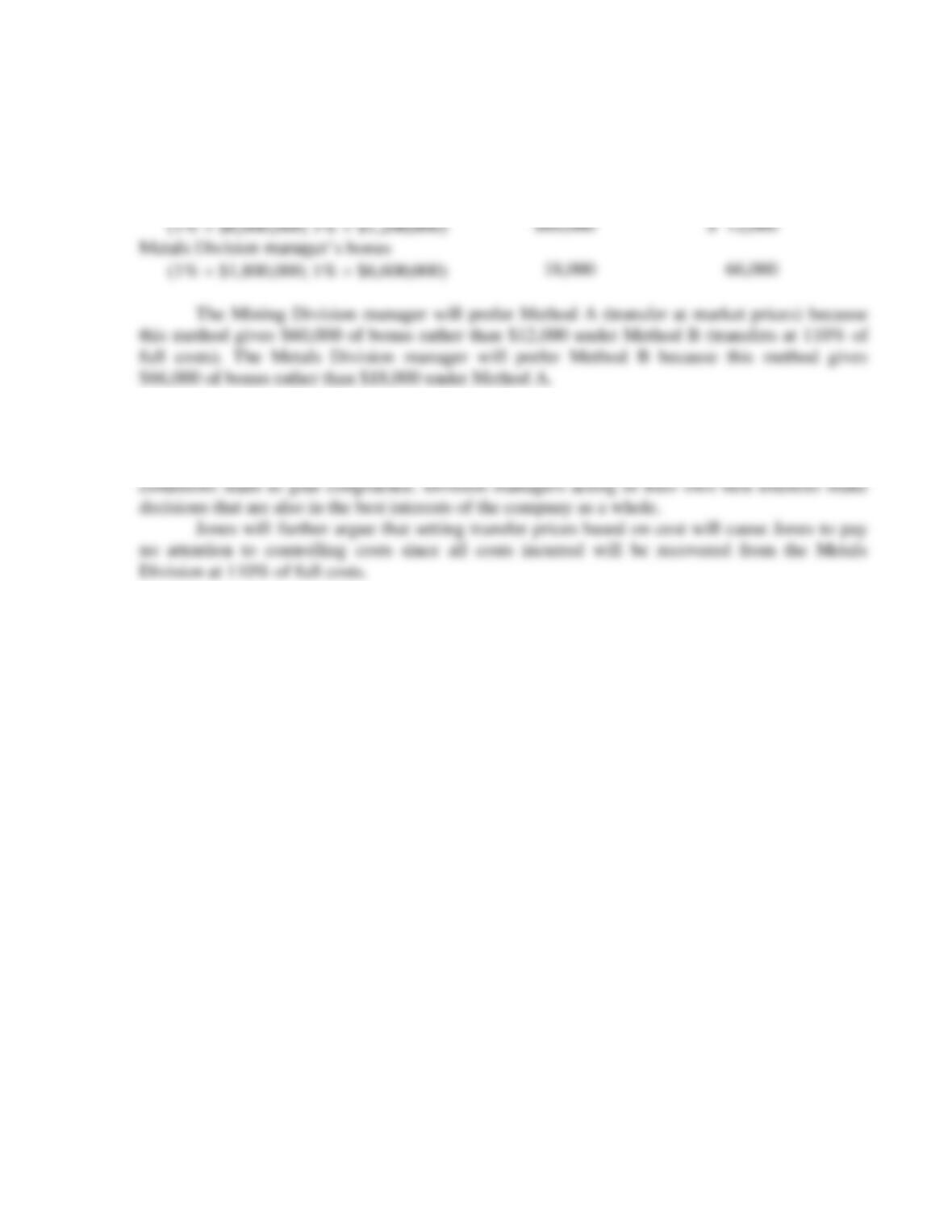
2. Bonus paid to division managers at 1% of division operating income will be as follows:
Method A
Internal Transfers
at Market Prices
Method B
Internal Transfers at
110% of Full Costs
Mining Division manager’s bonus
(1% $6,000,000; 1% $1,200,000)
$60,000
$ 12,000
Metals Division manager’s bonus
(1% $1,800,000; 1% $6,600,000)
18,000
66,000
The Mining Division manager will prefer Method A (transfer at market prices) because
this method gives $60,000 of bonus rather than $12,000 under Method B (transfers at 110% of
full costs). The Metals Division manager will prefer Method B because this method gives
$66,000 of bonus rather than $18,000 under Method A.
3. Brian Jones, the manager of the Mining Division, will appeal to the existence of a
competitive market to price transfers at market prices. Using market prices for transfers in these
22-12
22-22 (30 min.) Transfer pricing, general guideline, goal congruence.
1. Using the general guideline presented in the chapter, the minimum price at which the
Airbag Division would sell airbags to the Vivo Division is $90, the incremental costs. The
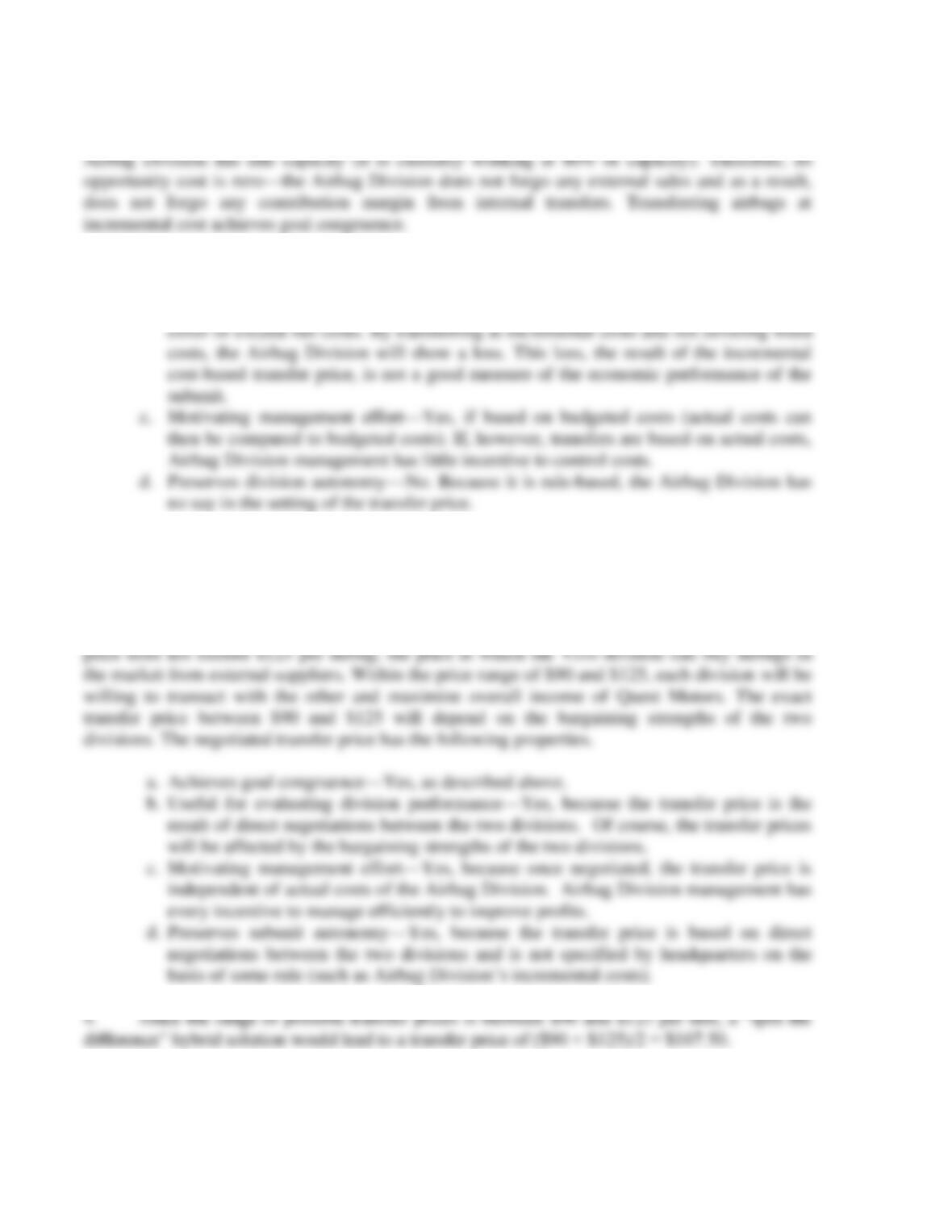
2. Transferring products internally at incremental cost has the following properties:
a. Achieves goal congruence—Yes, as described in requirement 1 above.
b. Useful for evaluating division performance—No, because this transfer price does not
3. If the two divisions were to negotiate a transfer price, the range of possible transfer prices
will be between $90 and $125 per unit. The Airbag Division has excess capacity that it can use to
supply airbags to the Vivo Division. The Airbag Division will be willing to supply the airbags
only if the transfer price equals or exceeds $90, its incremental costs of manufacturing the
airbags. The Vivo Division will be willing to buy airbags from the Airbag Division only if the
22-13
1. Solution Exhibit 22-23 shows the after-tax operating incomes earned by the U.S. and
2. There are many ways to proceed, but the first thing to note is that the transfer price that
minimizes the total of company import duties and income taxes will be either the full
manufacturing cost or the market price of comparable imports.
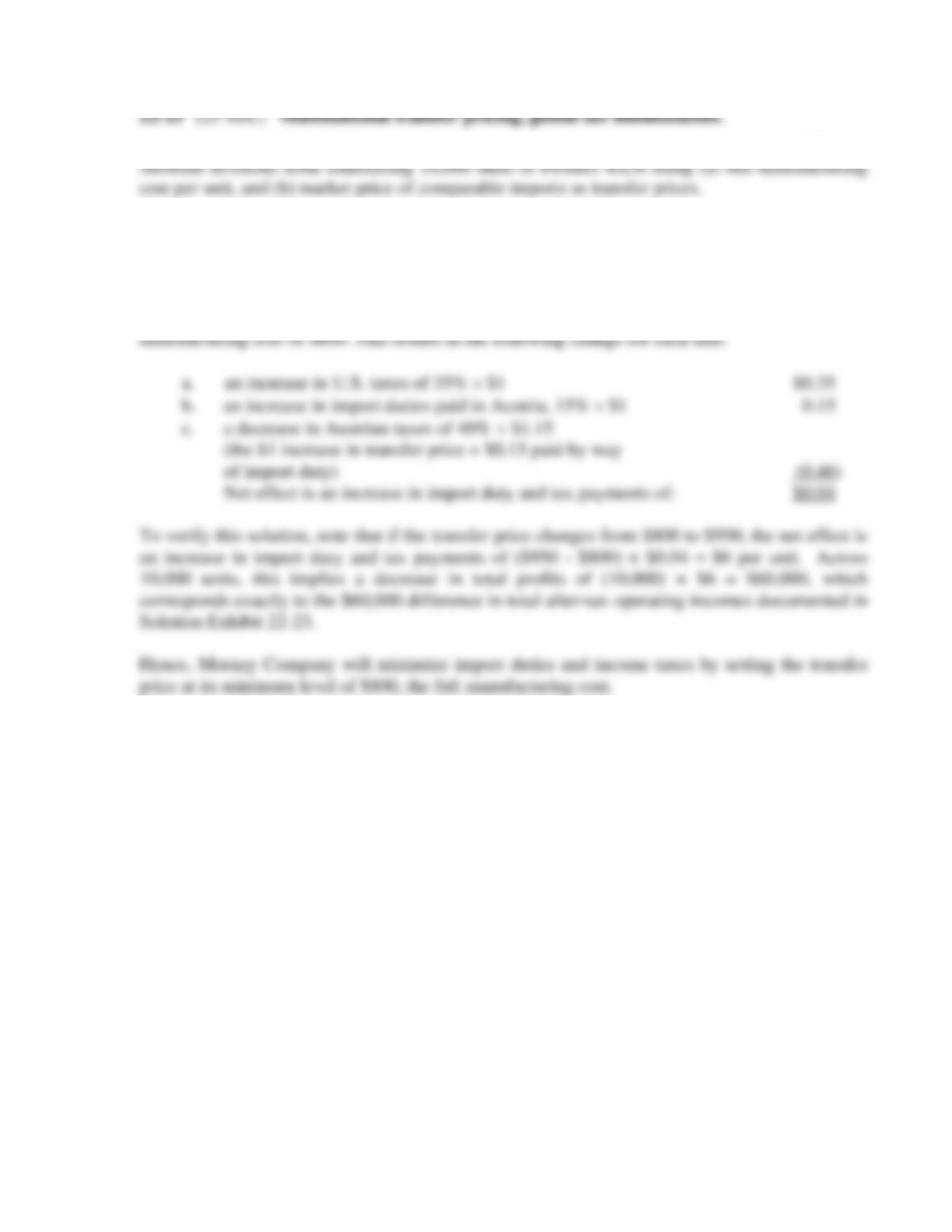
Consider what happens every time the transfer price is increased by $1 over, say, the full
22-14
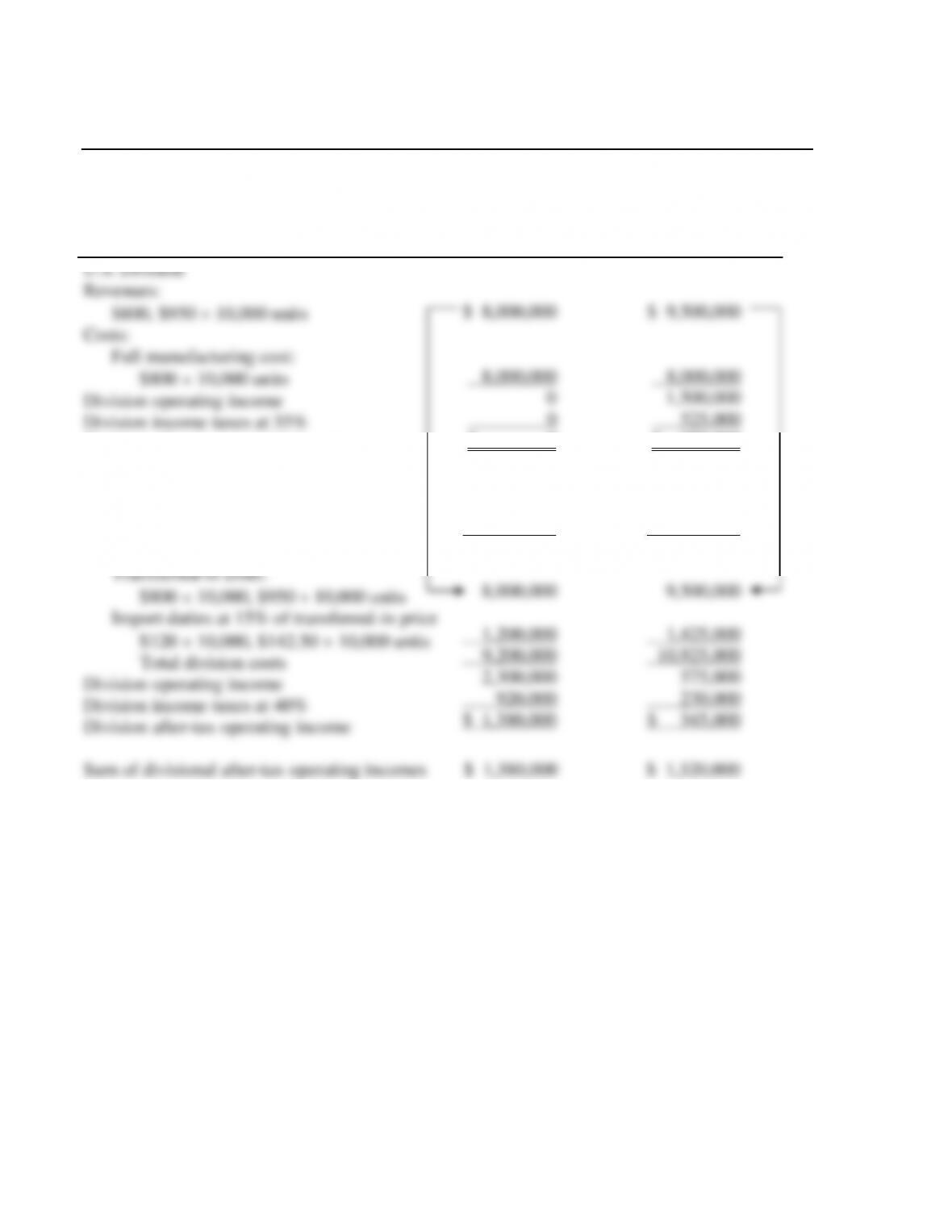
SOLUTION EXHIBIT 22-23
Division Incomes of U.S. and Austrian Divisions from Transferring 10,000 Units of Product
4A36
Method A
Internal Transfers
at Full
Manufacturing Cost
Method B
Internal
Transfers at
Market Price
U.S. Division
Revenues:
$800, $950 10,000 units
Costs:
Full manufacturing cost:
$800 10,000 units
Division operating income
Division income taxes at 35%
Division after-tax operating income
Austrian Division
Revenues:
$1,150 10,000 units
Costs:
Transferred-in costs:
$800 10,000, $950 10,000 units
Import duties at 15% of transferred-in price
$120 10,000, $142.50 10,000 units
Total division costs
Division operating income
Division income taxes at 40%
Division after-tax operating income
$ 8,000,000
8,000,000
0
0
$ 0
$11,500,000
8,000,000
1,200,000
9,200,000
2,300,000
920,000
$ 1,380,000
$ 9,500,000
8,000,000
1,500,000
525,000
$ 975,000
$11,500,000
9,500,000
1,425,000
10,925,000
575,000
230,000
$ 345,000
22-15
1. After-tax operating income if Mornay Company sells all 10,000 units of Product 4A36 in
the United States:
Revenues, $900 10,000 units $9,000,000
2. Transferring Product 4A36 at the full manufacturing cost of the U.S. Division minimizes
import duties and taxes (Exercise 22-23, requirement 2), but creates zero operating income for
3. The minimum transfer price at which the U.S. division manager acting autonomously will
agree to transfer Product 4A36 to the Austrian division is $900 per unit. Any transfer price less
than $900 will leave the U.S. Division’s performance worse than selling directly in the U.S.
market. Because the U.S. Division can sell as many units as it makes of Product 4A36 in the U.S.
22-16
Austrian Division
Revenues, $1,150 10,000 units` $11,500,000
Transferred in costs, $900 10,000 units 9,000,000
Import duties at 15% of transferred-in price,
$135 10,000 units 1,350,000
of $0.04 100 = $4.00
For 10,000 units transferred, this equals $4.00 10,000 = $40,000
22-25 (20 min.) Transfer-pricing dispute.
This problem is similar to the Problem for Self-Study in the chapter.
1. Company as a whole will not benefit if Division C purchases from external suppliers:
Purchase costs paid to external suppliers, 1,000 units $135 $135,000
Deduct: Savings in variable costs by reducing
2. Company as a whole will benefit if Division C purchases from external suppliers:
Purchase costs paid to external suppliers, 1,000 units $135 $135,000
Deduct: Savings in variable costs,
3. Company as a whole will benefit if Division C purchases from external suppliers:
Purchase costs paid to external suppliers, 1,000 units $115 $115,000
(1)
(2)
(3)
Purchase costs paid to external suppliers
Relevant costs if purchased from Division A:
Incremental (outlay) costs if purchased from Division A
Opportunity costs if purchased from Division A
Total relevant costs if purchased from Division A
Operating income advantage (disadvantage) to
company as a result of purchasing from Division A
$135
120
–
120
$ 15
$135
120
18
138
$ (3)
$115
120
–
120
$ (5)
Goal congruence would be achieved if the transfer price is set equal to the total relevant costs of
purchasing from Division A.
22-18
22-26 (5 min.) Transfer-pricing problem (continuation of 22-25).
The company as a whole would benefit in this situation if Division C purchased from external
suppliers. The $15,000 disadvantage to the company as a whole as a result of purchasing from
external suppliers would be more than offset by the $30,000 contribution margin of Division A’s
22-19
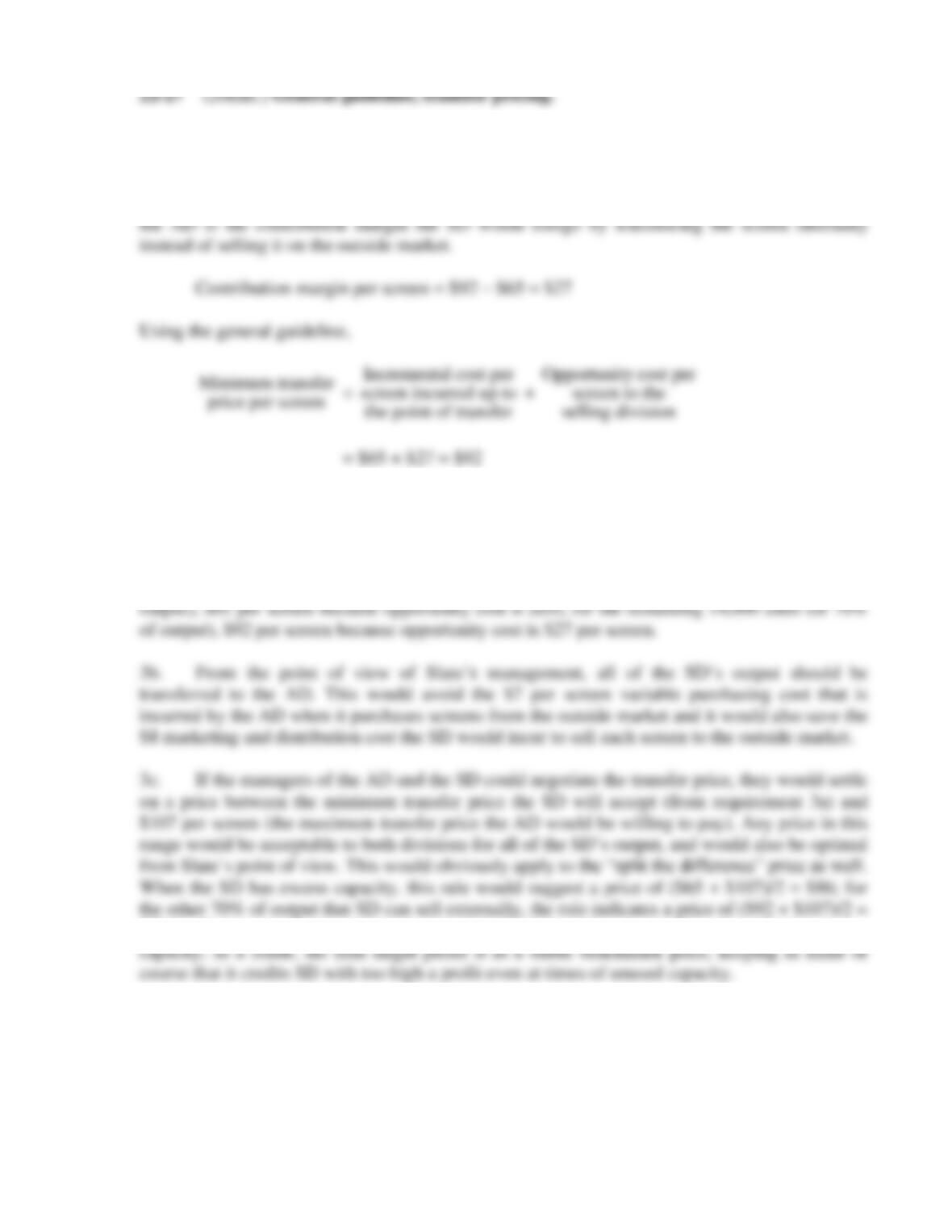
1. The minimum transfer price that the SD would demand from the AD is the net price it
could obtain from selling its screens on the outside market: $100 minus $8 marketing and
distribution cost per screen, or $92 per screen. The SD is operating at capacity. The incremental
cost of manufacturing each screen is $65. Therefore, the opportunity cost of selling a screen to
2. The maximum transfer price the AD manager would be willing to offer SD is its own
total cost for purchasing from outside, $100 plus $7 per screen, or $107 per screen.
3a. If the SD has excess capacity (relative to what the outside market can absorb), the
minimum transfer price using the general guideline is: for the first 6,000 units (or 30% of
$99.5. From a practical standpoint, note that the latter price also works when SD has excess
22-20
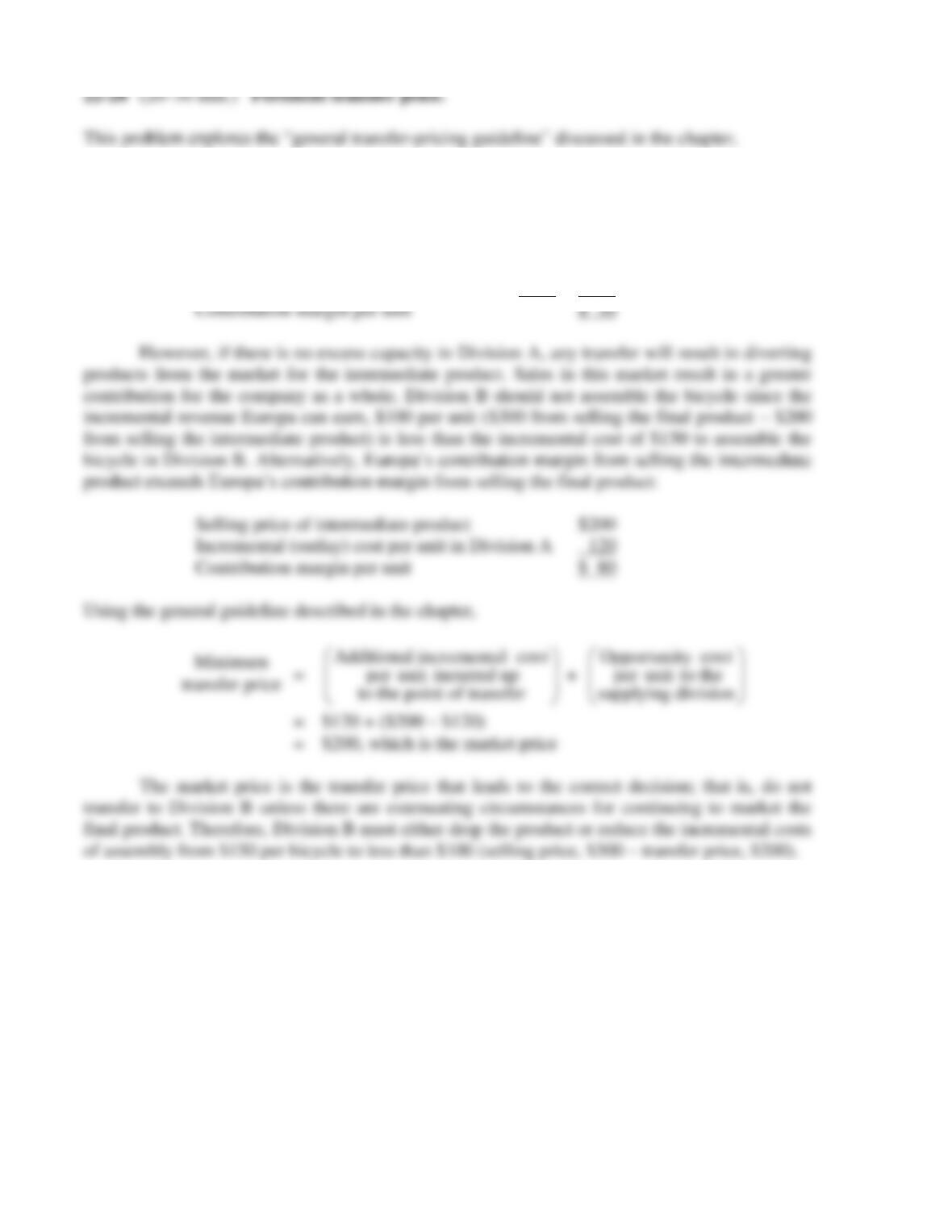
1. No, transfers should not be made to Division B if there is no unused capacity in Division A.
An incremental (outlay) cost approach shows a positive contribution for the company as a whole:
Selling price of final product $300
Incremental cost per unit in Division A $120
Incremental cost per unit in Division B 150 270