21-1
21-1 No. Capital budgeting focuses on an individual investment project throughout its life, recognizing
21-2 The five stages in capital budgeting are the following:
2. An information-acquisition stage to gather data from all parts of the value chain in order to
evaluate alternative capital investments.
projects.
4. An evaluation stage where capital budgeting methods are used to choose the best
alternative for the firm.
21-3 In essence, the discounted cash-flow method calculates the expected cash inflows and outflows of
21-4 No. Only quantitative outcomes are formally analyzed in capital budgeting decisions. Many
21-5 Sensitivity analysis can be incorporated into DCF analysis by examining how the DCF of each
21-6 The payback method measures the time it will take to recoup, in the form of expected future net
cash inflows, the net initial investment in a project. The payback method is simple and easy to
21-7 The accrual accounting rate–of-return (AARR) method divides an accrual accounting measure of
average annual income of a project by an accrual accounting measure of investment. The strengths of
21-2
21-8 No. The discounted cash-flow techniques implicitly consider depreciation in rate of
return computations; the compound interest tables automatically allow for recovery of
21-9 A point of agreement is that an exclusive attachment to the mechanisms of any single
method examining only quantitative data is likely to result in overlooking important aspects of a
decision.
21-10 All overhead costs are not relevant in NPV analysis. Overhead costs are relevant only if
21-11 The Division Y manager should consider why the Division X project was accepted and
the Division Y project rejected by the president. Possible explanations are:
a. The president considers qualitative factors not incorporated into the IRR computation
21-12 The categories of cash flow that should be considered in an equipment-replacement
decision are:
1a. Initial machine investment,
21-13 Income taxes can affect the cash inflows or outflows in a motor vehicle replacement
decision as follows:
21-14 A cellular telephone company manager responsible for retaining customers needs to
21-15 These two rates of return differ in their elements:
Real-rate of return
Nominal rate of return
1. Risk-free element
1. Risk-free element
2. Business-risk element
2. Business-risk element
3. Inflation element
21-16 Exercises in compound interest, no income taxes.
21-17 (20–25 min.) Capital budget methods, no income taxes.
1a. The table for the present value of annuities (Appendix A, Table 4) shows:
8 periods at 8% = 5.747
0
-$250,000
1
$67,000
.926
$62,042
$62,042
-$187,958
2
$67,000
.857
$57,419
$119,461
-$130,539
3
$67,000
.794
$53,198
$172,659
-$77,341
4
$67,000
.735
$49,245
$221,904
-$28,096
5
$67,000
.681
$45,627
$267,531
21-4
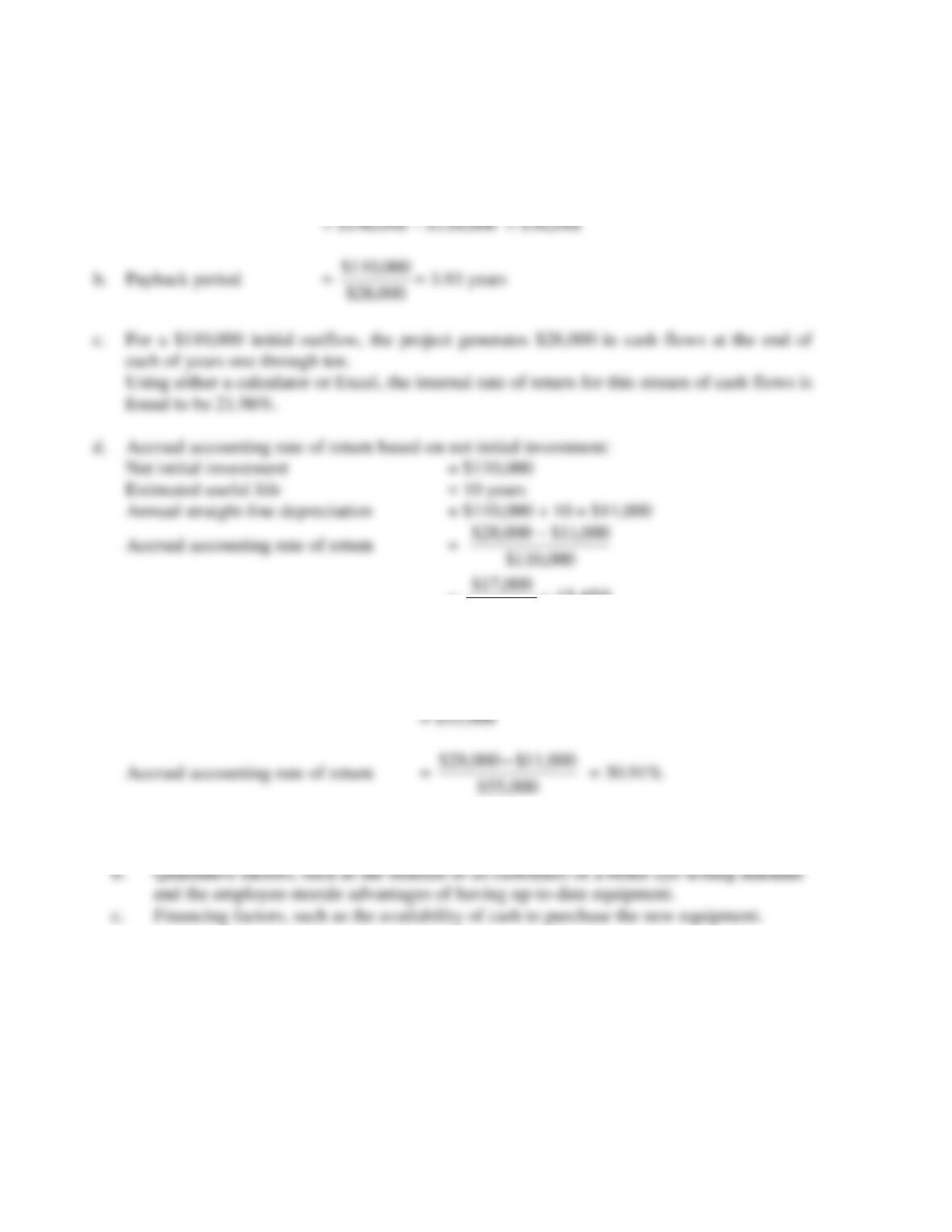
1d. Internal rate of return:
$250,000 = Present value of annuity of $67,000 at R% for 8 years, or
what factor (F) in the table of present values of an annuity
(Appendix A, Table 4) will satisfy the following equation.
$250,000 = $67,000F
2. Other than the NPV, rate of return and the payback period on the new computer system,
factors that Riverbend should consider are:
• Issues related to the financing the project, and the availability of capital to pay for the
system.

21-5
21-6
21-18 (25 min.) Capital budgeting methods, no income taxes.
The table for the present value of annuities (Appendix A, Table 4) shows:
10 periods at 14% = 5.216
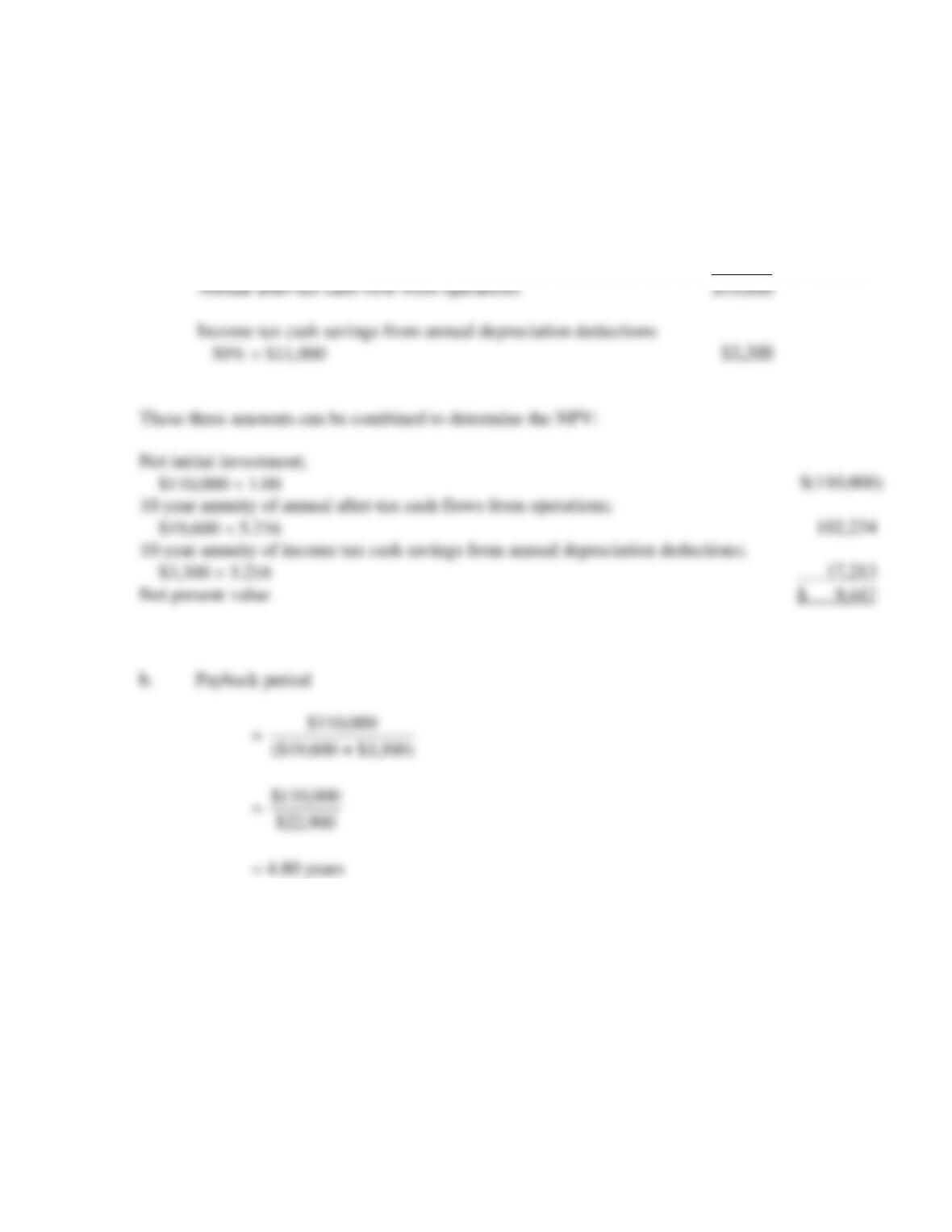
1a. Net present value = $28,000 (5.216) – $110,000
000,110$
=
000,110$
000,17$
= 15.45%
e. Accrual accounting rate of return based on average investment:
Average investment = ($110,000 + $0) / 2
$55,000
2. Factors City Hospital should consider include:
a. Quantitative financial aspects.
21-7
21-19 (35 min.) Capital budgeting, income taxes.
1a. Net after-tax initial investment = $110,000
Annual after-tax cash flow from operations (excluding the depreciation effect):
Annual cash flow from operation with new machine
$28,000
Deduct income tax payments (30% of $28,000)
8,400
Annual after-tax cash flow from operations
$19,600
Income tax cash savings from annual depreciation deductions
30% $11,000
$3,300
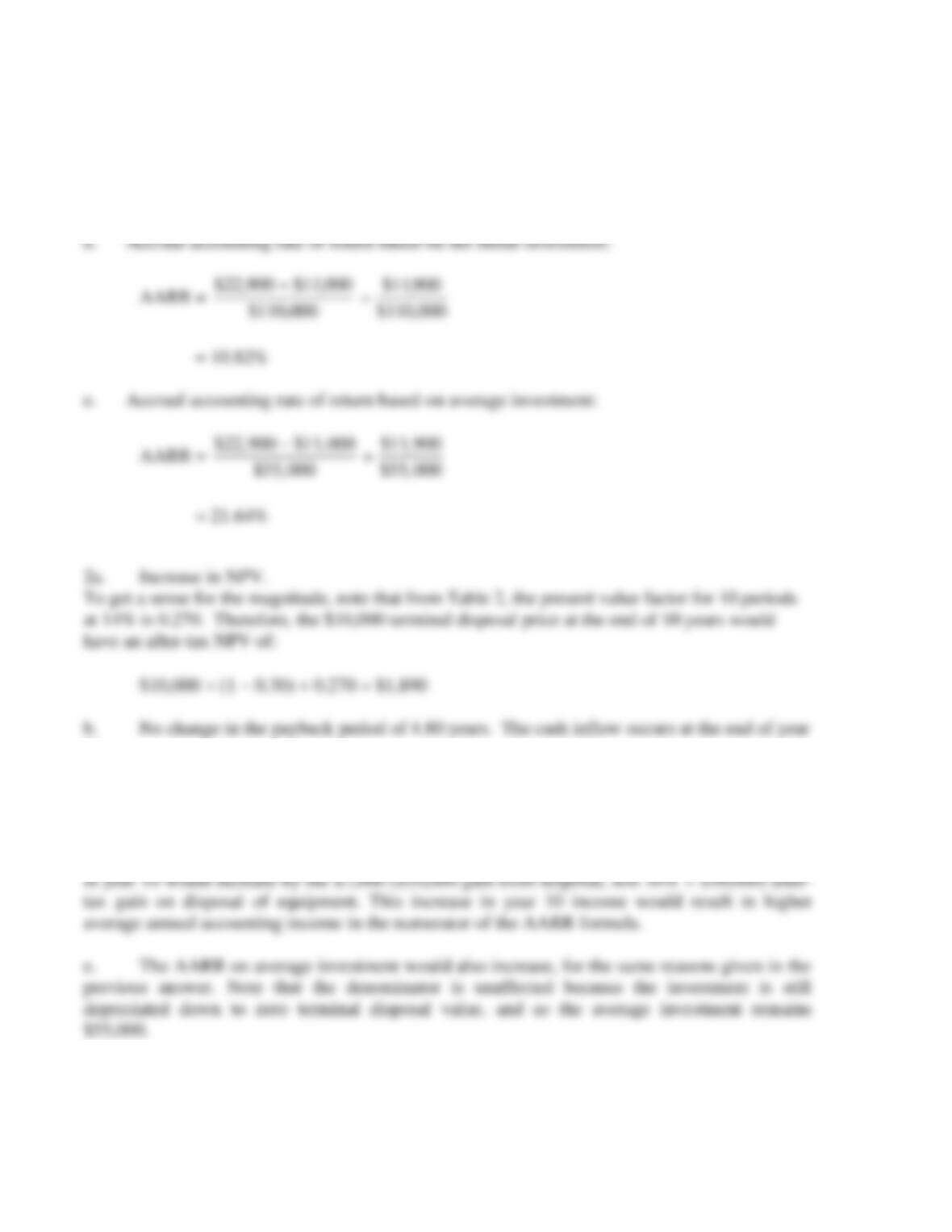
These three amounts can be combined to determine the NPV:
Net initial investment;
$110,000 1.00
$(110,000)
10-year annuity of annual after-tax cash flows from operations;
$19,600 5.216
102,234
10-year annuity of income tax cash savings from annual depreciation deductions;
$3,300 5.216
17,213
Net present value
$ 9,447
b. Payback period
=
)300,3$600,19($
000,110$
+
=
900,22$
000,110$
= 4.80 years
21-8
c. For a $110,000 initial outflow, the project now generates $22,900 in after-tax cash flows at
the end of each of years one through ten.
Using either a calculator or Excel, the internal rate of return for this stream of cash flows is
found to be 16.17%.
10.
c. Increase in internal rate of return. The $10,000 terminal disposal price would raise the
IRR because of the additional inflow. (The new IRR is 16.54%.)
d. The AARR on net initial investment would increase because accrual accounting income
1. Present value of savings in cash operating costs:
$10,000 × 0.862 $ 8,620
2. Payback period:
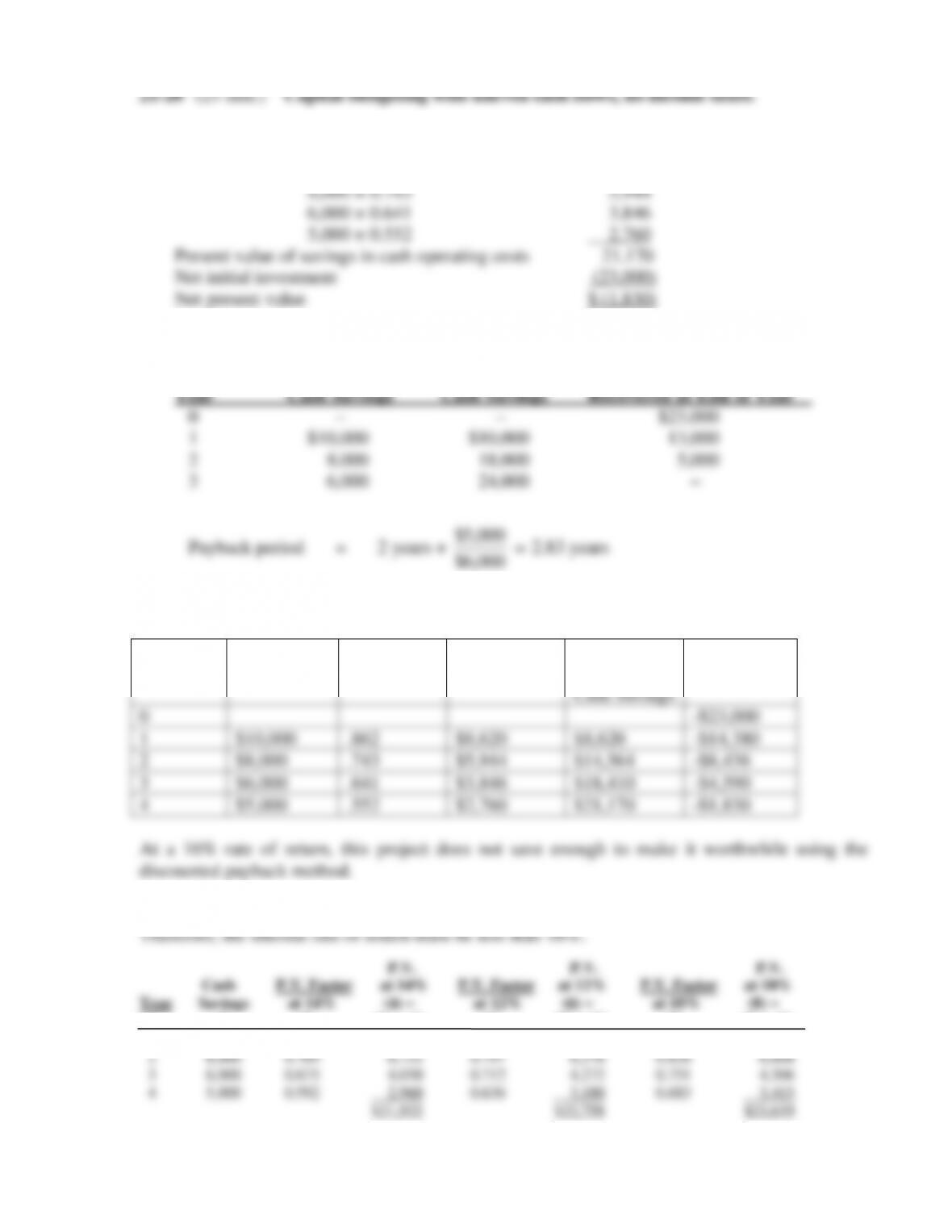
Cumulative Initial Investment Yet to Be
$6,000
3. Discounted Payback Period
Period
Cash
Savings
Disc Factor
(16%)
Discounted
Cash Savings
Cumulative
Discounted.
Cash Savings
Unrecovered
Investment
0
-$23,000
1
$10,000
.862
$8,620
$8,620
-$14,380
2
$8,000
.743
$5,944
$14,564
-$8,436
3
$6,000
.641
$3,846
$18,410
-$4,590
4
$5,000
.552
$2,760
$21,170
-$1,830
At a 16% rate of return, this project does not save enough to make it worthwhile using the
discounted payback method.
4. From requirement 1, the net present value is negative with a 16% required rate of return.
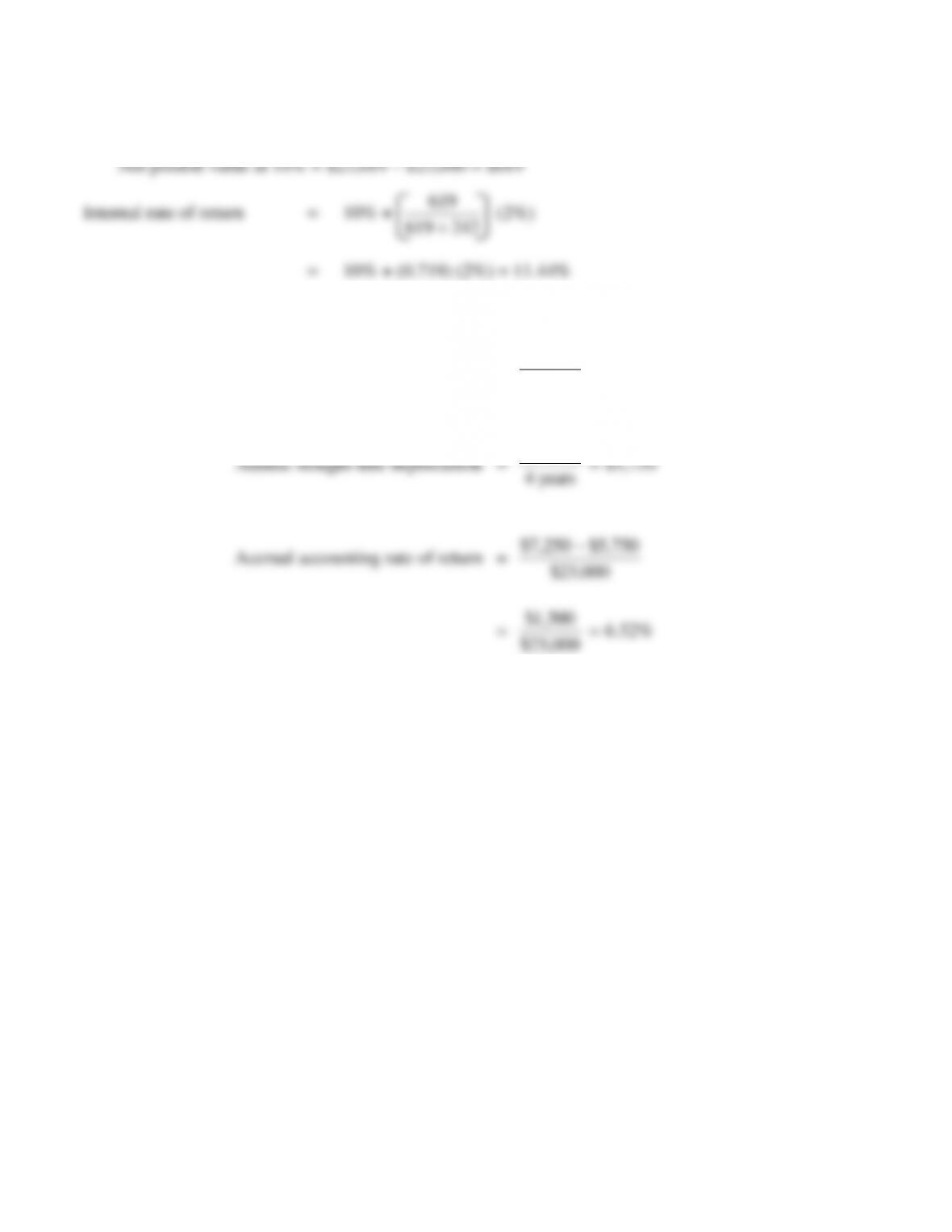
Net present value at 14% = $21,932 – $23,000 = $(1,068)
Net present value at 12% = $22,758 – $23,000 = $(242)
5. Accrual accounting rate of return based on net initial investment:
Average annual savings in cash operating costs =
years 4
$29,000
= $7,250
$23,000