21-41
21-35 (40-45 min.) Recognizing cash flows for capital investment projects, NPV.
1.
Net initial investment
Initial equipment investment
$(2,575,000)
Initial working-capital investment
(25,000)
Net initial investment
$(2,600,000)
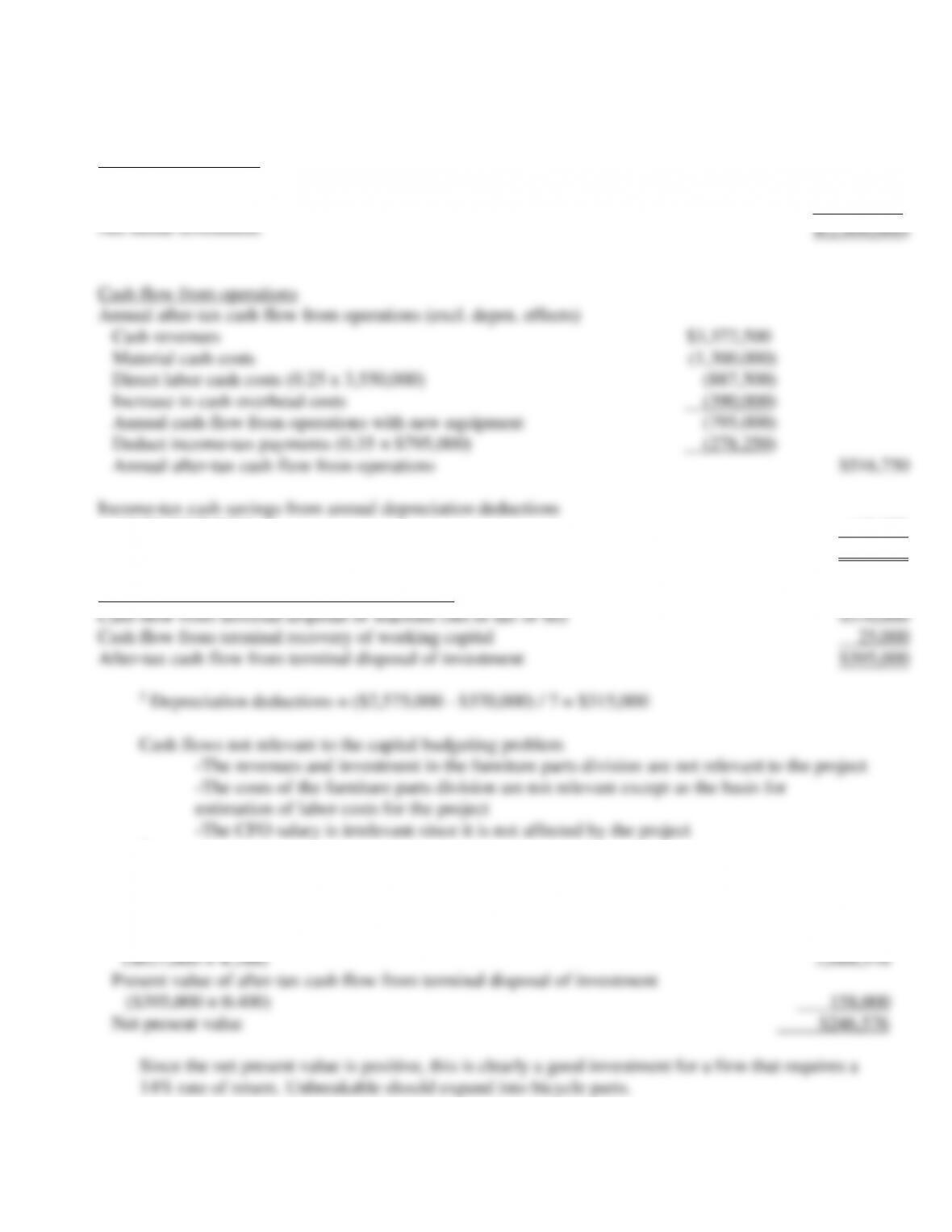
Cash flow from operations
Annual after-tax cash flow from operations (excl. deprn. effects)
Cash revenues
$3,372,500
Material cash costs
(1,300,000)
Direct labor cash costs (0.25 x 3,550,000)
(887,500)
Increase in cash overhead costs
(390,000)
Annual cash flow from operations with new equipment
(795,000)
Deduct income-tax payments (0.35 × $795,000)
(278,250)
Annual after-tax cash flow from operations
$516,750
Income-tax cash savings from annual depreciation deductions
(0.35×$315,000)1
110,250
Total cash flow from operations (after-tax)
$627,000
Cash flow from terminal disposal of investment
Cash flow from terminal disposal of machine (net of tax of $0)
$370,000
Cash flow from terminal recovery of working capital
25,000
After-tax cash flow from terminal disposal of investment
$395,000
2.
These three amounts can be combined to determine the NPV at a 14% discount rate:
Present value of net initial investment, $(2,600,000) × 1.000
$(2,600,000)
Present value of 7-year annuity of annual after-tax cash flow from operations
($627,000 × 4.288)
2,688,576
Present value of after-tax cash flow from terminal disposal of investment
($395,000 × 0.400)
158,000
Net present value
$246,576
Since the net present value is positive, this is clearly a good investment for a firm that requires a
14% rate of return. Unbreakable should expand into bicycle parts.
21-36 (25 min.) NPV, inflation and taxes.
1.Without inflation or taxes this is a simple net present value problem using an 8% discount rate
Present value of initial investment, $(749,700) × 1.000
$(749,700)
Present value of 7-year annuity of annual cash savings:
$160,000 × 5.206
832,960
Net present value
$ 83,260
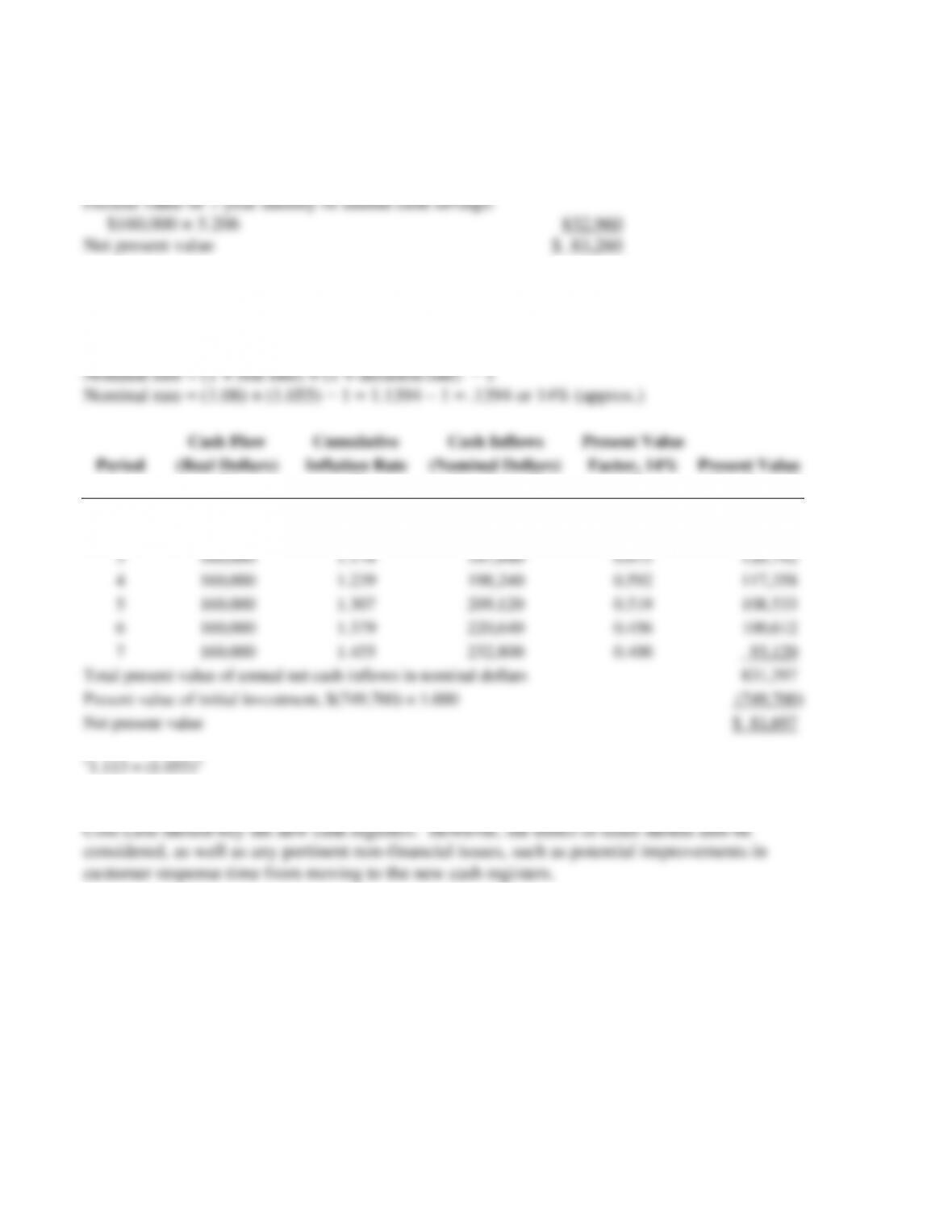
2. With inflation, we adjust each year’s cash flow for the inflation rate to get nominal cash flows
and then discount each cash flow separately using the nominal discount rate.
4. Initial equipment investment
$(749,700)
Annual cash flow from operations (excl. deprn. effects)
$160,000
Deduct income tax payments (0.30 × $160,000)
48,000
Annual after-tax cash flow from operations (excl. deprn. effects)
$ 112,000
Income tax cash savings from annual depreciation deductions
(0.30 × $107,100)1
$ 32,130
1 Depreciation deductions = ($749,700 – $0) / 7 = $107,100
The terminal disposal price of the equipment is equal to the book value at disposal = $0, so these
three amounts can be combined to determine the NPV at a 8% discount rate.
Present value of net initial investment, $(749,700) × 1.000
$(749,700)
Present value of 7-year annuity annual after-tax cash flow from operations,
$112,000 × 5.206
583,072
Present value of 7-year annuity of income tax cash savings from
annual depreciation deductions, $32,130 × 5.206
167,269
Net present value
$ 641
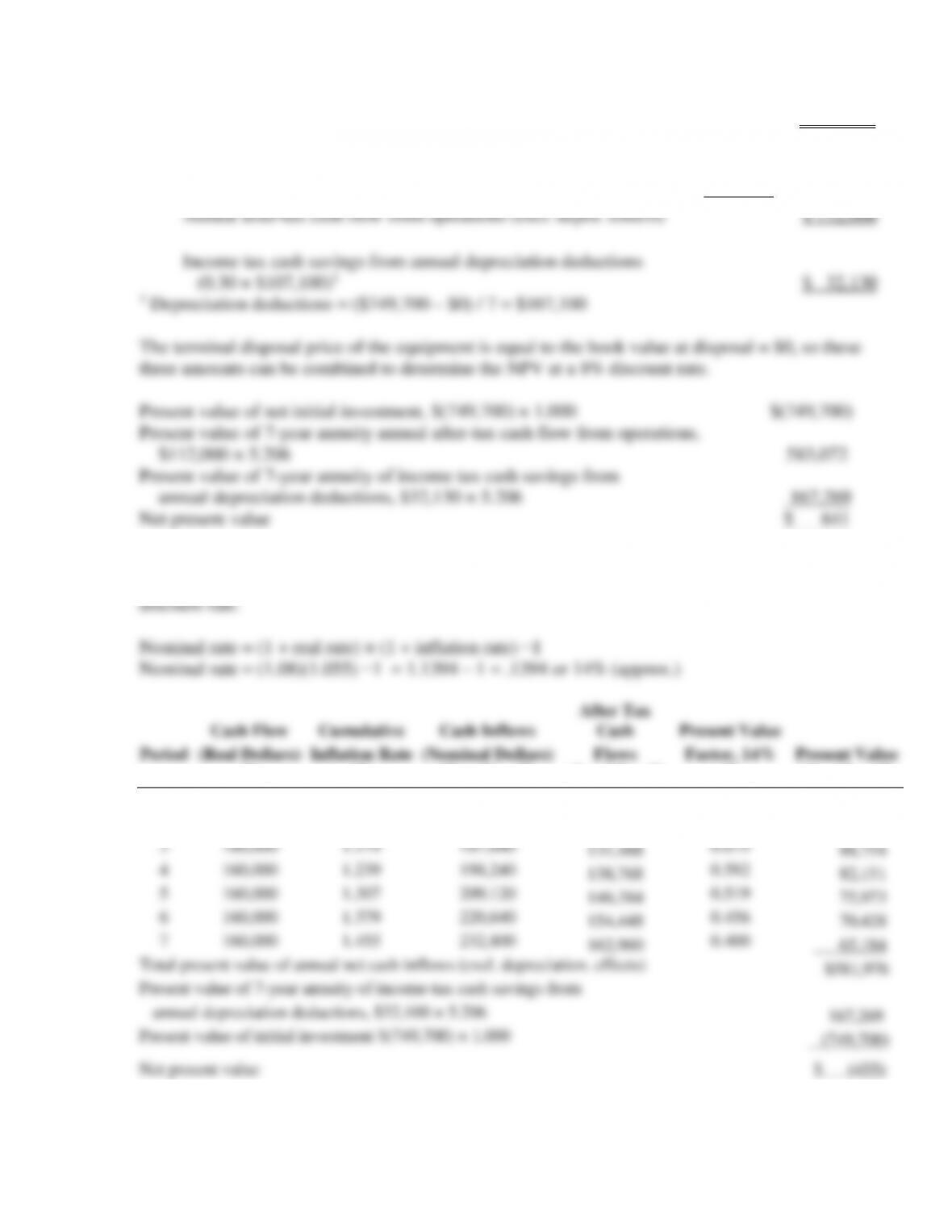
5. As in the previous section, with inflation, we adjust each year’s cash flow for the inflation rate
to get nominal cash flows and then discount each cash flow separately using the nominal
21-44
6. Without inflation, we obtain a positive NPV; however, with inflation NPV is negative, and
Best-Cost Foods would be better off not purchasing the new registers. Negative NPV is obtained
21-37 (45 min.) Net present value, Internal Rate of Return, Sensitivity Analysis.
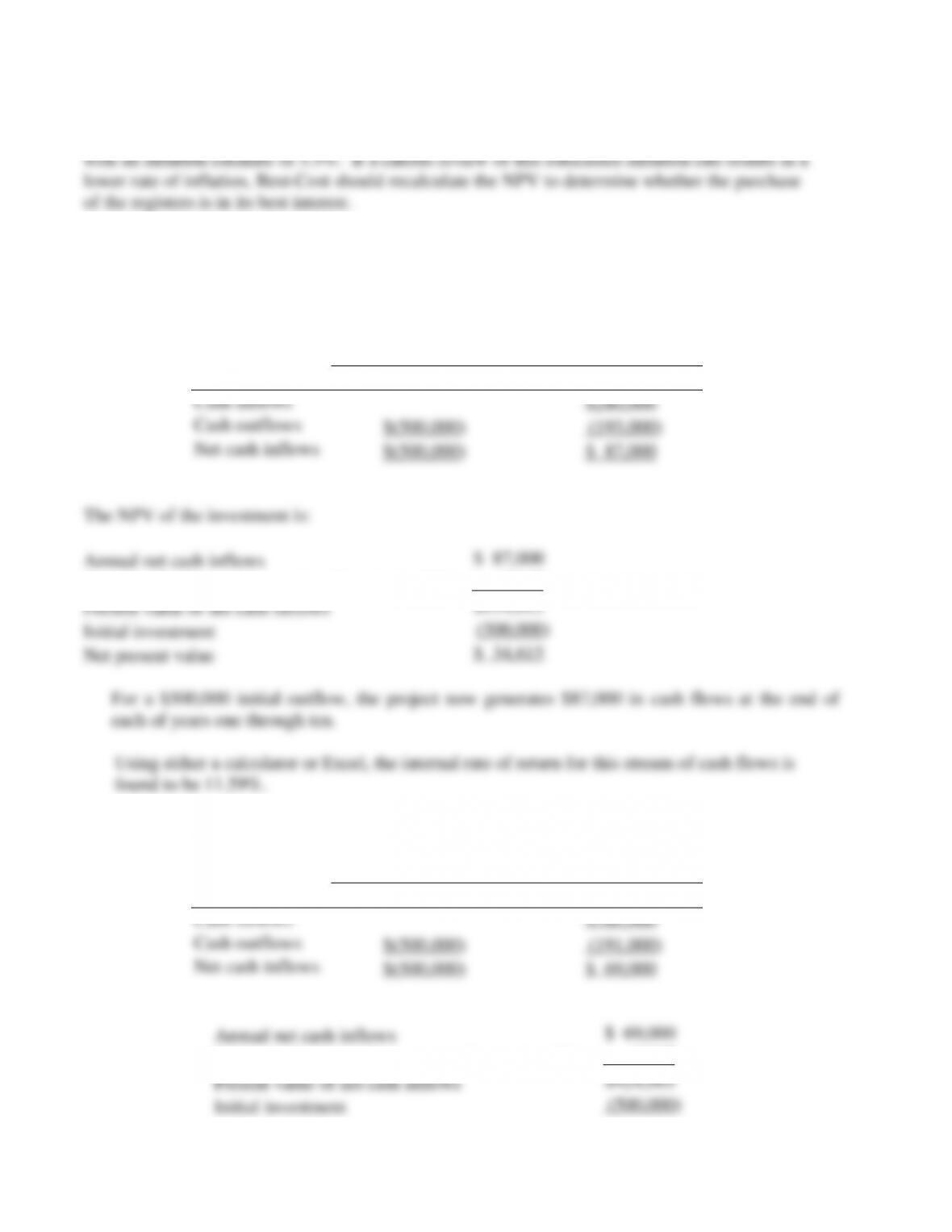
1. Given the annual operating cash outflows of $165,000 and the payment of 10% of revenues
(10% × $280,000 = $28,000), the net cash inflows for each period are as follows:
Period
0
1 – 10
Cash inflows
$280,000
Cash outflows
$(500,000)
(193,000)
Net cash inflows
$(500,000)
$ 87,000
The NPV of the investment is:
Annual net cash inflows
$ 87,000
Present value factor for annuity, 10 periods, 10%
× 6.145
Present value of net cash inflows
$534,615
Initial investment
(500,000)
Net present value
$ 34,615
For a $500,000 initial outflow, the project now generates $87,000 in cash flows at the end of
each of years one through ten.
Using either a calculator or Excel, the internal rate of return for this stream of cash flows is
found to be 11.59%.
2. For revenues of $260,000, the cash flows and NPV computation are given below.
Period
0
1 – 10
Cash inflows
$260,000
Cash outflows
$(500,000)
(191,000)
Net cash inflows
$(500,000)
$ 69,000
Annual net cash inflows
$ 69,000
Present value factor for annuity, 10 periods, 10%
× 6.145
Present value of net cash inflows
$424,005
Initial investment
(500,000)
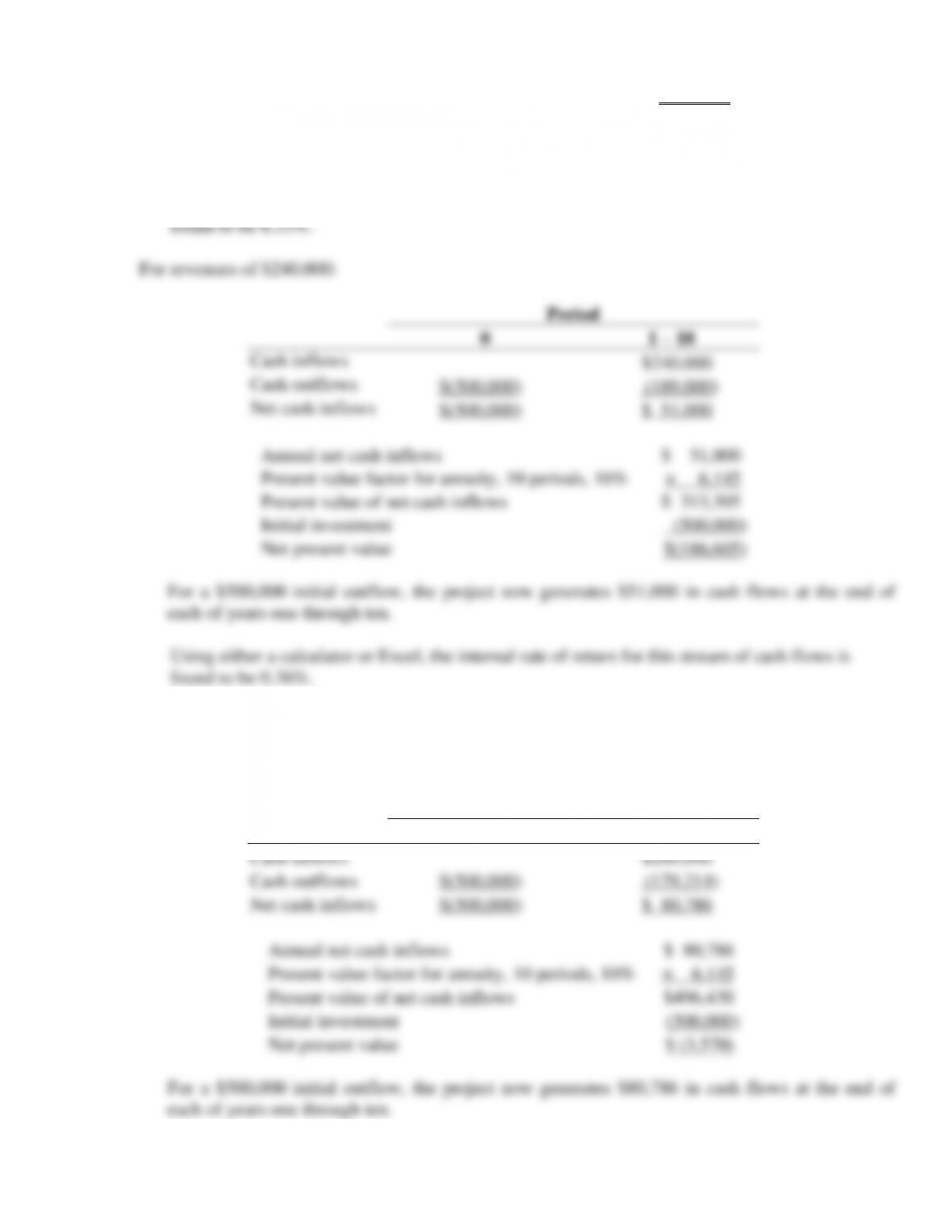
Net present value
$ (75,995)
For a $500,000 initial outflow, the project now generates $69,000 in cash flows at the end of
each of years one through ten.
Using either a calculator or Excel, the internal rate of return for this stream of cash flows is
Present value factor for annuity, 10 periods, 10%
Initial investment
Cash outflows
Present value factor for annuity, 10 periods, 10%
Initial investment
21-46
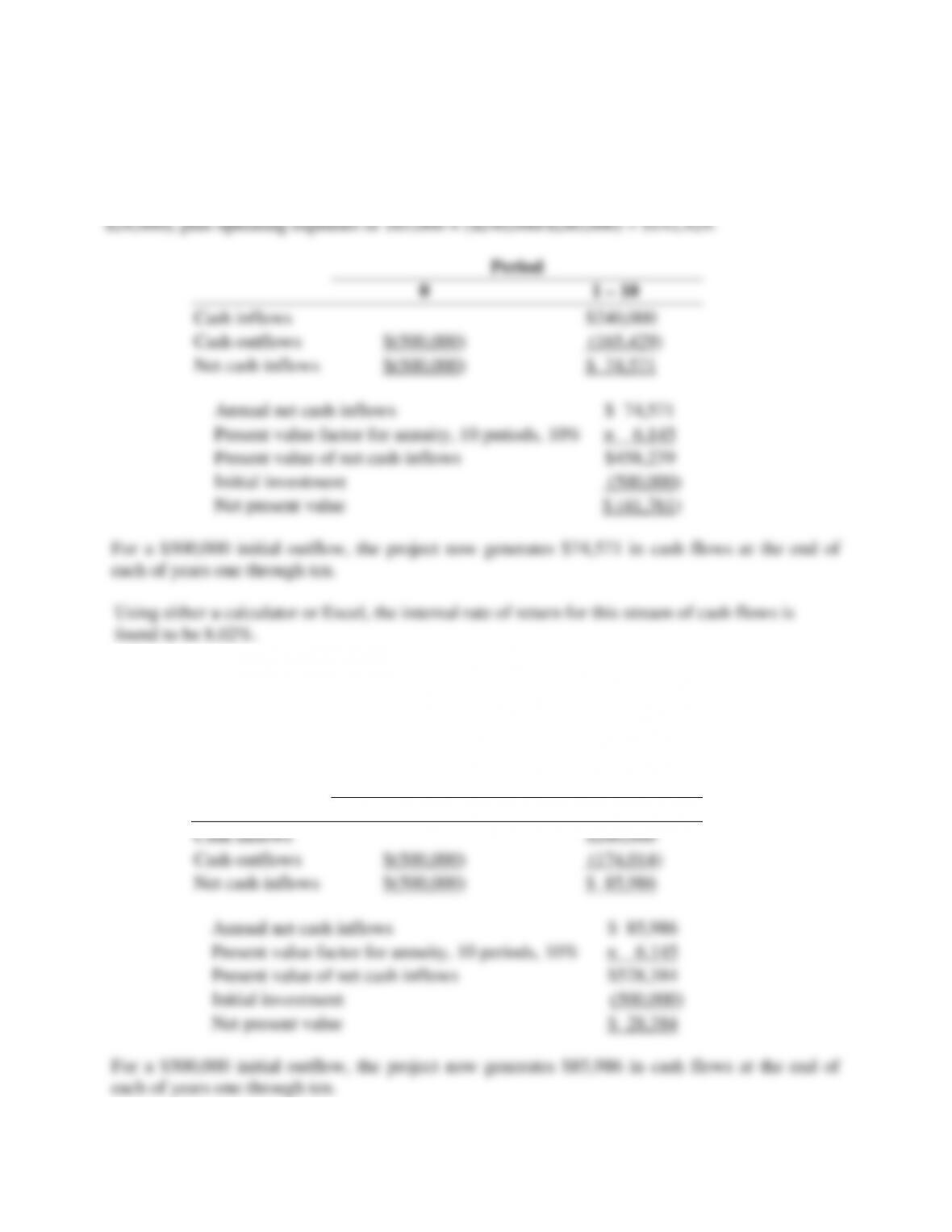
Using either a calculator or Excel, the internal rate of return for this stream of cash flows
is found to be 9.83%.
For revenues of $240,000, with proportional lower expenses:
The annual cash outflows now equal payment of 10% of revenues (10% × $240,000 =
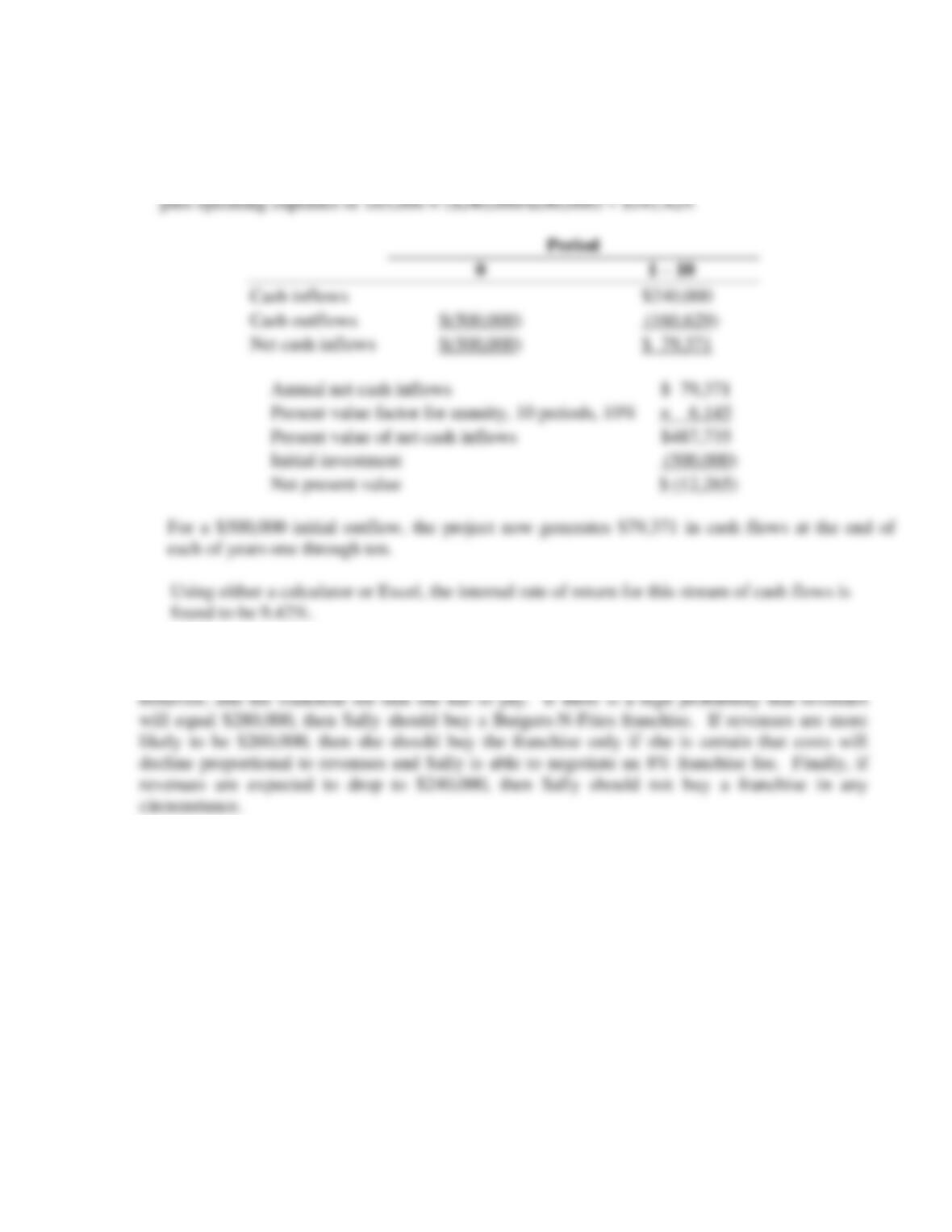
4. For revenues of $260,000, with proportional lower expenses and fees of 8%:
The annual cash outflows now equal payment of 8% of revenues (8% × $260,000 = $20,800),
plus operating expenses of 165,000 × ($260,000/$280,000) = $153,214.
Period
0
1 – 10
Cash inflows
$260,000
Cash outflows
$(500,000)
(174,014)
Net cash inflows
$(500,000)
$ 85,986
Annual net cash inflows
$ 85,986
Present value factor for annuity, 10 periods, 10%
× 6.145
Present value of net cash inflows
$528,384
Initial investment
(500,000)
Net present value
$ 28,384
For a $500,000 initial outflow, the project now generates $85,986 in cash flows at the end of
each of years one through ten.
Cash outflows
$(500,000)
Net cash inflows
$(500,000)
Annual net cash inflows
Present value factor for annuity, 10 periods, 10%
Present value of net cash inflows
Initial investment
Net present value
21-47
Using either a calculator or Excel, the internal rate of return for this stream of cash flows is
found to be 11.30%.
For revenues of $240,000, with proportional lower expenses and fees of 8%:
The annual cash outflows now equal payment of 8% of revenues (8% × $240,000 = $19,200),
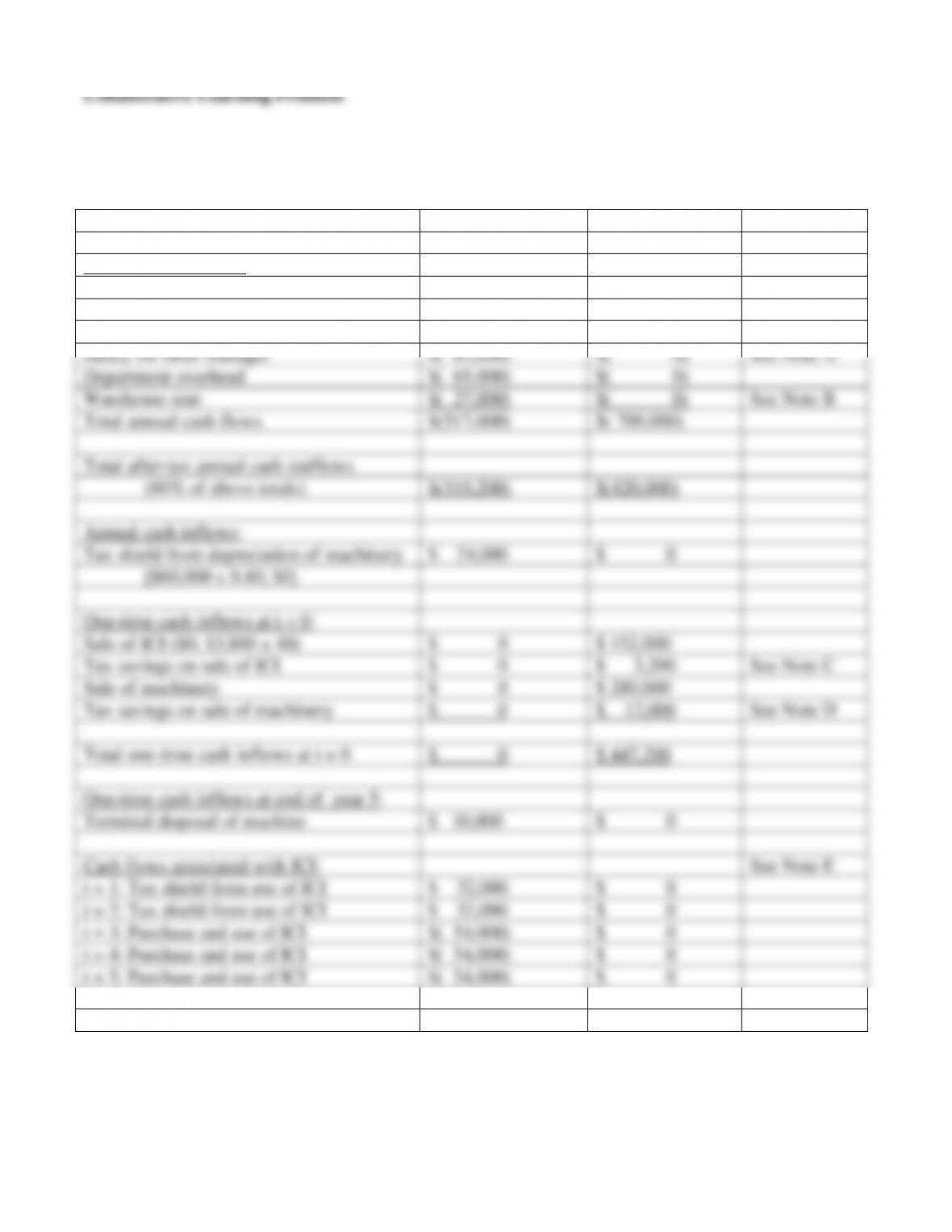
5. Sally learns from this sensitivity analysis that the profitability of her investment depends
critically on a variety of factors, including the expected annual revenue, the nature of cost
21-48
21-38 (45 min.) NPV, Relevant costs, Income taxes
1.
Alternatives
As Is
Outsource
Annual cash outflows:
Cost of out-sourcing
$( 0)
$( 700,000)
Non-ICI direct material
$(120,000)
$( 0)
Direct labor
$(220,000)
$( 0)
Salary for other manager
$( 85,000)
$( 0)
See Note A
Department overhead
$( 65,000)
$( 0)
Warehouse rent
$( 27,000)
$( 0)
See Note B
Total annual cash flows
$(517,000)
$( 700,000)
Total after-tax annual cash outflows
(60% of above totals)
$(310,200)
$(420,000)
Annual cash inflows:
Tax shield from depreciation of machinery
$ 24,000
$ 0
[$60,000 x 0.40; $0]
One-time cash inflows at t = 0:
Sale of ICI ($0; $3,800 x 40)
$ 0
$ 152,000
Tax savings on sale of ICI
$ 0
$ 3,200
See Note C
Sale of machinery
$ 0
$ 280,000
Tax savings on sale of machinery
$ 0
$ 12,000
See Note D
Total one-time cash inflows at t = 0
$ 0
$ 447,200
One-time cash inflows at end of year 5:
Terminal disposal of machine
$ 10,000
$ 0
Cash flows associated with ICI:
See Note E
t = 1: Tax shield from use of ICI
$ 32,000
$ 0
t = 2: Tax shield from use of ICI
$ 32,000
$ 0
t = 3: Purchase and use of ICI
$( 54,000)
$ 0
t = 4: Purchase and use of ICI
$( 54,000)
$ 0
t = 5: Purchase and use of ICI
$( 54,000)
$ 0
21-49
Notes:
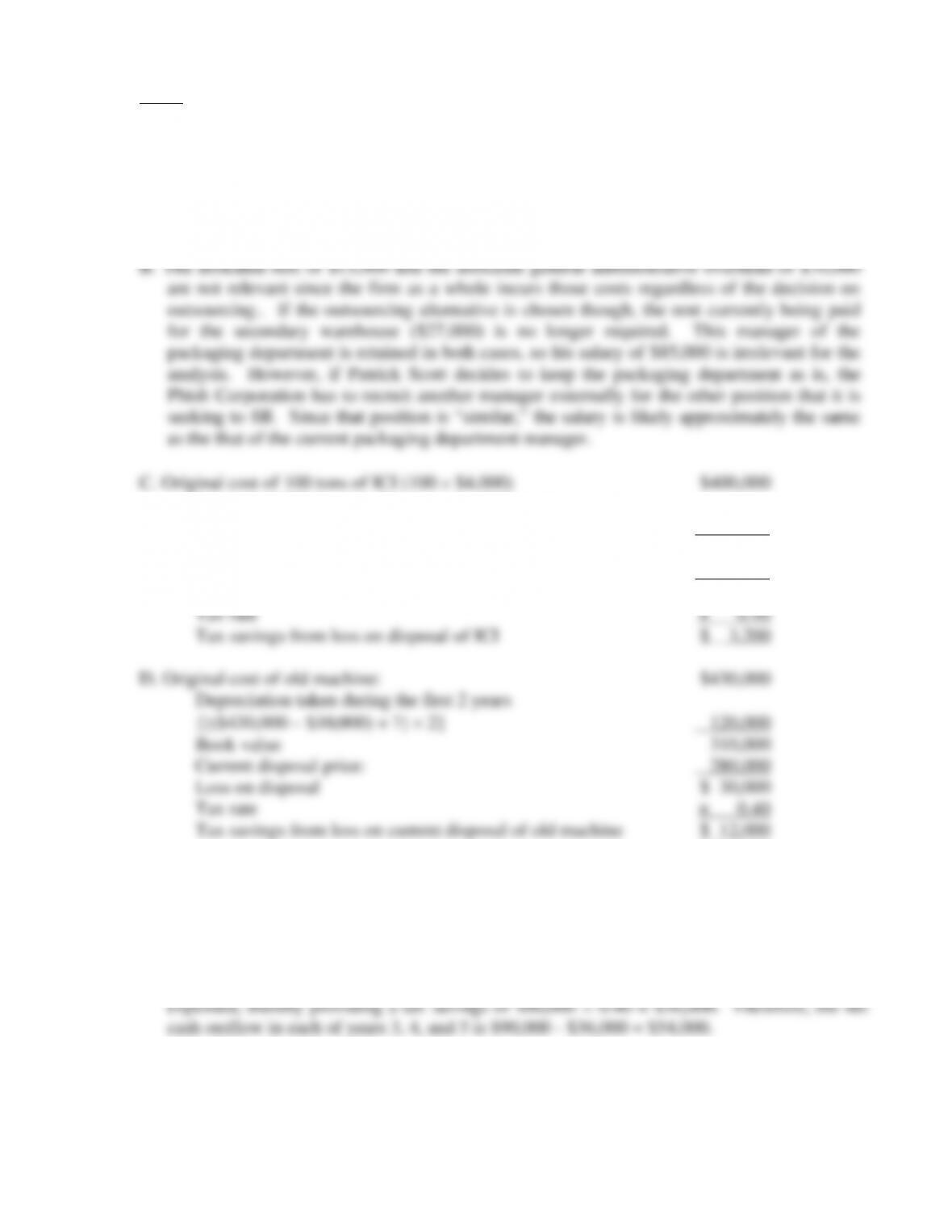
A. The manager of the packaging department is retained in both cases, so his salary of $85,000
is irrelevant for the analysis. However, if Patrick Scott decides to keep the packaging
department as is, the Phish Corporation has to recruit another manager externally for the
other position that it is seeking to fill. Since that position is “similar,” the salary is likely
approximately the same as the that of the current packaging department manager.
Amount of ICI consumed in previous three years
{20 tons per year 3 years $4,000} 240,000
Book value of remaining inventory (40 tons) 160,000
Current disposal price: (40 tons $3,800) 152,000
Loss on disposal $ 8,000
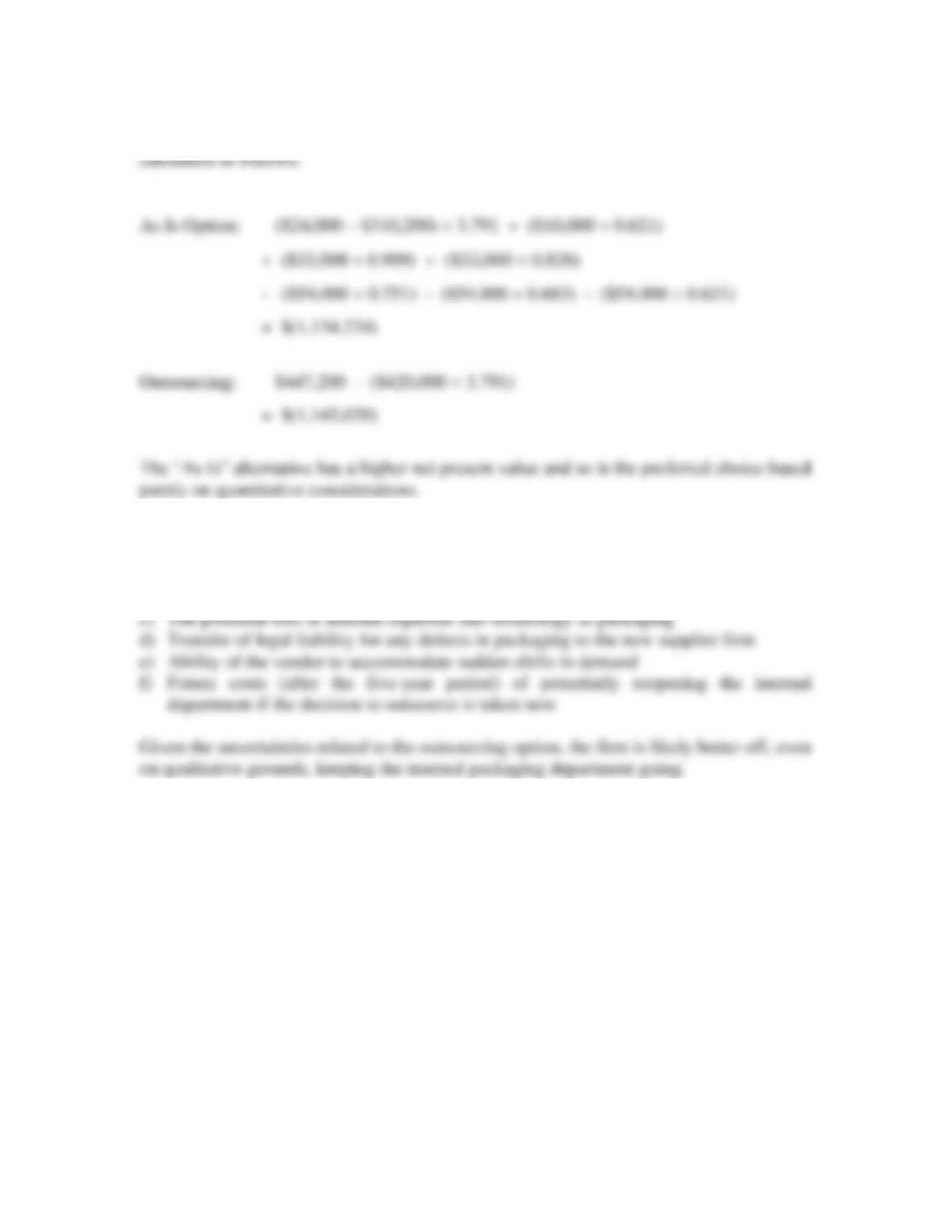
E. For the first two years, Phish uses up the remaining inventory of ICI. This results in an
expense of $80,000 each year, thereby providing a tax savings of $80,000 0.40 = $32,000.
There is no cash outflow since the ICI was purchased earlier and that outflow is a sunk cost.
From year 3 onwards, Phish has to purchase 20 tons of ICI each year at $4,500 per ton. This
represents a cash outflow of 20,000 $4,500 = $90,000. The ICI is then consumed and
21-50
2. Suppose that the annual cash flows occur at the end of the year. Then, using the cash
flows derived in requirement 1, and applying the present value and annuity factors from
Tables 2 and 4 of Appendix A, the net present value of the two alternatives can be
3. Other issues that are relevant to the choice between the alternatives faced by Phish are:
a) The effect on employee morale from closing a department
b) The ability to ensure quality control when packaging is outsourced