21-31
1. Net Present Value of project:
Period
0
1 – 10
Cash inflows
$28,000
Cash outflows
$(62,000)
(18,000)
Net cash flows
$(62,000)
$ 10,000
Annual net cash inflows
$ 10,000
Present value factor for annuity, 10 periods, 8%
× 6.71
Present value of net cash inflows
$67,100
Initial investment
(62,000)
Net present value
$ 5,100
For a $62,000 initial outflow, the project now generates $10,000 in cash flows at the end of
each of years one through ten.
Using either a calculator or Excel, the internal rate of return for this stream of cash flows is
found to be 9.79%.
2. If revenues are 10% higher, the new Net Present Value will be:
Period
0
1 – 10
Cash inflows
$30,800
Cash outflows
$(62,000)
(18,000)
Net cash inflows
$(62,000)
$12,800
21-32
If revenues are 10% lower, the new net present value will be:
Period
0
1 – 10
Cash inflows
$25,200
Cash outflows
$(62,000)
(18,000)
Net cash inflows
$(62,000)
$ 7,200
Annual net cash inflows
$ 7,200
Present value factor for annuity, 10 periods, 6%
x 6.71
Present value of net cash inflows
$ 48,312
Initial investment
(62,000)
Net present value
$ (13,688)
For a $62,000 initial outflow, the project now generates $7,200 in cash flows at the end of each
of years one through ten.
Using either a calculator or Excel, the internal rate of return for this stream of cash flows is
found to be 2.82%.
3. If both revenues and costs are higher, the new Net Present Value will be:
Period
0
1 – 10
Cash inflows
$30,800
Cash outflows
$(62,000)
(19,260)
Net cash inflows
$(62,000)
$11,540
Annual net cash inflows
Present value factor for annuity, 10 periods, 6%
Present value of net cash inflows
Initial investment
Net present value
21-33
If both revenues and costs are lower, the new Net Present Value will be:
Period
0
1 – 10
Cash inflows
$25,200
Cash outflows
$(62,000)
(16,200)
Net cash inflows
$(62,000)
$ 9,000
4. To find the NPV with a different rate of return, use the same cash flows but with a different
discount rate, this time for ten periods at 10%.
Annual net cash inflows
$ 10,000
Present value factor for annuity, 10 periods, 10%
× 6.145
Present value of net cash inflows
$61,450
Initial investment
(62,000)
Net present value
$ (550)
5. The sensitivity analysis shows that the return on the project is sensitive to changes in the
projected revenues and costs. With the cost of capital (8%) as the discount rate, the NPV is
positive and the IRR exceeds the required rate of return in most cases. The exceptions occur
Net present value
Payback problem:
1.
Annual revenue
$140,000
Annual costs
Fixed
$96,000
Variable
14,000
110,000
Net annual cash inflow
$ 30,000
Payback period = Investment net cash inflows = $159,000 ÷ $30,000 = 5.30 years
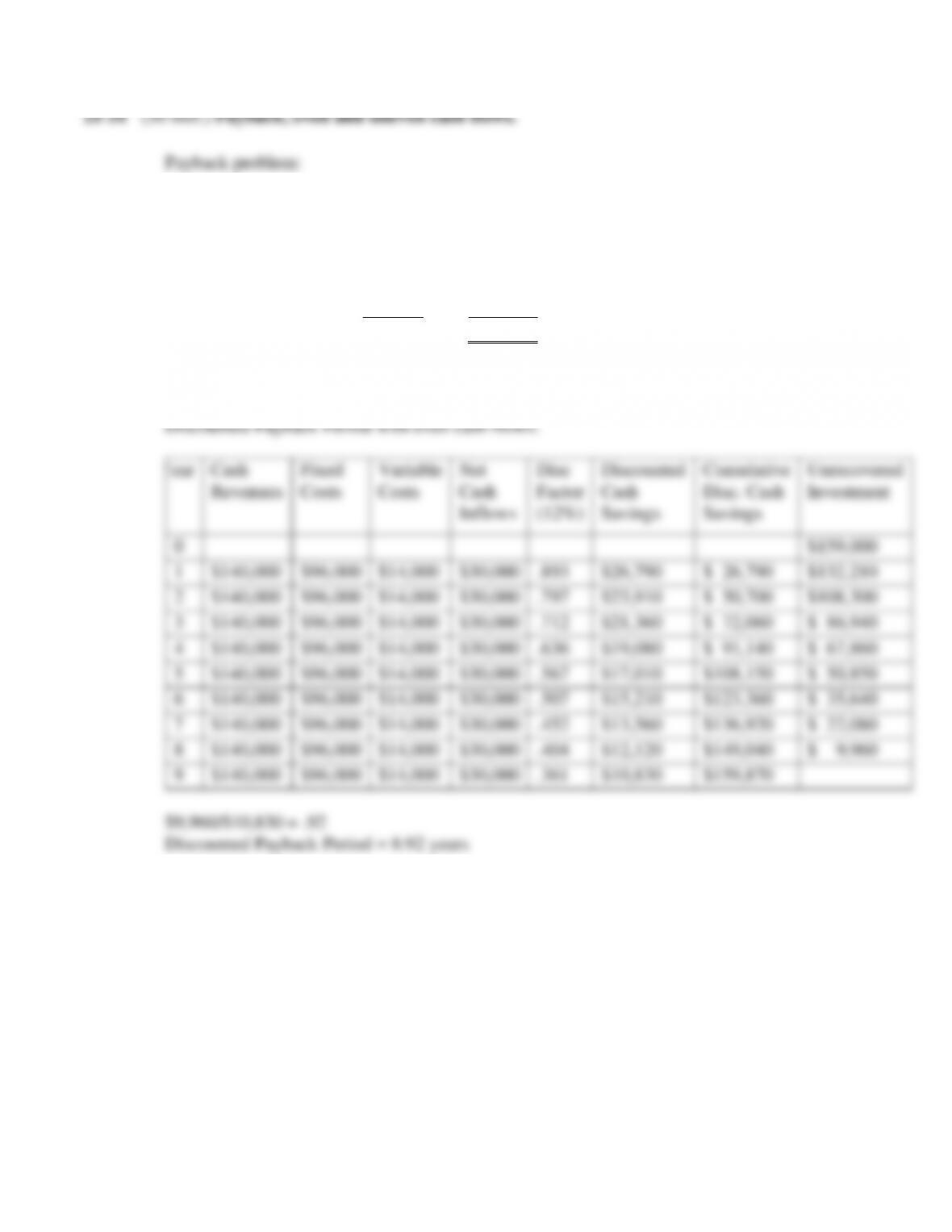
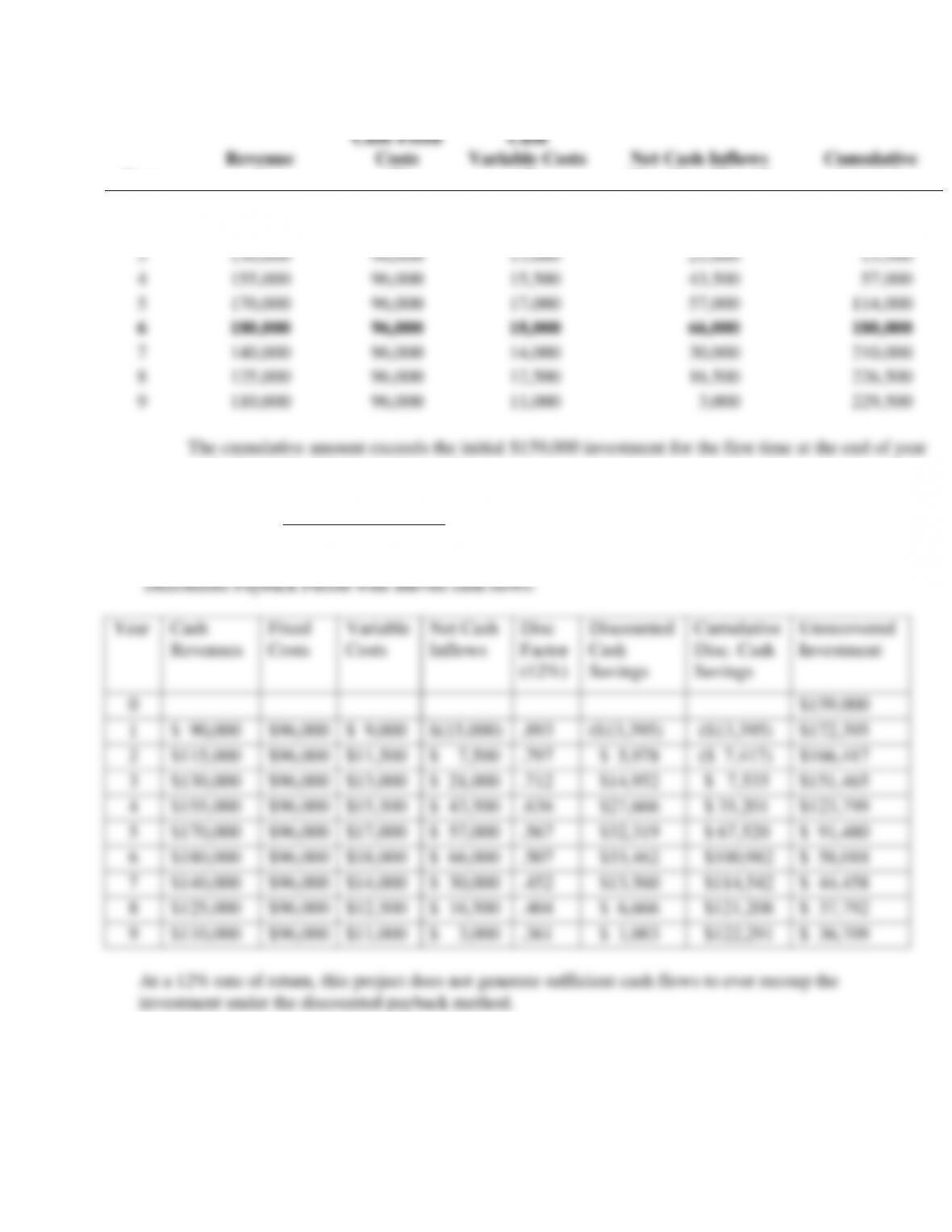
Discounted Payback Period with even cash flows:
ioYear
Cash
Revenues
Fixed
Costs
Variable
Costs
Net
Cash
Inflows
Disc
Factor
(12%)
Discounted
Cash
Savings
Cumulative
Disc. Cash
Savings
Unrecovered
Investment
0
$159,000
1
$140,000
$96,000
$14,000
$30,000
.893
$26,790
$ 26,790
$132,210
2
$140,000
$96,000
$14,000
$30,000
.797
$23,910
$ 50,700
$108,300
3
$140,000
$96,000
$14,000
$30,000
.712
$21,360
$ 72,060
$ 86,940
4
$140,000
$96,000
$14,000
$30,000
.636
$19,080
$ 91,140
$ 67,860
5
$140,000
$96,000
$14,000
$30,000
.567
$17,010
$108,150
$ 50,850
6
$140,000
$96,000
$14,000
$30,000
.507
$15,210
$123,360
$ 35,640
7
$140,000
$96,000
$14,000
$30,000
.452
$13,560
$136,920
$ 22,080
8
$140,000
$96,000
$14,000
$30,000
.404
$12,120
$149,040
$ 9,960
9
$140,000
$96,000
$14,000
$30,000
.361
$10,830
$159,870
21-35
2.
Year
Revenue
(1)
Cash Fixed
Costs
(2)
Cash
Variable Costs
(3)
Net Cash Inflows
(4) = (1) − (2) − (3)
Cumulative
Amounts
1
$ 90,000
$ 96,000
$ 9,000
$(15,000)
$(15,000)
2
115,000
96,000
11,500
7,500
(7,500)
3
130,000
96,000
13,000
21,000
13,500
4
155,000
96,000
15,500
43,500
57,000
5
170,000
96,000
17,000
57,000
114,000
6
180,000
96,000
18,000
66,000
180,000
7
140,000
96,000
14,000
30,000
210,000
8
125,000
96,000
12,500
16,500
226,500
9
110,000
96,000
11,000
3,000
229,500
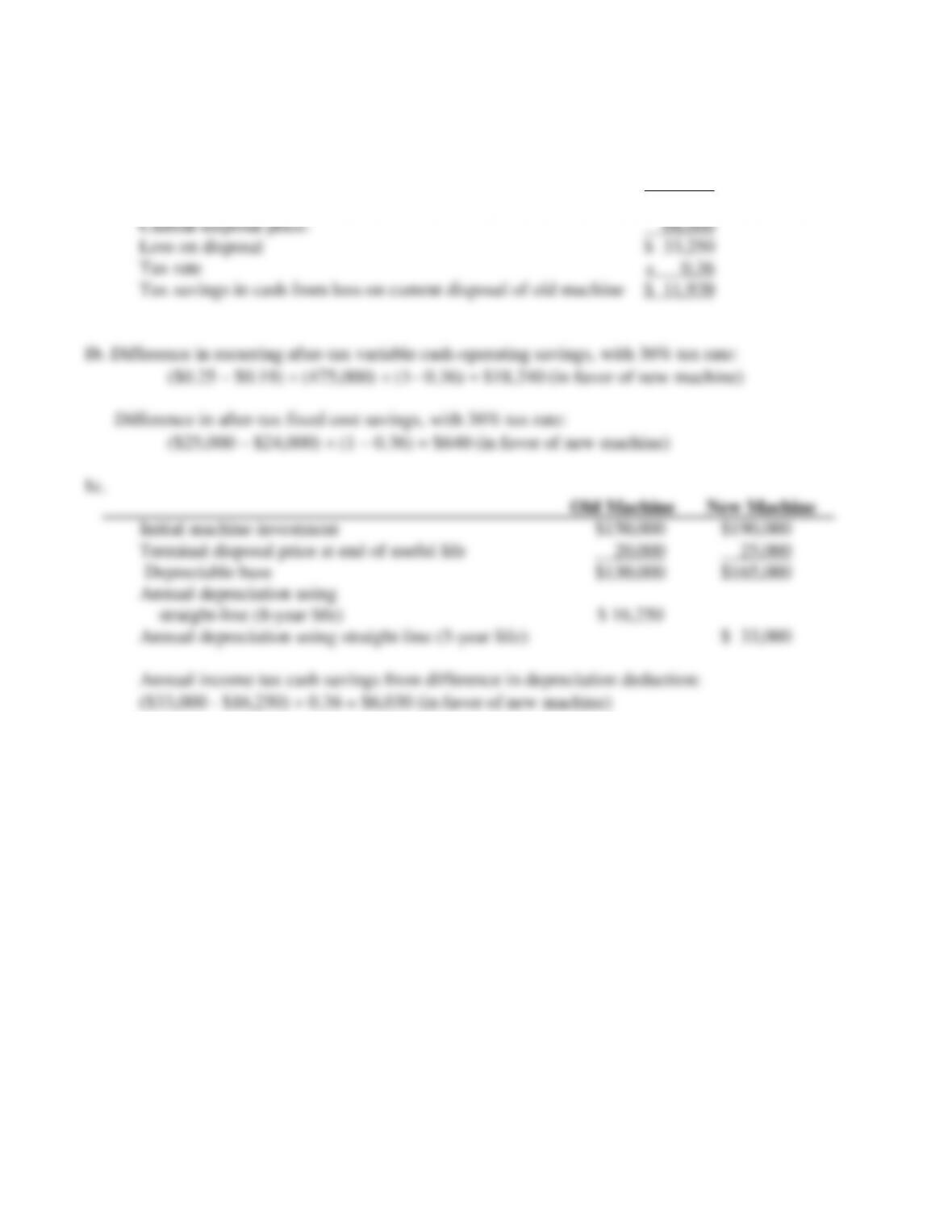
The cumulative amount exceeds the initial $159,000 investment for the first time at the end of year
6. So, payback happens in year 6.
Using linear interpolation, a more precise measure is that payback happens at:
5 years +
$159,000 – $114,000 5.68 years.
$66,000 =
21-36
21-32 (40 min.) Replacement of a machine, income taxes, sensitivity.
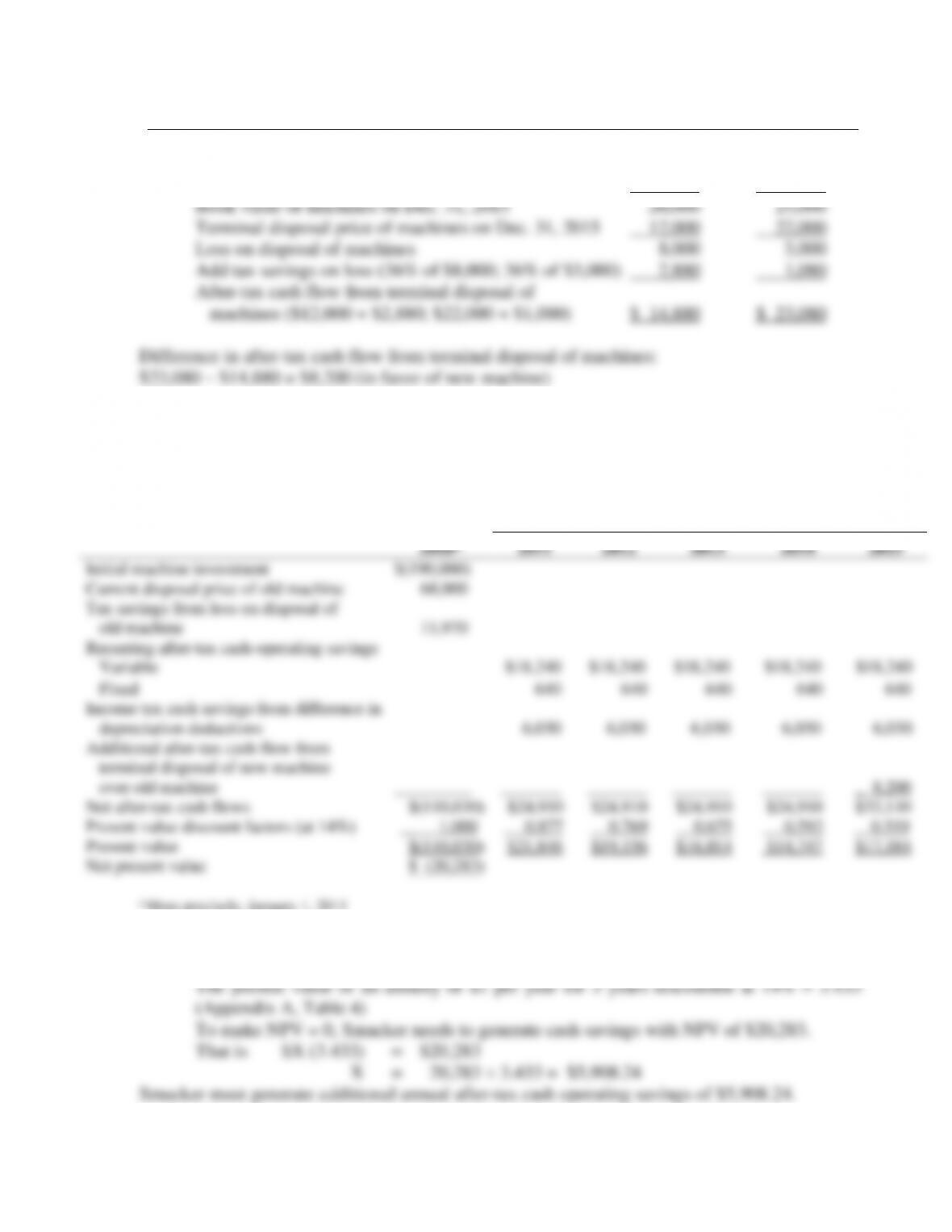
1a. Original cost of old machine: $150,000
Depreciation taken during the first 3 years
{[($150,000 – $20,000) ÷ 8] 3} 48,750
Book value 101,250
21-37
1d.
Old Machine
New Machine
Original cost $150,000 $190,000
Total depreciation 130,000 165,000
2. The Smacker Company should retain the old equipment because the net present value of
the incremental cash flows from the new machine is negative. The computations, using the
results of requirement 1, are presented below. In this format the present value factors appear at
the bottom. All cash flows, year by year, are then converted into present values.
After-Tax Cash Flows
2010a
2011
2012
2013
2014
2015
Initial machine investment
$(190,000)
Current disposal price of old machine
68,000
Tax savings from loss on disposal of
old machine
11,970
Recurring after-tax cash-operating savings
Variable
$18,240
$18,240
$18,240
$18,240
$18,240
Fixed
640
640
640
640
640
Income tax cash savings from difference in
depreciation deductions
6,030
6,030
6,030
6,030
6,030
Additional after-tax cash flow from
terminal disposal of new machine
over old machine
_________
_______
_______
_______
_______
_ 8,200
Net after-tax cash flows
$(110,030)
$24,910
$24,910
$24,910
$24,910
$33,110
Present value discount factors (at 14%)
_ 1.000
0.877
0.769
0.675
0.592
0.519
Present value
$(110,030)
$21,846
$19,156
$16,814
$14,747
$17,184
Net present value
$ (20,283)
a More precisely, January 1, 2011
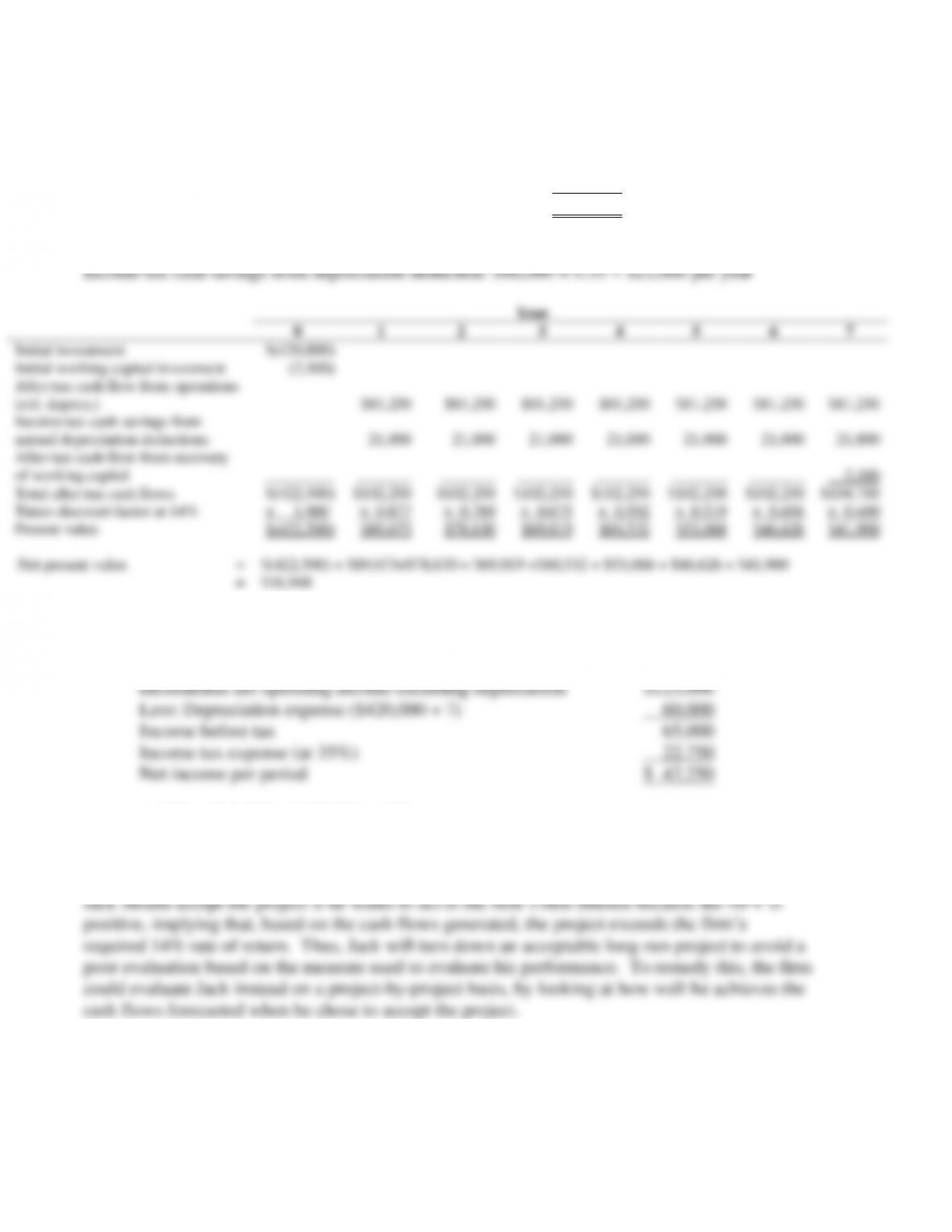
3. Let $X be the additional recurring after-tax cash operating savings required each year to
make NPV = $0.
21-33 (30–35 min.) NPV and AARR, goal-congruence issues.
1.
Annual cash flow from operations
$125,000
Income tax payments (35%)
43,750
After-tax cash flow from operations (excl. deprn.)
$ 81,250
Depreciation: $420,000 ÷ 7 = $60,000 per year
21-39
21-34 (35 min.) Recognizing cash flows for capital investment projects.
1. Partitioning relevant cash flows into categories:
(1) Net initial investment cash flows:
– The $98,000 cost of the new Flab-Buster 3000
– The disposal value of the old machine, $5,000, is a cash inflow
– The book value of the old machine $4,000 ($50,000 − $46,000), relative to the disposal
21-40
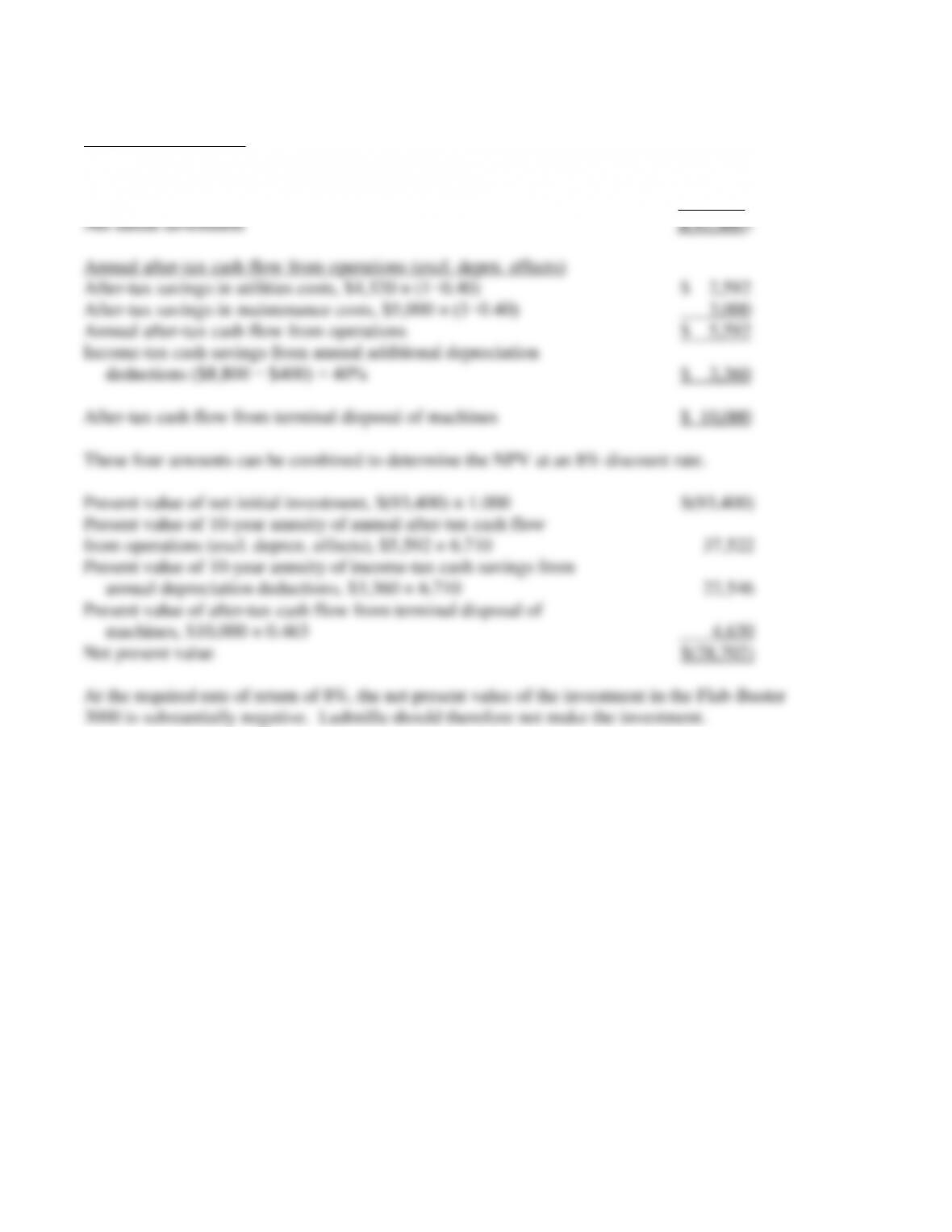
2. Net present value of the investment:
Net initial investment
Initial investment in Flab-Buster 3000
$(98,000)
Current disposal value of Fit-O-Matic
5,000
Tax on gain on sale of Fit-O-Matic, 40% × $1,000
(400)
Net initial investment
$(93,400)
Annual after-tax cash flow from operations (excl. deprn. effects)
After-tax savings in utilities costs, $4,320 × (1−0.40)
$ 2,592
After-tax savings in maintenance costs, $5,000 × (1−0.40)
3,000
Annual after-tax cash flow from operations
$ 5,592
Income-tax cash savings from annual additional depreciation
deductions ($8,800 − $400) × 40%
$ 3,360
After-tax cash flow from terminal disposal of machines
$ 10,000
These four amounts can be combined to determine the NPV at an 8% discount rate.
Present value of net initial investment, $(93,400) × 1.000
$(93,400)
Present value of 10-year annuity of annual after-tax cash flow
from operations (excl. deprcn. effects), $5,592 × 6.710
37,522
Present value of 10-year annuity of income-tax cash savings from
annual depreciation deductions, $3,360 × 6.710
22,546
Present value of after-tax cash flow from terminal disposal of
machines, $10,000 × 0.463
4,630
Net present value
$(28,702)
At the required rate of return of 8%, the net present value of the investment in the Flab-Buster
3000 is substantially negative. Ludmilla should therefore not make the investment.