21-11
21-21 (30 min.) Comparison of projects, no income taxes.
1.
Total Present Value Year
Present Discount
Value Factors at 10% 0 1 2 3
Plan I
$ (100,000) 1.000 $ (100,000)
3. Factors to consider, in addition to NPV, are:
a. Financial factors including:
• Competing demands for cash.
Year 1.
• Investment alternatives available. If New Bio has capital constraints, the new
21-12
21-22 (30 min.) Payback and NPV methods, no income taxes.
1a. Payback measures the time it will take to recoup, in the form of expected future cash
flows, the net initial investment in a project. Payback emphasizes the early recovery of cash as a
key aspect of project ranking. Some managers argue that this emphasis on early recovery of cash
is appropriate if there is a high level of uncertainty about future cash flows. Projects with shorter
000,800$
21-13
Project C
Outflow, $4,000,000
Payback Period
1. Project C
2 years
2. Project B
2.25 years
3. Project A
3 years
If payback period is the deciding factor, Andrews will choose Project C (payback period = 2
NPV
1. Project B
$ 207,800
2. Project A
$ 169,000
3. Project C
$(311,500)
3. Using NPV rankings, Projects B and A, which require a total investment of $3,000,000 +
$1,500,000 = $4,500,000, which is less than the $6,000,000 capital budget, should be funded.
21-14
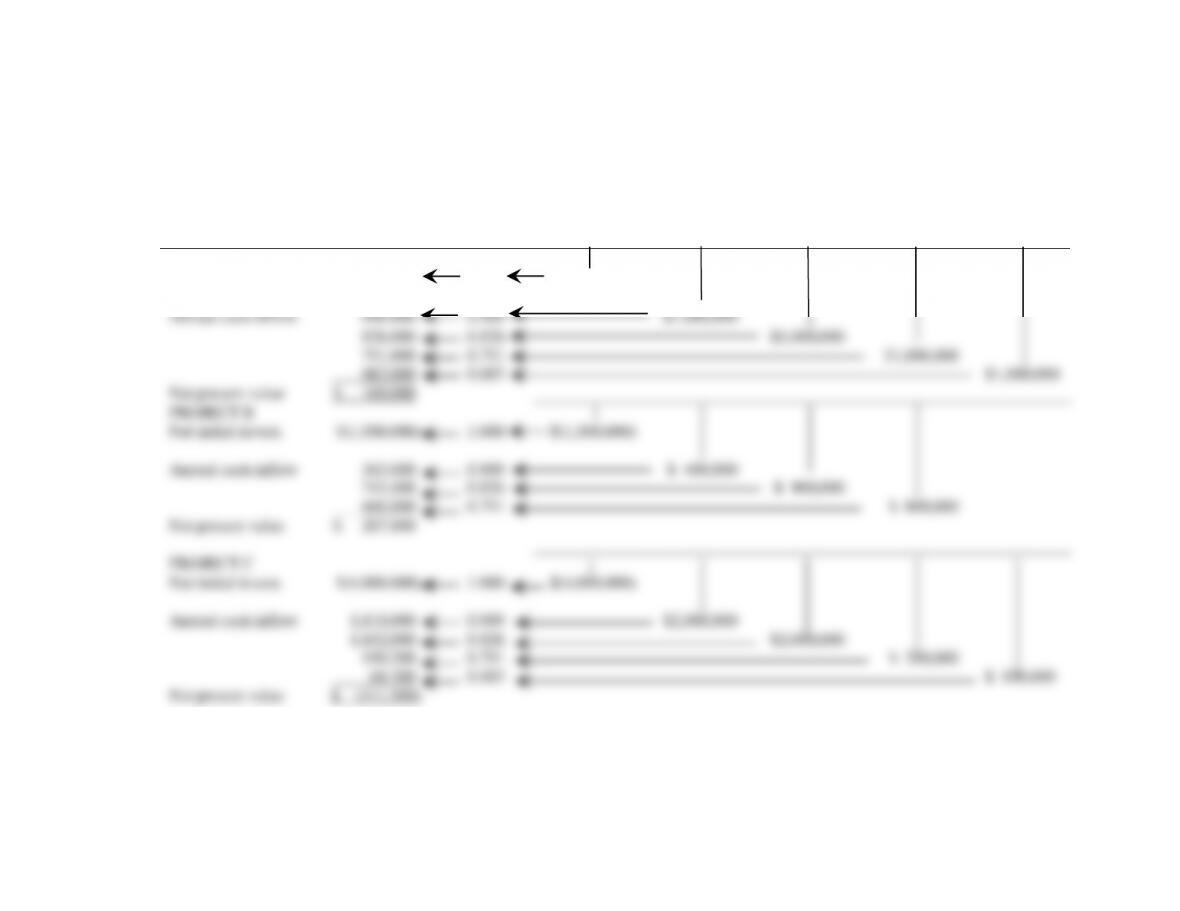
SOLUTION EXHIBIT 21-22
Total Present
Value
Present
Value
Discount
Factors at
10%
Sketch of Relevant Cash Flows
0
1
2
3
4
PROJECT A
Net initial invest.
$(3,000,000)
1.000
$(3,000,000)
Annual cash inflow
909,000
0.909
$1,000,000
826,000
0.826
$1,000,000
751,000
0.751
$1,000,000
683,000
0.683
$1,000,000
Net present value
$ 169,000
PROJECT B
Net initial invest.
$(1,500,000)
1.000
$(1,500,000)
Annual cash inflow
363,600
0.909
$ 400,000
743,400
0.826
$ 900,000
600,800
0.751
$ 800,000
Net present value
$ 207,800
PROJECT C
Net initial invest.
$(4,000,000)
1.000
$(4,000,000)
Annual cash inflow
1,818,000
0.909
$2,000,000
1,652,000
0.826
$2,000,000
150,200
0.751
$ 200,000
68,300
0.683
$ 100,000
Net present value
$ (311,500)
21-15
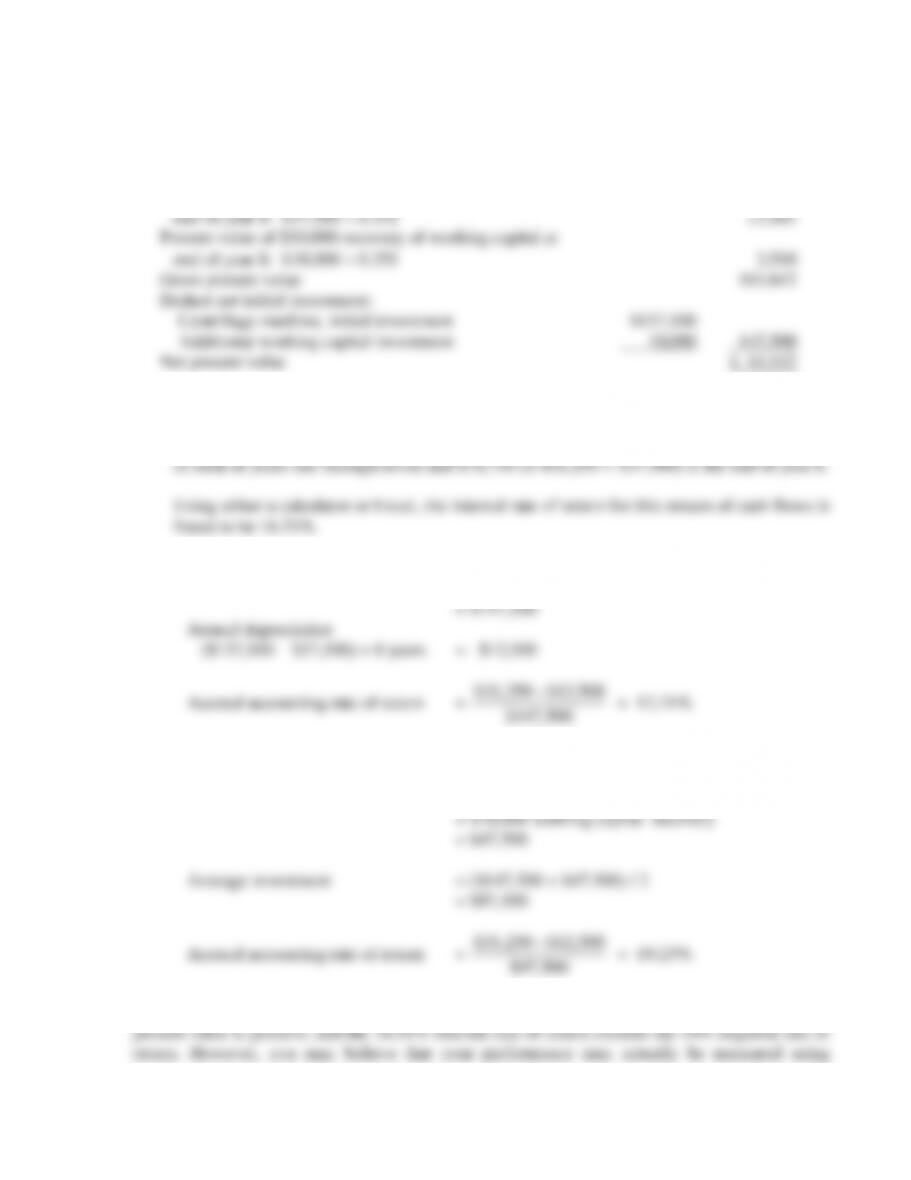
21-23 (22–30 min.) DCF, accrual accounting rate of return, working capital, evaluation of
performance, no income taxes.
1. Present value of annuity of savings in cash operating costs
($31,250 per year for 8 years at 14%): $31,250 4.639 $144,969
Present value of $37,500 terminal disposal price of machine at
2. The sequence of cash flows from the project is:
For a $147,500 initial outflow, the project now generates $31,250 in cash flows at the end
3. Accrual accounting rate of return based on net initial investment:
Net initial investment = $137,500 + $10,000
$147,500
4. Accrual accounting rate of return based on average investment:
Net terminal cash flow = $37,500 terminal disposal price
$97,500
5. If your decision is based on the DCF model, the purchase would be made because the net

21-16
accrual accounting. This approach would show a 12.71% return on the initial investment, which
21-17
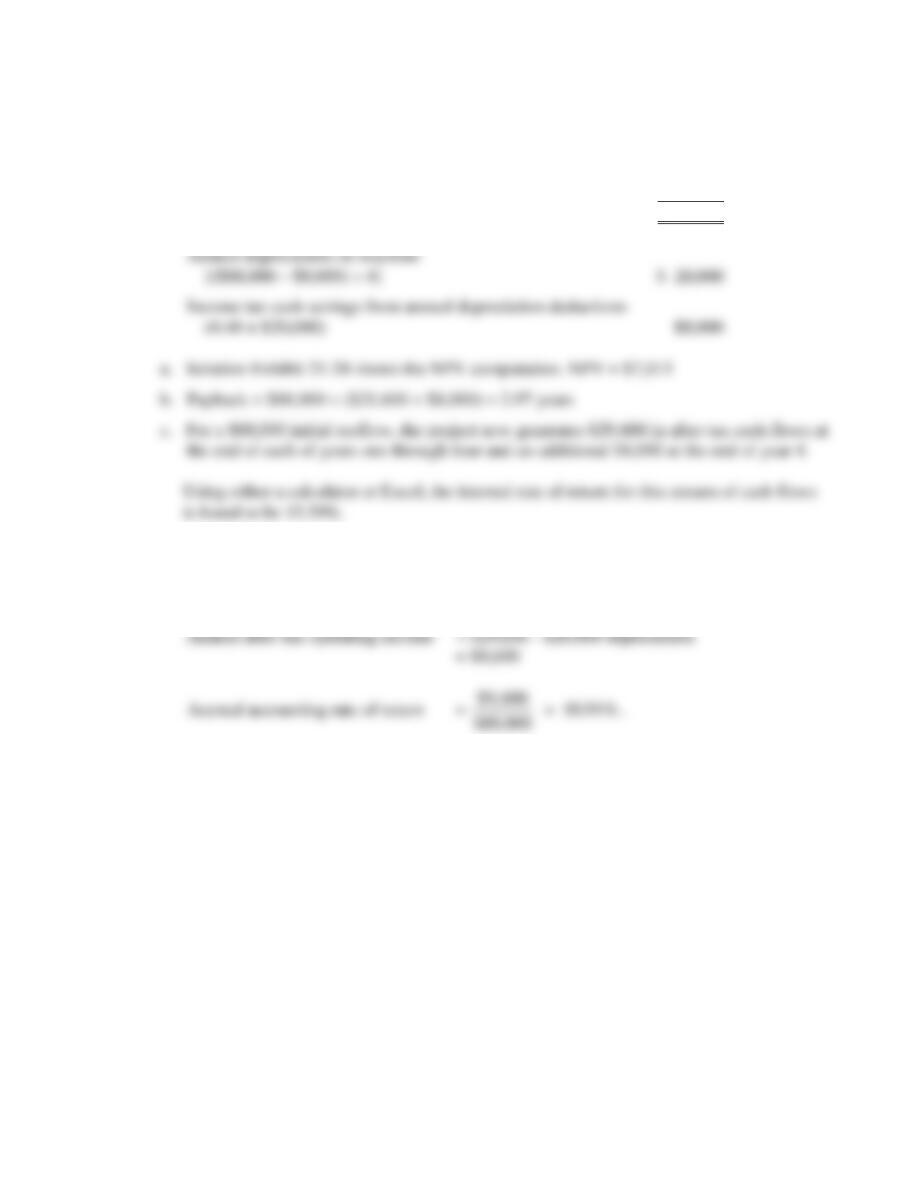
21-24 (40 min.) New equipment purchase, income taxes.
1. The after-tax cash inflow per year is $29,600 ($21,600 + $8,000), as shown below:
Annual cash flow from operations $ 36,000
Deduct income tax payments (0.40 × $36,000) 14,400
Annual after-tax cash flow from operations $ 21,600
2. Accrual accounting rate of return based on net initial investment:
Net initial investment = $88,000
$88,000
21-18
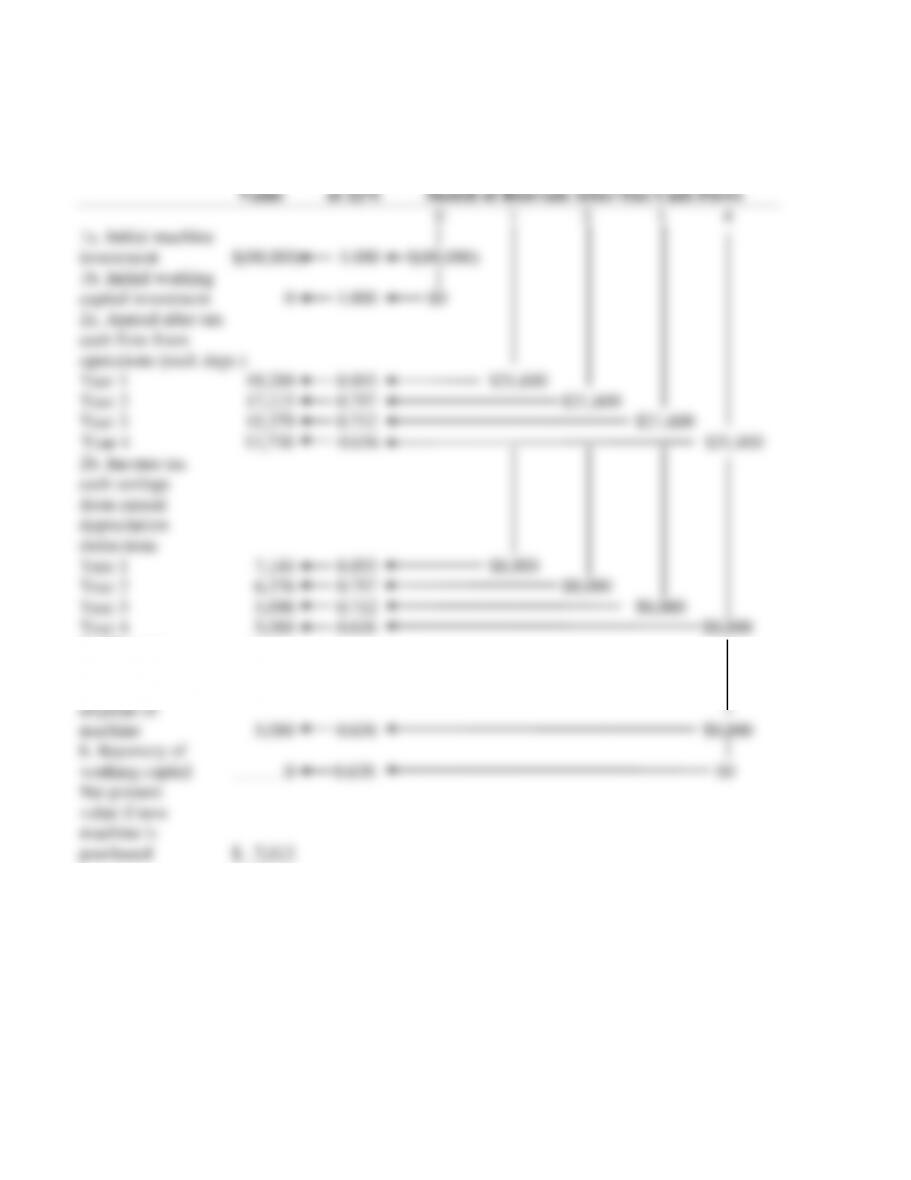
SOLUTION EXHIBIT 21-24
Present
Value
Total Discount
Present Factor
3. After-tax
cash flow from:
a. Terminal
21-19
21-25 (40 min.) New equipment purchase, income taxes.
1. The after-tax cash inflow per year is $21,500 ($16,250 + $5,250), as shown below:
Annual cash flow from operations
$25,000
Deduct income tax payments (0.35 $25,000)
8,750
Annual after-tax cash flow from operations
$16,250
Annual depreciation on motor ($75,000 5 years)
$15,000
Income tax cash savings from annual depreciation deductions
(0.35 $15,000)
$ 5,250
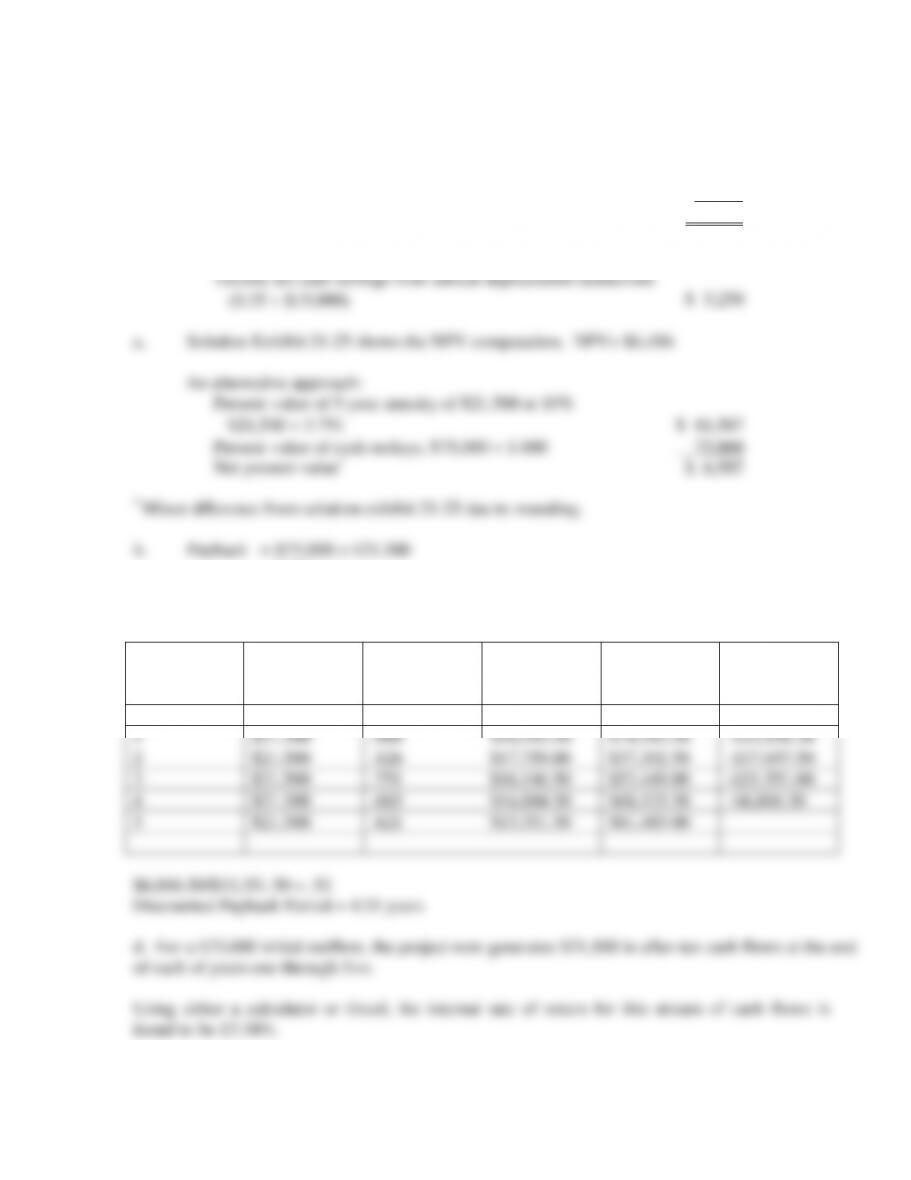
a. Solution Exhibit 21-25 shows the NPV computation. NPV= $6,486
An alternative approach:
Present value of 5-year annuity of $21,500 at 10%
$21,500 3.791 $ 81,507
Present value of cash outlays, $75,000 1.000 75,000
Net present value* $ 6,507
* Minor dfference from solution exhibit 21-25 due to rounding.
b. Payback = $75,000 ÷ $21,500
= 3.49 years
c. Discounted Payback Period
Period
Cash Savings
Disc Factor
(10%)
Discounted
Cash Savings
Cumulative
Disc Cash
Savings
Unrecovered
Investment
0
-$75,000.00
1
$21,500
.909
$19,543.50
$19,543.50
-$55,456.50
2
$21,500
.826
$17,759.00
$37,302.50
-$37,697.50
3
$21,500
.751
$16,146.50
$53,449.00
-$21,551.00
4
$21,500
.683
$14,684.50
$68,133.50
-$6,866.50
5
$21,500
.621
$13,351.50
$81,485.00
21-20
2. Both the net present value and internal rate of return methods use the discounted cash
flow approach in which all expected future cash inflows and outflows of a project are measured
as if they occurred at a single point in time. The net present value approach computes the surplus
generated by the project in today’s dollars while the internal rate of return attempts to measure its