20-1
CHAPTER 20
20-1 Cost of goods sold (in retail organizations) or direct materials costs (in organizations with
a manufacturing function) as a percentage of sales frequently exceeds net income as a percentage
1. purchasing costs;
3. carrying costs;
5. costs of quality; and
20-3 Five assumptions made when using the simplest version of the EOQ model are:
2. Demand, ordering costs, carrying costs, and the purchase-order lead time are certain.
4. No stockouts occur.
20-4 Costs included in the carrying costs of inventory are incremental costs for such items as
20-5 Examples of opportunity costs relevant to the EOQ decision model but typically not
recorded in accounting systems are the following:
2. lost contribution margin on existing sales when a stockout occurs; and
20-6 The steps in computing the costs of a prediction error when using the EOQ decision
model are:
20-2
20-7 Goal congruence issues arise when there is an inconsistency between the EOQ decision
20-8 Just-in-time (JIT) purchasing is the purchase of materials (or goods) so that they are
20-9 Factors causing reductions in the cost to place purchase orders of materials are:
• Companies are establishing long-run purchasing agreements that define price and
20-10 Disagree. Choosing the supplier who offers the lowest price will not necessarily result in
the lowest total purchase cost to the buyer. This is because the price or purchase cost of the
20-11 Supply-chain analysis describes the flow of goods, services, and information from the
initial sources of materials and services to the delivery of products to consumers, regardless of
20-12 Just-in-time (JIT) production is a “demand–pull” manufacturing system that has the
following features:
manner.
20-13 Traditional normal and standard costing systems use sequential tracking, in which journal
entries are recorded in the same order as actual purchases and progress in production, typically at
20-3
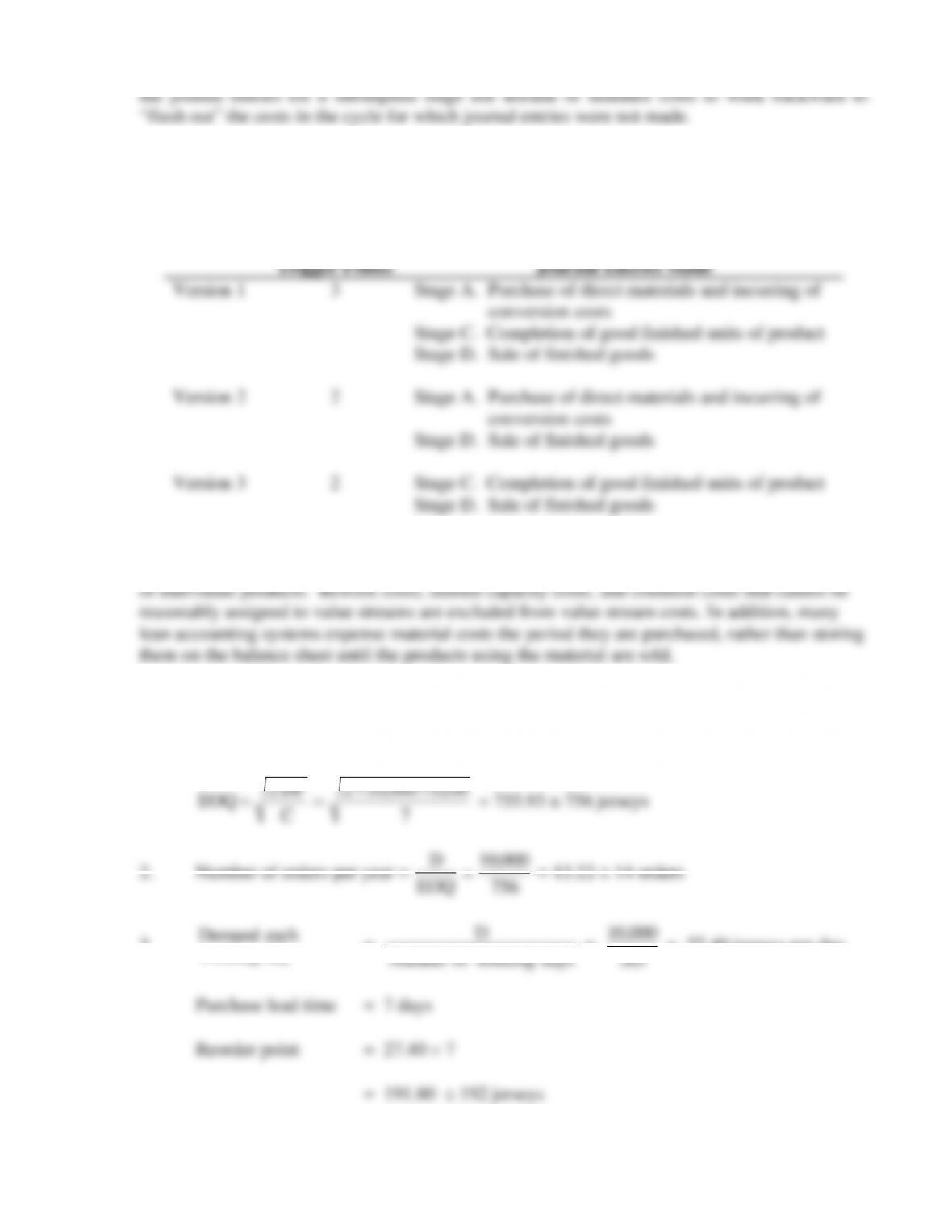
20-14 Versions of backflush costing differ in the number and placement of trigger points at
which journal entries are made in the accounting system:
Number of
Journal Entry
Trigger Points
Location in Cycle Where
Journal Entries Made
Version 1
3
Stage A. Purchase of direct materials and incurring of
conversion costs
Stage C. Completion of good finished units of product
Stage D. Sale of finished goods
Version 2
2
Stage A. Purchase of direct materials and incurring of
conversion costs
Stage D. Sale of finished goods
Version 3
2
Stage C. Completion of good finished units of product
Stage D. Sale of finished goods
20-15 Traditional accounting systems cost individual products, and separate product costs from
selling, general, and administrative costs. Lean accounting costs the entire value stream instead
20-16 (20 min.) Economic order quantity for retailer.
1. D = 10,000 jerseys per year, P = $200, C = $7 per jersey per year
200$000,102
DP 2
3.
day working each Demand
=
days workingofNumber
D
=
365
000,10
= 27.40 jerseys per day
1. D = 10,000 jerseys per year, P = $30, C = $7 per jersey per year
30$000,102
DP 2
20-5
20-19 (20 min.) EOQ for manufacturer.
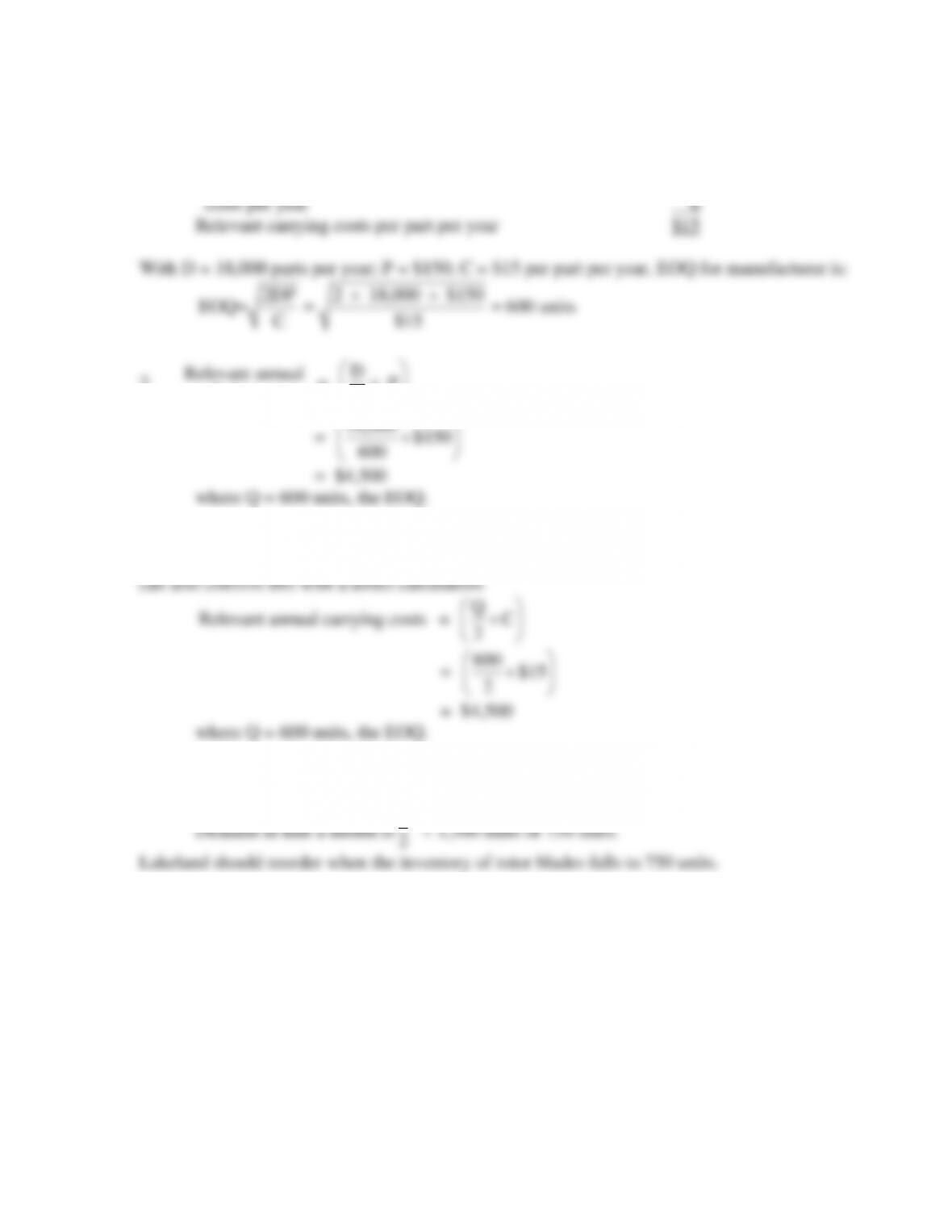
1. Relevant carrying costs per part per year:
Required annual return on investment 15% $60 = $ 9
Relevant insurance, materials handling, breakage, etc.
2.
Relevant annual
ordering costs
=
D P
Q
$150
000,18
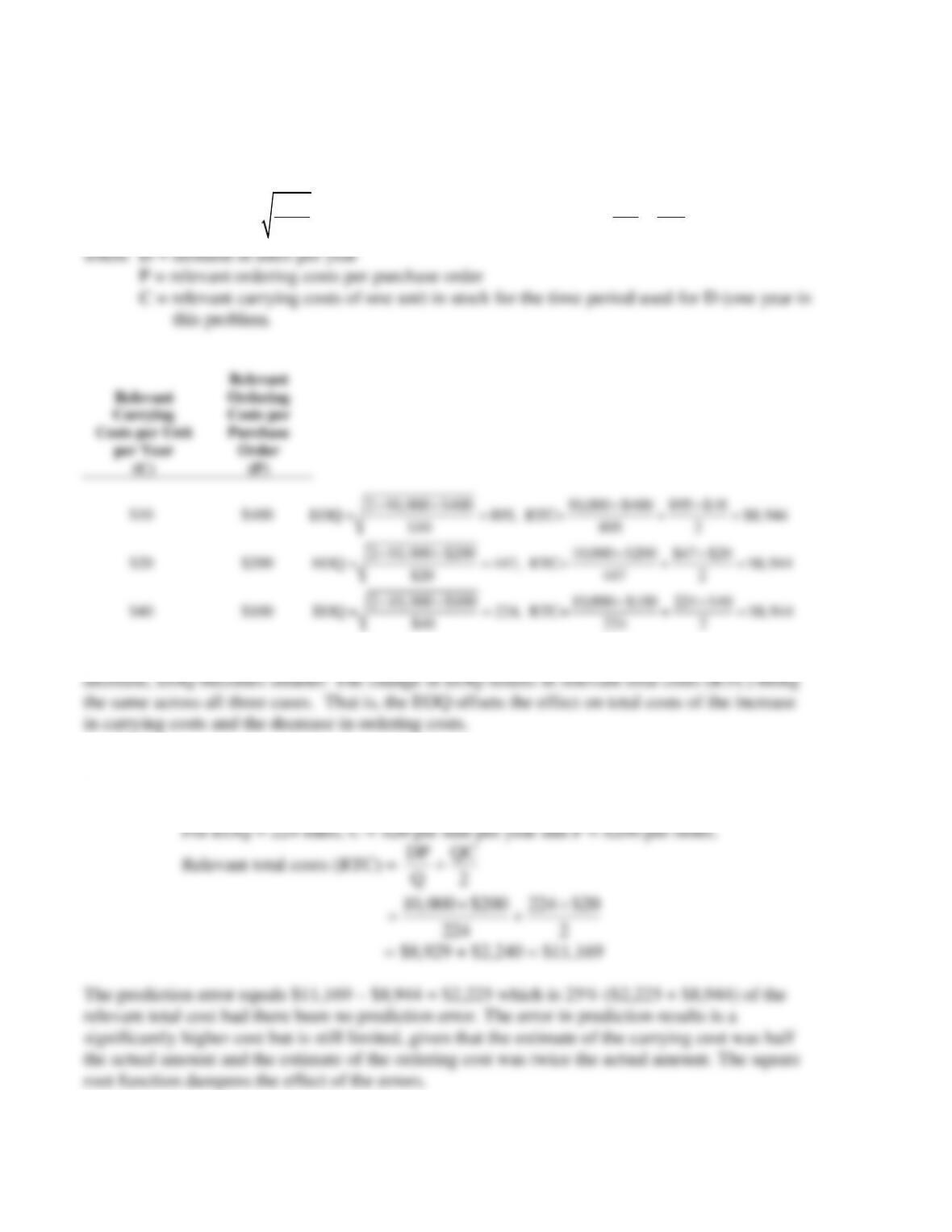
3. At the EOQ, total relevant ordering costs and total relevant carrying costs will be exactly
equal. Therefore, total relevant carrying costs at the EOQ = $4,500 (from requirement 2). We
4. Purchase order lead time is half a month.
Monthly demand is 18,000 units ÷ 12 months = 1,500 units per month.
20-6
20-20 (20 min.) Sensitivity of EOQ to changes in relevant ordering and carrying costs.
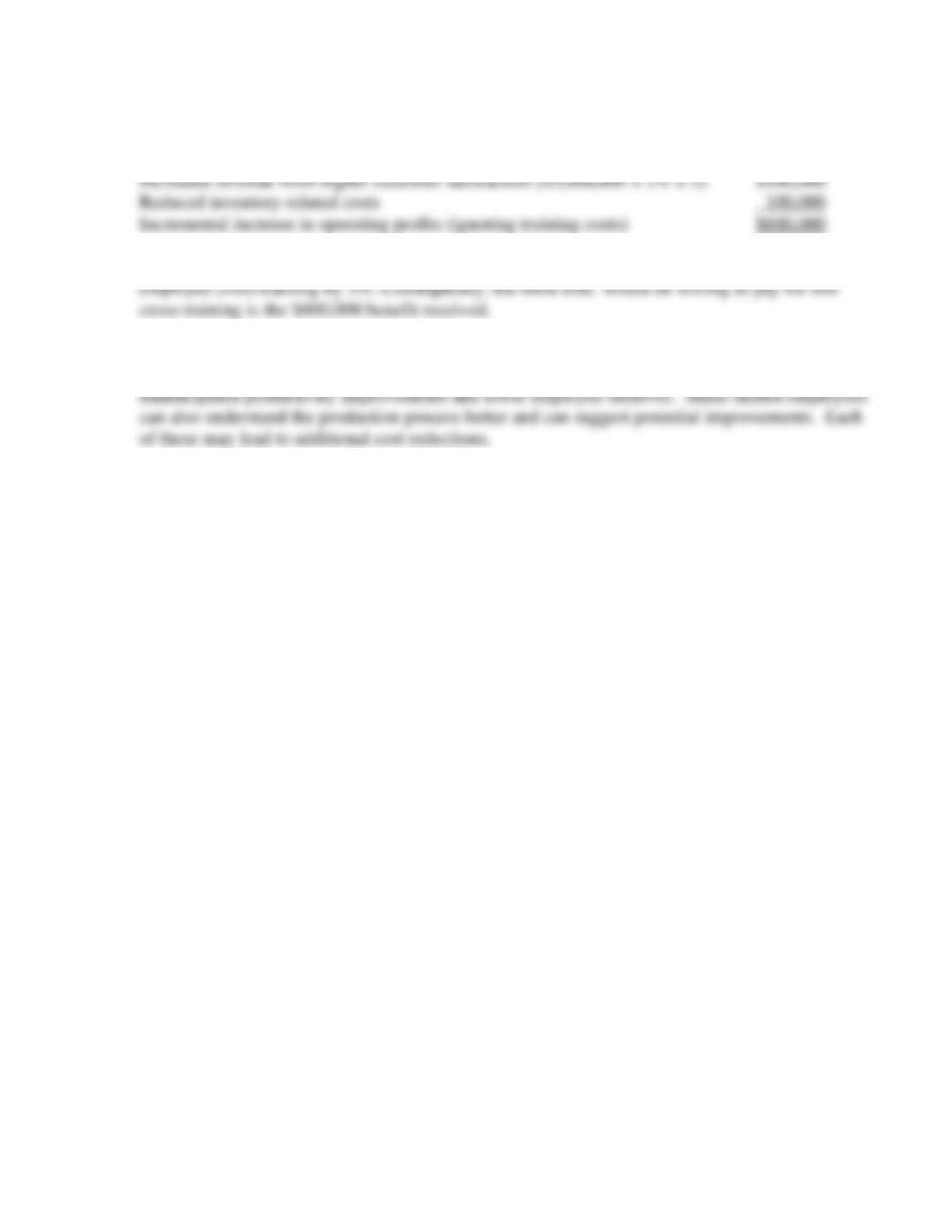
1. A straightforward approach to the requirement is to construct the following table for
EOQ at relevant carrying and ordering costs. Annual demand is 10,000 units. The formula for the
EOQ model is:
EOQ =
2DP DP QC
and for Relevant Total Costs (RTC) =
C Q 2
+
$40 224 2
2. For a given demand level, as relevant carrying costs increase and relevant ordering costs
3. If Alpha estimates C = $10 per unit per year and P = $400 per order, then from
requirement 1,
EOQ = 224 units and Relevant Total Cost (RTC) = $8,944
20-7
20-21 (15 min.) Inventory management and the balanced scorecard.
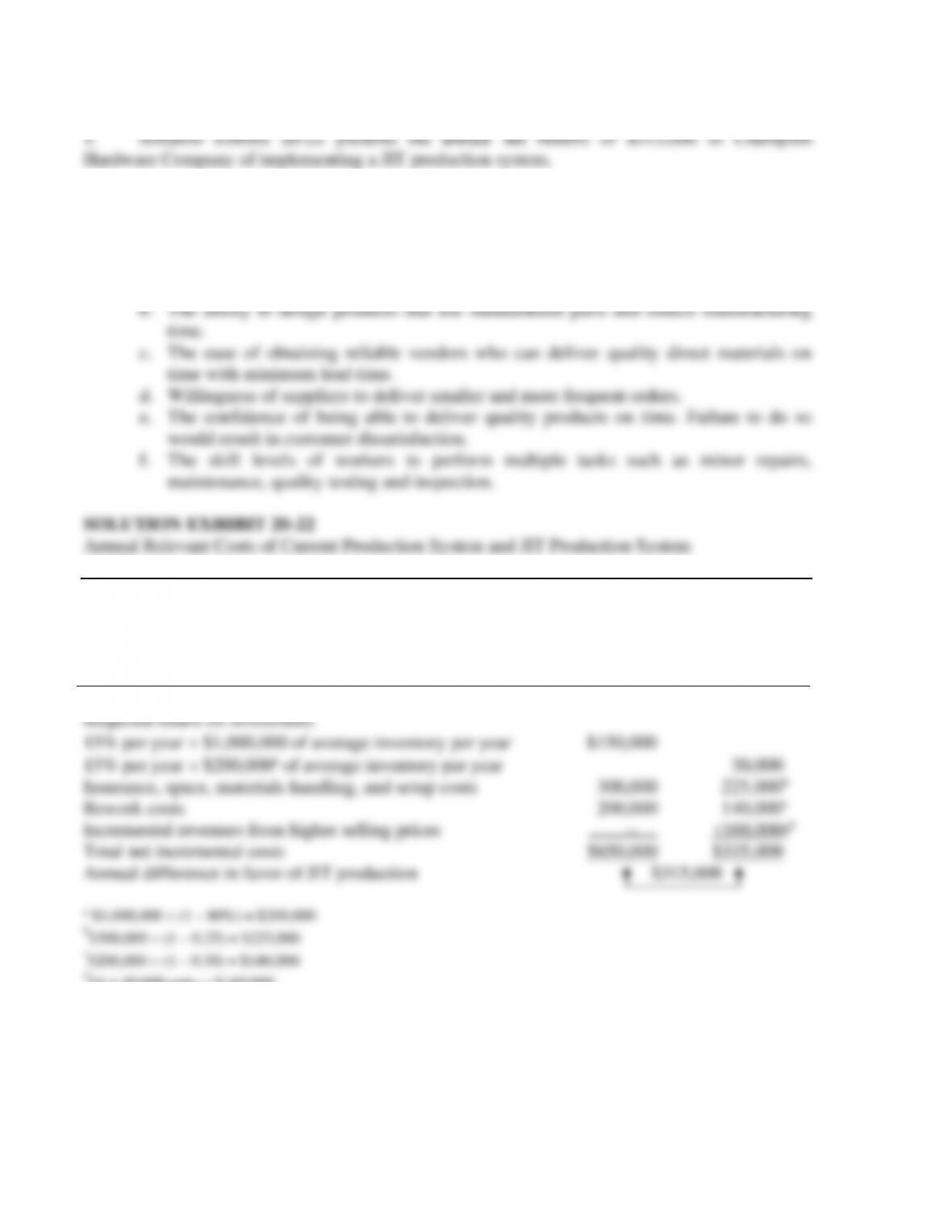
1. The incremental increase in operating profits from employee cross-training (ignoring the cost
of the training) is:
2. At a cost of $600,000, DSC will be indifferent between current expenditures and increasing
3. Besides increasing short-term operating profits, additional employee cross-training can
improve employee satisfaction because their jobs can have more variety, potentially leading to
20-8
20-22 (20 min.) JIT production, relevant benefits, relevant costs.
2. Other nonfinancial and qualitative factors that Champion should consider in deciding
whether it should implement a JIT system include:
a. The possibility of developing and implementing a detailed system for integrating the
sequential operations of the manufacturing process. Direct materials must arrive when
needed for each subassembly so that the production process functions smoothly.
for Champion Hardware Company
Relevant Items
Relevant
Costs under
Current
Production
System
Relevant
Costs under
JIT
Production
System
Annual tooling costs
–
$100,000
Required return on investment:
15% per year $1,000,000 of average inventory per year
$150,000
15% per year $200,000a of average inventory per year
30,000
Insurance, space, materials handling, and setup costs
300,000
225,000b
Rework costs
200,000
140,000c
Incremental revenues from higher selling prices
–
(160,000)d
Total net incremental costs
$650,000
$335,000
20-9
3. Personal observation by production line workers and managers is more effective in JIT
plants than in traditional plants. A JIT plant’s production process layout is streamlined.
Operations are not obscured by piles of inventory or rework. As a result, such plants are easier to
evaluate by personal observation than cluttered plants where the flow of production is not
logically laid out.
20-10
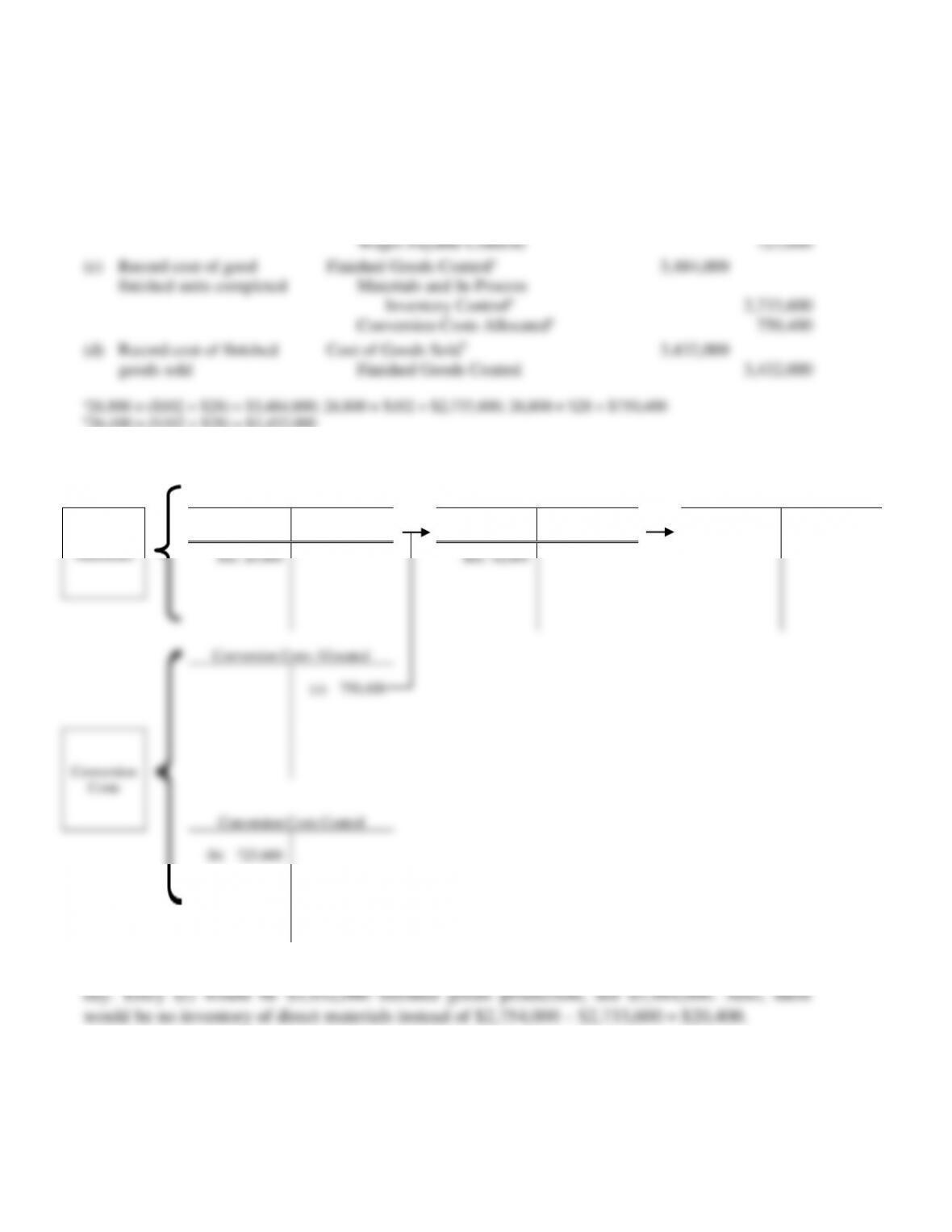
20-23 (30 min.) Backflush costing and JIT production.
1.
(a) Record purchases of
direct materials
Materials and In-Process Inventory Control
Accounts Payable Control
2,754,000
2,754,000
(b) Record conversion costs
incurred
Conversion Costs Control
Various Accounts (such as
723,600
Wages Payable Control)
723,600
(c) Record cost of good
finished units completed
Finished Goods Controla
Materials and In-Process
3,484,000
Inventory Controla
2,733,600
Conversion Costs Allocateda
750,400
(d) Record cost of finished
goods sold
Cost of Goods Soldb
Finished Goods Control
3,432,000
3,432,000
2.
Materials and In-Process
Inventory Control
Finished Goods Control
Cost of Goods Sold
Direct
Materials
(a) 2,754,000
(c) 2,733,600
(c) 3,484,000
(d) 3,432,000
(d) 3,432,000
Bal. 20,400
Bal. 52,000
Conversion Costs Allocated
(c) 750,400
Conversion
Costs
Conversion Costs Control
(b) 723,600
3. Under an ideal JIT production system, there would be zero inventories at the end of each