20-11
1.
(a). Record purchases of direct
materials
Inventory Control
Accounts Payable Control
2,754,000
2,754,000
(b) Record conversion costs
incurred
Conversion Costs Control
Various Accounts (such as
723,600
Wages Payable Control)
723,600
(c) Record cost of good
finished units completed
No entry
(d) Record cost of finished
goods sold
Cost of Goods Solda
Inventory Controla
3,432,000
2,692,800
Conversion Costs Allocateda
739,200
(e) Record underallocated or over-
allocated conversion costs
Conversion Costs Allocated
Costs of Goods Sold
739,200
15,600
Conversion Costs Control
723,600
a26,400 × ($102 + $28) = $3,432,000; 26,400 × $102 = $2,692,800; 26,400 × $28 = $739,200
2.
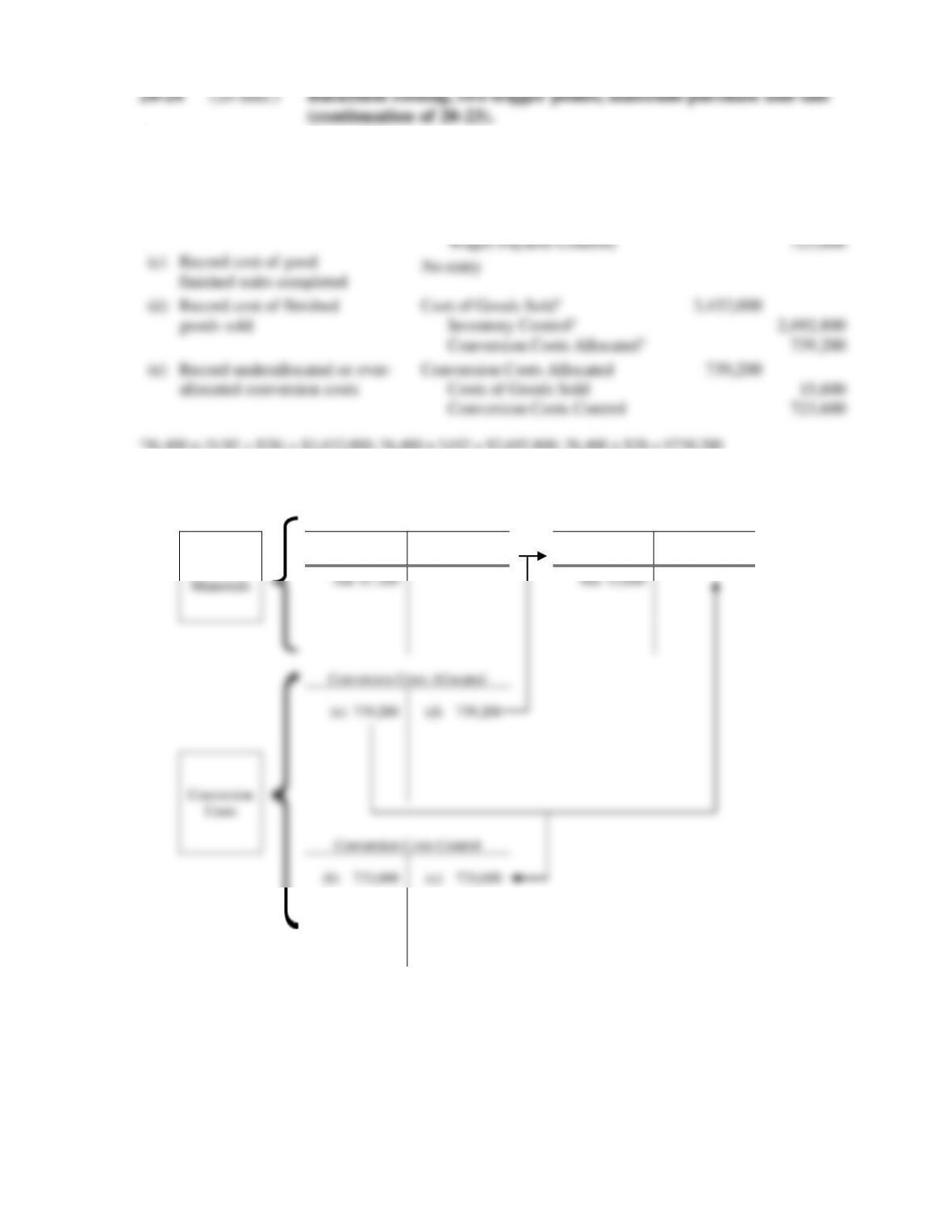
Inventory Control
Cost of Goods Sold
Direct
Materials
(a) 2,754,000
(d) 2,692,800
(d) 3,432,000
(e) 15,600
Bal. 61,200
Bal. 52,000
Conversion Costs Allocated
(e) 739,200
(d) 739,200
Conversion
Costs
Conversion Costs Control
(b) 723,600
(e) 723,600
20-12
1.
(a). Record purchases of direct
materials
No Entry
(b) Record conversion costs
incurred
Conversion Costs Control
Various Accounts (such as
723,600
Wages Payable Control)
723,600
(c) Record cost of good finished
units completed
Finished Goods Controla
Accounts Payable Controla
3,484,000
2,733,600
Conversion Costs Allocateda
750,400
(d) Record cost of finished
goods sold
Cost of Goods Soldb
Finished Goods Control
3,432,000
3,432,000
(e) Record underallocated or over-
allocated conversion costs
Conversion Costs Allocated
Costs of Goods Sold
750,400
26,800
Conversion Costs Control
723,600
2.
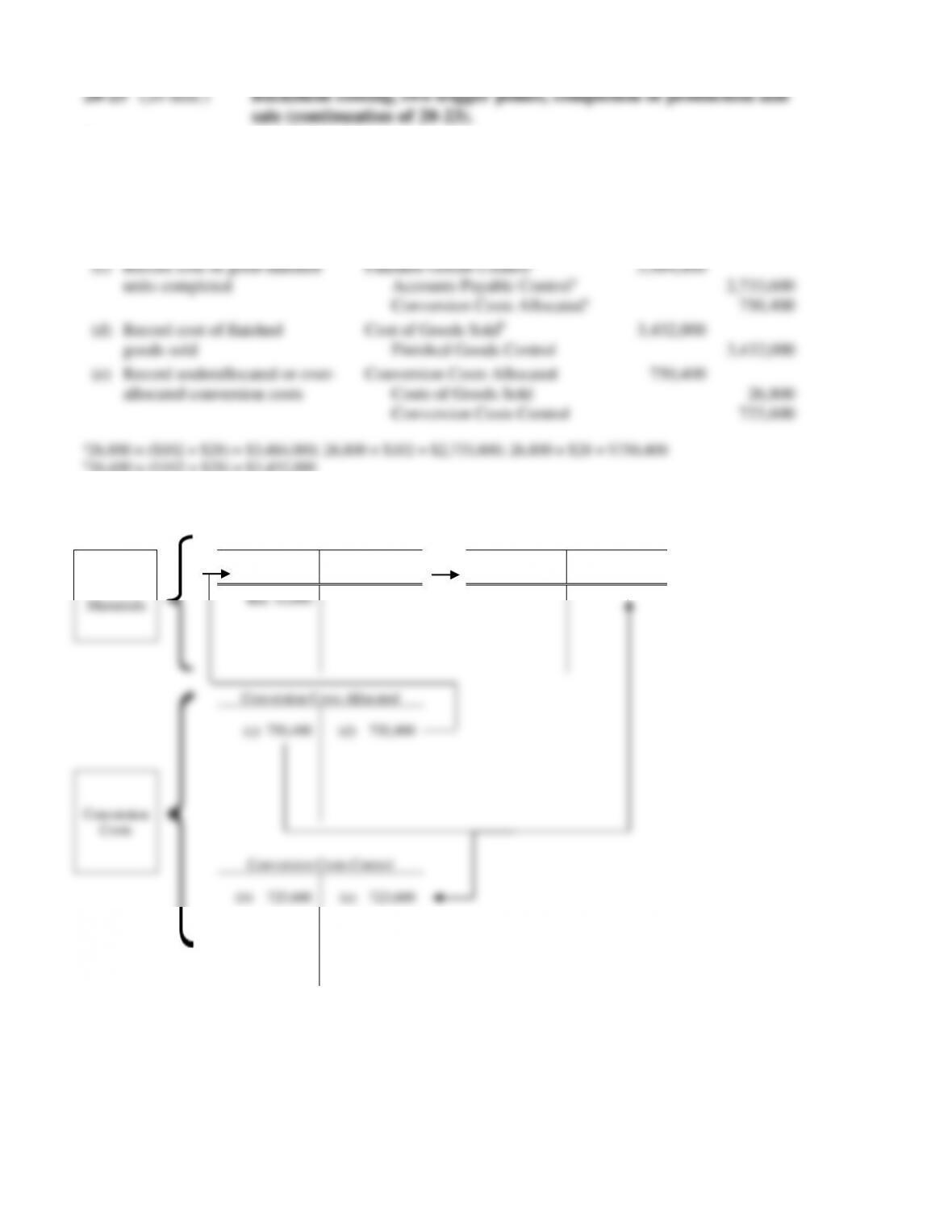
Finished Goods Control
Cost of Goods Sold
Direct
Materials
(a) 3,484,000
(d) 3,432,800
(d) 3,432,000
(e) 26,800
Bal. 52,000
Conversion Costs Allocated
(e) 750,400
(d) 750,400
Conversion
Costs
Conversion Costs Control
(b) 723,600
(e) 723,600
1.
Scenario
1
2
3
4
5
Demand (units) (D)
380,000
380,000
380,000
380,000
380,000
Cost per purchase order (P)
$ 57.00
$ 57.00
$ 57.00
$ 57.00
$ 57.00
Annual carrying cost per package (C)
$ 12.00
$ 12.00
$ 12.00
$ 12.00
$ 12.00
Order quantity per purchase order (units) (Q)
760
1,000
1,900
3,800
4,750
Number of purchase orders per year (D
Q)
500
380
200
100
80
Annual ordering costs (D
Q)
P
$28,500
$21,660
$11,400
$ 5,700
$ 4,560
Annual carrying costs (QC
2)
$ 4,560
$ 6,000
$11,400
$22,800
$28,500
Total relevant costs of ordering and carrying inventory
$33,060
$27,660
$22,800
$28,500
$33,060
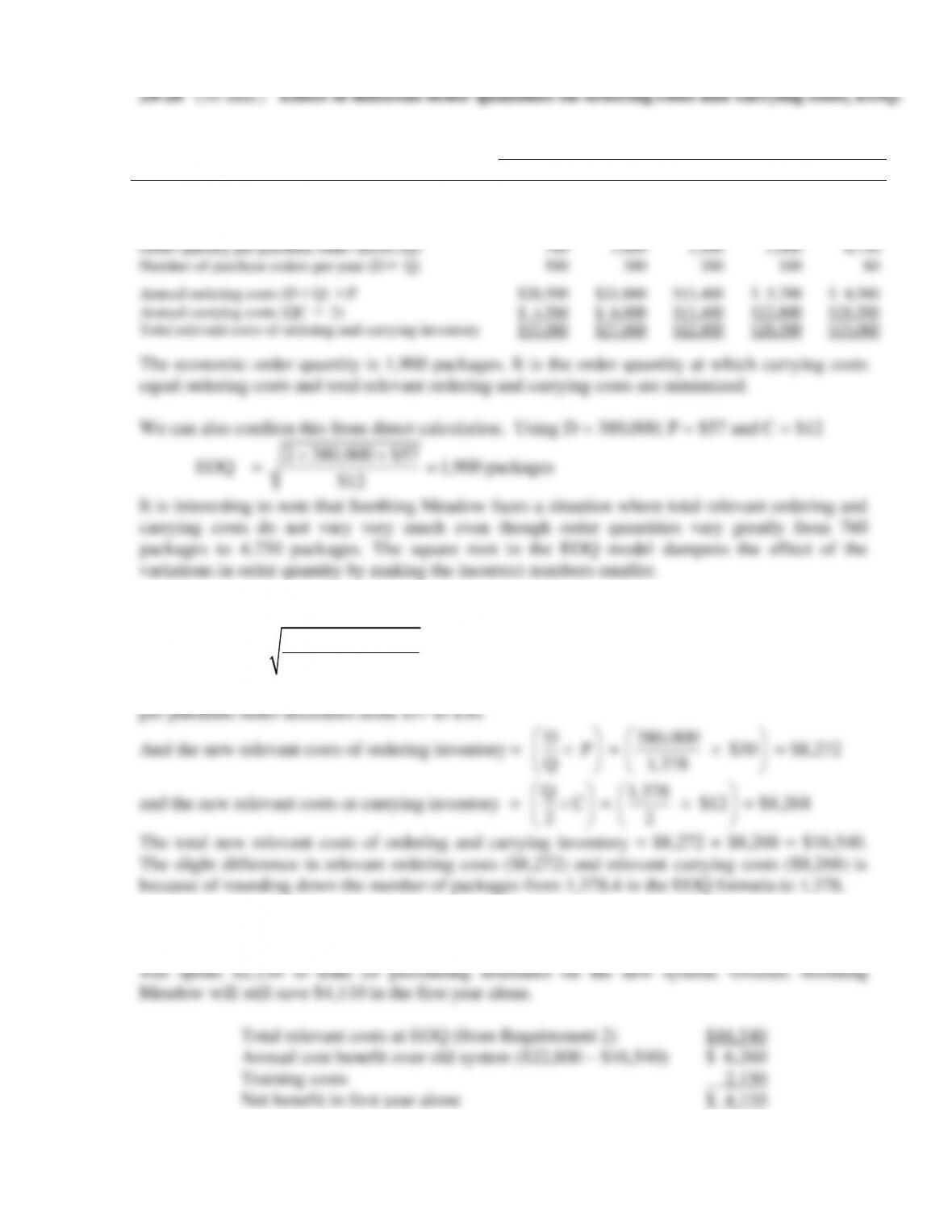
2. When the ordering cost per purchase order is reduced to $30:
EOQ =
2 380,000 $30 1,378.4 packages (or 1,378 packages)
$12
=
The EOQ drops from 1,900 packages to 1,378 packages when Soothing Meadow’s ordering cost
3. As summarized below, the new Mona Lisa web-based ordering system, by lowering the
EOQ to 1,378 packages, will lower the carrying and ordering costs by $6,260. Soothing Meadow
20-27 (30 min.) EOQ, uncertainty, safety stock, reorder point.
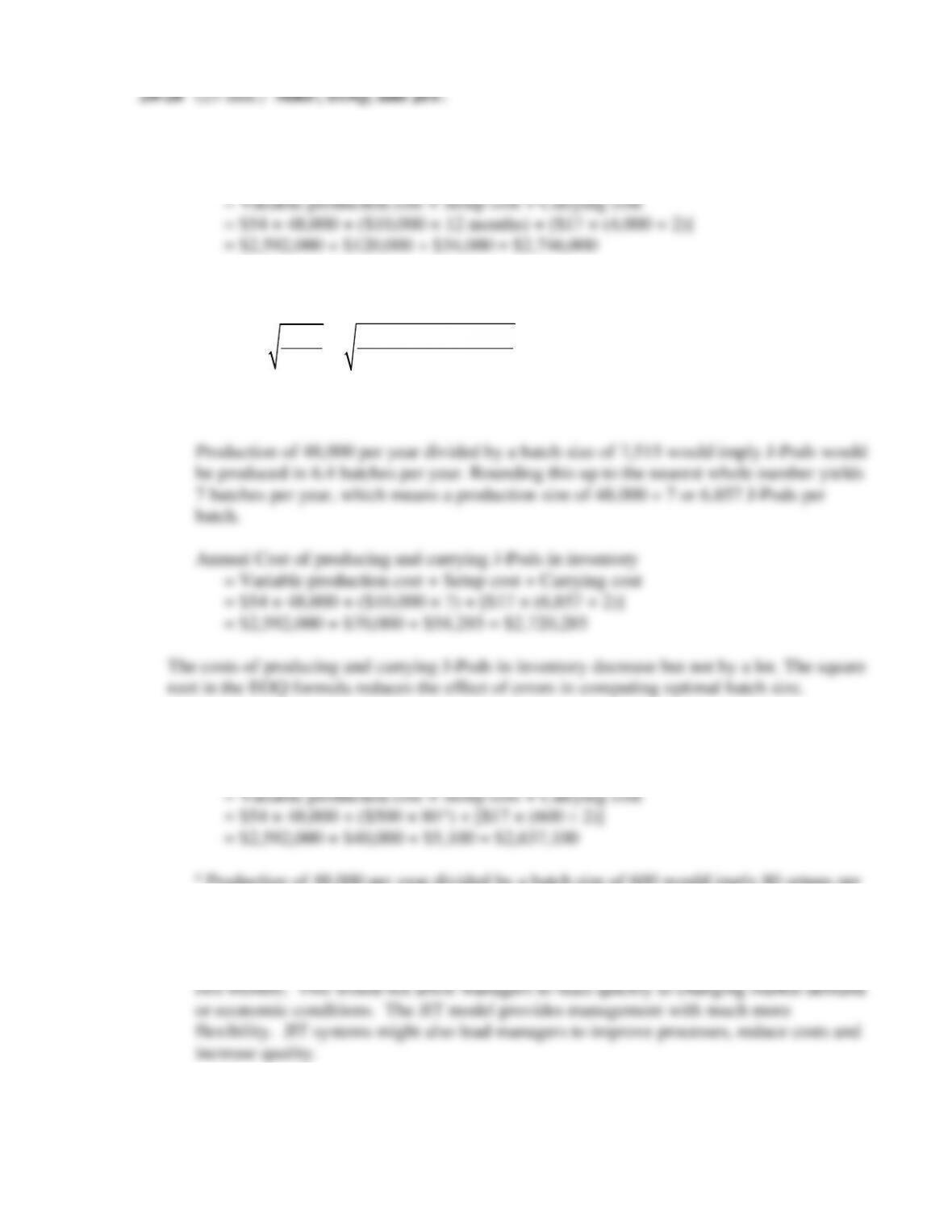
2 DP 2 120,000 $250
2. Weekly demand = Monthly demand ÷ 4
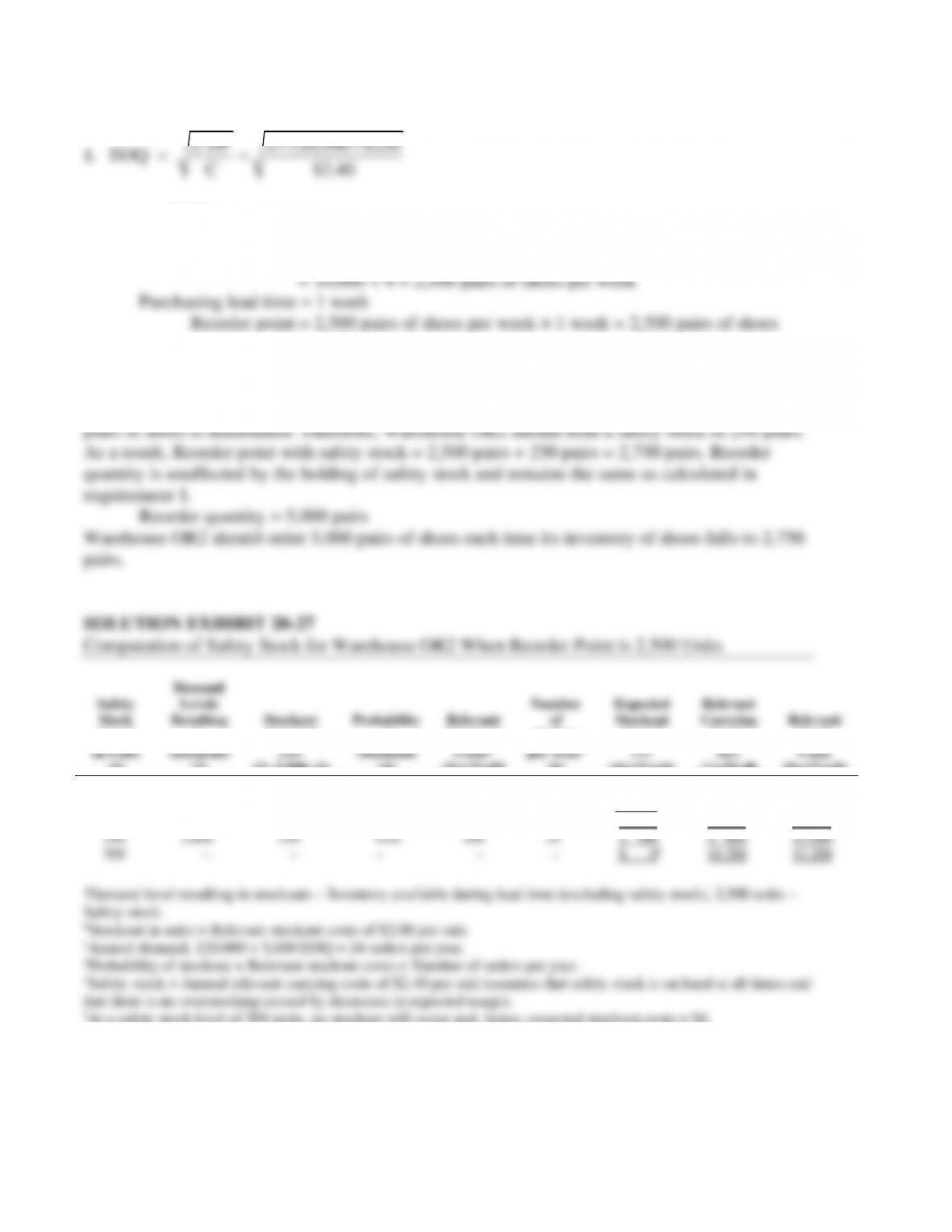
3. Solution Exhibit 20-27 presents the safety stock computations for Warehouse OR2 when
the reorder point excluding safety stock is 2,500 pairs of shoes. The exhibit shows that annual
relevant total stockout and carrying costs are the lowest ($1,080) when a safety stock of 250
20-15
1. Under a MRP system:
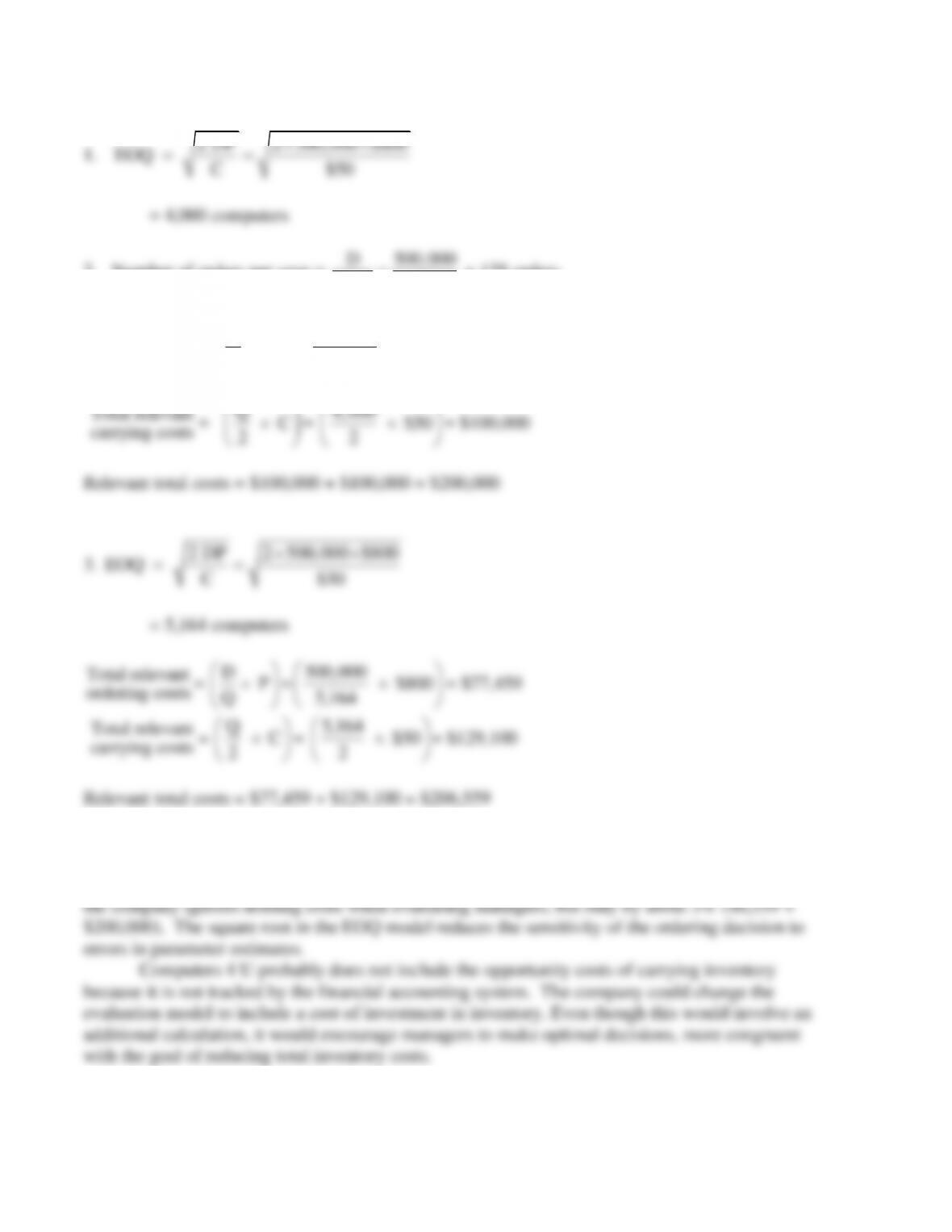
Annual cost of producing and carrying J-Pods in inventory
2. Using an EOQ model to determine batch size:
2 48,000 $10,000
2 DP
EOQ C $17
==
= 7,515 J-Pods per batch
3. Under a JIT system
Annual Cost of producing and carrying J-Pods in inventory
year.
4. The JIT model resulted in the lowest costs because set up and carrying costs were lower
than for the EOQ model. The EOQ model also limits production to almost once every
20-29 (30 min.) Effect of management evaluation criteria on EOQ model.
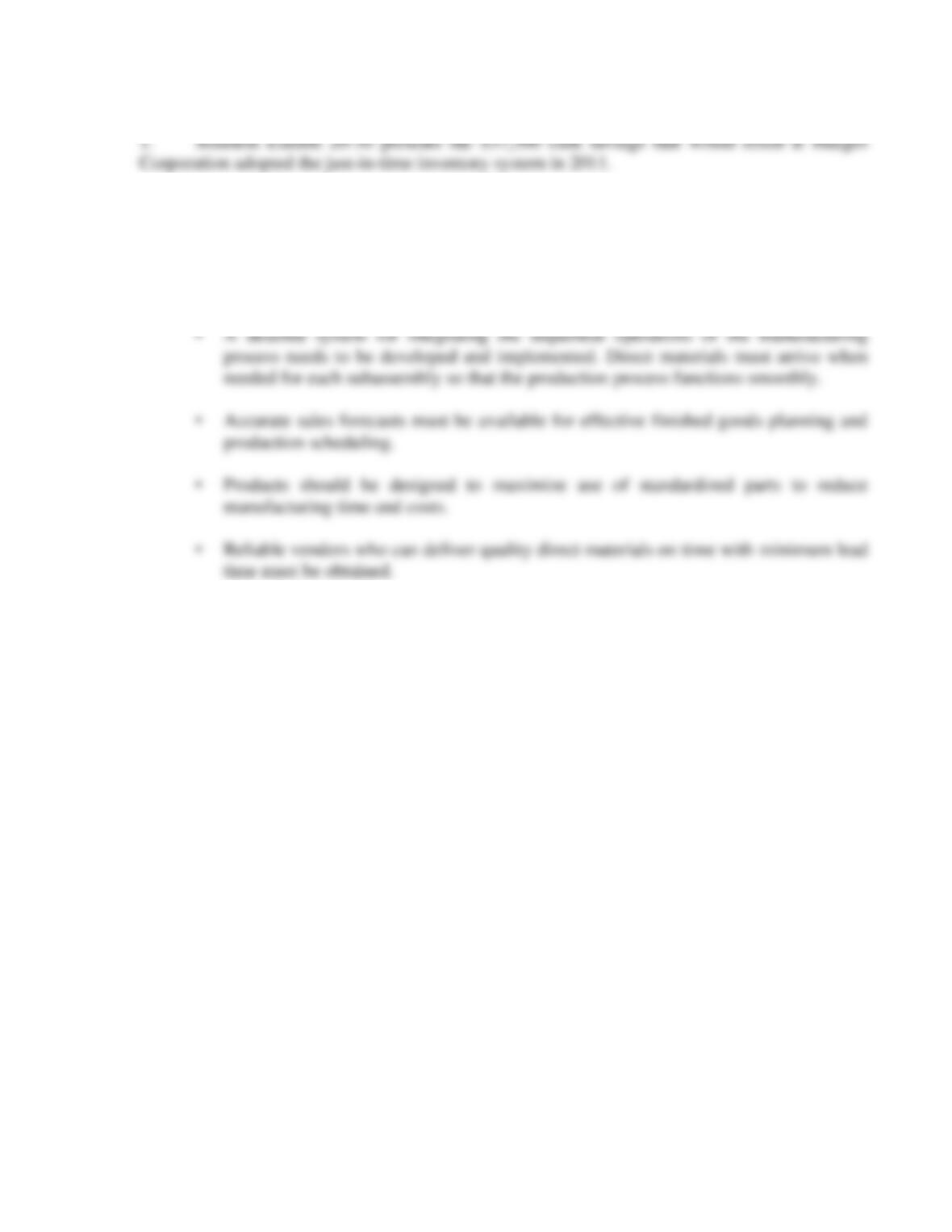
2 DP 2 500,000 $800
2. Number of orders per year =
D 500,000
EOQ 4,000
=
= 125 orders
Total relevant
=
ordering costs
D P
Q
=
500,000 $800
4,000
= $100,000
=
Total relevant
Q C
4,000 $50
carrying costs
2 DP 2 500,000 $800
D P
Q
500,000 $800
5,164
Q C
20-17
20-30 (30 min.) JIT purchasing, relevant benefits, relevant costs.
2. Conditions that should exist in order for a company to successfully adopt just-in-time
purchasing include the following:
• Top management must be committed and provide the necessary leadership support to
ensure a company-wide, coordinated effort.