2-21
2-35 (15–20 min.) Interpretation of statements (continuation of 2-32).
1. The schedule in 2-34 can become a Schedule of Cost of Goods Manufactured and Sold
simply by including the beginning and ending finished goods inventory figures in the supporting
2. The sales manager’s salary would be charged as a marketing cost as incurred by both
manufacturing and merchandising companies. It is basically an operating cost that appears below
3. The direct-indirect distinction can be resolved only with respect to a particular cost
5. Direct materials unit cost would be unchanged at $320 per unit. Depreciation cost per
6. Unit costs are averages, and they must be interpreted with caution. The $320 direct materials
unit cost is valid for predicting total costs because direct materials is a variable cost; total direct
2-22
2-36 (25–30 min.) Income statement and schedule of cost of goods manufactured.
Calendar Corporation
Income Statement
for the Year Ended December 31, 2011
(in millions)
Schedule of Cost of Goods Manufactured
for the Year Ended December 31, 2011
(in millions)
Direct material costs
Beginning inventory, Jan. 1, 2011 $ 32
Depreciation––plant and equipment 6
Miscellaneous manufacturing overhead costs 15 63
Manufacturing costs incurred during 2011 213
Add beginning work–in–process inventory, Jan. 1, 2011 18
Total manufacturing costs to account for 231
2-23
2-37 (15–20 min.)Terminology, interpretation of statements (continuation of 2–34).
1. Direct materials used $108 million
Direct manufacturing labor costs 42 million
2. Inventoriable costs (in millions) for Year 2011
Plant utilities $ 9
Indirect manufacturing labor 27
3. Design costs and R&D costs may be regarded as product costs in case of contracting with
5. Direct materials unit cost would be unchanged at $108. Depreciation unit cost would be
6. In this case, equipment depreciation is a variable cost in relation to the unit output. The
2-24
1.(a) Total cost of hours worked at regular rates
44 hours × $20 per hour
$ 880
43 hours × $20 per hour
860
48 hours × $20 per hour
960
46 hours × $20 per hour
920
3,620
Minus idle time
(3.5 hours × $20 per hour)
(6.4 hours × $20 per hour)
(5.8 hours × $20 per hour)
(2 hours × $20 per hour)
70
128
116
40
Total idle time
354
Direct manufacturing labor costs
$3,266
(b) Idle time = 17.7 hours × $20 per hour =
(c) Overtime and holiday premium.
$ 354
Week 1: Overtime (44 – 40) hours × Premium, $10 per hour
$ 40
Week 2: Overtime (43 – 40) hours × Premium, $10 per hour
30
Week 3: Overtime (48 – 40) hours × Premium, $20 per hour
160
Week 4: Overtime (46 – 40) hours × Premium, $10 per hour
60
Week 4: Holiday 8 hours × 2 days × Premium, $20 per hour
320
Total overtime and holiday premium
$ 610
(d) Total earnings in December
Direct manufacturing labor costs
$3,266
Idle time
354
Overtime and holiday premium
610
Total earnings
$4,230
2. Idle time caused by regular machine maintenance, slow order periods, or unexpected
mechanical problems is an indirect cost of the product because it is not related to a specific
product.
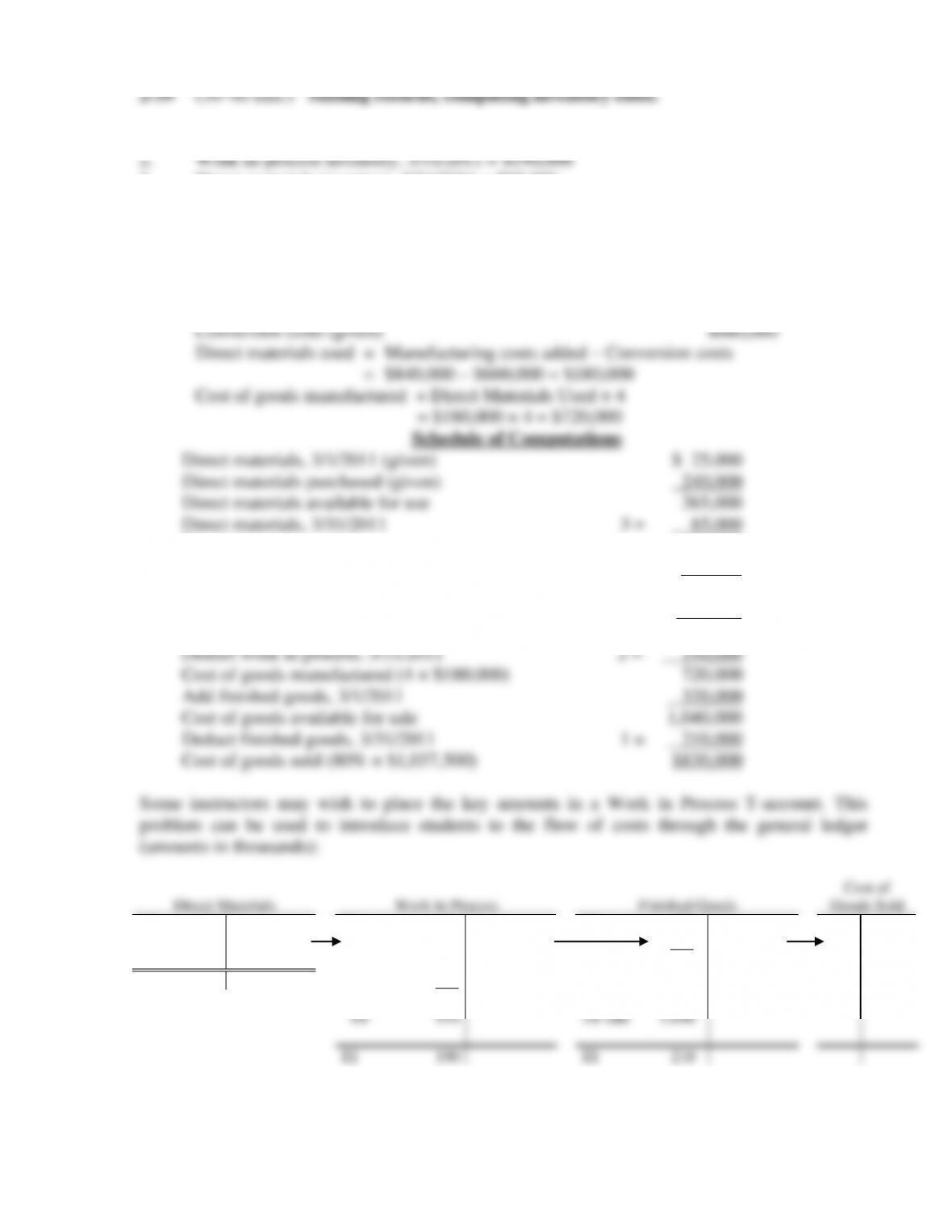
1. Finished goods inventory, 3/31/2011 = $210,000
3. Direct materials inventory, 3/31/2011 = $85,000
This problem is not as easy as it first appears. These answers are obtained by working from the
known figures to the unknowns in the schedule below. The basic relationships between
categories of costs are:
Manufacturing costs added during the period (given) $840,000
Direct materials used 180,000
Conversion costs (given) 660,000
Manufacturing costs added during the period (given) 840,000
Add work in process, 3/1/2011 (given) 70,000
Manufacturing costs to account for 910,000
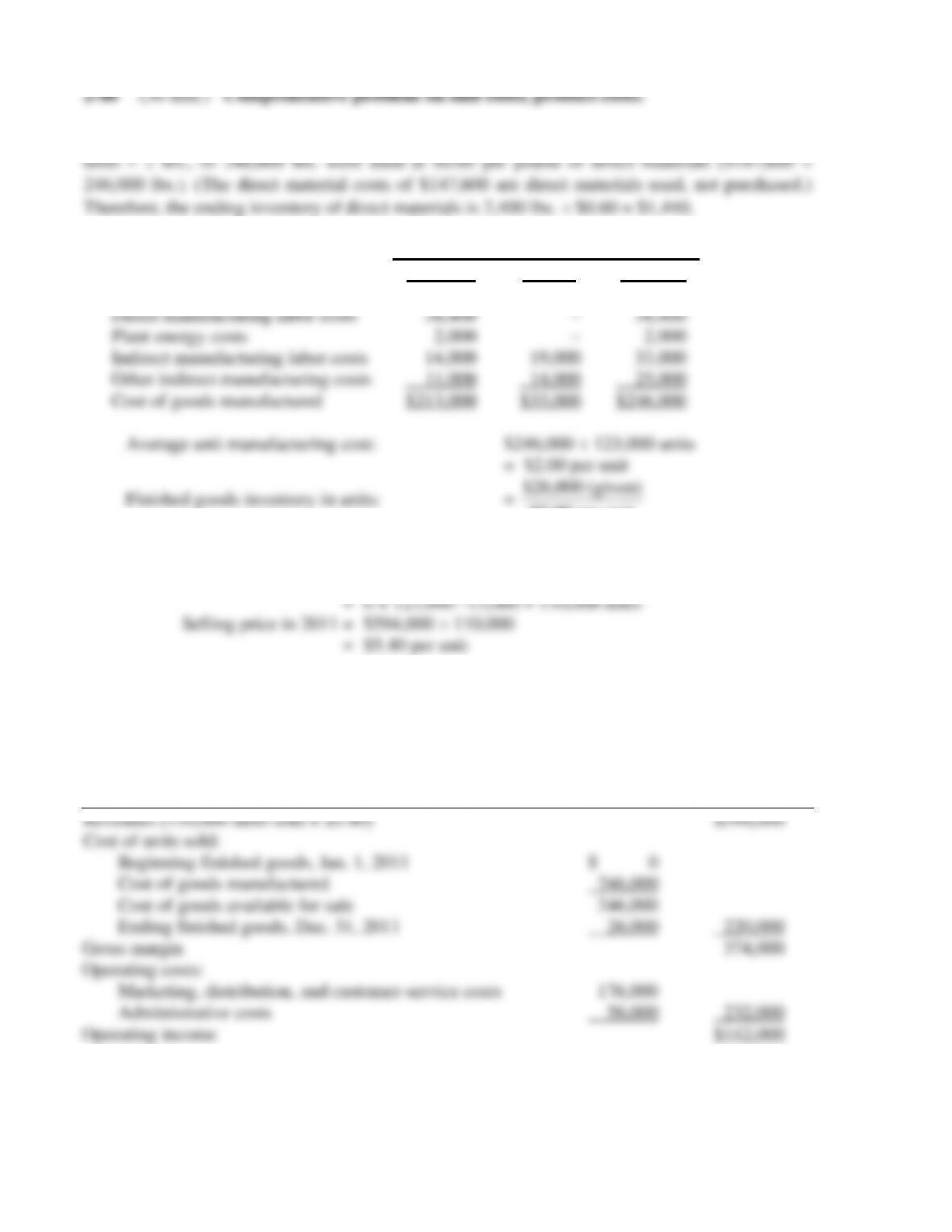
1. If 2 pounds of direct materials are used to make each unit of finished product, 123,000
2. Manufacturing Costs for 123,000 units
Variable Fixed Total
Direct materials costs $147,600 $ – $147,600

2-27
Note: Although not required, the full set of unit variable costs is:
Direct materials cost
$1.200
Direct manufacturing labor cost
0.312
Plant energy cost
0.016
= $1.731 per unit manufactured
Indirect manufacturing labor cost
0.114
Other indirect manufacturing cost
0.089
Marketing, distribution, and customer-service costs
$1.041
per unit sold
2-28
2-41 (20-25 min.) Classification of costs; ethics.
1. Warehousing costs per unit =
Warehousing costs
Units produced
=
$3,250,000 $16.25 per unit.
200,000 units =
2. No. With respect to classifying costs as product or period costs, this determination is made
by Generally Accepted Accounting Principles (GAAP). It is not something that can be justified
4. The controller should not reclassify costs as product costs just so the plant can reap short–
term benefits, including the increase in Hewitt’s personal year-end bonus. Research and
development costs, costs related to the shipping of finished goods and costs related to
warehousing finished goods are all period costs under generally accepted accounting principles,
2-29
2-42 (20–25 min.) Finding unknown amounts.
Let G = given, I = inferred
Step 1: Use gross margin formula Case 1 Case 2
Revenues $ 32,000 G $31,800 G
Cost of goods sold A 20,700 I 20,000 G