19-31
3. Delays occur in the processing of B7 and A3 because of (a) uncertainty about how many
orders Brandt will actually receive (Brandt expects to receive 125 orders of B7 and 10 orders of
A3), and (b) uncertainty about the actual dates when Brandt will receive the orders. The
uncertainty (randomness) about the quantity and timing of customer orders means that Brandt
may receive customer orders while another order is still being processed. Orders received while
the machine is actually processing another order must wait in queue for the machine to be free.
19-32
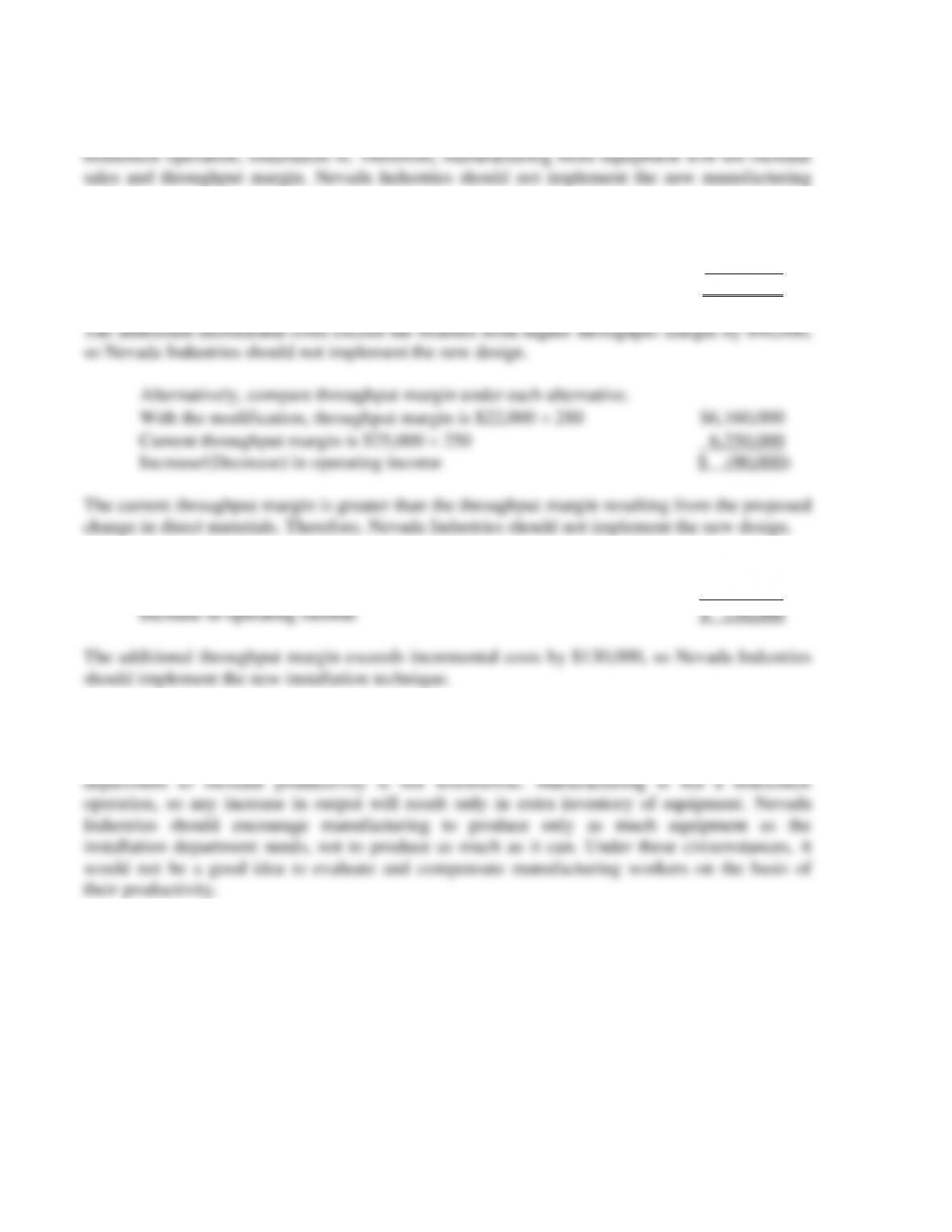
19-34 (20 min.) Theory of constraints, throughput contribution, relevant costs.
1. It will cost Nevada $60 per unit to reduce manufacturing time. But manufacturing is not a
method.
2. Increase in throughput margin, $25,000 0 units, $ 750,000
Additional relevant costs of new direct materials, $3,000 280 units, 840,000
Increase/(Decrease) in operating income $ (90,000)
3. Increase in throughput margin, $25,000 units $ 175,000
Increase in relevant costs 45,000
4. Motivating installation workers to increase productivity is worthwhile because
installation is a bottleneck operation, and any increase in productivity at the bottleneck will
increase throughput margin. On the other hand, motivating workers in the manufacturing
19-33
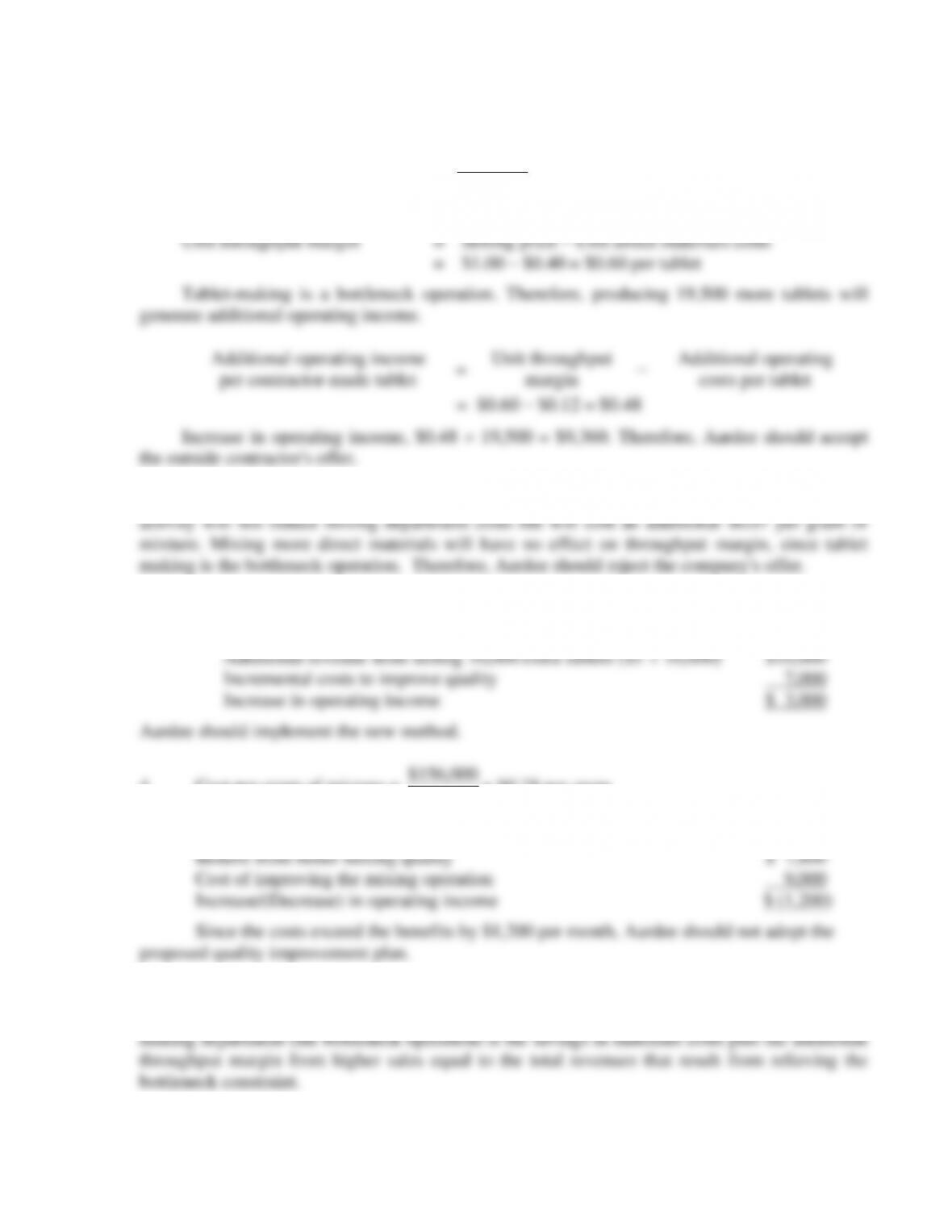
19-35 (30–40 min.) Theory of constraints, throughput contribution, quality, relevant costs.
1. Direct materials costs to produce 390,000 tablets, $156,000
Direct materials costs per tablet =
000,390
000,156$
= $0.40 per tablet
Selling price per tablet = $1.00
2. Operating costs for the mixing department are a fixed cost. Contracting out the mixing
3. The benefit of improved quality is $10,000. Aardee is using the same quantity of direct
materials as before, so it incurs no extra direct materials costs.
4. Cost per gram of mixture =
000,200
000,156$
= $0.78 per gram
Cost of 10,000 grams of mixture = $0.78 10,000 = $7,800
5. Compare the answers to requirements 3 and 4. The benefit of improving quality at the
mixing operation is the savings in materials costs. The benefit of improving quality of the tablet–
19-36 (30-35 min.) Theory of constraints, contribution margin, sensitivity analysis.
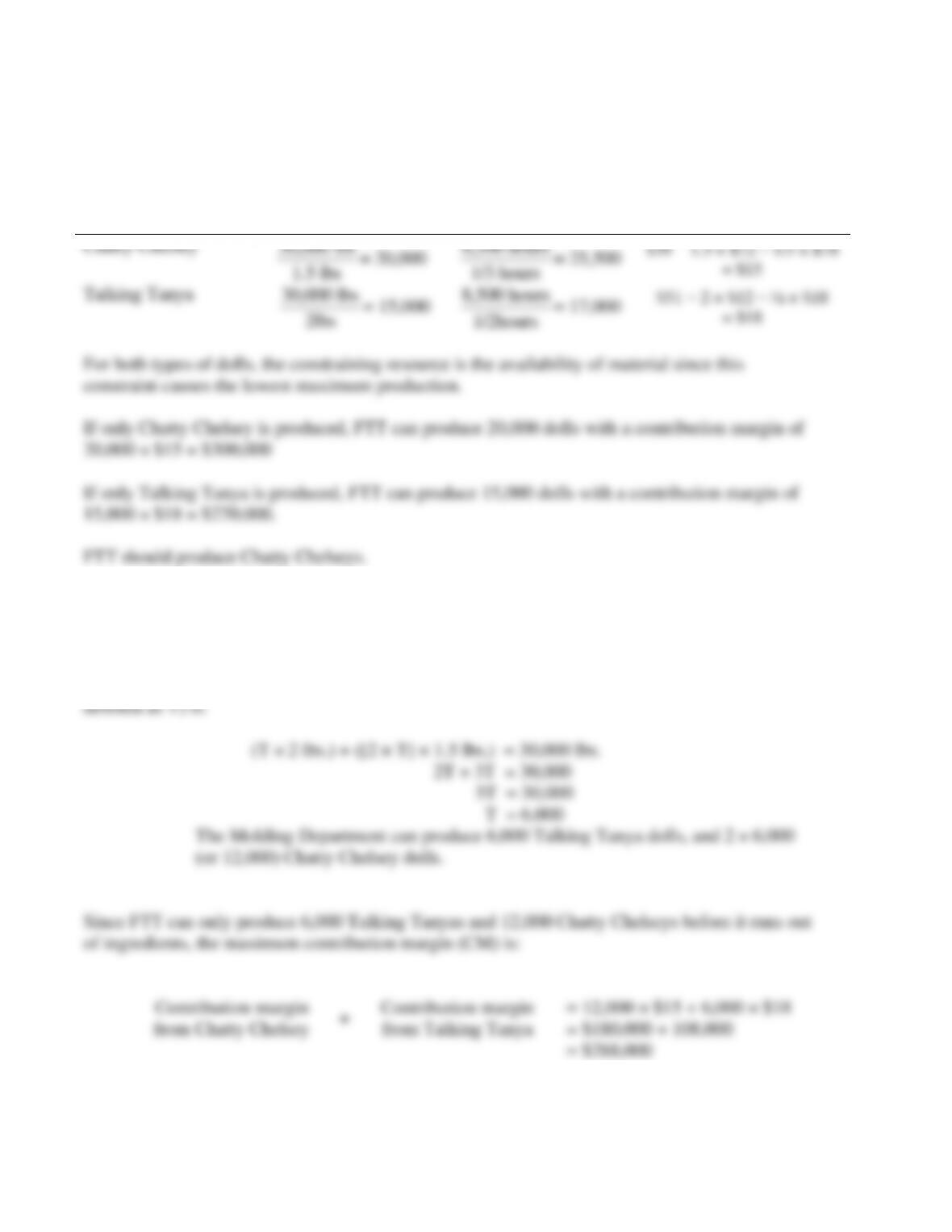
1. Assuming only one type of doll is produced, the maximum production in each department
given their resource constraints is:
Molding
Department
Assembly
Department
Contribution Margin
Chatty Chelsey
30,000 lbs = 20,000
1.5 lbs
8,500 hours = 25,500
1/3 hours
$39 − 1.5 × $12 – 1/3 × $18
= $15
Talking Tanya
30,000 lbs = 15,000
2lbs
8,500 hours = 17,000
1/2hours
$51 − 2 × $12 − ½ × $18
= $18
For both types of dolls, the constraining resource is the availability of material since this
constraint causes the lowest maximum production.
If only Chatty Chelsey is produced, FTT can produce 20,000 dolls with a contribution margin of
20,000 × $15 = $300,000
If only Talking Tanya is produced, FTT can produce 15,000 dolls with a contribution margin of
15,000 × $18 = $270,000.
FTT should produce Chatty Chelseys.
2. As shown in Requirement 1, available material in the Molding department is the limiting
constraint.
If FTT sells two Chatty Chelseys for each Talking Tanya, then the maximum number of Talking
Tanya dolls the Molding Department can produce (where the number of Talking Tanya dolls is
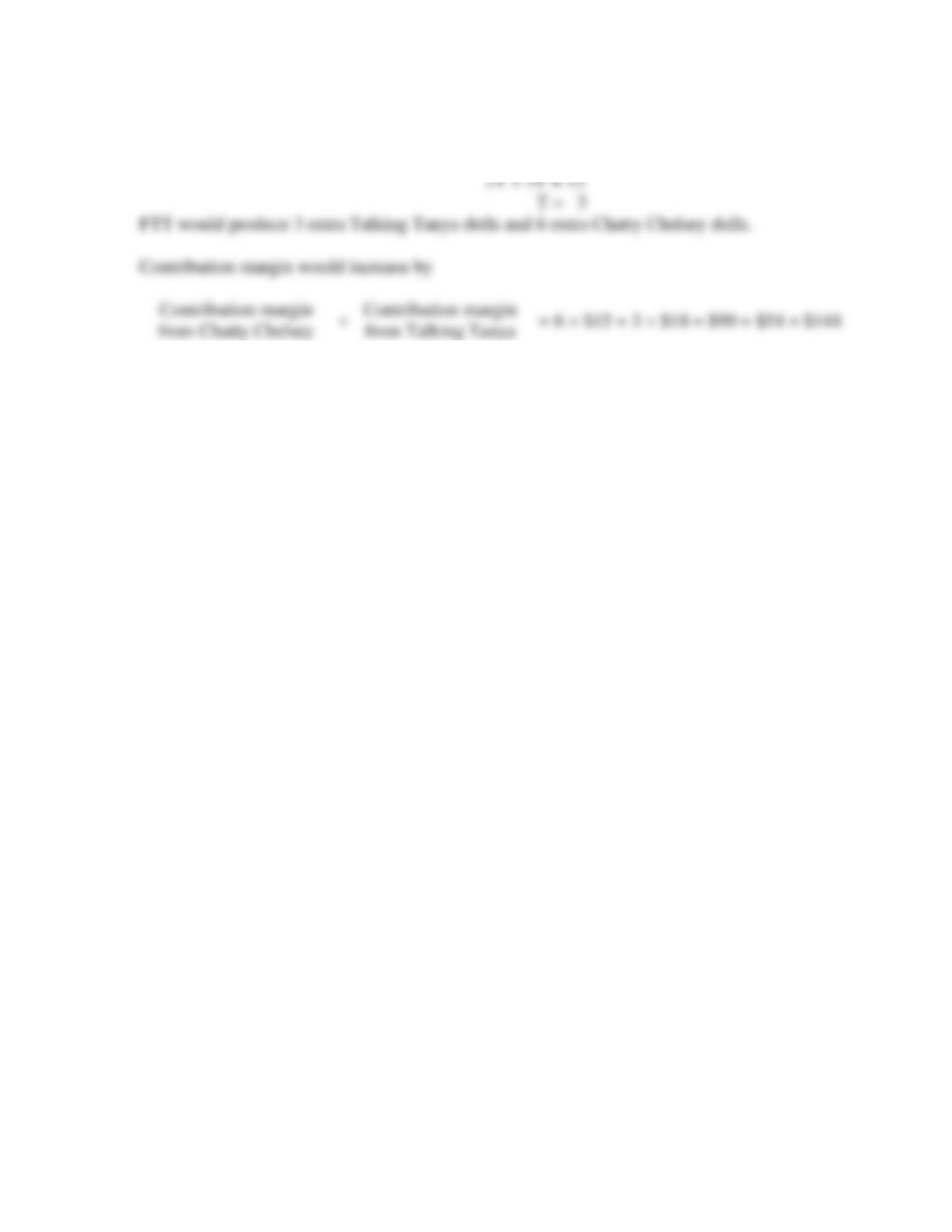
3. With 15 more pounds of materials, FTT would produce more dolls. Using the same technique
as in Requirement 2, the increase in production is:
(T × 2 lbs.) + ([2 × T] × 1.5 lbs.) = 15 lbs.
19-36
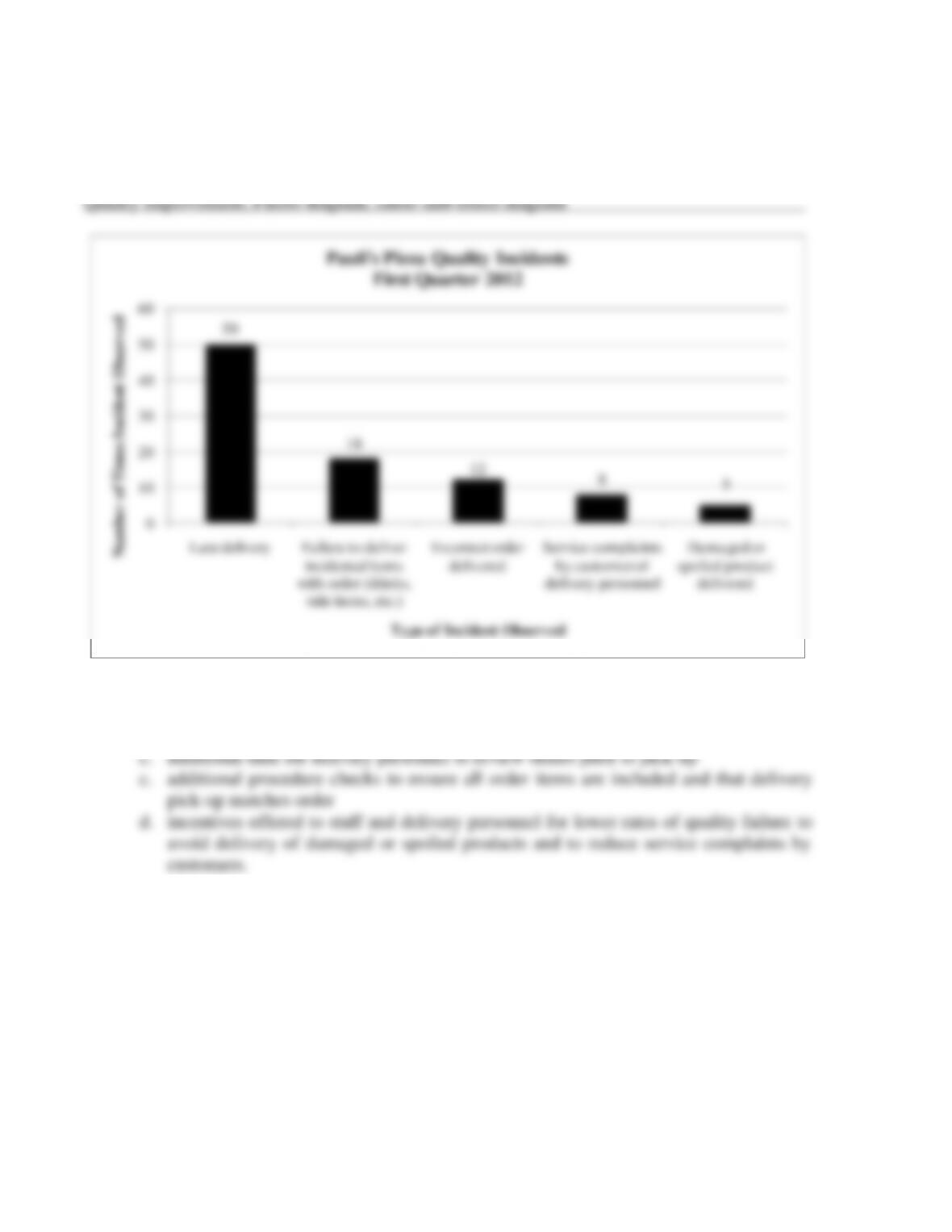
19-37 (25 min.) Quality improvement, Pareto diagram, cause-and-effect diagram.
1. Solution Exhibit 19-37A presents a Pareto diagram for the quality incidents observed by
Pauli’s Pizza.
SOLUTION EXHIBIT 19-37A