19-11
3. Using information from requirement 2,
Revenues
$26,250,000
Fixed costs
$7,500,000
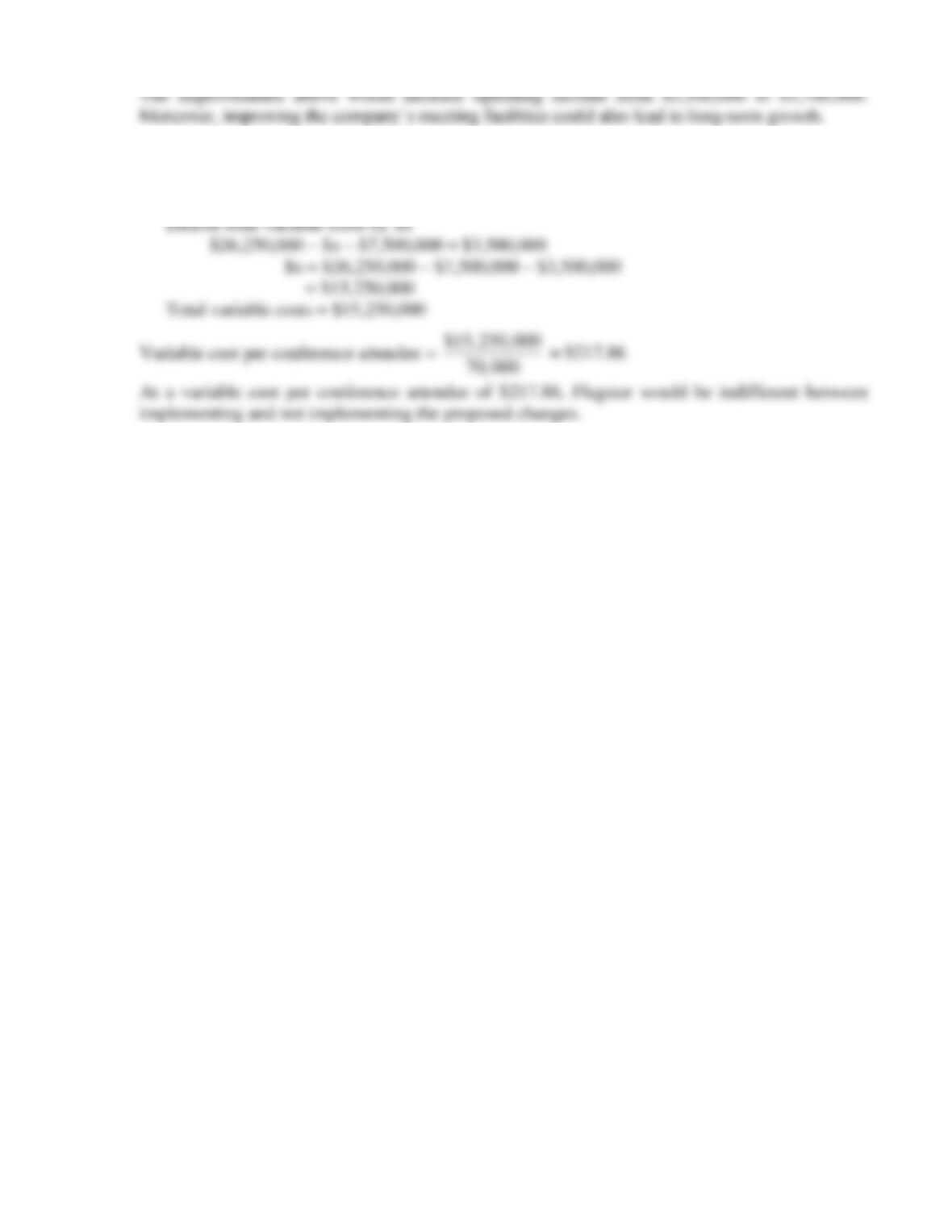
Denote total variable costs by $x
$26,250,000 – $x – $7,500,000 = $3,500,000
$x = $26,250,000 – $7,500,000 – $3,500,000
= $15,250,000
Total variable costs = $15,250,000
Variable cost per conference attendee =
$15,250,000 = $217.86
70,000
At a variable cost per conference attendee of $217.86, Flagstar would be indifferent between
implementing and not implementing the proposed changes.
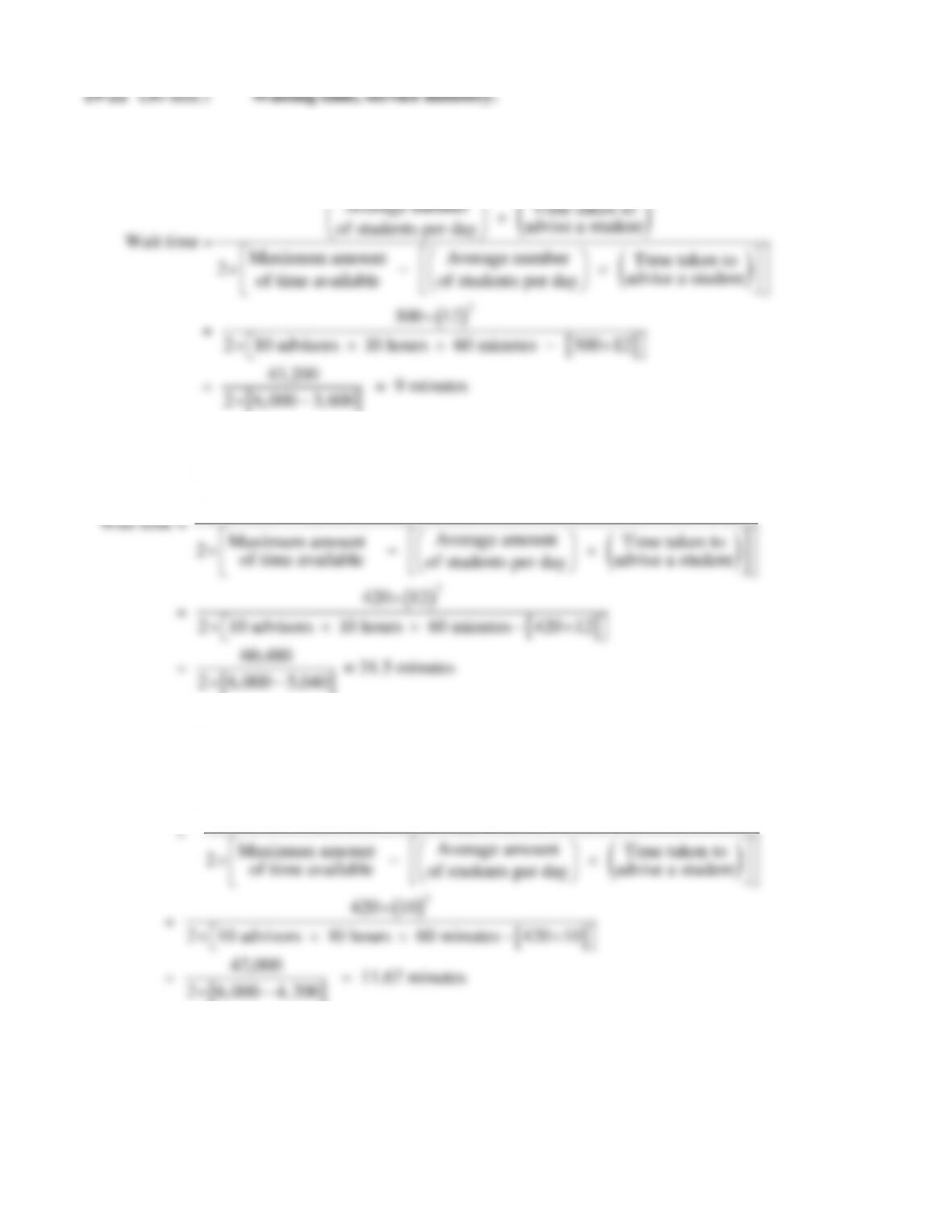
1. If SMU’s advisors expect to see 300 students each day and it takes an average of 12 minutes to
advise each student, then the average time that a student will wait can be calculated using the
following formula:
( )
( )
2
=
Average number Time taken to
advise a student
of students per day
Wait time Maximum amount Average number Time taken to
2 advise a student
of students per day
of time available
−
=
( )
2
300 12
2 10 advisors 10 hours 60 minutes 300 12
−
=
43,200
2 6,000 3,600−
= 9 minutes
2. At 420 students seen a day,
( )
( )
2
=
Average number Time taken to
advise a student
of students per day
Wait time Average amount
Maximum amount Time taken to
2
of time available advise a student
of students per day
−
=
( )
2
420 12
2 10 advisors 10 hours 60 minutes 420 12
−
=
60,480 = 31.5 minutes
2 6,000 5,040−
3. If the average time to advise a student is reduced to 10 minutes, then the average wait time
would be
( )
( )
2
Average number Time taken to
advise a student
of students per day
Average amount
Maximum amount Time taken to
2
of time available advise a student
of students per day
−
=
( )
2
420 10
2 10 advisors 10 hours 60 minutes 420 10
−
=
42,000 11.67 minutes
2 6,000 4,200 =
−
19-13
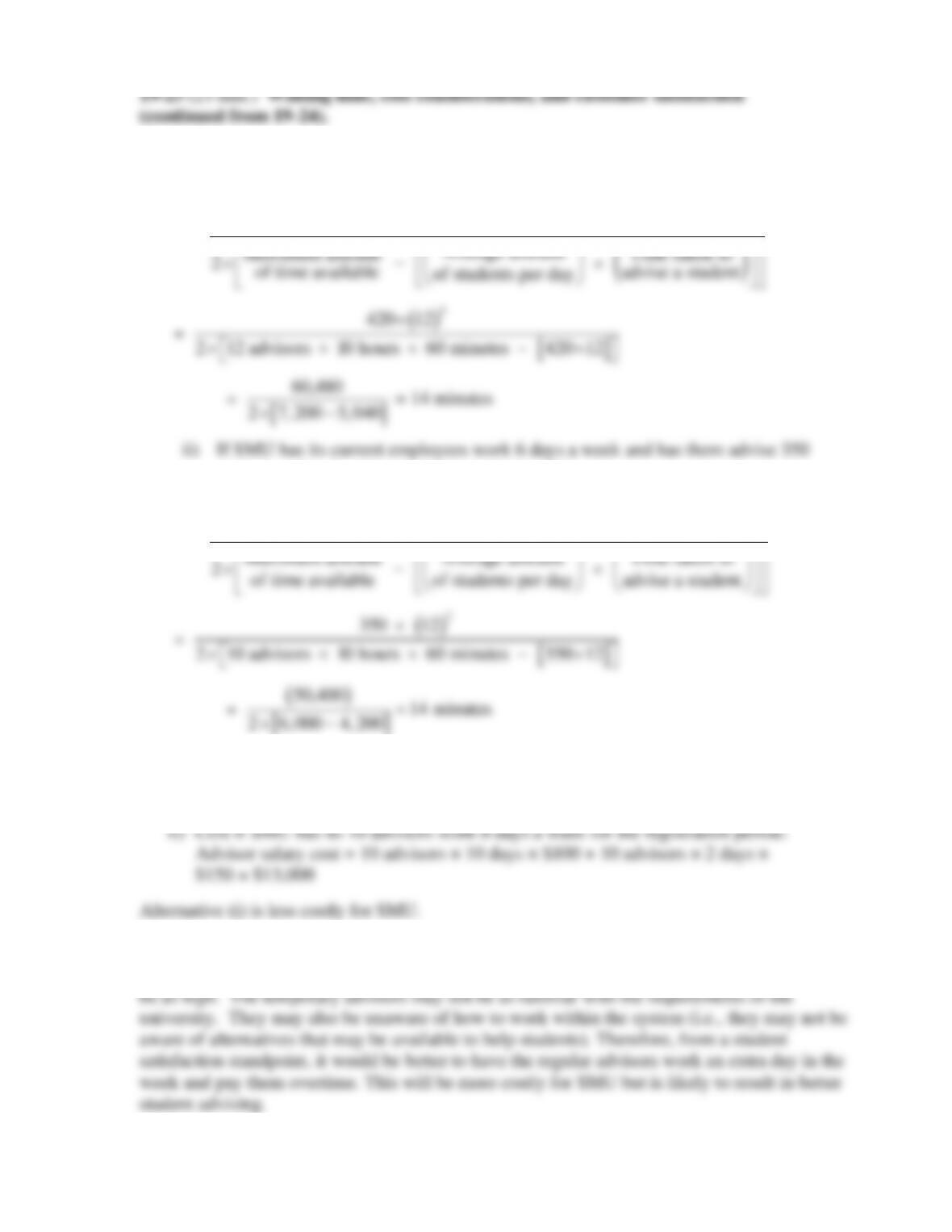
1. i) If SMU hires two more advisors then the average wait time will be:
=
( )
( )
2
Average number Time taken to
advise a student
of students per day
Average amount
Maximum amount Time taken to
2
of time available advise a student
of students per day
−
( )
2
420 12
students a day then the average wait time will be:
=
( )
2
Average number Time taken to
advise a student
of students per day
Maximum amount Average amount Time taken to
2
of time available of students per day advise a student
−
( )
2
350 12
2 6,000 4,200 =
−
2. i) Cost if SMU hires 2 extra advisors for the registration period:
Advisor salary cost = 12 advisors ×10 days × $100 = $12,000
3. Hiring two extra advisors has the same waiting time and a lower cost than extending the
workweek to 6 days during the registration period. However, the quality of the advising may not
19-14
19-24 (15 min.) Manufacturing cycle time, manufacturing cycle efficiency, non-financial
measures of quality.
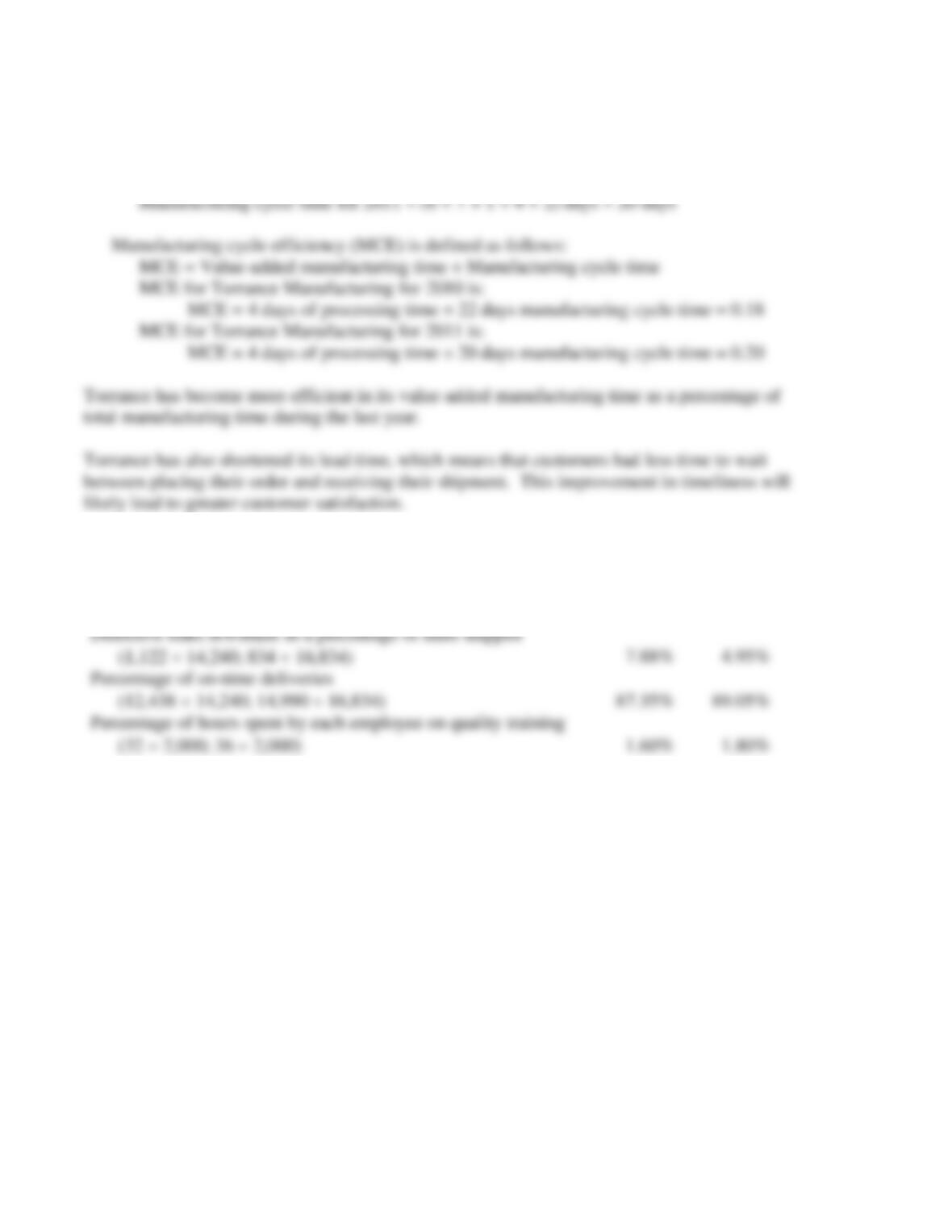
1, Manufacturing cycle time = Total time from receipt of an order by production until its completion.
Manufacturing cycle time for 2010 = (8 + 6 + 2 + 4 + 2) days = 22 days
2.
Non-Financial Quality Measure
2010
2011
Percentage of goods returned (as a percentage of units shipped)
(385 14,240; 462 16,834)
2.70%
2.74%
Defective units reworked as a percentage of units shipped
(1,122 14,240; 834 16,834)
7.88%
4.95%
Percentage of on–time deliveries
(12,438 14,240; 14,990 16,834)
87.35%
89.05%
Percentage of hours spent by each employee on quality training
(32 2,000; 36 2,000)
1.60%
1.80%
19-15
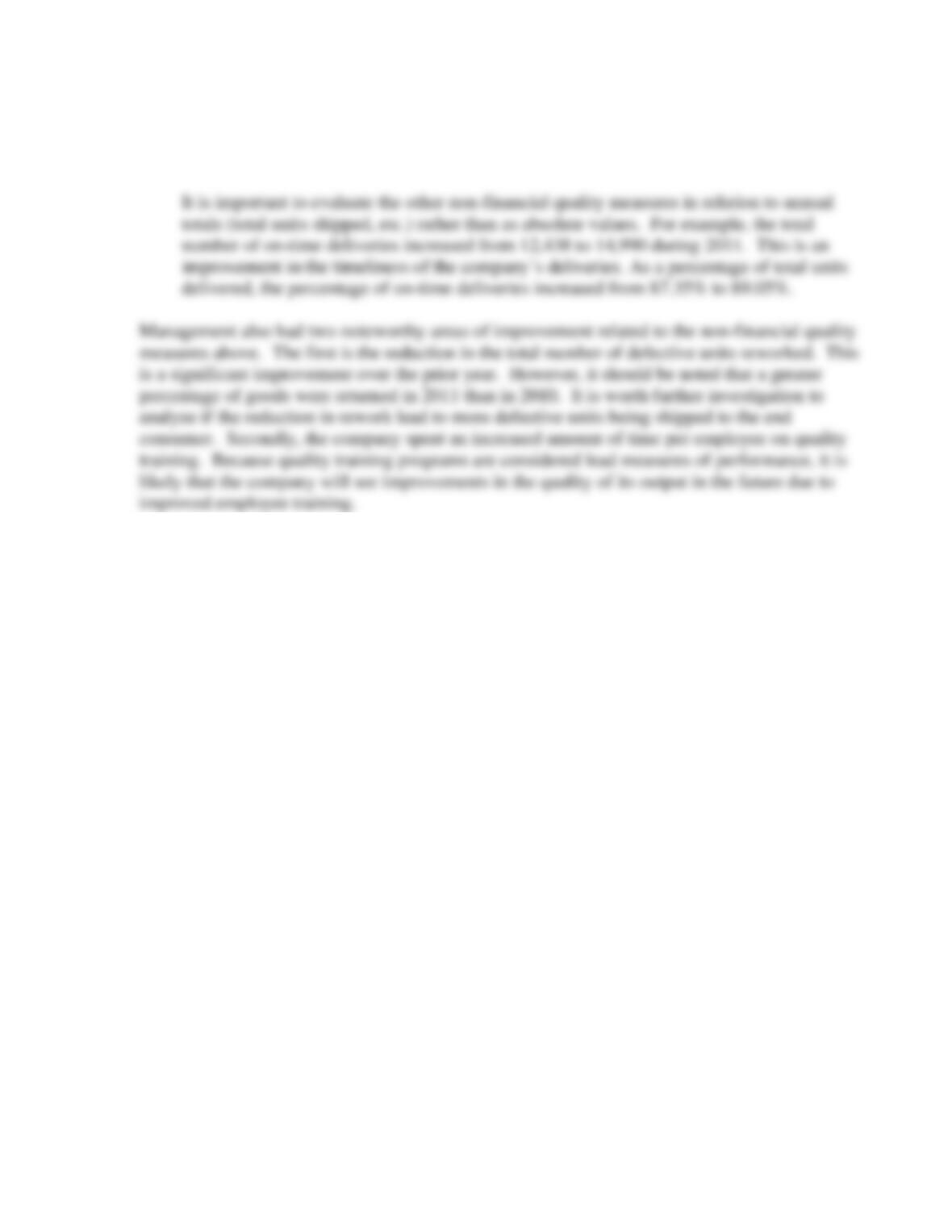
3. Torrance has become more efficient in its value-added manufacturing time as a percentage
of manufacturing cycle time and has improved the company’s lead time. This improved
efficiency should result in cost savings for the company as well as greater customer
satisfaction.
19-16
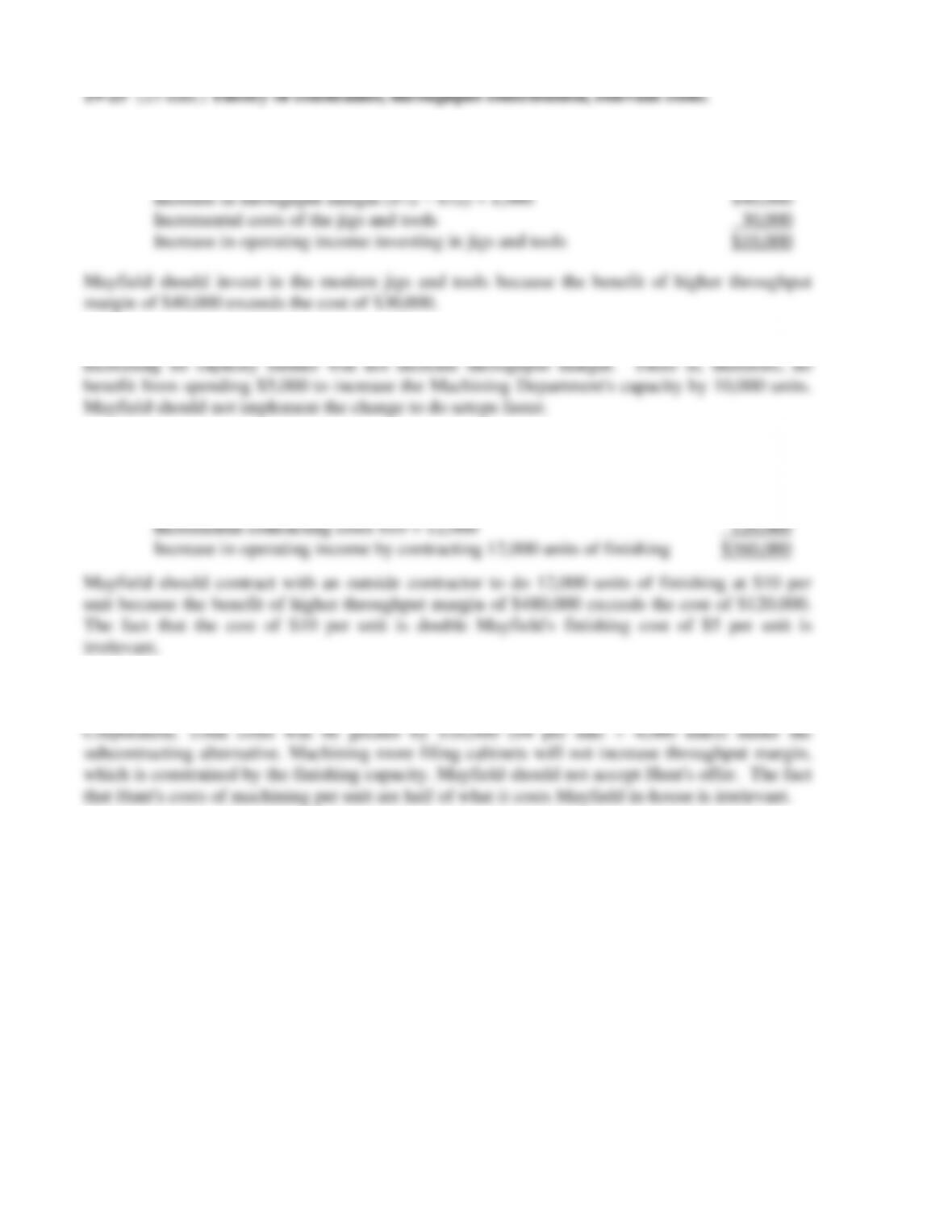
1. Finishing is a bottleneck operation. Therefore, producing 1,000 more units will generate
additional throughput margin and operating income.
2. The Machining Department has excess capacity and is not a bottleneck operation.
3. Finishing is a bottleneck operation. Therefore, getting an outside contractor to produce
12,000 units will increase throughput margin.
Increase in throughput margin ($72 – $32) 12,000 $480,000
4. Operating costs in the Machining Department of $640,000, or $8 per unit, are fixed costs.
Mayfield will not save any of these costs by subcontracting machining of 4,000 units to Hunt
19-17
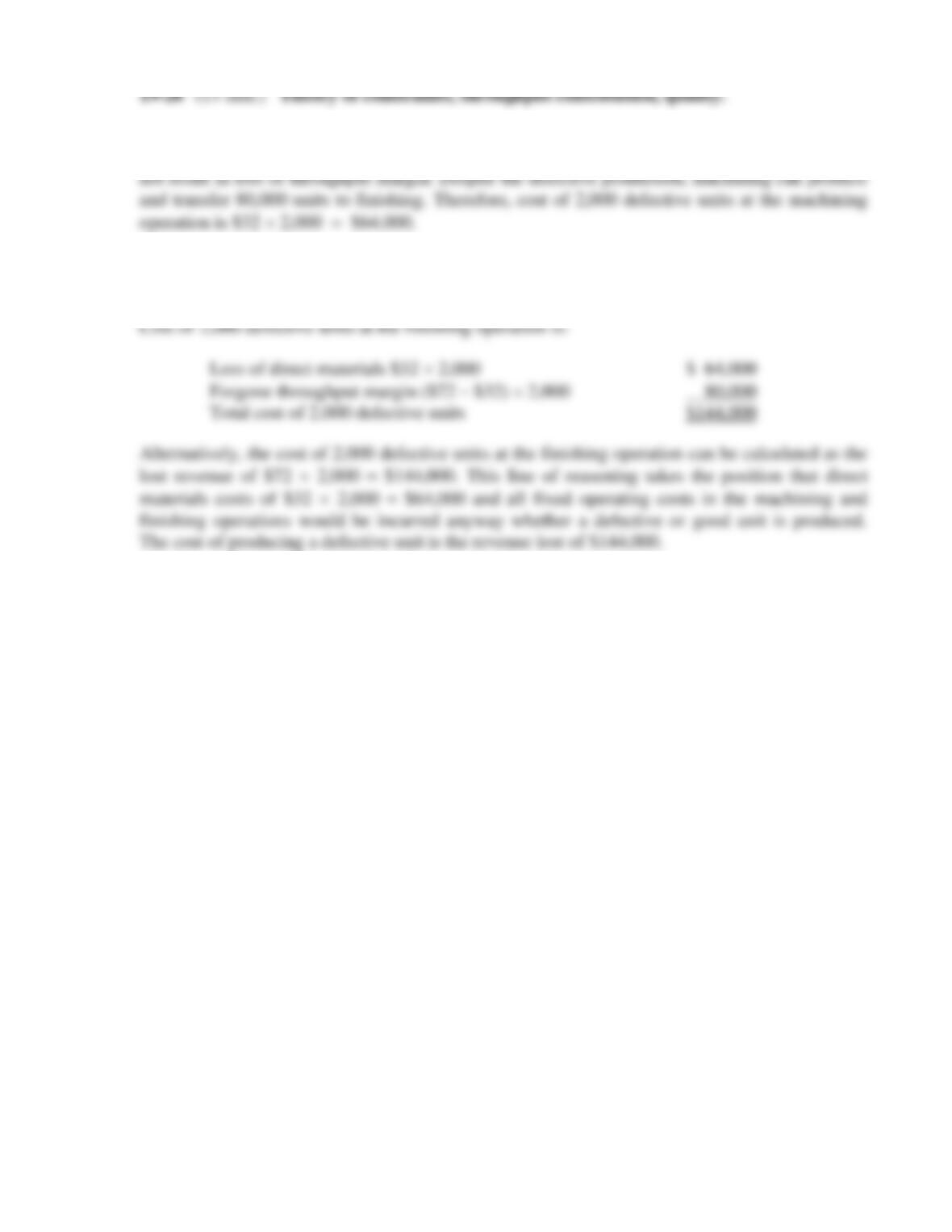
1. Cost of defective unit at machining operation which is not a bottleneck operation is the
loss in direct materials (variable costs) of $32 per unit. Producing 2,000 units of defectives does
2. A defective unit produced at the bottleneck finishing operation costs Mayfield materials
costs plus the opportunity cost of lost throughput margin. Bottleneck capacity not wasted in
producing defective units could be used to generate additional sales and throughput margin.
19-18
19-27 (30 min.) Quality improvement, relevant costs, and relevant revenues.
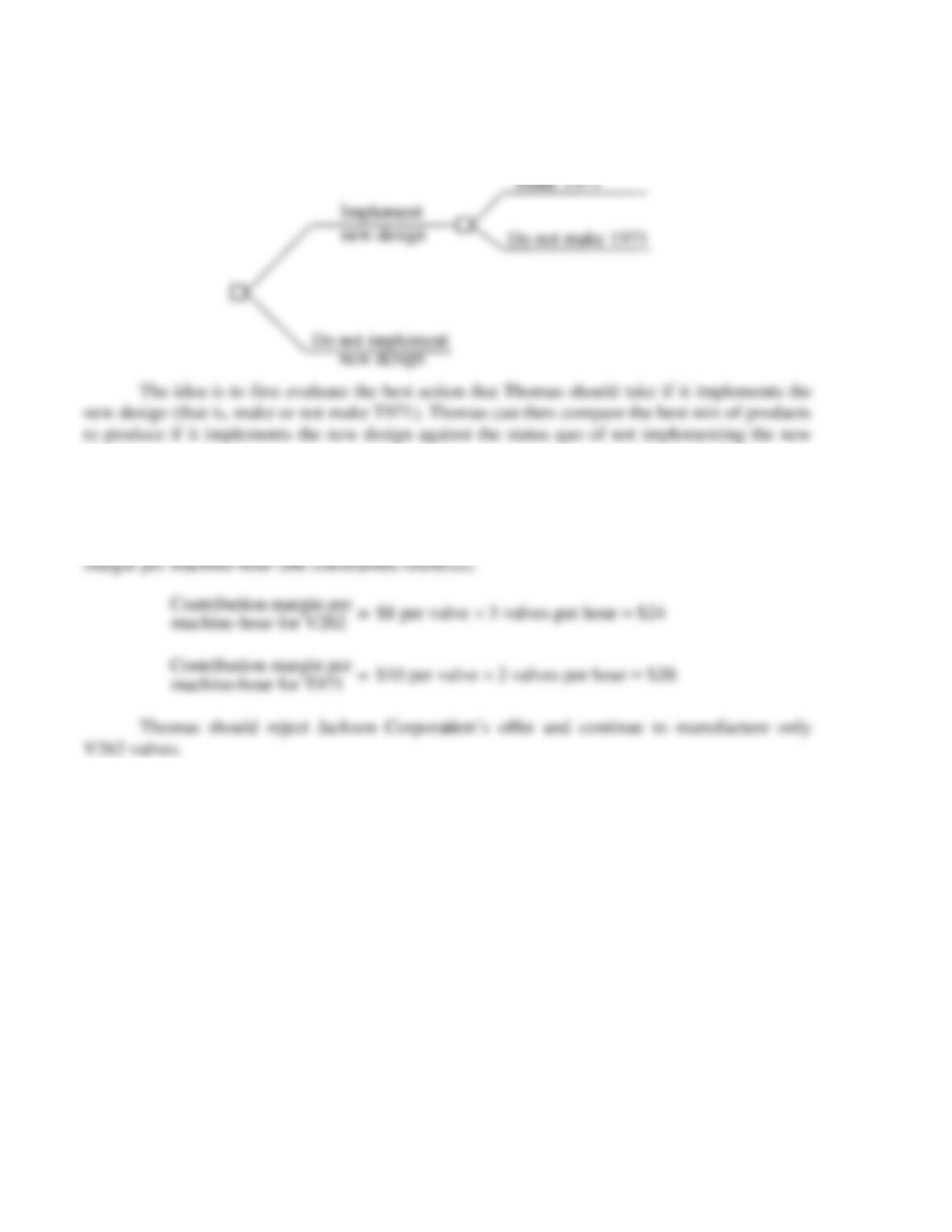
One way to present the alternatives is via a decision tree, as shown below.
Implement
new design
Do not implement
new design
Make T971
Do not make T971
The idea is to first evaluate the best action that Thomas should take if it implements the
new design (that is, make or not make T971). Thomas can then compare the best mix of products
to produce if it implements the new design against the status quo of not implementing the new
design.
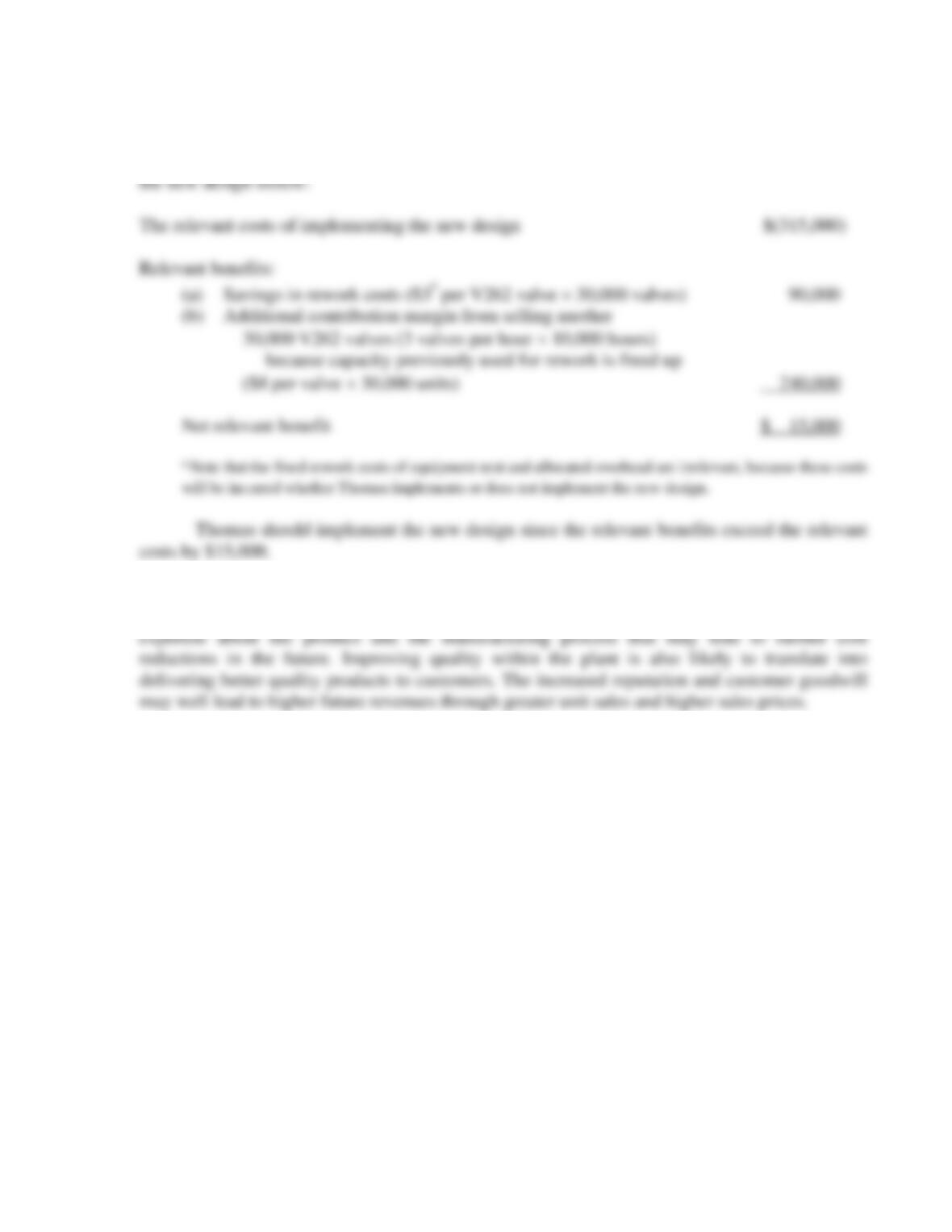
1. Thomas has capacity constraints. Demand for V262 valves (370,000 valves) exceeds
production capacity of 330,000 valves (3 valves per hour 110,000 machine-hours). Since
capacity is constrained, Thomas will choose to sell the product that maximizes contribution
19-19
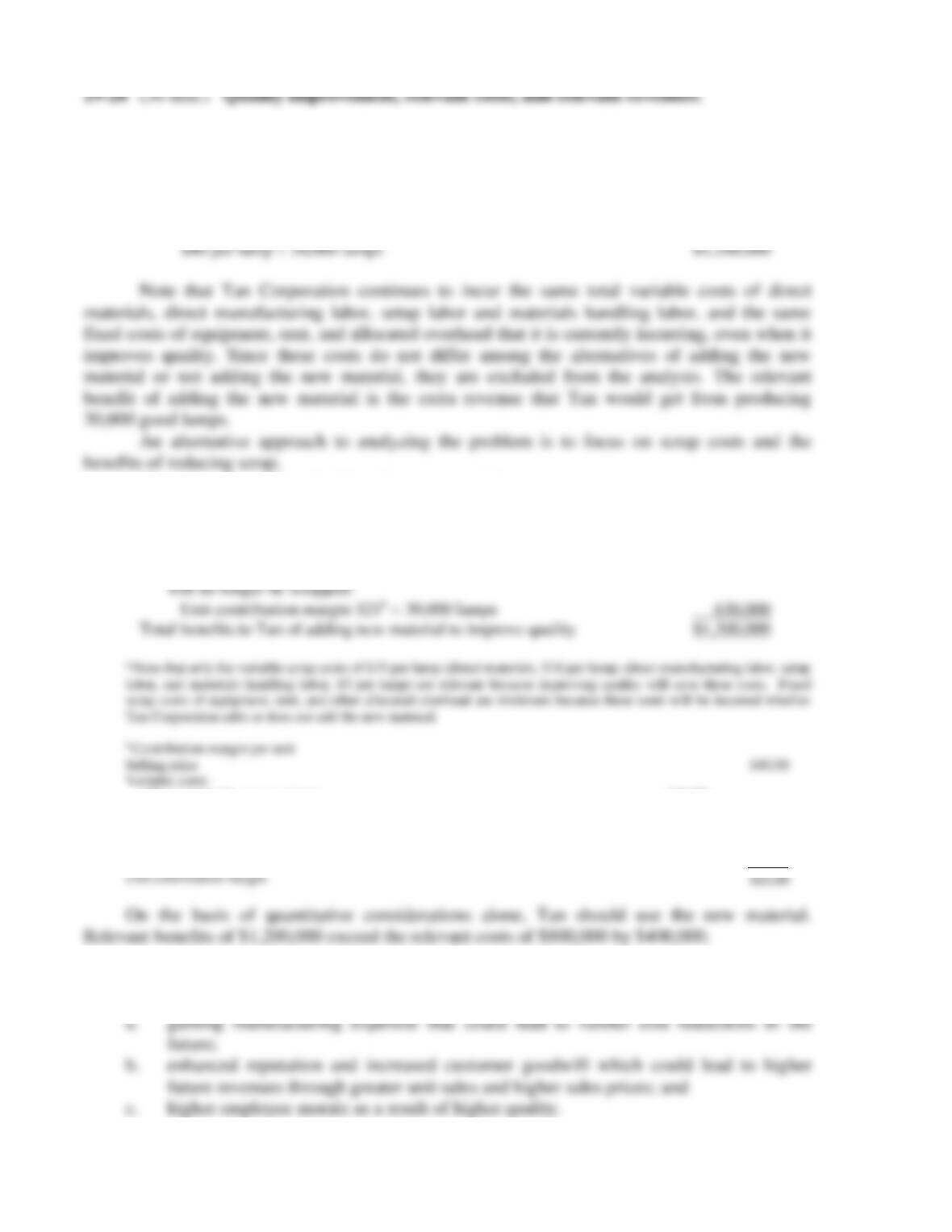
2. Now compare the alternatives of (a) not implementing the new design versus
(b) implementing the new design. By implementing the new design, Thomas will save 10,000
machine-hours of rework time. This time can then be used to make and sell 30,000 (3 valves per
hour 10,000 hours) additional V262 valves. The relevant costs and benefits of implementing
3. Thomas Corporation should also consider other benefits of improving quality. For
example, the process of quality improvement will help Thomas’s managers and workers gain
19-20
1. By implementing the new method, Tan would incur additional direct materials costs on all
the 200,000 units started at the molding operation.
Additional direct materials costs = $4 per lamp 200,000 lamps $800,000
The relevant benefits of adding the new material are:
Increased revenue from selling 30,000 more lamps
The relevant benefits of adding the new material are:
a. Cost savings from eliminating scrap:
Variable cost per lamp, $19a 30,000 lamps $ 570,000
b. Additional contribution margin from selling
another 30,000 lamps because 30,000 lamps
Direct materials costs per lamp $16.00
Molding department variable manufacturing costs
per lamp (direct manufacturing labor, setup labor, and
materials handling labor) 3.00
Variable costs (19.00)
2. Other nonfinancial and qualitative factors that Tan should consider in making a decision
include the effects of quality improvement on: