17-1
CHAPTER 17
PROCESS COSTING
17-1 Industries using process costing in their manufacturing area include chemical processing,
17-2 Process costing systems separate costs into cost categories according to the timing of
when costs are introduced into the process. Often, only two cost classifications, direct materials
17-3 Equivalent units is a derived amount of output units that takes the quantity of each input
(factor of production) in units completed or in incomplete units in work in process, and converts
17-4 The accuracy of the estimates of completion depends on the care and skill of the
17-5 The five key steps in process costing follow:
Step 1: Summarize the flow of physical units of output.
17-6 Three inventory methods associated with process costing are:
17-7 The weighted-average process-costing method calculates the equivalent-unit cost of all
17-2
17-8 FIFO computations are distinctive because they assign the cost of the previous
accounting period’s equivalent units in beginning work–in-process inventory to the first units
17-9 FIFO should be called a modified or departmental FIFO method because the goods
17-10 A major advantage of FIFO is that managers can judge the performance in the current
period independently from the performance in the preceding period.
17-11 The journal entries in process costing are basically similar to those made in job-costing
17-12 Standard-cost procedures are particularly appropriate to process-costing systems where
there are various combinations of materials and operations used to make a wide variety of similar
17-13 There are two reasons why the accountant should distinguish between transferred-in
costs and additional direct materials costs for a particular department:
17-14 No. Transferred-in costs or previous department costs are costs incurred in a previous
period.
17-15 Materials are only one cost item. Other items (often included in a conversion costs pool)
include labor, energy, and maintenance. If the costs of these items vary over time, this variability
17-3
17-16 (25 min.) Equivalent units, zero beginning inventory.
1. Direct materials cost per unit ($750,000 ÷ 10,000) $ 75.00
Conversion cost per unit ($798,000 ÷ 10,000) 79.80
Assembly Department cost per unit $154.80
3. The difference in the Assembly Department cost per unit calculated in requirements 1 and
2 arises because the costs incurred in January and February are the same but fewer equivalent
units of work are done in February relative to January. In January, all 10,000 units introduced are
fully completed resulting in 10,000 equivalent units of work done with respect to direct materials
and conversion costs. In February, of the 10,000 units introduced, 10,000 equivalent units of
17-4
SOLUTION EXHIBIT 17-16B
Compute Cost per Equivalent Unit,
Assembly Department of Nihon, Inc. for February 2012.
Total
Production
Costs
Direct
Materials
Conversion
Costs
(Step 3) Costs added during February
$1,548,000
$750,000
$798,000
Divide by equivalent units of work done
in current period (Solution Exhibit 17-l6A)
10,000
9,500
Cost per equivalent unit
$ 75
$ 84
1. Work in Process––Assembly 750,000
Accounts Payable 750,000
2. Work in Process––Assembly 798,000
Various accounts 798,000
3. Work in Process––Testing 1,431,000
Work in Process––Assembly 1,431,000
To record 9,000 units completed and
1. Direct materials 750,000 Work in Process––Testing 1,431,000
17-5
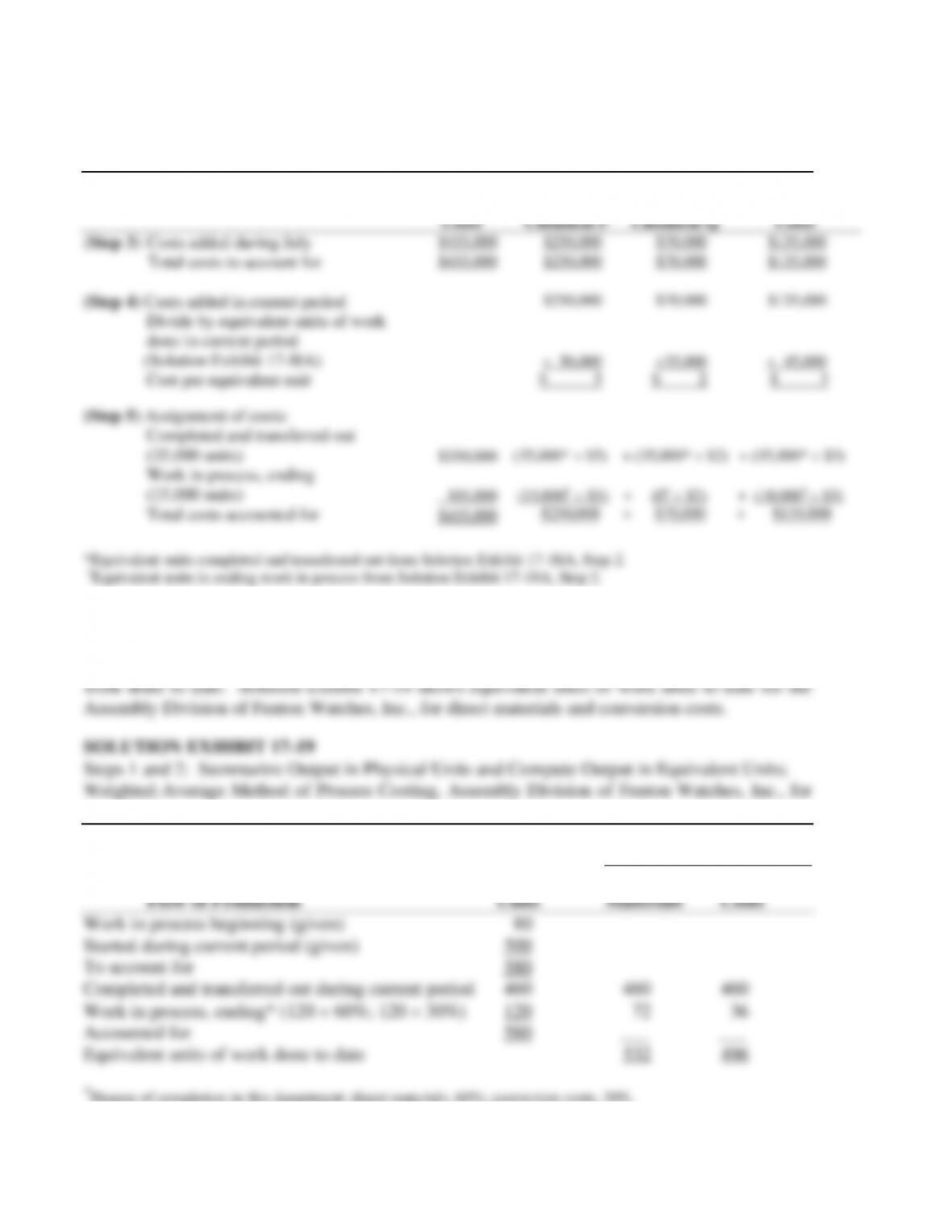
1. Solution Exhibit 17-18A shows equivalent units of work done in the current period of
Chemical P, 50,000; Chemical Q, 35,000; Conversion costs, 45,000.
2. Solution Exhibit 17-18B summarizes the total Mixing Department costs for July 2012,
calculates cost per equivalent unit of work done in the current period for Chemical P, Chemical
Q, and Conversion costs, and assigns these costs to units completed (and transferred out) and to
units in ending work in process.
SOLUTION EXHIBIT 17-18A
17-6
SOLUTION EXHIBIT 17-18B
Steps 3, 4, and 5: Summarize Total Costs to Account For, Compute Cost per Equivalent Unit,
and Assign Total Costs to Units Completed and to Units in Ending Work in Process;
Mixing Department of Roary Chemicals for July 2012.
Total
Production
Costs
Chemical P
Chemical Q
Conversion
Costs
(Step 3) Costs added during July
$455,000
$250,000
$70,000
$135,000
Total costs to account for
$455,000
$250,000
$70,000
$135,000
(Step 4) Costs added in current period
$250,000
$70,000
$135,000
Divide by equivalent units of work
done in current period
(Solution Exhibit 17-l8A)
50,000
35,000
45,000
Cost per equivalent unit
$ 5
$ 2
$ 3
(Step 5) Assignment of costs:
Completed and transferred out
(35,000 units)
$350,000
(35,000* $5) + (35,000* $2) + (35,000* $3)
Work in process, ending
(15,000 units)
105,000
(15,000† $5) + (0† $2) + (10,000† $3)
Total costs accounted for
$455,000
$250,000 + $70,000 + $135,000
*Equivalent units completed and transferred out from Solution Exhibit 17-18A, Step 2.
†Equivalent units in ending work in process from Solution Exhibit 17-18A, Step 2.
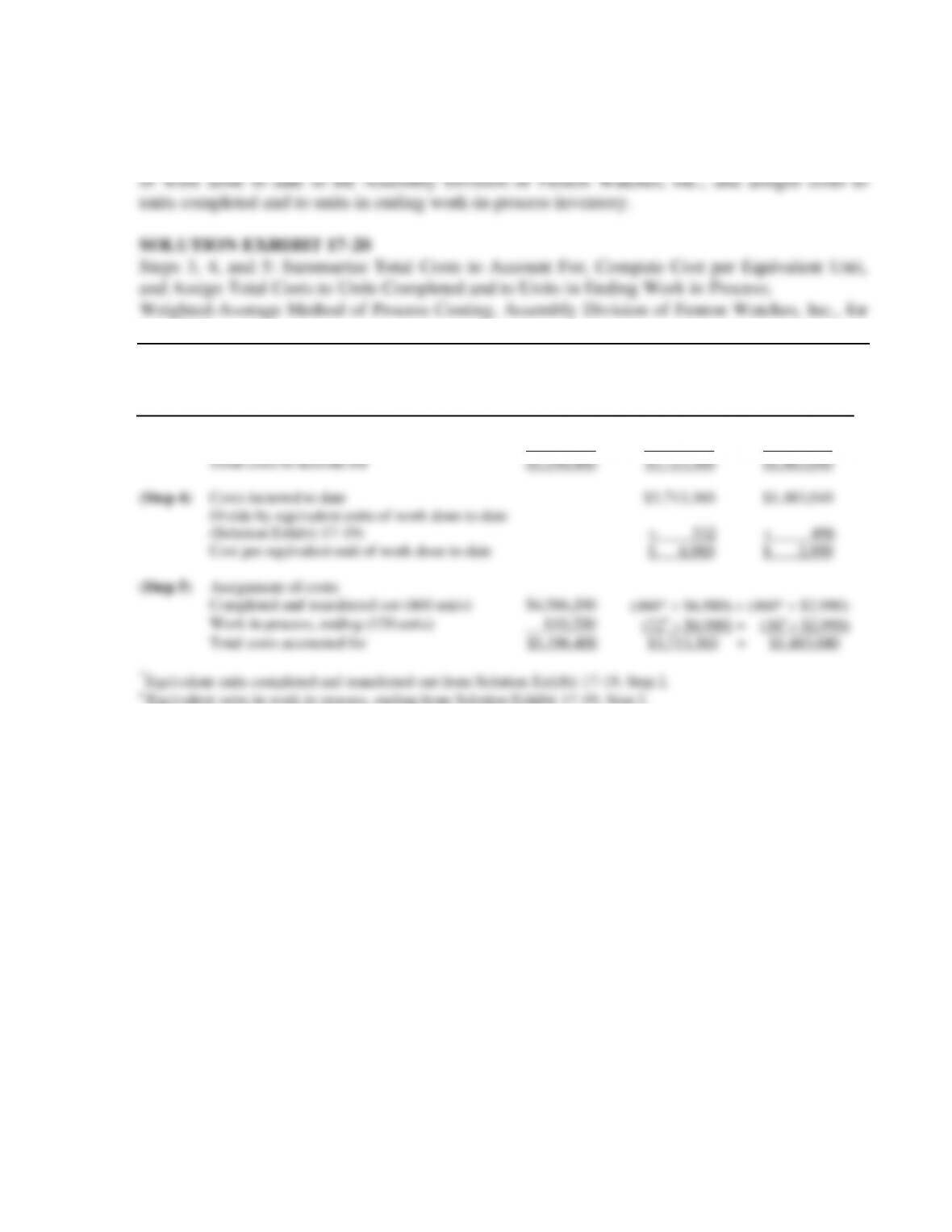
17-19 (15 min.) Weighted-average method, equivalent units.
Under the weighted-average method, equivalent units are calculated as the equivalent units of
May 2012.
(Step 2)
(Step 1) Equivalent Units
Physical Direct Conversion
17-7
17-20 (20 min.) Weighted-average method, assigning costs (continuation of 17-19).
Solution Exhibit 17-20 summarizes total costs to account for, calculates cost per equivalent unit
May 2012.
Total
Production
Costs
Direct
Materials
Conversion
Costs
(Step 3) Work in process, beginning (given)
$ 584,400
$ 493,360
$ 91,040
Costs added in current period (given)
4,612,000
3,220,000
1,392,000
Total costs to account for
$5,196,400
$3,713,360
$1,483,040
(Step 4) Costs incurred to date
$3,713,360
$1,483,040
Divide by equivalent units of work done to date
(Solution Exhibit 17-19)
532
496
Cost per equivalent unit of work done to date
$ 6,980
$ 2,990
(Step 5) Assignment of costs:
Completed and transferred out (460 units)
$4,586,200
(460* $6,980) + (460* $2,990)
Work in process, ending (120 units)
610,200
(72† $6,980) + (36† $2,990)
Total costs accounted for
$5,196,400
$3,713,360 + $1,483,040
*Equivalent units completed and transferred out from Solution Exhibit 17-19, Step 2.
† Equivalent units in work in process, ending from Solution Exhibit 17-19, Step 2.
17-8
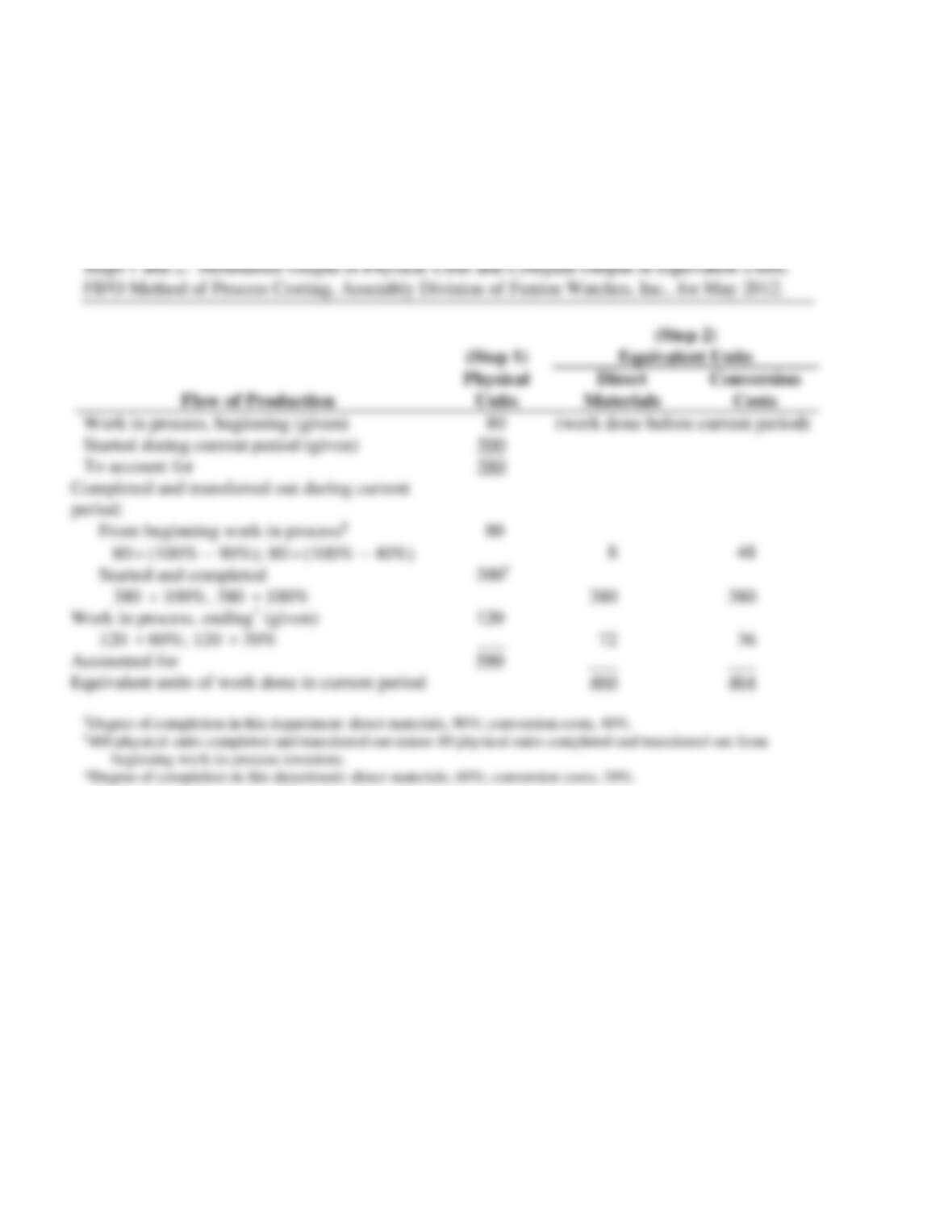
17-21 (15 min.) FIFO method, equivalent units.
Under the FIFO method, equivalent units are calculated as the equivalent units of work done in
the current period only. Solution Exhibit 17-21 shows equivalent units of work done in May
2012 in the Assembly Division of Fenton Watches, Inc., for direct materials and conversion
costs.
SOLUTION EXHIBIT 17-21
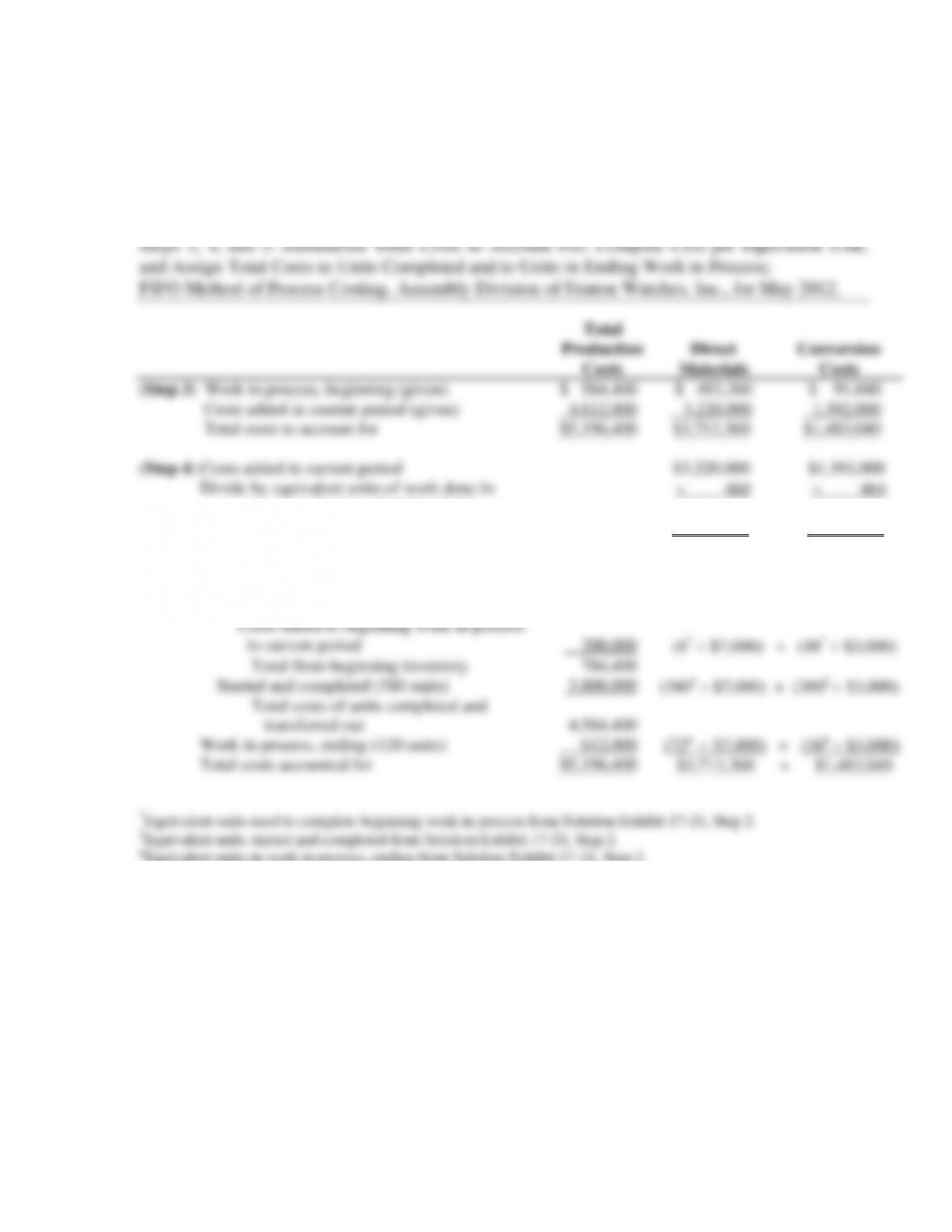
17-22 (20 min.) FIFO method, assigning costs (continuation of 17-21).
Solution Exhibit 17-22 summarizes total costs to account for, calculates cost per equivalent unit
of work done in May 2012 in the Assembly Division of Fenton Watches, Inc., and assigns total
costs to units completed and to units in ending work-in–process inventory.
SOLUTION EXHIBIT 17-22
17-10
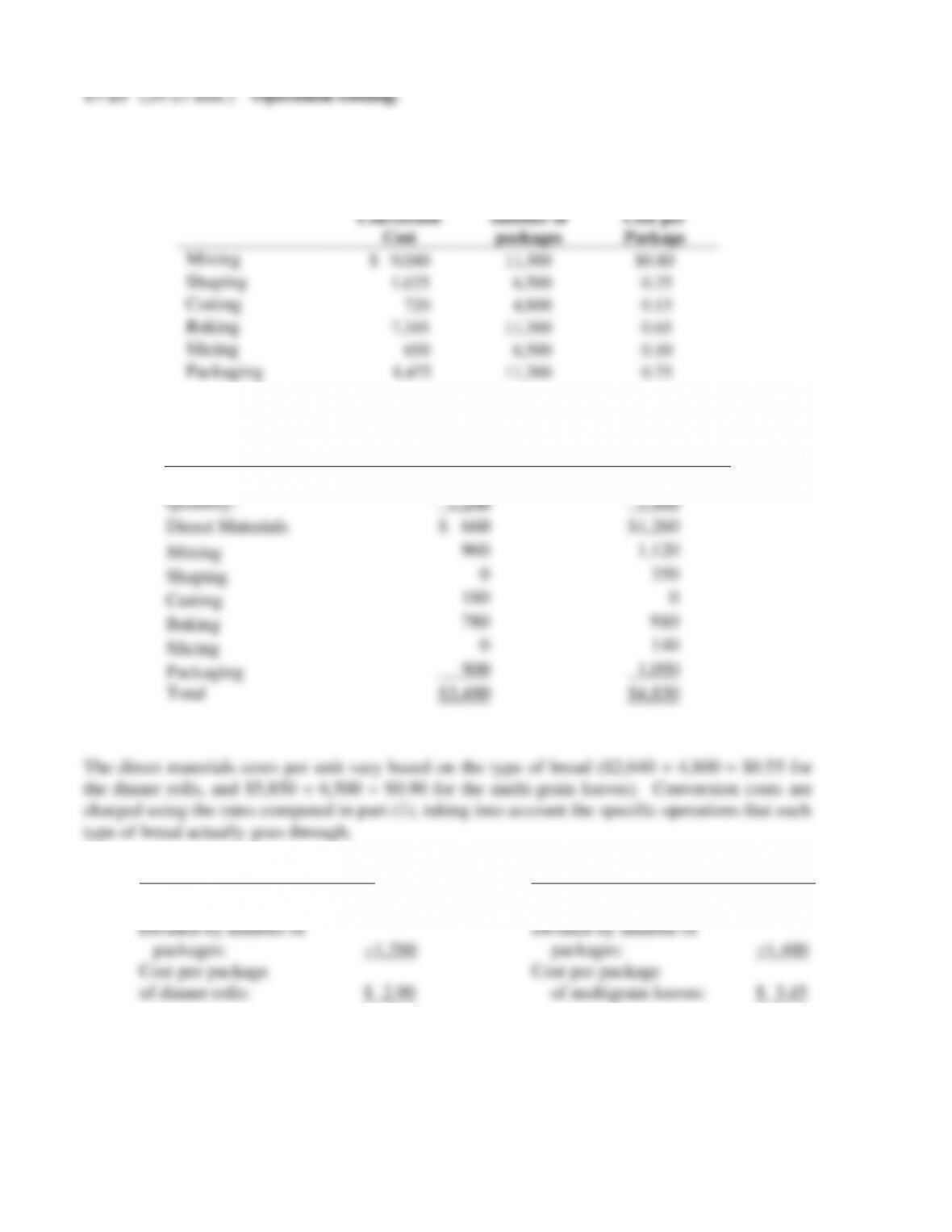
1. To obtain the conversion-cost rates, divide the budgeted cost of each operation by the number
of packages that are expected to go through that operation.
Budgeted
Conversion
Cost
Budgeted
number of
packages
Conversion
Cost per
Package
Mixing
$ 9,040
11,300
$0.80
Shaping
1,625
6,500
0.25
Cutting
720
4,800
0.15
Baking
7,345
11,300
0.65
Slicing
650
6,500
0.10
Packaging
8,475
11,300
0.75
2.
Work Order
Work Order
#215
#216
Bread type:
Dinner Roll
Multigrain Loaves
Quantity:
1,200
1,400
Direct Materials
$ 660
$1,260
Mixing
960
1,120
Shaping
0
350
Cutting
180
0
Baking
780
910
Slicing
0
140
Packaging
900
1,050
Total
$3,480
$4,830
The direct materials costs per unit vary based on the type of bread ($2,640 ÷ 4,800 = $0.55 for
the dinner rolls, and $5,850 ÷ 6,500 = $0.90 for the multi-grain loaves). Conversion costs are
charged using the rates computed in part (1), taking into account the specific operations that each
type of bread actually goes through.
3. Work order #215 (Dinner rolls): Work order #216 (Mulit-grain loaves):
Total cost $3,480 Total cost: $4,830