16-1
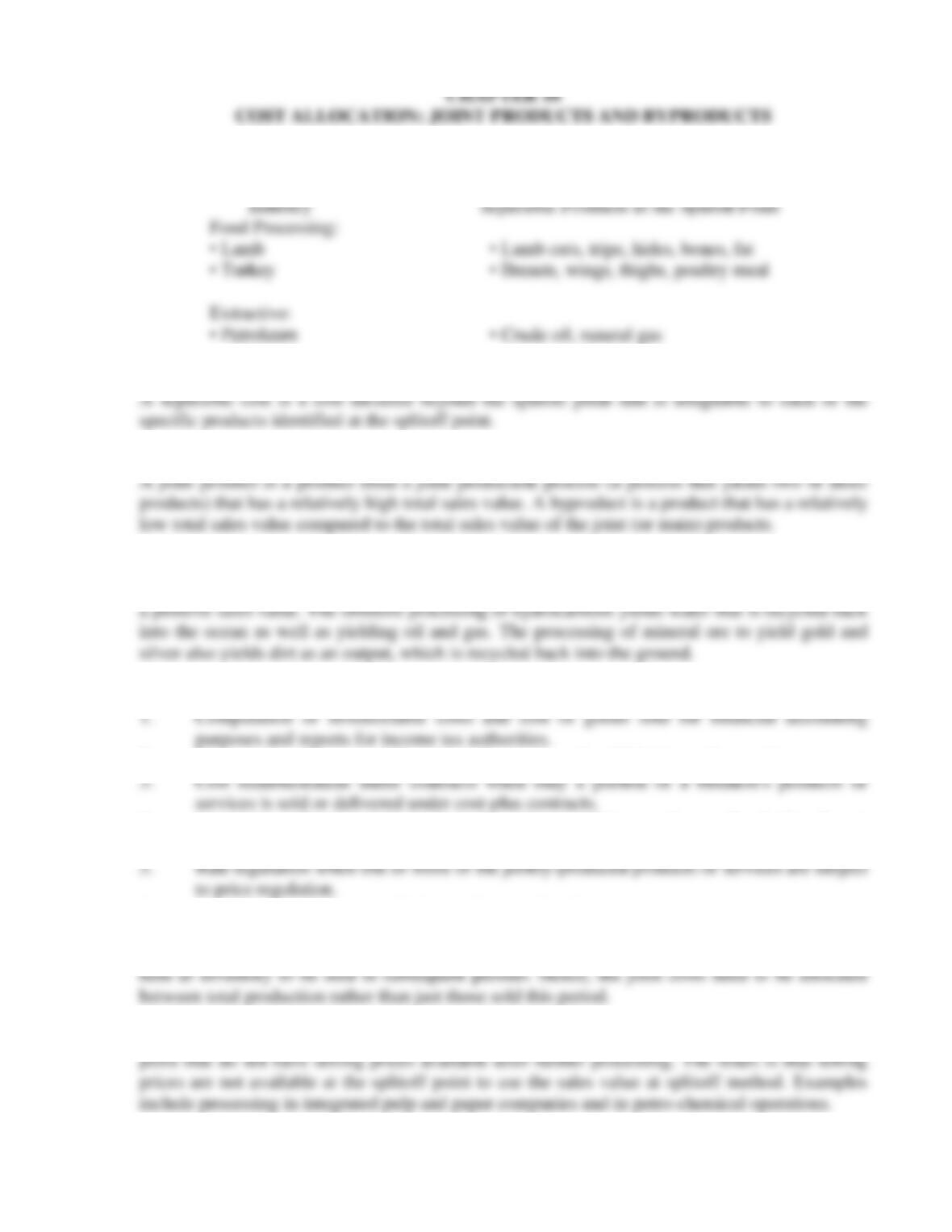
16-1 Exhibit 16-1 presents many examples of joint products from four different general
industries. These include:
16-2 A joint cost is a cost of a production process that yields multiple products simultaneously.
16-3 The distinction between a joint product and a byproduct is based on relative sales value.
16-4 A product is any output that has a positive sales value (or an output that enables a
company to avoid incurring costs). In some joint-cost settings, outputs can occur that do not have
16-5 The chapter lists the following six reasons for allocating joint costs:
2. Computation of inventoriable costs and cost of goods sold for internal reporting purposes.
4. Insurance settlement computations for damage claims made on the basis of cost
information of joint products or byproducts.
6. Litigation in which costs of joint products are key inputs.
16-6 The joint production process yields individual products that are either sold this period or
16-7 This situation can occur when a production process yields separable outputs at the splitoff
16-2
16-8 Both methods use market selling-price data in allocating joint costs, but they differ in
which sales-price data they use. The sales value at splitoff method allocates joint costs to joint
16-9 Limitations of the physical measure method of joint-cost allocation include:
a. The physical weights used for allocating joint costs may have no relationship to the
16-10 The NRV method can be simplified by assuming (a) a standard set of post-splitoff point
16-11 The constant gross-margin percentage NRV method takes account of the post-splitoff
16-12 No. Any method used to allocate joint costs to individual products that is applicable to
the problem of joint product-cost allocation should not be used for management decisions
16-13 No. The only relevant items are incremental revenues and incremental costs when
making decisions about selling products at the splitoff point or processing them further.
16-14 Two methods to account for byproducts are:
16-15 The sales byproduct method enables a manager to time the sale of byproducts to affect
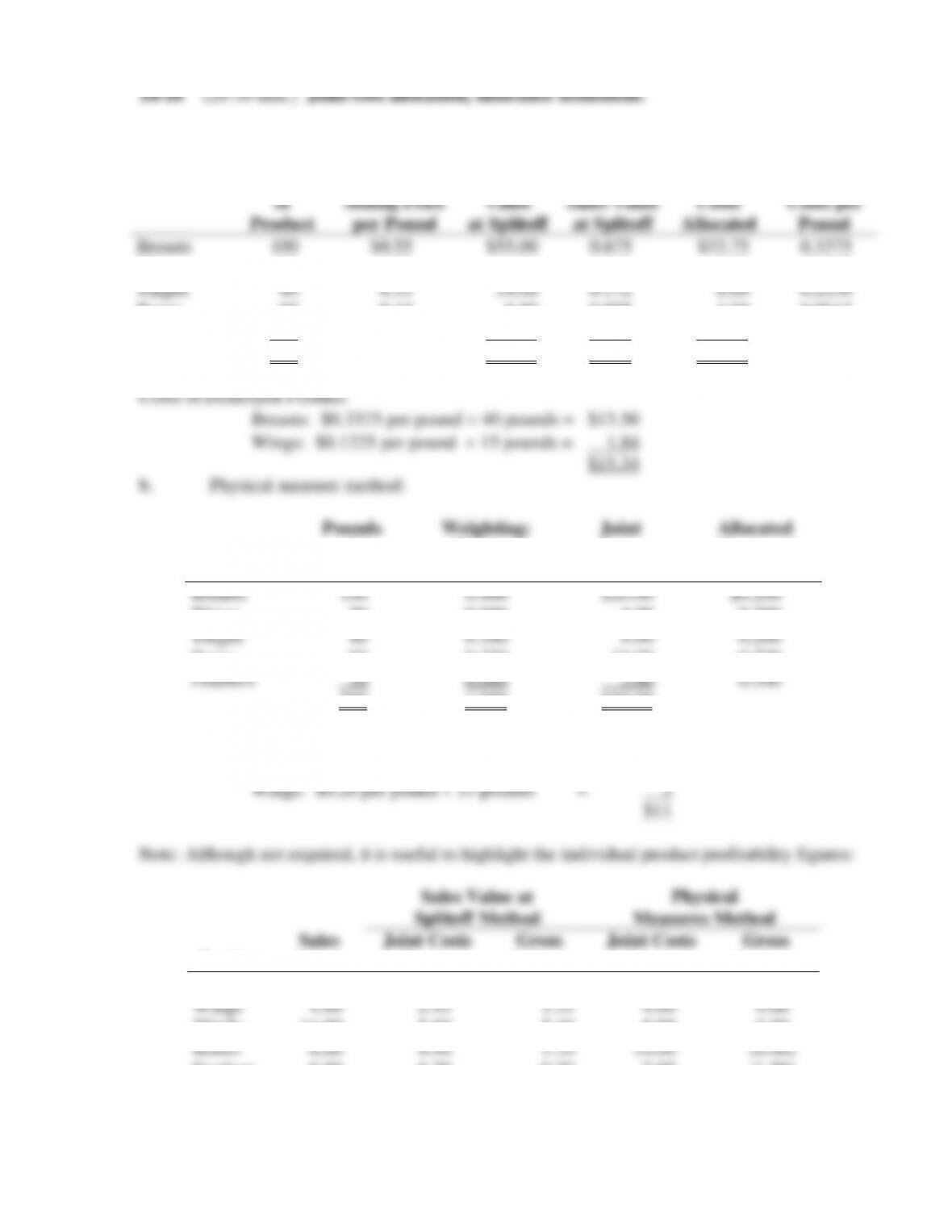
1. (a) Sales value at splitoff method:
Pounds
of
Product
Wholesale
Selling Price
per Pound
Sales
Value
at Splitoff
Weighting:
Sales Value
at Splitoff
Joint
Costs
Allocated
Allocated
Costs per
Pound
Breasts
Wings
Thighs
Bones
Feathers
100
20
40
80
10
250
$0.55
0.20
0.35
0.10
0.05
$55.00
4.00
14.00
8.00
0.50
$81.50
0.675
0.049
0.172
0.098
0.006
1.000
$33.75
2.45
8.60
4.90
0.30
$50.00
0.3375
0.1225
0.2150
0.0613
0.0300
16-4
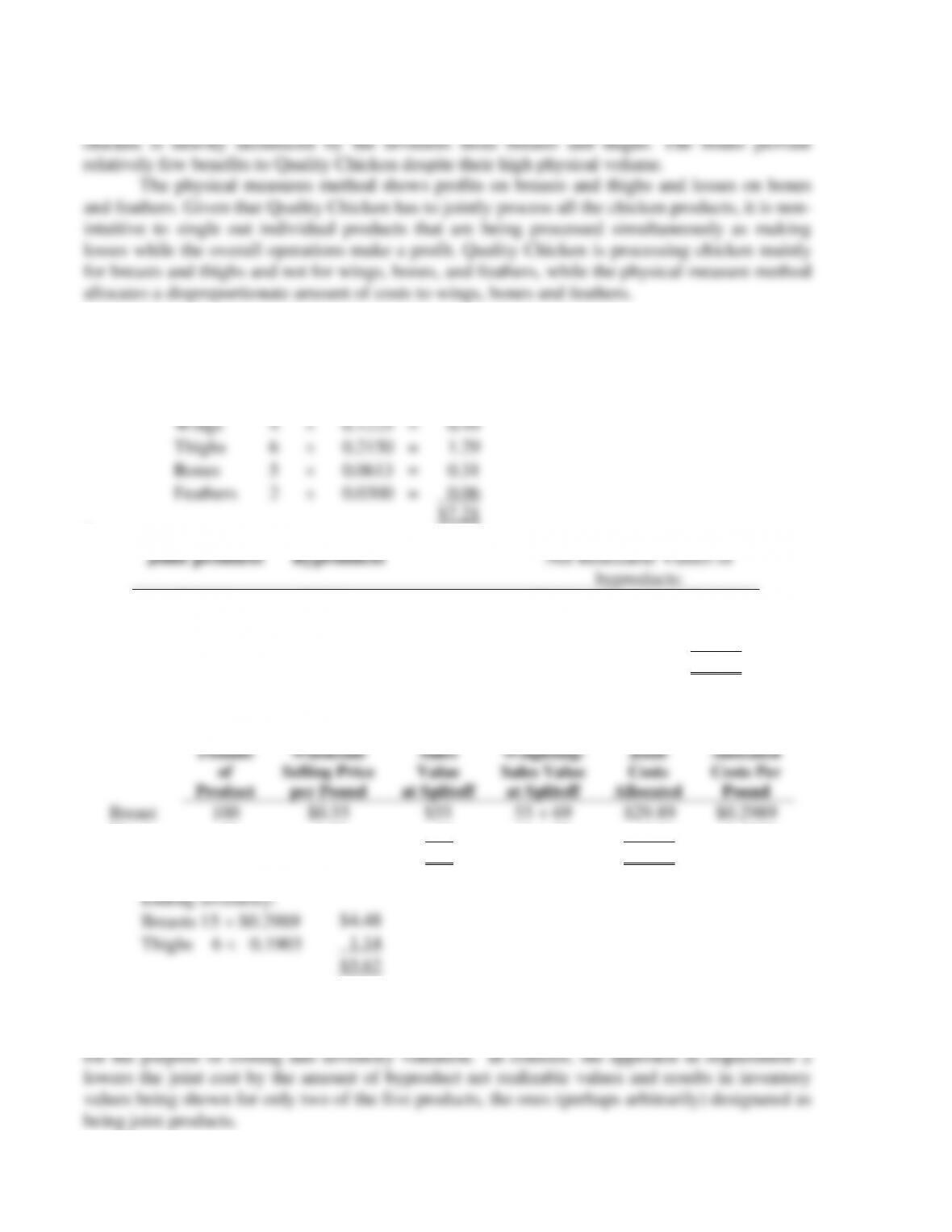
2. The sales-value at splitoff method captures the benefits-received criterion of cost
allocation and is the preferred method. The costs of processing a chicken are allocated to
products in proportion to the ability to contribute revenue. Quality Chicken’s decision to process
16-17 (10 min.) Joint products and byproducts (continuation of 16-16).
1. Ending inventory:
Breasts 15 $0.3375 = $5.06
2.
Joint products
Byproducts
Net Realizable Values of
byproducts:
Breasts
Wings
Wings
$ 4.00
Thighs
Bones
Bones
8.00
Feathers
Feathers
0.50
$12.50
Joint costs to be allocated:
Joint costs – Net Realizable Values of byproducts = $50 – $12.50 = $37.50
Pounds
of
Product
Wholesale
Selling Price
per Pound
Sales
Value
at Splitoff
Weighting:
Sales Value
at Splitoff
Joint
Costs
Allocated
Allocated
Costs Per
Pound
Breast
100
$0.55
$55
55 ÷ 69
$29.89
$0.2989
Thighs
40
0.35
14
14 ÷ 69
7.61
0.1903
$69
$37.50
Ending inventory:
Breasts 15 $0.2989
$4.48
Thighs 6 0.1903
1.14
$5.62
3. Treating all products as joint products does not require judgments as to whether a product
is a joint product or a byproduct. Joint costs are allocated in a consistent manner to all products
16-5
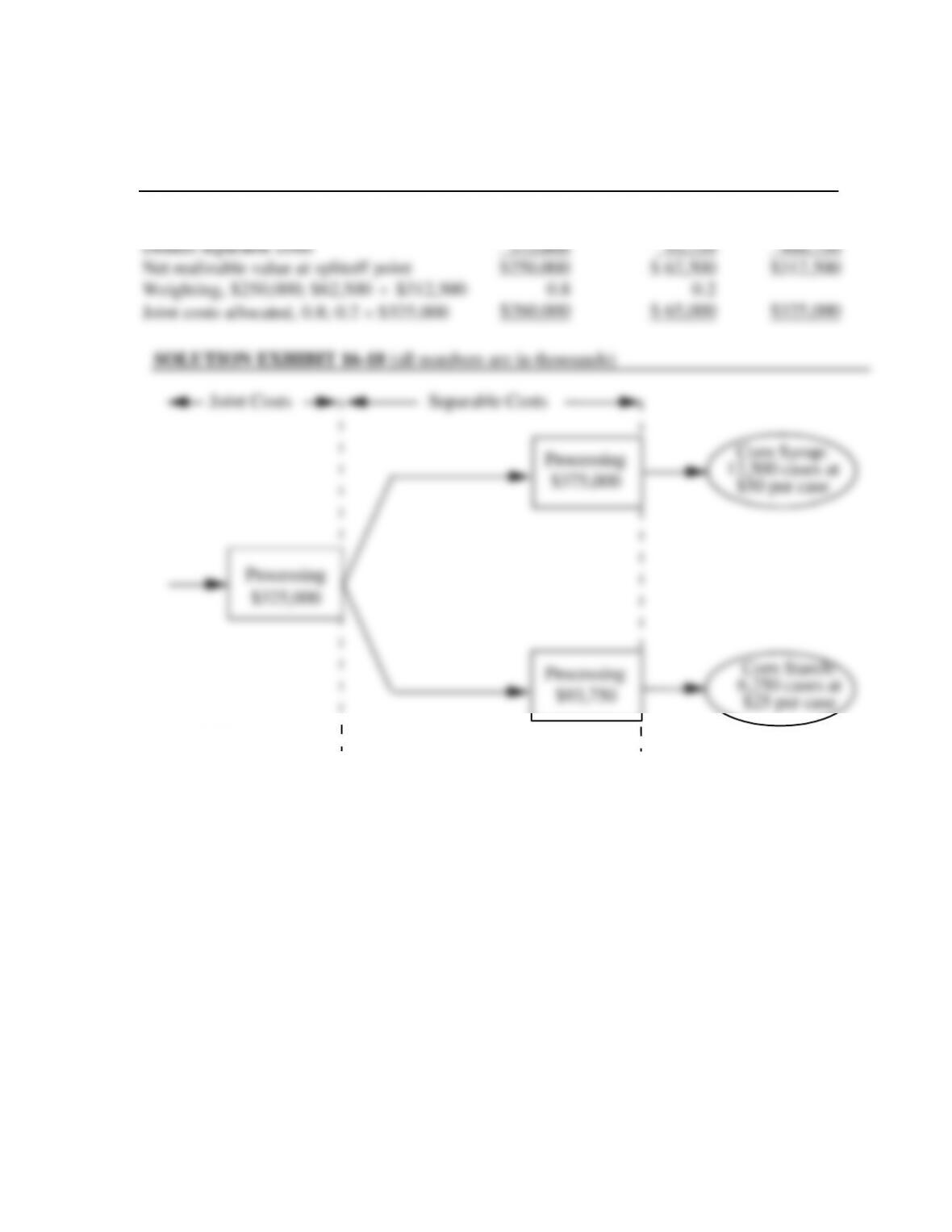
16-18 (10 min.) Net realizable value method.
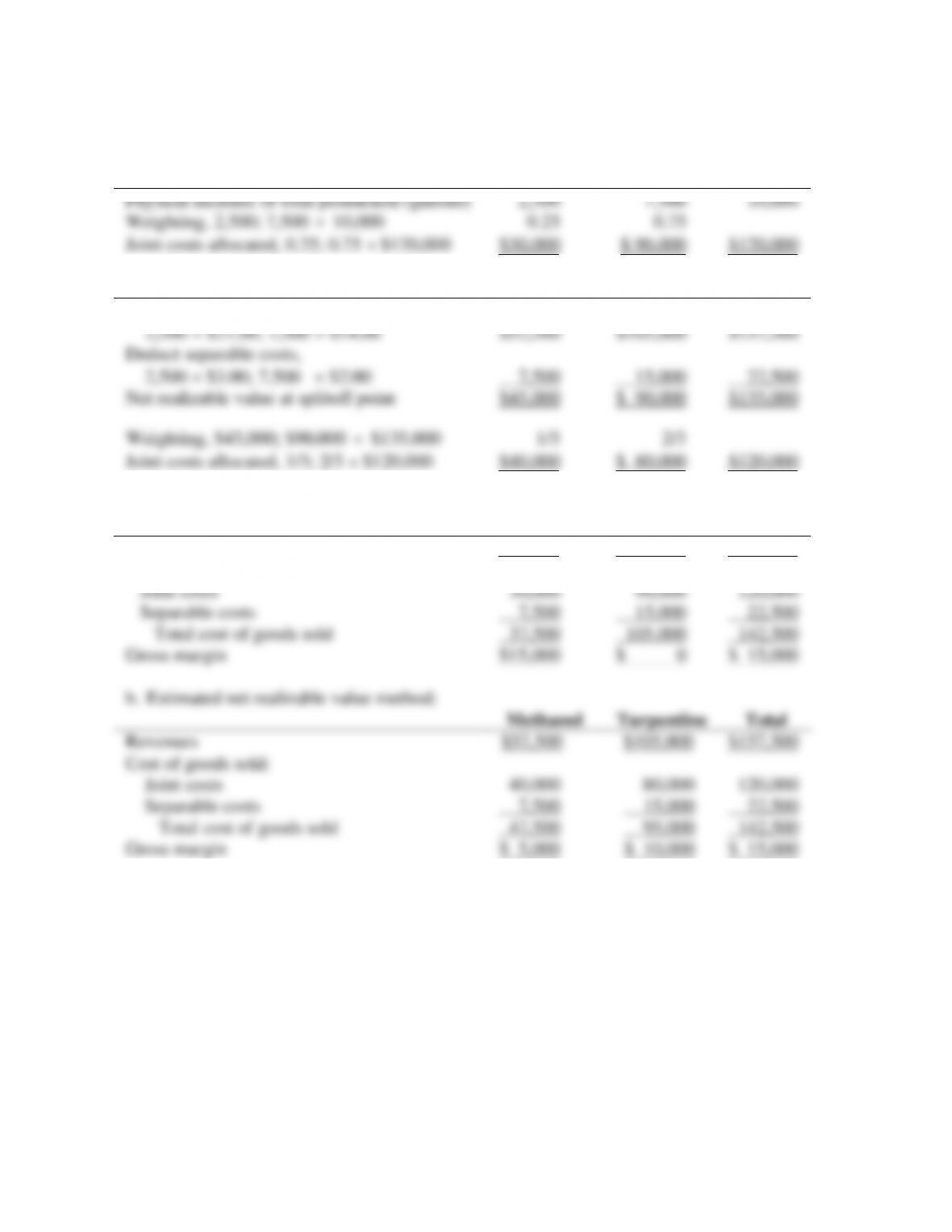
A diagram of the situation is in Solution Exhibit 16-18.
Corn Syrup
Corn Starch
Total
Final sales value of total production,
12,500 $50; 6,250 $25
$625,000
$156,250
$781,250
Deduct separable costs
375,000
93,750
468,750
Net realizable value at splitoff point
$250,000
$ 62,500
$312,500
Weighting, $250,000; $62,500
$312,500
0.8
0.2
Joint costs allocated, 0.8; 0.2 $325,000
$260,000
$ 65,000
$325,000
SOLUTION EXHIBIT 16-18 (all numbers are in thousands)
Corn Starch:
6,250 cases at
$25 per case
Corn Syrup:
12,500 cases at
$50 per case
Processing
$325000
Processing
$375,000
Processing
$93,750
Splitoff
Point
Joint Costs
Separable Costs
16-6
16-19 (40 min.) Alternative joint-cost-allocation methods, further-process decision.
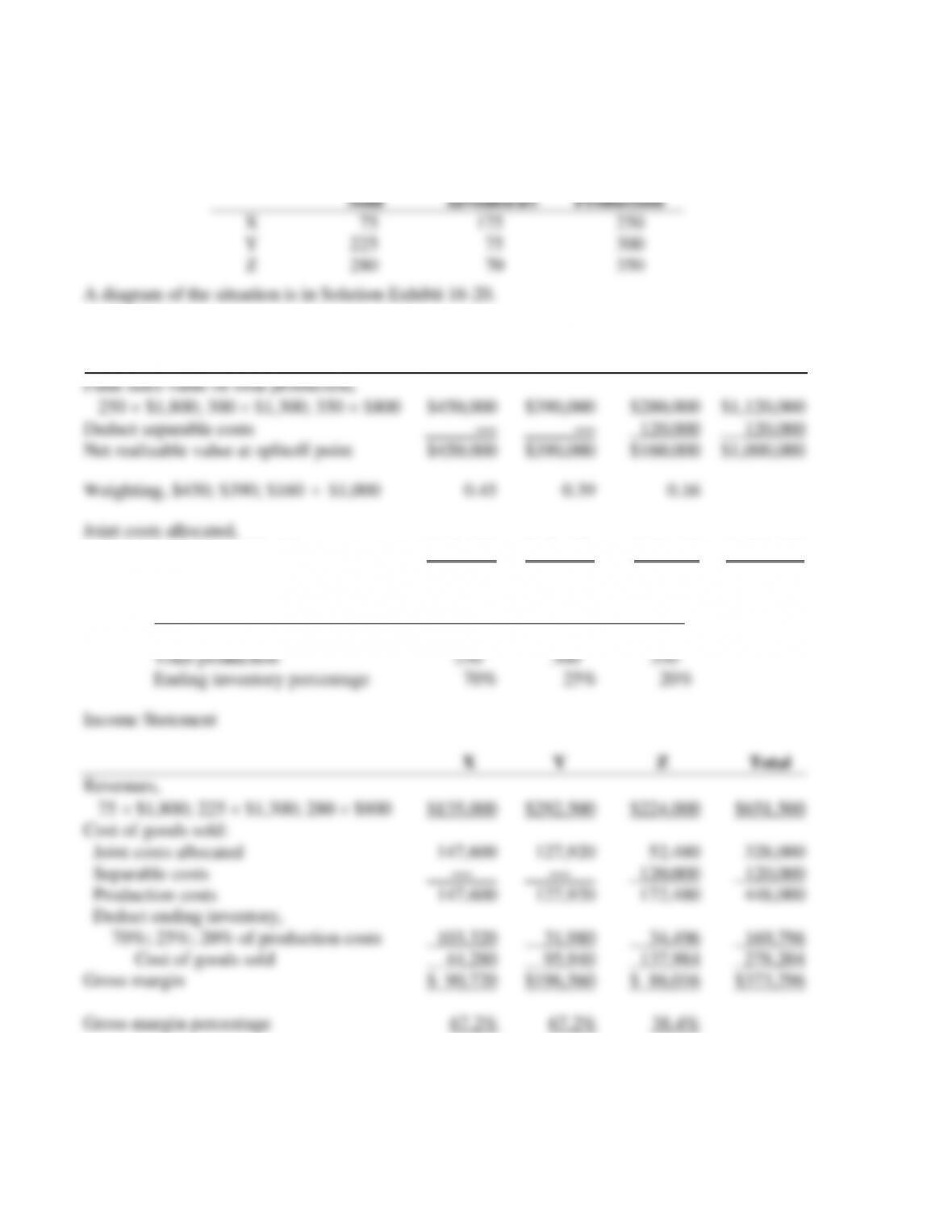
A diagram of the situation is in Solution Exhibit 16-19.
1.
Methanol
Turpentine
Total
2.
Methanol
Turpentine
Total
Final sales value of total production,
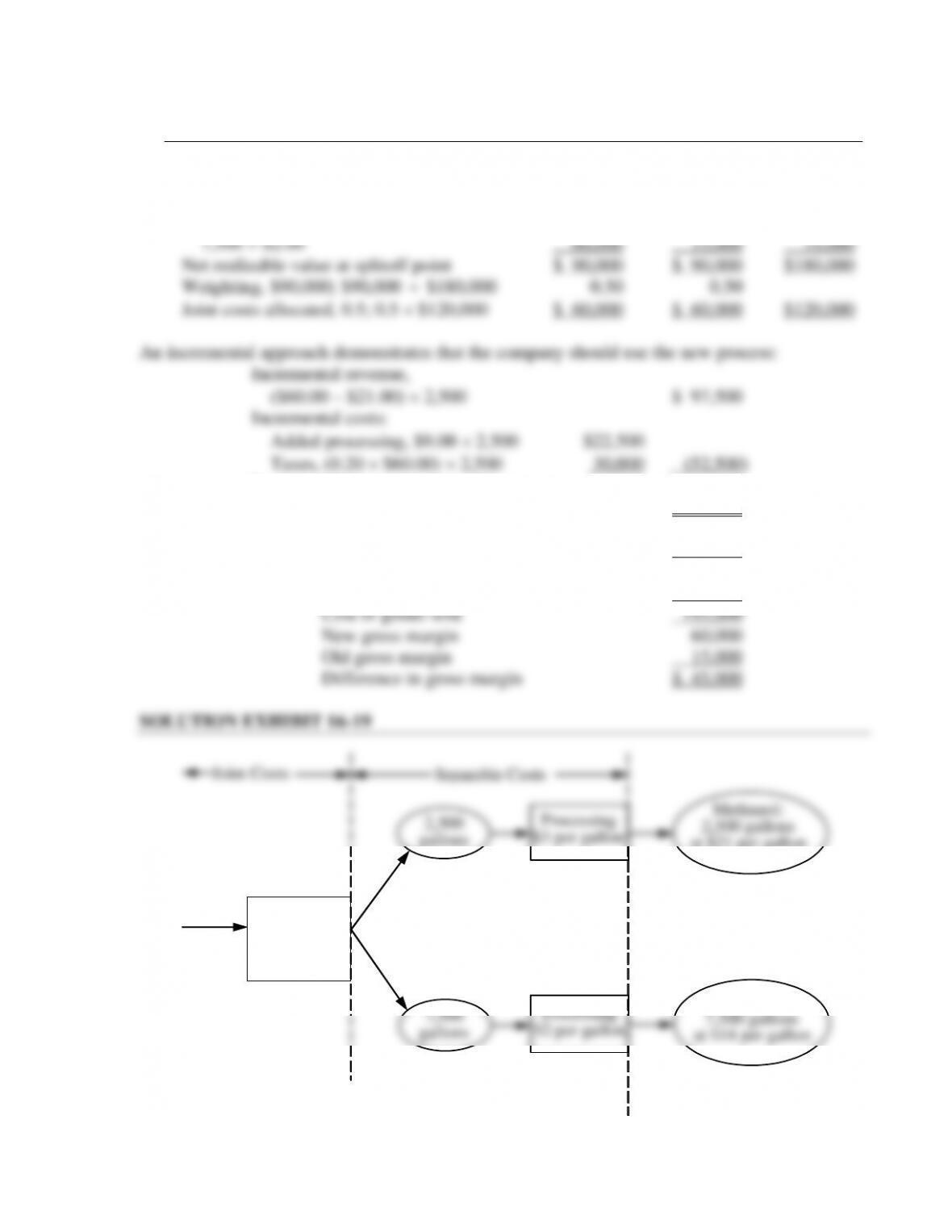
3. a. Physical-measure (gallons) method:
Methanol
Turpentine
Total
Revenues $52,500 $105,000 $157,500
Cost of goods sold:
4.
Alcohol Bev.
Turpentine
Total
Final sales value of total production,
2,500 $60.00; 7,500 $14.00 $150,000 $105,000 $255,000
Deduct separable costs,
(2,500 $12.00) + (0.20 $150,000);
Incremental operating income from
further processing $ 45,000
Proof: Total sales of both products $255,000
Joint costs 120,000
Separable costs 75,000
16-8
16-20 (40 min.) Alternative methods of joint-cost allocation, ending inventories.
Total production for the year was:
Ending
Total
Sold
Inventories
Production
X 75 175 250
Y 225 75 300
Z 280 70 350
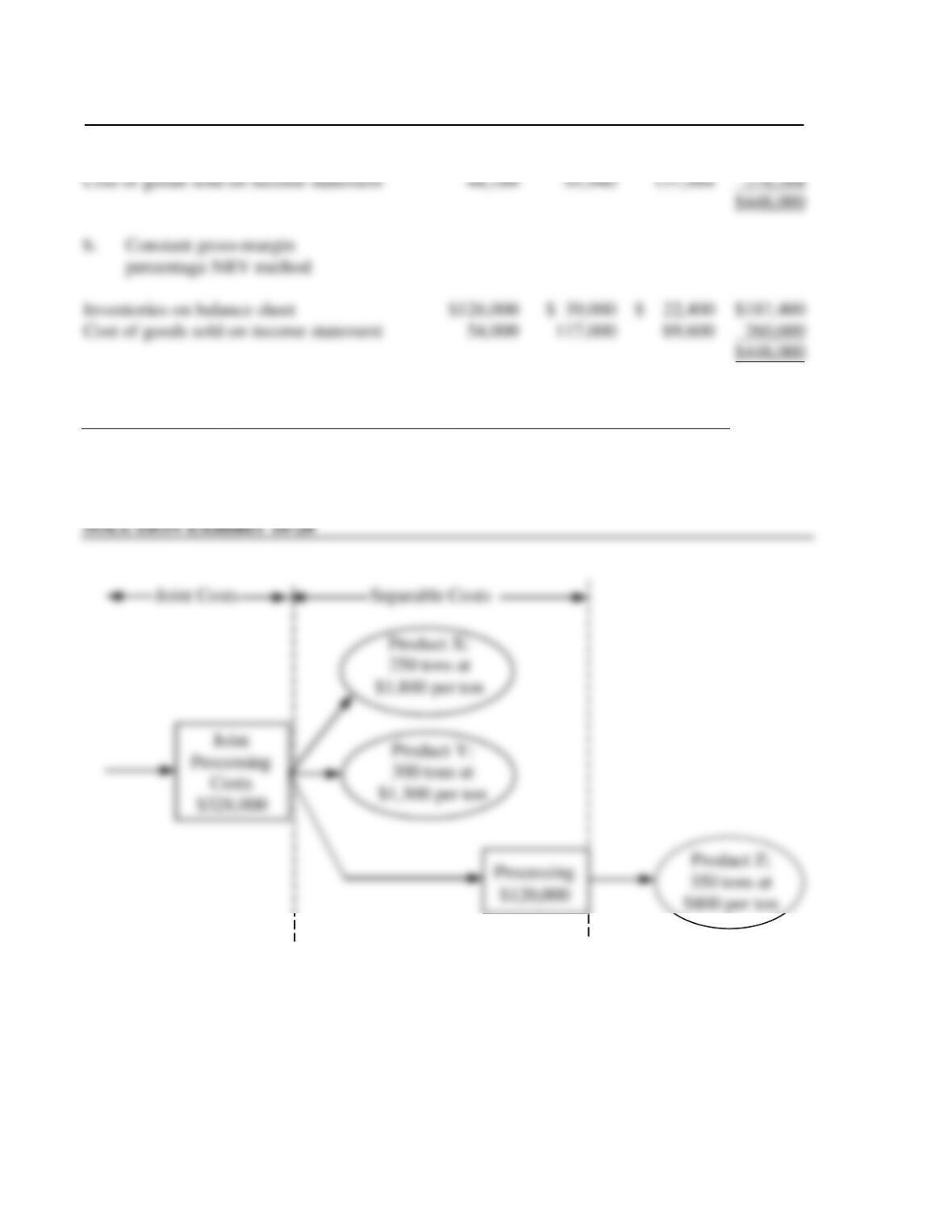
A diagram of the situation is in Solution Exhibit 16-20.
1. a. Net realizable value (NRV) method:
X Y Z Total
0.45, 0.39, 0.16 $328,000 $147,600 $127,920 $ 52,480 $ 328,000
Ending Inventory Percentages:
X Y Z
Ending inventory 175 75 70
16-9
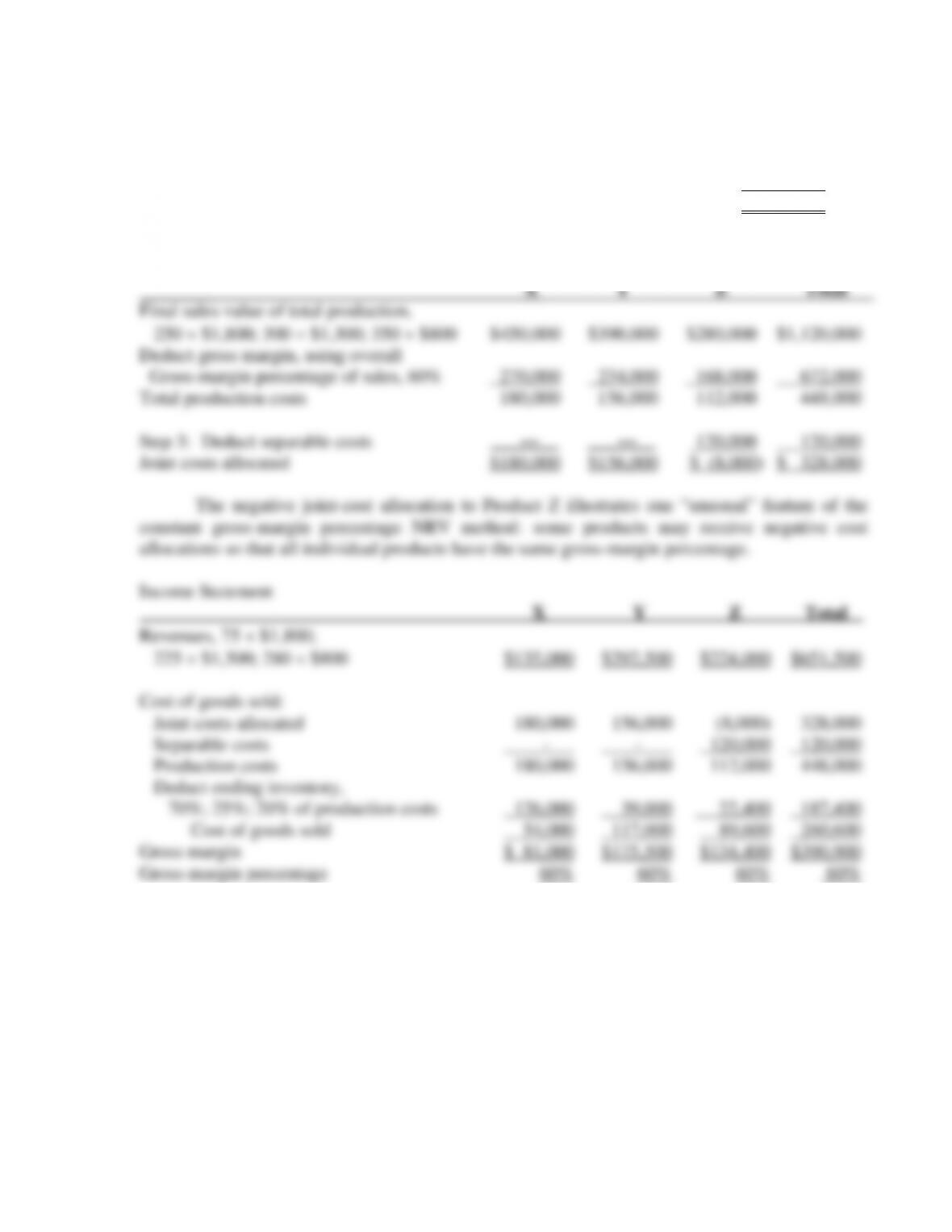
b. Constant gross-margin percentage NRV method:
Step 1:
Final sales value of prodn., (250 $1,800) + (300 $1,300) + (350 $800) $1,120,000
Deduct joint and separable costs, $328,000 + $120,000 448,000
Gross margin $ 672,000
Gross-margin percentage, $672,000 ÷ $1,120,000 60%
Step 2:
16-10
Summary
X Y Z Total
a. NRV method:
Inventories on balance sheet $103,320 $ 31,980 $ 34,496 $169,796
2. Gross-margin percentages:
X Y Z
NRV method 67.2% 67.2% 38.4%
Constant gross-margin percentage NRV 60.0% 60.0% 60.0%
Splitoff
Point
Processing
$120000
Product Z:
350 tons at
$800 per ton