16-31
16-31 (10 min.) Further processing decision (continuation of 16-30).
1.and 2. The decision about which combination of products to produce is not affected by the
method of joint cost allocation. For both the sales value at splitoff and physical measure
methods, the relevant comparisons are as shown below:
Butter
Buttermilk
Revenue if sold at splitoff
$39,600a
$ 32,400b
Process further NRV
54,000c
21,600d
Profit (Loss) from processing further
$15,600
$(10,800)
a 18,000 lbs × $2.20 = $39,600
b 27,000 quarts × $1.2 = $32,400
c 36,000 tubs × $2.3 – 18,000 lbs × $1.6 = $54,000
d 54,000 pints × $0.75 – 54,000 pints × $.35 = $21,600
To maximize profits, Elsie should process butter further into spreadable butter. However, Elsie
should sell the buttermilk at the splitoff point in quart containers. The extra cost to convert to
pint containers ($0.35 per pint × 2 pints per quart = $0.70 per quart) exceeds the increase in
selling price ($0.75 per pint × 2 pints per quart = $1.50 per quart – $1.20 original price = $0.30
per quart) and leads to a loss of $10,800.
3. The decision to sell a product at split off or to process it further should have nothing to do
with the allocation method chosen. For each product, you need to compare the revenue from
16-32 (20 min.) Joint-cost allocation with a byproduct.
1. Sales value at splitoff method: Byproduct recognized at time of production method
Floor Mats
Car Mats
Rubber
Shreds (lbs)
Products manufactured
31,250a
93,750b
50,000c
Products sold
25,000
85,000
43,000
Ending inventory
6,250
8,750
7,000
Weighting, $375,000; $562,500
0.40
Joint costs allocated, 0.40; 0.60 × $565,000
Revenues, 25,000 × $12; 85,000 × $6
Cost of goods sold
Joint costs allocated, 0.40; 0.60 × $565,000
Less: Ending inventory
Gross margin
16-33
Floor Mats
Car Mats
Rubber
Shreds
Total
Revenues, 25,000 × $12; 85,000 × $6
$300,000
$510,000
$30,100d
$840,100
Cost of goods sold
Joint costs allocated, 0.40; 0.60 × $600,000
240,000
360,000
600,000
Less: Ending inventory
(48,000)e
(33,600)f
(81,600)
Cost of goods sold
192,000
326,400
518,400
Gross margin
$108,000
$183,600
$30,100
$321,700
d 43,000 lbs × $0.70 per lb. = $30,100
e 6,250 × $240,000/31,250 = $48,000
f 8,750 × $360,000/93,750 = $33,600
3. The production method of accounting for the byproduct is only appropriate if The Mat
Place is positive they can sell the byproduct at the expected selling price. Moreover, The Mat
16-34
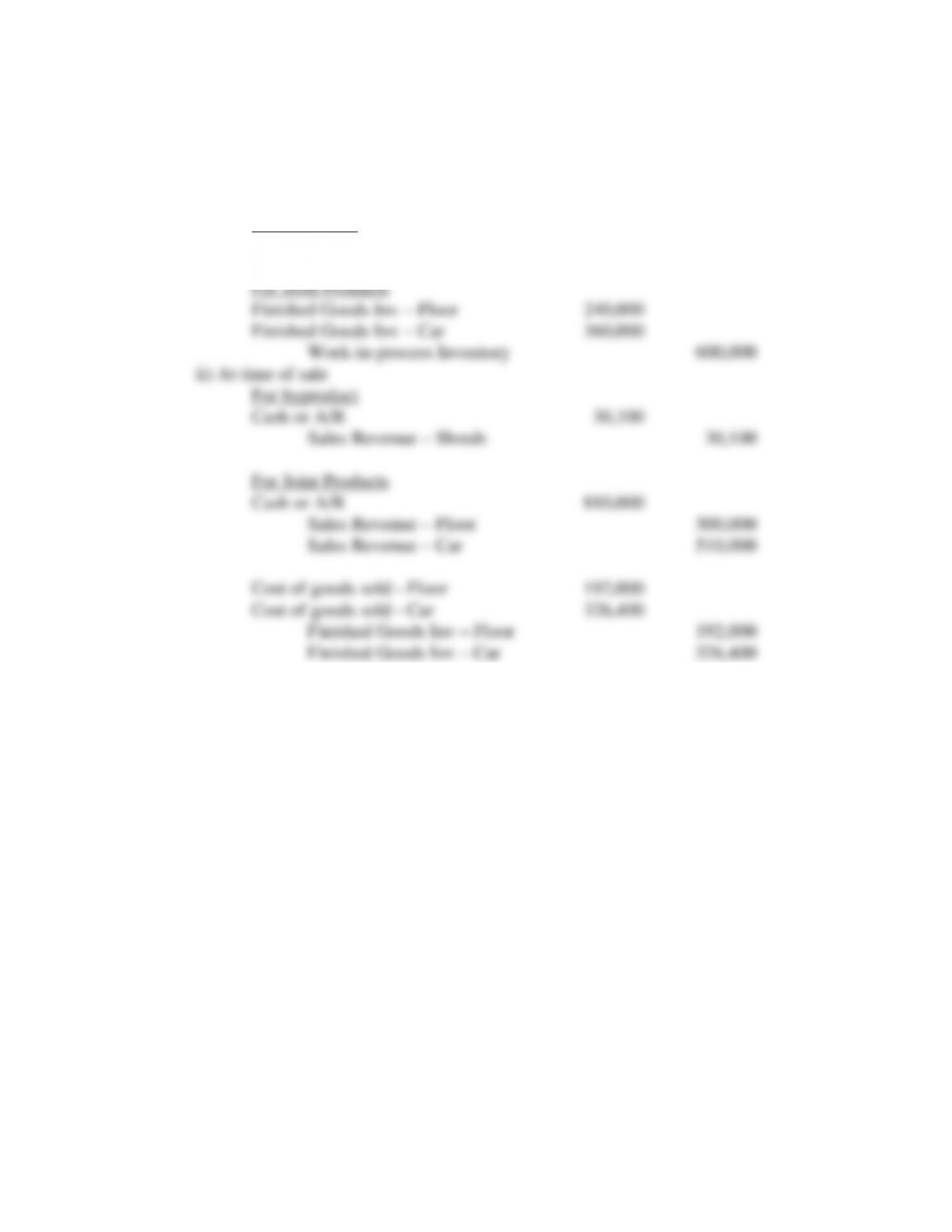
16-33 (15 min.) Byproduct journal entries (continuation of 16-32).
1. Byproduct – production method journal entries
i) At time of production:
Work-in–process Inventory 600,000
Accounts Payable, etc. 600,000
For byproduct:
16-35
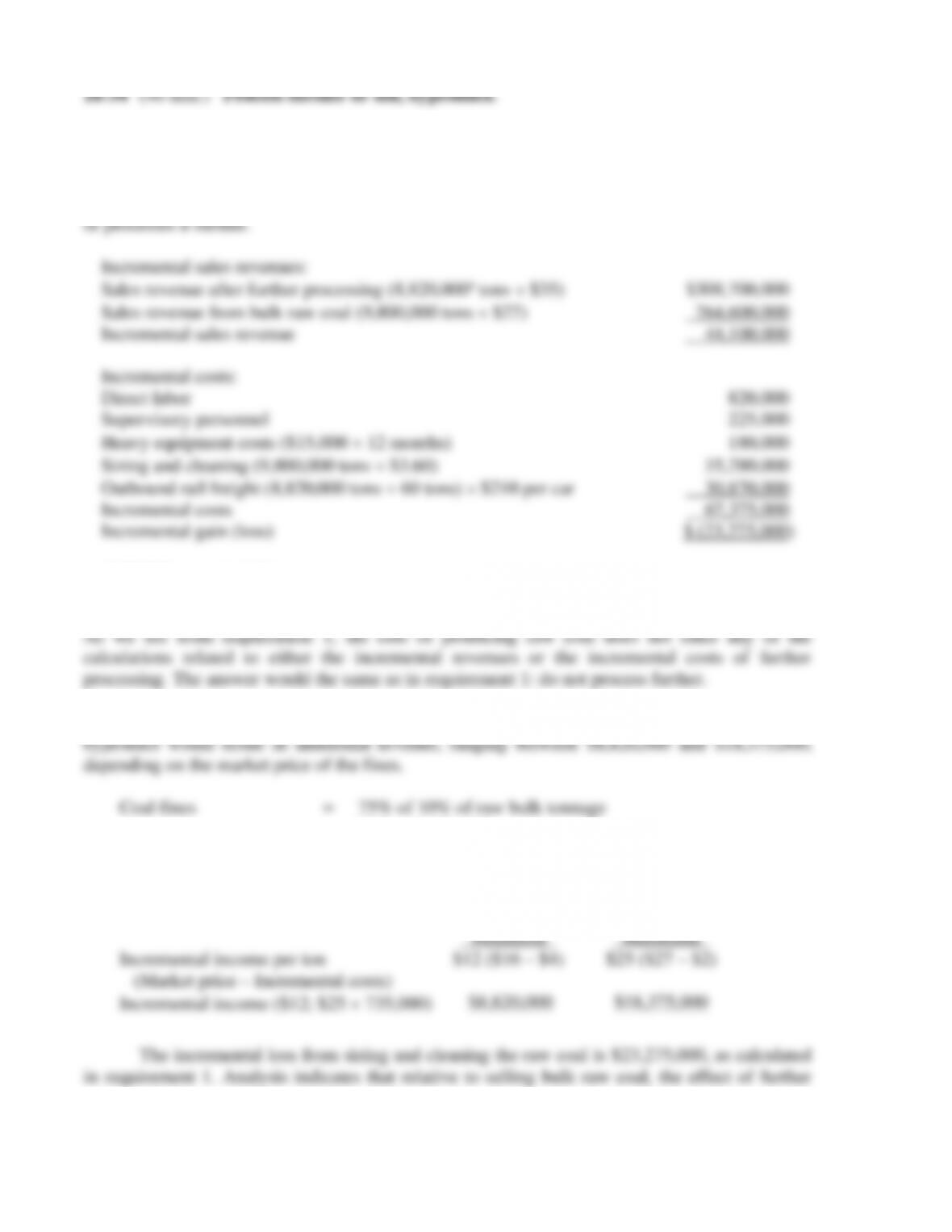
2. Byproduct – sales method journal entries
i) At time of production:
Work-in–process Inventory 600,000
Accounts Payable, etc. 600,000
For byproduct:
No entry
16-36
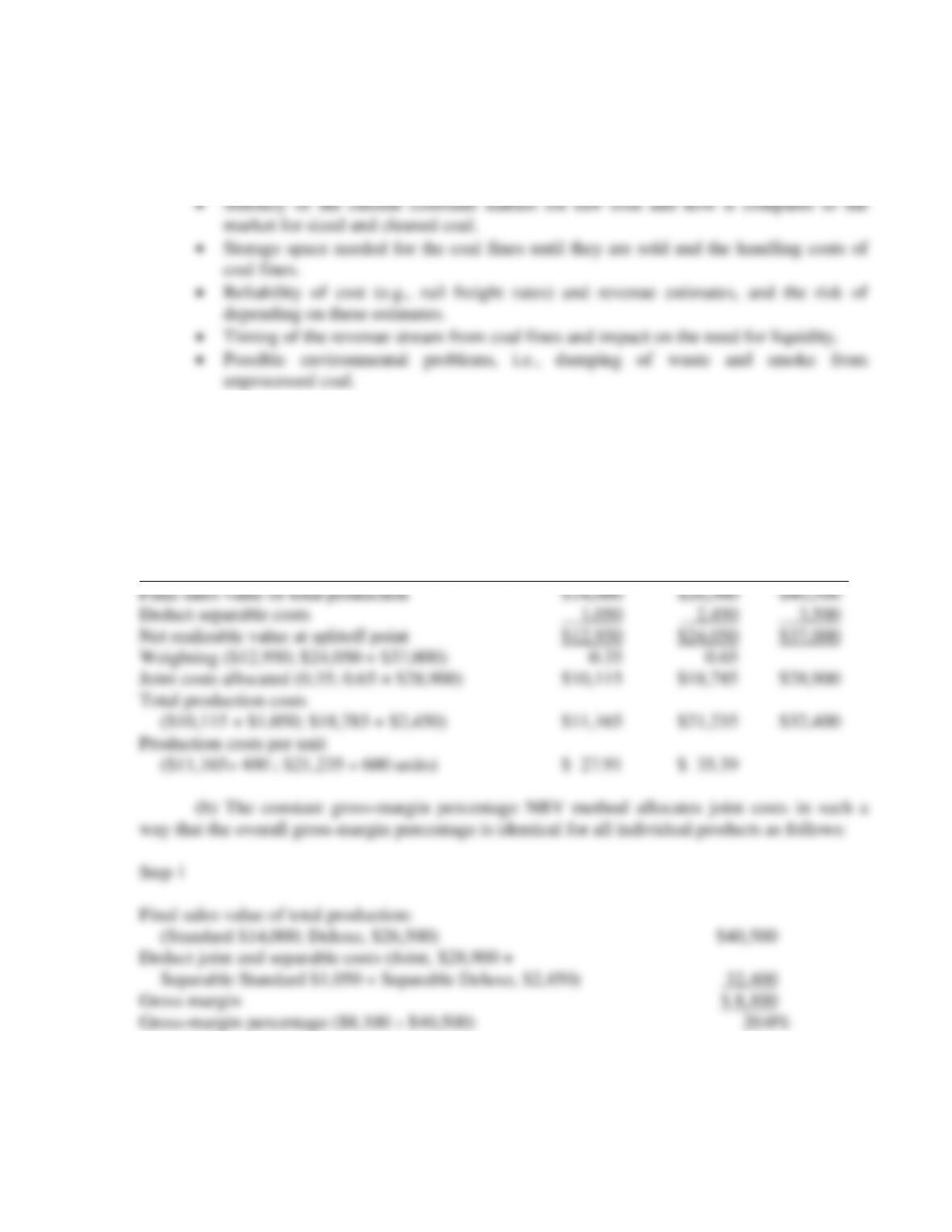
1. The analysis shown below indicates that it would be more profitable for Rochester
Mining Company to continue to sell bulk raw coal without further processing. This analysis
ignores any value related to coal fines. It also assumes that the costs of loading and shipping the
bulk raw coal on river barges will be the same whether Rochester sells the bulk raw coal directly
Incremental sales revenues:
Sales revenue after further processing (8,820,000a tons $35)
$308,700,000
Sales revenue from bulk raw coal (9,800,000 tons $27)
264,600,000
Incremental sales revenue
44,100,000
Incremental costs:
Direct labor
820,000
Supervisory personnel
225,000
Heavy equipment costs ($15,000 12 months)
180,000
Sizing and cleaning (9,800,000 tons $3.60)
35,280,000
Outbound rail freight (8,820,000 tons 60 tons) $210 per car
30,870,000
Incremental costs
67,375,000
Incremental gain (loss)
$ (23,275,000)
a9,800,000 tons (1– 0.10)
2. The cost of producing the raw coal is irrelevant to the decision to process further or not.
3. The analysis shown below indicates that the potential revenue from the coal fines
Coal fines
=
75% of 10% of raw bulk tonnage
=
0.75 (9,800,000 .10)
=
735,000 tons
Potential incremental income from preparing and selling the coal fines:
Minimum
Maximum
Incremental income per ton
(Market price – Incremental costs)
$12 ($16 – $4)
$25 ($27 – $2)
Incremental income ($12; $25 735,000)
$8,820,000
$18,375,000
The incremental loss from sizing and cleaning the raw coal is $23,275,000, as calculated
in requirement 1. Analysis indicates that relative to selling bulk raw coal, the effect of further
16-37
processing and selling coal fines is still not enough to make profits. Hence, further processing is
not preferred.
Note that other than the financial implications, some factors that should be considered in
evaluating a sell-or-process-further decision include:
16-35 (30 min.) Joint Cost Allocation
1. (a) The Net Realizable Value Method allocates joint costs on the basis of the relative net
realizable value (final sales value minus the separable costs of production and marketing). Joint
costs would be allocated as follows:
Standard Deluxe
Module Module Total