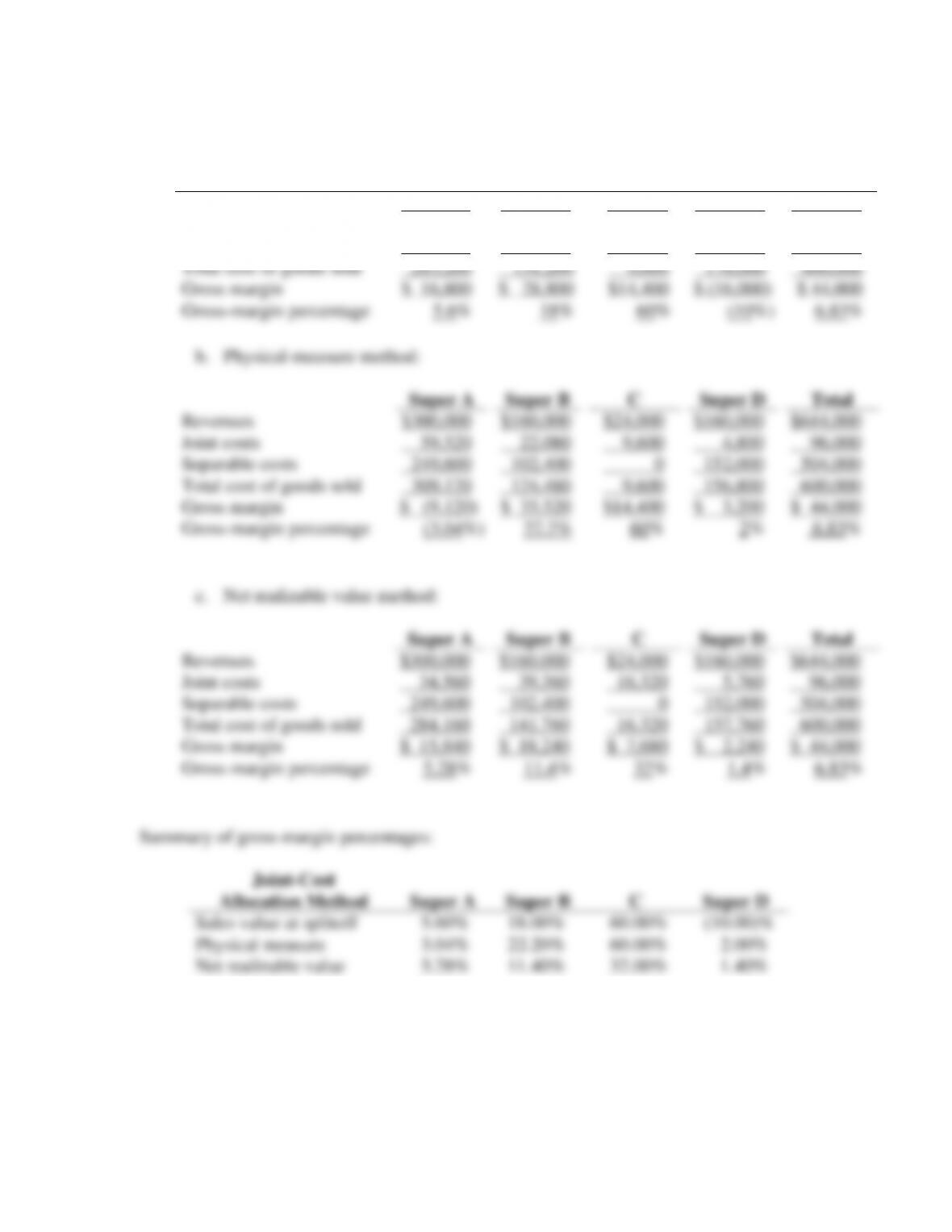
Computation of gross-margin percentages:
a. Sales value at splitoff method:
Super A
Super B
C
Super D
Total
Revenues
$300,000
$160,000
$24,000
$160,000
$644,000
Joint costs
33,600
28,800
9,600
24,000
96,000
Separable costs
249,600
102,400
0
152,000
504,000
Total cost of goods sold
283,200
131,200
9,600
176,000
600,000
Gross margin
$ 16,800
$ 28,800
$14,400
$ (16,000)
$ 44,000
Gross-margin percentage
5.6%
18%
60%
(10%)
6.83%
b. Physical-measure method:
Super A
Super B
C
Super D
Total
Revenues
$300,000
$160,000
$24,000
$160,000
$644,000
Joint costs
59,520
22,080
9,600
4,800
96,000
Separable costs
249,600
102,400
0
152,000
504,000
Total cost of goods sold
309,120
124,480
9,600
156,800
600,000
Gross margin
$ (9,120)
$ 35,520
$14,400
$ 3,200
$ 44,000
Gross-margin percentage
(3.04%)
22.2%
60%
2%
6.83%
Revenues
$300,000
$160,000
$24,000
$160,000
$644,000
Joint costs
34,560
39,360
16,320
5,760
96,000
Separable costs
249,600
102,400
0
152,000
504,000
Total cost of goods sold
284,160
141,760
16,320
157,760
600,000
Gross margin
$ 15,840
$ 18,240
$ 7,680
$ 2,240
$ 44,000
Allocation Method
Super B
C
Sales value at splitoff
18.00%
Physical measure
22.20%
Net realizable value
11.40%
16-22
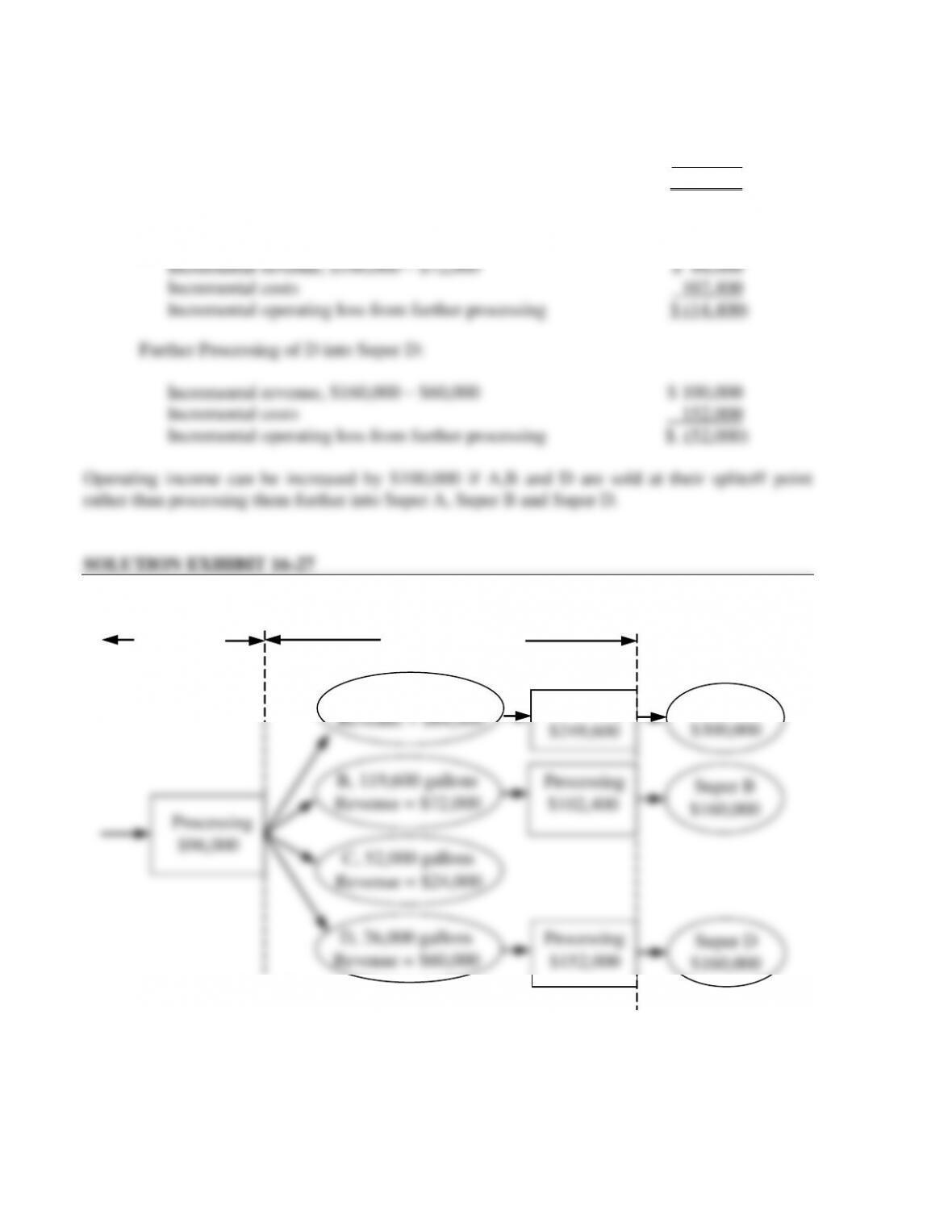
2. Further Processing of A into Super A:
Incremental revenue, $300,000 – $84,000 $216,000
Incremental costs 249,600
Incremental operating loss from further processing $ (33,600)
Further processing of B into Super B:
Processing
$96000
A, 322400 gallons
Revenue = $84000
B, 119600 gallons
Revenue = $72000
D, 26000 gallons
Revenue = $60000
C, 52000 gallons
Revenue = $24000
Joint Costs
Revenues at Splitoff
and Separable Costs
Processing
$249600
Processing
$102400
Processing
$152000
Super A
$300000
Super B
$160000
Super D
$160000
Splitoff
Point
16-23
16-28 (40–60 min.) Comparison of alternative joint-cost allocation methods, further-
processing decision, chocolate products.
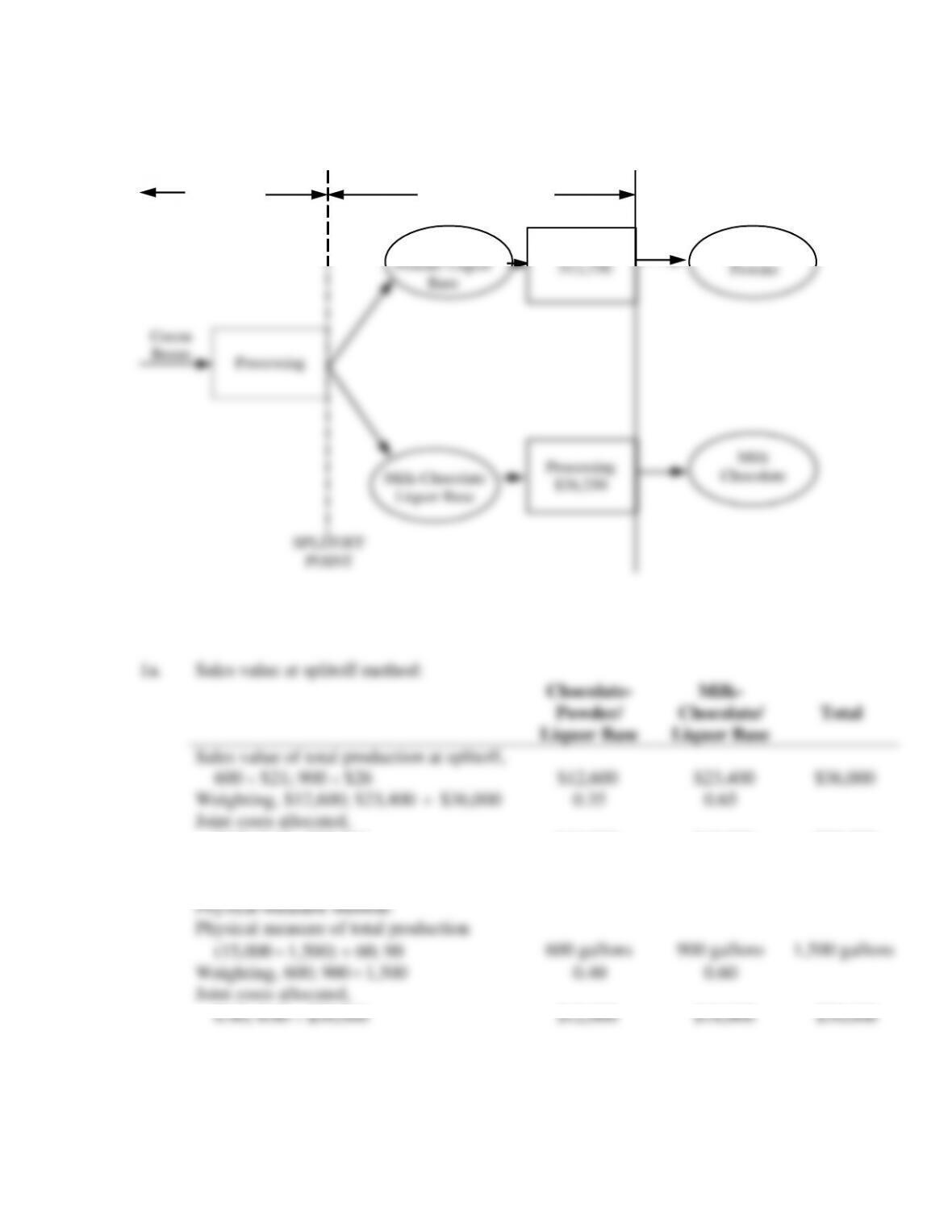
Chocolate-
Powder Liquor
Base
Milk-Chocolate
Liquor Base
Processing
Processing
$26,250
Joint Costs
$30,000
Separable Costs
Processing
$12,750
Chocolate
Powder
SPLITOFF
POINT
Cocoa
Beans
Milk
Chocolate
1a. Sales value at splitoff method:
Chocolate-
Powder/
Liquor Base
Milk-
Chocolate/
Liquor Base
Total
Sales value of total production at splitoff,
600 $21; 900 $26
$12,600
$23,400
$36,000
Weighting, $12,600; $23,400
$36,000
0.35
0.65
Joint costs allocated,
0.35; 0.65 $30,000
$10,500
$19,500
$30,000
1b.
Physical-measure method:
Physical measure of total production
(15,000
1,500) 60; 90
600 gallons
900 gallons
1,500 gallons
Weighting, 600; 900
1,500
0.40
0.60
Joint costs allocated,
0.40; 0.60 $30,000
$12,000
$18,000
$30,000
16-24
1c. Net realizable value method:
Chocolate-
Powder
Milk-
Chocolate
Total
Final sales value of total production,
6,000 $4; 10,200 $5
$24,000
$51,000
$75,000
Deduct separable costs
12,750
26,250
39,000
Net realizable value at splitoff point
$11,250
$24,750
$36,000
Weighting, $11,250; $24,750
$36,000
0.3125
0.6875
Joint costs allocated,
0.3125; 0.6875 $30,000
$ 9,375
$20,625
$30,000
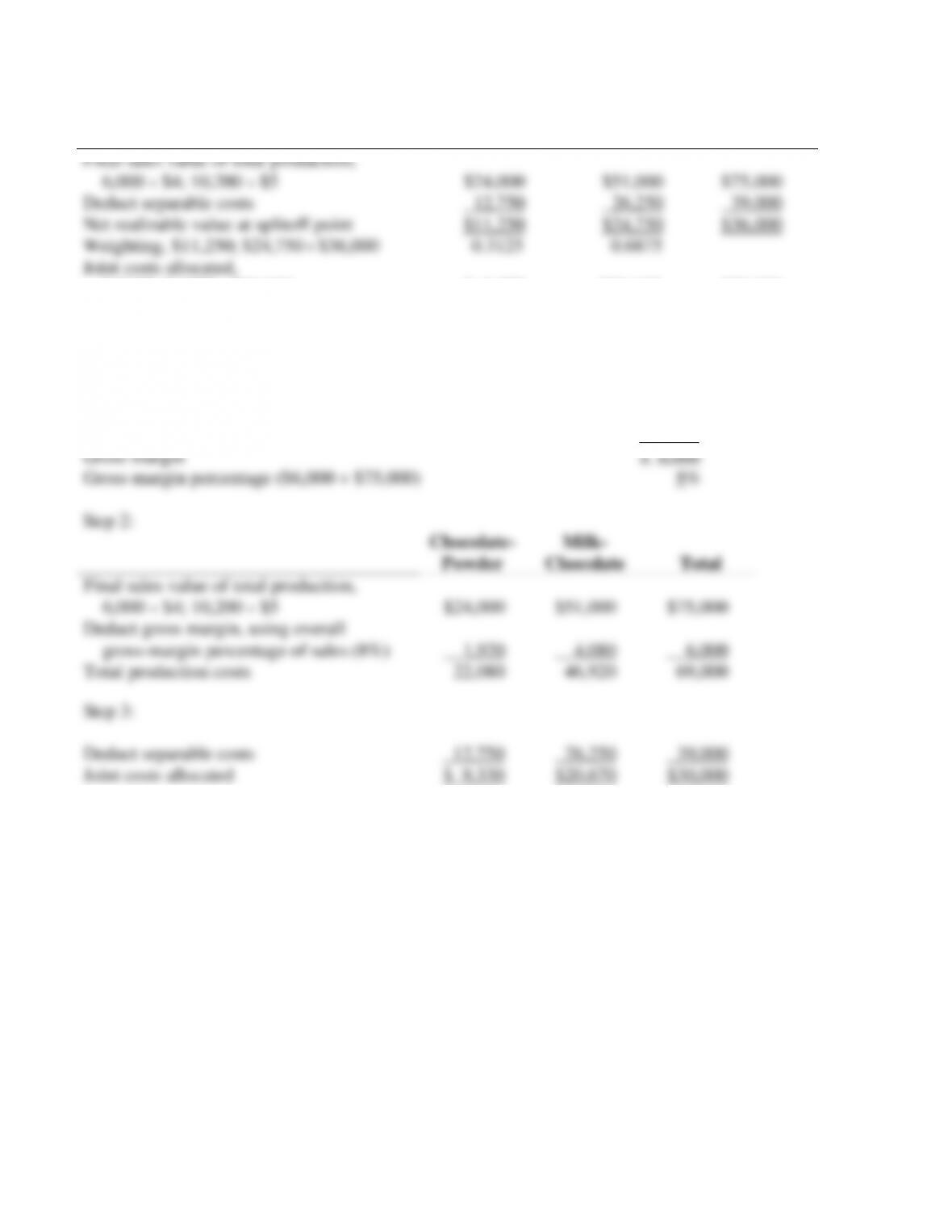
d. Constant gross-margin percentage NRV method:
Step 1:
Final sales value of total production, (6,000 $4) + (10,200 $5) $75,000
Deduct joint and separable costs, ($30,000 + $12,750 + $26,250) 69,000
Chocolate-
Milk-
Powder
Chocolate
Total
Final sales value of total production,
6,000 $4; 10,200 $5
$24,000
$51,000
$75,000
Deduct gross margin, using overall
gross-margin percentage of sales (8%)
1,920
4,080
6,000
Total production costs
22,080
46,920
69,000
Step 3:
Deduct separable costs
12,750
26,250
39,000
Joint costs allocated
$ 9,330
$20,670
$30,000
16-25
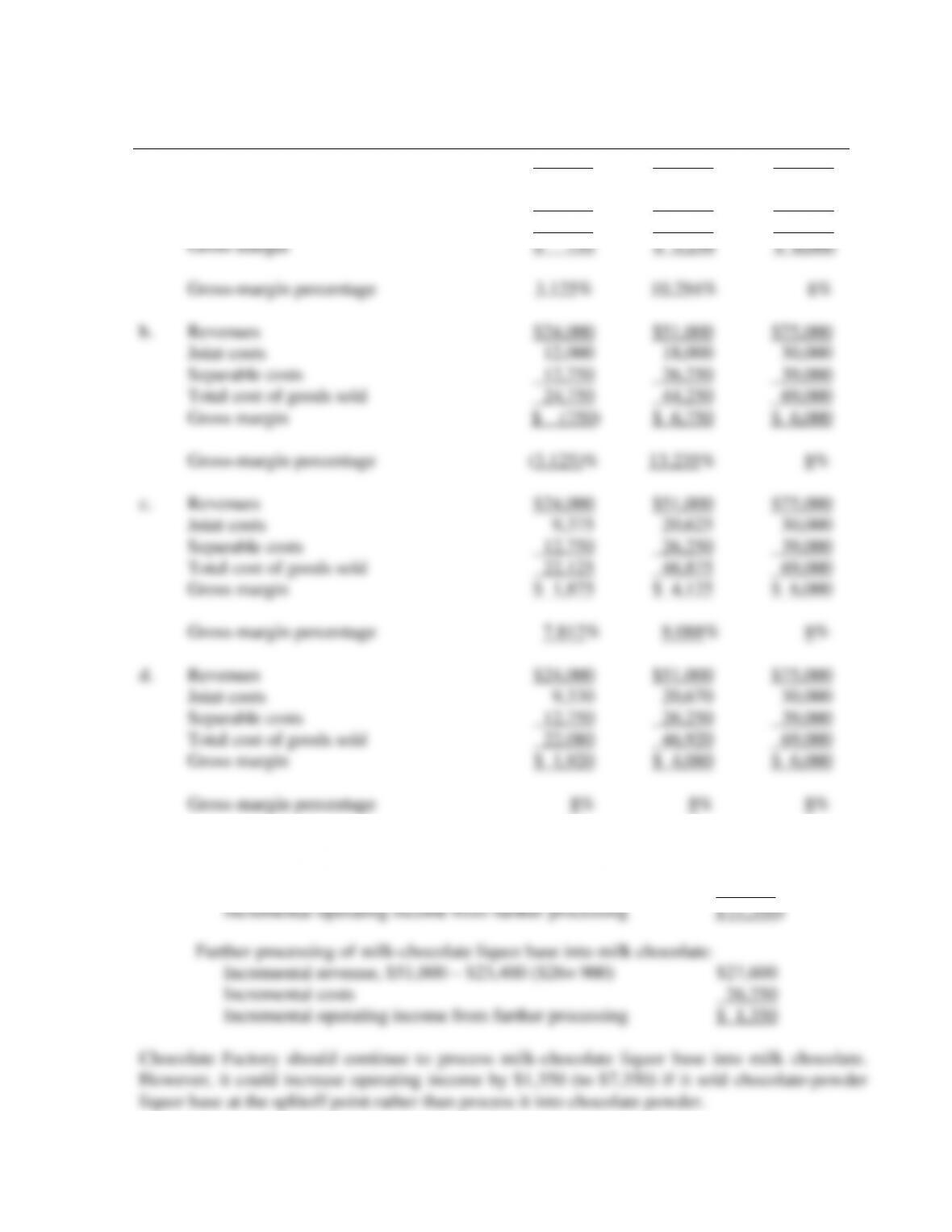
2.
Chocolate-
Milk-
Powder
Chocolate
Total
a.
Revenues
$24,000
$51,000
$75,000
Joint costs
10,500
19,500
30,000
Separable costs
12,750
26,250
39,000
Total cost of goods sold
23,250
45,750
69,000
Gross margin
$ 750
$ 5,250
$ 6,000
Gross-margin percentage
3.125%
10.294%
8%
b.
Revenues
$24,000
$51,000
$75,000
Joint costs
12,000
18,000
30,000
Separable costs
12,750
26,250
39,000
Total cost of goods sold
24,750
44,250
69,000
Gross margin
$ (750)
$ 6,750
$ 6,000
Gross-margin percentage
(3.125)%
13.235%
8%
c.
Revenues
$24,000
$51,000
$75,000
Joint costs
9,375
20,625
30,000
Separable costs
12,750
26,250
39,000
Total cost of goods sold
22,125
46,875
69,000
Gross margin
$ 1,875
$ 4,125
$ 6,000
Gross-margin percentage
7.812%
8.088%
8%
d.
Revenues
$24,000
$51,000
$75,000
Joint costs
9,330
20,670
30,000
Separable costs
12,750
26,250
39,000
Total cost of goods sold
22,080
46,920
69,000
Gross margin
$ 1,920
$ 4,080
$ 6,000
Gross-margin percentage
8%
8%
8%
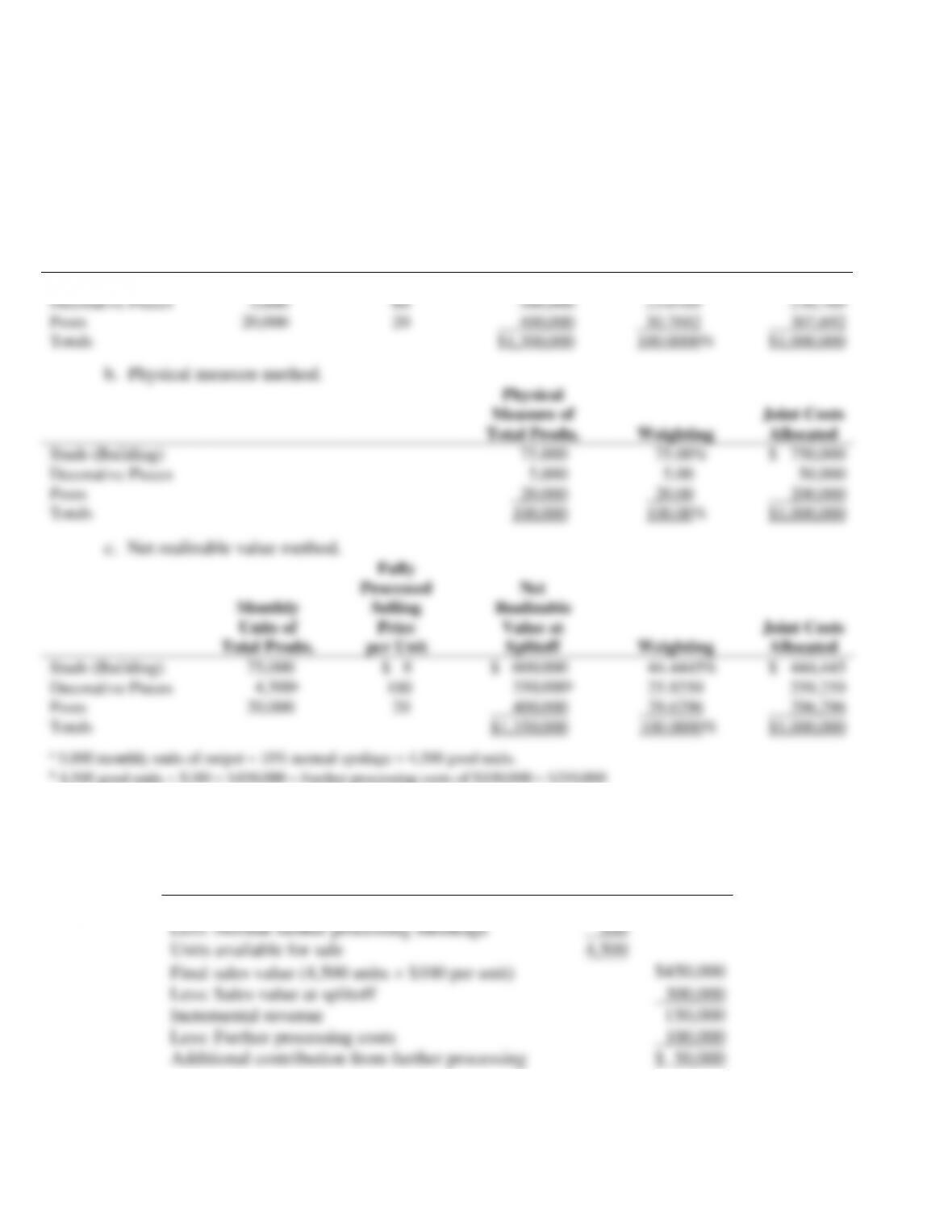
3. Further processing of chocolate-powder liquor base into chocolate powder:
Incremental revenue, $24,000 – $12,600 ($21× 600) $11,400
Incremental costs 12,750
16-26
16-29 (30 min.) Joint-cost allocation, process further or sell.
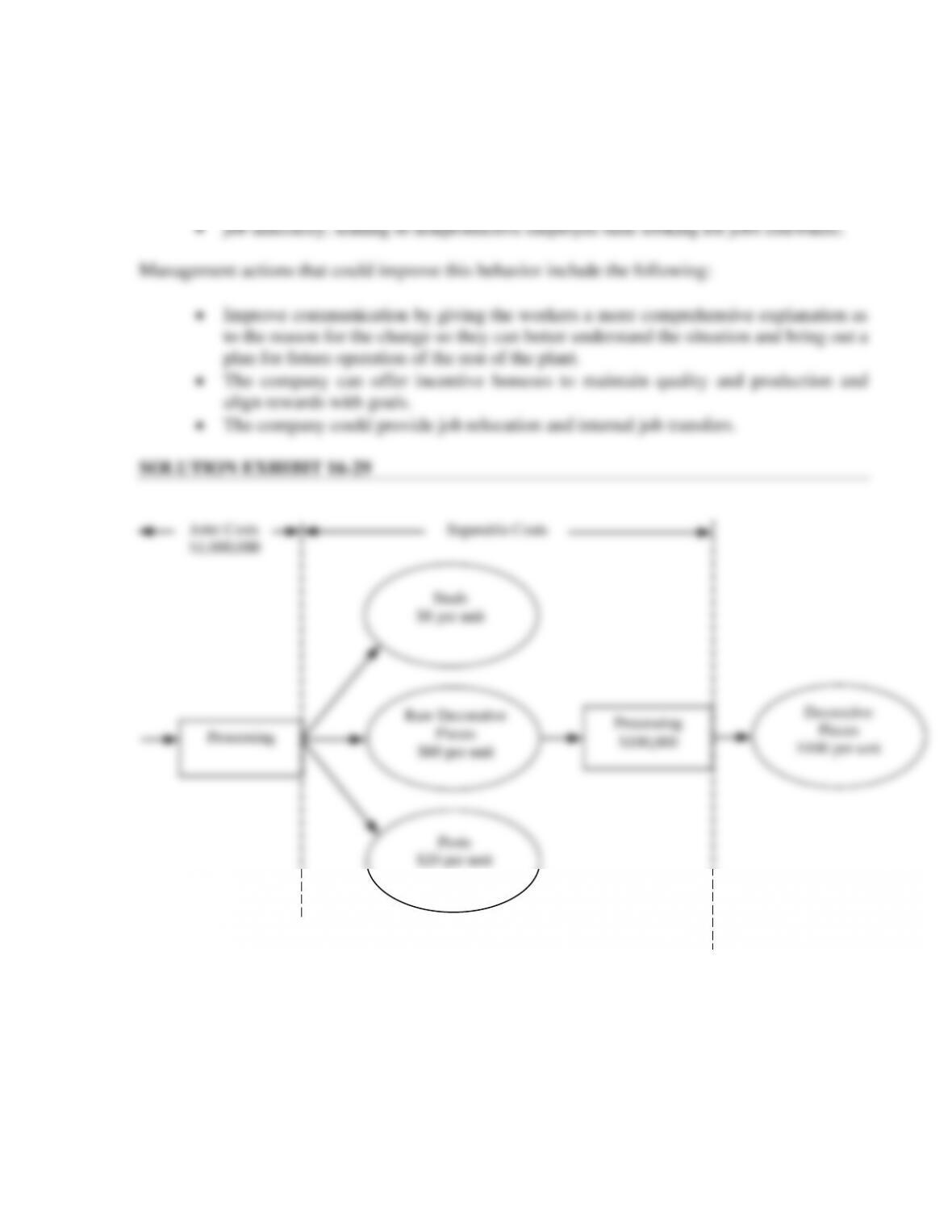
A diagram of the situation is in Solution Exhibit 16-29.
1.
a. Sales value at splitoff method.
Monthly
Unit
Output
Selling
Price
Per Unit
Sales Value
of Total Prodn.
at Splitoff
Weighting
Joint Costs
Allocated
Studs (Building)
75,000
$ 8
$ 600,000
46.1539%
$ 461,539
Decorative Pieces
5,000
60
300,000
23.0769
230,769
Posts
20,000
20
400,000
30.7692
307,692
Totals
$1,300,000
100.0000%
$1,000,000
b. Physical measure method.
Physical
Measure of
Total Prodn.
Weighting
Joint Costs
Allocated
Studs (Building)
75,000
75.00%
$ 750,000
Decorative Pieces
5,000
5.00
50,000
Posts
20,000
20.00
200,000
Totals
100,000
100.00%
$1,000,000
c. Net realizable value method.
Monthly
Units of
Total Prodn.
Fully
Processed
Selling
Price
per Unit
Net
Realizable
Value at
Splitoff
Weighting
Joint Costs
Allocated
Studs (Building)
75,000
$ 8
$ 600,000
44.4445%
$ 444,445
Decorative Pieces
4,500a
100
350,000b
25.9259
259,259
Posts
20,000
20
400,000
29.6296
296,296
Totals
$1,350,000
100.0000%
$1,000,000
a 5,000 monthly units of output – 10% normal spoilage = 4,500 good units.
b 4,500 good units $100 = $450,000 – Further processing costs of $100,000 = $350,000
2. Presented below is an analysis for Sonimad Sawmill, Inc., comparing the processing of
decorative pieces further versus selling the rough-cut product immediately at splitoff:
Units
Dollars
Monthly unit output
5,000
Less: Normal further processing shrinkage
500
Units available for sale
4,500
Final sales value (4,500 units $100 per unit)
$450,000
Less: Sales value at splitoff
300,000
Incremental revenue
150,000
Less: Further processing costs
100,000
Additional contribution from further processing
$ 50,000
3. Assuming Sonimad Sawmill, Inc., announces that in six months it will sell the rough-cut
product at splitoff due to increasing competitive pressure, behavior that may be demonstrated by
the skilled labor in the planing and sizing process include the following:
• lower quality,
• reduced motivation and morale, and
16-28
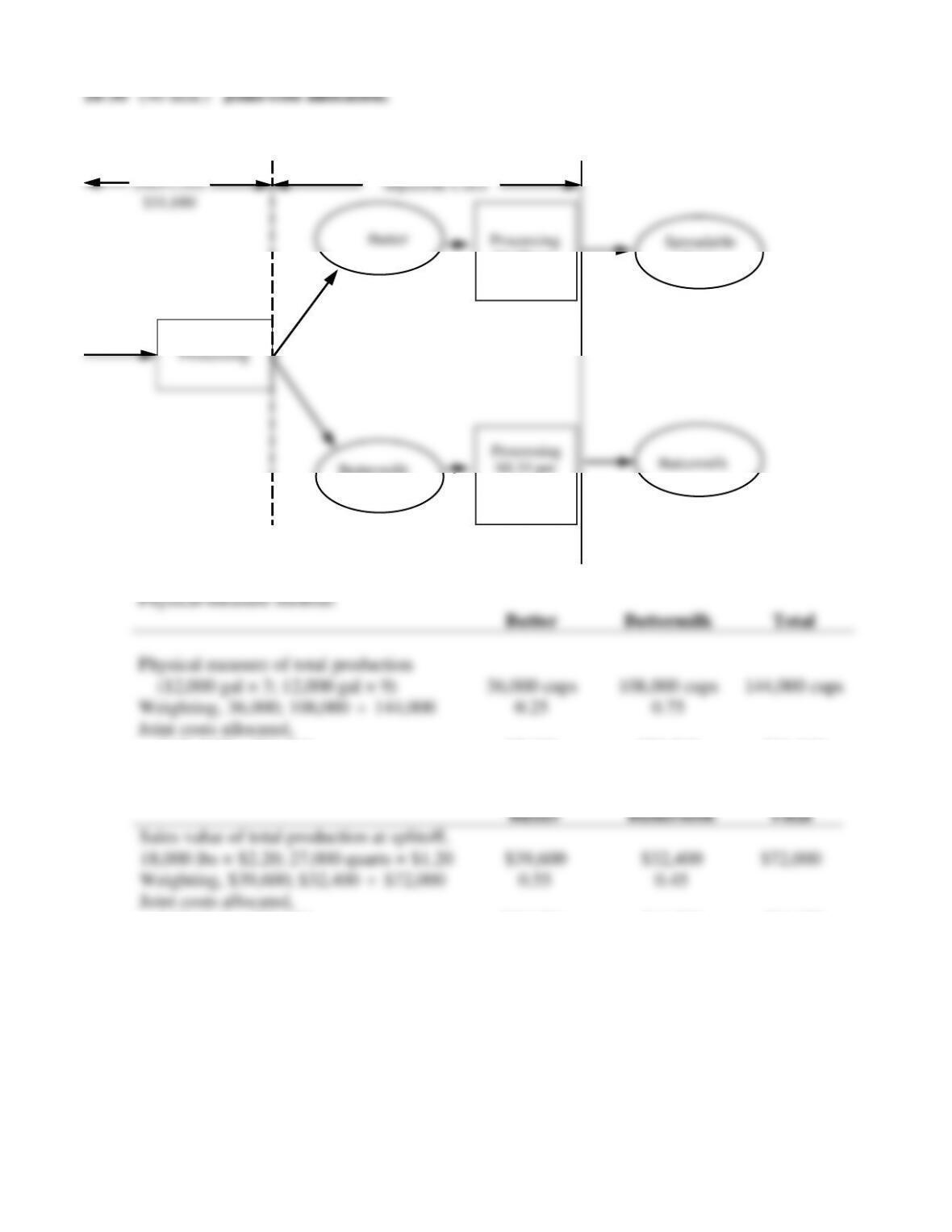
1.
Butter
Buttermilk
Processing
Processing
$0.35 per
pint
Joint Costs
$31,680
Separable Costs
Buttermilk
Processing
$1.60 per
pound
Spreadable
Butter
SPLITOFF
POINT
Milk
a.
Physical-measure method:
Butter
Buttermilk
Total
Physical measure of total production
(12,000 gal × 3; 12,000 gal × 9)
36,000 cups
108,000 cups
144,000 cups
Weighting, 36,000; 108,000
144,000
0.25
0.75
Joint costs allocated,
0.25; 0.75 × $31,680
$7,920
$23,760
$31,680
b. Sales value at splitoff method:
Butter
Buttermilk
Total
Sales value of total production at splitoff,
18,000 lbs × $2.20; 27,000 quarts × $1.20
$39,600
$32,400
$72,000
Weighting, $39,600; $32,400
$72,000
0.55
0.45
Joint costs allocated,
0.55; 0.45 $31,680
$17,424
$14,256
$31,680
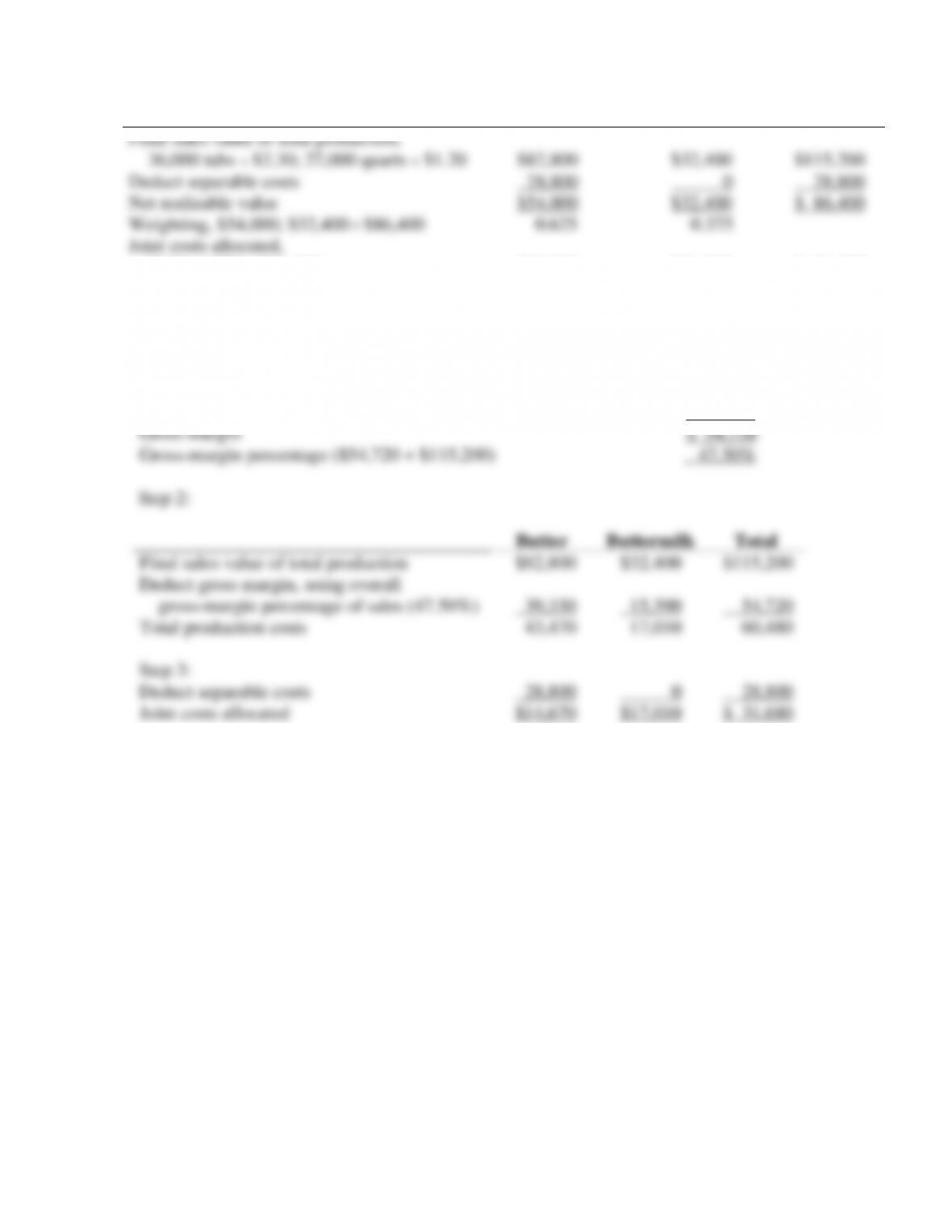
c. Net realizable value method:
Butter
Buttermilk
Total
Final sales value of total production,
36,000 tubs $2.30; 27,000 quarts $1.20
$82,800
$32,400
$115,200
Deduct separable costs
28,800
0
28,800
Net realizable value
$54,000
$32,400
$ 86,400
Weighting, $54,000; $32,400
$86,400
0.625
0.375
Joint costs allocated,
0.625; 0.375 $31,680
$19,800
$11,880
$ 31,680
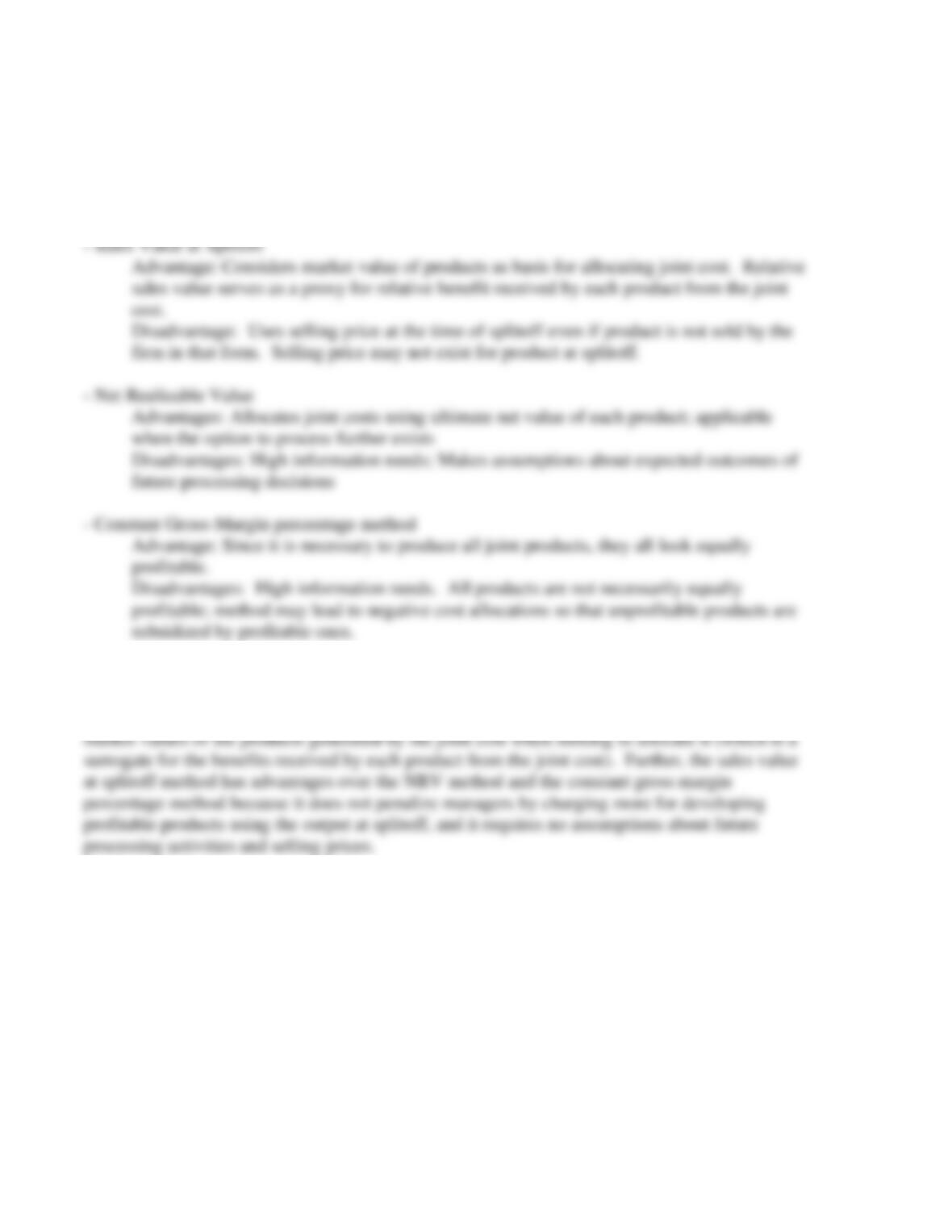
d. Constant gross-margin percentage NRV method:
Step 1:
Final sales value of total production (see 1c.) $115,200
Deduct joint and separable costs ($31,680 + $28,800) 60,480
Final sales value of total production
Deduct gross margin, using overall
gross-margin percentage of sales (47.50%)
Total production costs
Deduct separable costs
Joint costs allocated
16-30
2. Advantages and disadvantages:
– Physical-Measure
Advantage: Low information needs. Only knowledge of joint cost and physical
distribution is needed.
Disadvantage: Allocation is unrelated to the revenue-generating ability of products.
3. When selling prices for all products exist at splitoff, the sales value at split off method is the
preferred technique. It is a relatively simple technique that depends on a common basis for cost
allocation – revenues. It is better than the physical method because it considers the relative